An Experimental Study on The Effect of Ceramic
Waste in Concrete
Mr. Rasl Muhammed Rafeeq Mr. S Rahul
P.G Student P.G Student
Department of Civil Structural Engineering Department of Civil Structural Engineering RVS Technical Campus, Coimbatore, Tamilnadu-641402 RVS Technical Campus, Coimbatore, Tamilnadu-641402
Dr. T Senthil Vadivel Dr. S Kanchana
Professor & Head of Dept. Associate Professor Department of Civil Engineering Department of Civil Engineering
RVS Technical Campus, Coimbatore, Tamilnadu-641402 RVS Technical Campus, Coimbatore, Tamilnadu-641402
Abstract
The concrete is made with any material wastes which are eco-friendly to make the pollution free called Green concrete. Green concrete is a revolutionary topic in the history of concrete industry. As we are all civil engineers we people plays important role in environmental aspects in the manufacturing of cement. To avoid the cement usage we need to control the clinker content as the ingredient of cement which emits the gas called CO2 it’s mostly not practical in cement manufacturing so we need to go for the alternate. In this project presents the feasibility of the usage of by product materials like ceramic wastes for the supplementary for cements and rock fractions for the replacement of fine aggregates and their combinations on the compressive strength, split tensile strength and flexural strength with different concrete mixture were casted and tested (0%, 10%, 20% and 30%) by weight of M-25 grade concrete. The usage of those green materials in concrete contributes the reduction of greenhouse emissions with negative impacts on the economy.
Keywords: Green concrete, Ceramic waste, Rock fraction, compressive strength, flexural strength, split tensile strength ________________________________________________________________________________________________________
I. INTRODUCTION
Green concrete is a revolutionary topic in the history of concrete industry. As green concrete is made with concrete wastes it does take more time to come in India because of industries having problem to dispose wastes and it also reduces environmental impact with reduction in CO2 emission. Use of green concrete can help us reduce a lot of wastage of several products. Various
non- biodegradable products can also be used and thus avoiding the issues of their disposal. The review presented in this report clearly indicates an increasing trend and incentives for the greater use of manufactured lignin in construction. This report focuses on known benefits and limitations of a range to environment. Use of concrete product like green concrete in future will not only reduce the emission of CO2in environment and environmental impact but it is also economical to produce.
The ceramic waste from ceramic and construction industries is a major contribute to construction and demolition waste, representing a serious environmental, technical and economic problem of society nowadays. The major sources of ceramic waste are ceramic industry, building construction and building demolition. It has been estimated that about 30% of the daily production in the ceramic industry goes to waste. This waste is not recycled in any form at present. However, the ceramic waste is durable, hard and highly resistant to biological, chemical and physical degradation forces. As the ceramic waste is piling up every day, there is pressure on the ceramic industries to find a solution for its disposal
II. MATERIALS
The properties of selected material for this experimental study have been reported as given below.
Cement:
Ordinary Portland current 53 Grade with physical and chemical properties as give in table has been used in this experimental study
Table – 1
Physical Properties of Ordinary Portland cement SL. No Physical Properties Results
1 Specific gravity 3.12
An Experimental Study on The Effect of Ceramic Waste in Concrete
(IJSTE/ Volume 2 / Issue 12 / 084)
Ceramic Powder:
The principle waste coming into the ceramic industry is the ceramic powder, specifically in the powder forms. Ceramic wastes are generated as a waste during the process of dressing and polishing The physical properties were given in Table 2.
Table – 2
Physical Properties of ceramic powder SL. No Physical Properties Results
1 Specific gravity 3.152
2 Consistency 33
3 Initial Setting Time 30 minutes 4 Final setting time 500 minutes
Coarse Aggregate:
Locally available crushed stones conforming to graded aggregate of normal size 12.5 as per IS: 383-1970, was used in this experimental work.
Fine Aggregate:
Those fractions from 4.75 mm to 150 microns are termed as fine aggregate. The river sand is used in combination as fine aggregate conforming to the requirements of IS: 383. The river sand is washed and screens, to eliminate deleterious materials and oversize particles.
Rock Fractions:
Quarry Rock fractions can be defined as residue, tailing or other non-valuable waste material after the extraction and processing of rocks to form fine particles, less than 4.75mm. Quarry dust is made while blasting, crushing, and screening coarse aggregate.
Table – 3
Physical Properties of Fine Aggregate & Rock Fraction SL. No Physical Properties Fine Aggregate Rock Fractions
1 Specific gravity 2.74 2.42
2 Water absorption (%) 0.97 1.49
3 Fine particles < 0.075 (%) 8 13
4 Sieve analysis Zone II Zone II
Water:
The water used for the study was free of acids, organic matter, suspended solids, alkalis and impurities when present may have adverse effect on the strength of concrete. Portable water with pH value 7 conforming to IS: 456-2000 was used for making concrete and curing this specimen as well.
III. MIX PROPORTIONS
In this study total of 4 concrete mixtures were designed as per IS10262-2009 having a constant water binder ratio of 0.40 and total binder content of 492.5kg/m3. The cementatious replacement material is ceramic wastes and fine aggregate was completely
replaced with rock fractions which makes the concrete as most binder. The replacement levels of ceramic powder are 0%, 10%, 20% and 30% equally proportioned.
IV. EXPERIMENTAL INVESTIGATION
This study involved in the replacement of cementatious material and fine aggregate with the abundantly available waste material such as ceramic powder and rock fractions. For the work 30 cubes, 30 cylinder and 30 prism specimens were casted and tested for the required properties.
Fresh Concrete Properties:
Slump Test:
Fig. 1: Slump Test Result
Harden Concrete Properties:
Compressive Strength:
Compression test is the Most Common test Conducted on hardened concrete; partly it is easy because most of the desirable characteristic properties of concrete are qualitatively related to its compressive Strength. The Compression test is carried out on Specimens Cubical or Cylindrical in Shape. The size of the Cube specimens used for finding out the Compressive Strength is 150x150x150mm.
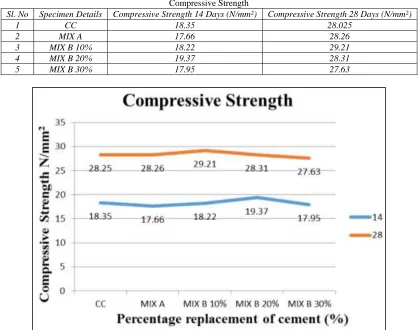
Table – 4 Compressive Strength
Sl. No Specimen Details Compressive Strength 14 Days (N/mm2) Compressive Strength 28 Days (N/mm2)
1 CC 18.35 28.025
2 MIX A 17.66 28.26
3 MIX B 10% 18.22 29.21
4 MIX B 20% 19.37 28.31
An Experimental Study on The Effect of Ceramic Waste in Concrete
(IJSTE/ Volume 2 / Issue 12 / 084)
From the graph it is clear that there occurs an increase in the compressive strength for the 10% replacement of ceramic powder after 28 days.
Split Tensile Strength:
The test is carried out by placing cylinder specimen of dimension 150mm diameter and 300mm length, horizontally between the loading surface of compression testing machine and the load is applied until failure of the cylinder along the vertical diameter. The failure load of the specimen is noted. The failure load of tensile strength of cylinder is calculated by using the formula
Tensile strength = 2P / 3.14 DL Table – 5
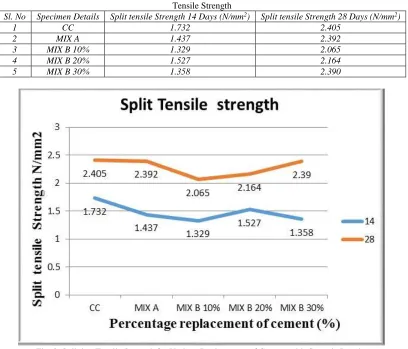
Tensile Strength
Sl. No Specimen Details Split tensile Strength 14 Days (N/mm2) Split tensile Strength 28 Days (N/mm2)
1 CC 1.732 2.405
2 MIX A 1.437 2.392
3 MIX B 10% 1.329 2.065
4 MIX B 20% 1.527 2.164
5 MIX B 30% 1.358 2.390
Fig. 3: Splitting Tensile Strength for Various Replacement of Cement with Ceramic Powder
In Fig 3, the splitting tensile strength seems to be increased with the blended cement percentage of 30% cement replacement for 28 days curing.
Flexural Strength:
The test is carried out to find the flexural strength of the prism of dimension 100 x 100 x 500 mm. The prism is then placed in the machine in such manner that the load is applied to the uppermost surface as cast in the mould. Two points loading adopted on an effective span of 400 mm while testing the prism .The load is applied until the failure of the prism. By using the failure load of prism
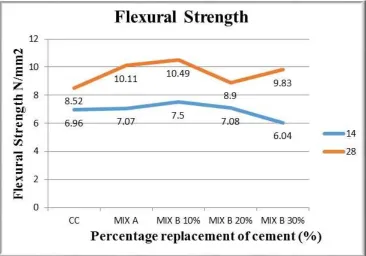
Table – 6 Flexural Strength
Sl. No Specimen Details Flexural Strength 14 Days (N/mm2) Flexural Strength 28 Days (N/mm2)
1 CC 6.96 8.52
2 MIX A 7.07 10.11
3 MIX B 10% 7.50 10.49
4 MIX B 20% 7.08 8.90
Fig. 3: Flexural Strength for Various Replacement of Cement with Ceramic Powder
V. RESULT AND DISCUSSION
Based on experimental investigations concerning the compressive strength of concrete, the following observations are made. 1) Concrete on 30% replacement of cement with ceramic waste and full replacement of fine aggregates with rack fractions,
compressive strength obtained is 27.63 N/mm2in M25 grade and hence it becomes more economical without compromising concrete strength than the standard concrete. It becomes technically and economically feasible and viable.4
2) Utilization of ceramic waste and its application are used for the development of the construction industry are to be improvised.
3) It is the possible alternative solution of safe disposal of ceramic waste and to make our environment as greenhouse free.
VI. CONCLUSION
The experimental study shows the study of replacement of cement by ceramic powder and sand by rock fraction.
The Compressive Strength of M25 grade concrete increases when the replacement of cement with ceramic waste up to 30% by weight of cement and further replacement of cement with ceramic powder decreases the compressive strength.
Rock fraction give better strength than river sand.
REFERENCES
[1] Green Concrete in Denmark- Mette Glavind Project Manager, M.Sc., Ph.D. Concrete Centre, Danish Technological Institute.
[2] A Study of Sustainable Industrial Waste material as Partial Replacement of Cement Chandana Sukesh1, Bala Krishna Katakam1, P. Sahaa and K. Shyam
Chamberlin.
[3] C.Medina Martinez, M.I.Guerra Romero, J. M.Moran del Pozo and A. Juan Valdes, “use of ceramic wastes in structure’s concretes”
[4] David Pearce and Giles Atkinson, “The concept of sustainable development: an evaluation of its usefulness ten years after brundtland”
[5] D.Bigoni,Nonlinear Solid Mechanics - Bifurcation Theory and Material Instability. 2012, Cambridge.
[6] David Pearce and Giles Atkinson, “The concept of sustainable development: an evaluation of its usefulness ten years after brundtland”, CSERGE Working
Paper PA 98-02.
[7] D. Bigoni, Nonlinear Solid Mechanics: Bifurcation Theory and Material Instability. 2012, Cambridge University Press. [8] Gerard Valenduc, Patricia
VendraminScience, “Technological Innovation and Sustainable Development”, International Conference “Science for a Sustainable Society”Roskilde, 27-29/10/97.
[8] Hasnat Dewan, “Re-Defining Sustainable Human Development to Integrate Sustainability and Human Development Goals”Thompson Rivers University,
Canada.
[9] i.B.TOP£U And M.CANBAZ, “Utilization of crushed tile as aggregate in concrete”, Iranian Journal of Science & Technology, Transaction B, Engineering,
Vol. 31, No. B5, pp. 561565, 2007.
[10] Philip J. Vergragt, “How Technology Could Contribute to a Sustainable World”, GTI Paper Series, 2006.