DOI:10.21276/ijprhs.2018. 2018. 03.09
Srikanth Reddyet al. CODEN (USA)-IJPRUR, e-ISSN: 2348-6465
Original Article
Formulation and Evaluation of
Crosslinked-Kondagogu Gum as a carrier in Developing Floating
Matrix Tablet
Poreddy Srikanth Reddy
1,*, Penjuri Subhash Chandra bose
1, Damineni Saritha
2, Vuppula
Sruthi
11
Department of Pharmaceutics, MNR College of Pharmacy, Sangareddy, Telangana state, India.
2
Department of Pharmaceutics, Sultan-ul-Uloom College of Pharmacy, Hyderabad, Telangana state, India.
A R T I C L E I N F O A B S T R A C T
______
1. INTRODUCTION
Natural polymers and their derivatives are non-toxic, less expensive, biodegradable and are widely used to prepare dosage forms1. Natural polymers can be modified physically and chemically for preparing various drug delivery systems and thus can compete with synthetic polymers available in the market2. Oral route is the most convenient mode of drug delivery and has better patient compliance compared to other routes of drug administration. However, oral administration
International Journal of Pharma Research and Health Sciences
Available online at
www.pharmahealthsciences.net
Received: 25 Apr 2018 Accepted: 13 May 2018
The aim of the present work was to prepare floating tablets of metoprolol succinate using crosslinked-kondagogu gum as matrix forming carrier. The floating matrix tablet formulations were prepared by varying the concentrations of kondagogu gum and cross linked kondagogu gum with CaCl2. The tablets were prepared by direct compression
technique using PVP K-30 as a binder, hydroxy propyl methyl cellulose (HPMCK4M) as a gel forming polymer and sodium bicarbonate for development of CO2. The prepared matrix
tablets were evaluated for properties such as hardness, thickness, friability, weight variation, floating lag time, compatibility using DSC and FTIR. In vitro dissolution was carried out for 12 hrs in 0.1N HCl buffer at 37±0.5 ℃using USP basket type dissolution apparatus. It was noted that, all the prepared formulations had desired floating lag time and constantly floated on dissolution medium by maintaining the matrix integrity. The drug release from prepared tablets was found to vary with varying concentration of the polymer, kondagogu gum. From the study it was concluded that floating drug delivery system can be prepared by using cross linked kondagogu gum as a carrier.
Key words: Floating drug delivery system, metoprolol succinate, kondagogu gum, in vitro dissolution .
Corresponding author * P. Srikanth Reddy,
Department of Pharmaceutics, MNR College of Pharmacy, Sangareddy, Telangana-502294.
has limited use for drugs that have poor oral bioavailability or which undergoes degradation in the gastrointestinal (GI) tract3. A gastric floating drug delivery systems (GFDDS) prolongs the retention time of a dosage form in stomach, thereby improving the oral bioavailability of the drug. These systems improve oral administration of drugs which otherwise had to be administered parenterally4.
The gastric retention of administered oral dosage form can be achieved either by mucoadhesion, floatation, sedimentation, expansion, modified shape systems, or by the simultaneous administration of drugs that vary in gastric emptying5, 6. In the present study, an attempt was made to develop a GFDDS containing metoprolol succinate as a model drug using crosslinked kondagogu gum as hydrophilic matrix polymer carriers.
The factors influencing the release of drugs from hydrophilic matrices include viscosity of the polymer, ratio of the polymer to drug, mixtures of polymers, compression pressure, thickness of the tablet, particle size of the drug, pH of the matrix, entrapped air in the tablets, molecular size of the drug, molecular geometry of the drug, solubility of the drug, the presence of excipients or additives, and the mode of incorporation of these substances7.
Kondagogu gum [KG] is the dried exudates obtained from tree Cochlospermum gossypium which belongs to the family Bixaceae8. KG is a high molecular weight complex acetylated polysaccharide consisting mainly of D-galacturonic acid, D-galactose and L-rhamnose9. Metoprolol succinate is a β1-selective (cardio selective) adrenoceptor blocking agent, which is widely prescribed in diverse cardiovascular diseases such as hypertension, angina, arrhythmia and congestive heart failure. It undergoes extensive first pass metabolism of about 40-50% and a short biological life of 4 hrs and hence a suitable candidate for GFDDS10, 11.
The objective of the present work was to prepare a matrix floating tablet using kondagogu gum, drug and excipients. Different formulations were prepared by varying the concentration of gum in the matrix, cross-linking agent and the prepared tablets were evaluated for hardness, thickness, friability, swelling, buoyancy, compatibility, percentage drug release, diffusion coefficient (n) and stability studies.
2. MATERIALS AND METHODS Materials
Metoprolol succinate was received as gift sample from Dr. Reddy’s Laboratories, Hyderabad, India. It is a white to almost white powder, slightly soluble in water, fairly soluble in hot water, and freely soluble in alcohol, acetone, and chloroform. Directly compressible lactose was obtained as gift sample from Strides Acrolab, Bangalore, India. Kondagogu gum was purchased from Girijan cooperative society, Hyderabad, India. Sodium bicarbonate and all other chemicals used were of analytical grade and purchased from Loba Chemie, Mumbai, India.
Purification of gums12
First the foreign extraneous matter like bark etc was separated from kondagogu gum, and then powdered using mixer grinder and passed through sieve #80. The powdered gum was dispersed in distilled water to get a 1% solution, kept in sonicator for 10 min until it was clear and then added to equimolar mixture of acetone and ethanol (2:1 v/v) to give precipitation of gum. Precipitated polymer was kept in an oven at 40˚C for drying, powdered and evaluated for general characteristic properties.
Preparation of cross-linked kondagogu gum13, 14
The powdered gum was dispersed in distilled water to get a 1% solution and the resulting dispersion was extruded through 23 Guage hypodermic needle into CaCl2solution (3,
5 and 7% w/v) kept under stirring at 800 rpm using a magnetic stirrer. The obtained cross-linked gum was then collected by filtration, washed with deionized water, air dried at room temperature for 12 h and dried at 40°C in a hot air oven to constant weight, powdered and passed through sieve #100 for further use.
Preparation of floating tablets15
The floating tablets containing metoprolol succinate were prepared by using direct compression technique. Six formulations were prepared by varying the concentration of gums and cross-linking agent as given in Table 1. Accurately weighed quantities of drug, polymer, binder (PVP K-30), sodium bicarbonate and other excipients were blended in a mortar and pestle. The resultant homogenous mixture was compressed into tablets in a 10-station rotary tablet machine (Rimek, Mumbai, India) at a speed of 10 rpm and using 9 mm round concave punches and optimum pressure. The prepared tablets were evaluated for properties such as hardness, thickness, weight variation, percent friability and drug content.
UV/Visible spectroscopy16
The maximum absorbance (λmax) of the selected drug,
metoprolol succinate was determined by scanning a known concentration of sample solution in the wavelength region of 200–400 nm by using Shimadzu 1601 UV/ Visible spectrophotometer. The λmax was found to be 222 nm and
this wavelength was used for further UV studies.
In vitro buoyancy studies17
Water uptake study18
The water uptake study for the prepared tablet formulation was performed using a paddle type USP dissolution tester (Electrolab TDL-08L). The study was conducted in 900 ml of 0.1 N HCl, which was maintained at a temperature of 37±0.5 ºC. After a specific period of time (8 hrs), the tablets were removed, blotted to remove excess water and weighed. Swelling characteristics of the prepared tablets were expressed in terms of water uptake (WU) using;
…….(1)
Fourier Transform Infrared Spectroscopy (FTIR)19
FTIR spectra of the pure metoprolol succinate and the optimized formulation were recorded. Samples were prepared as KBr disks using a hydraulic pellet press and then scanned from 4000 to 400 cm-1 using a Fourier transform infrared spectrophotometer (FTIR 8400, Shimadzu, Japan).
Differential Scanning Calorimetry (DSC)20
DSC thermograms were recorded for pure metoprolol succinate drug and the optimized formulation. Accurately weighed samples were placed on aluminum plates, sealed with aluminum lids and heated at a constant rate of 5º/min over a temperature range of 0-400 ºC. All dynamic DSC studies were carried out using DuPont thermal analyzer with 2010 DSC module.
In vitro dissolution studies21, 22
Dissolution studies were carried out in basket type USP type –II (paddle) dissolution apparatus (Electrolab TDL-08L) at 100 rpm and 37±0.5°C using 900 ml of 0.1N HCl for a period of 12 hrs. The samples were withdrawn at regular intervals and diluted to a suitable concentration with 0.1N HCl and the absorbance was measured at 222 nm using Shimadzu UV-Visible spectrophotometer.
Peppas model fitting23, 24
Koresmeyer-Peppas model is one of the mathematical expression to evaluate the mechanism of drug delivery. The Koresmeyer-Peppas equation is as follows;
Mt/ M∞ = 1- A (exp -kt) (2)
log (1 - Mt/M∞) = log A–kt/2.303 (3)
where, Mt/M∞is the fractional amount of drug released and t
is the time in hrs. In this study, the release constant, k and constant, A were calculated from the slopes and intercepts of the plot of In (1- Mt/M∞) versus time t respectively where,
Mt is the amount of drug release at time t; M∞is the amount of drug release after infinite time; k is a release rate constant incorporating structural and geometric characteristics of the tablet; and A is the diffusional exponent indicative of the mechanism of drug release.
Stability studies25
Stability studies for the optimized formulation of metoprolol succinate floating matrix tablets was carried out to determine the effect of formulation additives on the stability of the drug in the final formulation and also to determine the physical stability. The optimized formulation was subjected to
stability studies according to ICH guidelines by storing at 25 ± 2°C/60 ± 5 % RH and 30 ± 2 °C/65 ± 5 % RH for 12 months, and 40 ± 2 °C/75 ± 5 % RH for 6 months (Thermolab, Mumbai, India). The samples were analyzed and checked for changes in physical appearance and drug content at regular intervals.
3. RESULTS AND DISCUSSION
The prepared tablets were evaluated for properties such as hardness (Inweka hardness tester, Ahmedabad, India), thickness (Mitotoya screw guage, Japan), weight variation (Shimadzu AW 120, Japan), percent friability (Electrolab EF-2 friabilator, Mumbai, India) and drug content (Shimadzu 1702 UV/Visible spectrophotometer, Japan). The percentage weight variation, percent friability and content of active ingredient for all the formulations were found to be well within United States Pharmacopoeia (USP) standards and the data obtained is given in Table 2. From the table, it was clear that the hardness of the prepared tablets had increased as the amount of kondagogu gum concentration in the tablet formulation increased (F1-F3). Formulations F3 showed maximum hardness of about 7.2 Kg/cm2among the three polymer ratios selected (40%, 50% and 60% w/w kondagogu gum). It was clear that cross linking of kondagogu gum had a negative impact on hardness of tablet (decreased hardness for formulations F4-F6). From the table, it was noticed that the percent drug content, thickness and friability lies in the range 99.7–102.4 %, 5.21-5.29 mm and 0.33-0.37% respectively.
In the present study, an effervescent approach using sodium bicarbonate as gas generating agent was employed to make the tablet float. As the dissolution medium (0.1 N HCl buffer) imbibed into the tablet matrix, the interaction of acid with sodium bicarbonate results in the generation of CO2
gas. The generated gas was entrapped and protected within the gel which was formed due to hydration of kondagogu gum, which decreased the density of the tablet, as a result of which, the tablet float.
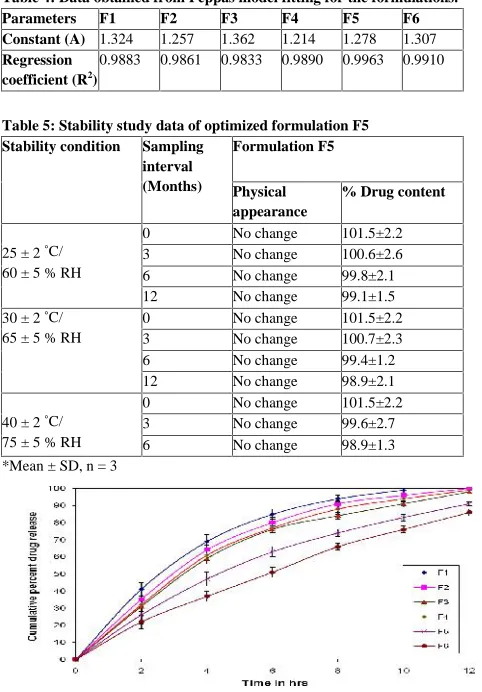
The in vitro drug release of metoprolol succinate from the prepared hydrophilic floating matrix tablets is shown in Fig. 1. From the figure, it is clear that the concentration of kondagogu gum in the formulation had a remarkable influence on the drug release. Formulations F1 to F3 (40, 50 and 60% w/w kondagogu gum) showed drug release of about 41, 35 and 31% at the end of 2 hrs. This decrease in amount of drug release can be directly attributed to the increase in polymer concentration. Increase in polymer concentration leads to the formation of thick gel barrier, which causes the drug diffusion through the matrix difficult and thus decreases the overall drug release from the tablet. Formulations F1 – F3 released about 69, 64 and 58% metoprolol at the end of 4 hrs indicating that they are unsuitable for showing 12 hr release profile. On the other hand, formulations F4-F6 showed a drug release of 61, 47 and 37% at the end of 4 hrs study period indicating their suitability for showing 12 hr release profile.
Formulations F4 to F6 showed a drug release of about 32, 26 and 22% at the end of 2 hrs. The decrease in amount of drug release compared to F1 can be attributed to the degree of cross linking of kondagogu gum in the tablet formulation. At the end of in vitro dissolution study, F5 and F6 formulations have shown the drug release of 91 and 86% respectively indicating that they are suitable for showing drug release up to 12 hrs.
The data obtained from in vitro drug release studies was fit into Peppas model. From the plot of log Mt/ M∞ versus t, the parameters such as release constant (k), constant (A) and the regression coefficient (R2) were calculated and are given in Table 4. If A is equivalent to 0.5 indicates Fickian (case I) release; greater than 0.5 but less than 1 for non-Fickian (anomalous) release and A is greater than 1 indicates super case II type of release. Case II generally refers to the erosion of the polymeric chain, and anomalous transport (Non-Fickian) refers to a combination of both diffusion and erosion controlled drug release. From the table it was concluded that, formulation F5 with R2 value of 0.9963 is the optimized formulation for 12 hr study period.
The IR spectra taken of metoprolol succinate drug and the optimized formulation (F5) were found to be identical (Figure 2). The characteristic IR absorption peaks of metoprolol Succinate at 3600-2300 (NH2, OH Aliphatic and
aromatic OH), 1580 (Carboxylic acid salt), 1580, 1515 (Aromatic ring), 1250, 1015 (Aromatic Ether), 1180 (Isopropyl Group) and 1100 cm-1 (Aliphatic Ether, Secondary Alcohol) 820 1,4 (disubstituted Benzene) were obtained. The FTIR spectra of the pure drug as well as coated formulation indicated that no chemical interaction occurred between the metoprolol succinate and the polymers used.
The optimized formulation F5 was subjected for 3 months stability studies. Stability studies of the drug formulations are performed to ascertain whether the drug undergoes any degradation during its shelf life. The data obtained from the
stability studies is tabulated in Table 5. From the stability study data, it was clear that the drug was stable in the optimized formulation for the study period of 6 weeks. DSC thermograms of the pure drug and its formulations before and after stability studies were recorded to evaluate whether the drug has undergone any degradation during the study period. From the DSC data obtained (figure 3), it was evident that the melting point of metoprolol succinate has not changed after placing the tablets for stability studies. Hence, it may be inferred that there was no interaction between metoprolol and polymers used. From DSC results it can be concluded that the drug maintained its chemical identity throughout the process.
4. CONCLUSION
The evaluation data for properties such as hardness, thickness, friability, weight variation, floating lag time and water uptake indicated that the prepared floating tablets were well within the specified standards. At the end of in vitro dissolution study, F5 and F6 formulations have shown the drug release of 91 and 86% respectively indicating that they are suitable for showing drug release up to 12 hrs. The data obtained from the Peppas model fitting indicates that the mechanism of drug release was by super case-II transport i.e., drug release was by both diffusion and erosion of the polymer. From the stability studies, it was clear that the optimized formulation F5 was stable for six weeks. The DSC thermograms and FTIR spectra for the pure drug and optimized formulation indicated no change in chemical identity of the drug. From the results obtained it can be concluded that kondagogu gum, which is natural and biodegradable polymer can be employed for use as carrier in developing floating drug delivery systems. It can also be concluded that CaCl2 as a cross linker is effective in
sustaining drug release.
Table 1: Composition of floating metoprolol succinate tablets Ingredients Formulation code and weight in mg
F1 F2 F3 F4 F5 F6
Metoprolol succinate (mg) 60 60 60 60 60 60 Kondagogu gum (mg) 120 150 180 120 120 120 Sodium bicarbonate (mg) 30 30 30 30 30 30
Calcium chloride (% w/v) -- -- -- 3 5 7
PVP K-30 (mg) 9 9 9 9 9 9
Magnesium Stearate (mg) 6 6 6 6 6 6
Directly compressible lactose (mg)
75 45 15 75 75 75
Table 2: Evaluation data obtained for prepared tablets.
Formulation code
% weight variation*
Thickness* (mm)
Hardness* (kg/ cm2
)
Friability* (%)
% Drug content*
F1 301±3.3 5.29±0.12 6.7±0.57 0.35±0.12 101.2±2.4 F2 302±2.6 5.27±0.15 6.8±0.39 0.38±0.12 100.8±2.6 F3 299±3.2 5.21±0.13 7.2±0.33 0.33±0.12 102.3±3.1 F4 300±2.5 5.24±0.17 6.6±0.65 0.34±0.11 99.7±1.8 F5 302±3.8 5.25±0.14 6.5±0.72 0.36±0.12 101.5±2.2 F6 301±2.1 5.24±0.16 6.2±0.52 0.37±0.11 102.4±3.2 *Mean ± SD, n = 3
Table 3: Buoyancy results for the prepared formulations. Formulation
code
Onset of Floating* (secs)
Duration of Floating (hrs)
Water uptake* (%)
F1 38±3.4 >24 303±8.4
F2 37±2.7 >24 314±9.2
F3 36±2.4 >24 328±7.7
F4 38±3.1 >24 336±8.6
F5 40±3.3 >24 368±7.3
F6 44±2.5 >24 394±6.5
*Mean ± SD, n = 3
Table 4: Data obtained from Peppas model fitting for the formulations.
Parameters F1 F2 F3 F4 F5 F6
Constant (A) 1.324 1.257 1.362 1.214 1.278 1.307 Regression
coefficient (R2
)
0.9883 0.9861 0.9833 0.9890 0.9963 0.9910
Table 5: Stability study data of optimized formulation F5 Stability condition Sampling
interval (Months)
Formulation F5
Physical appearance
% Drug content
25 ± 2˚C/ 60 ± 5 % RH
0 No change 101.5±2.2
3 No change 100.6±2.6
6 No change 99.8±2.1
12 No change 99.1±1.5
30 ± 2˚C/ 65 ± 5 % RH
0 No change 101.5±2.2
3 No change 100.7±2.3
6 No change 99.4±1.2
12 No change 98.9±2.1
40 ± 2˚C/ 75 ± 5 % RH
0 No change 101.5±2.2
3 No change 99.6±2.7
6 No change 98.9±1.3
*Mean ± SD, n = 3
Fig 1: In vitro drug release profile for the prepared floating tablets
Fig 2: FTIR chromatogram for pure metoprolol (peak A) and formulation F5 (peak B)
Fig 3: DSC chromatogram for pure metoprolol succinate (peak A) and formulation F5 (peak B)
5. ACKNOWLEDGEMENT
The authors are thankful to Dr. Reddys Laboratories, Hyderabad, India for providing gift sample of metoprolol and Principal, MNR College of Pharmacy, Sangareddy, for encouragement and support in carrying out the work.
6. REFERENCES
1. Jiyoung MD, Kam WL. Natural polymers for gene delivery and tissue engineering. Advanced Drug Delivery Reviews 2006; 58: 87-499.
2. Alina S. Current research on the blends of natural and synthetic polymers as new biomaterials: Review. Progress in Polymer Science 2011; 36: 1254-1276. 3. Amnon H, David S, Eran L, Sara E, Eytan K, Michael
F. Pharmacokinetic and pharmacodynamic aspects of gastroretentive dosage forms. International Journal of Pharmaceutics 2004; 277: 141-153.
5. Perioli L, Pagano C. Gastroretentive inorganic-organic hybrids to improve class IV drug absorption. Int J Pharm 2014; 477(1-2): 21-31.
6. Malik R, Garg T, Goyal AK, Rath G. Polymeric
nanofibers: targeted gastro-retentive drug
delivery systems. J Drug Target 2015; 23(2): 109-24. 7. Viral FP, Natavarlal MP. Statistical evaluation of
influence of viscosity and content of polymer on dipyridamole release from floating matrix tablets: A technical note. AAPS PhamSciTech 2007; 8: E140– E144.
8. Vinod VTP, Sashidhar RB, Sarma VUM, Vijaya
Saradhi UVR. Compositional Analysis and Rheological Properties of Gum Kondagogu (Cochlospermum gossypium): A Tree Gum from India J Agric Food Chem 2008; 56: 2199–2207.
9. Vinod VTP, Sashidhar RB, Sreedhar B. Biosorption of nickel and total chromium from aqueous solution by gum kondagogu (Cochlospermum gossypium): A carbohydrate biopolymer. J Hazardous Materials 2010; 178: 851–860.
10. Li Z, Sobek A, Radke M. Flume experiments to investigate the environmental fate of pharmaceuticals and their transformation products in streams. Environ Sci Technol 2015; 49(10): 6009-17.
11. Sjögren E, Dahlgren D, Roos C, Lennernäs H. Human
in vivo regional intestinal permeability: quantitation
using site-specific drug absorption data. Mol Pharm 2015; 12(6): 2026-39.
12. Gurpreet Arora, Malik K, Rana V, Singh I. Gum Ghatti-A pharmaceutical excipient: development, evaluation and optimization of sustained release mucoadhesive matrix tablets of domperidone. Acta Pol Pharm 2012; 69: 725-737.
13. Valluru Ravi, Pramod Kumar TM, Rama Rao N. Investigation of kondagogu gum as a carrier to develop polymeric blend beads of galantamine hydrobromide. World Journal of Pharmacy and Pharmaceutical Sciences 2015; 4 (8): 1802-1816.
14. Jakir AC, Sheikh TJ, Md. Masud Morshed, Jewel M. Development and evaluation of diclofenac sodium loaded alginate cross-linking beads. Bangladesh Pharm J 2011; 14: 31-39.
15. Sakonjan T, Satit P, Tasana P, Srisagul S. Development of curcumin floating tablets based on low density foam
powder. Asian Journal of Pharmaceutical
Sciences 2016; 11 (1): 130-131.
16. Seung-Woo Nam, Yeomin Yoon, Dae-Jin Choi,
Kyung-Duk Zoh. Degradation characteristics
of metoprolol during UV/chlorination reaction and a factorial design optimization. J of Hazardous Materials 2015; 285: 453-463.
17. Boldhane SP, Kuchekar BS. Development and optimization of metoprolol succinate gastroretentive drug delivery system. Acta Pharm 2010; 60(4): 415-25.
18. Taranalli SS, Dandagi PM, Mastiholimath VS.
Development of hollow/porous floating beads
of metoprolol for pulsatile drug delivery. Eur J Drug Metab Pharmacokinet 2015; 40(2): 225-33.
19. Zhou M, Ao J, Liu S, Wu C, Lai A, Gao H, Zhang G. A new polymorphic form of metoprolol succinate. Pharm Dev Technol 2017; 22(1): 58-62.
20. Malode VN, Paradkar A, Devarajan PV. Controlled
release floating multiparticulates
of metoprolol succinate by hot melt extrusion. Int J Pharm 2015; 491(1-2): 345-51.
21. Vilas NM, Anant P, Padma VD. Controlled
release floating multiparticulates
of metoprolol succinate by hot melt extrusion. Int J Pharm 2015; 491(1-2): 345-351.
22. Xueying Tan, Jingbo Hu. Investigation for the quality factors on the tablets containing medicated pellets. Saudi Pharm Journal 2016; 24(5): 507-514.
23. Korsmeyer RW, Gurny R, Doelker E, Buri P, Peppas NA. Mechanisms of solute release from porous hydrophilic polymers, Int J Pharm 1983; 15: 25-35. 24. Peppas NA. Analysis of Fickian and non-Fickian drug
release from polymers, Pharmaceutica Acta Helvetiae 1985; 60: 110-111.
25. Valluru Ravi, Pramod Kumar TM. Investigation of kondagogu gum as a pharmaceutical excipient: A case study in developing floating matrix tablet, Interntional Journal of PharmTech Research 2013; 5: 70-78.
Conflict of Interest: None