Analyzing the Viability of Replacing Sand with
Glass Powder in Concrete using Fly Ash
Rohan Roy Shruti Singh
Department of Civil Engineering Department of Civil Engineering
Manipal Institute of Technology, Manipal, 576104, Manipal Institute of Technology, Manipal, 576104, Karnataka, India Karnataka, India
Ishani Singal
Department of Civil Engineering
Manipal Institute of Technology, Manipal, 576104, Karnataka, India
Abstract
The alteration in quantities for preparing sundry concrete mix has been a great challenge for the concrete industry. The present work investigates replacement of sand and cement with glass powder (GP) and fly ash (FA) respectively. GP being rich in silica has the potential to replace sand as fine aggregate in concrete. The propensity of using FA as a supplementary cementitious material was done to improve the properties of concrete that utilized finely crushed waste GP, especially with regards to inhibit the alkali-silica reaction (ASR). This proportionate replacement of sand with GP can possibly solve the ongoing crisis of sand procurement through mining which is a direct cause of erosion. The term environmental economics has been used to analyse the burgeoning effects on nature and to alleviate the increasing cost of construction. The GP was used in proportions of 0%, 5%, 10%, 15% and 20% as a fine aggregate replacement. An experimental study was made where compression strength, flexural strength, tensile strength and modulus of elasticity of proportioned concrete mixes were examined and compared. Therefore viable improvisation can be done by using FA and GP as binders to make an efficacious concrete.
Keywords: Glass Powder, Aggregate replacement, Environmental economics, Material properties, Modulus of elasticity ________________________________________________________________________________________________________
I. INTRODUCTION
Numerous researches have been going on to find sundry replacement of concrete constituents. Previous studies have indicated the successful use of FA as partial cement replacement material where pozzolanic reaction improves strength in concrete mix [17]. The use of FA also helps in controlling ASR in concrete mix [30]. It has been observed that replacement of cement by FA up to 40% improves the performance of high strength concrete [7].
The procurement of fine aggregate i.e. sand by mining and from river beds has led to lowering of water table and over exploitation of natural resources. The present scenario demands identification of substitute materials for sand in concrete. The use of waste glass in the construction industry is among the most attractive option because it can consume a significant quantity of these materials; it does not ask for very high conditions of quality and are used in several widespread building sites of construction [3]. The use of GP as coarse aggregate is negated due to strong ASR which leads to marked strength regression and excessive expansion in concrete [18 and 29]. It was also proved that the introduction of waste glass in cement could result in flash setting due to high alkali content and formation of 2CaSO4.K2SO4 [31]. Glass is amorphous in nature and rich in silica content which is
similar to the properties of sand. The usage of glass as fine aggregate is preferred especially in architectural and decorative applications of concrete [6, 18 and 26]. It is an ideal waste material to utilize as aggregate owing to the low water absorption of its structure. It improves the workability of concrete without using plasticizer and increases the strength of concrete [18]. A study undertaken by [24] demonstrated that use of glass as a fine aggregate achieved higher levels of compressive strength than those containing glass as a cement replacement.
The purpose of this experimental study is to investigate replacement of sand and cement with GP and FA respectively. This cardinal change is to engender greater strength and increase elasticity in concrete as well as providing environmental friendly solution and controlled construction cost.
II. ENVIRONMENTAL ECONOMICS
Environmental Study:
as fine aggregate in the replacement of river sand [5]. Recycling of waste glass by converting it to aggregate not only saves landfill space but also reduces the demand for extraction of natural raw material for construction activity [22].The use of recycled waste glass in concrete has attracted much interest worldwide and numerous researches have been carried out, showing the possibility of use of waste glass as building materials by partially replacing concrete mixtures [15, 20, 21, 23 and 26]. The GP was obtained by crushing transparent glass bottles using an attritor ball mill machine. The particle size of >80µ and <100µ was used in the investigation.
Economical Study:
The glass was procured from a local dealer at the rate of Rs 6000/tonne. An economical study was engendered where we tried to analyse the cost of constructing a 1000sq.ft. house. The cost calculation was done by using quantity and rate of materials as shown in Table 1. A computational study for total cost was inferred from Table 1 and shown in Table 2. The rate for the materials was procured locally.
Table – 1
Rate and Quantities of Materials Material Rate (Rs) Reference Mix 10%FA+
0%GP
10%FA+ 5% GP
10%FA+ 10% GP
10%FA+ 15% GP
10%FA+ 20% GP Cement 35 8/bag 400 bags 360 bags 360 bags 360 bags 360 bags 360 bags
FA 1.6/Kg nil 2000 kg 2000 kg 2000 kg 2000 kg 2000 kg
Sand 1.6/Kg 132522kg 132522kg 125896kg 119270kg 112644kg 106018kg
GP 6/Kg nil nil 6626kg 13252kg 19878kg 26504kg
Coarse Aggregate 900/m3 101.94m3 101.94m3 101.94m3 101.94m3 101.94m3 101.94m3 Table – 2
Total Cost
Mix Reference
Mix
10%FA+ 0%GP
10%FA+ 5%GP
10%FA+ 10%GP
10%FA+ 15% GP
10%FA+ 20%GP
Total Cost (Rs) 4,46,981 4,35,861 4,65,016 4,94,170 5,23,324 5,52,479
% variation (w.r.t. Reference
Mix) nil -2.48 +4.03 +10.55 +17 +23.6
As observed, the total cost of GP proportioned concrete shows an incremental variation ranging from 4.03% to 23.6% w.r.t. reference mix. The increase in cost can be imputed to the high unit cost of GP acquired from local dealer. This includes raw material procurement cost, machine operating cost, packaging cost and the dealer’s profit.
III. MATERIAL PROPERTIES AND METHODS
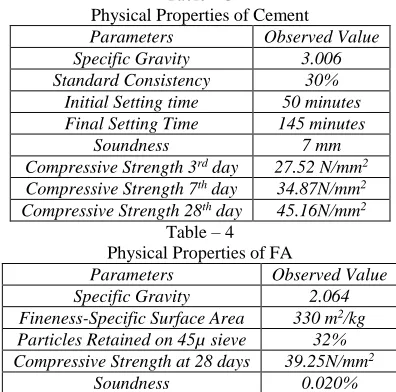
In this investigation Ordinary Portland Cement (OPC) 43 grade concurring to the specifications mentioned in Indian Standard (IS) code 8112-2013 was used. The analysis of physical properties was carried out as per the procedure mentioned in IS 4031-1988. All the values given in Table 3 are in accordance to IS 8112-2013.The test on FA was performed as per IS 1727-1967 and the physical properties so obtained in Table 4 were in accordance to IS 3812-2003.
Table – 3
Physical Properties of Cement
Parameters Observed Value
Specific Gravity 3.006
Standard Consistency 30%
Initial Setting time 50 minutes Final Setting Time 145 minutes
Soundness 7 mm
Compressive Strength 3rd day 27.52 N/mm2 Compressive Strength 7th day 34.87N/mm2 Compressive Strength 28th day 45.16N/mm2
Table – 4 Physical Properties of FA
Parameters Observed Value
Specific Gravity 2.064
Fineness-Specific Surface Area 330 m2/kg Particles Retained on 45µ sieve 32% Compressive Strength at 28 days 39.25N/mm2
Soundness 0.020%
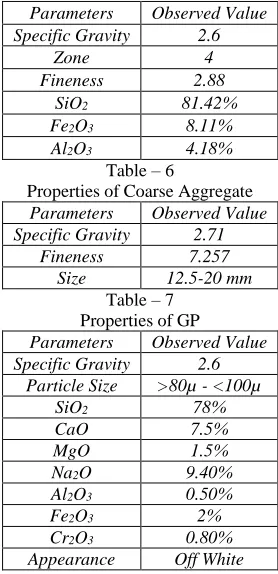
Test on fine aggregate and coarse aggregate was performed as per IS 2386-1963 and their properties are shown in Table 5 and Table 6 respectively. Table 7 consist properties of GP obtained from local areas. For the pozzolanic activity and ASR to be minimal, GP of size between 80µ-100µ was used. Similar observations were made by [16] and [4] respectively.
Table – 5
Parameters Observed Value Specific Gravity 2.6
Zone 4
Fineness 2.88
SiO2 81.42%
Fe2O3 8.11%
Al2O3 4.18%
Table – 6
Properties of Coarse Aggregate Parameters Observed Value Specific Gravity 2.71
Fineness 7.257
Size 12.5-20 mm
Table – 7 Properties of GP Parameters Observed Value Specific Gravity 2.6
Particle Size >80µ - <100µ
SiO2 78%
CaO 7.5%
MgO 1.5%
Na2O 9.40%
Al2O3 0.50%
Fe2O3 2%
Cr2O3 0.80%
Appearance Off White
Procedure:
A total of six concrete mixes were produced with details of the mixing proportions shown in Table 8. The mixes each comprising of six cubes, beams and cylinders were casted and tested for compression, flexural and split tensile strength at 7 and 28 days respectively. Three cylinders were separately casted to test the modulus of elasticity for each mix. A concrete mix ratio of 1:1.5:3 was taken with water cement ratio of 0.48. GP was tested as 5%, 10%, 15% and 20% fine aggregate replacement in the presence of 10% FA as cement substitute.
Table – 8 Concrete Mix Details Mix Name Mix Description
C1 Reference Mix, 100% OPC
C2 10% FA, 0% GP
C3 10% FA, 5% GP
C4 10% FA, 10% GP
C5 10% FA, 15% GP
C6 10% FA, 20% GP
IV. TEST RESULTS AND DISCUSSIONS
Slump Test:
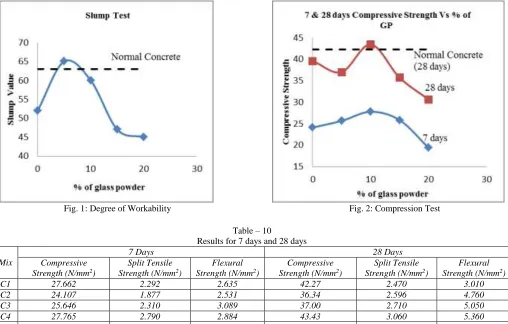
Fig. 1. shows the graph of the slump test and the results are presented in Table 9. The workability drops as we replace the cement with FA. This substitution leads to increase in the specific surface area of cement and fly ash blend due to finer particle size of the latter which results in decrease in mobility of particles. On addition of GP, the inferred slump value showed a decreasing trend with increase in glass content. This decline in the slump values can be attributed to the poor geometry of GP resulting in lesser fluidity of the mixes as well as reduction in fineness modulus. In spite of the decline in the slump values, the waste glass concrete mixes were considered workable in accordance to IS 456-2000. A study by [19] and [28] also reported that increasing the mixing ratio of waste glass and fine aggregate decreased the slump of the concrete.
Table – 9
Slump of waste glass concrete mix
Mix C1 C2 C3 C4 C5 C6
Fig. 1: Degree of Workability Fig. 2: Compression Test Table – 10
Results for 7 days and 28 days Mix
7 Days 28 Days
Compressive Strength (N/mm2)
Split Tensile Strength (N/mm2)
Flexural Strength (N/mm2)
Compressive Strength (N/mm2)
Split Tensile Strength (N/mm2)
Flexural Strength (N/mm2)
C1 27.662 2.292 2.635 42.27 2.470 3.010
C2 24.107 1.877 2.531 36.34 2.596 4.760
C3 25.646 2.310 3.089 37.00 2.710 5.050
C4 27.765 2.790 2.884 43.43 3.060 5.360
C5 25.818 2.688 2.354 35.70 2.962 4.740
C6 19.378 2.630 1.763 26.75 2.810 4.576
Compressive Strength:
The compressive strength of the GP concrete mix at 7 and 28 days are presented in Table 10. Fig. 2. illustrates the trend in the compressive strength. According to the test results, the best 28 day compressive strength value of 43.43 N/mm2 was obtained from the concrete mix made of 10% GP. In comparison to the reference mix an increase of 2.74% was observed. This can be attributed to the pozzolanic action of FA and the angular nature of the glass aggregate, which has a greater surface area than the naturally rounded sand particles which allows greater bonding with the cement paste resulting in a stronger concrete matrix. Beyond 10%, glass replacement showed a decreasing trend as a result of reduced adhesion between the glass particles and cement paste. [1] suggested that where glass aggregate is present in higher proportions, there is insufficient cement paste available within the mix to facilitate bonding with all particles. Therefore it results in the formation of microscopic voids which adversely affects concrete strength.
Split Tensile Strength:
The tensile strength test results are shown in Table 10. In Fig. 3 it’s observed that the 7 and 28 days strength follows similar trend with acclivity in strength up to 10 % GP replacement and then a gradual decrement beyond it. However, the 28 day split tensil e strength of all the mixes is more than the reference mix. In comparison to the reference mix an increase of 23.88% was observed for 10% GP replacement. The decline in strength beyond 10% GP replacement can be imputed to the poor shape, poor surface characteristics and high friability of glass particles.
Flexural Strength:
The flexural strength results are given in Table 10. Fig. 4 illustrates a similar behaviour between 7 and 28 days graph when requisite GP replacement were made. In comparison to the reference mix an increase of 78.07% was observed for 10% GP replacement. This shows that significant pozzolanic reaction had taken place in the mix at 28 days. Similar observation was made by [32]. The decrease in flexural strength may be due to the decrease in adhesion between the smooth GP surface and the cement paste [19 and 27].
Fig. 5: Modulus of Elasticity Modulus of Elasticity:
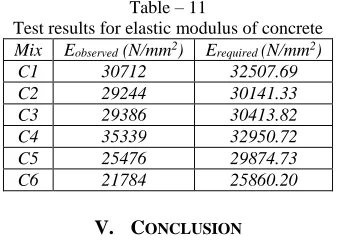
The stress strain curve obtained for all the mixes is given in Fig. 5. The slope of the trend line drawn for each curve gave us the value of modulus of elasticity for respective mixes. Table 11 shows the comparison between the observed elastic modulus and required elastic modulus as per IS 456-2000. As observed, 10% GP replacement mix gives the highest elastic strength with an increment of 15.63% as compared to the reference mix. This increase can be accredited to the higher compressive strength of concrete at 10% GP replacement. According to [25], stronger the concrete, stronger is the gel and hence less is the strain for a given load which leads to higher modulus of elasticity.
Table – 11
Test results for elastic modulus of concrete Mix Eobserved (N/mm2) Erequired (N/mm2)
C1 30712 32507.69
C2 29244 30141.33
C3 29386 30413.82
C4 35339 32950.72
C5 25476 29874.73
C6 21784 25860.20
V. CONCLUSION
will inchoate a two-fold aid to environment, by reducing the over-exploitation of raw materials and by diverting the additional glass waste from landfills. The economic analogy between the use of GP mix and reference mix led to the discovery of increased construction cost. This variation can be minimized by studying the scope of establishing an industry solely dedicated to the production of GP from waste glass for construction purpose. Further inferences of this investigation are summarized as follows:
1) The slump of all the concrete mixes was deemed as workable in-spite of the decreasing trend and was within the felicitous interval.
2) The optimum percentage replacement of sand with GP was inferred to be 10%.
3) The compressive, flexural and split tensile strength of the specimens for 7 and 28 days showed an increase in strength up to 10%. This can be imputed to the angular nature of the glass particles which augments bonding with the cement paste. 4) A decrement in strength was observed when the proportioned quantity of GP in concrete was increased beyond 10%. This
eccentric behaviour can be attributed to increase in GP content. Therefore resulting in reduction of available cement paste which created voids in concrete thus reducing its strength.
5) Elastic Modulus deduced from the combined graph of all specimens gave the optimum value at 10% GP replacement. This observation is compendious to the fact that the modulus of elasticity of concrete is proportional to its strength. 6) Data presented in this paper has a predilection for the use of GP as fine aggregate replacement. Therefore propelling
further investigations in analyzing the long term effects and optimizing the procurement cost of finely crushed waste GP as a feasible binder in concrete.
REFERENCES
[1] Adaway M. & Wang Y., Recycled glass as a partial replacement for fine aggregate in structural concrete – Effects on compressive strength. School of Engineering, Deakin University, Waurn Ponds, Australia. 71-74.
[2] Bilodeau A. & Malhotra VM. High-volume fly ash system: concrete solution for sustainable development. ACI Mater J 2000; 97(1). 24-25.
[3] Chesner W.H, Coollins R.J & Mackay M.H, User Guidelines for Waste and By-product Materials in Pavement Construction, U.S. Department of Transportation, Federal Highway Administration, Publication No. FHWARD- 97-148, 1997.6-9.
[4] Corinaldesi V.,Gnappi G. , Moriconi G. , Montenero A. (2005) , Reuse of ground waste glass as aggregate for mortars. Department of Materials and Environment Engineering and Physics, Technical University of Marche, Via Brecce Bianche, 60131 Ancona, Italy. Department of General and Inorganic Chemistry, Analytical Chemistry, Chemistry–Physics, University of Parma, Parma, Italy. 50-51.
[5] Chi sing lam, chi sun poon and Dixon chan (2007), “Enhancing the performance of pre – cast concrete blocks by incorporating waste glass – Alkali-silica reaction consideration”, Cement and concrete composites, vol: 29. 28-29.
[6] Hui-ying, Z., Byars, E.A., 2004. Alkali–silica reaction of recycled glass in concrete. Alkali aggregate reaction in concrete, In: Proceedings of the 12th International Conference on Alkali-Aggregate Reaction in Concrete, China.12-13.
[7] Ghais A., Ahmed D., Siddig E., Elsadig I., Albager S. , Performance of Concrete with Fly Ash and Kaolin Inclusion (2014). Chemical Engineering Department, University of Khartoum, Khartoum, Sudan. 4-5.
[8] IS 456-2000: Plain and Reinforced Concrete- Code of Practice (Fourth Revision), tenth reprint, April 2007. [9] IS 516-1959: Method of Tests for Strength of Concrete, eighteenth reprint, June 2006.
[10] IS 1199-1959: Method of sampling and analysis of concrete, eleventh reprint 1991.
[11] IS 1727-1965: Methods of Test for Pozzolanic Materials (First Revision), sixth reprint, October 1996. [12] IS 2386-1962: Methods of Test for Aggregates for Concrete, eighth reprint, March 1997.
[13] IS 4031-1988: Methods of Physical Tests for Hydraulic Cement (First Revision), fourth reprint, February 2006. [14] IS 8112-2013: Ordinary Portland Cement, 43 Grade- Specification (Second Revision).
[15] Jonhston, C. D. (1974). “Waste glass as coarse aggregate for concrete”. J Test Eval., 2(5).30-32.
[16] Khmiri A.,Samet B. & Chaabouni M., ASSESSEMENT OF THE WASTE GP POZZOLANIC ACTIVITY BY DIFFERENT METHODS (2012), Laboratoire de Chimie Industrielle, Ecole Nationale d'Ingénieurs de Sfax, BP W 3038, Sfax, Tunisie. 50-51.
[17] Mehta P.K., 2002. Greening of the concrete industry for sustainable development. Concrete International 24 (7).1-3 and 24. [18] Meyer C., 2003. Glass concrete. Concrete International 25 (6).9-10, 12-13 and 14-15.
[19] Park, S.B, Lee, C.B and Kim, J.H. (2004). “Studies on mechanical properties of concrete containing waste glass aggregate.” Cement and Concrete Research, 34 (12). 63-64 and 83-84.
[20] Pike, R. G., Hubbard, N. D., Binary, E.S. (1960). Silicate glasses in the study of alkali aggregate reaction. High Res. Board Bull. 275. 30-32. [21] Phillips J. and Cahn S. (1973).Refuse Glass Aggregate in Portland Cement.‟‟ Proc., 3rd. Mineral Waste Utilization Symposium Chicago.30-32. [22] Rakshvir, M., Barai, S.V., 2006. Studies on recycled aggregates-based concrete. Waste Management & Research 24 (3). 29-30.
[23] Schmidt, A., Saia, WHF. (1963). Alkali-aggregate reaction tests on glass used for exposed aggregate wall panel work.‟‟ ACI Mater J. 60. 30-32.
[24] Shayan A., Xu A., Performance of glass powder as a pozzolanic material in concrete: A field trial on concrete slabs (2006), ARRB Group, 500 Burwood Highway, Vermont South, Victoria, Australia.15-16.
[25] Shetty M.S., Concrete Technology- Theory and Practice (S. Chand and Company Ltd, New Delhi), page no.347-348. 88-89.
[26] Shi, C. and Zheng, K. (2007) „A review on the use of waste glasses in the production of cement and concrete.‟‟ Resources, Conservation and Recycling, 52 (2).12-13 and 30-32.
[27] Taha, B. and Nounu, G. (2008). “Properties of concrete contain mixed colour waste recycled glass as sand and cement replacement.” Constr.Build. Mater., 22(5). 83-84.
[28] Topçu, Í.B. and Canbaz, M. (2004). “Properties of concrete containing waste glass.” Cement and Concrete Research, 34 (2). 63-64.
[29] Topçu Í.B., Boğa A.R., Bilir T. (2007), Alkali–silica reactions of mortars produced by using waste glass as fine aggregate and admixtures such as FA and Li2CO3. Eskisehir Osmangazi University, Civil Engineering Department, 26480 Eskişehir, Turkey. 9-10.
[30] Türker and Erdoğan 1998. Alkali–silica reaction. Cement and Concrete World 2 (13).3-4.
[31] Xie, Z., Xiang, W., and Xi, Y. (2003). “Alkali Silica Reaction potentials of glass aggregates in water-glass activated FA and portland cement mortars.” J. Mater. Civ. Eng., 15(1).10-11.