New Address Back off Algorithm for Channel
Acquisition in Wireless Sensor Networks
Prof. Aniruddh Kurtkoti Prof. Gopi Bhatt
A D Patel Institute of Technology A D Patel Institute of Technology
Prof. Siddharth Shah Prof. Chinmay Joshi
A D Patel Institute of Technology A D Patel Institute of Technology
Prof. Prerak Thakkar A D Patel Institute of Technology
Abstract
MAC layer is mainly responsible for channel sharing and acquisition among different nodes. In wireless sensor networks, while designing MAC protocols, factors that are kept in mind are energy efficiency and reliability. An important factor that has been missed out by these protocols is priority. An attempt is made to show the importance of priority factor in sensor network environment and based on that a new back off algorithm for channel acquisition based on priority is discussed.
Keywords: Wireless Sensor Network, MAC Layer Protocols, Priority
________________________________________________________________________________________________________
I. INTRODUCTION
Today with technology commercially available becomes established enough to warrant greater investment, straightforward engineering efforts will yield complete devices with processing, storage, sensing, and communication functions that fit in much less than a cubic centimeter of space.
Looking forward, the technology will likely evolve into a much less distinct and visible form. Instead of being housed in many small devices, these elements will likely become part of the manufacturing process for various materials and objects. These sensors will tend to operate within the ambient energy sources of their intended environment and be placed at key junctures where analysis is most critical.
Over the years of modern computing, we have seen a new class of computer emerge about once a decade, progressing through mainframes, minicomputers, personal computers, and mobile computers. Each successive model relies upon technical advances, especially integration, to make computing available in a form factor not previously possible. Each has ushered in new uses for computer technology.
WSNs appear to represent a new class. They follow the trends of size, number, and cost, but have a markedly different function. Rather than being devoted to personal productivity tasks, WSNs make it possible to perceive what takes place in the physical world in ways not previously possible. In addition to offering the potential to advance many scientific pursuits, they also provide a vehicle for enhancing larger forms of productivity, such as manufacturing, agriculture, construction, and transportation. The emerging field of wireless sensor networks combines sensing, computation, and communication into a single tiny device. The power of wireless sensor networks lies in the ability to deploy large numbers of tiny nodes that assemble and configure themselves. Usage scenarios for these devices range from real-time tracking, to monitoring of environmental conditions, to ubiquitous computing environments, to in site monitoring of the health of structures or equipment.
The most straightforward application of wireless sensor network technology is to monitor remote environments for low frequency data trends. For example, a chemical plant could be easily monitored for leaks by hundreds of sensors that automatically form a wireless interconnection network and immediately report the detection of any chemical leaks. Unlike traditional wired systems, deployment costs would be minimal
II. APPLICATION OF WIRELESS SENSOR NETWORK
The concept of Wireless Sensor Networks is based on a simple equation
Sensing + CPU + radio = applications
violation that should be reported. For security monitoring applications, the network must be configured so that nodes are responsible for confirming the status of each other.
Node tracking scenarios
A third usage scenario commonly discussed for sensor network is the tracking of a tagged object through a region of space monitored by a sensor network. There are many situations where one would like to track the location of valuable assets or personnel.
With wireless sensor networks, objects can be tracked by simply tagging them with a small sensor node. The sensor node will be tracked as it moves through a field of sensor nodes that are deployed in the environment at known locations.
III. MACLAYER IN SENSOR NETWORK
Medium access control for wireless sensor networks has been a very active research a r e a f o r t h e p a s t c o u p l e o f years. There is much more innovative work to be done at the MAC Layer, but current efforts are not addressing the hard unsolved problems.
The Medium Access Control (MAC) layer sits directly on top of the physical layer and controls the radio. MAC protocols for Sensor Network focus on energy efficiency, instead of meeting traditional goals for wireless MAC design such as fairness, delay and bandwidth utilization. Main sources of energy wastage at the MAC layer are collisions, idle listening, overhearing, and control packet overhead.
MAC Layers from Literature
To perform successful transmission among different nodes we need to have set of protocols. With these protocols channel acquisition and synchronization among nodes becomes better and success of transmission increases. MAC layer is mainly responsible for doing the above functions.
For sensor networks new set of protocols were suggested. The most common protocol used is TDMA [3], where time is divided into slots and each node is given an individual slot for transmitting. Sinen et. al [3] describes the problems faced in implementing TDMA. Some of the contention based MAC protocols are also developed. SMAC [4] and BMAC [5] are some of the examples. Wei Ye [4] and Joseph et. al [5] explains how energy saving is done by SMAC protocol and BMAC respectively. Some other protocols like CMAC [6] are also available.
IV. NEW ADDRESS BACK OFF ALGORITHM
After studying some of the MAC protocols and understanding their advantages and disadvantages a new algorithm for acquiring the channel has been proposed. The some of the drawbacks are
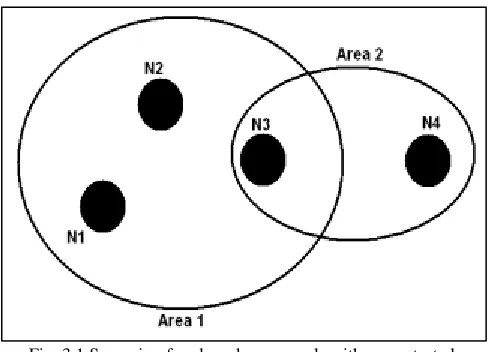
Fig. 3.1 Scenario of nodes where new algorithm was tested.
Let us assume that two nodes N1, N2 wants to send data to N4 which can be sent only through N3. N1, N2 and N3 will be sharing same channel. If it happens that 90 % of successful attempts is obtained by N2 and N1 only, then all the data sent by N1 and N2 will be buffered inN3 and it will not be forwarded to N4. In this case, as the buffer of N3 will be full it will discard frames sent by N1 and N2 leading to chaotic situation. To solve these types of problems the new algorithm is proposed.
if (status = transmit && 2(i-mi)-mi>2mi)
wait (2(i-mi)-mi+ imax); if(sense channel () = busy) mi++;
wait (2* tslot -2mi); goto start;
Assumption
For implementation of new algorithm we are making some assumptions as under: We have n number of nodes who will be
done: end: else mi=0;
wait (tslot -2mi); send data ();
using same channel for communication
Each node n has been given a unique address i, where i >0
The time frame is slotted with each time slot equal to imax + 2imax, where imax is the largest address.
Algorithm
tslot = imax + 2imax (1) status={transmit,receive}
channel = {busy, free}
mi // transmission attempts for node with address i, initially 0 sense channel() // function for sensing channel
send data () // function for sending data for all nodes n do:
mi=0;
Figure 4.1 New Address Back Off algorithm
Collision Free: Theorem
In the above proposed algorithm, we cannot get a situation of collision between two nodes if necessary conditions are satisfied. To prove the above condition we will be proving a theorem. Statement: No t w o n o d e s n i a n d n j where i and j are address of nodes respectively (i>j), we cannot have a situation where
2(i-mi)-mi = 2(j-mj)-mj (2)
where 2(x-mx)-mx > 2mx x=i,j;
Proof: Initially let us assume the above equation is true, i.e. two nodes ni and nj have same transmission time
Fig. 4.2: Three nodes with address i, j,k where i>j>k with their waiting time.
We have 3 nodes with address k,j,i where i>j>k. Above figure shows the transmission time of 3 nodes. According to the
algorithm initially the waiting time for the 3 nodes will be 2k,2j,2i (transmission attempt m will be 0) After i-k attempts for ni and j-k attempts for nj and using equation 2, we will have a situation like
2(i-mi) = 2(j-mj) = 2k (3)
but transmission attempts i-k and j-k are not equal (as i>j). So we will have different transmission time
2(i-mi)-mi != 2(j-mj)-mj (4)
but this is contradicting our assumption of two nodes having same transmission time. Hence we can say that no two nodes can have same transmission time.
V. PERFORMANCE ANALYSIS
Fig. 5.1: Graph of waiting time vs attempts
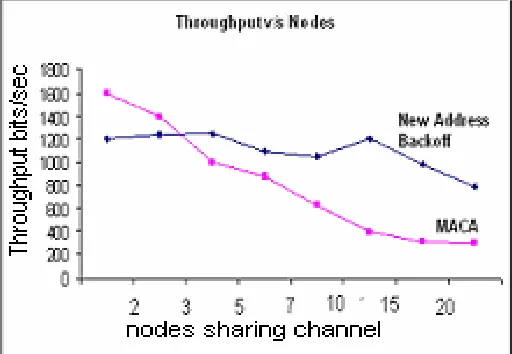
Looking at the above graph, we can say that the waiting time decreases exponentially with number of attempts increasing. When simulation of nodes with 100 MHz frequency and data rate of 2000 bits/sec was carried out, the result obtained, is presented graphically. When done with MACA as number of nodes sharing the channel increased throughput decreased, while with the new algorithm even with increase of number of nodes throughput remained constant.
Fig. 5.2: Graph of Throughput vs number of nodes sharing channel
VI. CONCLUSION
After doing the performance analysis of the above algorithm it was concluded that in this algorithm with increase in number of nodes sharing a channel does not have much effect as compared to that of other algorithms (MACA). Moreover, priority is given to that node which has waited maximum for transmitting data.
VII.FUTURE WORK
In future, further modification and betterment will be done to the above algorithm. Moreover, comparison of the above algorithm with other standard WSN protocols will also be carried out