www.pharmascholars.com
267
Original Article
CODEN: IJPNL6
STABILITY INDICATING METHOD DEVELOPMENT AND VALIDATION FOR THE
ESTIMATION OF RESIDUE OF ABIRATERONE BY HPLC
M. Ramesh Babu
1,2*and V. Umamaheswararao
31
Aizant Drug Research Solutions Pvt.Ltd, Dulapally Village, Hyderabad-500 100, India.
2Faculty of Pharmaceutical Sciences, Jawaharlal Nehru Technological University,
Hyderabad-500 085, India.
3
CMR College of Pharmacy, Medchal Road, Hyderabad-501 401, India.
*Corresponding author e-mail: [email protected]
Received on: 15-01-2016; Revised on: 15-02-2016; Accepted on: 25-03-2016
ABSTRACT
The purpose of the investigation was to develop a new RP-HPLC Method for estimation of Abiraterone in pharmaceutical dosage forms. Chromatography was carried out on an Symmetry shield RP-18, 250 mm x 4.6 mm, 5µm with a isocratic mobile phase composed of Buffer: mixture of solvent in the ratio of 10:90 % v/v (mixture of solvent of solvents in the ratio of Acetonitrile and Water in the ratio of 90:10 v/v) at a flow rate of 1.5 mL/min. The column temperature was maintained at 40°C and the detection was carried out using a PDA detector at 252 nm. Validation parameters such as system suitability, linearity, precision, accuracy, specificity, limit of detection (LOD), limit of quantification (LOQ), Stability of sample and standard stock solutions and robustness were studied as reported in the International Conference on Harmonization guidelines. The retention time for Abiraterone was 7.20 min. The percentage recovery of Abiraterone was 101.65%. The relative standard deviation for assay of tablet wa s fo und to b e less than 2%. The Method was fast, accurate, precise and sensitive hence it can be employed for routine quality control of tablets containing drugs in quality control laboratories and pharmaceutical industries.
Keywords: Abiraterone, ICH guidelines.
INTRODUCTION
Abiraterone is a derivative of steroidal progesterone and is an innovative drug that offers clinical benefit to patients with hormone refractory prostate cancer. Abiraterone is administered as an acetate salt prodrug because it has a higher bioavailability and less susceptible to hydrolysis than abiraterone itself, (1S,2R,5S,10R,11S,15S)-2,15-dimethyl-14-(pyridin-3-yl)tetracyclo[8.7.0.0²,⁷.0¹¹,¹⁵ ]heptadeca-7,13-dien-5-ol. Its empirical formula is C24H31NO.1
Abiraterone acetate has been seen to be a novel steroidal inhibitor of CYP17A1(C17,20 lyase), a cytoochrome P450 complex, a rate-limiting enzyme in androgen biosynthesis resulting in inhibtion of
testosterone production in both the adrenals and the testes. It has been observed to decrease the DHEA, androstenedione and testosterone. The compound has been shown to be approximately 21-24 times more potent than ketoconazole (sc-200496) and liarozole (sc-204055) in CYP17A1 lyase inhibition. In medicine, Abiraterone is used for treating prostate cancer.2.
Various HPLC assay Methods are also reported in the literature for the estimation of Abiraterone5-7. According to literature survey there is official Method for the estimation of Abiraterone by RP-HPLC. Hence, an attempt has been made to develop better Method for estimation and validation of Abiraterone in formulation in accordance with the ICH guidelines3-4.
International Journal of Pharmacy
www.pharmascholars.com
268
EXPERIMENTAL
Instrumentation: Chromatography was performed with waters 2690 HPLC provided with high speed auto sampler, column oven, degasser and & 2996 PDA detector to provide a compact and with class Empower-2 software.
Reagents and chemicals: The reference sample of Abiraterone was provided as gift samples from Aizant Drug Research Solutions Pvt. Ltd, Hyderabad. HPLC grade Acetonitrile, HPLC grade Methanol and all other chemicals were obtained from Merck chemical division, Mumbai. HPLC grade water obtained from Milli-Q water purification system was used throughout the study. Commercial formulation (Dosage: Abiraterone-250 mg tablet).
Chromatographic condition: The chromatographic separation was carried out under the isocratic
conditions. Chromatographic separation was
achieved by injecting a volume of 10μl of standard into Symmetry shield RP-18, 250 mm x 4.6 mm, 5µm column. The mobile phase composed of 10:90 % v/v (mixture of solvent of solvents in the ratio of Acetonitrile and Water in the ratio of 90:10 v/v) was allowed to flow through the column at a flow rate of 1.5 ml per minute for a period of 12 min at 400C column temperature. Detection of the component was carried out at a wavelength of 252 nm. The retention time of the component was found to be 7.20 min for Abiraterone.
Preparation of diluent solution: Mix water and Methanol in the ratio of 10:90 (%v/v) and sonicate to degas for 5 minutes.
Preparation of standard stock solution: Weigh and transfer about 30 mg of AIZ 34 working standard/ reference standard into 100 mL volumetric flask. Add about 70 mL of diluent and sonicate to dissolve for 10 minutes made up with diluents.
Sample preparation: Weigh 20 tablets and calculate the average weight. Crush the 20 tablets to a fine powder in a mortar with pestle. Transfer accurately weighed portion of tablet powder equivalent to 300 mg of Abiraterone acetate into 200 mL volumetric flask. Add about 150 mL of diluent and sonicate for 30 minutes with intermittent shaking, dilute to the volume with diluent and mix well; centrifuge at 4000 RPM for 5 minutes or filter through 0.45µ Nylon or PVDF filter. Pipette out 5 mL of above solution into 25 mL volumetric flask, dilute to volume with diluent and mix well.
Method validation:
System suitability tests: To ensure the resolution and reproducibility of the HPLC system was adequate for the analysis, a system suitability test was established. Data from six injections of 10 µL of the working standard solutions of Abiraterone was used for the evaluation of the system suitability parameters like tailing factor, the number of theoretical plates, retention time.
Linearity: A series of Abiraterone solutions were prepared in the range of about LOQ to 150% of standard concentration and injected into the HPLC system.
Linearity of detector response was established by plotting a graph between concentration and response of Abiraterone peak. The detector response was found to be linear from about LOQ
to 150% of standard concentration. The
correlation coefficient, squared correlation
coefficient, slope, intercept, residual sum of squares was calculated by least square fit method .
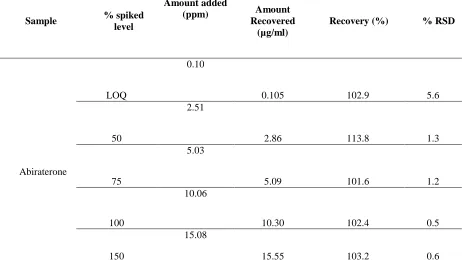
Accuracy: Recovery studies by the standard addition Method were performed with a view to justify the accuracy of the proposed Method. Previously analyzed samples of Abiraterone to which known amounts of standard Abiraterone corresponding to LOQ, 50%, 100% and 150% of target concentration were added. The accuracy was expressed as the percentage of analyte recovered by the proposed Method.
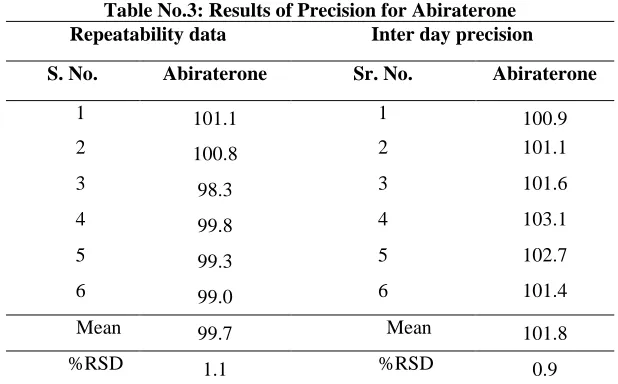
Precision: Precision was determined as repeatability
and intermediate precision (ruggedness), in
accordance with ICH guidelines. The intra-day and inter-day precision were determined by analyzing the samples of Abiraterone. Determinations were performed on the same day as well as well as on consequent days.
Limit of detection and the limit of quantification: Limit of detection (LOD) and limit of quantification (LOQ) of Abiraterone was determined by calibration curve Method. Solutions of both Abiraterone was prepared in linearity range and injected in triplicate. Average peak area of three analyses was plotted against concentration. LOD and LOQ were calculated by using following equations. LOD = (3.3 ×Syx)/b, LOQ= (10.0×Syx)/b
Where Syx is residual variance due to regression; b is slope.
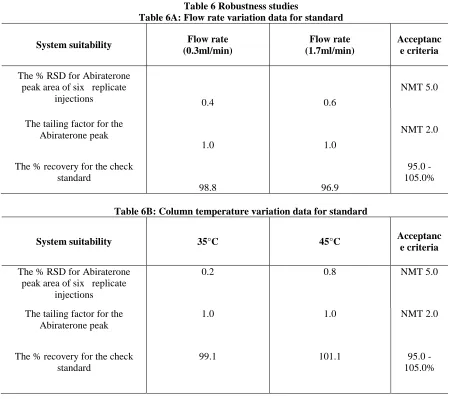
Robustness: The robustness of Abiraterone was
performed by deliberately changing the
www.pharmascholars.com
269
strength was varied by ±5%, column temperature was varied by ±50c, flow rate was varied by ±0.2mL and the mobile phase buffer pH was varied by ±0.2pH.
Stability:The sample and standard solutions injected at 0 hr (comparison sample) and after 24 hr (stability sample) by keeping at ambient room
temperature. Stability was determined by
determining %RSD for sample and standard solutions.
Degradation studies:
Oxidation: To 1 ml of stock solution of Abiraterone, 1 ml of 20% hydrogen peroxide (H2O2) was added separately. The solutions were kept for 30 min at 600c. For HPLC study, the
resultant solution was diluted to obtain
300µg/ml solution and 10 µl were injected into the system and the chromatograms were recorded to assess the stability of sample.
Acid Degradation Studies: To 1 ml of stock s solution Abiraterone, 1 ml of 2N Hydrochloric acid was added and refluxed for 30mins at 600c .The resultant solution was diluted to obtain 300µg/ml l solution and 10 µl solutions were injected into the system and the chromatograms were recorded to assess the stability of sample.
Alkali Degradation Studies: To 1 ml of stock solution Abiraterone, 1 ml of 2N sodium hydroxide was added and refluxed for 30mins at 600c. The resultant solution was diluted to obtain 300µg/ml solution and 10 µl were injected into the system and the chromatograms were recorded to assess the stability of sample.
Dry Heat Degradation Studies: The standard drug solution w a s placed in oven at 1050c for 6 h to study dry heat degradation. For HPLC study, the resultant solution was diluted to 300µg/ml solution and10µl were injected into the system and the chromatograms were recorded to assess the stability of the sample.
Photo Stability studies: The photochemical stability of the drug was also studied by exposing the 3000µg/ml solution to UV Light and visible by keeping the beaker in UV Chamber for 7days or 200 Watt hours/m2 in photo stability chamber. For HPLC study, the resultant solution was diluted to obtain 300µg/ml solutions and 10 µl were injected into the system and the chromatograms were recorded to assess the stability of sample.
Neutral Degradation Studies: Stress testing under neutral conditions was studied by refluxing the drug in water for 6h r s at a temperature of 60º. For HPLC study, the resultant solution was diluted to 300µg/ml solution and 10 µl were injected into the system and the chromatograms were recorded to assess the stability of the sample.
Statistical analysis: Wherever applicable, results were expressed as the Mean±SD, %RSD and data were analyzed statistically by using t- test with aid of Microsoft excel-2007 software and data were considered not significantly different at 5% significance level of probability P ≤0.05.
RESULTS AND DISCUSSION:
Abiraterone method development: Initially reverse phase liquid chromatography separation was tried to develop using various ratios of Methanol and Water, Acetonitrile and Water as mobile phases, in which drugs did not responded properly, and the resolution was also poor. The organic content of mobile phase was also investigated to optimize the separation of both drugs. To improve the tailing factor, the pH of mobile phase becomes important factor. Thereafter, 0.01N phosphate buffer (pH 2.5): Mixter of solvent were taken in isocratic ratio: 10:90 and with flow rate
of 1.5 mL/min was employed. Symmetry shield
RP-18, 250 mm x 4.6 mm, 5µm was selected as the stationary phase to improve resolution and the tailing of both peaks were reduced considerably and brought close to 1. To analyze drug detection were tried at wavelengths 252nm. Abiraterone showed maximum absorption at 252nm of wavelength and 252 nm was selected as the detection wavelength for PDA detector. The retention times were found to about 7.20 min for Abiraterone. The chromatogram obtained was shown in the Fig. 2.
Abiraterone method Validation:
System suitability and Specificity: System suitability parameters such as number of theoretical plates, peak tailing, and retention time was determined. The total run time required for the method is only 12 minutes for eluting Abiraterone. The results obtained were shown in Table No.1. The chromatogram obtained for blank and spiked was shown in the Fig. 3.
Linearity:Abiraterone showed a linearity of response between 0 . 1 - 1 5 μg/mL. These were represented by a linear regression equation as follows: y
(Abiraterone) = 18,125.2031x + 1,255.3019
www.pharmascholars.com
270
Hence the curves established were linear.
Accuracy: To pre analyzed sample solution, a definite concentration of standard drug (LOQ, 50%, 100% & 150 % level) was added and recovery was studied. The % Mean recovery for Abiraterone is 102.4% and these results are within acceptable limit of 98-102. The % RSD for Abiraterone was 0.491 and %RSD for Abiraterone is within limit of ≤2, hence the proposed method is accurate and the results were summarized in Table No.2.
Precision: Repeatability: Six replicates injections in same concentration (10μg/ml of Abiraterone) were analyzed in the same day for repeatability and the % RSD for Abiraterone found to be 0.2 and % RSD for Abiraterone found to be within acceptable limit of ≤2 and hence method is reproducible and the results are shownin Table No. 3.
Intermediate Precision: Six replicates injections in same concentration were analyzed on two different days with different analyst and column for verifying the variation in the precision and the % RSD for Abiraterone is found to be 0.2 and it is within acceptable limit of ≤2. Hence the Method is reproducible on different days with different analyst and column. This indicates that the method is precise and the results are as shown in Table No. 3.
Robustness: The robustness was established by changing the flow rate, column temperature, pH of buffer and composition of the mobile phase within allowable limits from actual chromatographic conditions. It was observed that there were no marked change in mean Rt and RSD is within limit of
≤2 .The tailing factor, resolution factor and no. of theoretical plates are found to be acceptable limits for
Abiraterone. Hence the Method is reliable with variations in the analytical conditions and the result of Abiraterone was shown in Table No.5.
Stability of sample solution:. The sample solution injected after 24 hr by keeping at ambient room temperature 30OC did not show any appreciable change. The % Deviation in the assay is not more than 2 and the results are shown in table-6.
LOD and LOQ: LOD and LOQ for Abiraterone were 0.033 and 0.101 μg/mL respectively. The lowest values of LOD and LOQ as obtained by the proposed Method indicate that the Method is sensitive.
Tablet Analysis: TheContent of Abiraterone in the tablets was found by the proposed method. RSD values for both Abiraterone was within limit of ≤2 and the results were shown in Table No. 7.
Degradation studies: The degradation studies for Abiraterone was performed by various conditions like Acid, Alkali, Oxidation, Thermal, Photolytic UV, visible, Humidity and Neutral Degradation Studies and their limits like purity angle and purity threshold values like purity angle< purity threshold and the results shown in table no.8.
CONCLUSION
A new precise accurate and simple HPLC Method was developed and validated for estimation of Abiraterone pharmaceutical dosage form. This Method is fast, accurate, precise and sensitive hence it can be employed for routine quality control of tablet containing drug in QC laboratories and industries.
www.pharmascholars.com
271
Fig.2.A typical Chromatogram of Abiraterone
(a)
www.pharmascholars.com
272
Fig.3. Chromatograms of Blank (a) and spiked (b) Table No.1: System suitability of Abiraterone
Table No.2: Results of accuracy of Abiraterone
Sample % spiked level
Amount added
(ppm) Amount Recovered
(µg/ml)
Recovery (%) % RSD
Abiraterone
LOQ
0.10
0.105 102.9 5.6
50
2.51
2.86 113.8 1.3
75
5.03
5.09 101.6 1.2
100
10.06
10.30 102.4 0.5
150
15.08
15.55 103.2 0.6
SYSTEM SUITABILITY PARAMETERS ABIRATERONE
No of theoretical plates 14522
Tailing Factor 1.0
RT 7.20 min
Mean Area
14106307
%RSD
www.pharmascholars.com
273
Table No.3: Results of Precision for Abiraterone Repeatability data Inter day precision S. No. Abiraterone Sr. No. Abiraterone
1 101.1 1 100.9
2 100.8 2 101.1
3 98.3 3 101.6
4 99.8 4 103.1
5 99.3 5 102.7
6 99.0 6 101.4
Mean 99.7 Mean 101.8
%RSD 1.1 %RSD 0.9
Table No. 4: Linearity results of Abiraterone
% Linearity level Concentration (ppm) Response
LOQ 0.0999 2049
25
2.4981 45126
50
4.9962 92988
100
9.9923 186567
150 14.9885 269975
Correlation coefficient (r) : 0.9993 Slope : 18125.2031
Intercept : 1255.3019 Residual sum of squares : 30733852.0
Table 6: Results of stock solution stability for Abiraterone
Drug %Assay at 0 hr %Assay at 24 hr %Deviation
ABIRATERONE 102.8 100.5 2.3
Table 5: Results of HPLC Analysis of tablet for Abiraterone
Label amount (mg) Amount found(mg) n=6 %Assay (Mean±SD) RSD
www.pharmascholars.com
274
Table 6 Robustness studies
Table 6A: Flow rate variation data for standard System suitability Flow rate
(0.3ml/min)
Flow rate (1.7ml/min)
Acceptanc e criteria
The % RSD for Abiraterone peak area of six replicate
injections 0.4 0.6
NMT 5.0
The tailing factor for the Abiraterone peak
1.0 1.0
NMT 2.0
The % recovery for the check standard
98.8 96.9
95.0 -105.0%
Table 6B: Column temperature variation data for standard
System suitability 35°C 45°C Acceptanc e criteria
The % RSD for Abiraterone peak area of six replicate
injections
0.2 0.8 NMT 5.0
The tailing factor for the Abiraterone peak
1.0 1.0 NMT 2.0
The % recovery for the check standard
99.1 101.1 95.0
-105.0%
Table 6C: Wavelength variation data for standard
System suitability 250nm 254nm Acceptanc e criteria
The % RSD for Abiraterone peak area of six replicate
injections
0.2 0.3 NMT 5.0
The tailing factor for the Abiraterone peak
1.0 1.0
www.pharmascholars.com
275
The % recovery for the check standard
99.4 99.4 95.0
-105.0%
Table 6D: variation in mobile phase composition data for standard
System suitability High Organic Low Organic Acceptanc e criteria
The % RSD for Abiraterone peak area of six replicate
injections
0.3 0.2 NMT 5.0
The tailing factor for the
Abiraterone peak 1.0 1.0 NMT 2.0
The % recovery for the check
standard 98.4 97.9
95.0 -105.0%
Table 7: Results of HPLC Degradation of Abiraterone
Degradation Condition
Drug Product % Assay % Net
degradation
Peak purity PA PT PF
Control N/A 100.3 N/A 0.067 0.310 No
Acid 1 N HCl on benchtop
for 3 hour 80.1 20.2 0.085 0.312 No
Base 0.1N NaOH at
benchtop 94.2 6.1 0.076 0.281 No
Peroxide 3% H2O2 at 60°C for
1hour 96.7 3.6 0.084 0.289 No
Water 1 Hour at 60°C 95.6 4.7 0.074 0.303 No
Humidity 7 days at 90%RH 101.8 Nil 0.067 0.287 No
UV light 200 Watt.hr/m2 101.0 Nil 0.071 0.251 No
Visible 1.2 million lux hours 99.8 0.5 0.082 0.271 No
www.pharmascholars.com
276
REFERENCES
1. O’Donnell A, Judson I, Dowsett M, Raynaud F, Dearnaley D, Mason M, Harland S, Robbins A, Halbert G,
Nutley B, Jarman M: Hormonal impact of the 17alpha-hydroxylase/C(17,20)-lyase inhibitor abiraterone
acetate (CB7630) in patients with prostate cancer. Br J Cancer. 2004 Jun 14; 90(12):2317-25.
2. Ryan CJ, Cheng ML: Abiraterone acetate for the treatment of prostate cancer. Expert Opin Pharmacother.
2013 Jan; 14(1):91-6.
3. ICH guidelines for the stability of new drug substances and products. Q1A (R2) ICH, Geneva; 2005. p.
1-13.
4. ICH guidelines for validation of analytical procedures: text and methodology. Q2 (R1) ICH, Geneva; 2005.
p. 1-14.
5. Gadhave RV, Tamnar AB, Bansode AS, Choudhari VP: Stability indicating rp-hplc-pda method for
determination of abiraterone acetate and characterization of its base catalyzed degradation product by
lc-ms. IJPPS. 2016; 8(2): 76-81.
6. Belleville T, Noé 2, Huillard O, Thomas SA, Vidal M, Goldwasser F, Alexandre J, Blanchet B. A
HPLC-fluorescence method for the quantification of abiraterone in plasma from patients with metastatic
castration-resistant prostate cancer. J Ch B Anal Tech Bmed Life Sci. 2015 May 1; 989:86-90.
7. Alaa K, Ibrahim D, Faida B: Analysis of abiraterone stress degradation behavior using liquid
chromatography coupled to ultraviolet detection and electrospray ionization mass spectrometry. Jpbmed