Learning Beyond Class-Active Learning and Learner Autonomy Dr Soufiane A-Rahmane
Faculty of Language Studies Sohar University
Email: [email protected] Sultanate of Oman
Abstract
The T&L context of the 21st century is characterized by much emphasis on learner involvement and novice technology-enhanced learning platforms. Current approaches evolve around the development of active learning capacity and learner autonomy in and beyond classroom. The current paper builds on three research projects conducted in the Omani context, focusing mainly on the ’beyond-class’ learning given the fact that only 30% of students’ education time is taken for class contact hours.
The first research explored learner autonomy, concluding that Omani learners have the readiness, willingness and capacity to develop autonomy but of a re-defined type with due consideration to their collaborative and collective orientation. The second investigated the role of extra-curricular activities in enhancing learners’ productive skills, and thus their degree of involvement through the development of control, identification and ownership. The research concludes that providing a favourable and challenging environment increases students’ interest in learning and enhances their involvement both in class and beyond class.The third research explored the link between active learning perceptions and practices, concluding that proper understanding and adequate provisions have a positive impact. It equally concludes that much can be achieved individually and collaboratively through students’ engagement in learning in class as an initiation stage, and later beyond class.
Keywords: Active learning, Collaborative Learner autonomy, Beyond-class Learning, Inter-dependence, Collectivism, Self-constructs, Self-regulation, Motivation, Learning Opportunities.
Introduction
self-regulation are the parameters along which Acikgoz (2003)1 defines active learning. Expanding the view to the learning environment in an attempt to define active learning, it is believed to be an environment where teachers avail, and guide students to create, opportunities to talk, listen, read, write and use critical and analytical skills in various class interaction dynamics.
Active learning is also viewed as a set of teaching practices that manifests the implementation of the fundamental concept that learning in its essence implies embracing an idea, a concept or a solution incorporating it in own personal knowledge and experience. Active learning relates much to Littlewood’s (1999) reactive autonomy type. Learners’ involvement is initiated by learning opportunity regulated by the teacher then transferred in terms of ownership and control to the learners who, deliberately and freely, embrace it, and choose their interactional dynamic, be it individual or collaborative, competitive or complementary.
Active learner involvement progresses learners from a receptive role, targeting low-level thinking skills, to productive role that highlights high-level skills, getting learners to self-assess, reflect and critically observe their learning. Active learning develops in learners a sense of responsibility towards learning that is initiated, self-controlled, effective and permanent (Al-Maqbali, 2017). Blidi (2017) puts much emphasis on responsibility, suggesting that it increases learners’ feeling of ownership and thus reduces their negative attitudes to learning2.
The current paper exhibits three important research projects that were conducted in the Omani context and that yielded findings that can be valid to similar contexts in the MENA region. These projects share in common a significant focus on learning opportunities provisions that engage learners, challenge their traditional role and develop in them a more active and engaging attitude to learning. They also share the main underpinning principle that Omani students have a sound readiness and an inherent capacity to actively engage in learning and develop learner autonomy but with a re-defined approach, taking into account their collectivist orientations and inclination to be inter-dependent. The three research projects provide field evidence of the potential the Collaborative Learner autonomy (CLA-Blidi, 2017) has to facilitate the integration of active learning and the allocation of a more responsible and control role to the learners over their own learning.
Building on the significant findings that came out of the three research projects, the paper suggests a set of recommendations to the T&L stakeholders and concludes that Omani students have more in terms of readiness, willingness and intrinsic motivation to be active learners and develop learner autonomy than their teachers, and the T&L context parties, think. It is the way their readiness and potential is tuned and directed that makes the difference. 1 Theoretical Background
In a changing T&L environment characterized by the heavy presence of technology and various potential platforms and learning venues, stakeholders are expected to make learning opportunities provisions that take into account learners’ inclination towards collaboration, peer-support and redefined roles of teachers and learners. This echoes what Blidi, Chaou and Al Ajmi (2018) advocate as a needed variation in learning opportunities and environments characterized by partnership, shared responsibility and collaboration.
Actively engaging learners in their learning, autonomously and collaboratively, requires the consideration of what Lee (1997) suggests as prerequisites for active learning, autonomous in particular. These are voluntariness, learner choice, flexibility, redefined teacher’s, and peer support (Blidi,2017). In the same vein, Benson &Voller (1997) suggest the addressing of cognitive strategies, meta-cognitive strategies, motivation, attitudes, and knowledge
1
Cited in Ayten, 2017. 2
See Demirci’s (2017); Aytan’s(2017) and Al Kharousi’s (2015) experimental studies, revealing a positive impact active learning has on
about language learning, as conditions that need to be met for active engagement in learning, individually and collaboratively, to take place (Blidi, 2017).Voluntariness implies that T&L environments need to be void of compulsion (Lee & Ng, 1994) which, in the long run, is bound to be counterproductive, contradicting with the principles of readiness and willingness that are influential in active learning. Freedom of learning task choice, in terms of direction, content, pace, location and related conditions, is expected to ensure interest in learning and increase the degree of voluntary active engagement in learning3. Concomitant with voluntariness and choice, flexibility emerges as the key word, being central to the development of interest in actively engaging in learning4. Providing room for flexibility allows learners to become more aware and identify with their learning opportunities. These perquisites entail a radical change in teacher’s role, doing away with prescriptive acts and embracing a supportive role. Teachers guide, facilitate, and orchestrate learners’ involvement in learning and growth into active learners through developing in them learning task awareness, the ability to set up learning goals, and providing them with necessary feedback and reinforcement. Teachers’ new role is of a guiding, orienting and supporting character and learners’ reliance on them does not reflect a rejection learner involvement rejection, it is rather a necessary presence at an initiating stage. This necessity applies to the role and presence of peers for support and collaboration. In an active learning environment targeting learners’ development into learners who are fully involved in and responsibly taking control of their learning, active learners enjoy the attitude and aptitude, the competencies to deliberately and willingly learn independently and in collaboration with their peers, in the interaction dynamic they choose5. Concomitant with the development of active learning competencies, cognitive strategies, meta-cognitive strategies, motivation, attitudes, and knowledge about language learning emerge as vital conditions (Benson &Voller 1997) that enhance learners’ choice and preference to actively engage in learning, self-regulating their use of availed learning opportunities and endeavour to create their own. This relates to learners’ awareness of learning styles and its impact on meta-cognition, consciously reflecting their learning attitudes and performance (See Self-constructs).
T&L environments stipulate teachers’ focus on making provisions for appropriate and adequate diversified learning opportunities6. Applied T&L methods need to tally with learners’ preferences and styles, ultimately aiming at individualising instruction and enhancing learners’ identification with the learning task. This involves the development of learners’ ability to make spontaneous learning decisions based on their identified learning styles and strategies. Teachers’ role at this stage is evidently vital and requires a minute exploration of learner profiles and proper assessment of their needs (See Graves 2000, Nunan 1989 and Brown 1995).
Learners' increased self-awareness is connected with developed self-constructs and self-reflectionthat enable them to be active and proactive learners. It is the role of the HEIs to create an environment conducive to proactivelearning attitudes among learners and develop in them self-confidence and self-belief, ultimately achieving a better understanding and awareness of their own learning and the ability to design, implement, monitor and evaluate learning activities. Learners’ developed abilityto take control of,define and reflecttheir learning marks a change in learners’ self-image and thus in theirperception of learning, becoming masters of the process who are determined and motivated both extrinsically and intrinsically7.
3See Lee’s (1997) focus on learner choice as essential to autonomous learning and Holec’s (1981) focus on the exercise of learning decision making.
4
Flexibility helps establish a supportive environment that facilitates and fosters learner autonomy (Blidi, 2017), allowing learners to change learning options, such as objectives, contents, process of learning, among others, according to their needs and interests (Lee, 1997).
5See Benson’s (2006) Tandem Learning, Breen & Littlejohn’s (2000) Negotiated Learning, Little (2002) Collaborative Teaching ci ted in Blidi (2017). See also the concepts of Peer Scaffolding and Collaborative Learner Autonomy (CLA) in Blidi (2017).
Though poorly defined and researched, as Benson (2007)suggests, the concept of beyond-the-classroom learning is an incontestable reality and need, especially with the emerging role and impetus technology8 has now in education. This directs the focus of T&L environments to novice modes of learning that enable learners’ choice and their active involvement, reducing the privileged position formal classroom learning has long had.
Though he views them as broad, Benson (2006) highlights the notions of access, directed, self-managed, and self-enhanced learning. In practical terms categorising students as either exclusively out-of-class or exclusively in-class would side with the reality and negatively impact learners’ attitudes. The scarcity of research on learning beyond the classroom limits its focus on exploring most efficient and possible ways to extend learning beyond the conventional classroom. Lamb (2004) suggests that learning happens dominantly out of class in multiple settings, multiple contexts, and multiple modes of practice. These modes and settings build much on learners’ constructs (Mercer,2008) that are confidence, concept, efficacy, and esteem. Self-concept, self-esteem, and self-efficacy emphasisethe individual learner’s beliefs about their attributes and abilities, thus influencing their motivation, interest in learning and willingness to communicate (Dornyei, 2005).
The culture and the structure of the society, whether collectivist or individualist, are influential factors in learners’ inclination towards active learning, individually or collaboratively. In T&L contexts similar to the Omani context, where the society in predominantly collectivist, learners’ interdependence primes over independence in learning. Collectivist educational systems direct learners to identify with their community and learn to act collaboratively from within. This justifies Omani learners’ clear preference to form groups and perform collaboratively and competitively. Learners in Eastern and MENA region educational systems, the Gulf region in particular9, are mainly and strongly collectivist. As Littlewood (1999) suggests, "person-based concepts of the independent self and the interdependent" are influential and the primacy is for the inter-depended self at an initial stage with a parallel move towards the independent self who is capable of self-regulating learning. Teachers’ role in this movement is evidently crucial. In this regard, Zimmerman & Martinez Pons (1988) suggest teachers should shift from simply teaching specific study strategies to teaching students’ self-regulation. Actively engaging in learning requires teachers to help learners develop self-regulatory skills and avail opportunities for life-long learning as, it is believed that “self-regulated learners actively and autonomously guide their own learning and update their knowledge whenever necessary” (Puustinen&Pulkkinen, 2001: 283). Self-regulation then emerges as a pre-requisite and a core feature of active learning as it encompasses the skills and strategies that prepare the ground for learners to develop learner autonomy and learn actively. Recent research on self-regulatory strategies suggest a strong correlation between the success of the learner in developing these strategies and their academic achievement.
The development of active learning requires due consideration of learners’ personal constructs like learner beliefs (Mercer, 2008), metacognitive knowledge (Wenden,1998), learner management (Rubin, 2001), and self-regulation (Dornyei, 2005). This justifies the growing focus in Educational psychology on self-self-regulation that gauges learners’ degree of active involvement in their learning. Equally important as self-regulation, motivation plays a vital role in the development of learner’s active learning, and learner autonomy. Ushioda’s (1996) self-motivation links Deci& Ryan’s intrinsic motivation withthe Vygotskyan framework (1979), suggesting that social mediation and social environment play a role in the development of motivation, and thus active learning and autonomy. This echoes the focus on motivational scaffolding processes: peer scaffolding (Blidi, 2017) and teacher scaffolding.
Active learning builds on Dewey’s progressive theory that suggests redefined roles in T&L contexts for learners and teachers. The view of knowledge as a personal experience infers teachers’ role in availing learning opportunities that engage learners in the process of collaborative and individual learning control through
8 See Benson’s Blended Learning (2006) and Reinders’ (2007) reference to the increased use of Virtual Learning Environments.
identification, motivation and interest. This echoes Vygotsky’s (1979) focus on social interaction where learners and teachers work under a shared understanding of the learning opportunity in terms of its aim, purpose, tool, and context.According to Crabbe (2003), a learning opportunity is a “cognitive or meta-cognitive activity [that] is likely to lead to learning” [and which is] “available to learners everywhere at all times” (p. 117).This echoes Demirci’s (2006) dynamic type of learning characterised by learners’ interaction with teachers, materials and their peers. Active learning is meant to provide learners with pools of learning opportunities and involvement chances. Watters (2014) suggests a strong link between active learning and learners’ involvement in learning through engaging in learning opportunities. Learners’ engagement in learning is a situation of sharing whereby learners share their teachers’ values and approaches to learning in class and out of class, actively explore ideas with their peers and learn to evaluate different perspectives.
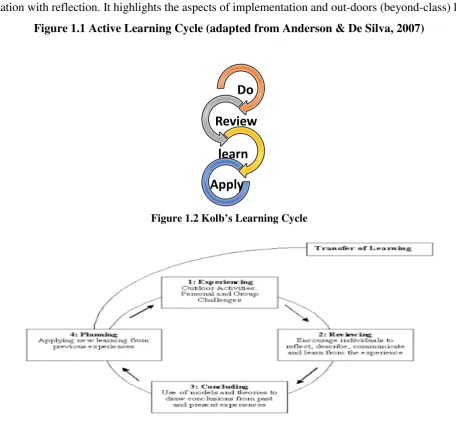
Active learning cycle highlights the gradual development of reflective skills among learners. Learning, in fact, follows a cycle that starts with the individual or collaborative engagement in the learning activity and moves on gradually towards the reflection on the activity by reviewing it in terms of aims, objectives, outcomes and interaction dynamics.
The active learning cycle echoes Kolb’s Learning Cycle in balancing concrete with abstract notions and experimentation with reflection. It highlights the aspects of implementation and out-doors (beyond-class) learning.
Figure 1.1 Active Learning Cycle (adapted from Anderson & De Silva, 2007)
Figure 1.2 Kolb’s Learning Cycle
Do
Review
learn
Current practices indicate more focus on the first stage of both cycles that is task conducting, and a limited, if not total, neglect of learning task review and reflection. This waters down to the role of the teacher in providing learners with, as Bergh et al. (2012) argue, qualitative feedback in addition to the regular summative feedback they get(quantitative evaluation of the task translated in marks). Qualitative feedback can be in the form of an assessment of the task goals and interaction dynamics in terms of their efficiency, relevance, adequacy and feasibility, drawing learners’ attention to the potential obstacles that may hinder achievement. It is through such feedback that learners learn to critically reflect on and evaluate their learning.
One of the main implications of the current T&L environment and learner profiles is a change in role distribution. Teachers and learners get to embrace new roles, with more guidance on the part of the teacher who is meant to be a learning opportunity provider and a proactive role on the part of the learner, becoming a learning opportunity creator, implementer and evaluator. Watkins, Carnell and Lodge (2007) place much emphasis on classroom active involvement and control outside. Niemi (2002) stresses teachers' roles through becoming facilitators, giving more
responsibility to learners and availing varied interaction dynamics (individual, pairs and groups) and foci (completive and
collaborative). Teachers are expected to embrace a partnership role, becoming members in a learning team that mixes individual work, collaborative arrangements, more open questions and projects that enhance active involvement. Teachers’ feedback (Cattaneo,2017) guides learners’ path and alleviates the traditional sense of imposition and knowledge spell felt and believed to hinder learner involvement and render them passive receivers of information (El Salhi, 2013).
2 Methodology
The complex character of today’s T&L environments and the versatility of the 21st century learner profile stipulate the use of methodological approaches that are varied and provide in-depth exploration of the research problem. Exploring active learning calls for combining a set of complementary research methods.
2.1 Mixed Research Methods
According to Creswell (2003), “the practice of collecting and analysing both quantitative and qualitative data within one study” has increased in the last two decades. Integrating both quantitative and qualitative data in a meaningful way achieves required depth and breadth within a more multi-dimensional and accurate view of the research area under exploration. The growing perceived legitimacy of the mixed methods research in exploring social sciences issues is evidently clear. Given the vulnerability typically characterising research studies that use one single method to errors Patton (2002), the decision to use mixed methods emerges as a valid choice. Cross-validation is at stake and achieves the validity and reliability levels required. The flexibility of the mixed methods researchfacilitates the choice of the best strategies that allow the researcher to address the research issue more in depth and put emphasis on the findings.
Chart 1.1 Qualitative Research Instruments - Research 1
A set of quantitative research tools was also used for more details and quantifying purposes, User Count and Database and Survey Questionnaires.
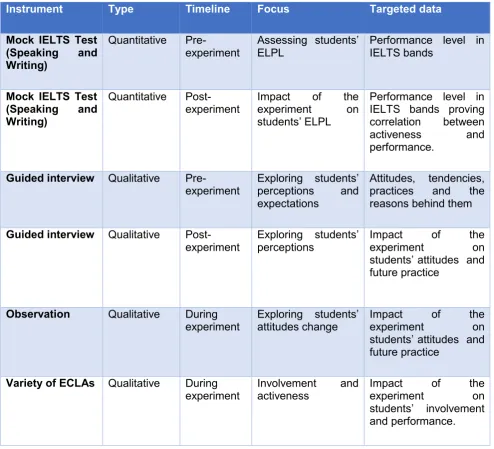
The various research instruments used in the second research, exploring the impact of extra-curricular activities on productive skills proficiency levels, are exhibited in Table 1.1 with their link to the research focus and targeted data.
Case Study: Reading Circles
• learners who meet to research and discuss particular problems or issues,
• problem-solving study groups to guide discussion and learning experiences.
Interviews
•used to satisfy the need for more in-depth information on students’ perceptions.
•review of a number of studies (Murphy, 2005; Gardner & Miller, 1999; Reinders, 2000; Cotterall & Reinders, 2001
Observations
•used for triangulation purposes
•identify students’ perceptions of autonomy, the observation task involved both
descriptive and evaluative (judgmental) aspects
Original Documents
•official version of any document being used,
•students’ diary log books, database, module descriptors and course profiles, GFP Standards as well as lecture notes and course resources.
Students’ Diary
Log Books
•an instrument used in RC and was given to all participants to record any information, event, happening, feeling, or opinion that they had during the whole period of the research.
•meant to avoid rendering the task to the mere act of “just entering stream
-of-consciousness thoughts at the end of the day” (Lynch 1996, p135).
GFP Standards
•a document that consists of the set of standards that the Ministry of Higher
Research participants are 40 Level 1 students with a GPA between 1 and 1.5 on a scale of 4 (45% to 49%) divided into two populations, an experimental population that consists of and a controlled population.
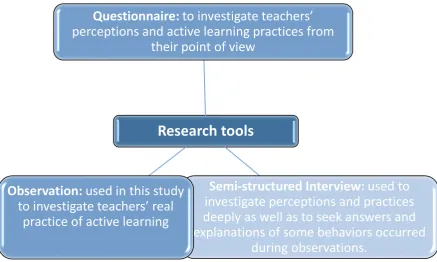
Instruments used in the third research, investigating Omani teachers’ active learning perceptions and practices, consist of a mix that aims at triangulation, using a questionnaire, an observation checklist, and a semi-structured interview.
The population of the study (Blidi & Al Rubaii, 2018) is cycle two EFL teachers from Batinah North Governorate. According to MoE portal, the total number of the target population is 560 teachers teaching grades five to ten in Batinah North for the academic year 2017/2018; 273 male teachers and 287 female teachers.
Table 1.1 Research Instruments - Research 2
Instrument Type Timeline Focus Targeted data
Mock IELTS Test
(Speaking and
Writing)
Quantitative
Pre-experiment
Assessing students’ ELPL
Performance level in IELTS bands
Mock IELTS Test
(Speaking and
Writing)
Quantitative Post-experiment
Impact of the experiment on students’ ELPL
Performance level in IELTS bands proving correlation between activeness and performance.
Guided interview Qualitative
Pre-experiment
Exploring students’ perceptions and expectations
Attitudes, tendencies, practices and the reasons behind them
Guided interview Qualitative
Post-experiment
Exploring students’ perceptions
Impact of the experiment on students’ attitudes and future practice
Observation Qualitative During
experiment
Exploring students’ attitudes change
Impact of the experiment on students’ attitudes and future practice
Variety of ECLAs Qualitative During
experiment
Involvement and activeness
Chart 1.2 Research Instruments - Research 3
2.2 Measurement of Reliability in Questionnaires
As stated above, the information from the questionnaires was processed using Statistical Package for Social Sciences (SPSS 10.0 version) software to enable data analysis to be carried out. The data obtained from the three questionnaires were analysed for reliability using the Cronbach alpha.10
Statistics in Table 1.2 indicates that the reliability Cronbach alpha in the three research projects is reasonably acceptable.
Table 1.2Measurement of Reliability in Questionnaires
Survey
Cronbach
Alpha
Research 1 Research 2 Research 3
Students’ Survey 0.92
0.90 0.81
Teachers’ Survey 0.80
2.3 Data Analysis
Closed questions are more amenable to quantification but open questions often provide more meaningful information (Nunan, 1992). The Lickert scale provides an easily quantifiable set of answers for closed questions. However, care
Research tools
Questionnaire:
to investigate teachers’
perceptions and active learning practices from
their point of view
Semi-structured Interview:
used to
investigate perceptions and practices
deeply as well as to seek answers and
explanations of some behaviors occurred
during observations.
Observation:
used in this study
to investigate teachers’ real
was taken to ensure the overall consistency of the questions. Quantitative research data was directly processed using the Statistical Package for Social Sciences software (SPSS) version 10.0. Data from Interviews, Log Books, Observation Forms (student observation sheets deriving from the RC meetings) and Original Documents needed to be sorted out and grouped into frequency distribution tables before and resulted in charts.
In addition to the measurement of reliability, in the first and second research projects, the possibility of statistically significant relationships (correlations) between various variables was investigated using a Spearman test of correlation for ordinal data.11 Correlation analysis is used to measure the strength of the association (linear relationship) between two or more variables where the only concern is with strength of the relationship between variables. Given that the research population in the present research is a sample and not a whole population parameter, Carl Pearson’s measure of correlation /r/ was used to measure the level of correlation significance against Alpha standard correlation at .01. Correlation is there and significant if the value is above .01, and if the value is less than .01then correlation is negative and does not exist. Carl Pearson’s measure of correlation /r/ is used on a sample population to predict Kendall’s correlation tau rank /T/ and Spearman’s /rho/. These latter two are used as population parameters, which would enable the generalisation of the results. A number of correlation measurements12 referred to as correlation tests were conducted to assess the degree of variation which one variable shares with other variable(s). The term ‘variables’ is used to refer to the statements in teachers’ and students’ questionnaires.
In the third research, the software SPSS version 10.0. was used to analyze the data. The descriptive analysis used in this study were means, standard deviation, and percentages. For finding the correlations between the variables, T-test, One-way ANOVA and Pearson’s Correlation Coefficient were used. As for the descriptive data of the questionnaire, they were analysed qualitatively by thematising them into headings and sub-headings.
3 Main Findings
One main research finding drawn from the first research, exploring Learner Autonomy in the Omani context, is Omani learners’ significant degree of readiness, willingness and motivation to actively engage in their learning. They appraise the variety of learning opportunities active learning platforms, such as Reading Circles, provide. Students’ deliberate and genuine engagement is evident from the enthusiasm shown in the Pre-RC activities. Their eager and enthusiasm in selecting the input (topics, reading texts, movies and documentaries) and structure (debate format) reflect their awareness of the merits that variety, creativity, and involvement bring about to the T&L situation. The RC variations students created, namely the Movie Circle and the Debate Circle, and the genuine engagement in the self-initiated, self-designed, self-controlled activities indicate their developed level of active learning. This is an evident exhibit of their growing sense of, using Little’s words “detachment, critical reflection, decision-making, and independent action” (1991: 4). RCs and similar derived forms can be indicative of an actual significant inherent potential for the development of active learning culture.
A second finding is the need to take into account Omani learners’ interdependence; acting from within groups they create to achieve common goals within a spirit of safety, protection and self-confidence. Their collectivist orientation and tendencies need to be viewed as an impetus and a vehicle towards self-realisation, not an obstacle to growth.
A third finding is that Omani learners have positive perceptions of active learning and learner autonomy and this calls for the adoption of the Collaborative Learner Autonomy Blidi (2017) advocates and the establishment of favourable T&L environments, beyond the regular formal classroom context. The environment at stake is supportive
11 See also Francis, Coats & Gibson (1999);Yule & Kendall (1950), Francis, Coats & Gibson (1999), Dowdy &Wearden (1983), Rodgers &Nicewander (1988).
of the interdependence character of the Omani learners and in which the teacher is seen as a facilitator and a caretaker.
A more significant finding is the enhanced sense of ownership and responsibility RCs provide, indicating
learners’ psychological readiness that is gradually tuned towards full involvement and learner autonomy development. It is
the responsibility of HEIs to createa cooperative and collaborative learning environment in which learners enjoy freedom, and can gradually develop self-confidence, self-esteem and self-constructs that enhance their active involvement in learning. Respecting learners’ preferences increases their awareness of their learning. Learners’ active learning potential develops through the enhancement of their self-concepts and self-esteem, and their personal growth. The shift from other-directed to self-directed learning stipulatesa range of possibilities, mainly the conscious reflection on learning experiences and sharing reflections with peers in cooperative groups.
Another major finding is that RCs enable participant learners to be aware as they combine sufficiency and independent choice of learning input, mutual accountability in engaging in the learning task, self-awareness and shared experience. Self-self-awareness is an important factor in the development of reflective skills active learning requires.
A further significant finding is that teachers take the responsibility for the enhancement of their learners’ awareness. This echoes Crabbe’s (2007: 119) concept of “conscious perception and take-up of a learning opportunity”. This responsibility implies that “learners themselves need to be actively engaged in identifying and managing the learning opportunities” and this can only happen “when learners are better equipped, and therefore more likely, to manage learning opportunities outside the classroom” (Ibid).
Chart 3.1 exhibits the main aspects and characteristics of the ideal T&L environment, taking into account learners’ profiles and conducive to proper learner involvement and the adoption of active learning, and learner autonomy.
One main finding drawn from the second research, exploring the impact of extra-curricular collaborative and autonomous learning activities on learner involvement and proficiency in productive skills, is Omani learners’ readiness to engage in learning behaviour contracts, mostly designed in partnership, enable the reduction of undesirable behaviours and enhance desirable student performance.These contracts are limited formal classroom contexts despite their evidenced positive impact on learners’ language proficiency levels. Provisions for informal learning environment is expected to enhance learners’ motivation and interest in learning. Voluntary active involvement in learning is made possible through the creation of a positive learning environment beyond the classroom. Results emerging from tests conducted after the use of extra-curricular activities show clear progress. Anecdotal evidence, oral feedback from students participating in the experiment, highlights the importance that the freedom they enjoy in selecting materials, deciding on their learning pace and choosing the adequate interaction dynamics increase their interest in learning, and thus enhances their motivation to learn.Comparing students’ expectations with their actual performance post-experiment shows that they correlate and this indicates that expressed students’ belief in the positive impact of taking part in such activities increases their motivation to learn. This finds its echo in Pintrich and Schunk’ssuggestion (2002) that active learner involvement is a combination of extrinsic and intrinsic motivation. Students’ expectations prove right and this confirms their belief in self-confidence as a vital feature they lack, and are meant to develop through such learning opportunities. Voluntariness, collaboration, and shared goal setting in a positive and non-threatening learning environment free from stress are believed to develop in them the confidence they lack. Unanimously, students taking part in the research experiment perceive classroom formal learning as somehow threatening, ultimately inhibiting the development of self-confidence, reducing their involvement, and thus minimizing their chances to improve their proficiency level. Contenting themselves to formal learning opportunities is believed by students to be counter-productive and far from enabling them to actively engage and improve. Due to issues like class size, class dynamics and cultural factors, such as shyness, formal classroom
Ideal T&L Environment Leading to Active
Learning and Autonomy Development
Readiness and Responsibility
Ownership
Collaboration, Partnership and Sharing
Interdepende nce and Peer Scaffolding Motivation
contexts seem to fail to offer sufficient opportunities for active involvement. This confirms the initial assumption suggested by the research that providing students with informal, learner-directed and group-oriented learning opportunities outside the class is believed to be beneficial. The positive impact that peer-support provided by extra-curricular activities is evident, calling for more consideration of the concept of Peer Scaffolding (Blidi, 2017) deemed
vital in enhancing learners’ active involvement.Formal classroom contexts often fail to provide necessary opportunities for
peer-support and is pre-dominantly steered by formal teacher-set goals. They deprive students from developing a positive sense of self-efficacy. Margolis and McCabe (2003) rightly suggest that self-efficacy is a personal construct that often results in academic success given its strong association “with greater persistence, decreased procrastination, increased use of self-regulatory strategies, and higher grade attainment” (p.162). In this respect, a significant research finding is that Omani learners have a clear psychological readiness to actively engage in learning, and ultimately grow autonomous. This readiness is at its crude shape and is expected, if properly nurtured, tuned and gradually directed, to promote active and voluntary involvement, shifting emphasis onto the learner and beyond the formal classroom setting.
In pursuit of properly addressing the chronic issue of addressing low language proficiency levels, active learner involvement and learner autonomy in collaboration (See Blidi 2017) are believed to be instrumental. Student-directed collaborative activities, initiated by learners and carried out in beyond class contexts,exemplify how ideal novice learning environments should be. Learningconsciously, voluntarily and in preferred interaction dynamics and location are the recipe ingredients of a constructivist and constructive active learning involvement.
The advocated student-directed collaborative learning activities advocated in the research experiment represent a model that works towards the enhancement of active learning and the development of collaborative autonomy and self-regulated learning in a stress-free learning context, reiterating the mounting importance of beyond-class learning. The research, however, does not mean to discard formal learning but advocates varied learning opportunities and environments as a support and parallel learning environment that goes in line with formal learning to help students learn, develop and improve their language and learning proficiency in a collaborative, shared responsibility and partnership environment.
One main finding in the third research, exploring teachers’ active learning perceptions and practices, is that these perceptions reflect a perceived positive impact they believe active learning is expected to have on students
(Blidi & Al Rubaii, 2018). Teachers in the Omani context believe active learning, as a mode of learning, positively
changes students’ understanding of the content, skill development and learning styles.
Active learning, according to Omani teachers, plays a vital role in providing students with constructive learning opportunities that cater for their needs at their own pace in their preferred environment. It promotes learner involvement and responsibility, and enables students to take decisions about their learning. Collaborative student-initiated and controlled learning activities, such as student-led debates and forum discussions, allow for active involvement and enhance their interest.
Teachers highly believe in the role active learning plays in creating excitement in classroom, motivating students, increasing their participation and changing their attitudes to learning positively. This perception correlates with findings from previous researches suggesting active learning effectiveness in changing students’ attitudes, raising their satisfaction and motivating them to learn (See Demirci,2017; Hyun, Eidger and Lee, 2017; and Blidi, Chaou & Al Ajmi, 2018).
Lack of balance in contexts of application remain an issue for further consideration towards proper addressing. More emphasis is given to phase one of the active learning at the expense of other phases involving reflection and application. This can find its explanation in teachers’ heavy reliance on low-risk active learning strategies in EFL classrooms and this is, anecdotally, justified by the novice character of the concept in the Omani education tradition. This also justifies the observed reluctance to use active learning due to formal learning constraints. Formal learning system is believed to put constraints on learning andto limit the opportunities that allow for learning variation and exercise of freedom and control over own learning.
One last significant finding is the misperception that characterizes teachers’ and students’ role in Omani formal school contexts, still pre-dominantly teacher-led with a view of the teacher as the knowledge provider and the students as passive receivers of knowledge. The research suggests that this is due to a dominating view of teaching as an exam driven and content coverage process. The research suggests a radical change in role distribution and advocates alearning context characterised by shared responsibility and collaboration. Teacher’s dominance keeps the existing barriers, related to logistic, affective and cognitive factors, there and suggests a paramount urgency to address them in order to ensure proper implementation of active learning, in class and beyond class.
4 Recommendations
In the light of the findings emerging from the three research projects referred to in the current paper, a number of recommendations to all the participants in the T&L pyramid, Students, Teachers and Stakeholders, are deemed useful and necessary:
1. T&L learning environments need to dare and challenge the regular classroom context, going beyond class and the traditional role distribution, working more out of the teachers’ sphere and in collaboration (See Appendices 1 and 2: Beyond-class Student-directed Learning Activities cited in Blidi 2017 and in Blidi, Chaou and Al Ajmi 2018).
2. Given the limited number of contact hours compared with the formal time spent at HEIs, it is a must that extra-curricular activities become a beyond-class context where student-initiated, led, controlled and assessed learning takes place.
3. Teachers’ knowledge about active learning and the various potentials of application need broadening with an eye on various experiences in other contexts worldwide.
4. Education officials need to work on providing teachers with proper training to teachers to ensure adequate grasp of the active learning concept, address misconceptions and ensure productive implementation of active learning strategies and activities.
5. Curriculum designers and text-book writers need to re-evaluate the provided content and resources, including more active learning strategies and including more extra-curricular activities with relevant variation in dynamics and a duly observed balance of individual, competitive, and collaborative components.
6. Beyond-class learning opportunities should be incorporated in formal syllabi and out-of-class student-led activities should be integrated into the syllabus of teaching English.
7. Stakeholders of the educational pyramid in the Omani context need to work collaboratively to create partnership environments where responsibility will be shared by everyone in order to build a strong educational system.
learning and active learning enough to initiate further research projects to come, probably as planned, in an edited issue drawing on field practice and the real view of practitioners from different contexts.
References
Acikgoz, K. U. (2003). AktifOgrenme (Active Learning) (5. Edition). Izmir: EgitimDunyasiYayinlari: The World of Education Publishings.
Al Kharousi, A.M. (2015). The effectiveness of using Active learning on developing students' Achievements and Attitudes towards Learning Math in Grade Eight Students. Unpublished Master Thesis. Sultan Qaboos University. Muscat. Oman.
Al Mahrooqi, N. H (2013). Investigating EFL Teachers' Perceptions, Practices and Difficulties of Learner- Centered Approach in Oman. Un published Thesis. Sultan Qaboos University. Oman
Al Maqbali, W. (2017). Exploring the Understanding and Practices of Learner Autonomy by Students and EFL Teachers at Boys’ Secondary Schools in Oman. Unpublished Master Thesis. British University. Dubai. Anderson, M. & De Silva, S. (2007). Active Learning. Uk: Me-and-Us Ltd.
Aytan. T. (2017). The Effect of Listening Education Practices Organized by Active Learning Techniques on the Attitudes of 6th Grade Students. Journal of Education and Practice, 8(12), pp. 41-48.
Bellanca, J. (2009). 200+Active Learning Strategies and Projects for Engaging Students' Multiple Intelliggences. California: Corwen Press.
Benson, P. (2006). Autonomy in language teaching and learning. ELT Journal. (40), 21–40.
Benson, P. (2007). Teachers’ and learners’ perspectives on autonomy In T. E. Lamb & H. Reinders (Eds.),
Learner and teacher autonomy: Concepts, realities and responses. Amsterdam: John Benjamins. Benson, P., &Voller, P. (1997). Autonomy and independence in language learning. London: Longman.
Bergh, L. R., Ros, A. &Beijaard, D. (2012). Teacher feedback during active learning: Current practices in primary schools. British Journal of Educational Psychology (2013), 83, pp.341-362.
Blidi, S. (2017). Collaborative Learner Autonomy: A Mode of Learner Autonomy Development. Singapore: Springer Science and Business Media Ptd. Ltd.
Blidi, S., Chaou, A. & Al Ajmi, A. (2018). Improving Language Proficiency through Student-Directed Collaborative Learning Activities. PONTE International Journal of Science and Research, 74 (3/1), pp.83-100.
Blidi, S. & Al Rubaii, M (2018). Omani Teachers' Perception of Active Learning-Impact on Classroom Practices. International Journal of Business and Applied Social Science (IJBASS). 4, 10: 20-49.
classroom. Cambridge: Cambridge University Press.
Breen, M. P., & Littlejohn, A. (2000). Classroom decision-making: negotiation and process syllabuses in practice. Cambridge: Cambridge University Press.
Brown, J.D. (1995) Elements of language curriculum: A systematic approach to program development. Boston: Heinle&Heinle.
Cattaneo, K. (2017, July). Telling Active Learning Pedagogies Apart: from theory to practice. Journal of New Approaches in Educational Research, 6 (2), pp.144–152.
Collins, J. & O'Brien, A. (2003). The Greenwood Dictionary of Education. Westport, CT: Greenwood. Westport, CT: Greenwood.
Cotterall, S., &Reinders, H. (2003). Fortress or bridge? Learners' Perceptions and Practice in Self-access Language Learning. TESOLANZ. (8), 23-38.
Crabbe, D. (2003). The Quality of Language Learning Opportunities. TESOL Quarterly, 37 (1), pp. 9-34. Crabbe, D. (2007). Learning opportunities: adding learning value to tasks ELT Journal, 61(62), 118-125. Creswell, J. W. (2009). Research design: qualitative, quantitative, and mixed methods approaches. Los Angeles; London: SAGE.
Creswell, J. W. (2009). Research design: qualitative, quantitative, and mixed methods approaches (3rd ed. ed.). Los Angeles; London: SAGE.
Deci, E. & Ryan. M. (1982). Intrinsic Motivation and Self-Determination in Human Behaviour. New York: Plenum.
Demirci, C. (2017). The Effect of Active Learning Approach on Attitudes of 7th Grade Students. International Journal of Instruction, 10(4), pp. 129-144.
Dornyei, Z. (1998). Motivation in Second and Foreign Language Learning. Language Teaching. (31), 117-135.
Dornyei, Z. (2005). The psychology of the language learner: individual differences in second language acquisition. Mahwah, N.J./London: Lawrence Erlbaum Associates.
Eison, J. A. (2010). Using Active Learning Instructional Strategies to Create Excitement and Enhance Learning. University of Florida.
Gardner, D. (2006). Learner autonomy 10: Integration and support. Dublin: Authentik. Gardner, D. (2007). Integration and support. Dublin: Authentik.
Gardner, D., & Miller, L. (1999). Establishing self-access: from theory to practice. Cambridge: Cambridge University Press.
Graves, K. (2000) Designing language courses: A guide for teachers.Boston: Heinle&Heinle Publishers. Hofstede, G. H. (1991). Cultures and organizations: software of the mind. London/New York: McGraw-Hill. Holec, H. (1981). Autonomy and Foreign Language Learning. Oxford: Pergamon Press.
Hyun, J., Eidger, R. & Lee, D. (2017). Students' Satisfaction on Their Learning Process in Active Learning and Traditional Classrooms. International Journal of Teaching and Learning in Higher Education, 29 (1), pp.108-118. https://files.eric.ed.gov/fulltext/EJ1135821.pdf
Kayes, C. (2002). Experiential Learning and its Critics: Preserving the Role of Experience in Management Learning and Education. Published online in 2017 by: Academy of Management Learning & Education, 1 (2). Lamb, M. (2004). It depends on the students themselves: Independent language learning at an Indonesian state school. Language, Culture and Curriculum. 17(13), 229–245.
Lamb, T., &Reinders, H. (2006). Supporting independent language learning: issues and interventions. Frankfurt am Main; Oxford: Peter Lang.
Lamb, T., &Reinders, H. (2008). Learner and teacher autonomy: concepts, realities, and responses. Amsterdam; Philadelphia: John Benjamins Pub. Co.
Lee, I. (1997). Supporting greater autonomy in Language Learning. ELT Journal. (52), 54.
Lee, I., Ng, R. (1994). Self-directed learning: does it make any difference? Paper presented at the International Language Education Conference., Hong Kong.
Little, D. (2002). The European Language Portfolio: Structure, origins, implementation and challenges Language Teaching. 35(33), 182–189.
Littlewood, W. (1999). Defining and developing autonomy in East Asian contexts. Applied Linguistics.
20(21), 71–94.
Lynch, B. K. (1996). Language program evaluation: theory and practice. Cambridge: Cambridge University Press.
Mercer, S. (2008). Learner Self-beliefs. ELT Journal. 62(2).
Murphy, J., & Phillips, D. K. (2005). Psychological perspectives in assessing mathematics learning needs.
Journal of Instructional Psychology. (32), 277–286.
Mynard, J. (2003). Synchronous computer-mediated communication and learner autonomy in female Emirati learners of English. (PhD), University of Exeter, Exeter.
Nunan, D. (1989) Syllabus Design. Oxford: Oxford University Press.
Nunan, D. (1999). Collaborative Language Learning and Teaching. Cambridge: Cambridge University Press. Palfreyman, D. (2001). Learner Autonomy: Knowing Who to depend on and How? Dubai: Zayed University. Pintrich, P. R., and Schunk, D. H. (2002). Motivation in education: theory, research, and applications (2nd ed. ed.). Englewood Cliffs, N.J.: Merrill, Prentice-Hall International.
Prince, M. (2004). Does active learning really work? A review of the research. Journal of Engineering Education, 93(3), pp. 223-231.
Puustinen, M., &Pulkkinen, L. (2001). Models of self-regulated learning: A Review. Scandinavian Journal of Educational Research. (45), 269–286.
Reinders, H. & Lewis, M. (2005). How well do self-access call materials support self-directed learning? JALT CALL Journal. 1(2), 41-49.
Reinders, H. & Lewis, M. (2006). An evaluative checklist for self-access materials. ELT Journal. 60(3), 272-278.
Reinders, H. (2000). Self-Access Language Learning in the English Proficiency Programme. A Report on Students’ Perceptions and Use of Independent-Learning Resources.
Reinders, H. (2007). Big brother is helping you. Supporting self-access language learning with a student monitoring system. System. 35(1), 93-111.
Reinders, H. (2007). The English Language Self-Access Centre. IATEFL Learner Autonomy Newsletter,
39(3).
Reinders, H., Hacker, P. & Lewis, M. (2004). The language advisor's role: identifying and responding to needs. Language Learning Journal. (30), 30-35.
Rubin, J. (2001). Language learner self-management. Journal of Asia-Pacific Communication. 11(11), 25-37. Silberman.M. (1996). Active Learning :101 Strategies to Teach Any Subject. Needham Heights: MA: Allyan& Bacon.
Triandis, H. C. (1995). Individualism and Collectivism. Boulder: Westview Press. Ushioda, E. (1996). Learner Autonomy 5: The Role of Motivation. Dublin: Authentik.
Ushioda, E. (2006). Motivation, autonomy and sociocultural theory. In P. Benson (Ed.). Learner autonomy 8: Insider perspectives on autonomy in language teaching and learning (5-24). Dublin: Authentik.
Vygotsky, L. (1979). Consciousness as a problem of psychology of behavior. Soviet Psychology. (17), 29–30. Watkins, C., Lodge, C. & Carnell, E. (2007). Effective Learning in Classroom. London: SAGE Publication Ltd. Retrieved from: http://web.a.ebschost.com/ehost/detail?sid=3dc68cee9a53-41bs-8196-72e368
Watters, N. (2014). An exploration of the concept and practice of active learning in higher education. PHD Thesis. University of Glasgow.
Wenden, A. (1998). Meta-cognitive knowledge and language learning. Applied Linguistics. 19(14), 515–537. Wenden, A. (1999). Special issue on meta-cognitive knowledge and beliefs in language learning. System.
27(24).
Wenden, A. (2002). Learner development in language learning. Applied Linguistics. 23(21), 32–55.
Zeytoun-Millie, D. (2002). Vocational self-directed Learning in Fujairah Workplaces: Alive but is it all?
Deakin University. Geelong.
Zhou, G., Zhang, L., & Fu, G. (2001). A study on the relationship between self-regulated learning strategy and academic achievement. Psychological Science (China). (24), 612–619.
Zimmerman, B.J. & Martinez-Pons, M. (1988). Construct validation of a strategy model of self-regulated learning. Journal of Educational Psychology. (80), 284–90.
Appendix1: Student-directed Collaborative Learning Activities (Blidi, Chou and Al Ajmi 2018)
ECLA Focus Interaction Dynamics
1 Reading Circle (RC) Collaborative Competitive
Engaging students in post-reading discussion and debate on the reading text chosen.
- Groups of 5 - 1 rotational leader - 4 members
2 Movie Circle (MC) Collaborative
Engaging students in post-film discussion and debate on the movie chosen.
- Experiment group
- 1 rotational leader to select the movie
3 Debate Circle (DC) Collaborative
Engaging students in an open discussion and debate on a topic/issue chosen by the
Competitive leader. - 4 members
4 Literature Circle (LC) Collaborative
Engaging students in an open discussion and debate on the piece of literature chosen by the leader.
- Experiment group
- 1 rotational leader to select the piece of literature
5 Photo Talk Contest (PTC) Competitive
Engaging students in an open discussion on the Photos presented in the contest leading to a vote for the best Photo.
Experiment group divided into groups of 5 and 1 rotational group to act as a panel.
6 Job Fair (JF) Collaborative Competitive
Engaging students in role plays (job seeker / employers).
Experiment group divided into groups of 5
7 Job Interviews (JI) Collaborative
Engaging students in role plays (interviewer / interviewee).
Experiment group divided into groups of 5
8 Operetta (OP) Collaborative
Engaging students in a collaborative writing, staging, and acting of an operetta.
Experiment group
9 Theatre Play (TP) Collaborative
Engaging students in a collaborative writing, staging, and acting of an theatre play.
Experiment group
10 TV Broadcast (TB) Engaging students in a collaborative creation of a TV broadcast (variety show).
Experiment group divided into groups of 5 with each group contributing to the variety of items in the show.
Appendix 2: CLA Resource Pack (Blidi 2017) CLA Resource Sheet 1
A
c
tiv
it
y
N
a
m
e Reading Circle (RC) Participants Audience Students Teacher
Yes
No √
A
c
ti
vi
t
Collaborative Competitive
Interaction Dynamics
- 1 rotational leader
- 4 members LRC Support Needed
No
Specify the rationale behind answering Yes (Teacher/LRC Support needed):
LRC support is needed to provide adequate location, logistics, books required, support and guidance during reading weeks in book/information search RC members would conduct in preparation of the meeting.The teacher is not needed but could occasionally attend for guidance and support purposes without interfering in the RC.
Lea rni ng Obj e c tiv e s Out c om e s
1.consolidate reading strategies
2.implement communication skills
3.develop critical and analytical skill
4.practise information search using the Library, the
Internet and multiple database,
5. consolidate team-spirit, collaborative working and leadership skills
6. implement communication and group discussion protocols
Langua ge a nd C om m un ic a tion Tar get
1. polite forms
2. spoken discourse markers
3. speech features
4. use of modals
5. grammatical structures used to express opinion (agreement,
disagreement…etc.)
6. text-bound lexicon depending on the theme of the text chosen for RC
R e s ource s R e qui re d (LR C , I T , A udi o -v is ual, a c c e s s ori e s …e tc
.). Round tables with 5 chairs each PC and data show
Recorder (audio / video)
P
roc
e
s
s
Each group of 5 students meet bi-weekly to discuss a reading text chosen by the leader who prepares a task sheet with questions
to accompany the reading text assignment and potentially selects a supporting video, documentary, audio document on the same
topic of the text assigned. The leader changes every RC meeting. Alternatively a number of groups (a whole class divided into 6
or 7 groups) meet to discuss a text chosen by one group each time.The RC meeting can start with a presentation on the text by
the leader then proceeds with answers to the task sheet questions, discussions on the theme and issues raised by participants
(See Image 5).
Image 5: Reading Circle
The objective of the RC is mainly to ensure that students:
1. selected a reading of their own choice,
2. run the discussion at their own style and pace,
3. performed in a non-threatening and a friendly environment,
4. identified with a learning opportunity, gaining a sense of belonging and protection,
5. participated from within the group and developed self-confidence.
Developments on the RC as a CLA activity can be the generation of follow-up activities such as:
1. Film Circle
2. Documentary writing
3. Debate session
CLA Resource Sheet 2 A c tiv it y N a m
e Movie Circle
(MC)
Participants Audience
Students Teacher
Yes √
No A c tiv it y Type Group Interaction Dynamics
- Groups of 5 - 1 rotational leader - 4 members
LRC Support Needed
Yes √
No
Specify the rationale behind answering Yes (Teacher/LRC Support needed):
LRC and IT support is needed to provide adequate location and technical support related to the broadcasting of the audio-visual input. The teacher is not needed but could occasionally attend for guidance and support purposes without interfering.
Lea rni ng Obj e c tiv e s Out c om e s
1. consolidate listening skills and strategies
2. implement communication skills
3. grasp movie structure and technical features
4. consolidate team-spirit, collaborative working and leadership skills
5. implement communication and group discussion protocols
Langua ge a nd C om m un ic a tion Tar get
1. polite forms
2. spoken discourse markers
3. use of modals
4. grammatical structures used to express opinion (agreement,
disagreement…etc.) 5. tenses R e s ource s R e qui re d (LR C , I T) A udi o -v is ual, s…e tc .).
Round tables with 5 chairs each
PC and data show
P
roc
e
s
s
As a follow-up development of the RC Activity, a movie watching session can be organized (See Image 6). The movie selected
addresses the same issue of the RC text.
Image 6: Movie Circle
The MC meeting can start with a presentation of the movie by the leader then proceeds with watching then a post-movie
discussion in which participants:
1. express their appreciation of the movie,
2. discuss themes and issues the movie raises,
3. compare the way the theme was addressed by the RC text and by the movie.
The objective of the MC is mainly to ensure that students:
1. selected a movie of their own choice,
2. run the activity at their own style and pace,
3. performed in a friendly learning environment within a group with which they feel secure,
4. identified with a learning opportunity that is interesting and developed in them a sense of self-confidence.
Developments on the MC activity can be the generation of follow-up activities such as:
1. Documentary writing
2. Debate session
3. Student Movie Club Forum
4. Establishment of a Movie
CLA Resource Sheet 3 A ct iv it y N a me
Debate Circle (DC)
Participants Audience
Students Teacher
Yes √
No A ct iv it y T y p
e Group - Contest
Collaborative Competitive
Interaction Dynamics
- Groups of 5 - 1 rotational leader
- 4 members LRC Support Needed
Yes √
No
Specify the rationale behind answering Yes (Teacher/LRC Support needed):
LRC support is needed to provide adequate location, logistics, books required, support and guidance during reading weeks in book/information search group members would conduct in preparation of the meeting.The teacher is not needed but could occasionally attend for guidance and support purposes and to enhance the debate. Guests (other classes or teachers) can be invited to attend the debate.
L ea rn in g Ob je ct iv es Ou tc o m es
1. consolidate language skills (speaking and listening) 2. implement communication skills
3. consolidate team-spirit, collaborative working and leadership skills 5. implement communication and debate protocols
L a n g u a g e a n d C o mm u n ic a tio n T a rg et
1. polite forms
2. spoken discourse markers
3. use of modals
4. grammatical structures used to express opinion (agreement,
disagreement…etc.) 5. tenses R eso u rc es R eq u ir ed (L R C , IT , A u d io -v isu a l, ac cess or ies… et
Round tables with 5 chairs each PC and data show
Pr
o
ce
ss
As a potential development of the RC and MC Activity, a DC session can be organized (See Images 7 and 8). The debate culminates initial
discussions that took place in RC and MC meetings.
Image 7: Debate Circle
Image 8: Debate Circle
The Debate Circle meeting can start with a presentation of the debate theme and a summary of the RC and MC activities by the leader then
proceeds with the debate. Participants:
1. express their opinions in relation to the themes discussed in RC and MC activities, 2. open up horizons on related issues,
3. broaden background knowledge and culture.
The objective of the DC is mainly to ensure that students: 1. freely expressed their views in an open debate,
2. exchanged opinions and ideas in a friendly cooperative learning environment,
3. run the activity at their own style and pace,
4. identified with a learning opportunity that is interesting and developed in them a sense of self-confidence.
Developments on the DC activity can be the generation of follow-up activities such as:
1. Documentary writing 2. Debate Forum
CLA Resource Sheet 4 A ct iv it y N a me
Literature Circle (LC)
Participants Audience
Students Teacher
Yes √
No A ct iv it y T y p
e Group
Collaborative
Interaction Dynamics - Class
- 1 rotational leader LRC Support Needed
Yes √
No
Specify the rationale behind answering Yes (Teacher/LRC Support needed):
LRC support is needed to provide adequate location, logistics, books required, support and guidance during reading weeks in book/information search group members would conduct in preparation of the circle meeting.The teacher is needed to guide, support and enhance the debate literary work at stake. Guests (other classes or teachers) can be invited to attend the discussion of the literary work.
L ea rn in g Ob je ct iv es Ou tc o m es
1. consolidate knowledge about literary works (structure,
characterization, climax, themes, imagery…etc.).
2. implement communication skills
3. consolidate critical and analytical skills
3. consolidate language skills (speaking and listening)
5. appreciate stylistics and genre features (rhyme, rhythm, imagery,
symbols…etc.) in literary works (novel, poetry…etc.)
L a n g u a g e a n d C o mm u n ic a tio n T a rg et
1. use of tenses in narrative genre,
2. use of verbs, nouns and adjectives in literary works,
3. nominal vs verbal structures
4. grammatical structures used to express opinion (agreement,
disagreement…etc.)
5. communications skills and polite forms use in discussions
R eso u rc es R eq u ir ed (L R C , IT , A u d io -v isu a l, ac cess or ies… et
Round tables with 5 chairs each PC and data show
Accessories
Pr
o
ce
ss
The class meets monthly to discuss a selected by the literary work (a novel, a poem, a play…etc.). One voluntary student takes the lead and
chooses the literary work to be used. The leader prepares a task sheet and potentially selects a supporting video, documentary, audio document
on the same topic of the text assigned. The leader changes every LC meeting. An alternative structure could be dividing the whole class
divided into 6 or 7 groups. The LC meeting can start with a presentation on the novel chosen by the leaderthen proceeds with answers to the task sheet questions, discussions on the theme and issues raised by participants then ends up with a photo talk activity (e.g. Cover Page photos
of the novel).
The objective of the LC is mainly to ensure that students:
1. selected a literary work of their own choice and interest,
2. run the discussion at their own style and pace,
3. performed in a friendly learning context,
4. identified with a learning opportunity that provided them with a sense of belonging and protection, 5. developed their sense of self-confidence.
Developments on the LC as a CLA activity can be the generation of follow-up activities such as:
1. Film Circle (the story of the film should be the same novel or play selected for the LC) 2. Documentary writing
3. Debate session on the literary work and its film