International Journal of Pharmaceutical and Phytopharmacological Research
(ICV-5.09)ISSN (Online) 2249 – 6084
ISSN (Print) 2250 – 1029
Int.J.Pharm.Phytopharmacol.Res.
2012, 2(2): 101-108
(Research Article)
Formulation Development and Optimization of Floating Microballoons for Oral Delivery of
Domperidone
Nilesh K. Gorde, Harshal A. Pawar, Nilesh Khutle, Yogesh Chaudhari
Dr. L. H. Hiranandani College of Pharmacy, Ulhasnagar, Maharashtra, India
Received on: 10/08/2012 Accepted on: 30/10/2012
ABSTRACT
The present study involves preparation and evaluation of floating microballoons with Domperidone as model drug for prolongation of gastric residence time.Microballoons (MB) were prepared by the emulsion solvent diffusion method utilizing enteric acrylic polymers dissolved in a mixture of dichloromethane and ethanol.Full factorial design employed in formulating the microballoons with ratio of dichloromethane: ethanol and Eudragit RS100: Eudragit RL100 as independent variables. Buoyancy and t50%(time for 50% drug release) were selected as dependent variables. Formulation variables were found to be significant for buoyancy andt50%(P < 0.05). All formulations were found to releases the drug by diffusion mechanism. Optimization of the formulations was achieved by applying the constrained optimization. Experimental values of % buoyancy and t50%release for the
optimized formulation were found to be 88.79±2.35% and 10.19±0.89 hours, respectively which showed an exellent aggrement with those predicted with mathematical model. The quadratic mathematical model developed could be used to further predict formulations with desirable release and buoyancy.
Key Words: Microballoons, Domperidone, Oral Delivery, Buoyancy studies
INTRODUCTION
Rapid gastrointestinal transit could result in incomplete drug release from the drug delivery system to the absorption window leading to diminished efficacy of the administered dose. Prolonged gastric retention is important in achieving control over the GRT because this helps to retain the CR system in the stomach for a longer time in a predictable manner 1. Retention of drug delivery systems in the stomach prolongs overall gastrointestinal transit time and improves the oral bioavailability of the drugs that are having site-specific absorption from the stomach or upper part of the small intestine 2. From several approaches, floating drug delivery system is a more convenient and logical approach to prolong gastric residence time. Floating devices administered in a single- unit form such as hydrodynamically balanced systems are unreliable in prolonging the GRT owing to their 'all-or-none' emptying process and thus, they may cause high variability in bioavailability and local irritation due to a large amount of drug delivered at a particular site of GIT. Multiple-unit dosage forms may be better suited because they are claimed to reduce the intersubject variability in absorption and lower the probability of dose dumping 3-5.
Domperidone is structurally related to butyrophenones. The antiemetic properties of domperidone are related to its dopamine receptor blocking activity at both the chemoreceptor trigger zone and at the gastric level.
Domperidone is also used as a prokinetic agent for treatment of upper gastrointestinal motility disorders 6-8. After oral administration; domperidone is rapidly absorbed from the stomach and the upper part of the GIT with fewer side effects. It is a weak base with good solubility in acidic pH but in alkaline pH its solubility is significantly reduced. Oral controlled release dosage forms containing drug, which is a weak base, are exposed to environments of increasing pH and poorly soluble free base may get precipitated within the formulation in the intestinal fluid. Precipitated drug is no longer capable of release from formulation 9-11.
The objective of the present study was to develop floating microballoons of domperidone in order to achieve an extended retention in the upper GIT, which may result in enhanced absorption and thereby improved bioavailability. The prepared microballoons were evaluated for incorporation efficiency, drug content, buoyancy and t50%.
The effect of formulation variables on the buoyancy and t50%
was investigated.
MATERIALS AND METHODS Materials
Domperidone was received as a gift sample from ALPA laboratories Ltd, Indore (India).
chemical and pharmaceutical Ltd and sd. fine chemie. Pvt. Ltd respectively. Polyvinyl alcohol and all other chemical were of analytical grade.
Methodology
Formulation Design
DESIGN EXPERT 7.1.5.0 (STAT-EASE) demo version software was used for formulation design. The 32 full factorial design was used in the study. In this design, two factors each in three levels (Table-1) were evaluated and experimental trials were performed in all 9 possible combinations. Ratios of Eudragit RS100: Eudragit RL100 (X1) and ethanol: dichloromethane (X2) were selected as independent variables. Incorporation efficiency, drug content, buoyancy and t50% were selected as dependent
variables. The experimental design with the corresponding formulations is outlined in Table-2. The statistical model:
Yi = b0+ b1X1+ b2X2+ b12X1X2+ b1X12+ b2X22
Where Yi is the level of response variable; b is the regression coefficient; X1and X2 stands for the main effect; X1X2 is the interactions between the main effects; and X12 and X22are quadratic terms of the independent variables.
Preparation of Microballoons
Microballoons were prepared by the emulsion solvent diffusion method using Eudragit RS100 and Eudragit RL100 (Table-1). The drug (0.1 g), and polymer Eudragit RS100: Eudragit RL100 (0.9 g) were dissolved in a mixture of ethanol and dichloromethane (12ml) at room temperature. The solution of domperidone in the organic phase was poured into an aqueous solution of polyvinyl alcohol (0.75 w/v%, 200 ml) at 25°C. The resultant emulsion or suspension was stirred at 200 rpm employing a propeller type agitator for 1 h at 40°C. Subsequently, the resulting microballoons were filtered, washed several times with water to remove the traces of polyvinyl alcohol and dried for 12 hr at 45°C (12).
In vitro Buoyancy Studies
The floating test was carried out using USP paddle type apparatus with 900 ml of fresh water as the medium and a paddle speed of 100 rpm at room temperature. One hundred milligrams of the microballoons were spread over the surface of the medium. The floating microballoons were collected after 24 h and filtered. The filter paper containing the microballoons was dried in an oven at 80 ◦C for 2 h. The percentage of floating microballoons was then determined. The change in weight of the filter papers was determined after wetting them with fresh water and drying in an oven at 80 ◦C for 2 h. The change in the weight of the filter papers was <5% and was considered to be insignificant (13).
% buoyancy = (weight of floating microballoons/ initial weight of floating microballoons) × 100
Drug content (DC) and Encapsulation Efficiency (EE) To measure the loading content and loading efficiency, the domperidone-loaded samples prepared by optimized method were used. The loading content and loading efficiency were determined using the following formulae 13:
Scanning Electron Microscopy
Surface morphology and inner surface of a broken half of a microballoon with domperidone were examined by Scanning electron microscopy. Microballoons from the optimized batch were mounted on the SEM sample stab using a double-sided sticking tape and coated with gold under reduced pressure for 5 min using an Ion sputtering device. The gold coated microballoons were observed under the scanning electron microscope and photomicrographs of suitable magnifications were obtained.
Differential Scanning Calorimetry
Thermograms of domperidone, dummy microballoons, physical mixture of domperidone and dummy microballoons and optimized microballoon formulation were recorded in a differential scanning calorimeter to characterize the solid state of the drug in the microballoons. The samples were placed in flat bottomed aluminum pans and heated over a temperature rang of 30-350°C at a constant rate of 5°C/min with purging of nitrogen (50 mL/min), using alumina as a reference standard.
In-vitro Drug Release Study
The release rate of domperidone from floating microballoons was determined using USP Dissolution Testing Apparatus 2 (paddle method). The dissolution test was performed using 900 mL of 0.1N HCl, at 37 ± 0.5°C and 100 rpm. A sample (5 mL) of the solution was withdrawn from the dissolution apparatus hourly for 12 hours, and the samples were replaced with fresh dissolution medium. The samples were filtered through a 0.45-µ membrane filter and diluted to a suitable concentration with 0.1N HCl and measured the absorbance at 284 nm using a Shimadzu double-beam spectrophotometer 1700 (Japan). Cumulative percentage drug release was calculated using an equation obtained from a standard curve.
Statistical Analysis
Differences in encapsulation efficiency, drug content, % buoyancy and t50% were statistically analyzed by the two-way analysis of variance (ANOVA) which was performed using the DESIGN EXPERT 7.1.5.0 (STAT-EASE) demo version software. To graphically demonstrate the influence of each factor on the response, the response surface plots were generated using the DESIGN EXPERT 7.1.5.0 (STAT-EASE) demo version software.Differences were considered to be statistically significant at p < 0.05.
Response Surface Plot
and independent variables can be directly visualized from the response surface plot.
RESULTS AND DISCUSSION
Full factorial design employed in formulating the microspheres with ratios of Eudragit RS 100: Eudragit RL 100 and dichloromethane: ethanol as independent variables. The mathematical models developed for all the dependent variables using statistical analysis software are shown in Equations (1)–(4):
EE = 71.83 – 6.04 X1 + 22.23 X2 + 0.42 X1X2 – 17.68 X12 – 6.34 X22
R2= 0.9460 ……… (1)
DC = 8.46 – 0.66 X1 + 2.11X2 + 0.088 X1X2 – 1.77 X12 – 0.54 X22
R2= 0.9054 ……… (2)
% buoyancy = 84.24 – 13.67 X1 + 3.83 X2 – 0.50 X1X2 – 9.33 X12 – 1.83 X22
R2= 0.9994 ……… (3)
t50% = 9.31 – 0.31 X1 + 1.49 X2 + 0.47 X1X2 – 0.40 X12 + 0.14 X22
R2= 0.9542 ……… (4) By 32 full factorial design, 9 formulations of domperidone microballoons are possible using DESIGN EXPERT 7.1.5.0 (STAT-EASE) demo version software (Table-2). Correlation coefficient (R2) of
Eq. 1 to4 clearly indicates that the response is dependent on the factors.
Kawashima et al. 12 reported the mechanism for the formation of floating microballoons made from an acrylic polymer dissolve in solvent system of dichloromethane and ethanol. However, ethanol has higher solubility in water. As soon as the polymer solution was added to the aqueous medium, the ethanol diffused rapidly from the droplets of the polymer solution resulting in polymer precipitation by simultaneous diffusion of water inside the sphere. Due to the poor miscibility of dichloromethane in water, it could not effectively invade by the water. Therefore, the diffusion of dichloromethane began late, after the initial solidification, and formed a central hollow structure. The central cavity produced by the solvents was gradually filled with water due to the reduced internal pressure. Water escaped out of the cavity during the drying process ultimately forming microballoons which led to lowering of the density and enabling the microballoons to float.
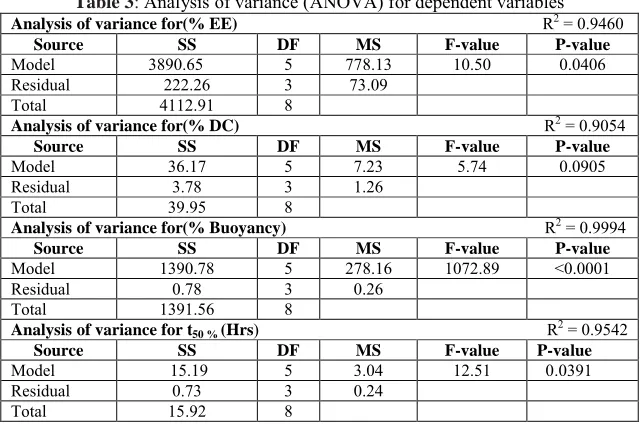
The multiple regression analysis performed revealed that both the formulation variables analyzed had a significant influence on response parameter. The ANOVA table demonstrates that the model was significant for EE, buoyancy and t50% (p < 0.05, Table-3). The correlation coefficients indicate a good fit. As the amount of Eudragit RL100 increased, buoyancy of the microballoons decreased with increased in drug release rate; this may be due to high affinity of Eudragit RL100 toward water, which promotes water penetration into microballoons, leading to increased density. In addition, the polymer might have been dragged further by the presence of more ethanol in the droplets, resulting in a thicker water/ethanol mixture zone. The thicker water/ethanol mixture zone resulted in a thicker wall thickness and a larger particle size that leads to decreased in drug release rate. As ethanol is rapidly partitioned into an
aqueous phase during emulsification, most of the domperidone molecules remain within the polymeric shell area and solidify together with the polymer. The thick wall of the microspheres provides a larger volume for loading the drug. Hence, the loading content and loading efficiency of domperidone was fairly high.
The result obtained from ANOVA table collectively indicated that optimum polymer and solvent ratio are essential to produce microballoons with desirable buoyancy and drug release characteristic.
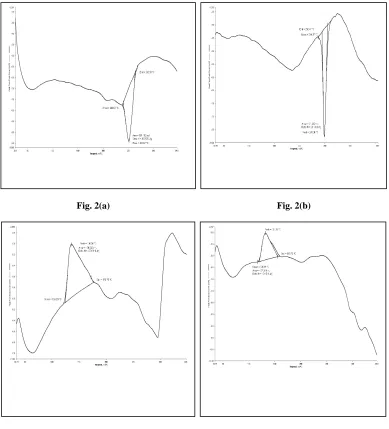
The microballoons prepared in this study, as observed under scanning electron microscopy (Fig. 1a and b), were spherical in shape with a rough outer surface. A photograph of a broken half of a microballoons loaded with domperidone (Fig. 1c) showed that microballoons contained a central hollow core surrounded by a thick shell wall. Differential scanning calorimetry (DSC) thermograms of domperidone and domperidone-loaded microballoons displayed in Fig. 2. Thermograms of physical mixture showed distinct peak for domperidone whereas domperidone-loaded microballoons exhibited diffused spectra indicating amorphization of the drug.
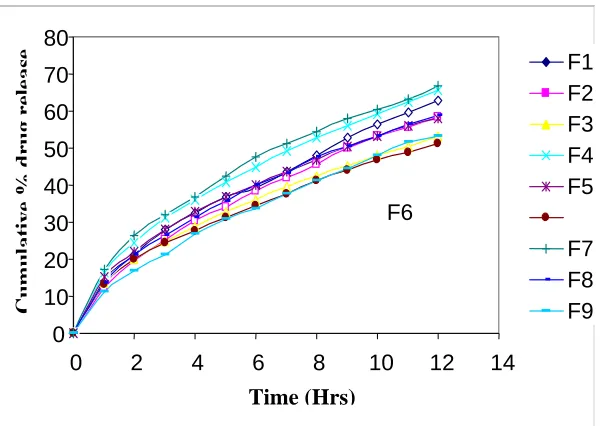
In vitro domperidone release studies were performed in 0.1N HCl for 12 h. The cumulative release of domperidone significantly decreased with increasing Eudragit RS100 concentration(p < 0.05, Fig. 3) this is due to the fact that Eudragit RL100 contains more functional quaternary ammonium groups (10%) than RS100 (5%) gives the microspheres membrane a more open structure. Moreover Eudragit RL100 is strongly hydrophilic which promotes the penetration of the aqueous buffers and hence good leaching of the drug. So due to strong permeability and greater porosity of RL100 the release of drug was more as compared to the RS100. Solvent compositions also have significant effect on the in vitro release of domperidone.
Thicker wall-thickness and larger particle size obtained at higher concentration of ethanol and have an increased diffusional pathlength when exposed to dissolution medium giving rise to decrease drug release.
The data obtained for in vitro release were fitted into
equations for the zero-order, first-order and Higuchi release models 14–16. The interpretation of data was based on the
value of the resulting regression coefficients (Table-4). The
in vitro drug release showed the highest regression
coefficient values for Higuchi’s model, indicating diffusion to be the predominant mechanism of drug release.
Response Surface Plot
Graph presentation of the data show the relationship between the response and independent variables. The response surface plots for the dependent variables EE, DC, buoyancy and t50% were generated to demonstrate graphically the effect of ratios of dichloromethane: ethanol and Eudragit RS 100: Eudragit RL 100(Fig. 4).
ratio, respectively at equal levels of eudragit RS100 and eudragit RL100 in polymer ratio (Fig 4b). This was probably due to increased in wall thickness of the microspheres at higher levels of ethanol that provides a larger volume for loading the drug. Hence, the loading content and loading efficiency of domperidone was fairly high.
The quadratic model generated revealed that the levels of ethanol and Eudragit RL100 have an antagonistic influence on buoyancy. Levels of ethanol were found to have a positive influence on buoyancy since increased in wall thickness of microballoons increases resistance to the diffusion of the dissolution fluid that ultimately leads to decreased in density of the microballoons. The 3-D plot (Fig 4c.) shows that the % buoyancy increased from 82±2.99%to 91±3.26% and from 56±1.23% to 63±2.34% at lower and higher level of ethanol in solvent ratio, respectively as the decreased in eudragit RL100 level in polymer ratio. In contrast % buoyancy declined from 91±3.26% to 63±2.34% and from82±2.99%to 56±1.23% at low and high level of eudragit RL100, respectively, as the ethanol levels increased. The decreased in buoyancy can be due increased in Eudragit RL100, which is strongly hydrophilic which promotes the penetration of the dissolution medium and enhance the density of the microballoons.
The mathematical model generated indicated that both the levels of ethanol and Eudragit RS100 were found to have positive influence on t50%. The3-D plot (Fig 4d.)
demonstrate the positive influence of ethanol level on t50% which indicate that t50%increased from 8.54±0.59 hours to 10.24±0.87 hours and from 6.78±0.41 hours to10.35±0.75 hours at lower and higher level of ethanol in solvent ratio, respectively as the eudragit RS100 level increased in polymer ratio. This could be probably due to increased in wall thickness of microballoons increases resistance to the diffusion of the dissolution fluid that ultimately leads to decreased in the drug release. In contrast t50% declined at high and low level of eudragit RS100, respectively, as the ethanol levels increased. This can be attributed to the fact that Eudragit RL100 contains more functional quaternary ammonium groups (10%) than RS100 (5%) and gives the microspheres membrane a more open structure. Hence increased Eudragit RL100 probably leads to increased in drug release.
A constrained optimization technique was used to generate the optimum setting for the formulation using maximization of the % buoyancy and t50% as our major optimization objectives. Maximization of the buoyancy and t50%would be
more favorable as our main object is to retain the microballoons for prolong period in the acidic environment of the stomach and releases the drug for entire period in order to achieve once daily formulation.
Optimization results therefore obtained were included in Table-5. The optimum formulation was developed using polymer ratio at -0.50 and solvent ratio 1.00. The optimized formulation was evaluated for % buoyancy and t50%. There was excellent agreement between the measured responses and those predicted by mathematical data for the % buoyancy and t50%. The drug release mechanism from optimized formulation was found to be diffusion.
CONCLUSION
In vitro data obtained for floating microballoons of
Domperidone showed excellent encapsulation efficiency, good buoyancy and prolonged drug release. Desired release of domperidone from floating microballoons was achieved by carefully monitoring the selection of formulation variables. Diffusion was found to be the main release mechanism. The statistical approach was used for formulation optimization. The mathematical model generated by regression analysis used to predict and optimize the formulation variables. The prediction from the model and the experimental results in this study conform to each other quite well, indicating the validity of the method. Thus, the prepared floating microballoons may prove to be potential candidates for multiple-unit delivery devices adaptable to any intragastric condition.
ACKNOWLEDGEMENT
Authors are thankful to Chhattishgarh Council of Science and Technology (C-COST/MRP/05-08/sch. no. 144), Chhattishgarh and All India Council of Technical Education (AICTE- F. No: 8023/BOR/RPS-153/2006-07), New Delhi for financial support under Research Promotional Scheme (RPS).
Table 1:Variables and their levels used in production of floating microballoons of Domperidone
Variables Levels
I II III
Ratio of Eudragit RS100 and Eudragit RL100 (X1) -1 0 +1 Ratio of Ethanol and Dichloromethane (X2) -1 0 +1 Polymer ratio: -1 = 600:300 mg, 0 = 450:450 mg, +1 = 300:600 mg
Solvent ratio: -1 = 4:8 ml, 0 = 6:6 ml, +1 = 8:4 ml
Table-2:Studied formulations of domperidone microballoons by 32full factorial design using DESIGN EXPERT 7.1.5.0 (STAT-EASE) demo version software
Batch code X 1 X 2 EEa % DCa % Buoyancya % t50%a Hrs
F1 1.00 -1.00 16.26±1.38 2.81±0.54 56±1.23 8.54±0.59 F2 -1.00 0.00 55.53±1.11 7.3±0.47 89±2.52 9.19±0.68 F3 1.00 1.00 68.35±1.25 8.31±0.81 63±2.34 10.24±0.87 F4 0.00 1.00 78.05±1.3 8.82±0.31 86±1.89 7.77±0.51 F5 1.00 0.00 47.01±1.44 5.89±0.51 61±2.12 8.99±0.6 F6 -1.00 1.00 81.38±1.29 9.42±0.6 91±3.26 11.48±0.94 F7 -1.00 -1.00 30.96±0.89 4.27±0.11 82±2.99 6.78±0.41 F8 0.00 0.00 77.57±1.08 8.66±0.29 84±2.29 8.97±0.66 F9 0.00 -1.00 47.18±1.21 6.82±0.72 79±3.11 10.35±0.75 X 1 = Polymer ratio, X 2 = Solvent ratio, t50= time for 50% drug release,aMean±SD, n = 3
Table 3:Analysis of variance (ANOVA) for dependent variables Analysis of variance for(% EE) R2= 0.9460
Source SS DF MS F-value P-value
Model 3890.65 5 778.13 10.50 0.0406
Residual 222.26 3 73.09
Total 4112.91 8
Analysis of variance for(% DC) R2= 0.9054
Source SS DF MS F-value P-value
Model 36.17 5 7.23 5.74 0.0905
Residual 3.78 3 1.26
Total 39.95 8
Analysis of variance for(% Buoyancy) R2= 0.9994
Source SS DF MS F-value P-value
Model 1390.78 5 278.16 1072.89 <0.0001
Residual 0.78 3 0.26
Total 1391.56 8
Analysis of variance for t50 % (Hrs) R2= 0.9542
Source SS DF MS F-value P-value
Model 15.19 5 3.04 12.51 0.0391
Residual 0.73 3 0.24
Total 15.92 8
SS – Sum of squares, DF – Degrees of freedom, MS – Mean of square, F – Fischer’s ratio, P – Probability, R2= Correlation coefficient
Table-4: Pharmacokinetic Models for Analysis of In Vitro Dissolution Data
Batch code Zero order First order Higuchi F1. 0.9620 0.9089 0.9905 F2. 0.9606 0.8855 0.9918
F3. 0.9407 0.8939 0.9984 F4. 0.94 0.8898 0.9984 F5. 0.9359 0.8874 0.9989
F6. 0.9422 0.9021 0.9979 F7. 0.9292 0.8757 0.9987 F8. 0.9507 0.8834 0.9956 F9. 0.9712 0.9062 0.9862
Table-5: Composition of the Optimized Formulation Obtained by Constrained Optimization Technique and Comparison of Experimental and
Predicted Values
Optimized formulation
Polymer ratio -0.50
Solvent ratio 1.00
Formulation % buoyancy(±SD) t50% (hour’s±SD)
Predicted 90.97 10.77
Experimental 88.79±2.35 10.19±0.89
Fig. 1:SEM photographs of Domperidone loaded Microballoons
Fig. 1(c)
Fig. 2: DSC thermograms of a) Domperidone, b) physical mixture, c) dummy microballoons and d) Domperidone loaded microballoons
Fig. 2(a) Fig. 2(b)
Fig. 3: Comparative release profile of developed formulations
Fig. 4: Response surface plot for the effect of ratiosof dichloromethane: ethanol and Eudragit RS100: Eudragit RL100 on a) EE, b) DC, c) Buoyancy and d)t50%.
Fig. 4 (a) Fig. 4 (b)
Fig. 4 (c) Fig. 4 (d)
0
10
20
30
40
50
60
70
80
0
2
4
6
8
10
12
14
Time (Hrs)
C
u
m
u
la
ti
v
e
%
d
ru
g
r
el
e
a
se
F1
F2
F3
F4
F5
REFERENCES
1) Soppimath KS, Kulkarni AR, Aminabhavi TM., Development of hollow microspheres as floating controlled-release systems for cardiovascular drugs: Preparation and release characteristics, Drug Development and Industrial Pharmacy, 2001, 27(6): 507-515.
2) Gambhire MN, Ambade KW, Kurmi SD, Kadam VJ, Jadhav KR., Development and in-vitro evaluation of oral floating matrix tablet Formulation of Diltiazem Hydrochloride, AAPS PharmSciTech, 2007, 8:166-174. 3) Whitehead L, Fell JT, Collett JH, Sharma HL, Smith AM.,
Floating dosage forms: an in vivo study demonstrating prolonged gastric retention, J. Control. Rel., 1998, 55: 3– 12.
4) Talukder R, Fassihi R., Gastroretentive delivery systems: a mini review, Drug Dev. Ind. Pharm., 2004, 30:1019–1028.
5) Rouge N, Leroux JC, Cole ET, Doelker E, Buri P., Prevention of the sticking tendency of floating minitablets filled into hard gelatin capsules, Eur. J. Pharm. Biopharm., 1997, 43:165–171.
6) Brogden RN, Carmine AA, Heel RC, Speight TM, Avery GS., Domperidone. A review of its pharmacological activity, pharmacokinetics and therapeutic efficacy in the symptomatic treatment of chronic dyspepsia and as an antiemetic, Drugs, 1982, 24: 360–400.
7) Shuto K, Shiozaki Z, Kojima T, Tanaka M., Antagonism of KW-5338 (domperidone) against emesis and depression of intestinal motility induced by L-DOPA, J Pharmacobiodyn,1980, 3: 709–714.
8) Niemegeers CJ, Schellekens KH, Janssen PA. “The antiemetic effects of domperidone, a novel potent gastrokinetic, Arch Int Pharmacodyn Ther, 1980; 244,
130–140.
9) Mehta B, Doshi P, Joshi M, Dattat M., Floating Osmotic Device for Controlled Release Drug Delivery, U.S. Patent,
9 92 897. 3 March 2003.
10) Naonori K, Yatabe H, Iseki K, Katsumi M. A new type of pH independent controlled release tablet. Int. J. Pharm.
1991, 68: 255–264.
11) Thomma K, Zimmer T. Retardation of weakly basic drug with diffusion tablet. Int. J. Pharm. 1990, 58: 197–202. 12) Kawashima Y, Niwa T, Takeuchi H, Hino T, Itoh Y.
Hollow microspheres for use as a floating controlled drug delivery system in the stomach. Journal of Pharmaceutical Sciences. 1992, 81: 135-140.
13) Choi HK, Pushp R, Chun MK. Preparation of floating microspheres for fish farming. International Journal of Pharmaceutics. 2007, 341: 85–90.
14) Costa P, Lobo JMS. Modeling and comparison of dissolution profiles, Eur. J. Pharm. Sci.1987, 39: 39–45.
15) Wagner JG, Interpretation of percent dissolved-time plots derived from in vitro testing of conventional tablets and capsules. J. Pharm. Sci.1969, 58: 1253–1257.
16) Schefter E, Higuchi T., Dissolution behavior of crystalline solvated and non-solvated forms of some pharmaceuticals. J. Pharm. Sci. 1963, 52: 781–791.
*Corresponding Author: Mr. Nilesh K. Gorde,
Dr. L. H. Hiranandani College of Pharmacy, Opp.Smt. CHM College Campus,