RESEARCH ARTICLE
VIEWS AND PREFERENCES IN THE DEVELOPMENT OFINSTRUCTIONAL
MATERIALSFOR IT COURSES: THE CASE OF BSIT STUDENTS
*Lowell A. Quisumbing, Las Johansen B. Caluza,Devine Grace D. Funcion,
Micheline A. Gotardo, Rommel L. Verecio and Jeffrey C. Cinco
Leyte Normal University, Philippines
ARTICLE INFO ABSTRACT
Instructional material is apreeminent factor toward academic performance. It is remarkable for the teacher to develop instructional material to guide the student in their academic performance. With the presence of this instructional material, thelearning process can be fun because of the healthy exchange of information from the student and teacher. The research method that was used in this study is amixed method, thirty-four (34) students were identified based on the random sampling from thefirst year to fourth year IT Students. Based on the result there is a need for the IT faculty to develop instructional materials specifically on the IT_101 (Information Technology with Software Application) since this subject is offered in the first year, thefirst semester of the school year. It is recommended that there is an evaluation of the instructional materials that is being developed to know the effectiveness of these instructional materials in the learning process and improvement of academic performance of the students.
INTRODUCTION
The development of effective instructional materials designed to enriched student learning. Teachers should begin by analyzing what the learner should know at the end of the course and how learning will be demonstrated. The teacher must have more knowledge and understanding of the learning process, particularly how individual learning. This will help them learn immensely in both the design and implementation of teaching that enhances learning (Sims, Sims,1995). It is essential that teachers learn how to identify the needs of their students and their own professional learning needs. They also need to develop the self-regulatory skills that will enable them to monitor and reflect on the effectiveness of the changes they make to their practice (Timperley, Wilson, Barrar, Fung, 2008). The approach of education is now more on learner-centered rather than teacher-learner-centered. It is high time to encourage that teacher to produce activities that are more on student-centered, which focuses on students’ needs for learning and communicating effectively. The teacher provides opportunities for students to engage actively in meaningful communication, encourages them to take ownership of their own learning, and gives them explicit instruction in the content and language skills they need and in strategies for gaining that knowledge and those skills (Peyton, Moore, Young, 2010). The Information Technology Unit, take the challenge to create
*Corresponding author: Lowell A. Quisumbing,
Leyte Normal University, Philippines.
instructional materials because of the limited resources of IT books found in the library. It difficult for the student to access this learning material in the library if there are a limited number of copies per book title. Hence, with limited learning materials found in the library, it would be difficult for the student to participate and understand the lesson and therefore it can affect the academic performance of the students. Referable to the high price of ready-made instructional materials, teachers should strive to produce improvised materials for their
educational activity from local resources.The report
highlighted some instructional materials that could be developed for the teaching of Art-based courses and the local resources that could be used for their production (Olumorin, Yusuf, Ajidagba, Jekayinfa, 2010). Instructional materials will stressfully help the IT instructor to deliver the IT lessons and ensure that the students will be able to understand with the aid of IM’s. For effective teaching and learning to take place, Abdu-Raheem (2011) suggested that improvisation of local and simple instructional materials by the teachers has become necessary for the uplift of academic standard. Eniayewu (2005) also agreed that it is very significant to use instructional materials during teaching and learning to make students gain more knowledge and to promote theacademic standard. Hence, Oluwagbohunmi (2008) asserted that students enjoy learning through the use of instructional materials and the best direction to assist them to learn is to precede them to real life situation. Teaching with relevant instructional materials is an exceptional one, going into any class without these materials is a problem on its own. In the teaching of computer science, instructional Article History:
Received 03rd June, 2017 Received in revised form 14th July, 2017
Accepted 26th August, 2017
Published online 29th September, 2017
International Journal of Recent Advances in Multidisciplinary Research
Vol. 04, Issue 09, pp.2758-2765, September, 2017
Keywords:
materials perform such functions as anaddition to the series of experience available to learners, anadd-on to the teacher’s voice explanations thereby making learning experience better-off and providing the teacher with interest into an extensive variety of learning activities (Bawa, 2016). The importance of instructional materials in the development of learners’ intellectual abilities and attainment of teaching/learning objectives cannot be over-emphasized. The students taught with instructional materials have excellent achievement scores compared with those taught without any material (Olayinka, 2016).
Statement of the Problem
With limited IT books found in the library, it was noted that there is a need for developed instructional materials for IT classes to supplement learning/teaching process in the delivery of IT lessons. This will specifically answer the following questions:
What IT subjects the respondents find difficulty in
accessing references in relation to the IT lessons?
What is the level of priority that this Instructional
material(s) be implemented in the classroom?
What is the perception of the respondents on how they
access references?
What materials and technology are being utilized by the
teacher to deliver the lesson?
What can research output be derived based on the
responses of the BSIT students?
Conceptual Framework/ Theoretical Framework
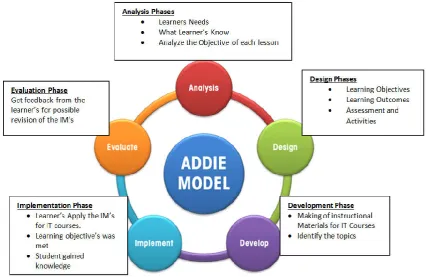
According to Nada(2015),this model helps in the evolution of instructional materials where teachers follow the ADDIE
phases which are Analysis, Design, Development,
Implementation and Evaluation.
Each phase in ADDIE model is related to the different
stages.Analysis Phase in order to bear out the analysis phase,
we have to analyze four things, like we have to analyze the learners (where they are at, their skills and needs, and so forth), prepare an instructional analysis (to provide the necessary steps and present opportunities to discover and employ new information in an instruction), create instructional goals (aimed at limiting the end desired result), and analysis’s learning objectives (how to measure the accomplishment of ends).That implies you have to be open about your goals and where you
want your learners to be.Design Phasethis phase is really close
to giving the command. In the design phase, the instructional designer evolves and focuses on designing assessment for (his/her) topic, select a form of the course, and making their own instructional strategy.Development Phase in this third stage, the instructional designers integrate the engineering with
the educational setting and operation.Implementation Phase
this phase is about transforming our plan into action. In order to go through this phase, we have to hold three major steps, which are training the instructors, preparing the learners, and organizing the learning environment. With these three steps, we can display our form in very dynamic and reliable ways to
reach the implementation phase. Evaluation Phase the final
process in ADDIE model is Evaluation phase. It is very important to assess each step in theparliamentary procedure to make sure that we attain our goals using the instructional plan and materials to meet the learner needs. There are two types of evaluation formative evaluation and summative evaluation. First, formative evaluation is a continuing process that we get along as we are turning on our instructional materials in each stage of the ADDIE model. There are three basic processes of formative evaluation, which are one to one, small evaluation group, and test in the arena. When we measure, we want to choose learners that have similar features to our real learners and assess the materials.The development of the IT Course instructional material will follow the ADDIE model.
Wherein it will undergo the five (5) phases of analysis, design, development, implementation and evaluation phase.
Significance of the Study
The result of the study will be significant for the following:
Leyte Normal University Administration: this will be the
basis for the administrator to give incentives to the faculty who can produce instructional materials.
Faculty:the outcomes of the study this work will enable
educators to take efficient and improved methods of teaching and learning the subject be more interesting, more attractive and more pleasurable.
Students:the result of the study will help them improve their
academic performance in the BIST course and be able to participate in classroom discussion.
Future Researcher:the result will serve as thebasis for further
studies on development and evaluation of instructional materials.
Review of Related Literature
Instructional materials are defined, according to Olumorin, Yusuf, Ajidagba, and Jekayinfa, (2010) instructional materials in its simplest term are those materials that facilitate the teachers to teach with ease and the learners to learn without stress. Instructional materials appeal to the sensations of seeing, touching, sensing, touch and hearing.
Table 1. IT courses that need to have instructional materials
RANK Subject Code INFORMATION TECHNOLOGY SUBJECT FREQUENCY
1 IT_105 Programming 1 34
2 IT_202 Programming 2 33
3 IT_103 Computer Hardware and Repair 26
4 IT_306 Web Development 26
5 IT_309 Software Engineering 24
6 IT_406 Network Management 24
7 IT_104 Networking Basic 23
8 IT_302 Database Management System 23
9 IT_101 Information Technology Fundamentals w/ Systems Application 22
10 IT_102 Program Logic Formulation 22
11 IT_308 Database Management System 2 22
12 IT_205 Object Oriented Programming 21
13 IT_207 Data Structures and Algorithms 21
14 IT_208 Data Communication and Networking 21
15 IT_303 Systems Analysis and Design 21
16 IT_402 Capstone Project 1 21
17 IT_405 Capstone Project 2 21
18 IT_201 Descrete Structure 17
19 IT_206 Computer Organization 17
20 IT_307 Operating Systems Application 17
21 IT_203 Quality Consciousness Habits and Processes 16
22 IT_409 IT Elective IV 16
23 IT_204 Accounting Principle 15
24 IT_301 Professional Ethics 15
25 IT_304 IT Elective I 15
26 IT_408 IT Elective III 15
27 IT_305 Free Elective I 14
28 IT_310 IT Elective II 14
29 IT_311 Free Elective II 14
They include projected, non-projected, printed and others, such as objects/relia, 3-dimensional objects that are produced through locally sourced materials, plan direction, instruction package among others. Hence, Bawa, N (2016) define Instructional materials refer to anything a teacher uses in teaching and learning situation from small stones, pieces of papers, small sticks, asample of aleaf, chalkboard, maps, charts, radio, television, computers.Meanwhile, According to Olayinka, (2016),the importance of instructional materials in the development of learners’ intellectual abilities and attainment of teaching/learning objectives cannot be over-emphasized. The students taught with instructional materials have excellent achievement scores compared with those taught without any material. It was also noted in the study that there is no significant interaction effect of treatment and gender on students’ achievement in Social Studies.While, according to Aina, (2013) instructional materials are very important because what students hear can easily be forgotten but what they see cannot be easily forgotten and last longer in their memory. On the other hand,in his study Okobia (2011), pointed out that educational attainment depends a lot on the quality of teaching. The lack of instructional materials and resources for the implementation of Social Studies curriculum in the junior secondary schools in the Edo State of Nigeria. Most instructors do not use instructional materials to instruct. The deficiency of necessary instructional materials and resources reduces the students to mere passive participants in the scholarship process. Therefore, there is anerosion of enthusiasm in the instruction/learning process by both instructors and pupils. According to Abdu-Raheem and Oluwagbohunmi (2015), improvisation of locally made and unsophisticated instructional materials by instructors, including pre-service teachers will go a long way to standardizing teaching/learning, promote students’ performance and improve thequality of education generally.
Despite the advantages of improvisation of instructional materials for the teaching and learning of Social Studies, it is a challenge to teachers at all levels of instruction in Nigeria, since most teachers are teaching with irrelevant materials or
without any textile.Hence, George and Amadi (2016)
improvisation of instructional materials for teaching
mathematics is the ability of the mathematics instructors and pupils to produce appropriate, adequate and relevant material resources. There are prerequisite skills that mathematics teachers need for the improvisation of instructional materials. In parliamentary law to effectively produce instructional materials from locally sourced materials, the instructor must possess adequate skills which are basic.This attainment of skill can be made possible through constant practice and observation of the experts.They also must include the knowledge of the basic rules and elements of the invention.Some of the skills required in the production of instructional materials are making out, closing up, painting, measurement, sorting, and setting up, and mounting of devices. According to Mercado and Ching (2016), educational materials bring more positive than negative implications in their classroom pedagogy as well as their performance towards other educators. It greatly helps them to personalize their teaching strategies because they know the various learning speeds and capacity of their students despite the challenges in developing their own or looking for relevant materials that suit the needs of their learners.Muñoz Oyola, J. E. (2010). According to Ruto,
and Ndaloh, (2013) the teachers need to use various and appropriate teaching methods and instructional materials, in order to develop positive attitudes of learners towards the subject.Meanwhile, according to Oladejo, Olosunde, Ojebisi, and Isola, (2011) Instructional materials supplement, clarify, vitalize, emphasize instruction and enhance learning in the process of transmitting knowledge, ideas, skills, and attitude.
This calls for teacher resourcefulness and improvisation on the parts of the Physics teachers. The ability of the teacher to make use of “local” materials in place of “standard” ready-made materials makes lesson more effective and improved students’ achievement.Hence, Ogbondah, L. (2008),it is a fact that classroom learning depends on effective communication, skillful application of the several techniques and materials for learning. When adequate instructional materials are added to suitable methods, efficiency in learning is assured. The maximum impact can be made on learning when an efficient instructor uses thesuitable method and appropriate teaching materials. According to Nsa, Ikot, and Udo, (2013), the results indicated that students taught practical agriculture using instructional charts, pictures and filmstrips performed significantly better than students taught without instructional materials. In the process of teaching/learning, instructional materials that were used facilitated students understanding by supplementing, clarifying, revitalizing and emphasizing the teacher’s verbal efforts that inadequate use or lack of use of instructional materials in the teaching/learning situation (lecture method) negates the objective of teaching.Hence, according to Muñoz (2010), the strengthening of the cognitive prerequisites mentioned above proved that instructional materials positively influenced the children's cognitive skills development since the first graders were able to identify, compare, classify, differentiate, analyze pictures, decode and use divergent thinking during the implementation.
METHODOLOGY
This study provides a discussion about the research method that will be utilized in the study. This chapter also includes the research design, locale of the study and the respondents of the study.
Research Design
This research usesmixed methods that employ strategies of inquiry that involve collecting data either simultaneously or sequentially to best understand research problems. The data collection also involves gathering both numeric information (e.g., on instruments) as well as text information (e.g., on interviews) so that the final database represents both quantitative and qualitative information (Creswell, 1998).
Research Method
syllabus. This is to ensure that the content design and learning objectives in the design phase were met. The implementation phase was to make sure that the learners were able to apply the instructional materials in their subjects. Lastly, feedback from the studentswas taken to further improve the developed instructional materials.
Respondents and the Research Locale of the Study
This study will be conducted at Leyte Normal University, Tacloban City.The Leyte Normal University offer programs related to education, hotel management, and computer related studies. BSIT program is one of the programs that LNU offers which the study aimed to identify the need for instructional materials of the BSIT students.
The respondents of the study were determined from thefirst-year to fourth-thefirst-year BSIT students through random sampling. The BSIT program has a total population of 391 students. Sixteen percent (16%)are fourth year students,Thirty-Eight percent (38%) from the third year, Twenty Five percent (25%) are second-year students, and the remaining Twenty One percent (21%) are first-year students.Thirty-four (34) IT students or Nine percent (9%) of the population who was identified to answer the survey questionnaire from the population.
Research Instruments
The main instruments that will be used in this study will be the questionnaire and interview.
Survey Questionnaire: The questionnaire was formulated to
determine what instructional material(s) that needs to be developed for the IT students in order for them to improve their academic performance.
Interview Schedule: The researchers will conduct
unstructured interviews. This will be done simultaneously with the administration of thequestionnaire. When there will be doubts about the responses of the respondents, the researchers will verify and clarify answers through the interview. Items left unanswered by the respondents will be answered during the interview.
RESULTS AND DISCUSSION
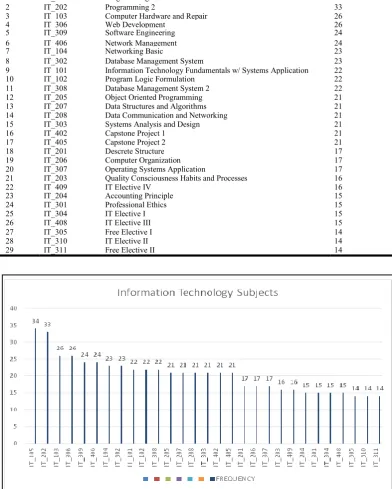
This part of the research presents the data analysis using tables and graphs and supported by qualitative responses of the respondents.Table 1 shows the list of IT subjects that needs to have an Instructional Material based on the respond of the IT Students. There are twenty-nine IT subject that was identified by the IT faculty to know what IT subject(s) that needs to have an instructional material that will help the IT student(s) improve their knowledge in computer.Based on the illustration the researcher identify the top ten(10) IT courses that need to have and instructional material,it was observed that the number one(1)and two highest IT subject that must have an instructional material is on IT_202 Programming II and IT_105 Programming I. What is being taught here is the basic programming concepts wherein thestudents must learn and understand solving problems and interpret into programming language, must be able to write, debug, and test a software. Programming is certainly a complicated skill to master, and
learning to program is correspondingly complex. There are many features of the skills that contribute to the complexity of programming, these issues center on the nature of the programming skill, while others have more to do with the ways in which the participants teach and learn (Jenkins, 2002).
Third, Computer Repair and Maintenance (IT_103), IT
students should develop a skill on troubleshooting
acomputerproblem. (e.x problem in motherboard, beeping sound in the computer, computer monitor not working) these are just a few of the computer problem that the IT student should know how to troubleshoot acomputer problem. Web Development (IT_306), these are higher programming skills that will allow students to create software application and Web-based application. Since the students were already exposed to the basic programming concepts in the IT_202 and IT_205, it won’t be difficult for the IT students to understand other programming languages. Software Engineering (IT_309) and Network Management (IT_406) got that same number of respond from the IT students. These subjects dealwith software development (e.g. System Development Life Cycle) and advance study on computer network simultaneously. IT students’ needs to develop the skills on planning, designing, implementation and testing of software and network. Networking basic (IT_104) is the foundation subject for Networking Management, topology, different transmission devices or media, and types of computer network basic knowledge in networking. Database Management System (IT_302), this is the foundation subject for Database Management System 2 (IT_308) once the student learns the basic concept in DBMS the students won’t find it difficult since the required skills in DBMS has already been established in (IT_302).
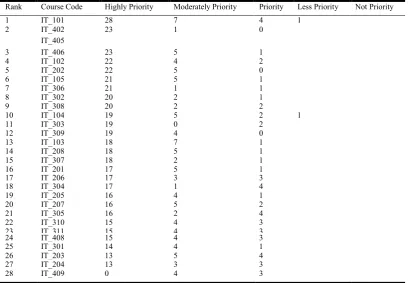
understand the topic if there is no Instructional material available for this subject. The least among the priority to develop instructional material is on IT Elective IV (IT_409) dot Net Programming, IT students has already acquired knowledge in Programming 1 and II, this is just an additional knowledge in making programming using dot NET. In the questionnaire, the researcher included questions on what are the perceptions of the IT students on how they access references. Based on the responses of the IT students, the researcher was able to identify the theme based on their answers:
Theme one: Availability of learning resources and technology In thepursuitof academic excellence, IT students aim to have an extensive access to the different learning resources and technology that would help them acquire new knowledge in IT subjects. We can’t deny the fact that learning resources such as textbooks, workbook, manuals, computer and other learning resources may be limited due to the lack of fund, students are given limited time to access these learning materials.
Only if they are available.
Only allowed to use the computers when it's our class
time.
The disadvantage is that it is only limited.
Only if teachers allowed us to use.
Theme two: Importance of learning materials and technology in the learning process. Based on the different literature, it was found that in the learning process, student will be able to improve their academic performance only if there’s an adequate learning material available for the students;
Helps us in enhancing our knowledge and aid us in our
study.
Presentations of reports and others will be more
efficient. Reports and presentations will be delivered in a better way.
Technologies like computers are important to us, it is
easy to use and we can get information through it.
Maximize the capabilities of a student in learning.
Students will no longer be ignorant of this technologies.
Theme three: Improvement of learning materials to enhance
academic performance. It was found out the there are other technologies or learning materials that the teachers can utilize in the classroom to enhance the learning environment for the students.
We borrow projectors in our instructors, the advantage
of getting this device is you can easily report in class or it is usable in reporting, the disadvantage for this is when you broke it you have to pay it.
Edmodo can be used in subjects where instructors assign
it and can be used anytime and anywhere.
It was convenient in getting information from the
internet than the other sources.
Technologies like computers are important to us, it is
easy to use and we can get information through it.
Theme four: Importance of having Instructional Materials
Based on the different literature, it is undeniable the importance of the instructional materials in the learning process. The importance of instructional materials in the development of learners’ intellectual abilities and attainment of teaching/learning objectives cannot be over-emphasized (Olayinka, 2016). It will enhance the cognitive skills of the student (Muñoz,2010).
Table 3. Level of Priority in developing Instruction material per IT course
Rank Course Code Highly Priority Moderately Priority Priority Less Priority Not Priority
1 IT_101 28 7 4 1
2 IT_402 23 1 0
IT_405
3 IT_406 23 5 1
4 IT_102 22 4 2
5 IT_202 22 5 0
6 IT_105 21 5 1
7 IT_306 21 1 1
8 IT_302 20 2 1
9 IT_308 20 2 2
10 IT_104 19 5 2 1
11 IT_303 19 0 2
12 IT_309 19 4 0
13 IT_103 18 7 1
14 IT_208 18 5 1
15 IT_307 18 2 1
16 IT_201 17 5 1
17 IT_206 17 3 3
18 IT_304 17 1 4
19 IT_205 16 4 1
20 IT_207 16 5 2
21 IT_305 16 2 4
22 IT_310 15 4 3
23 IT_311 15 4 3
24 IT_408 15 4 3
25 IT_301 14 4 1
26 IT_203 13 5 4
27 IT_204 13 3 3
I recommend having an instructional material like books because it is very important in this subject because it can help to get a guide or to get a high grade.
Yes, it is important to us to have an instructional material
so that we can learn the subject outside the campus.
Yes, because it will help us to understand the discussions
and when we have a test, it is easy to study.
Yes, it will be a big help.
Yes, why is it important? Because I can learn even without
the instructors teaching. Is it convenient? Of course.
Yes, so we don’t have to xerox it.
Yes, because it's also for the good of the students and it
will help us in knowing how the material works.
It’s very important to the point that with the use of a
manual, students will no longer ask many questions on how to use this material.
Less hustle and very useful especially when a student has
assignments or researchers, it is convenient in the way that we don’thave to write the questions or even assignments because we have a workbook.
If the school gains these instructional materials that
students learn faster because there are enough materials for learning.
Yes, of course, because it is highly needed for those
students that study the related subject.
Based from the respond, there is a need to the development and instructional materials ease the burden of the student from photocopying the lessons and at there on thepace of learning, they will be able to comprehend the lesson since they can bring the instructional materials anywhere.
Conclusion and Recommendation
Instructional Material is important in the learning process to raise the intellectual reasoning of the IT students.Instructional resources are efficient vehicles for transmitting information for learning to take place.Instructional resources should be employed for teaching and learning as these can help to
meliorate on the student’s achievement in natural
philosophy.Physics students taught with instructional resources achieved higher and safer than those taught without instructional resources (Akani, 2015).It is commented that the IT staff should develop instructional materials to facilitate the students improved their academic functioning.Primarily the IT faculty must come up with instructional material on Information Technology with Software Application (IT_101) since this subject is being offered in the first semester, in the First year grade. Thou in high school software application is being incorporated in their computer subject they already have basic knowledge in (Word, Excel, Powerpoint). It is still important that they have instructional material for their personal references. It is also recommended that there is an evaluation of instructional materials to know the efficiency in the learning and performance of the IT students.
REFERENCES
Abdu-Raheem, B. O., & Oluwagbohunmi, M. F. 2015. Pre-Service Teachers' Problems of Improvisation of Instructional
Materials in Social Studies in Ekiti State University. Journal
of Education and Practice, 6(4), 15-18.
Abdu-Raheem, B.O. 2011. Availability, adequacy, and utilization of social studies instructional materials in Ekiti State secondary schools. Journal of Current Discourse and Research 3: 242-255.
Aina, K. J. 2013. Instructional materials and improvisation in
physics class: Implications for teaching and
learning. Computer, 2(20), 8.
Akani, A. P. O. 2015. Effect of instructional resources on student’s achievement in physics and chemistry in secondary
schools in ebonyi state, nigeria. European Journal of
Training and Development Studies, 2(2), 56-65.
BAWA, N 2016. Effects of Instructional Materials (computer) in Promoting Secondary Schools Students’ Academic Performance in Computer Science in Kebbi State, Nigeria. Creswell, J. 1998. Research design: Qualitative, quantitative,
and mixed methods approaches (2nd ed.). Thousand Oaks, CA: Sage.
Eniayewu, J. 2005. Effect of instructional materials on theteaching of economics in secondary schools in Akoko North-East Local Government Area of Ondo State. Ikere Journal of Education 7: 117-120.
George, N.R., & Amadi, O. 2016. Improvisation Skills Possessed by Mathematics Teachers in Junior Secondary Schools in Rivers State, Nigeria.
Jenkins, T. 2002, August. On the difficulty of learning to
program. InProceedings of the 3rd Annual Conference of the
LTSN Centre for Information and Computer Sciences (Vol.
4, pp. 53-58).
Mercado, J. D. S., & Ching, M. R. 2016. Teachers as Producers and Consumers of Educational Materials: An Analysis. Muñoz Oyola, J. E. 2010. Instructional Materials: A platform
to enhance cognitive skills and writing
development. Colombian Applied Linguistics Journal, 12(1),
27-53.
Nada, A. 2015. ADDIE Model.University Of Northern Colorado. American International Journal of Contemporary Research Vol. 5, No. 6; December 2015 68 .
Nsa, S. O., Ikot, A. S., & Udo, M. F. 2013. Instructional materials utilization and students’ performance in practical
agriculture. Journal of Educational Research and
Reviews, 1(4), 49-54.
Ogbondah, L. 2008. An appraisal of instructional materials used to educate migrant fishermen’s children in Rivers State,
Nigeria. International Journal of Scientific Research in
Education, 1(1), 13-25.
Okobia, E. O. 2011. Availability and teachers' use of instructional materials and resources in the implementation of social studies in junior secondary schools in Edo State,
Nigeria. Review of European Studies, 3(2), 90.
Oladejo, M. A., Olosunde, G. R., Ojebisi, A. O., & Isola, O. M. 2011. Instructional materials and students’ academic
achievement in physics: some policy implications. European
Journal of Humanities and Social Sciences, 2(1).
Olayinka, A. R. B. 2016. Effects of Instructional Materials on Secondary Schools Students' Academic Achievement in
Social Studies in Ekiti State, Nigeria. World Journal of
Education, 6(1), 32.
Olumorin, C. O., Yusuf, A., Ajidagba, U. A., & Jekayinfa, A. A. 2010. Development of Instructional materials from local
resources for art-based courses. Asian Journal of Information
Technology, 9(2), 107-110.
Peyton, J. K., Moore, S. C. K., &Young, S. 2010. Evidence-Based, Student-Centered Instructional Practices. CAELA
Network Brief. Center for Adult English Language
Acquisition.
Ruto, Z. J., & Ndaloh, A. M. 2013. Overcoming the challenges of using instructional methods and materials encountered by teachers of history and government in Wareng district,
Kenya. Journal of Emerging Trends in Educational
Research and Policy Studies, 4(2), 265.
Sims, R. R., & Sims, S. J. 1995. The Importance of Learning
Styles: Understanding the Implications for Learning, Course Design, and Education: Understanding the Implications for
Learning, Course Design, and Education. ABC-CLIO.
Timperley, H., Wilson, A., Barrar, H., & Fung, I. 2008. Teacher professional learning and development.