e- ISSN: 2278-067X, p-ISSN: 2278-800X, www.ijerd.com
Volume 15, Issue 1 (January 2019), PP.31-40
Investigation the Effect of Aggregates on Hot Mix Asphalt (HMA)
Performance - A Case Study
Getu Tamiru Tessema
1, Palani Ponnurangam
212Department of Civil Engineering, College of Engineering and Technology
Mizan Tepi University, Tepi, Ethiopia Corresponding Author:Getu Tamiru Tessema
ABSTRACT
Aggregate types and gradation are one of the characteristics of aggregates that affected the properties of HMA performance. Therefore, the main objective of this research is to investigate the effects of aggregates types on hot mix asphalt performance. In order to get the desired objective, a systematic methodology was adopted which includes field investigation, and laboratory tests was carried. While the purposive techniques was used to collect aggregate samples. The laboratory test results of aggregate types were fulfilled and achieve the requirement of Ethiopia Road Authority (ERA). The laboratory test result of basalt, rhyolite and limestone aggregate HMA mix design volumetric properties, stability and flow value are affected by aggregate gradation. The same gradation of laboratory test result of HMA mix design volumetric properties, stability and flow values are impressively affected by aggregate types. In all aggregate types trial mixes of HMA rutting depth were increase with increasing of cycle time of load. For both type of aggregate gradation, the minimum rut depth was achieved in gradation trial mix 3. The maximum rut depth were achieve in gradation trial mix 5 for basalt and rhyolite, but for limestone aggregate the maximum rut depth was achieve in gradation trial mix 1. In trial mix 1 and 2 limestone’s aggregate gradation is achieved maximum value of rut depth and in trial mix 3, 4 and 5 rhyolite aggregate is achieved maximum value of rut depth. For both types of aggregate gradation maximum dynamic stability values are achieved in gradation trial mix 3 and the minimum values are achieved in gradation trial mix 5. The maximum dynamic stability value was achieve in basalt aggregate and gradation trial mix 4 and 5 only limestone aggregate was achieve the minimum requirement of dynamic stability. Generally, aggregate types and its gradation are affected HMA properties and rutting performance. The gradation of medium to lower limit of Ethiopia Road Authority (ERA) standard technical specification use to produce good performance of HMA. Limestone aggregate was hydrophobic which reduce the problems of stripping of aggregate during wet and subjected to water. As this study was done for specific location and specific aggregate types, it is recommended as more laboratory and field investigation should be performed on same parts of the country. Effect of aggregate source and shape of the same aggregate types on HMA properties are another perspective.
Key words: HMA concrete properties, Gradation of aggregate, Marshall Mix, Rut depth and, Dynamic stability.
---
Date of Submission: 25-02-2019 Date of acceptance: 18-03-2019
---I.
INTRODUCTION
A conventional flexible pavement consists of a prepared sub grade or foundation and layers of sub- base, base and surface courses. The layers are selected to spread traffic loads up to a limit that the carrying capacity of the sub grade is not passed. The surface course consists of a mixture of mineral aggregates cemented by a bituminous material. HMA wearing courses are the most critical layer in a pavement structure and must be of high quality and have predictable performance. Hot Mix Asphalt wearing courses (AC) was a heterogeneous material that consists of bitumen, natural or artificial aggregate, mineral filler, additives and air voids. Aggregate comprise the vast bulk of paving mixture and therefore, exerted significant influence on the resulting engineering properties of the structure. The content of aggregates in hot-mix asphalt concrete (HMAC), covers 80% to 90% of the total volume of the mix or 94% to 95% of the total mass of the mix (Leonardo T. Souza and Yong-Rak Kim, 2009). The quality of the aggregate type and aggregate gradation significantly influences pavement performance. Generally, the hot mix asphalt concrete mixture contains from 35-65% of coarse aggregate for a nominal maximum size of 19.0 mm. This content normally gives a suitable texture for a heavily trafficked road (ASTM, 2003).
higher than usual (Brown, E.R., et al., 1989). Gandhi and Lytton (1984) investigated large number of aggregate tests and whether these tests can be used as indicators of performance of asphalt concrete mixes. Bissada (1984) reported that, resistances to compaction of bituminous mixes are affected by mix variables (filler content, binder content and type of asphalt binder). Higher the resistance of the mix to compaction, higher it’s measured stiffness value and consequently better resistance to permanent deformation performance is expected in the pavement. Higher the percent of fines in the mix, higher is the measured stiffness of mix at a lower value of resistance to compaction.
In our country, constructions of pavement structures are taking place in different parts of a country throughout the year to connect woreda to woreda, woreda to zone, zone to zone, zone to region, region to region, and country to neighboring countries. But, the pavements have no longer service life. In different parts of our country the surface course of the pavements are damaged and the maintenance costs are increased year to year and not comfortable for travels and damaged different parts of vehicles. In ERA standard technical specification manual (2002) grading limit for combined aggregate and mix proportions for asphaltic surfacing describe in table 6400/8. In this standard technical specification manual percentage of nominal mix proportions by mass describe and about 93.5% of the mix is covered by aggregates. The major parts of the surface course mix are covered by aggregates. Based on geological formation, area of Ethiopia is covered by igneous rock, Sedimentary rock and metamorphic rock and those rocks are sources of aggregates. The aggregates produced from igneous, sedimentary and metamorphic rocks are different in chemical composition and we produced different types of aggregate in different parts of our country.
Therefore, this study focused on the effect of aggregate type and gradation more in detail and investigates the effect of coarse and fine gradation for different aggregate types on Marshal Properties and rutting resistance performance by dividing the gradation limits into different parts (upper, middle and lower gradation). Fine, medium and coarse gradation mixtures are tested and the effects of variation in the aggregate gradation on mix properties and rutting performance are investigated.
II.
RESEARCH QUESTIONS
What are the engineering properties of aggregate type and binder?
What are the effects of aggregate gradation on HMA properties?
What are the effects of aggregate type on HMA properties?
What are the effects of aggregate gradation on rutting performance?
What are the effects of aggregate type on rutting performance?
III. STUDY AREA
Location South-West of Ethiopia, in south National Regional State, around kometa china beaching plant of HMA along Mizan to Dima new construction asphalt road.
3.1.Quarry site
The geological nature of along Mizan to Dima is covered by igneous rock, Basalt rock types and most commonly used to make crushed stone aggregates. It was widely available and suitable for a greater diversity of uses than any other types of rock. It is used as aggregate source for highway construction of base and surface course.
IV. RESEARCH DESIGN
4.1 Quarry site4.3 Independent variables
The properties of hot mix asphalt and rutting HMA performance.
Figure 1: Research Methodology Chart
V.
RESULTS AND DISCUSSION
5.1 Aggregate Test Results
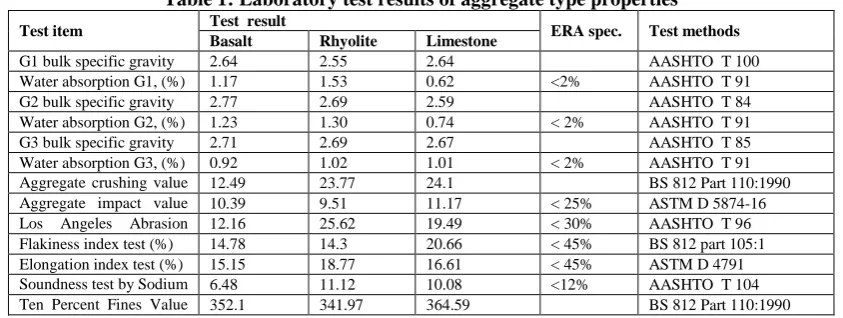
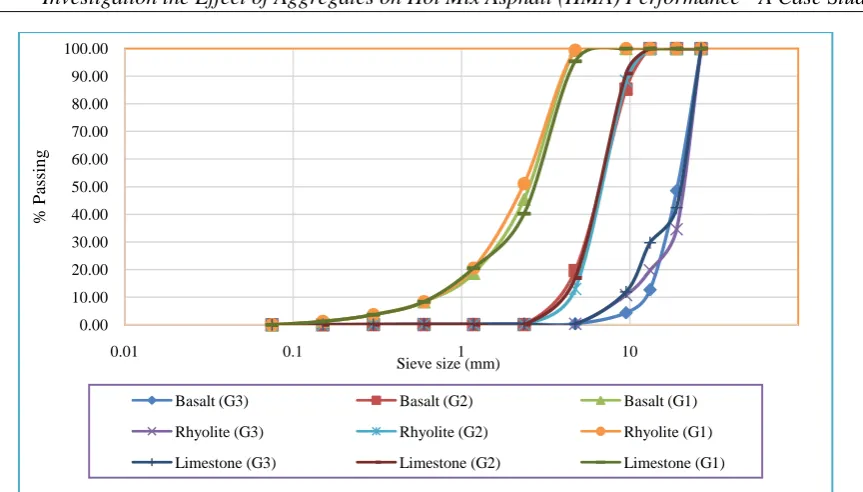
The sieve analysis of G1, G2 and G3 used for aggregate blending and proportioning of the mix. The properties of basalt, limestone and rhyolite aggregate were evaluated by using different laboratory tests.
Table 1: Laboratory test results of aggregate type properties
Test item Test result ERA spec. Test methods
Basalt Rhyolite Limestone
G1 bulk specific gravity 2.64 2.55 2.64 AASHTO T 100
Water absorption G1, (%) 1.17 1.53 0.62 <2% AASHTO T 91
G2 bulk specific gravity 2.77 2.69 2.59 AASHTO T 84
Water absorption G2, (%) 1.23 1.30 0.74 < 2% AASHTO T 91
G3 bulk specific gravity 2.71 2.69 2.67 AASHTO T 85
Water absorption G3, (%) 0.92 1.02 1.01 < 2% AASHTO T 91
Aggregate crushing value (ACV, %)
12.49 23.77 24.1
< 25%
BS 812 Part 110:1990 Aggregate impact value
(AIV, %)
10.39 9.51 11.17 < 25% ASTM D 5874-16
Los Angeles Abrasion value (%)
12.16 25.62 19.49 < 30% AASHTO T 96
Flakiness index test (%) 14.78 14.3 20.66 < 45% BS 812 part 105:1
Elongation index test (%) 15.15 18.77 16.61 < 45% ASTM D 4791
Soundness test by Sodium Salphate
6.48 11.12 10.08 <12% AASHTO T 104
Ten Percent Fines Value in KN
Figure 2: Particle size distribution of aggregate type’s using sieve analysis
Table 2: Laboratory test results of bitumen (80/100 Grade) properties
Experiment Value Standard test methods
penetration at 25ºC, 1/10mm 89 AASHTO T 49
Solubility in trichloroethylene (%) 99 AASHTO T 44
ductility (cm) at 25ºC, 100 AASHTO T 51
specific gravity at 25ºC, 1.02 AASHTO T 228
softening point( ºC) 54 AASHTO T 53
Loss on heating (%) 0.4 ASTM D6
Viscosity, kinematic(centi Stoke)135oC 225 AASHTO T 201
Figure 3: Five Blends of Aggregate Gradation for HMA and Rutting
Table 3: Percent passing for mix 1, mix 2, mix 3, mix 4, and mix 5 gradation blends
Sieve (mm) Percent passing of trial ERA standard specification
Mix 1 Mix 2 Mix 3 Mix 4 Mix 5 Lower limit Upper limit
26.5 100 100 100 100 100.0 100 100
19.5 98 93 87 90 97.3 85 100
13.2 82 77 73 75 80.5 71 84
0.00 10.00 20.00 30.00 40.00 50.00 60.00 70.00 80.00 90.00 100.00
0.01 0.1 1 10
%
P
ass
in
g
Sieve size (mm)
Basalt (G3) Basalt (G2) Basalt (G1)
Rhyolite (G3) Rhyolite (G2) Rhyolite (G1)
Limestone (G3) Limestone (G2) Limestone (G1)
0 10 20 30 40 50 60 70 80 90 100
0.075 0.75 7.5
%
o
f
p
assi
n
g
Sieve size (mm) Mix 1
5.2 Marshal Mix Design Test Results
Table 4: Basalt aggregate HMA mix design summary
HMA properties Trial Mix MS-2 Mix
Mix 1 Mix 2 Mix 3 Mix 4 Mix 5 Criteria spec.
VA (%) 3.81 4.10 4.13 3.73 3.92 3 - 5%
OBC (%) 5.40 5.05 5.35 4.80 5.40
VMA (%) 13.99 13.91 13.72 13.37 13.54 Min. 13%
VFB (%) 72.48 70.39 70.36 71.83 70.75 65 - 75%
Stability (KN) 12.53 9.27 9.45 13.35 14.48 Min. 8.006KN
Flow (mm) 3.89 3.46 3.41 3.77 3.45 2 - 4mm
Marshal stiffness (KN/mm) 3.25 2.58 2.67 3.54 4.20 Unit Weight (g/cm3) 2.527 2.500 2.521 2.529 2.575
Table 5: Rhyolite aggregate HMA mix design summary
HMA properties Trial Mix MS-2 Mix
Mix 1 Mix 2 Mix 3 Mix 4 Mix 5 Criteria spec.
VA ,% 3.98 4.43 4.34 4.07 4.49 3 - 5%
OBC, % 5.85 6.15 5.35 5.75 5.35
VMA, % 16.33 15.91 17.49 17.19 17.64 Min. 13%
VFB, % 74.78 72.44 73.38 74.50 73.15 65 - 75%
Stability, KN 11.89 12.18 13.40 13.77 11.44 Min. 8.006KN
Flow, mm 3.89 3.63 3.51 3.92 3.81 2 - 4mm
Marshal stiffness (KN/mm) 3.05 3.39 3.81 3.52 3.00 Unit Weight, g/cm3 2.290 2.229 2.205 2.214 2.186
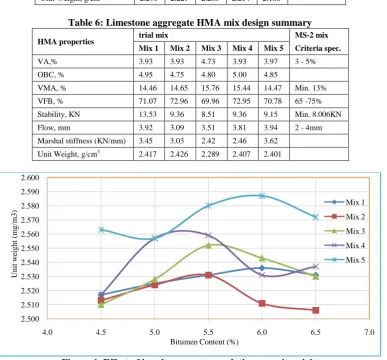
Table 6: Limestone aggregate HMA mix design summary
HMA properties trial mix MS-2 mix
Mix 1 Mix 2 Mix 3 Mix 4 Mix 5 Criteria spec.
VA,% 3.93 3.93 4.73 3.93 3.97 3 - 5%
OBC, % 4.95 4.75 4.80 5.00 4.85
VMA, % 14.46 14.65 15.76 15.44 14.47 Min. 13%
VFB, % 71.07 72.96 69.96 72.95 70.78 65 -75%
Stability, KN 13.53 9.36 8.51 9.36 9.15 Min. 8.006KN
Flow, mm 3.92 3.09 3.51 3.81 3.94 2 - 4mm
Marshal stiffness (KN/mm) 3.45 3.03 2.42 2.46 3.62 Unit Weight, g/cm3 2.417 2.426 2.289 2.407 2.401
Figure 4: Effect of basalt aggregate gradation on unit weight 2.500
2.510 2.520 2.530 2.540 2.550 2.560 2.570 2.580 2.590 2.600
4.0 4.5 5.0 5.5 6.0 6.5 7.0
U
n
it
w
ei
g
h
t (m
g
/m
3
)
Bitumen Content (%)
Mix 1
Mix 2
Mix 3
Mix 4
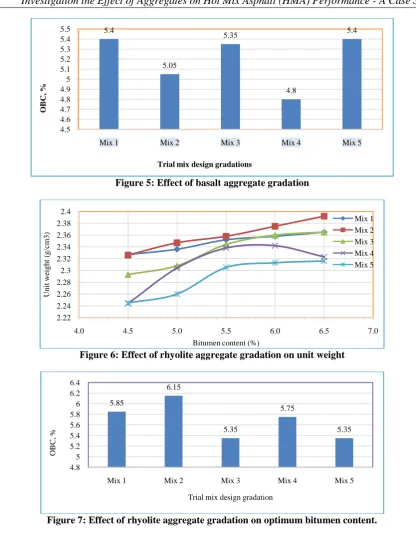
Figure 5: Effect of basalt aggregate gradation
Figure 6: Effect of rhyolite aggregate gradation on unit weight
Figure 7: Effect of rhyolite aggregate gradation on optimum bitumen content. 5.4 5.05 5.35 4.8 5.4 4.5 4.6 4.7 4.8 4.9 5 5.1 5.2 5.3 5.4 5.5
Mix 1 Mix 2 Mix 3 Mix 4 Mix 5
O
BC
,
%
Trial mix design gradations
2.22 2.24 2.26 2.28 2.3 2.32 2.34 2.36 2.38 2.4
4.0 4.5 5.0 5.5 6.0 6.5 7.0
U n it w ei g h t (g /c m3 )
Bitumen content (%)
Mix 1 Mix 2 Mix 3 Mix 4 Mix 5 5.85 6.15 5.35 5.75 5.35 4.8 5 5.2 5.4 5.6 5.8 6 6.2 6.4
Mix 1 Mix 2 Mix 3 Mix 4 Mix 5
O
B
C
,
%
Trial mix design gradation
Figure 9: Effect of limestone aggregate gradation on optimum bitumen content
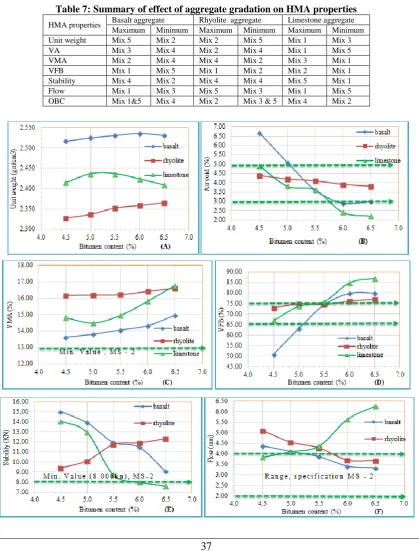
Table 7: Summary of effect of aggregate gradation on HMA properties
HMA properties Basalt aggregate Rhyolite aggregate Limestone aggregate Maximum Minimum Maximum Minimum Maximum Minimum
Unit weight Mix 5 Mix 2 Mix 2 Mix 5 Mix 1 Mix 3
VA Mix 3 Mix 4 Mix 2 Mix 4 Mix 1 Mix 5
VMA Mix 2 Mix 4 Mix 4 Mix 2 Mix 3 Mix 1
VFB Mix 1 Mix 5 Mix 1 Mix 2 Mix 2 Mix 1
Stability Mix 4 Mix 2 Mix 4 Mix 4 Mix 5 Mix 1
Flow Mix 1 Mix 3 Mix 5 Mix 3 Mix 1 Mix 5
OBC Mix 1&5 Mix 4 Mix 2 Mix 3 & 5 Mix 4 Mix 2 4.95
4.75
4.8
5
4.85
4.6 4.65 4.7 4.75 4.8 4.85 4.9 4.95 5 5.05
mix 1 mix 2 mix 3 mix 4 mix 5
O
p
ti
mu
m
B
it
u
me
n
C
o
n
te
n
t
(O
B
C
,
%)
Figure 10: Effects of aggregate type on gradation of trial mix: (A) unit weight (g/cm3); (B) percent air void; (C) percent void in mineral aggregate; (D) percent void filled with bitumen; (E) stability; (F) flow
and (G) optimum bitumen content 5.4
5.85
4.95
4 4.5 5 5.5 6 6.5
basalt rhyolite limestone
O
p
ti
mu
m
B
it
u
me
n
C
o
n
te
n
t
(O
B
C
,
%)
Aggregate types (G)
0 0.5 1 1.5 2 2.5 3 3.5
0 5 10 15 20 25 30 35 40 45 50 55 60 65
R
u
tt
in
g
d
ep
th
v
(mm
)
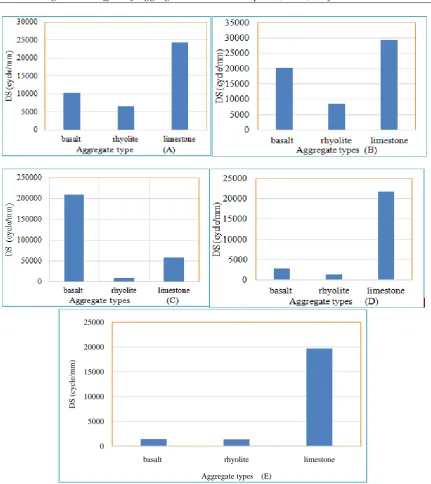
Figure 12: Effects of aggregate type gradation trial mixes on DS of HMA: (A) trial mix 1; (B) trial mix 2; (C) trial mix 3; (D) trial mix 4 and (E) trial mix 5
VI. CONCLUSION AND RECOMMENDATION
6.1 Conclusions The laboratory test result of basalt, rhyolite, and limestone aggregate were fulfilled and achieve the requirement of ERA standard technical specification. Basalt aggregate has excellent resistance of gradually applied load, impact force, abrasive forces and has excellent durability relative to rhyolite and limestone, and the shape of limestone, aggregate was flakiness and elongated relative to basalt & rhyolite. Limestone aggregate was hydrophobic and rhyolite aggregate was hydrophilic. The bulk specific gravity of aggregate types with increasing order as shown in aggregate tests is rhyolite, limestone and basalt.
The laboratory test result of basalt, rhyolite and limestone aggregate HMA volumetric properties are affected by aggregate gradation. The value of the bitumen content in the mix increase, the mix becomes workable and compact easily, meaning more weight can be compressed in to less volume. Hence, the bulk density of the mix increase, but at each gradation the bulk density was different and its value used for computation of volumetric properties (%VA, %VMA and %VFB). The volumetric properties of HMA at each gradation were different and these volumetric properties were affect the rutting resistance and durability (aging and fatigue) properties of surface course.
0 5000 10000 15000 20000 25000
basalt rhyolite limestone
D
S
(
cy
cl
e/
mm
)
The laboratory test result of basalt, rhyolite and limestone aggregate HMA stability and flow values are affected by aggregate gradation. Meaning, the internal friction between aggregate particles and the binding ability of bitumen was different at different aggregate gradation. This indicates that, the ability to withstand traffic loads without deterioration especially at higher temperatures is affected by aggregate gradation.
The laboratory test result of trial mix 1, 2, 3, 4 and 5 HMA volumetric properties are affected by aggregate types. This indicates that, the unit weight and crushing face of basalt, rhyolite and limestone aggregates were different and it affect workability and easily compaction properties of HMA and this produce different bulk density. This different bulk density of aggregate types and HMA mixtures are produced different volumetric properties (%VA, %VMA and %VFB). These shows, the performance of HMA mixes were different from one aggregate type to other aggregate types.
The laboratory test result of trial mix 1, 2, 3, 4 and 5 HMA stability and flow values are impressively affected by aggregate types for the same gradation of aggregates. This indicates that, the interlock between aggregate particles, internal friction between aggregate particles and the binding ability of bitumen was different in basalt, rhyolite and limestone aggregate.
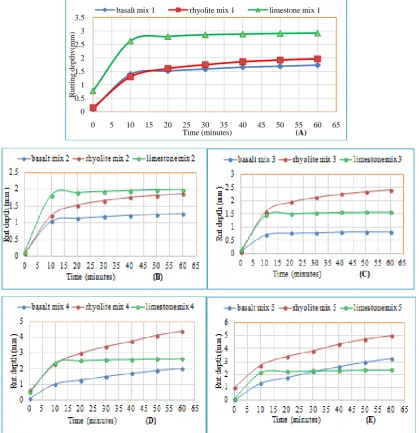
In all aggregate gradation and type trial mixes of HMA, the propagation of rutting depth were increase with increasing of cycle time of load.
The minimum rut depth was achieved in gradation trial mix 3 and 2 for basalt, limestone and rhyolite respectively. The maximum rut depth were achieve in gradation trial mix 5 for basalt and rhyolite, but for limestone aggregate the maximum rut depth was achieve in gradation trial mix 1. The gradation near to lower limit of ERA standard technical specification, the aggregate composition becomes coarser and the resistance of rutting increases. This means, the coarser aggregate has good rut resistance performance than fine aggregate. So, aggregate gradation was affect rutting performance of HMA.
In trial mix 1 and 2 limestone’s aggregate gradation is achieved maximum value of rut depth and in trial mix 3, 4 and 5 rhyolite aggregate is achieved maximum value of rut depth. But, in trial mix 1, 2, 3 & 4 basalt aggregate is achieved minimum value of rut depth and in trial mix 5 limestone aggregate is achieved minimum value of rut depth. So, aggregate type was affect rutting performance of HMA.
For both types of aggregate gradation maximum DS values are achieved in gradation trial mix 3 and the minimum values are achieved in gradation trial mix 5. Basalt and rhyolite aggregate gradation trial mix 4 and 5 were achieve below the minimum limitation of DS, but all values of DS of limestone aggregate gradation was above the minimum limitation of DS. As compared the DS value of basalt, rhyolite and limestone aggregate gradation the maximum DS value was achieve in basalt aggregate gradation trial mix 3.
6.2 Recommendations
Basalt aggregate has excellent resistance of gradually applied load, impact force; abrasive forces and has excellent durability relative to rhyolite and limestone aggregates.
Limestone aggregate is hydrophobic which reduce the problem of stripping of aggregate during wet and subjected to water , and rutting resistance performance are excellent relative to rhyolite aggregate.
The gradation of medium (average value of lower and upper limit) to lower limit of ERA standard technical specification use to produce good performance of HMA.
REFERENCES
[1]. AACRA, 2003. Addis Ababa City Road Authority Pavement Design Manual. Pavement materials. Section 5. Page 5.
[2]. AASHTO, 2003. Standard Specifications for Transportation Materials and Methods of Sampling and Testing. Part I and II. American Association of State Highway and Transportation Officials, Washington, DC.
[3]. ASTM, 2003. ASTM D3381 standard Specification for viscosity graded bitumen for use in pavement construction, Annual Book of ASTM Standards, West Conshohocken, Pennsylvania.
[4]. ASTM, 2003. ASTM D6373 Standard Specification for Performance Graded Asphalt Binder, Annual Book of ASTM Standards, West Conshohocken, Pennsylvania.
[5]. Bissada A. F., 1984. Resistance to compaction of asphalt paving mixtures and its relationship to stiffness. ASTM STP 829. USA. [6]. Brown, E.R., Haddock, J.E., Mallick, R.B., and Lynn, T. A., 1997. Development of a mixture design procedure for stone matrix
asphalt (SMA), NCAT Report No. 97-3, Auburn, Alabama.
[7]. Brown, E.R., McRae, J. and Crawley, 1989. Effect of aggregate on performance of bituminous concrete. ASTM STP, 1016: 34-63 [8]. ERA, 2002. Ethiopian Road Authority pavement design manual. Volume I.
[9]. European Standards, 2003. EN 12697-22. Bituminous mixtures – test methods for hot mix asphalt. Part 22: wheel tracking. Sweden: The Swedish Standards Institute, European Committee for Standardization.