Abstract
Quality of Work life is paramount importance in understanding the socio-psychological needs of the employees and development of competencies, growth and security. It refers to understanding of favorableness or un- favorableness towards various organizational factors. The study examines number of variables that play a vital role in influencing the quality of work life in various selected manufacturing organizations and attempts to group variables using factor analysis. The study explores the interrelationship between variables of quality of work life and analyzes their existence in the selected organizations in the present scenario.
Introduction
Quality of work life has evolved as a vital concept, which affects organizational efficiency and productivity. Quality of work life (QWL) is critical input for existence and success of any corporate enterprise. Employees feel comfortable to work with the organization that promote Quality of work life and stay with the organization. So, Retention and engagement of talented employees becomes easier for the organization, which in turn arrests attrition. It is a comprehensive programme, to motivate employees perform better and become adoptable to change and transition.
QWL provides an opportunity to the individuals to direct and achieve self-actualization status. The individuals involved treat it as worthwhile activity. QWL has also been perceived (a) as a movement (b) as a set of organizational interventions and (c) as a type of work life by employees. QWL refers to the strengths and weakness in the total work environment.
"Quality of work life has been defined as the workplace strategies, operations and environment that promote and maintain employee satisfaction with an aim to improving working conditions for employees and organizational effectiveness for employers." The success of any organization depends on how well it manages its human resources, motivates, improves levels of commitment and provides high standard work life.
* Principal, KSRM College of Management Studies, Kadapa, Andhra Pradesh. E-mail:[email protected]
** Asst Professor, KSRM College of Management Studies, Kadapa, Andhra Pradesh. Email: [email protected]
Quality of Work Life: An Application of Factor Analysis
Quality of work life means providing good conditions at work place to motivate employees to perform to their fullest potential. Motivating work environment makes the employee to have a positive attitude towards their job and the organization. Satisfying work environment includes good interpersonal relations and proper communication among employees, superiors and subordinates leading to teamwork. The teamwork in turn enhances the organization's capability to perform better and excel in intensive competition. Accepted levels of working conditions, good interpersonal skills, and transparency in the system make the employee fell better and contribute to the best of him for the growth of organization. The environment encouraging autonomy and freedom for doing a job will increase employee's creativity and innovative skills so that they can adopt different optimal methods to best utilize the resources.
The organization, which is able to implement policies and procedures effectively, will fix up the proper norms for employees to perform their job without any confusion and generating the clarity of tasks. The employees are satisfied towards that job which provides them stimulating tasks, opportunity for learning and personal growth and a chance to be responsible and accountable for results. Reward system plays a prominent role in determining the quality of work life. Adequate, fair and equitable rewards have a greater impact on employee's attitude towards the job and organization.
Organizational features such as policies and procedures, leadership style, operations, and general contextual factors of setting, all have a profound effect on how staff views the quality of work life. Dissatisfaction with quality of work life is a major problem for the firm, which affects all employees of the firm regardless of position or status. The organization tries to fill the gap between existing condition and expected condition to increase the employee satisfaction towards organization.
Review of Literature
(1973) emphasized on adequate and fair compensation, safe and healthy working conditions, development of human competencies, growth and security, social integration, total life space and social reliance as major determinants of QWL.
Katzell et. al, 1975 opine Quality of work life as the quality of the content of relationship between employees and their total working environment. An employee may enjoy a high quality of working life when he has positive attitude towards his job and its future growth prospects that are motivating him to stay on the job and to perform well. In addition, when he feels there is a work life balance. Shalini Sheel, et al (2012), reviewed the past studies and established a relationship between QWL, employee performance and career growth opportunities.
According to Lau, Wong, Chan and Law (2001), QWL is the favorable working conditions that support and increase satisfaction by providing employees with equitable rewards, job security and career growth opportunities.
Objectives of the Study
• To asses various variables that influence QWL in selected manufacturing organizations
• To identify the important factors that contribute to the QWL using factor analysis
Methodology of the Study
The Study examines the variables that play a vital role in influencing the quality of work life in the organizations. The study explores different variables from the existing literature and analyzes their existence in the selected organizations in the present scenario. The variables selected for the study are Working conditions, inter personal relations, trust among employees, autonomy and freedom, decision making, training, career advancement, superior support, top management support, conflict management, safety conditions, amenities, performance linked pay system, communication, implementation of organizational policies, transparency system, participative management, nature of job, rewards and recognition, value system and job satisfaction.
The study adopts both primary and secondary data. Primary data collected by administering structured questionnaire to 200 selected employees of different manufacturing organizations in the Rayalaseema Region of Andhra Pradesh. Tabulation made only to 195 respondents as five questionnaires invalidated due to incomplete information. In addition to the primary data, number of working papers, books and other literary material reviewed to get into the insights of information.
is descriptive in nature and uses convenience-sampling approach to select the respondents. The data is analyzed using descriptive statistics and data is reduced using factor analysis.
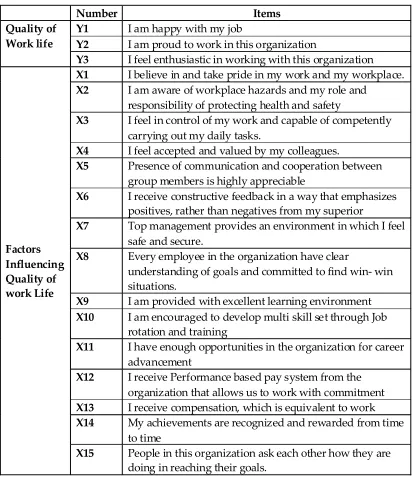
Table 1 : The scale of factors influencing Quality of work life
Number Items
Quality of Work life
Y1 I am happy with my job
Y2 I am proud to work in this organization
Y3 I feel enthusiastic in working with this organization
Factors Influencing Quality of work Life
X1 I believe in and take pride in my work and my workplace.
X2 I am aware of workplace hazards and my role and
responsibility of protecting health and safety
X3 I feel in control of my work and capable of competently carrying out my daily tasks.
X4 I feel accepted and valued by my colleagues.
X5 Presence of communication and cooperation between
group members is highly appreciable
X6 I receive constructive feedback in a way that emphasizes positives, rather than negatives from my superior
X7 Top management provides an environment in which I feel
safe and secure.
X8 Every employee in the organization have clear
understanding of goals and committed to find win- win situations.
X9 I am provided with excellent learning environment X10 I am encouraged to develop multi skill set through Job
rotation and training
X11 I have enough opportunities in the organization for career advancement
X12 I receive Performance based pay system from the organization that allows us to work with commitment X13 I receive compensation, which is equivalent to work
X14 My achievements are recognized and rewarded from time
to time
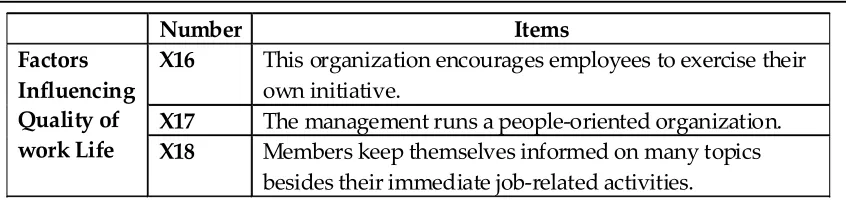
Number Items Factors
Influencing Quality of work Life
X16 This organization encourages employees to exercise their own initiative.
X17 The management runs a people-oriented organization.
X18 Members keep themselves informed on many topics
besides their immediate job-related activities.
Data Analysis
The data collected among the respondents 128 are male and 66 are female. The age group of respondents are 82 in between 25-35, 54 in between 36-45 and 59 in between 46-55. The data is collected among the employees of surronding organizations in rayalseem region of Andhra pradesh.
Table 2 : Respondents profile
Item Category Sample
Age Group 25-35 82
36-45 54
46-55 59
Gender Male 128
Female 66
The majority of the items are minimally skewed or kurtotic. An examination of correlation matrix states that all the items exceed 0.3 and thus the items are appropriate for factoring. The Bartlett's Test of Sphericity (x2=1.366E3,df =266, p= .000) is significant
and Kaiser-Meyer-Olkin Measure of Sampling Adequacy yielded a value of 0.638 which justifies in proceeding with factor analysis.
KMO and Bartlett's Test
Kaiser-Meyer-Olkin Measure of Sampling Adequacy. .638
Bartlett's Test of Sphericity Approx. Chi-Square 1.366E3
df 276
Sig. .000
Table 3 : Total Variance Explained
Compo nent
Extraction Sums of Squared Loadings Rotation Sums of Squared Loadings
Total % of Variance Cumulative % Total % of Variance Cumulative %
1 3.567 16.986 16.986 2.623 12.490 12.490
2 2.575 12.260 29.246 2.515 11.978 24.468
3 2.271 10.813 40.059 2.464 11.735 36.203
4 2.080 9.905 49.964 2.287 10.892 47.095
5 1.599 7.616 57.580 2.140 10.191 57.286
6 1.142 5.438 63.018 1.204 5.733 63.018
Extraction Method: Principal Component Analysis.
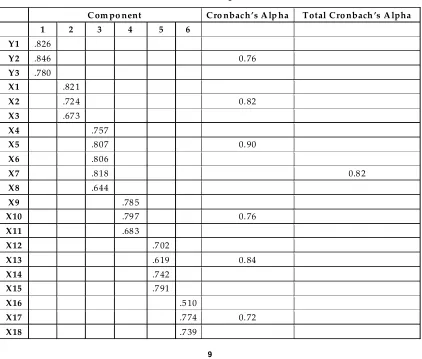
Table 4 : Rotated Component Matrix
C om po nent Cro nbach’s A lp ha Total Cro nbach ’s A lpha
1 2 3 4 5 6
Y1 .826
Y2 .846 0. 76
Y3 .780 X1 .82 1
X2 .72 4 0. 82
X3 .67 3
X4 .757
X5 .807 0. 90
X6 .806
X7 .818 0.8 2
X8 .644
X9 .78 5
X10 .79 7 0. 76
X11 .68 3
X12 .7 02
X13 .6 19 0. 84
X14 .7 42
X15 .7 91
X16 .5 10
X17 .7 74 0. 72
Extraction Method: Principal Component Analysis. Rotation Method: Varimax with Kaiser Normalization. Rotation converged in 6 iterations.
The scale's validity tests the internal consistency of the item, whether all the items in a factor are perceived same. The internal consistency can be tested by Cronbach's Alpha. See Table: 4 Cronbach's for each variable is bigger than 0.6; Cronbach's for 21 items are 0.82, and this shows the data is good in internal coherence.
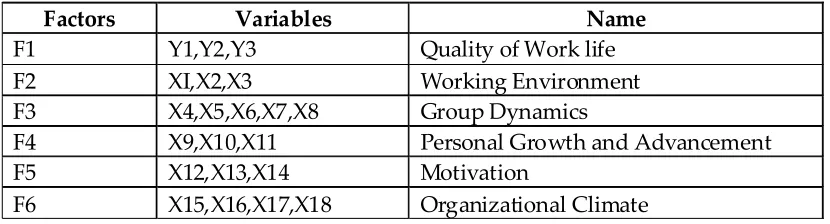
The Table:5 shows the factor naming, when the grouped items were observed based on the factors, the following names have been mentioned for each factor. The following section explains the variance explained by each factor.
Factor 1: Quality of Work life Y1 to Y3, which accounts for 16.9 % of variance.
Factor 2: Working Environment XI, X2, X3, which accounts for 12.26% of variance.
Factor 3: Group dynamics X4, X5, X6, X7, X8, which accounts for 10.813% of Variance.
Factor 4: Personal growth and Advancement X9, X10, X11, which accounts for 9.905 % of Variance
Factor 5: Motivation X12, X13, X14, which accounts for 7.616 % of Variance.
Factor 6: Organizational Climate X15, X16, X17, X18, which accounts for 5.438 % of variance.
Table 5 : Factor Naming
Factors Variables Name
F1 Y1,Y2,Y3 Quality of Work life
F2 XI,X2,X3 Working Environment
F3 X4,X5,X6,X7,X8 Group Dynamics
F4 X9,X10,X11 Personal Growth and Advancement
F5 X12,X13,X14 Motivation
F6 X15,X16,X17,X18 Organizational Climate
Conclusion
amenities at the work place can improve working environment and enhance quality of work life. The better interpersonal relationships, among employees trust development among employees, enhanced superior support and top management support can improve the employee morale and in turn generates a sense of positive feeling on quality of work life. The support of the organization to the employees to ease the performance on the job through training activities, development of multi skill set and facility for career advancement are prerequisites of personal growth. Employees expect the organization to adopt performance linked pay along with appropriate reward and recognition policies. Development of appropriate two-way communication, promotion of value system, adoption of participative management and transparency improves organization climate. Organizations can look into these factors and adopt appropriate measures to improve quality of work life. Quality of work life rewards the organization in the form of improved productivity, reduced cost and higher returns.
References
1. Chan, Ka Wai and Thomas A. Wyatt (2007), “Quality of Work Life: A Study of Employees in Shanghai, China”, Asia Pacific Business Review, Vol: 13, No. 4, (Oct), pp. 501-517
2. Chander, Subash and Singh, Parampal (1983), “Quality of work life in a University: An Empirical Investigation”, Management and Labour Studies, Vol.18, No.2, pp. 97-101.
3. Davis Louis F, Cherns. Albert B. (1975). The Quality of Working life II New York: The free press. P 349.
4. Gani , A ( 1993), Quality of Work Life ( QWL) in a State Setting : Findings of an
Empirical Study . The Indian Journal of Labour Economics. 36(4) pp 817823.
5. Gardon, Herman (1984), “Making sense of Quality of work life programmes”, Business Horizons.
6. Gosh, Subratesh (1992), “Quality of Work Life in Two Indian Organizations” Decisions, Vol.19, No.2, pp- 89- 102.
7. Grayson, C.J (1973), “Management Science and Business Practice”, Harvard Business Review, Vol.51, No.4.
8. Kanungo , R. N. (1982) Work Alienation - an Integrative approach Prager Publisher, New York , USA.
10. Normala and Daud (2010), ”Investigating the Relationship Between Quality of Work Life and Organizational Commitment Amongst Employees in Malaysian Firms”, International Journal of Business and Management, Vol: 5, No. 10.
Productivity and Job Satisfaction”, The Psychological Corporation, New York.
11. Rethinam, Gunaseelan and Maimunah Ismail (2008), “Constructs of Quality of Work Life: A Perspective of Information and Technology Professionals”, European Journal of Social Sciences, Vol: 7, No. 1, p.58
12. Walton (1982): International Labour Organization: recommended from the National Seminar on improving Quality of Work Life, Productivity, 22 (4), pp
7983.
13. Walton, R. (1973), “Quality of Work life Indicators- Prospects and Problems- A Portigal Measuring the Quality of working life, pp-57-70, Ottawa.
14. Yousuf A. S. M. (1996) Evaluating the Quality of Work life, Management and