
MOLECULAR DOCKING STUDIES OF ZANTHOXYLUM TETRASPERMUM WIGHT AND ARN STEM BARK CONSTITUENTS AGAINST 2XNU (ACETYLCHOLINE BINDING PROTEIN)
9
0
0
Full text
(2) Ravikkumar V R., et al., Int. J. Pharm. & H. Care Res., Vol.–02 (02) 2014 [65 - 73]. efforts have been directed towards improving the methods used to predict docking. en.wikipedia .org/wiki/Docking.(molecular) Molecular docking can be thought of as a problem of “lock-and-key”, where one is interested in finding the correct relative orientation of the “key” which will open up the “lock” (where on the surface of the lock is the key hole, which direction to turn the key after it is inserted, etc.). Here, the protein can be thought of as the “lock” and the ligand can be thought of as a “key”. Molecular docking may be defined as an optimization problem, which would describe the “best-fit” orientation of a ligand that binds to a particular protein of interest. However, since both the ligand and the protein are flexible, a “hand-in-glove” analogy is more appropriate than “lock-and-key”[3]. During the course of the process, the ligand and the protein adjust their conformation to achieve an overall “best-fit” and this kind of conformational adjustments resulting in the overall binding is referred to as “induced-fit”[4]. The focus of molecular docking is to computationally simulate the molecular recognition process. The aim of molecular docking is to achieve an optimized conformation for both the protein and ligand and relative orientation between protein and ligand such that the free energy of the overall system is minimized. Zanththoxylum tertraspermum Wight and Arn., (Rutaceae) is a thorny, stout, aromatic, climbing shrub, with brown bark having short recurved prickles, found in Western Ghats especially in Nilgiri, Aanaimalai and in Eastern Ghats Kolli hills at the altitudes of 1,200-1,800 and also found in western Ghats of Kerala and Karnataka. The wood is yellowish and soft. The plant is credited in Srilanka with stimulant, astringent and digestive properties and is prescribed in dyspepsia and diarrhoes[5].Two benzophenathrene like 8actonyldihydronitidine, 8-actonyldihydroavicine, liriodenine, seasmin, lichexanthone, (+)-pipritol gamma-gamma-dimethylallylether, savinine, amyrin, iso-arborenol, betulinic acid, -sitosterol, Spthulenol have been reported[6]. This plant is ethnomedically reputed and is used in the treatment of various ailments. A preliminary ethno medical survey revealed that this plant was used by the tribals in tooth extraction. Literature survey. 66. revealed that the plant was scientifically under explored. In this current project explain the analgesic, antiinflammatory and antimicrobial activity of different identified constituents of Zanththoxylum tertraspermum by using insilico methods.. Materials and methods Following tool and software used analyze this protein sequence and assign structure and to study its docking properties. Protein data bank The Protein Data Bank (PDB) was a repository for the 3-D structural data of large biological molecules, such as proteins and nucleic acids. The data typically obtained by X-ray crystallography or NMR spectroscopy and submitted by biologists and biochemists from around the world and can be accessed at no charge on the internet. The PDB was overseen by an organization called the World Protein Data Bank. The RCBS PDB website had contained an extensive list of both free and commercial molecule visualization programs and web browser plugins[7]. Drug Bank The Drug Bank database is a unique bioinformatics and chem informatics resource that combines detailed drug (i.e. chemical, pharmacological and pharmaceutical) data with comprehensive drug target (i.e. sequence, structure, and pathway) information. Since its first release in 2006, Drug Bank has been widely used to facilitate Insilico drug target discovery, drug design, drug docking or screening, drug metabolism prediction, drug interaction prediction and general pharmaceutical education [8]. Pubchem Compound PubChem was a database of chemical molecules. The system was maintained by the National Center for Biotechnology Information (NCBI), a component of National Library of Medicine, which was part of the a United States National Institutes of Health (NIH). PubChem can be accessed for free through a web user interface. Millions of compound structures and descriptive datasets can be freely downloaded via FTP. PubChem contain substance descriptions and small molecules with fewer than 1000 atoms and 1000 bonds. The. www.ijphr.com.
(3) 67. Ravikkumar V R., et al., Int. J. Pharm. & H. Care Res., Vol.–02 (02) 2014 [65 - 73]. American Chemical Society tried to get the U.S. Congress to restrict the operation of PubChem, because the claim it had competed with their Chemical Abstracts Service. More than 80 database vendors contribute to growing PubChem database. PubChem was designed to provide information on biological activities of small molecules, generally those with molecular weight less than 500 daltons. PubChem’s integration with NCBI’s Entrez information retrieval system provides sub/structure, similarity structure, bioactivity data as well as links to biological property information in PubMed and NCBI’s Protein 3D Structure Resource. PubChem Compound was a searchable database of chemical structures with validated chemical depiction information provided to describe substances in PubChem Substance. Structures stored within PubChem Compounds are preclustered and cross-referenced by identify and similarity groups [9]. Open babel software Open Babel is free software, a chemical expert system mainly used for converting chemical file formats. Due to the strong relationship to informatics this program belongs more to the category cheminformatics than to molecular modeling. It is available for Windows, UNIX, and Mac OS. It is distributed under the GNU GPL. The project's stated goal is: "Open Babel is a community-driven scientific project assisting both users and developers as a cross-platform program and library designed to support molecular modeling, chemistry, and many related areas, including inter conversion of file formats and data [10] . Chem sketch software Chem Sketch software is designed to be used on its own for drawing chemical structures, reactions, schematic diagrams or integrated with other ACD applications and as the front end to our software. Able to import Windows Metafile, MDL MOL, CS ChemDraw, or ISIS/Sketch BIN file. Export Bitmap, TIFF, Metafile, MOL, Paintbrush, ISIS/Sketch, GIF, and ChemDraw. Fully loaded with useful pre-drawn structures including lab equipment, DNA/RNA building kit, amino acids etc. Structures can be 2D "cleaned" as well as 3D optimized using ACD's powerful algorithm.. Publish a professional quality report from within ChemSketch or drag drop structures/ text into MS applications [11]. Argus Lab The Argus Lab Molecule Builder allows to construct new molecules and to modify existing molecules. It is a very useful, highly-featured and easy-to-use molecular modeling, graphics, and drug design program. The program contains two docking engines and a simple scoring function, based on an enhancement of the X-Score method. Argus Lab first generates the scoring grids used during the docking, then the various search phases will occur, and finally the candidate poses are processed and the calculation is done. Argus Dock is advantageous in terms of the computational time it provides. (i) Receptor-Ligand Interactions The interactions between a receptor and a ligand were fundamental to drug discovery. Argus lab provided a set of methods for predicting and analyzing the interactions between protein receptors and ligands. These methods allowed us to carry out structure-based design, or even to examine possible interactions with theoretical structures such as homology models. A common technique central to receptor-ligand interactions was docking. (ii) Dock Ligands (Ligand fit) The Dock Ligands (Ligand fit) protocol 1. Docking: During Docking, an attempt was made to dock a ligand or series of ligands in to a user defined binding site. 2. In-situ Ligand Minimization: In this stage, the ligands may be energy minimized in the presence of a fixed or partially flexible receptor. 3. Scoring: During scoring, various scoring functions may be applied to ligands. The Dock Ligands (Ligand fit) protocol had allowed us to combine docking, minimization, and scoring in one protocol run. Groups of parameters had allowed us to control the three phases of the protocol: docking, minimization, and scoring. (a) Protein preparation The ligands and crystallographic water molecules were removed from the protein and the chemistry. www.ijphr.com.
(4) Ravikkumar V R., et al., Int. J. Pharm. & H. Care Res., Vol.–02 (02) 2014 [65 - 73]. of the protein was corrected for missing hydrogen. Crystallographic disorders and unfilled valence atoms were corrected using alternate conformations and valence monitor options. (b) Ligand preparation The three dimensional structures of the compounds were retrieved from Databases and converted it to mol format using open babel software suit. The ligand preparation was then carried out by adding hydrogen bonds and lowering energy using CHARMm force field. (c) Docking Process Before beginning the docking, it was necessary to specify a binding site of the receptor. Ligand fit uses a method based on protein shape searching for cavities. Often the largest cavity was part of the ligand – binding site [12].. Result and Discussion Molecular docking studies of different constituents of stem bark of Z. tetraspermum are used to identify the structurally novel drug (ligand) and confirm its cholinergic activity. Molecular docking is used to predict the active site of the intermolecular complex formed between two or more molecules. The most interesting case is the protein ligand interaction, because of its application in medicine. Ligand is small molecules which interact with protein binding site at the areas of the protein, known to be active of forming of compounds. Drug protein interactions involve one or more of the following types of bonding and the stability of these types of bonds hardly permit the formation of an easily reversible drug receptor complex. An important type of bonding between drug and receptor is a weak and easily broken Hbond. Since many drugs contain hydroxyl, amino, carboxyl and carbonyl groups, they can form hydrogen bonds with the receptor complex. Hydrogen bonds are a type of dipole-dipole interaction formed between the proton of a group X-X , where X is electronegative atom and other electronegative atoms (Y) containing a pair of nonbonded electrons. Hydrogen bond is unique to hydrogen because it is the only atom the can carry a positive at physiological pH while remaining covalently bonded in molecules.. 68. Cholinergic drugs (also called as parasympatho mimetics) act on organs innervated by postganglionic parasympathetic nerves. They produce and effect similar to the stimulation of parasympathetic nervous system. The receptors for acetylcholine are classified as muscarinic receptors and nicotinic receptors. Muscarinic receptors are present at postganglionic parasympathetic nerve ending. The three subtypes of muscarinic receptors are M1, M2 and M3. M1 receptors are present in autonomic ganglia, gastric glands and CNS. Their functions are gastric acid secretion and GI motility. M2 receptors are present in heart. They produce a decrease in the rate ad force of the heart. (Negative inotropic and chronotropic). M3 receptors are present in smooth muscles and exocrine glands. Their functions are Contraction of smooth muscles and secretions of the exocrine glands. Nicotinic receptors are present in both sympathetic and parasympathetic ganglia (NN receptors). The effect is stimulation of these ganglia. Neuromuscular junction (NM receptors). The effect is contraction of skeletal muscles. In Molecular docking studies, the different constituents (ligands) of ethanolic and aqueous extract of stem bark of Zanthoxylum Tetraspermum bind with acetylcholine protein receptor and produce stable complex. A binding interaction between a small molecular ligand and an enzyme protein may result in activation or inhibition of the enzyme. If the protein is a receptor, ligand binding may result in agonism or antagonism. Docking is most commonly used in the field of drug design. Neurotransmitters are endogenous chemicals that transmit signals form a neuron to a target cell across a synapse. Release of neurotransmitters usually follows arrival of an action potential at the synapse, but may also follow graded electrical potentials. Neurotransmitters are synthesized from plentiful and simple precursors, such as amino acids, which are readily available from the diet and which require only a small number of biosynthetic steps to convert [13]. Otto Loewi is accredited for discovering acetylcholine (ACh) the first known. www.ijphr.com.
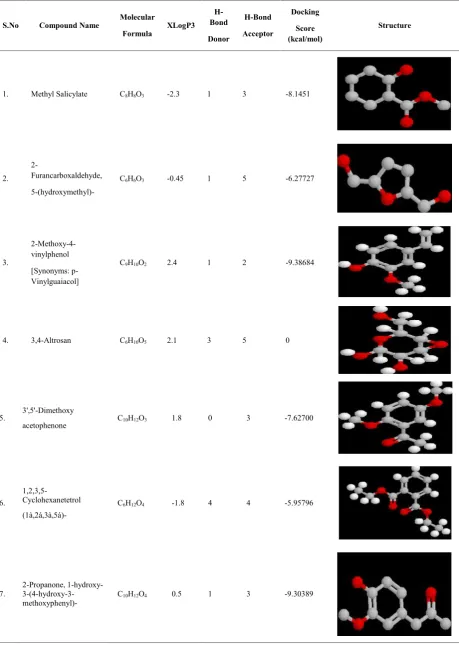
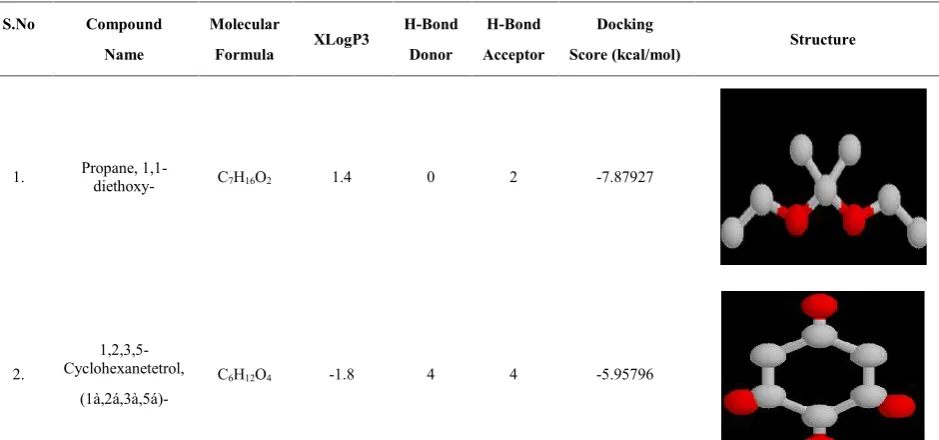
(5) 69. Ravikkumar V R., et al., Int. J. Pharm. & H. Care Res., Vol.–02 (02) 2014 [65 - 73]. neurotransmitter [14]. Acetylcholine is one of many neurotransmitters in the autonomic nervous system (ANS) and the only neurotransmitter used in the motor division of the somatic nervous system. We report the computational molecular docking studies of the different identified constituents (by GC-MS) of stem bark of Zanthoxylum tetraspermum Wight & Arn with nicotinic acetylcholine receptor. Nicotinic acetylcholine receptors (nAChRs) are cholinergic receptors that form ligand - gated ion channels in the plasma membranes of certain neurons and on the postsynaptic side of the neuromuscular junction [15-16]. Fig.1 Shows the releasing of acetylcholine from receptors and broken down by acetylcholine esterase. The target protein structures of 2XNU were docked with different identified constituents (by GC-MS) of ethanolic and aqueous extract of stem bark of Z. tetraspermum Wight & Arn which provided excellent results as were seen by the least values of the binding energy (Table No 1 & 2). Here through insilico approach it is predicted that different constituents of stem bark of extract of Z. tetraspermum also shown to inhibit Acetylcholine. binding protein as it has good Auto dock score [Phenol, 4-[2-(dimethyl amino)ethyl]- [Synonyms: Anhalin] as - 10.1041Kcal/ mol, 1,3] Benzo dioxolo [5,6-c]-1,3-dioxolo [4,5-i] phenanthridine [Synonyms: Norsanguinarine] as -11.0566Kcal/ mol] which is given in table 1 & 2. The concepts of protein – ligand interaction help in analyzing the binding properties of the receptor Acetylcholine binding with its inhibitors. A low (negative) energy of different constituents (ligands) of ethanolic and aqueous extracts of stem bark of Zanthoxylum tetraspermum indicates (Table-1&2) a stable system and thus a likely binding interaction and may produce cholinergic action like salivary secretion and also confirm traditional uses like Stimulant, Astringent, Digestive, treatment of Dyspepsia and Diarrhoea. Different compounds acting on different targets with moderate activity, either additively or synergistically, will give a response, which is larger than that shown by the individual compounds. This is an effect found frequently for natural products extracts and remedies.. Fig. No. 01: Releasing of acetylcholine from receptors and broken down by Acetylcholine esterase.. Fig. No. 02: Molecular docking of identified compounds of stem bark extracts of Zanthoxylum tetraspermum with Acetylcholine protein (2XNU) www.ijphr.com.
(6) 70. Ravikkumar V R., et al., Int. J. Pharm. & H. Care Res., Vol.–02 (02) 2014 [65 - 73]. Table No. 01: Structure and Molecular properties of Components identified in Ethanolic extract of stem bark of Zanthoxylum tetraspermum Wight & Arn S.No. Compound Name. Molecular Formula. XLogP3. HBond Donor. Docking. H-Bond Acceptor. Score (kcal/mol). 1.. Methyl Salicylate. C8H8O3. -2.3. 1. 3. -8.1451. 2.. 2Furancarboxaldehyde,. C6H6O3. -0.45. 1. 5. -6.27727. C9H10O2. 2.4. 1. 2. -9.38684. C6H10O5. 2.1. 3. 5. 0. 5-(hydroxymethyl)-. 3.. 4.. 5.. 6.. 2-Methoxy-4vinylphenol [Synonyms: pVinylguaiacol]. 3,4-Altrosan. 3',5'-Dimethoxy acetophenone. 1,2,3,5Cyclohexanetetrol. C10H12O3. 1.8. 0. 3. -7.62700. C6H12O4. -1.8. 4. 4. -5.95796. C10H12O4. 0.5. 1. 3. -9.30389. (1à,2á,3à,5á)-. 7.. 2-Propanone, 1-hydroxy3-(4-hydroxy-3methoxyphenyl)-. www.ijphr.com. Structure.
(7) 71. 8.. Ravikkumar V R., et al., Int. J. Pharm. & H. Care Res., Vol.–02 (02) 2014 [65 - 73]. 4-((1E)-3-Hydroxy-1propenyl)-2methoxyphenol. C10H12O3. 1.4. 2. 3. -9.85782. 9.. Phenol, 4-[2(dimethylamino)ethyl][Synonyms: Anhalin]. C10H15NO. 1.76. 1. 2. -10.1041. 10.. (+)-1,2,3,4Tetrahydroisoquinoline, 6,7-dimethoxy-1phenmethanol -2-methyl-. C19H23NO3. 2.6. 1. 4. -3.2277. 11.. NDimethylaminomethyltert.-butylisopropylphosphine. C10H24NP. 1.9. 0. 1. 0. Table No. 02: Structure and Molecular Properties of Components identified in Aqueous extract of stem bark of Zanthoxylum tetraspermum Wight & Arn S.No. 1.. 2.. Compound. Molecular. Name. Formula. Propane, 1,1diethoxy-. C7H16O2. C6H12O4. 1,2,3,5Cyclohexanetetrol,. H-Bond. H-Bond. Docking. Donor. Acceptor. Score (kcal/mol). 1.4. 0. 2. -7.87927. -1.8. 4. 4. -5.95796. XLogP3. (1à,2á,3à,5á)-. www.ijphr.com. Structure.
(8) Ravikkumar V R., et al., Int. J. Pharm. & H. Care Res., Vol.–02 (02) 2014 [65 - 73]. 3.. 4-((1E)-3Hydroxy-1propenyl)-2methoxyphenol. C10H12O3. 1.4. 2. 3. C19H11NO4. 4.3. 0. 5. -11.0566. C28H40N2O5. 3.8. 0. 7. 0. 72. -9.85782. [1,3]Benzodioxolo[5,64.. c]-1,3-dioxolo[4,5-i] phenanthridine [Synonyms: Norsanguinarine]. 5.. Gallopamil. Conclusion Screening methods are routinely and extensively used to reduce cost and time by argus lab. It has been clearly demonstrated that the approach utilized in this study is successful in finding novel Antimicrobial Inhibitors from Zanthoxylum tetraspermum Wight & Arn. The identified compounds of Zanthoxylum tetraspermum Wight & Arn that targeted the 2XNU protein were screened and ranked based on their dock score. The lipinkis prediction helped in the identification of more suitable ligand towards target protein. The dock score and other scores were observed out of which [1,3] Benzodioxolo [5,6-c]-1,3-dioxolo[4,5-i] phenanthridine [Synonyms: Norsanguinarine] (11.0566) had highest dock score, but in spite of having good binding score it render unsatisfactory results in drug. Lipinkis rule of 5 is used as a first step filter to perform virtual screening of compound libraries, in an effort to quickly eliminate lead candidates that have poor physicochemical properties for oral bioavailability. However the compound Phenol, 4-[2-(dimethyl amino) ethyl]-[Synonyms: Anhalin] (-10.1041) not higher than the [1,3] Benzodioxolo [5,6-c]-1, 3dioxolo [4,5-i] phenanthridine [Synonyms: Norsanguinarine] but it qualified all the important. parameters for being a good activation for 2XNU protein. A good drug must contain important parameters are dock score (for binding affinity) and drug likeness properties for being a good inhibitor. Molecular docking studies of different identified constituents (table 1 & 2) stem bark of Zanthoxylum tetraspermum Wight & Arn. supports its cholinergic action like salivary secretion, confirm traditional uses like Stimulant, Astringent, Digestive and used in treatment of Dyspepsia, Diarrhea, Rheumatism and also confirm Dental analgesic, anti-inflammatory antimicrobial activity.. References 1.. 2.. 3.. www.ijphr.com. Lengauer T, Rarey M. Computational methods for bio molecular docking, Curr. Opin. Struct. Biol., 6(3), 1996, 402-406. Kitchen DB, Decornez H, Furr JR, Bajorth J. Docking and scoring in virtual screening for drug discovery: methods and applications. Nature reviews. Drug discovery, 3(11), 2004, 935-949. Jorgensen WL, Rusting of the lock and key model for protein-ligand binding Science., 254(5034), 1991, 954-955..
(9) 73 4.. Ravikkumar V R., et al., Int. J. Pharm. & H. Care Res., Vol.–02 (02) 2014 [65 - 73]. Wei BQ, Weaver LH, Ferrari AM, Mathews BW, Shoichet BK. Testing a flexible receptor docking algorithm in a model binding site. J. Mol. Biol. 337(5), 2004, 1161-1182. 5. Ambasta SP. The wealth of India, Raw materials, CSIR, New Delhi, Vol XI,X-Z, 1998, Pp.17-25. 6. Nissanka APK, Karunaratathe V, Rathayake Bandara BM. Anti-Microbial Alkaloids from Zanthoxylum tetraspermum wight & Arn. and caudatum, Phytochemistry., 56(8), 2001, 857861. 7. www.rcsb.org/pdb. 8. www.drugbank.ca 9. www.pubchem.ncbi.nlm.nih.gov. 10. www.sourceforge.net/ projects/ openbabel 11. www.techrepublic.com/ software/ acdchem sketch.. 12. www.arguslab.com 13. Robart Sapolsky. “Biology and Human Behaviour: The Neurological Origins of Individuality: 2nd edition”. The Teaching Company. 2005, 13-14. 14. Saladin, Kenneth S, Anatomy and Physiology: The Unity of form and function, McGraw Hill. 2009. 15. Saravanan B, Saravanan RR, Manivannan V. Synthesis and Molecular docking studies of Indole based compound (2-Methyl – 1Phenylsulfonyl -1h-Indol-3-yl) Phenylmenthyl Acetate to nicotinic acetylcholine receptors, Journal of Chemical and Pharmaceutical Research., 4(6), 2012, 3057-3062. 16. Unwin N, Refined structure of the nicotinic Acetylcholine receptor at 4A resolution, J. mol. Biol., 346(4), 2005, 967-89.. www.ijphr.com.
(10)
Figure

Related documents