COMMUNICATION CHALLENGES IN SUCCESS OF
OFFSHORE SOFTWARE DEVELOPMENT
1
FARRUKH SHAHZAD, 2SHAHBAZ AHMED, , 3FALAK SHER, 4KAREEM ULLAH
1,3,4
Research Scholar, DCS &S SE, International Islamic University Islamabad, PAKISTAN 2
Asst. Professor, DSE, International Islamic University Islamabad, PAKISTAN
E-mail: 1[email protected], [email protected], [email protected],
4
ABSTRACT
Communication is a major factor of success or failure for any software project. In offshore software development OSD, communication is more critical than collocated software development. Frequent communication is not always possible due to challenges like time zone differences, holiday customs etc where client and vendor working hours do not overlap. This communication problem affects the success of offshoring decision in terms of cost, schedule, time-to-market, client-vendor trust, and customer and business satisfaction. For successful software project offshoring, successful communication is necessary. This paper provides a preliminary exploration for communication mode/mediums and challenges involved in OSD. A classification is presented for offshore software development activities and the communication modes/mediums used to perform those activities. A hypothetical framework has also been proposed on the basis of this classification.
Keywords: Offshore Software Development, Communication Challenges, Global Software Development, Client-Vendor Communication
1. INTRODUCTION
The core motivation behind offshoring software projects is cost reduction, decreased time to market, access to specialized skills and time saving. But due to challenges like cultural differences, linguistic problems, distances, time zone differences and holiday customs, communication between client and offshore vendor is very difficult [29]. The study analyzes the communication needs of different OSD activities. We have highlighted some common OSD activities and different communication modes/mediums used to perform those activities. On the basis of the communication needs, we have classified the offshore software development activities and communication modes used to perform those activities into five categories including coordinative, cooperative, informative, feedback-oriented, and inquiry based activities. On the basis of this classification, a hypothetical framework for has been proposed for successful communication between client and offshore
vendor. This framework describes that how offshore communication can be improved by utilizing different communication modes/mediums for different OSD activities.
2. LITERATURE REVIEW
Communication is big challenge in offshore software development. Since face to face communication is not always possible and availability of teams is often a big challenge due to time zone differences between client country and offshore vendor country. In our previous work we have analyzed different challenges of offshore software development and found that almost every challenge of OSD creates communication problems in an offshore setting [29]. “The most persistent problem seems to be the greatly reduced communication in multisite projects as compared to single site projects [6]”.
different offshore software development activities and what is role of communication in success of offshore software development projects.
2.1.Communication Challenges in Offshore
Software Development
Communication in offshore software development is very critical due to many challenges including cultural differences, linguistic problems, time zone difference, holiday customs etc [29]. The cultural differences greatly complicate communication process and leads to frustration and misconceptions [6, 7]. When all the project stakeholders speak common language e.g. when client and offshore vendor speak English, then chances of misunderstanding are greatly reduced because language is usually culture-based [4]. “Multi-site software developments have to deal with the frustration of communicating with remote workers in different time zones, difficulties of language and culture and lack of trust that restrict communication [27]”. The time zone differences in offshore software development create communication delays and reduce opportunities for real time collaborations [10]. It is very difficult to have real time communication in OSD. The geographical distance between client and offshore vendor reduces informal communication across the sites [7].
Videoconferencing provides a better alternative of face-to-face which provides a human touch and gives a better feel of customer requirements by the offshore team [3]. Email is a text-based communication mode; therefore sometimes it is considered most appropriate for communication in offshore settings [26]. Although face-to-face communication is a gold standard and it provides greater feedback to the sender, and fewer sensory cues to the receiver than all other communication modes [26]. But frequent face-to-face communication is difficult to manage at every time in offshore settings. Email and computer conferencing are not good because messages sent through email and computer conferencing are not modifiable and trust cannot establish between client and offshore vendor [26].
The above discussion describes that different communication modes/mediums are used for different OSD activities. This proves that different OSD activities have different communication needs.
2.2.Offshore Software Development Activities
The offshore software development lifecycle activities are same as activities in non-offshore or co-located software development but they are very difficult and complex to perform due to their offshore nature. Based on the offshore software development models [11] and the literature in the area of offshore software development, we have identified various common offshore software development communication-intensive activities including contract negotiation, requirements elicitation, requirements verification & validation, requirements specification, resolving ambiguities from requirements document, requirements change, scope change, design communication, resolving design conflicts, client’s acceptance testing, client-vendor artifacts review, code walkthroughs and inspections, initiating software maintenance, budget and schedule tracking, user support, status review meetings, top management reviews and service level audits [1, 4, 10, 11, 12, 26].
2.3. Communication Modes/mediums Used in
Offshore Software Development
We have analyzed the literature related to offshore software development communication. Offshore software development community is using various communication modes/medium in order to perform different offshore software development activities. These communication modes/modes include face-to-face (FF), Email (EM), telephone and fax (TF), video conferencing (VC), teleconferencing (TC), chatting (CH), instant messaging (IM), voice mail (VM), text messaging (TM), Online discussion forums (ODF), web interactive TV (WITV), and web repository (WR) [2, 3,10, 13, 26].
2.4. Need of Classification
requirements, acceptance testing, and most importantly communication of architecture [14]”.
For requirements change face-to-face communication is usually preferred and IM and email is on second and third preference respectively [10]. Initial requirements elicitation is usually conducted on client side and detailed specifications are completed offshore [1]. Email documents are not appropriate for architectural design [6]. A potential difficulty is time delays when a developer gets ambiguity in the specifications [3]. In offshore software development, user interface design is facilitated through a shared data repository [2]. In offshore software development, design and coding activities are conducted on offshore sites. Thus, an excellent communication and coordination mechanism is essential for communication needs in order to manage evolving changes [2].
The above discussion shows that different offshore software development activities have different communication needs. We have analyzed that in order to communicate; offshore software development practitioners use different communication modes/mediums for different offshore software development activities. There is no existing study dealing with the question that which communication mode/medium is most appropriate for a specific activity. This is a question mark which creates the need to study communication needs of different offshore software development activities. Therefore it is very important to see the relationship between an offshore software development activity and the communication mode/medium used to perform that activity.
2.5. Classification of OSD Activities
Communication is considered as the running blood of software development process, whether it is co-located software development or distributed. But when we shift from co-located software development to offshore software development, communication issues increase significantly and become more critical. In offshore software development, communication is such a serious issue, that if we do not take into account of it properly, the core advantages of offshore software development, such as access to specialized skills, flexible resource availability, and cheaper labor will be lost in the communication overhead [17]. The offshore outsourced projects are frequently prone to failures [4] and the only reason behind this is miscommunication or poor communication between client and offshore vendor. Due to
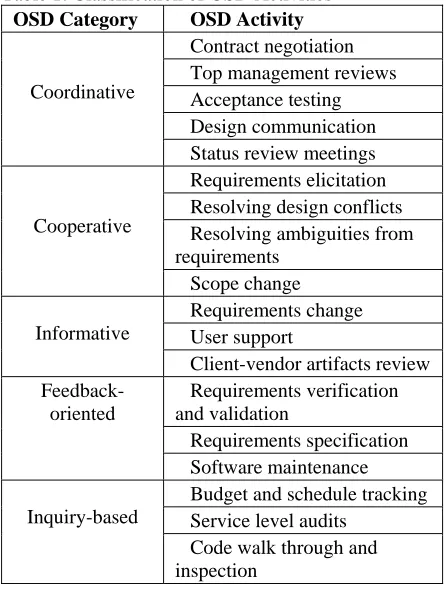
miscommunication, most of the offshore software development projects complicate the transmission process of the actual set of requirements which leads to frequent change requests [4]. According to [1], seamless communication oils the project speed. Therefore, effective communication between client and offshore vendor is primary success factor for offshore software development. According to literature evidence, a coordinative and cooperative environment is precondition for successful offshore software development [11]. Awareness about the activities, regular feedbacks, and proper response against the inquiries are essential to achieve the objectives of OSD effectively. Unfortunately, there is no research on activity specific communication mode/medium selection for an offshore software development environment. There is a need to investigate that, which communication mode/medium is appropriate for a specific offshore software development activity. Since appropriate communication mode/medium is essential to perform any activity in offshore software development. So, we have categorized the offshore software development activities in five categories with respect to their communication needs as depicted from the Table 1.
Table 1: Classification of OSD Activities
OSD Category OSD Activity
Coordinative
Contract negotiation Top management reviews Acceptance testing Design communication Status review meetings
Cooperative
Requirements elicitation Resolving design conflicts Resolving ambiguities from requirements
Scope change
Informative
Requirements change User support
Client-vendor artifacts review
Feedback-oriented
Requirements verification and validation
Requirements specification Software maintenance
Inquiry-based
Budget and schedule tracking Service level audits
2.5.1Coordinative Offshore Software
Development Activities
Coordination means the act of integrating each task and organizational unit so that it contributes to the overall objectives [17]. The coordination between client and offshore vendor is very essential in offshore software development activities. There are some activities in offshore software development which require strong coordination between client and vendor. We named this type of activities as coordinative offshore software development activities. These activities include contract negotiation, top management reviews, acceptance testing, design communication [26], and status review meeting. For architectural design communication, email and documents sharing is not appropriate, this type of activity requires physical presence of the key players responsible for the design activity [6]. Architectural design is a very critical activity, since making a decision by using email or teleconferencing is very difficult [6]. The project status review meetings are coordination mechanism used in offshore software development activities and take place through video conferencing [1]. At the time of contract negotiation, face-to-face communication is very essential because face-to-face communication increases trust between client and offshore vendor [26]. Acceptance testing is usually carried out by onsite team members and face-to-face communication is usually preferred [1]. In offshore software development, top management reviews are most effectively conducted through face-to-face and through video conferencing [26]. In offshore software development, we can only be able to perform the activities successfully if we encourage discussions in group meetings to jointly analyze and find out the barriers in the coordination process, minimize them and improve communication. Some studies reveal that cross-site communication and coordination issues can cause a substantial loss of development speed [19]. In offshore software development, coordination is very difficult and expensive. But some activities of offshore software development are strongly coordinative which require the strong coordination between client and vendor [23]. Coordination in offshore software development is more critical and important than in co-located software development.
2.5.2. Cooperative Offshore Software Development Activities
Each activity in offshore software development requires effective communication between client and vendor for its completion which is usually difficult. In offshore software development, client side members and offshore member cannot communicate effectively due to time zone differences, linguistic problems and cultural differences. Effective and regular communication is the only way to shorten the distance, covering the cultural gaps and resolving the conflicts and other problems [16]. Therefore, effective communication between client and vendor is necessary which is not possible without cooperation between client and vendor. Due to cultural differences, offshore software development requires close cooperation between client and vendor [17]. In offshore software development, some activities require close cooperation between client and vendor. These activities include requirements elicitation, resolving design conflicts, scope change, and resolving ambiguities from requirements [26]. For scope change, email is usually used for communication between client and vendor [10]. For requirements elicitation, discussion forums are usually used [6]. For resolving requirements and design ambiguities and conflicts, email is used [6].
2.5.3 Informative Offshore Software Development Activities
The offshore software development activities, where public information is required to be exchanged /shared between client and offshore vendor are called informative offshore vendor. Awareness about the project is very essential for client and offshore vendor because, due to lack of awareness software development mum effect increases which results in project failure. Without effective information and knowledge sharing mechanism, it is difficult to exploit the benefits of offshore sourcing [17]. In offshore software development, some activities are strongly information oriented. These activities include requirements change [10], user support, and client-vendor artifacts review [26]. For client-client-vendor artifacts review, usually web repository is used [26]. For documents sharing and requirements change data repository is used [10]. For user support, web interact TV is a best option in an offshore environment.
Most of the activities in offshore software development are interdependent, so they need feedback from other activities. If proper feedback-orientation is not implemented in offshore software development process, we cannot successfully perform the interdependent activities that cause failure of the project. These activities include software maintenance, requirements verification and validation, and requirements specifications. Software maintenance is demanded while giving the feedback of the system after using it. Feedback is given through net meetings. For requirements verification and validation, and requirements specification, teleconferencing is usually used.
2.5.5. Inquiry-Based Offshore Software Development Activities
In inquiries, client and vendor share very small but technical issues. Usually these issues include business secretes of the companies. It often happens that business secretes are not conveyed to the offshore vendors which causes serious problems for the developers. Especially in public documents, it is avoided to convey the business secrets of the company. One thing more is that the onshore workers often avoid sharing knowledge because of the fear that this might threaten their own jobs in the future [24]. These activities include budget and schedule tracking, service level audits and code walk through and inspections. Telephone is usually used for budget and schedule tracking, and service level audits. For code walk through and inspections, chatting is usually used.
2.6.Classification of Communication
Modes/Mediums Used in OSD
Communication techniques and tools are more important to offshore software development efforts than technologies and programming skills and companies that are doing offshore software development efforts can verify the fact that OSD projects do not fail because of technology or programming skills, but because of communication issues [18].After complete literature survey of communication modes/mediums used in offshore software development, we have classified OSD communication modes/mediums into five categories as depicted from the Table 2.
Table 2: Classification of communication modes/mediums used in OSD
Communication Modes/Mediums
Category
Communication Modes/Mediums
Coordinative Face-to-face Video conferencing
Cooperative Email
Discussion forum
Informative Shared data repository Web Interactive TV Feedback
oriented
Net meeting Teleconferencing
Inquiry-based Phone and Fax Chatting
2.6.1. Coordinative Communication
Modes/Mediums
2.6.2. Cooperative Communication
Modes/Mediums
In offshore software development, the client faces challenges like poor transfer of business logic understanding, unknown and ambiguous requirements and lack of customer involvement, differences between customer and vendor, geographical distance, and many more. To address these challenges, mutual cooperation and proper coordination from both the software vendor and the offshore client is essential to achieve the objectives [15]. For mutual cooperation between client and offshore vendor, the roles and responsibilities of each party should be clearly defined at the begging of the project [20]. In order to fulfill the mutual cooperation needs of both clients and offshore vendors, we need to use cooperative communication modes/mediums (e.g. email, discussion forum etc). Communication has to be transparent between the both [15]. Informal communication between client and vendor is very important for cooperative software development [7].
2.6.3. Informative Communication
Modes/Mediums
For successful offshore software development, everyone associated with the project should be informed about all the activities of the project. Without effective information and knowledge sharing mechanisms, it is very difficult to achieve the benefits of software offshore sourcing [17]. Everyone should be aware of the communication going on between the two parties [15]. Practically there are rare offshore software development companies which are utilizing informative communication modes/mediums (e.g. shared data repository, web interactive TV etc). Most of the companies rely just on emails and instant messages (IM) but most of the project activities are boasted by awareness. So, it is necessary to utilize informative communication tools to overcome this lack of awareness.
2.6.4. Feedback-oriented Communication
Modes/ Mediums
Software development is a feedback-oriented process. The method of continuous feedback and communication helps the success in the offshore development process [21]. Most of the activities in software development are interdependent, so they need feedback from other activities. If proper feedback-orientation is not implemented in software development process, we cannot successfully perform the interdependent activity that causes failure of the project. In offshore
software development when there are geographical and time zone differences, feedback requirements are more critical. Without clear feedback, teams facing ambiguities in different tasks are often unable to assess progress and thus may find it difficult to meet their performance goals [26]. One of the major challenges in OSD is information bottlenecks. These information bottlenecks can be minimized by having regular communication in the project development process [28]. The regular feedback ensures that the offshore team is synchronized with onsite team and the business requirements and information was transferred adequately. With e-mail communication feedback circles become slow down and communicator have to wait for feedback. The continuous feedback provided through daily communication would help in better team coordination and minimizes differences in team cultures which results in project success [28]. The feedback-oriented communication modes/mediums include teleconferencing and net meeting.
2.6.5. Inquiry-based Communication
Modes/Mediums
In inquiries, technical questions are asked from the client in order to understand the business logics of the company. But usually the business secrets are not conveyed to the offshore vendors which cause serious problems for the developers. Especially in public documents it is avoided to convey the business secrets of the company. So, business secrets are conveys privately in inquiries. For this it is needed to utilize only inquiry-based communication modes/mediums (e.g. telephone and fax, and chatting etc).
3. OFFSHORE SOFTWARE
DEVELOPMENT SUCCESS FACTORS
According to (Delone et al. 2005) the measures of IS project success are on-time completion of the project, within budget completion, meeting system requirements, system quality, user satisfaction, system user and net system benefits [9]. The poor or ineffective communication between client and offshore vendor was found to be negatively correlated to success of OSD [9]. According to a study, vendors felt that communication, conflict resolution, cooperation and integration are very important for a successful client-vendor relationship [8]. Offshore outsourcing success is usually measured in terms of meeting specification of time, cost, quality, and client-vendor trust [26]. In our study, we have analyzed the impact of communication mode/medium on the following success factors of offshore software development.
1) Schedule 2) Budget 3) Time-to-market
4) Customer and business satisfaction
5) Client-vendor trust
3.1.Schedule
Usually client requires quality deliverable, completed within schedule. This is the major demand of any client. The development speed is significantly reduces due to poor communication and coordination in an OSD environment [27].
3.2.Budget
Within budget completion is a very basic success factor of any software project. Since cost effectiveness is the primary objective of offshoring the software projects, so, we can say that, it is the most critical and challenging success factor. For offshore software outsourcing success factors are on time project delivery, within budget delivery, expected quality and functionality for customers and business satisfaction, and strong client-vendor relationship [25].
3.3.Time-to-Market
In OSD environment, time-to-market is also an important factor. Of course time-to-market has always been a key business driver and is still important goal for most of the OSD shareholders. Access to global market and improved time-to-market by using time zone differences in “round the clock” are the core advantages and objectives of OSD [27]. In a competitive environment, time-to-market pressure often increases cost because there are tradeoffs between task duration cost [23].
Improved time-to-market is also an important motivational factor of offshore software development. The time-to-market in offshore software can be improved by using time zone differences through round the clock development [17].
3.4.Customer and Business Satisfaction
Offshore outsourcing success is usually measured in terms of meeting specification of time, cost, quality, customer satisfaction, and client-vendor trust [26]. Customer satisfaction often reduces after project kickoff, as the customer feels that he does not know what status of the project is. Offshore interaction would be little complicated and longer compared to onshore interaction due to information overhead.
3.5.Client-Vendor Trust
In offshore software development, trust between clients and offshore vendor is also an important success factor. Communication and contract conformance are most important factors in establishing and maintaining trust between client and vendor in offshore outsourcing because contract conformance is essential to protect clients’ intellectual property (IP) [22]. If vendor is able to fulfill the contract then there will establish a strong vendor trust relationship and client-vendor trust is very important factor in OSD success. It is very difficult to establish and maintain trust relationship between onshore and offshore team member because the onshore workers often avoid sharing knowledge because of the fear that this might threaten their own jobs in the future [24]. In offshore software development, lack of trust made it very difficult to find out the appropriate person to answer the queries and coordinate the activities [24]. Trust is an interpersonal or an inter-group construct. Trust between a trustier and trustee [24].
4. PROPOSED HYPOTHETICAL
FRAMEWORK FOR OSD
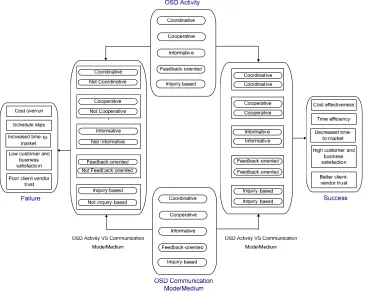
According to our hypothetical framework, activity-specific communication modes/mediums should be utilized in offshore software development in order to complete the project successfully. This hypothetical framework deals with offshore development activities and communication modes/mediums used to perform those activities.
This hypothetical framework is established in order to investigate the impact of communication mode/mediums on success or failure of offshore software development. The following figure 1 shows our hypothetical framework.
Figure 1: Proposed hypothetical Framework for OSD
According to this framework, OSD has five success factors including cost effectiveness, timeliness, customer and business satisfaction, time-to-market, and trust between client and vendor. This framework is established on the basis of individual communication needs of OSD activities. To find out the individual communication needs of OSD activities, we have categorized the communication modes/mediums and OSD activities in five categories. These categories include coordinative, cooperative, informative, feedback-oriented and inquiry-based. Our framework represents that for successful OSD, each OSD activity should have a categorically correspondence with the communication modes/mediums, and otherwise we will lose the fruitfulness of offshoring the
5. CONCLUSION
The study presents some common OSD activities and the communication modes/mediums used to perform those activities. In order to meet the communication needs of different activities, a classification of OSD activities and the communication modes/mediums is also presented. Finally, on the basis of this classification, a hypothetical framework for communication in OSD has been proposed.
6. FUTURE WORK
A hypothetical framework is proposed for the better communication between client and offshore vendor. This framework is further required to be validated in an offshore setting so that communication between client and offshore vendor can be improved.
REFERENCES
[1] A. Gopal, T. Mukhopadhyay, and M. S. Krishnan. The Role of Softawre Processes and Communication in Offshore Software Development. Communication of the ACM April 2002/vol, 45, No 4ve.
[2] S. Sakthivel. Managing Risk in Offshore Systems Development. Communication of the ACM April 2007/vol, 50.No 4.
[3] S. Gopalakrishnan, V.P. Kochikar, S. Yegneshwar. The Offshore Model for Software Development: The Infosys Experience. Education and Research Department, Infosys Technology Limited Bangalore-561 229, India.
[4] C. L. Iacovou and R. Nakatsu. Arisk. Profile of Offshore-outsourced development Projects. Communication of the ACM June 2008/vol, 51.No.6.
[5] E. Ferguson, W. Huen (Moderator), P. B. Henderson, C. Kussmaul. IT Offshore Outsourcing: Impact on CS/IS Curriculum. SIGCSE’05, February 23-27, 2005, St. Louis, Missouri, USA. ACM 1-58113-997-7/05/2002.
[6] J. D. Herbsleb, D. J. Paulish, M. Bass. Global Software Development at Siemens: Experience from Nine Projects. ICSE’05, May
15-21, 2005, St. Louis, Missouri, USA. ACM 1-58113-963-2/05/2005.
[7] A. Boden, B. Nett, V. Wulf. Articulation Work in Small-Scale Offshore Software Development Projects. CHASE’08, May 13, 2008, Leipzig, Germany, ACM 978-1-60558-039-5/08/05.
[8] A. Sargent, Jr. Outsourcing Relationship Literature: An Examination and Implications for Future Research. SIGMIS-CPR’06, April 13-15, 2006, Claremont, California, USA, ACM 1-59593-349-2/06/2004.
[9] A. Mathrani, D. Viehland, D. Parsons, Dynamics of Offshore Software Development Success: The Outsourcers’ Perspective. Institute of Information & Mathematical Sciences, Massy University, Auckland, New Zealand.
[10] K. T. Chang, Out of Sight but Not Out of Mind? Informal Networks Communication and Media Use in Global Software Teams. Klarissa Chang and IBM Corp, 2007.
[11] M. F. Faiz, U. Qadri, S. R. Ayyubi, Offshore software development models, Information and Emerging Technologies, 2007. ICIET 2007.
[12] R. Prilladnicki, J. Luis, N.Audy, D. Damian, Toacy C. de Oliveria, Distributed Software Development: Practices and challenges in different business strategies of offshoring and onshoring, ICGSE 2007 IEEE.
[13] S. Sakthivel. Virtual Workgroups in Offshore Sytems Development. Elsevier B.V, 2004.
[14] S. Fraser (Chair), L. Anderson, R. Crocker. Challenges in Outsoucing and Global Development: How Will Your Job Changes? OOPSLA’04, Oct. 24-28, 2004, Vancouver, British Columbia, Canada. ACM 58113-833-4/04/0010
[16] www.eikipedia.com, How to Succeed in Offshore Software Development.
[17] R. Evaristo, J. L. Nicolas, R. Prikladnicki, J. Avrtchir. Wholly Owned Offshore Subsidiaries for IT Development: A Program of Research. AMCIS 2004, New York, NY. IEEE, 2005
[18] J. M. Bhat, M. Gupta, and S. N. Murthy. Lessons from Offshore Outsourcing. IEEE Computer Society, 2006.
[19] S. Balaji, M. K. Ahuja, C. Ranganathan. Offshore Software Projects: Assessing the Effect of Knowledge Tranfer Requirements and ISD Capability. IEEE, 2006.
[20] A. Kornstadt and J. Sauer. Mastreing Dual-Shore Development-The Tools and Materials Approach Adapted to Agile Offshoring. B. Meyer and M. Joseph (Eds): SeAFOOD 2007.
[21] C. H. Szymanski, R. Prikladnicki. ICGSE 2007, IEEE.
[22] P. T. Nguyen, Muhammad Ali Babar, J. M. Verner. Critical Factors in Establishing and Maintaining Trust in Software Outsourcing Relationships. ICSE’06, May 20-28. 2006, Shanghai, China.
[23] J. Alberto Espinosa, E. Carnel. The Effect of Time Separation on Coordination Costs in Global Software Teams: A Dyad Model. IEEE, 2004.
[24] S. Newell, G. David, D. Chand. Exploring Trust Among Globally Distributed work Teams. HICSS’07, IEEE, 2007.
[25] J. M. Erickson, C. Ranganathan, Project Management Capabilities: Key to Application Development Offshore Outsourcing. HICSS’06, IEEE, 2006.
[26] R. Sharma, SR. Apoorva, V. Madireddy, and V. Jain, Best Practices for Communication between Client and Vendor in IT Outsourcing Projects. Journal of Information, Information Technology, and Organizations, Volume 3, 2008.
[27] F. Dumitriu, G. Mesnita, Issues of Communication and Cooperation in Offshore Software Development, 2006
[28] H. M. Christiansen, "Meeting the Challenge of Communication in Offshore Software Development," Proceedings of the First International Conference on Software Engineering Approaches for Offshore and Outsourced Development (SEAFOOD), Zürich, 5-6 February 2007, Springer 2007.