Solid Earth, 4, 179–200, 2013 www.solid-earth.net/4/179/2013/ doi:10.5194/se-4-179-2013
© Author(s) 2013. CC Attribution 3.0 License.
EGU Journal Logos (RGB)
Advances in
Geosciences
Open Access
Natural Hazards
and Earth System
Sciences
Open Access
Annales
Geophysicae
Open Access
Nonlinear Processes
in Geophysics
Open Access
Atmospheric
Chemistry
and Physics
Open Access
Atmospheric
Chemistry
and Physics
Open Access
Discussions
Atmospheric
Measurement
Techniques
Open Access
Atmospheric
Measurement
Techniques
Open Access
Discussions
Biogeosciences
Open Access Open Access
Biogeosciences
Discussions
Climate
of the Past
Open Access Open Access
Climate
of the Past
Discussions
Earth System
Dynamics
Open Access Open Access
Earth System
Dynamics
Discussions
Geoscientific
Instrumentation
Methods and
Data Systems
Open Access
Geoscientific
Instrumentation
Methods and
Data Systems
Open Access
Discussions
Geoscientific
Model Development
Open Access Open Access
Geoscientific
Model Development
Discussions
Hydrology and
Earth System
Sciences
Open Access
Hydrology and
Earth System
Sciences
Open Access
Discussions
Ocean Science
Open Access Open Access
Ocean Science
Discussions
Solid Earth
Open Access Open Access
Solid Earth
Discussions
The Cryosphere
Open Access Open Access
The Cryosphere
DiscussionsNatural Hazards
and Earth System
Sciences
Open Access
Discussions
The dynamics of laterally variable subductions: laboratory models
applied to the Hellenides
B. Guillaume1,2,3,4, L. Husson1,2,3, F. Funiciello4, and C. Faccenna4
1G´eosciences Rennes, Universit´e de Rennes 1, Rennes, France 2G´eosciences Rennes, CNRS UMR 6118, Rennes, France
3Laboratoire de Plan´etologie et G´eodynamique de Nantes, UMR-CNRS 6112,
Universit´e de Nantes, Nantes, France
4Laboratory of Experimental Tectonics, Dip. di Scienze, Universit`a Roma Tre, Rome, Italy Correspondence to: B. Guillaume ([email protected])
Received: 14 March 2013 – Published in Solid Earth Discuss.: 9 April 2013 Revised: 29 May 2013 – Accepted: 2 June 2013 – Published: 10 July 2013
Abstract. We designed three-dimensional dynamically
self-consistent laboratory models of subduction to analyse the re-lationships between overriding plate deformation and sub-duction dynamics in the upper mantle. We investigated the effects of the subduction of a lithosphere of laterally vari-able buoyancy on the temporal evolution of trench kinemat-ics and shape, horizontal flow at the top of the astheno-sphere, dynamic topography and deformation of the over-riding plate. Two subducting units, which correspond to a negatively buoyant oceanic plate and positively buoyant con-tinental one, are juxtaposed via a trench-perpendicular inter-face (analogue to a tear fault) that is either fully-coupled or shear-stress free. Differential rates of trench retreat, in ex-cess of 6 cm yr−1between the two units, trigger a more vig-orous mantle flow above the oceanic slab unit than above the continental slab unit. The resulting asymmetrical sub-lithospheric flow shears the overriding plate in front of the tear fault, and deformation gradually switches from exten-sion to transtenexten-sion through time. The consistency between our models results and geological observations suggests that the Late Cenozoic deformation of the Aegean domain, in-cluding the formation of the North Aegean Trough and Cen-tral Hellenic Shear zone, results from the spatial variations in the buoyancy of the subducting lithosphere. In particular, the lateral changes of the subduction regime caused by the Early Pliocene subduction of the old oceanic Ionian plate re-designed mantle flow and excited an increasingly vigorous dextral shear underneath the overriding plate. The models suggest that it is the inception of the Kefalonia Fault that
caused the transition between an extension dominated tec-tonic regime to transtension, in the North Aegean, Mainland Greece and Peloponnese. The subduction of the tear fault may also have helped the propagation of the North Anato-lian Fault into the Aegean domain.
1 Introduction
342˚W 342˚W 340˚W 340˚W 338˚W 338˚W 336˚W 336˚W 334˚W 334˚W 332˚W 332˚W 330˚W 330˚W 328˚W 328˚W 34˚N 34˚N 36˚N 36˚N 38˚N 38˚N 40˚N 40˚N 42˚N 42˚N m
0 1000 2000
-2000 -1000 ▲ ▲ ▲ ▲ ▲ ▲ ▲ ▲ ▲ ▲ ▲ ▲ ▲ ▲ ▲ ▲ ▲ ▲ ▲ ▲ ▲ ▲ ▲ ▲ ▲ ▲ ▲ ▲ ▲ ▲ ▲ ▲ ▲ ▲ ▲ ▲ ▲ ▲ ▲ ▲ ▲ ▲ ▲ ▲ ▲ ▲ ▲ ▲ ▲ ▲ ▲ ▲ ▲ ▲ ▲ ▲ ▲ ▲ ▲ ▲ ▲ ▲ ▲ ▲ ▲▲ ▲ ▲ ▲ ▲ ▲ ▲ ▲ ▲ ▲ ▲ ▲ ▲ ▲ ▲ ▲ ▲ ▲ ▲ ▲ ▲ ▲ ▲ ▲ ▲ ▲ ▲ ▲ ▲ ▲ ▲ 20 mm/yr
GPS velocities - Eurasia fixed
(Reilinger et al., 2010)
elevation
Menderes
CR
C r e t a n S e a
A e g e a n S e a
Pel.
C r e t e Cyprus
Rhod e
M E D I T E
R R A
N E A N R I D G E
B L A C K S E A
KF
H E L L
E N
I D E S
CHSZ
WASZ NAF
NAT
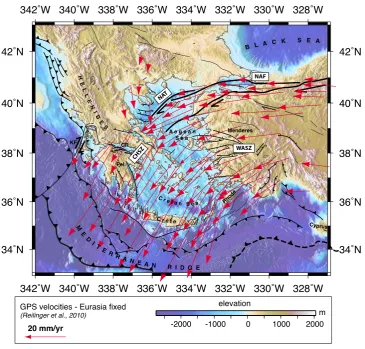
Fig. 1. Tectonic map of the Aegean and Anatolian regions showing the main active structures (after Jolivet et al., 2013) and GPS velocity
field (Eurasia fixed, after Reilinger et al., 2010). Topographic data come from the ETOPO1 global relief model (Amante and Eakins, 2009). CHSZ: Central Hellenic Shear Zone; CR: Corinth Rift; KF: Kefalonia Fault; NAF: North Anatolian Fault; NAT: North Aegean Trough; Pel: Peloponnese; WASZ: Western Anatolian Shear Zone.
flow circulation, overriding plate deformation and topogra-phy along the subduction zone. Yet, they are common fea-tures on Earth, where seamounts, aseismic ridges, continen-tal fragments, stretched continencontinen-tal margins often correspond to lateral variations in the buoyancy of slabs. Their descent into the mantle is expected to affect slab geometry and man-tle flow and subsequently, dynamic topography, upper plate strain and trench deformation (Duretz and Gerya, 2013).
Clearcut examples of such settings are the subduction of continental units adjacent to oceanic plates. The Australian continent in the Banda trench subducts underneath the Banda Sea; it is dragged along with the Indian oceanic plate that subducts in its western counterpart Sunda trench (e.g. Carter et al., 1976; Hamilton, 1979; Bowin et al., 1980). Similarly, the Adriatic plate subducts underneath the Apennines; to the south, in the Ionian Sea, the subducting plate is oceanic, pos-sibly the oldest worldwide (Speranza et al., 2012). To the north, the bathymetry is much shallower, which is diagnos-tic of a continental fragment, less dense than the underlying
mantle. Their respective buoyancies are thus extremely con-trasted, and the subduction zone reacts accordingly (Royden and Husson, 2009). The lateral continuity of the subduct-ing lithosphere is not entirely resolved, and may vary from one subduction zone to another: tear faults may occasion-ally adjust the geometry of the slab to the differential mo-tion between the low and high buoyancy units (e.g. Govers and Wortel, 2005; Rosenbaum et al., 2008; Guillaume et al., 2010; Baes et al., 2011). Alternatively, the slab may not be disrupted by tear faults and instead distort, at least during the earlier stages of continental subduction, in order to accom-modate the lateral variations in subducting rates (e.g. Spak-man and Hall, 2010).
slab
trench
Plexiglas tank
660-k
m depth disc
ontinuit y L = 58 cm
oceanic plate
Upper M antle (ρ
m,h
m)
Glucose syrup Silicone plate
x y
z
3D Laser Scan
cont. plate.
W
l = 45 cm cont.
vt
N
11 cm
Fig. 2. Experimental setup. The subducting lithosphere is modelled
by a silicone plate made of two different materials, a positively buoyant one (defined as continental lithosphere) and a negatively buoyant one (defined as oceanic lithosphere). The upper mantle is simulated by means of glucose syrup, the bottom of the box corre-sponding to an impermeable lower mantle-upper mantle disconti-nuity. The plate is fixed, i.e. its trailing edge is attached to the box. The surface topography is monitored by a 3-D laser scan and pic-tures are taken from the top and the side of the model every 30 s. See Table 1 for experimental parameters.
the Hellenic subduction and Aegean domain bear persist-ing questions: what are the mechanisms that trigger the late (≤5 Ma, Armijo et al., 1999) propagation of the North Ana-tolian Fault into the Aegean domain? What are the causes of the rapidly changing structural pattern during Neogene, in the Aegean in general and in particular in the Peloponnese and Mainland Greece, around the Corinth rift (Papanikolaou and Royden, 2007)? How do these events relate to the dis-ruption of the Hellenic arc by the Kefalonia Fault?
We thus perform a set of dynamically self-consistent 3-D laboratory models, in which no external kinematic boundary conditions, such as plate or trench velocity, are applied, to test the influence of the arrival at trench of a laterally het-erogeneous lithosphere, positively buoyant on half the width of the subduction zone (referred to as continental lithosphere in the following) and negatively buoyant on the other half (oceanic lithosphere in the following), on the subduction dy-namics. We further test the role of the shear stresses along the interface between the continental and oceanic plates, that we herein generically name tear fault, on the modulation of the dynamics. We finally analyse the well-documented tectonic evolution of the Aegean domain at the light of our models.
2 Models
Our simplified subduction system is designed to reproduce the force balance in natural subduction zones, which means that the slab drives the mantle flow and its motion is resisted by viscous dissipation in the mantle, in the slab, in the over-riding plate and at the plates interface (De Franco et al., 2008; Zhong and Gurnis, 1994). We performed a total of 11 mod-els, following the experimental procedure proposed by Fu-niciello et al. (2003) and Bellahsen et al. (2005) (Table 1). The set of models aims at exploring how the lateral variation in slab buoyancy affects the kinematics of the trench, mantle flow, dynamic topography and upper plate deformation. In the following, only 4 of the 11 models will be described in details while the others serve as a background for our anal-ysis. The modelled subducting lithosphere has been divided into a positively buoyant portion and a negatively buoyant portion (Fig. 2). Such an approach has already been used to study how the subduction of positively buoyant ridges and oceanic plateaux impact the subduction dynamics (Martinod et al., 2005; Espurt et al., 2008; Martinod et al., 2013). To compare the experimental results to the kinematics of the Hellenic subduction, we restrict the length of the subduction zone within the range 1200–2400 km and we fix the subduct-ing plate at its trailsubduct-ing edge, in analogy with the Hellenic subduction zone that is embedded into the massive, slowly moving African plate.
2.1 Setup
We use silicone putty (Rhodrosil Gomme, PDMS + iron fillers) and glucose syrup to model the lithosphere and the up-per mantle, respectively. Silicone putty is a viscoelastic mate-rial. However, it can be considered as a quasi-newtonian fluid since the elastic component is negligible for the applied low experimental strain rates (Weijermars and Schmeling, 1986). Glucose syrup is a transparent newtonian low-viscosity fluid. These materials have been selected to achieve the standard scaling procedure for stresses scaled down for length, den-sity and viscoden-sity in a natural gravity field as described by Weijermars and Schmeling (1986) and Davy and Cobbold (1991).
The scale factor for length is 1.67×10⁻⁷ (1 cm in the model corresponds to 60 km in nature). Densities and vis-cosities are assumed to be constant over the thickness of the individual layers and are considered to be averages of the ac-tual values. Scaling for timet is given by
tnature=
(1ρh)model.ηnature
(1ρh)nature.ηmodel
×tmodel (1)
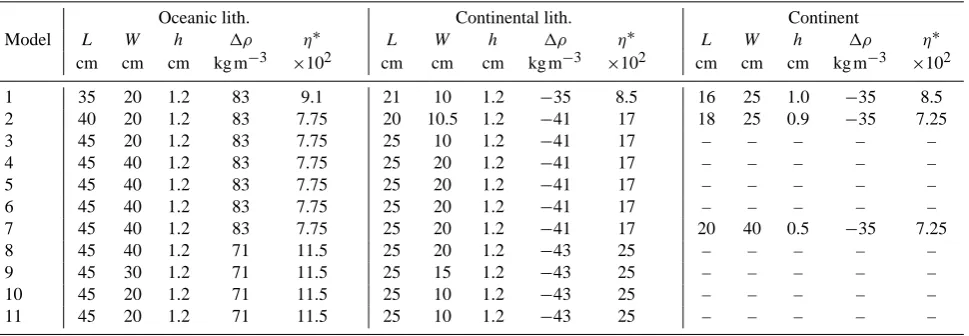
Table 1. Experimental parameters.L: length;W: width;h: thickness;1ρ:ρ−ρmantle;η∗:η/ηmantle. Considering a natural case with the
following parameters (hslab=72 km;ηmantle=1×10²⁰Pa s and1ρslab=71 kg m−3), 1 km in nature corresponds to 0.14 mm in the lab, a
period of 1 Myr in nature corresponds to 57 s in the lab, and a velocity of 10 cm yr−1in nature to a velocity of 17.6 mm min−1in the lab
(models 8–11).
Oceanic lith. Continental lith. Continent
Model L W h 1ρ η∗ L W h 1ρ η∗ L W h 1ρ η∗
cm cm cm kg m−3 ×102 cm cm cm kg m−3 ×102 cm cm cm kg m−3 ×10²
1 35 20 1.2 83 9.1 21 10 1.2 −35 8.5 16 25 1.0 −35 8.5
2 40 20 1.2 83 7.75 20 10.5 1.2 −41 17 18 25 0.9 −35 7.25
3 45 20 1.2 83 7.75 25 10 1.2 −41 17 – – – – –
4 45 40 1.2 83 7.75 25 20 1.2 −41 17 – – – – –
5 45 40 1.2 83 7.75 25 20 1.2 −41 17 – – – – –
6 45 40 1.2 83 7.75 25 20 1.2 −41 17 – – – – –
7 45 40 1.2 83 7.75 25 20 1.2 −41 17 20 40 0.5 −35 7.25
8 45 40 1.2 71 11.5 25 20 1.2 −43 25 – – – – –
9 45 30 1.2 71 11.5 25 15 1.2 −43 25 – – – – –
10 45 20 1.2 71 11.5 25 10 1.2 −43 25 – – – – –
11 45 20 1.2 71 11.5 25 10 1.2 −43 25 – – – – –
eclogitized crust; see Cloos, 1993) and that of the continen-tal lithosphere between −35 and−43 kg m−3 (correspond-ing to a continental lithosphere with a crust thickness of
∼16 km and a density of 2.75, in the range of crustal thick-ness found for the subducting lithosphere beneath the North-ern Hellenides (20 km; Pearce et al., 2012)) (Table 1). When present, the overriding lithosphere is positively buoyant with
1ρ= −35 kg m−3. The viscosities of the lithospheres and upper mantle are measured with a rheometer (Physica MCR 301, Anton Paar). At room temperature and for strain rates ranging between 10−4s−1and 10−3s−1, the viscosity of the silicone putty used for the oceanic lithosphere is 3.2×10⁴Pa s and the viscosity of the continental lithosphere is either 2.9×10⁴Pa s for model 1 or 6.8×10⁴Pa s for the other ones. Viscosity of the overriding lithosphere, when present, is 2.9×10⁴Pa s and the viscosity of the mantle ranges between 30 and 40 Pa s. The obtained viscosity ratio between the slab and the upper mantle varies between 7.75×10²and 25×102 (Table 1), which is in the high range of proposed values (e.g. Billen et al., 2003; Faccenna et al., 2007; Funiciello et al., 2008; Wu et al., 2008; Loiselet et al., 2009, 2010). In the following, we directly express the quantities with their cor-responding scaled values for a better relevance to real Earth. The mechanical behaviour of the trench-perpendicular boundary between the oceanic and continental lithospheres exerts a primary control on the evolution of subduction. Be-cause the lithosphere in our experiments is simulated by the means of an unstratified mechanical layer with a Newtonian rheology, its deformation is not localised enough to sponta-neously form a vertical tear fault during the subduction. We thus consider two end-members, in which the behaviour of the discontinuity is ascribed a priori, by artificially switching on and off the shear stresses at the boundary between the two
plates: (i) no lithospheric tear fault: we assume that differen-tial buoyancy forces and rheological properties do not meet the conditions required to trigger the rupture of the litho-sphere. The evolution of the oceanic and continental portions of the subducting lithosphere stay interdependent during the time of the experiment; (ii) preexisting tear fault: we assume that the rupture is instantaneous and localised at the transi-tion between oceanic and continental lithospheres. In prac-tice, this second case is obtained by forming a pre-existing structure precutting the subducting lithosphere at the transi-tion between negatively- and positively-buoyant lithospheres and filling in the created gap with petroleum jelly that pre-vents the two plates of silicone to stick together again during the experiment. Mechanically, the viscosity of the employed petroleum jelly is so low that it implies shear stresses (but not the normal stresses) are negligible between the two plates.
2.2 Experimental procedure
0 2 4 6
slab at 660 km
ocean-cont.
slab at 660 km
ocean-cont.
slab at 660 km
ocean-cont.
tear fault
tear fault
-1000 -500 1000
500
0
-1000 -500 1000
500
0
-1000 -500 1000
500
0
along−trench distance
y (km)
along−trench distance
y (km)
along−trench distance
y (km)
time (Myr)
−2 0 2 4 6 8 cm/yr
−2 0 2 4 6 8 cm/yr
−2 0 2 4 6 8 cm/yr
−2 0 2 4 6 8
vt
(cm/yr)
vt
(cm/yr)
vt
(cm/yr)
trench retreat
trench advance
trench retreat
trench advance
trench retreat
trench advance
time (Myr)
−2 0 2 4 6 8
a
b
c
d
e
f
time (Myr)
time (Myr)
time (Myr)
time (Myr)
−2 0 2 4 6 8
0 10 20 30
0 10 20 30 40 50 60
0 10 20 30 40 50 60
30 20 10
20 10
60
30 60
10 20 30
500 km 100 km -100 km -500 km
y
500 km 100 km -100 km -500 km
y
300 km 60 km -60 km -275 km
y
5
8
11
-1000 -500 1000
500
0
along−trench distance
y (km)
cm/yr
vt
(cm/yr)
trench retreat
trench advance
g
h
time (Myr)
time (Myr)
−2 0 2 4 6 8
0 10 20 30 40 50 60
20
10 30 40 50 60
300 km 60 km -60 km -300 km
y
1
slab at 660 km
ocean-cont.
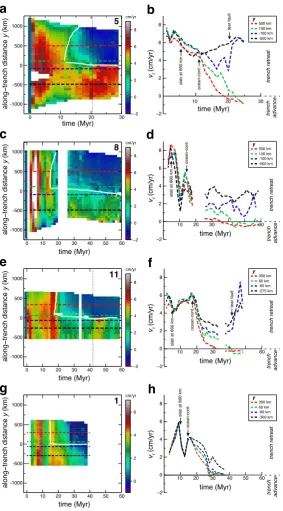
Fig. 3. (a) Trench migration rate as a function of time along y-axis for model 5, i.e. a large subduction zone with a vertical tear fault developing
before the lateral transition between oceanic and continental lithospheres enters the trench. In order to meet this condition and only identify the effects of the lateral variations in slab buoyancy, the leading part of the subducting plate is made of 1200 km-long oceanic lithosphere. For descriptive conve-nience, we geographically orient our models, such that West is on the foreland side of the plate (the unsubducted part of the plate).
When present, the overriding plate is decoupled from the subducting plate by a thin layer of glucose syrup (see Heuret et al., 2007; Espurt et al., 2008; Guillaume et al., 2009), which reduces the shear stresses to negligible values (be-cause stresses scale with viscosity) and prevents plates stick-ing to one another. It is somehow equivalent to introducstick-ing a weak zone in numerical models that is used to mimic the ef-fect of a fault subduction zone (e.g. Zhong and Gurnis, 1994; G´erault et al., 2012).
The glucose syrup in some of the models is initially seeded with highly reflecting air micro-bubbles. These bubbles are used as passive tracers to map the upper mantle circulation pattern and to quantify the related velocity field using the im-age analysis technique denoted as Particle Imim-age Velocime-try using the MatPIV 1.6.1 toolbox (Sveen, 2004). We as-sume that tracers only slightly influence the density and vis-cosity of the mantle fluid, as in Funiciello et al. (2006). For models 8–11, when steady state is reached, the surface is spray-painted (in order to overcome optical issues due to the translucency of the glucose syrup) and scanned with a 3-D scanner (EScan 3-D Imaging System), which acquires the to-pography with a maximum horizontal resolution of 0.13 mm (∼800 m in nature). The precision of topographic data is 0.05 mm (300 m in nature).
3 Modeling results
Lateral variations of slab buoyancy are accounted for by lo-cally changing the density contrast between the slab and sur-rounding mantle. At this transition, the two units are either decoupled from one another by a preexisting lithospheric tear fault or not.
3.1 Trench kinematics
3.1.1 Large subduction zone with tear faulting (model 5)
The trench in model 5 is 2400 km large. W–E trench migra-tion rate (vt) is computed for 90 s (∼1.2 Myr) time steps and
1 cm (60 km) steps along the trench (Fig. 3a, b). Trench kine-matics follow a 4 stage evolution, as also recorded in models 4 and 6:
i. For the first 6 Myr, the oceanic plate is sinking into the upper mantle, slab pull force progressively increases and trench retreat velocity reaches values as high as 6– 8 cm yr−1(Fig. 3a, b).
ii. Once the slab reaches the bottom of the box, ocean-ward trench motion slows down and stabilises at∼4.5 –5 cm yr−1.vtis slightly higher in the centre of the
sub-duction zone with values of∼5–5.5 cm yr−1 (Fig. 3a, b).
iii. The third stage starts with the onset of continental litho-sphere subduction in the northern half of the subduction zone after 11 Myr and stops when the offset along the vertical tear fault in the centre of the subduction zone develops after 20.5 Myr. In the northern part, the av-erage negative slab buoyancy progressively decreases, and the subduction and trench velocities drop. In the centre of the northern unit (y=500 km), trench motion switches from retreat to – moderate – advance after a pe-riod of∼8 Myr (Fig. 3a, b) when∼125 km of continen-tal lithosphere has subducted. We found similar results for model 8, which incorporates an overriding plate. Closer to the lateral transition between continental and oceanic units (y=100 km), the decrease in trench mi-gration rate is slower; for the 9.5 Myr duration of this third stage trench velocity drops from 5 to 0.5 cm yr−1 (Fig. 3a, b). On the oceanic side (y= −100 km), the decrease ofvt is more limited, with values just below
3 cm yr−1after 20.5 Myr. Farther from the central dis-continuity (y= −500 km), the arrival at trench to the north of the continental lithosphere does not decrease the trench retreat velocity, as observed elsewhere. In-stead,vtslightly increases from 5 to 6 cm yr−1between
11 Myr and 20.5 Myr (Fig. 3a, b), meaning that the lateral influence of a decrease in slab buoyancy van-ishes at remote locations (>500 km). We also observe a 1 cm yr−1 increase in trench retreat on a∼10 Myr in-terval in the centre of the oceanic unit for model 8. However, the additional overriding plate dragging re-sults in lower values of trench retreat, from∼2.5 to 3.5 cm yr−1.
iv. After 20.5 Myr, the differential trench retreat motion be-tween the oceanic and continental units offsets the two plates along a vertical tear fault (Figs. 3a, b and 4a). On its northern edge (y=100 km),vtkeeps decreasing
and eventually switches from oceanward to continent-ward motion with values up to 1 cm yr−1(Fig. 3a, b).
In-stead, on its southern edge (y= −100 km),vt
instanta-neously increases from 3 to 6 cm yr−1. Farther from the tear fault, changes in trench kinematics are less impor-tant. In the centre of the southern unit (y= −500 km),vt
-14
-9 -4 1
6
16
26 36 46
-1000 -500 500
0
500 0
-1500 -1000 -500 0 500
trench-orthogonal distance x (km)
500 0
-11
-7 -3 1
5
9
13 17
a
b
along−trench distance
y (km)
-1000 -500 500
0
-2000 -1500 -1000 -500 0
trench-orthogonal distance x (km)
along−trench distance
y (km)
5
8
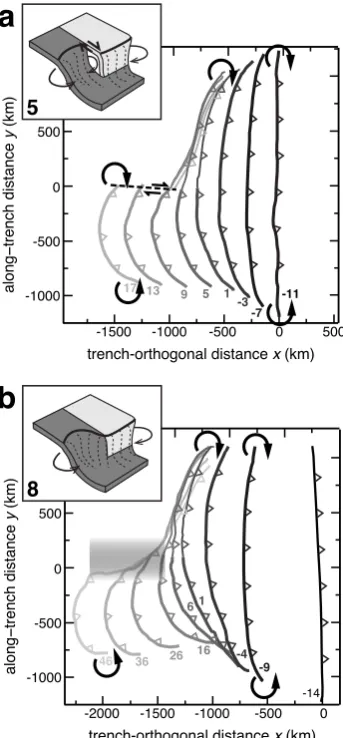
Fig. 4. Evolution of horizontal trench shape for models (a) 5 and (b) 8. Thick and thin lines indicates locations of oceanic and
conti-nental subductions, respectively. Numbers at the bottom indicate the time after subduction of continental lithosphere in Myr. Dashed line in (a) indicates the location of the tear fault and grey box in (b) the area where the slab deforms to accommodate differential roll-back velocities. Black arrows show schematic mantle flow pattern asso-ciated with subduction. Insets show 3-D sketches of the subducting plate shape at the end of each experiment.
decrease invtto the south of the tear fault after∼23–
24 Myr are edge effects, as the slab reaches the end wall of the tank.
The roll-back of slabs causes the development of toroidal cells at slab edges (Dvorkin, 1993; Funiciello et al., 2004; Schellart, 2004; Funiciello et al., 2006; Piromallo et al., 2006). In the model, the persistent rollback of the oceanic lithosphere to the south excites such a mantle flow that op-poses the roll-back of the northern continental lithosphere, which explains the decreasingvt, and even slight advance, to
the north.
3.1.2 Large subduction zone without tear faulting (model 8)
In this model, the subduction of positively buoyant litho-sphere after 15 Myr also strongly modifies the trench kine-matics (Fig. 3c, d). But unlike model 5, along-trench vari-ations of trench velocity are less pronounced. In details, 10 Myr after the entry of positively buoyant lithosphere, the difference of trench velocity between regions located 500 km north and south of the discontinuity is∼3 cm yr−1, half the value observed for model 5 (6 cm yr−1) (Fig. 3b, d). It also holds for regions closer to the discontinuity. The difference in trench velocity 15 Myr after the onset of continental subduc-tion between regions located 100 km away from the discon-tinuity is restricted to∼1 cm yr−1for model 8 as opposed to
∼6 cm yr−1for model 5 (Fig. 3c, d). Because in the absence
of a tear fault, shear stresses are high between the two plates, they remain coupled throughout and the kinematic evolution of the north and south trenches is never independent from one another. Thus, the absence of slab segmentation at the junction between regions with variable buoyancy results in a global slow down of trench motion along the entire sub-duction zone.
3.1.3 Narrow subduction zone with tear faulting (model 11)
Width of the plate has no significant influence on the evolu-tion of subducevolu-tion in the models. Indeed, both model 9 and 11, which share the same set-up as model 5 excepted the sub-duction zone width that is 1800- and 1200- km large, respec-tively, instead of 2400 km, follow a comparable 4 stage evo-lution (Fig. 3e, f). In the following, we only discuss results from the end-member (model 11).
During stage 2, the trench migrates slightly faster in model 11 than in model 5 (5.5–6 vs. 5 cm yr−1), in agreement with previous models that show that narrower slabs retreat faster (Guillaume et al., 2010). At the beginning of stage 3 after 18 Myr, trench retreat velocity decreases all along the sub-duction zone. In the centre of the oceanic unit of the subduct-ing lithosphere, where the migration rate slightly increases in model 5, model 11 instead shows a 50 % decrease ofvt.
12 10 8
8 6 4 2 6
4 2
12 10 8 6 4 2
2 4 6 8
0
0 0
a
b
c
depth
(km)
depth (km)
y (km)
−1200
−600
0
−600 0 600-11
-5
1
7
13
continen
tal
lithospher e
x (km)
oceanic lith.
z (km)
y (k m)
vt
(cm/yr)
vt (cm/yr)
-400 0 400
0
16.5 Myr 19 Myr
25 Myr 40 Myr
46.5 Myr
A A’
A
16.5 Myrvt vtA’
depth 40 Myrdepth
Fig. 5. (a) Digital Elevation Model for the surface of model 11
after 40 Myr of subduction. Zero is the average elevation of the glu-cose syrup away from the subduction zone. (b) Maximum trench depth (solid line) and corresponding trench migration rate along y-direction (dashed line) after 16.5 Myr (in gray) and 40 Myr (in
green) of subduction. (c) Trench maximum depth as function ofvt
at different times during subduction. Light and dark symbols corspond to points located in front of continental and oceanic units, re-spectively. To minimise boundary effects, only points located within a distance of 400 km from the centre of the subduction zone are in-cluded. Dashed lines and grey box indicate the regression envelope
forvt>0.
3.2 Trench shape and depth
Figure 4 shows the evolution of trench shape through time for the large subduction zone models with (5) or without (8) tearing. At first order, both models share a common geome-try that is controlled by the along-trench variability of trench motion. During stages 1 and 2, the trench retreats faster at the centre of the subduction zone than along the edges, which promotes trench curvature. After the arrival of continental lithosphere to the north, the trench remains almost stationary in the northern part whereas in the southern part roll-back of the subducting plate continues. This subsequently causes the formation of a concave trench to the south and an almost-linear trench to the north. The transition is sharp in model 5. The lithospheric fault offsets the trench position at an average velocity of∼7 cm yr−1, giving a cumulative offset of 500 km
after 7 Myr. Model 8 instead shows continuous transitions from fast trench retreat south of the discontinuity to a sta-tionary – or slowly advancing – trench to the north∼16 Myr after continental subduction. The difference is here accom-modated by slab deformation on a roughly 400 km wide band (Fig. 4b).
Trench depth is also sensitive to along-trench variations in slab buoyancy. We scanned the surface elevation of the model (Fig. 5a) in order to compare the along-trench variations of minimum trench elevation with the corresponding trench mi-gration rate for model 11 (Fig. 5b). Before the subduction of the buoyant lithosphere (16.5 Myr), both trench elevation and trench migration rate are uniform along the entire sub-duction zone with a∼10 km deep trench (below reference level, here the mean mantle surface elevation far from the subduction zone) associated to a trench velocity of 6 cm yr−1.
Instead, after 40 Myr, when up to 250 km of buoyant material has entered the trench, trench elevation varies laterally, with a maximum depth in front of the continental unit restricted to
−1000 0 1000
−1000 0 1000
−1000 0 1000
−1000 0 1000
−1000 0 1000
−1000 0 1000
−1000 0 1000 −1000
0 1000
−1000 0 1000
−8 −6 −4 −2 0
0 1000 2000 3000
02
4
6
cm/yr
−8 −6 −4 −2 0
0 1000 2000 3000
−8 −6 −4 −2 0
0 1000 2000 3000
20 Myr
25 Myr
40 Myr
velocity field
a
b
c
W-E component
N-S component
X2
−6
−4
−2
024
6
cm/yr
Westward
Eastward
−6
−4
−2
024
6
cm/yr
Southward
Northward
y (km)
y (km)
y (km)
vh(W-E)
(cm/yr)
x (km) x (km) x (km)
continental plate oceanic
plate
X2
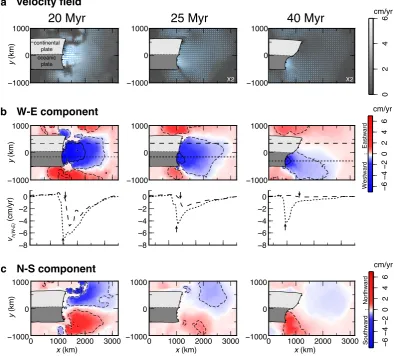
Fig. 6. (a) Velocity vectors and magnitude of the horizontal velocity field for model 11 after 20 Myr (left panel), 25 Myr (central panel) and
40 Myr (right panel) of subduction. Note the changing size of the arrows. (b) Magnitude and along-x profiles of the W–E component of the
velocity field. On the maps, black dashed lines underline regions with horizontal mantle flow velocity (vh) higher than 0.5 cm yr−1and black
solid lines withvh>4 cm yr−1. Positions of continental and oceanic units of the subducting plate are indicated in light grey and dark grey,
respectively, and the position of the trench by a black line with triangles. W-directed mantle flow is represented as negative values. Profiles pass through the centre of the continental (dashed line) and oceanic (dotted line) units. Black arrows indicate the position of the trench. (c) Same as (b) but for the N–S component of the velocity field. Southward mantle flow is represented as negative values.
3.3 Mantle flow
Horizontal velocities (vh) are computed at the surface of
the glucose syrup and silicone plate in the model 11 (that has no upper plate) using Particle Image Velocimetry (PIV) on top-view images with a pixel resolution of 0.25 mm and time intervals of 30 s. PIV relies on basic pattern matching, which reconstructs the Eulerian velocity field on a regular grid (Adrian, 1991; Nogueira et al., 2001, among others). We use a multipass cross-correlation analysis with a 50 % over-lap of the interrogation regions.
Figure 6 displays the horizontal velocity vectors and the magnitude of both W–E and N–S components of the hori-zontal velocity field 20 Myr, 25 Myr and 40 Myr after sub-duction initiation for model 11. During the early stage of
uniform subduction (20 Myr), the roll-back motion of the subducting panel results in the formation of two toroidal cells centred on the slab edges (Fig. 6, see also Funiciello et al., 2006; Husson et al., 2012). The pattern of mantle cir-culation is almost symetrical with (i) fast westward parti-cle motion in the centre of the subduction zone with max-imum velocities (vh(W–E)≈6 cm yr−1) (Fig. 6b), similar to
the westward trench migration rate at the same period, (ii) fast eastward flow (vh(W–E)>4 cm yr−1) at the edges of the
subduction zones (Fig. 6b).
300 km
300 km
trench
continental plate
oceanic plate
3
0 0.6 1.2 1.8 2.4 x 10⁻¹⁶ s-1
300 km
300 km
oceanic plate
300 km
300 km
continental plate
oceanic plate continental plate
0
-3 -2.4 -1.8 -1.2 -0.6 x 10⁻¹⁶ s-1
Stretching
Shortening
Displacement vectors
RP
RP
b
14.5 - 25 Myrc
25 - 38.5 Myra
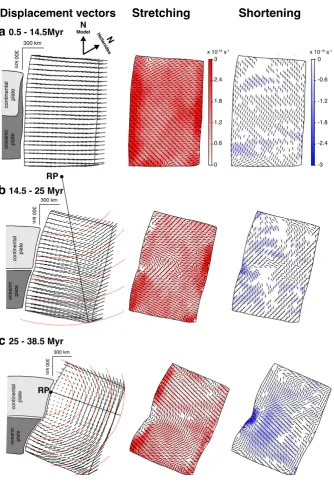
0.5 - 14.5Myr ModelN HellenidesNFig. 7. Motion and deformation of the overriding plate for model 1, (a) between 0.5 and 14.5 Myr, (b) 14.5 and 25 Myr, and (c) 25 and
38.5 Myr after the initiation of subduction. Left panel shows displacements fields for each time interval. Central and right panels show the main directions and rates of stretching and shortening, respectively. RP is for rotation pole.
(vh(W–E)>4 cm yr−1) and in front of the continental unit
(vh(W–E)∼2 cm yr−1) (Fig. 6b). Even if the surface involved
in mantle flow has not significantly decreased with respect to the previous stage, the average motion of particle has slowed down both in the W–E and N–S directions owing to the over-all decrease in trench migration rates (Fig. 6b, c).
After 40 Myr of subduction, a switch in mantle flow direc-tion occurs in front of the continental unit, particles moving eastward at low velocities (vh(W–E)<0.5 cm yr−1) (Fig. 6b).
3.4 Overriding plate deformation
We measure the horizontal strain within the overriding plate at different times of the experiment by tracking the dis-placement of grid nodes initially evenly-spaced by 60 km. Owing to the newtonian behaviour of the silicone used to model the overriding plate, deformation is continuous. Fig-ure 7 presents the displacement field and main strain direc-tions recorded during three time intervals for model 1. Sim-ilar trench kinematics evolution were obtained for model 2 and 3, with two-times higher absolute trench velocities in the latter owing to the lack of overriding plate, and the same spa-tial pattern of deformation was recorded in model 2.
Before the arrival of continental lithosphere at the trench (0.5–14.5 Myr), the finite displacement of the overriding plate with respect to the lower mantle reference frame is larger at its western edge than at its eastern edge, result-ing in trench-perpendicular stretchresult-ing (Fig. 7a). Stretchresult-ing is not uniform, owing to differential basal shear tractions at the lithosphere–asthenosphere boundary resulting from hetero-geneous mantle flow below the overriding plate. It is max-imal within the first 120–180 km from the trench (Fig. 7a) and decreases away from the boundary. Local trench-parallel stretching at the southern and northern edges of the upper plate results from the free lateral boundary conditions that allow the silicone plate to spread laterally above the low-viscosity glucose syrup under the effect of gravity.
The early stage of continental lithosphere subduction (14.5–25 Myr) is associated to a 30 to 60 % decrease in trench retreat rates along the entire subduction zone (Fig. 3g, h). Its deformation decomposes into translation (herein irrel-evant), plain rotation and stretching. During this period, the grid nodes rotate clockwise around a pole located∼500 km north of the northernmost extent of the overriding lithosphere (Fig. 7b). Overriding plate mainly deforms through later-ally non uniform stretching. For the first 180 km from the trench, trench-perpendicular stretching occurs in front of the oceanic unit about twice faster than in front of the conti-nental unit (∼3×10⁻¹⁶ vs.∼1.5×10⁻¹⁶s−1). Region of maximum trench-perpendicular stretching coincides with the area where the gradient of the east-west component of hor-izontal mantle flow at the top of the asthenosphere is maxi-mum (Fig. 6b), i.e. where shear stresses underneath the litho-sphere are the highest. Within the first 60 km in front of the continental–oceanic transition, the overriding plate mainly deforms under moderate trench-parallel shortening (Fig. 7b). In the final stage (25–38.5 Myr), the difference in along-trench kinematics results in a clockwise rotation of grid nodes with a rotation pole located on the trenchward edge of the overriding plate in front of the continental unit (Fig. 7c). Despite the almost null motion of the trench at the location of the continental unit, the trenchward edge of the overrid-ing plate north of the oceanic-continental transition still de-forms under trench-perpendicular stretching at higher rates than recorded before (>3×10⁻¹⁶s−1) (Fig. 7c).
Deforma-tion here is controlled by stresses arising from the far-field, associated with trench retreat for the oceanic unit at moder-ate rmoder-ates (2±1 cm yr−1) (Fig. 3g, h). Within the first 60 km
from the trench, the centre of the overriding plate is domi-nated by trench-perpendicular shortening (Fig. 7c). Indeed at this specific location, retreat of the oceanic lithosphere to the south triggers the westward absolute motion of the overrid-ing plate at a faster rate than the westward absolute trench motion, slowed down by the subduction of positively buoy-ant lithosphere to the north. Beyond 120 km, upper plate de-forms under a combination of moderate stretching and short-ening, the principal axis of stretching rotating from trench-perpendicular on its edges to trench-parallel in its centre (Fig. 7c).
3.5 Dynamic topography
Long-wavelength, non-tectonic uplift or subsidence counter-balance the vertical traction caused by the flowing mantle underneath the lithosphere. Ultimately, this flow is excited by density variations in the mantle, and that component of the topography is often referred to as dynamic topography (Ricard et al., 1984; Hager et al., 1985; Hager and Clayton, 1989; Cazenave et al., 1989; Mitrovica et al., 1989; Gurnis, 1993; Le Stunff and Ricard, 1995). Above the anomalies of the slabs, the amplitude of dynamic subsidence can exceed several hundred metres (Mitrovica et al., 1989; Gurnis, 1993; Zhong and Gurnis, 1994; Husson, 2006; Husson et al., 2012). We track the vertical deformation of the model surface with a scanner during subduction in model 11 and in particu-lar at the top of the asthenosphere above the subducting litho-sphere, north and south of the discontinuity (Fig. 8). Because there is no overriding plate in this model, all the topography has a dynamic origin.
0 10 20 30 40 50 250 km from trench
0 10 20 30 40 50 500 km from trench
time (Myr)
time (Myr)
Continental subduction
Oceanic subduction
tear fault
-2 2
0
z (km)
z (km)
-2 2
0
0 10 20 30 40 50 -20 10 20 30 40 50
2
0
z (km)
z (km)
-2 2
0
a
b
c
ocean-cont.
tear fault
ocean-cont. ocean-cont. tear fault
tear fault
ocean-cont.
z (km)
y (km) -2
-800 -400 0 400 800
2
0
continental subduction oceanic
subduction
16 Myr 25 Myr 40 Myr 46 Myr
0.2 mm/yr
0.02 mm/yr
0.2 mm/yr
0.02 mm/yr
0.2 mm/yr 0.2 mm/yr
0.02 mm/yr 0.02 mm/yr
continental plate oceanic plate
250 km
250 k
m
500 k
m
A
A’
A
A’
40 Myr
0 500
y
(km)
-500
Fig. 8. (a) Dynamic topography measured at the surface of the asthenosphere for model 11 at a distance of 250 km from the trench after 16,
25, 40 and 46 Myr of subduction. Inset indicates the location of cross-sections at 250 and 500 km from the trench after 40 Myr of subduction.
(b) Time-evolution of dynamic topography for the same model above the centre of the continental subduction zone at 250 km from the trench
(left panel) and 500 km from the trench (right panel). Elevations are averaged on a 60 km wide trench-perpendicular swath to remove any shorter wavelength perturbations (see position of swath on Fig. 8a). (c) Same as (b) for the oceanic subduction. Trends for uplift and downlift
velocities of 0.02 and 0.2 mm yr−1are indicated by dashed lines.
underneath the surface as a result of the overall decrease in slab buoyancy.
After 42 Myr, the tear fault decouples the continental and oceanic units, which strongly modifies the dynamic topogra-phy above the oceanic portion of the subduction zone. A∼
1.7 km downlift of the surface is recorded at 250 km from the trench, yielding a subsidence rate of∼0.3±0.1 mm yr−1 (Fig. 8c). Decoupling the two slab segments results in a lesser reciprocal influence, in the sense that the kinematics no longer correspond to an average buoyancy of some kind. The narrow oceanic slab unit then subducts at its proper rate, faster than the initial rate that corresponds to a wide slab.
342˚W 340˚W 338˚W 336˚W 334˚W 332˚W 330˚W 328˚W 34˚N 36˚N 38˚N 40˚N 42˚N 300 km 300 km oceanic plate 300 km 300 km continental plate 300 km 300 400 km 200 100 0 300 km oceanic plate continental plate oceanic plate continental plate 300 km 300 km 1 -1 -0.6 -0.2
curl divergence
0.2 0.6
x 10-15 s-1 0 1.2 2.4 3.6 4.8 6x 10-15 s-1 N N 60° oceanic plate continental plate ▲ ▲ ▲ ▲ ▲ ▲ ▲ ▲ ▲ ▲ ▲ ▲ ▲ ▲ ▲ ▲ ▲ ▲ ▲ ▲ ▲ ▲ ▲ ▲ ▲ ▲ ▲ ▲ ▲ ▲ ▲ ▲ ▲ ▲ ▲ ▲ ▲ ▲ ▲ ▲ ▲ ▲ ▲ ▲ ▲ ▲ ▲ ▲ ▲ ▲ ▲ ▲ ▲ ▲ ▲ ▲ ▲ ▲ ▲ ▲ ▲ ▲ ▲ ▲ ▲▲ ▲ ▲ ▲ ▲ ▲ ▲ ▲ ▲ ▲ ▲ ▲ ▲ ▲ ▲ ▲ ▲ ▲ ▲ ▲ ▲ ▲ ▲ ▲ ▲ ▲▲ ▲ ▲ ▲ ▲
c
14.5 - 25 MyrLate Miocene
Pliocene to
Quaternary 25 - 38.5 Myr
d
a
b
normal fault strike-slip fault thrust fault M=5 M=6 M=7340˚W 338˚W 336˚W 334˚W 332˚W 330˚W 328˚W
34˚N 36˚N 38˚N 40˚N 42˚N ▲ Cyprus CHSZ WASZ NAF NAT North Hellenic Zone So uth He llen ic Zone
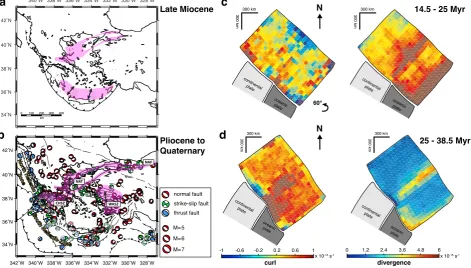
Fig. 9. Upper plate deformation within the Aegean region for (a) the Late Miocene and (b) Pliocene to Quaternary periods (after Royden
and Papanikolaou, 2011; Jolivet et al., 2013). The approximate areas affected by extension and/or strike-slip activity for the considered time period are indicated in pink (deformation is not palinspastically restored) and the main active structures and focal mechanisms of earthquakes at depths lower than 50 km (source: CMT, 2011) are shown in (b). Earthquakes with depths between 30 and 50 km are indicated with transparent beachballs. (c) Curl (left panel) and divergence (right panel) computed from the overriding plate horizontal displacement
field for the 14.5–25 Myr time period of model 1. (d) Same as (c) for the 25–38.5 Myr time period. A 60◦counterclockwise rotation has been
applied to panels (c) and (d) to make the trench orientation fit the orientation of the Hellenic trench.
4 Comparison to the Hellenic subduction
4.1 Geological setting
The Hellenic subduction is a small remnant of the vast Tethyan subduction that drove the collision of Africa and Eurasia (Fig. 1). Another few of those small subduction zones are found in the Mediterranean (e.g. Royden, 1993; Malinverno and Ryan, 1986), but the Aegean slab is proba-bly the last that remains powerful enough to be considered an active tectonic system, for the subducting Ionian lithosphere could be the oldest seafloor on Earth (Speranza et al., 2012). In the general framework of the now very slow African-Eurasian collision, the subduction of the Aegean slab, that is attached to Africa, resembles the fixed mode of subduction of our models. Fast rollback accompanied the subduction, triggering pervasive lithospheric extension in the Aegean do-main (see Jolivet et al., 2013, for a review), trenchward mi-grating volcanism and exciting adjacent mantle flow (Paul et al., 2010).
However, this activity did not prevail throughout the en-tire Tertiary (e.g. Papanikolaou and Royden, 2007; Brun and Sokoutis, 2010; Royden and Papanikolaou, 2011; Jolivet
et al., 2013). The Aegean domain globally spreads until Mid-Miocene, until the right lateral North Anatolian Fault (NAF) isolated Anatolia from the Eurasian continent ( ˇSeng¨or et al., 2005; Royden and Papanikolaou, 2011), cut through the Mar-mara Sea and reached the Aegean Sea and formed the North
Aegean Trough (NAT). During that early stage, lithospheric
stretching accommodated slab retreat and faults trended par-allel to the uniformly retreating trench.
342˚W 342˚W
340˚W 340˚W
338˚W 338˚W
336˚W 336˚W
334˚W 334˚W
332˚W 332˚W
330˚W 330˚W
328˚W 328˚W
34˚N 34˚N
36˚N 36˚N
38˚N 38˚N
40˚N 40˚N
42˚N 42˚N
1s (Paul et al., 2010) 1s (Evangelidis et al., 2011) 1s (Hatzfeld et al., 2001)
−80 −60 −40 −20 0 20 40 60 80
−80 −60 −40 −20 0 20 40 60 80 AZIMUTH OF HORIZONTAL MANTLE FLOW
−80 −60 −40 −20 0 20 40 60 80 AZIMUTH OF PRINCIPAL STRAIN AXIS
PHI
N Model after 40 Myr
N Model after 40 Myr
−1500 −1000 km
km
−500 0
500 100
0 1500
200 0
2500
−2000
−1500 −1000 km −500 0
500 1000
1500 2000
2500
−2000 continental plate
oceanicplate a
b N. He
lle nic su
b.
South H elle
nic s ubd
uction
60°
c
60° continental plate
oceanicplate
Fig. 10. (a) Azimuth (interpolated, colourscale) and delay (bars) of
seismic anisotropy in the Aegean–Anatolian region obtained from SKS waves (green bars, Hatzfeld et al., 2001; black bars, Paul et al., 2010; blue bars, Evangelidis et al., 2011). (b) Azimuth of horizon-tal mantle flow for model 11 after 40 Myr of subduction. Black bars indicate the direction and relative magnitude of mantle flow. The black dashed lined underlines the approximate corresponding re-gion of SKS data shown in Fig. 10a. (c) Azimuth of the principal strain axis for model 11 after 40 Myr of subduction. Black bars
in-dicate the direction of principal strain component. A 60◦
counter-clockwise rotation has been applied to panels (b) and (c) to make the trench orientation fit the orientation of the Hellenic trench.
2000; Royden and Papanikolaou, 2011; P´erouse et al., 2012), respectively, which offsets the South and North Hellenic sub-duction zones by a few tenths of kilometres at present day. The formation of the fault itself results from the entry in the subduction zone of a very negatively buoyant oceanic plate to the south, while in the north the subduction of a continen-tal unit of increasingly positive buoyancy proceeds, as the buoyancy difference of the two plate units suffices to trig-ger a laterally variable regime along the trench (Royden and Papanikolaou, 2011). P- and S-wave velocity perturbations show that the subducted crusts for two sections north and south of the Kefalonia Fault are dextrally offset, implying an additional∼70–85 km retreat of the southern segment of the slab (Pearce et al., 2012).
The Aegean Sea then migrated along with the trench to the southwest (with respect to stable Eurasia), as an ap-parently almost rigid unit (McClusky et al., 2000; Kreemer and Chamot-Rooke, 2004). Extension is now focussed in the
West Anatolian Shear zone (WASZ), on the western
mar-gin of Turkey, in the Peloponnese and in Mainland Greece (Gautier et al., 1999; Jolivet et al., 2013; Royden and Pa-panikolaou, 2011, Fig. 9b). Only in Mainland Greece and Peloponnese deformation remains somewhat diffuse (Vassi-lakis et al., 2011; Bradley et al., 2013); only in this area the Anatolian plate is not separated from Eurasia by a discrete right lateral fault. The Kefalonia Fault could be linked to the North Anatolian Fault via the diffuse transtensional
Cen-tral Hellenic Shear zone (CHSZ) (Royden and Papanikolaou,
2011) that separates the Peloponnese from Mainland Greece (Fig. 9b). In this area, normal faults, including the Corinth Rift, developed obliquely to the trench. From north to south, faults trend ∼N90 in Mainland Greece, gently swing to
∼N120 across the Gulf of Corinth, and reach∼N170 (ap-proximately trench parallel) in the South Peloponnese (e.g. Doutsos, 2001). From the western tip of the NAF to the Ke-falonia Fault (i.e. in the NAT and CHSZ), only normal fault-ing is unequivocally identified; this lead P´erouse et al. (2012) to advocate that the GPS inferred strain field does not require any dextral shear component in this area.
Despite the inherent oversimplifications of our experimen-tal setup, our dynamic models resemble the Hellenic subduc-tion by many aspects. The Kefalonia Fault shall be consid-ered as the tear fault (possibly shear-stress free) that begins to isolate plate units of contrasted buoyancies, as in the early stages of our models. In the following, we interpret the ob-servables for the Hellenic subduction (trench and upper plate kinematics, mantle flow and topography) at the light of our dynamic models.
4.2 The Hellenic trench
trench retreat (Fig. 4), as in earlier models (e.g. Funiciello et al., 2003; Morra et al., 2006; Loiselet et al., 2009). The shape of the trench responds efficiently to the entry of a plate of laterally variable buoyancy into the subduction zone. In the models, it corresponds to the introduction of a low buoy-ancy unit that locally decreases the trench migration rates (Fig. 3); in the Hellenides it is the introduction of the old Io-nian oceanic lithosphere after the consumption of the Adria block that speeds up trench migration to the south. In both cases, the difference in trench migration rates imposed by lateral slab buoyancy variability increases by a few tenths of mm yr−1 after a few million years. It is accompanied, in the models, either by a viscous shear of the subducting plate when no built-in tear fault accommodates the differen-tial trench motion, or by a right lateral slip along the tear fault when present (Fig. 4). This setting is akin to the Kefalonia Fault, and we confirm that it is this mechanism that excites the Kefalonia Fault and that offsets the margin of the overrid-ing plate by some∼100 km at a rate of∼14 to 25 mm yr−1 (Vassilakis et al., 2011; Royden and Papanikolaou, 2011). This value corresponds to the difference in the trench veloci-ties of the northern and southern Hellenic subduction zones, a figure that is also obtained in the models after a few mil-lion years (Fig. 3). Interestingly, the models show that it takes more than∼4 Myr, i.e. the time since the onset of the activ-ity of the Kefalonia Fault, before steady state is reached. This suggests that the slip rates along the Kefalonia Fault may be accelerating and continue to speed up in the future (along with an acceleration of the southern trench migration, as also shown by Royden and Papanikolaou, 2011).
Trench depth varies along strike; while in the Northern Hellenides the trench is shallower than ∼1000 m, in the southern counterpart, it is more than 3000 m deep (Fig. 11). The absolute trench depth in the models overshoots that fig-ure by 5000 to 8000 m (Fig. 5b, c, and Husson et al., 2012), because our setup does not account for faults (as in Zhong and Gurnis, 1994, for instance), and because the meniscus caused by surface tension increases the depth by a constant. Those undesired effects are particularly high at low rates. However, relative depths for similar subduction rates are comparable in our models (Fig. 5c), i.e. some 2000 to 4000 m deeper for fast subducting plates (at∼30 mm yr−1) than for the slowly subducting plates (at∼10 mm yr−1). This results confirms that the along strike variations in the Hellenic trench depth mirror the laterally variable subduction rates. Y´a˜nez et al. (2004) found similar results for the Andean subduc-tion, i.e. trench depth is controlled by convergence rate but also by interplate coupling.
4.3 Aegean deformation
Trench migration in our models follows the mechanism that was initially proposed by Royden and Papanikolaou (2011). In addition, our models explore the impact of the inception of the Kefalonia Fault onto the upper plate. Silicone plates
be-have as quasi-Newtonian fluids at experimental strain rates. Thus, in our simplified model, upper plate deformation is dif-fuse and the models do not produce any of the faults that may also accommodate deformation of the overriding litho-sphere in nature. In addition, strength layering that may pro-duce significant deformation partitioning over the lithosphere thickness is not accounted for. However, upon the assump-tion that the brittle crustal deformaassump-tion is a surface expres-sion of the overall viscous lithospheric deformation, the first-order comparison between the continuous deformation of the models to the discrete deformation observed on Earth holds. Indeed, our models show comparable patterns of deformation and may explain the temporal evolution of Aegean tecton-ics though, of course, the diffuse deformation and the unac-counted Anatolian extrusion prevent the reproduction of the discrete dextral shear found in the NAT and NAF.
During the early stage of Aegean expansion, prior to the inception of the Kefalonia Fault, lithospheric stretching ac-commodated slab retreat and faults trended parallel to the uniformly retreating trench, in agreement with the deforma-tion seen during the early stages of our models: extension is widespread and reaches its fastest rate on the entire plate (Fig. 7a). The inception of the tear fault initiated a non-uniform rollback and trench migration (see Sect. 4.2) that caused a wholesale rotation of the upper plate around a Euler pole located some 1200 km from the triple junction (Fig. 7b). Deformation remained essentially extensional, and the defor-mation axis in the models show that normal faults in front of the oceanic unit are expected to trend parallel to the trench (Fig. 7b). This episode explains the arc parallel “transitional” episode of deformation of Papanikolaou and Royden (2007) (Fig. 9a).
at an equivalent location to the CHSZ (Fig. 7c). The two last stages therefore reproduce the structural pattern of the Pelo-ponnese and Mainland Greece, where extension shifts from arc-parallel to arc-crossing trends. In particular, the∼EW trending Corinth rift is well explained by our models. In ad-dition, our models predict some localised compression next to the triple junction (Fig. 7c), a somewhat less abundant, yet present, feature in Greece around Kefalonia (Sachpazi, 2000; Vassilakis et al., 2011, and Fig. 9b).
A synthetic view is given by the horizontal divergence and curl of the model surface velocity fields (Fig. 9c, d), that we use to locate stretching and shear, respectively. After the first stage of widespread extension, the divergence field reveals the initiation of an elongated extensional zone in front of the triple junction during the second stage (after the inception of the tear fault) (Fig. 9c), i.e. at a location that compares to that of the CHSZ and NAT with respect to the Kefalonia Fault; this episode continues during the third stage, but decreases in magnitude (Fig. 9d). Furthermore, divergence in this area indicates that the extensional zone in our models enlarges and increases in magnitude north-eastward, away from the triple junction, i.e. at comparable location to the NAT. This pattern of scissors-like stretching is that of the deformation from the Gulf of Patras towards the Aegean sea. A second zone of extension appears by the oceanic trench, at a loca-tion that compares to that of the Cretan Sea and Peloponnese, a feature that decreases during the third stage, in accordance with the geological record. Second, mapping the curl of the horizontal velocity field locates occurrences of toroidal flow, that is the local rotation about the vertical axis, that we in-terpret as the location where strike slip faulting is expected (Fig. 9c, d). The curl shows that very little shear occurs dur-ing the second stage, but seriously increases durdur-ing the third stage. Besides the strong shear that the models show imme-diately adjacent to the trenches (dextral next to the oceanic unit, sinistral by the continental unit), dextral shear is found on a band that branches onto the triple junction, normally to the trench, that narrows eastward. It is largest close to the trench, at a location that compares to that of the wide CHSZ with respect to the Kefalonia Fault. It thins away at a location that matches that of the narrow NAT and NAF, as opposed to divergence. In summary, deformation evolves through time from extension towards strike-slip via transten-sion, as indicated by the ratio divergence/curl that decreases through time, by an average factor of∼4 from the second to the third stage. As dextral shear builds up, the deforming zones narrow, which resembles the evolution of the broad extensional NAT, Cretan Sea and Peloponnese (during Late Miocene and Early Pliocene, i.e. the second stage) towards a more localised dextral transtension across the CHSZ and NAT (during the third, Plio-Quaternary stage), as suggested by Papanikolaou and Royden (2007). This resemblance lead us to conclude that together, the divergence and curl fields of the model horizontal velocities clearly predict the deforma-tion field as revealed from structural analysis (Papanikolaou
and Royden, 2007), but also from the focal mechanisms at present-day (Fig. 9b). In details, eastward from Kefalonia, observed deformation shifts from (dominantly) compression to (dominantly) dextral strike slip and (dominantly) exten-sion around Corinth. Our models successfully reproduce the observed kinematics, with a late episode of∼N50 trending dextral shear (akin to the NAT and NAF) and∼N90 trending normal faults (akin to the Gulf of Corinth) that follows a tran-sitional episode of arc parallel normal faulting. The dynamic causes shall be explored from the analysis of the mantle flow.
4.4 Mantle flow
The three stage tectonic evolution of the Hellenic domain is successfully reproduced by our models; they correspond to the subduction of uniformly buoyant slab, to the entry of the heterogeneous slab, and last, to the complete subduction of the tear fault. How it forces the deformation of the up-per plate is due to the changes in the driving forces, and it is in the mantle that they vary most efficiently during tran-sient subduction. Significant insight for this comes from the fact that the curl does not show any influence of the incipient Kefalonia Fault until the tear fault reaches mantle depth and modifies the underlying mantle flow; this suggests that it is mostly mantle drag that efficiently controls the kinematics of plate boundaries (Husson, 2012).
At present-day, the Hellenic slab is most likely torn be-tween Rhodes and Cyprus and a window allows for mantle flow underneath West Anatolia (Govers and Wortel, 2005). The situation is less clear for the Kefalonia Fault; seismic tomography (Spakman et al., 1988; Piromallo et al., 2006; Suckale et al., 2009) possibly reveals a discontinuous slab and more detailed seismic experiments suggest that the sur-face of the slab is offset horizontally by some 100 km across the Kefalonia Fault (Gesret et al., 2011). However, whether the mantle flows through a potential Kefalonia window re-mains uncertain, and it is most likely small, if any. Only seis-mic anisotropy (Fig. 10a, Paul et al., 2010; Hatzfeld et al., 2001; Evangelidis et al., 2011) possibly advocates for along-arc mantle flow that could be interpreted as originating from the Kefalonia window, but the not-so-clear nature of along-arc anisotropy (e.g. Russo and Silver, 1994; Long and Silver, 2009; Faccenna and Capitanio, 2013) prevents from being conclusive. Overall the trend of seismic tomography in the sublithospheric mantle does not accurately match the mo-tion of Anatolia. In particular, anisotropy is not imprinted yet by the too young shear underneath the North Anatolian fault (Kreemer et al., 2004; Jolivet et al., 2009); this observa-tion precludes its use as a mean to explore recent changes in mantle deformation.
show that this behaviour is also obtained just before the ac-tual opening of the tear fault (Fig. 7c). However, our models also showed that it is only when the tear fault is actually sub-ducted that dextral shear appears. Although our main con-clusions hold, this contradicts the interpretations of P´erouse et al. (2012) on the timing of events. Our models show that the onset of differential motion between the two units leads to a more vigorous mantle flow in the oceanic section than in the continental section, which induces dextral shear in the overriding plate. This shear only happens when the diversion of the mantle flow because of the Kefalonia tear fault be-gins, and not before (when the fault has not reached mantle depths). If the slab window was fully opened, and allowed for mantle flow through it, dextral shear would be even more dra-matic. This shows that it is mantle flow, and not trench pull or any shallow process, that causes it. Instead, we conclude that the increasingly vigorous toroidal flow around the edges of the oceanic slab is responsible for dextral shear across the two units: basal, southwestward drag grows larger in the southern section than in the northern one and is enough to shear the overriding plate, possibly helping the NAF to make its way across the Aegean and Mainland Greece and Pelo-ponese.
4.5 Dynamic topography
Mantle flow induces vertical tractions that deflect the sur-face. Mantle flow models indicate that dynamic topography is likely in excess of 1000 m in the Cretan Sea (Husson, 2006; Boschi et al., 2010; Faccenna and Becker, 2010). In particular, it may be responsible for the very deep Cretan Sea (Fig. 11). Of course, residual topography is not real to-pography. Nevertheless, we note that in the Aegean domain, crustal thickness only varies by a few kilometres (e.g. Tirel et al., 2004) and isostasy by no means shall suffice to ex-plain the ∼2000 m variations in elevation. Indeed, eleva-tion drops from north to south across the CHSZ, from the continental North Hellenic subduction to the oceanic South Hellenic one (Fig. 11). Second, flooding of the Aegean sea started after rollback started (see the paleogeographic recon-structions of Dermitzakis and Papanikolaou, 1981) and likely increased during Late Neogene (Wright, 1978; van Hinsber-gen et al., 2004, 2005). It remains difficult to evaluate the subsidence rates, but we observe that subsidence therefore took place above the oceanic slab, at the time during which its purported negative buoyancy increased (Royden and Pa-panikolaou, 2011). These observations match our model re-sults (Fig. 8) that predict an increasing difference in eleva-tion between the two units. This result corroborates the idea that dynamic topography plays a critical role in shaping the Aegean seafloor.
342˚W 342˚W
340˚W 340˚W
338˚W 338˚W
336˚W 336˚W
334˚W 334˚W
332˚W 332˚W
330˚W 330˚W
328˚W 328˚W
34˚N 34˚N
36˚N 36˚N
38˚N 38˚N
40˚N 40˚N
42˚N 42˚N
−2000 −1000 0 1000 2000
meters N. He
lle nic su
b.
South H elle
nic s
ubductio n
elevation (m)
distance (km)
b
a
−4000 −3000 −2000 −1000 0 1000
0 200 400 600 800 1000 1200 1400 1600
CHSZ
trench ~250 km
~150 km
A B
B’ C’ C
C’ B
B’
AC
A’ A’
CHSZ
C
retan Sea
Fig. 11. (a) Smoothed topography of the Aegean region. ETOPO1
global topography (Amante and Eakins, 2009) has been filtered with a 150 km large median filter using Generic Mapping Tools (Wes-sel and Smith, 1998). (b) Topographic profiles of the trench (A–
A0; dashed line) and of the Aegean overriding lithosphere at a
dis-tance of∼150 km (B–B0; dotted line) and∼250 km (C–C0;
dashed-dotted line) from the trench.
5 Discussion and conclusions
We use three-dimensional analogue models of subduction to explore the interplay between mantle flow and surface tec-tonics during the subduction of a slab of laterally variable buoyancy. The simplified experimental setup provides the necessary ingredients to successfully reproduce the kinemat-ics and tectonic history of the Aegean–Anatolian region since middle Miocene and for the analysis, in particular, of the role played by mantle flow around the Kefalonia Fault.
influenced by the changes in neighbouring slab density. This is the case of the Hellenic subduction zone, where the buoy-ancy of the subducting lithosphere purportedly drastically changes across the Kefalonia Fault, from a dense oceanic to a continental lithosphere. In all models, trench migration rates within the oceanic unit decreases after the onset of con-tinental unit subduction despite the unchanged local slab pull force. The influence is gradual and vanishes at larger dis-tances than∼500 km from the density discontinuity. The re-ciprocal effect, that would be trench retreat for the continen-tal unit despite the low or null local slab pull force, is not veri-fied. Instead, trench stops retreating in spite of the still active local slab pull force. This illustrates the three-dimensional effect, which is the role played by the toroidal flow under-neath the continental plate, excited by the adjacent fast re-treating oceanic plate. Compressive stresses underneath the slow-retreating continental unit cause it to prematurely stall and even advance. Geological observations seem to indicate that the Cretan portion of the trench migrated substantially further to the south and southwest than did the Peloponnesus portion of the trench from Middle to Late Miocene onwards (Royden and Papanikolaou, 2011), illustrating the decreasing trench retreat rates in Peloponnesus due to the subduction of more buoyant material beneath the northern Hellenides. Our analysis also shows how mantle flow is controlled by changes in along-trench kinematics. During the subduction of a uniform slab, trench retreat is almost uniform along the entire length of the subduction zone and two symmetrical toroidal cells develop at the edges of the subduction zone. In the Central Mediterranean, such mantle flow pattern has been proposed to explain for instance anomalous uplift around the Calabrian subduction zone (Faccenna et al., 2011). A direct comparison with the Hellenic subduction zone at this stage is more hazardous since only one slab tear between the western edge of the Cyprus slab and the eastern edge of the Hellenic slab is clearly imaged by tomographic models (e.g. Sala¨un et al., 2012). The following stages instead more likely re-semble the Hellenic subduction zone with the introduction of a lateral buoyancy variation, similar to the difference in slab buoyancy across the Kefalonia region, that diverts hori-zontal mantle flow from its previous symmetry. Toroidal flow through the western Anatolian slab window, as imaged by SKS splitting data (Paul et al., 2010), results here from the fast retreat of the oceanic unit in the southern portion of the subduction zone. The latter is also responsible for trench-parallel mantle deformation north of the discontinuity, that could be one explanation for the NW–SE direction of fast polarisation of SKS data observed beneath Mainland Greece (Fig. 10). However, strain calculated in the model is short-term (calculated over a 0.5 Myr period) whereas fast direc-tion of SKS data most likely reflects the long-term deforma-tion of the mantle beneath the Aegean-Anatolian region. In addition, interpreting trench-parallel direction of SKS data close to the trench is not trivial (e.g. Long and Silver, 2009).
N
NAT
NAF WASZ
CHSZ
NAF Middle Miocene
Late Miocene Early Pliocene
Plio-Quaternary
speculative near future
NAF
NAF NAT
a
b
C
D
Fig. 12. 3-D sketches (redrawn after Jolivet et al., 2013) showing
middle Miocene to present-day evolution of slab geometry, mantle flow and overriding plate deformation in the Aegean–Anatolian re-gions and speculative interpretation of their evolution in the near future on the basis of outputs from the three-dimensional dynamic models.
Kefalonia Fault (Fig. 12b). This event initiated the disrup-tion of the chiefly poloidal flow underneath the Aegean. The Aegean plate got dextrally sheared because of the underly-ing mantle flow, while arc-parallel normal faultunderly-ing prevailed in the outer rim of the Aegean. From Pliocene onwards, the ongoing subduction of the Kefalonia tear fault increased the differential rollback between the two units (Fig. 12c). Dex-tral shear along the CHSZ grew stronger because of the un-derlying mantle that flowed at fast rates in the South while in the North it only got sucked by the adjacent oceanic plate, in a toroidal mode. Deformation became chiefly transten-sional, because of the closer location of the Euler pole to the triple junction. It is because of this transitional regime that normal faulting started in the Corinth Rift. In our mod-els as in nature, the differential motion across the Kefalonia Fault is∼20 mm yr−1. When the tear fault operates at
man-tle d