https://doi.org/10.5194/cp-13-855-2017
© Author(s) 2017. This work is distributed under the Creative Commons Attribution 3.0 License.
Water-mass evolution in the Cretaceous Western Interior
Seaway of North America and equatorial Atlantic
James S. Eldrett1, Paul Dodsworth2, Steven C. Bergman3, Milly Wright4, and Daniel Minisini3 1Shell International Exploration & Production B.V, Kesslerpark 1, 2288 GS Rijswijk, the Netherlands 2StrataSolve Ltd, 42 Gaskell Street, Stockton Heath, Warrington, WA4 2UN, UK
3Shell International Exploration and Production Inc, 200 N. Dairy Ashford, Houston, TX 77079, USA 4Chemostrat Inc., 3760 Westchase Drive, Houston, Texas, TX 77042, USA
Correspondence to:James S. Eldrett ([email protected])
Received: 1 November 2016 – Discussion started: 25 November 2016 Revised: 4 May 2017 – Accepted: 29 May 2017 – Published: 14 July 2017
Abstract.The Late Cretaceous Epoch was characterized by major global perturbations in the carbon cycle, the most prominent occurring near the Cenomanian–Turonian (CT) transition marked by Oceanic Anoxic Event 2 (OAE-2) at 94.9–93.7 Ma. The Cretaceous Western Interior Sea-way (KWIS) was one of several epicontinental seas in which a complex water-mass evolution was recorded in widespread sedimentary successions. This contribution integrates new data on the main components of organic matter, geochem-istry, and stable isotopes along a north–south transect from the KWIS to the equatorial western Atlantic and Southern Ocean. In particular, cored sedimentary rocks from the Eagle Ford Group of west Texas (∼90–98 Ma) demonstrate sub-tle temporal and spatial variations in palaeoenvironmental conditions and provide an important geographic constraint for interpreting water-mass evolution. High-latitude (boreal– austral), equatorial Atlantic Tethyan and locally sourced Western Interior Seaway water masses are distinguished by distinct palynological assemblages and geochemical signa-tures. The northward migration of an equatorial Atlantic Tethyan water mass into the KWIS occurred during the early–middle Cenomanian (98–95 Ma) followed by a ma-jor re-organization during the latest Cenomanian–Turonian (95–94 Ma) as a full connection with a northerly boreal wa-ter mass was established during peak transgression. This oceanographic change promoted de-stratification of the wa-ter column and improved oxygenation throughout the KWIS and as far south as the Demerara Rise off Suriname. In ad-dition, the recorded decline in redox-sensitive trace metals during the onset of OAE-2 likely reflects a genuine
oxygena-tion event related to open water-mass exchange and may have been complicated by variable contribution of organic matter from different sources (e.g. refractory/terrigenous material), requiring further investigation.
1 Introduction
weath-856 J. S. Eldrett et al.: Water-mass evolution in the Cretaceous Western Interior Seaway
ered nutrients into the photic zone, enhancing primary pro-duction (e.g. Adams et al., 2010) or a combination of both (e.g. Kidder and Worsley, 2010). However, increasing evi-dence indicates a decoupling in the precise timing of the CIE (hence OAE-2) and the location of organic-rich sediment de-position, reflecting that deposition of organic-rich sediment was modulated and ultimately dependent on local and re-gional processes (basin restriction, water stratification, bot-tom currents, sediment input) although favoured by global phenomena (sea level change, orbital forcing) (e.g. Trabucho Alexandre et al., 2010). This is particularly apparent within shallow epicontinental seaways such as the southern Creta-ceous Western Interior Seaway (KWIS), where parts of the seaway experienced anoxia and recorded organic-rich black shales prior to the OAE-2 interval; in addition, in contrast to other globally recognized sections that recorded organic-rich sediments during the OAE-2 interval (e.g. Plenus Marl and Bonarelli intervals in Europe), the KWIS recorded rela-tively organic-lean and oxygenated sediments (e.g. Meyers, 2007; Eldrett et al., 2014). Thus, the oceanographic regime of the southern KWIS and its influence on the geologic ex-pression of OAE-2 in this shallow epicontinental sea has been considered unique. It has been proposed that ocean circulation in the KWIS was restricted during the Cenoma-nian, promoting anoxia due to a sill in the southern gate-way (i.e.Texas/Mexico) and that late Cenomanian sea level rise (Greenhorn cyclothem of Kauffman, 1977, 1984) was sufficient to reach a critical sill depth allowing a breach of the southern end of the seaway, and the rapid incursion of warm, normal saline Tethyan waters (Arthur and Sageman, 2005). Previous publications have characterized the inflow of Tethyan waters at this time by the (i) improved environmen-tal conditions as indicated by the sharp increase in abundance and diversity of foraminiferal/molluscan and ammonite as-semblages reaching far north into the KWIS (McNeil and Caldwell, 1981; Kauffman, 1984, 1985; Eicher and Diner, 1985; Elder, 1985; Leckie et al., 1998; Caldwell et al., 1993; Kauffman and Caldwell, 1993, Elderbak and Leckie, 2016) and (ii) the lithologic transition from organic-rich mudrocks to a highly bioturbated limestone dominated facies (Corbett et al., 2014; Lowery et al., 2014).
The inflow of southern, more saline waters into the south-ern KWIS during the latest Cenomanian has been proposed to either promote overturning of the water column or mix-ing with a northern water mass resultmix-ing in “caballmix-ing” and the production of a third more dense water mass (Hay et al., 1993; Slingerland et al., 1996). In either scenario, the inflow of Tethyan water during OAE-2 was interpreted to have cu-mulated in the abrupt oxygenation of the seafloor as recorded by development and persistent abundance of benthic fauna (i.e. Elderbak and Leckie, 2016). However, this interval of benthic faunal abundance in the KWIS was originally termed the benthonic zone by Eicher and Worstell (1970), who demonstrated that the benthonic foraminifera zone was best expressed in northerly sections, where it spanned the
entire Cenomanian–Turonian Bridge Creek Limestone, and is less developed in the central KWIS sections, where it is stratigraphically restricted to the uppermost Cenomanian (i.e. beds 68–78 at Rock Canyon, Pueblo, Colorado; Eicher and Worstell, 1970), where it spans only part of the OAE-2 interval and was subsequently termed the benthic oxic zone by Keller and Pardo (2004). It should be noted that the ben-thonic/benthic oxic zone in the KWIS has also been shown to correspond with the equatorial migration of boreal dinoflag-ellate cyst (dinocyst) taxa (Eldrett et al., 2014; van Helmond et al., 2016) and has been correlated with a short-lived cli-mate cooling episode termed the Plenus Cold Event (PCE; Eldrett et al., 2014; van Helmond et al., 2014, 2016; Elder-bak and Leckie, 2016), whereby similarly cool boreal waters invaded northern and central Europe (Jefferies, 1963; Gale and Christensen, 1996; Voigt et al., 2006; Jarvis et al., 2011) and equatorial waters cooled by up to 4◦C (Forster et al., 2007). It is therefore difficult to reconcile the late Cenoma-nian northerly inflow of a warm Tethyan water mass into the southern KWIS, at a time of global cooling, southerly restric-tion in benthic fauna, and coeval equatorial migrarestric-tion of bo-real taxa and associated water mass in the KWIS and Europe. It is plausible that a much more complex oceanographic sys-tem existed in the KWIS, such as that modelled by Slinger-land et al. (1996) and Kump and SlingerSlinger-land (1999), whereby a strong cyclonic gyre developed in the central KWIS, draw-ing both Tethyan waters northward along the eastern margin and boreal waters southward along the western margin of the seaway (see also discussions in Elderbak and Leckie, 2016). In order to better understand and constrain the nature and timing of water-mass evolution in the southern gate-way to the KWIS, and the associated palaeoenvironmental and palaeoclimatic processes, this contribution presents de-tailed palynological and geochemical analyses within a mul-tidisciplinary framework from the Eagle Ford Group (Gr.) and bounding formations of the Buda Limestone and Austin Chalk from southwest Texas, USA. Furthermore, to place the southern gateway of the KWIS into a more supra-regional understanding we also analysed correlative materials from the central KWIS (Portland-1 core, Colorado) and to the south in the tropical Atlantic (ODP Leg 207, Demerara Rise) and Southern Ocean (ODP Leg 183, Kerguelen Plateau).
1.1 Geological setting
Creta-Figure 1.Site locations.(a)Present-day position of the study areas and(b)Turonian palaeogeographic reconstruction with site locations: grey shaded area, landmass; dotted line, palaeo-shelf; CLIP, Caribbean large igneous province; HALIP, high-Arctic large igneous province. Boxes show study area as presented in Fig. 2
ceous by the subduction of the conjugate oceanic plateau to the Shatsky Rise (Liu et al., 2010) dynamic topography from the subducting Farallon Plate (Liu, 2014) and thermally sub-siding Gulf of Mexico margin, resulting in the development of broad ramp shelves including the Comanche Platform with reactivated basement structures defining intra-shelf basins, such as the Maverick Basin and structural highs such as the Terrell Arch. The Cenomanian–Turonian Trans-Pecos region (Fig. 2) was deposited in a distal sediment starved setting > 500 km from the nearest shoreline during a locally quies-cent tectonic period resulting in stable platform conditions and gradual subsidence ideal for the preservation of mud-stones, limestones and bentonites of the Eagle Ford Gr., the underlying Buda Limestone and overlying Austin Chalk.
1.2 Previous palynological studies
Previous Cenomanian–Turonian palynological studies of the KWIS include those of Brown and Pierce (1962), Christopher (1982), Courtinat (1993), Li and Habib (1996), Cornell (1997), Dodsworth (2000, 2016), Harris and Tocher (2003), Eldrett et al. (2014, 2015a, b) and van Helmond et al. (2016). Brown and Pierce (1962) first re-ported dinocysts and other palynomorphs from the Eagle Ford Gr. in northeast Texas, whereas terrestrial sporomorphs were recovered from the Woodbine interval of the Eagle Ford Gr. by Christopher (1982). Subsequently, most stud-ies have focused on the central part of the KWIS and in particular the Global boundary Stratotype Section and Point (GSSP, “golden spike”) for the base of the Turonian at Rock Canyon, Pueblo, Colorado (e.g. Courtinat, 1993; Li and
858 J. S. Eldrett et al.: Water-mass evolution in the Cretaceous Western Interior Seaway
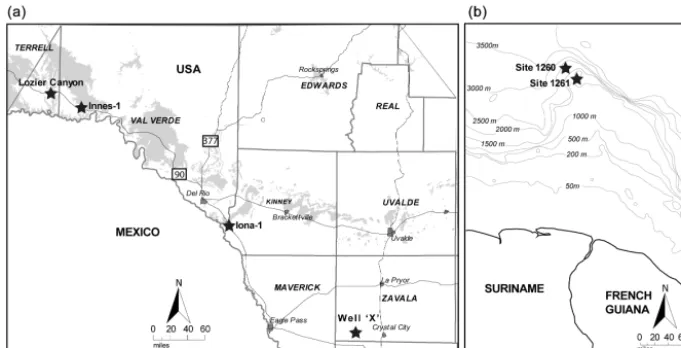
Figure 2.Site locations.(a)SW Texas map showing core locations (black stars): grey shading – Eagle Ford Gr., outcrop belt.(b)Demerara Rise site locations.
2015b). Subsequently, Dodsworth (2016) provided more de-tailed palaeoenvironmental interpretations from palynologi-cal assemblages primarily from the Eagle Ford Gr. exposed at the Lozier Canyon cliff section, Terrell County, west Texas, which is similar to the Innes-1 core (see below) and contains a significant unconformity (duration > 2 million years, Myr) within the Turonian. This unconformity is much less intense (duration < 0.2 Myr) in the more distal Iona-1 core.
This paper aims to build on and expand these previous con-tributions by (i) providing detailed palynological interpreta-tions of the Eagle Ford Gr. based on several locainterpreta-tions en-abling a more widespread geographic understanding, (ii) tegrating multidisciplinary datasets including organic and in-organic geochemistry allowing a greater understanding of the main palaeoenvironmental controls, and (iii) presenting new data analysed from sections further to the north in the KWIS (Portland-1 core) and to the south in the tropical At-lantic (ODP Leg 207, Demerara Rise; Figs. 1–2) and South-ern Ocean (ODP Leg 183, Kerguelen Plateau) to provide in-sights into supra-regional ocean circulation and water-mass evolution during the Cenomanian–Turonian greenhouse cli-mate state.
2 Material and methods
Core material from the Eagle Ford Gr., and bounding units in the Maverick Basin, west Texas, USA, were analysed for vi-sual kerogen analyses (palynology, palynofacies). The core material was sampled along a physiographic transect from the main Comanche carbonate shelf (Innes-1) towards the edge of the Maverick intra-shelf basin (Iona-1) and central part of the intra-shelf basin (well “X”; Figs. 1–2). Outcrop sections were also analysed in the San Marcos Arch area near Austin along the Bouldin Creek section. In order to com-pare data collected from the Eagle Ford Gr., with any
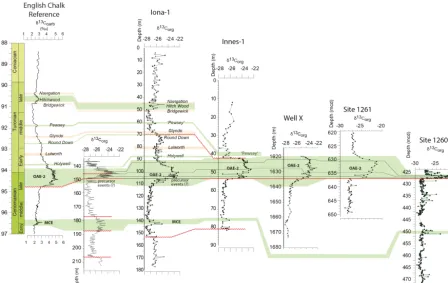
Figure 3.Isotope data and correlation between studied sites and the English Chalk Reference section. Data sources:δ13C for English Chalk (Jarvis et al., 2006), USGS Portland-1 (Joo and Sageman, 2014; Eldrett et al., 2014; Duvivier et al., 2014; Eldrett et al., 2015a, this study) ODP sites 1260-1261 (Erbacher et al., 2005; Friedrich et al., 2008) Note variable depth scales. Wavy horizontal red lines represent hiatal surfaces. Green shading, positiveδ13C isotope events; orange shading, negativeδ13C isotope events. Isotopic events nomenclature follows that of Jarvis et al. (2006), with the exception of precursor events (after Eldrett et al., 2014), which are now thought to occur within the OAE-2 CIE but in the section not recorded at Portland-1 core or the Pueblo GSSP due to the hiatal surface at the base of the Bridge Creek Limestone.
palaeoclimatic interpretations. Details of site locations and methodologies employed are presented in the Supplement.
3 Results
The following section describes some of the key results that are referred to in the Discussion section and presented in Figs. 3–11. Detailed results and data are presented in the Sup-plement and data file.
3.1 Organic carbon-isotope stratigraphy
Significant organic carbon isotopic differences are observed throughout the studied interval. The Buda Limestone records δ13Corgvalues∼ −26 ‰ and becomes more negative within the Eagle Ford Gr., where background values are ∼ −27 to
−28 ‰ for Iona-1, Innes-1 and well “X”. From these back-ground levels, five notable positive and three negative car-bon isotope excursions (CIEs) of varying magnitudes were recognized. These excursions can be correlated with the En-glish Chalk reference section of Jarvis et al. (2006; see El-drett et al., 2015a, for a detailed discussion of
860 J. S. Eldrett et al.: Water-mass evolution in the Cretaceous Western Interior Seaway
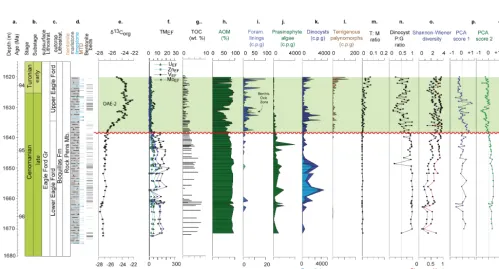
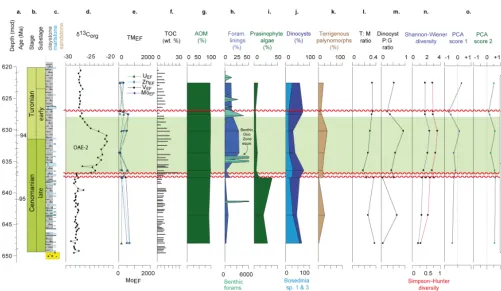
Figure 4.Iona-1 core data.(a)depth/age;(b)chronostratigraphy;(c)lithostratigraphy;(d)lithology;(e)δ13Corg;(f)redox-sensitive trace metal enrichments (TMEF);(g)TOC;(h)AOM;(i)foraminiferal test linings, with micropalaeontological abundance data as counts per gram (c.p.g) for both calcareous (Calc.) and agglutinated (Agglut.) benthic foraminifera;(j)prasinophyte algae;(k)dinocysts,Bosediniacf. sp. 1 & 3;(l); terrigenous palynomorphs;(m)T :Mratio;(n)dinocystP:Gratio;(o)Shannon–Wiener and Simpson–Hunter dinocyst diversity; (p)principle component results: eigenscore 1, eigenscore 2;(q)sequence stratigraphic interpretations (see Supplement); and(r)inferred relative sea level history (after Minisini et al., 2017), with Milankovitch orbital frequencies (after Eldrett et al., 2015a, b).
3.2 Geochemistry
3.2.1 Southern KWIS (Texas)
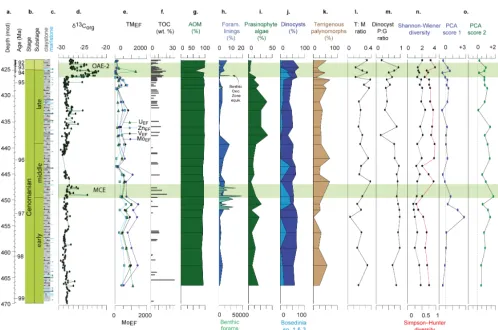
The Buda Limestone (early Cenomanian, ca. 98–97.5 Ma) is characterized in the Iona-1 core by high percentage of calcium oxide (CaO, > 45 wt %) and low percentages of aluminium oxide (Al2O3: < 2 wt %), silicon dioxide (SiO2: < 6 wt %) and titanium dioxide (TiO2: < 1 wt %). Exceptions occur in the interbedded bentonite layers that record higher values of Al2O3 (> 10 wt %), SiO2 (> 25 wt %) and TiO2 (∼1 wt %). Redox-sensitive trace metal concentrations and enrichment factors (EFs) in the limestones are low with molybdenum (Mo), uranium (U) and vanadium (V) record-ing < 1 ppm/< 2 EF, < 2 ppm/< 4 EF and < 20 ppm/< 2 EF re-spectively. The lower Eagle Ford Gr. (ca. 97.2–94.9 Ma) is characterized by high TOC and concentrations of redox-sensitive trace metals that are enriched compared to aver-age shale. In particular, the basal most part of the lower Eagle Ford Gr. at Iona-1 (153–144 m) records the highest trace metal enrichments with MoEF=ave. 400, UEF=12 and VEF=17. These trace metal enrichments decline sharply at the base of the MCE interval (143.37–142.27 m), after which they increase again and become relatively enriched
Bouldin Creek outcrop locality was not analysed for trace metals as part of this study.
3.2.2 Central KWIS (USGS Portland-1, Colorado) The Dakota Sandstone and Graneros Shale interval in the USGS Portland-1 core (213 to 175 m; ∼100–95.8 Ma; Fig. 8) is predominantly comprised of high relative con-centrations of SiO2 (ave. ∼60 wt %) and Al2O3 (ave.
∼15 wt %). The Thatcher Limestone interval (∼185 m;
∼96.5 Ma) is represented by a single sample that records a slight relative increase in CaO (∼8 wt %), but it is unlikely that this sample adequately represents or resolves the var-ied lithological endmembers recorded in this interval. A rel-ative increase in CaO is recorded from the base of the Lin-coln Shale Mb. to near the top of the Hartland Shale Mb. (175.29–150 m; 95.8–94.7 Ma), reaching up to 25 wt % and then increasing substantially to∼40 wt % CaO marking the lithological break of the base of the Bridge Creek Limestone Mb. (∼148.6 m).
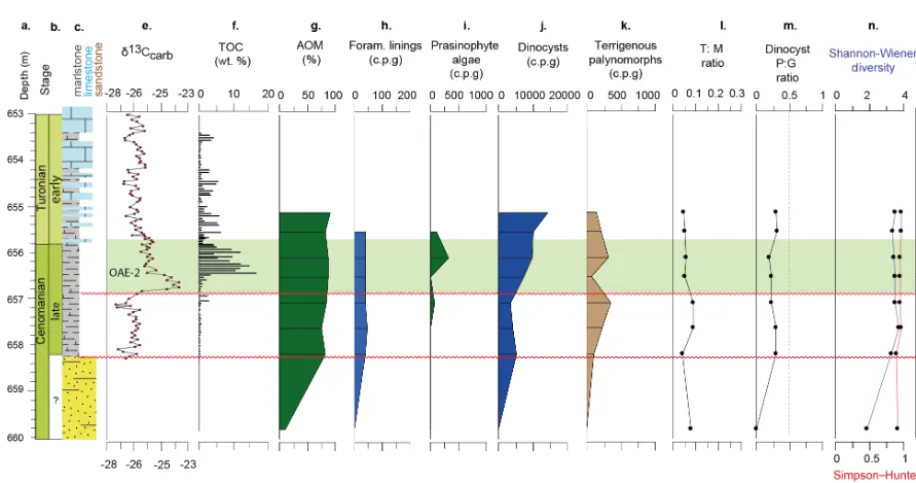
Throughout the Dakota Sandstone and Graneros Shale in-tervals the majority of the redox-sensitive trace metals record low concentrations and are not significantly enriched com-pared to average shales (e.g. U, V, Ni, Cu, Zn), and Mo is only slightly enriched (MoEF=ave. 3; ppm=ave. 4 ppm; Fig. 8). Redox-sensitive trace metal concentrations increase slightly in the Lincoln Shale Mb. and only become signif-icantly enriched in the Portland-1 core during the deposi-tion of the Hartland Shale Mb. The overlying Bridge Creek Limestone Mb. and in particular the interval recording the OAE-2 CIE is characterized by an overall reduction in redox-sensitive trace metals and lack of significant enrichments compared to average shale values. However, variations in redox-sensitive trace element enrichments are recorded in the marlstone and limestone couplets of the Bridge Creek Lime-stone Mb.
3.2.3 Demerara Rise, Atlantic Ocean (ODP Leg 207, sites 1260 and 1261)
The pre-OAE-2 sediments recovered from ODP sites 1260 and 1261 record high and variable values of CaO (25– 50 wt %) which decline substantially during the OAE-2 in-terval as SiO2 values increase with maximum values of 47 and 23 wt % recorded for each site respectively (see data file in the Supplement). At Site 1260 in the lower part of the studied interval (445.19 and 462.7 m composite depth, m c.d.) high concentrations of redox-sensitive trace metals are recorded that are significantly enriched compared to av-erage shale (see data file in the Supplement; Fig. 9). Con-centrations and enrichments of the redox-sensitive trace met-als decline from these high values around ∼443 m.c.d. and reach minima during part of the OAE-2 CIE interval (426– 423 m.c.d.) but still remain enriched compared to average shale (UEF=10; MoEF=25; VEF=4). This same trend is
mirrored in the sedimentary record from Site 1261, with minima enrichment values recorded during the OAE-2 CIE interval (albeit in lower resolution) that, even though rela-tively low compared with the pre-OAE-2 interval, are still en-riched compared to average shale (minima values: UEF=12; MoEF=46; VEF=5; Fig. 10).
3.3 Palynology
Detailed palynological results and data tables are presented in the Supplement and displayed in Figs. 4–11.
4 Discussion
4.1 Principal component analysis (PCA)
In order to provide additional understanding into the main controls on organic matter composition and palaeoenviron-mental significance, PCA was initially conducted on the pa-lynological and geochemical datasets separately and then on the integrated palynological and geochemical dataset. All three analyses showed the similar principal components and clusters and in support of the discussion only the PCA results run on the combined dataset are presented. The combined dataset PCA was run on cores that had multiple detailed analyses from the same core sample/depth, including Innes-1, Iona-Innes-1, well “X”, USGS Portland-1 and ODP sites 1260 and 1261 using the statistical software C2 (http://www.staff. ncl.ac.uk/stephen.juggins/software/C2Home.htm). Variables within the dataset include palynology, major and trace el-ements, δ13Corg and TOC. The PCA results show a clear grouping of samples along the two primary axes (Fig. 12).
862 J. S. Eldrett et al.: Water-mass evolution in the Cretaceous Western Interior Seaway
Figure 5.Innes-1 core data. Legend same as Fig. 4. Lithology after Minisini et al. (2017).
Figure 7.Bouldin Creek outcrop (AU-2) data. Legend same as Fig. 4. Lithology after Minisini et al. (2017).δ13Corgand TOC (wt %) from Lowery et al. (2014)
864 J. S. Eldrett et al.: Water-mass evolution in the Cretaceous Western Interior Seaway
Figure 9.ODP Site 1260 data. Legend same as Fig. 4.δ13Corgdata from Erbacher et al. (2005); Friedrich et al. (2008). Benthic foraminiferal abundance data from Friedrich et al. (2006).
2015b). Therefore, the clustering of the environmental vari-ables along the axis/eigenscore 1 is interpreted as repre-senting the carbonate–non-carbonate/volcaniclastic mixing trend.
Axis/eigenscore 2 is interpreted to represent a re-stricted/eutrophic/anoxic to open marine/oligotrophic/oxic marine trend influencing the water column and/or sediment– water interface, with high positive scores associated with high values in TOC, redox-sensitive trace metal concentra-tions, preservation of amorphous organic matter (AOM) and assemblages dominated by prasinophyte phycomata, the lat-ter are indicative of eutrophic and stratified walat-ter column conditions (see Prauss, 2007)
It is also noted that high eigenscores are associated with dinocyst assemblages dominated by peridinioid (P) cysts and particularly taxa comparable to those informally de-scribed from Tarfaya, Morocco, by Prauss (2012a, b): Bose-dinia cf. sp 1 & 3 of Prauss (2012b) (photographic illus-trations are provided in the Supplement). Sporadically com-mon/abundant occurrences ofBosediniasp. 1 & sp. 3 were recorded in the Cenomanian and Turonian of Tarfaya by Prauss (2012a, b), where it is often associated with common occurrences of the colonial green alga Botryococcus; high
in-Figure 10.ODP Site 1261 data. Legend same as Fig. 4. δ13Corg data from Erbacher et al. (2005) and Friedrich et al. (2008). Benthic foraminiferal abundance data from Friedrich et al. (2006).
dicators for eutrophic and anoxic marine conditions, poten-tially representing the enhanced nitrite/nitrate availability in the photic zone (see Dodsworth, 2016). During the Cenoma-nian Stage, abundances ofBosediniacf. sp 1 & 3 are confined to middle–lower latitudes (Prauss 2012a, b; this study), be-ing absent from higher-latitude records (e.g. Foucher, 1980; Jarvis et al., 1988, 2011; Fitzpatrick, 1995; Pearce et al., 2003, 2009; Lignum, 2009), and is thus interpreted to have a Tethyan equatorial central Atlantic affinity (see Supplement). The high negative eigenscores along axis 2 correspond with proxies associated with open marine oligotrophic con-ditions such as gonyaulacoid dinocysts (G cysts) includ-ing Spiniferitesspp. andPterodiniumspp.; the latter shows affinity with modern-day Impagadinium spp., which is found in oceanic and open marine conditions (Wall et al., 1977; Zonneveld et al., 2013). High negative eigenscores are also associated with proxies indicative of more oxy-genated water conditions such as higher concentration of the redox-sensitive trace metal manganese oxide (MnO) and foraminiferal test linings. The negative eigenscores are there-fore interpreted as representing an open marine, oxygenated and oligotrophic depositional environment. In addition, it is interesting to note that although phytoclasts plot nega-tively along eigenaxis 2 and may represent a reduced mask-ing effect of AOM durmask-ing oxygenated conditions (Tyson, 1995); they also plot positively along eigenscore 1
(non-carbonate/volcaniclastic trend) alongside freshwater algae and areoligeracean dinocysts; the latter are more sugges-tive of a more nearshore environment (see Brinkhuis and Zachariasse, 1988; Harker et al., 1990; Li and Habib, 1996). In addition, a component of this trend may also represent recycling and transportation of nearshore palynomorphs to relatively distal environments. The eigenscores are plotted against depth for each of the sites (Figs. 4–6, 8–10) to further support the palaeoenvironmental interpretation as discussed below.
4.2 Palaeoenvironmental interpretation 4.2.1 Southern KWIS
866 J. S. Eldrett et al.: Water-mass evolution in the Cretaceous Western Interior Seaway
Figure 11.ODP Site 1138 data. Legend same as Fig. 4.δ13Corgand TOC data from Dickson et al. (2016).
(e.g. Cookson and Hughes, 1964) and France (e.g. Foucher, 1980).
The overlying lower Eagle Ford Gr. interval (ca. 97.2– 94.9 Ma) is generally characterized by a decline in dinocyst species diversity, with the palynological assemblages com-prising high absolute abundance of prasinophyte phycomata, withP cysts being the major component of the dinocyst com-munity indicative of eutrophic and stratified water column conditions (see Prauss, 2007; Sluijs et al., 2005). This in-terpretation is supported by PCA results reflecting the en-richment and co-variance in redox-sensitive trace metals and high TOC values combined with low but sporadic occur-rences of benthic foraminifera indicative of restricted and suboxic-anoxic depositional conditions (see also Eldrett et al., 2014). Furthermore, the presence of aryl isoprenoids in the lower Eagle Ford Gr. section from Iona-1 has been demonstrated as originating fromChlorobi(green sulfur bac-teria) and is thus evidence for at least temporary and/or par-tial photic zone euxinia at this time (Sun et al., 2016). Bed-scale variations are also identified in redox conditions record-ing greater water-mass ventilation and current activity durrecord-ing the deposition of limestone beds compared to deposition of marlstone beds due to combined obliquity and precessional forcing on solar insolation (Eldrett et al., 2015b). Compara-ble palynological assemblages have not been reported from the middle to upper Cenomanian deposits in Europe but high relative abundances of prasinophyte phycomata and the peri-dinioid genusBosediniahave been documented further south in the Cenomanian and Turonian organic-rich shale facies at Tarfaya in north Africa (Prauss 2012a, b).
Within the middle part of the lower Eagle Ford Gr. (∼96.1–95.4 Ma) the relative abundance contribution of prasinophyte phycomata to the palynological assemblage de-creases as the absolute abundance of theP cystBosedinia cf. sp. 1 & 3 significantly increases. This shift in the pa-lynological assemblage is recorded in all the studied sec-tions including the San Marcos Arch outcrop, as well as in the nearby Lozier Canyon outcrop section (Dodsworth, 2016). As discussed in Sect. 4.1, the abundance of Bose-diniasp. 1 & sp. 3 had previously been interpreted as reflect-ing the occurrence of freshwater/brackish water conditions in the photic zone at Tarfaya and episodic salinity stratification there (Prauss 2012a, b, c), but in the absence of freshwater algae and the combined PCA results for the studied sections this interpretation is not supported here for the KWIS or De-merara Rise. Alternatively, Dodsworth (2016) proposed that the introduction of waters from respectively deeper denitri-fication zones into photic zone by vertical expansion of the oxygen-minimum zone or by upwelling may be a controlling factor, with reduced nitrogen/ ammonium favouring prasino-phyte algal production (see Prauss 2007) and availability of nitrite/nitrate promotingP cyst (e.g.Bosediniasp. 1 & sp. 3) productivity in the surface waters.
enrich-Figure 12.PCA results showing principle axis/eigenscores; selected environmental variables. Samples plotted as a function of site location (see insert) and lithostratigraphic interval (colours; groups in figure).
ments, lowered TOC, increased bioturbation and occurrence of benthic foraminifera indicate deposition within an open marine meso-oligotrophic and oxygenated depositional en-vironment (also see Eldrett et al., 2014). By contrast, in some European depositional basins, e.g. eastern England, northern Germany and Crimea, uppermost Cenomanian to lower Turonian deposits associated with OAE-2 are char-acterized by intervals of interbedded organic-rich mudrocks with limestones; the former contain isolated influxes of prasinophyte phycomata and higher numbers ofP cysts than under- and overlying formations (Marshall and Batten, 1988; Dodsworth, 1996, 2004; Prauss, 2006), whereas limestone deposition, lean in organic matter, is continuous in other ar-eas, e.g. southern England–northern France. The relative in-crease in theT :M ratio during OAE-2 in the studied sec-tions presented here likely reflects the closed-sum effect as absolute abundance of marine palynomorphs decreases dur-ing the upper Eagle Ford (transition from eutrophic to meso-oligotrophic conditions). Absolute abundance of terrestrial palynomorphs does not increase significantly, although this may partly reflect greater distance from shoreline during the Cenomanian–Turonian transgression and potentially di-luted concentration of all palynomorphs including pollen
868 J. S. Eldrett et al.: Water-mass evolution in the Cretaceous Western Interior Seaway
(see Eldrett et al., 2014). In addition, the Ti/Al record may also reflect alteration of biotite from the ubiquitous felsic vol-canic ash beds rather than solely aeolian versus fluvial in-puts, and the links with gymnosperm abundances could have resulted from changes in climate and/or oceanographic con-ditions resulting from these large-scale and regional igneous events.
The PCA results indicate occasional dysoxia–anoxia within the upper Eagle Ford Gr. interval, which becomes more persistent in the upper part of the Langtry Mb. as in-dicated by slight enrichment in redox-sensitive trace metals and palynological assemblages recording reduced dinocyst diversity and enhanced abundances of prasinophyte phyco-mata. This interpretation seems to contrast with the sedi-mentological evidence that preserves bioturbated marlstones and nodular limestones along with shell hash horizons form-ing symmetric ripples and abundant in situ macrofauna (i.e. echinioids), all indicative of a high-energy dynamic envi-ronment (Minisini et al., 2017). It may be the case that short-lived storm and oxic events are not resolved at our sampling resolution as bulk geochemical and palynological data integrates longer time periods; alternatively, we resolve short-lived periods of dysoxia–anoxia that are subsequently smeared and re-distributed by bioturbation within a back-ground environment characterized by high-energy and well-oxygenated conditions. It should be noted that similar abun-dance increases in prasinophyte phycomata are recorded in the upper part of the South Bosque Formation at the Bouldin Creek outcrop and in the Lozier Canyon outcrop section (Dodsworth, 2016). The occurrences of prasinophyte phyco-mata in the Lozier Canyon outcrop were thought to repre-sent an artifact of their preferential preservation in weathered material (Dodsworth, 2016); however, compared to the re-gional trends identified in the well-preserved core alongside trace metal enrichments, this suggests a genuine transition to at least partially and/or episodically dysoxic–anoxic de-positional environment. The limestones of the Austin Chalk record a return to open marine and persistently oxygenated conditions supported by the PCA results reflecting very di-verse dinocyst assemblages, comprising mainlyGcysts with abundant foraminiferal test linings, reduced AOM and no en-richments in redox-sensitive trace metals.
4.2.2 Regional water-mass evolution
In this study we infer three main water masses: (i) equato-rial Atlantic Tethyan source, (ii) a northern boreal source and (iii) a more local central KWIS source. The equatorial Atlantic-sourced water is primarily based on the occurrence of dinocysts and other microfauna (i.e. calcareous nanno-fossils and foraminifera) that are geographically restricted to low latitudes and specifically equatorial Atlantic with in-ferred Tethyan affinities (e.g.Bosediniacf. sp 1 & 3; see dis-cussion below). The surface waters of this water mass are characterized by low-diversity dinocyst assemblages
domi-nated byP cysts and prasinophyte phycomata indicative of stratified and hydrographically restricted and eutrophic con-ditions (this study), whilst the correspondence with the pres-ence of isorenieratene derivatives (i.e. Sinninghe Damsté and Köster, 1998; Kuypers et al., 2002; Kolonic et al., 2005; van Bentum et al., 2009; Sun et al., 2016) demonstrates at least temporary and/or partial photic zone euxinia. The underlying bottom water, or at least sediment–water interface, was pre-dominantly dysoxic–anoxic as evidenced by the enrichment in redox-sensitive trace metals and relatively sparse benthic foraminifera (i.e. Hetzel et al. 2009; Eldrett et al., 2014). The northerly sourced water mass is constrained by the oc-currence of dinocysts with a boreal affinity (see Eldrett et al., 2014; van Helmond et al., 2014, 2016), combined with the increased planktonic diversity and dominance ofGcysts that are associated with more oligotrophic/hydrographically unrestricted conditions. The absence of prasinophyte algae point towards a mixed water column (see Prauss, 2007), and the overall low values in redox-sensitive elements and in-creased abundance and diversity of benthic fauna along with enhanced bioturbation indices (e.g. Meyers et al., 2007; El-drett et al., 2014) indicate frequent ventilation of the bottom waters and/or sediment–water interface. A more local and partially restricted dysoxic water mass sourced by the central KWIS is interpreted based on the occurrence of mixed mod-erate diversity dinocyst assemblages, including taxa more typical of the northern and central KWIS, with rare Tethyan components combined with limited enrichment in redox-sensitive elements and abundance of low-diversity aggluti-nated benthic foraminifera assemblages (see discussion be-low). It should be noted that, within these regional water-mass regimes, higher-frequency variations in redox state are documented, in part a response to obliquity and precession forcing on the latitudinal distribution of solar insolation (see Eldrett et al., 2015b). Comparing the palaeoenvironmental trends recorded in the Cenomanian–Coniacian sections from SW Texas to those recorded further north within the cen-tral KWIS (USGS Portland-1; Pueblo GSSP outcrop) and to the south in the equatorial North Atlantic (ODP sites 1260, 1261, Demerara Rise) allows the reconstruction of water-mass evolution (Fig.13–14). A discussion of dinocyst and pollen palaeo-latitudinal provincialism across these regions during Cenomanian and Turonian times is given in the Sup-plement.
south-Figure 13.Cenomanian–Coniacian chronostratigraphic correlation of interpreted water masses along a south–north transect from the equato-rial western Atlantic to the central Cretaceous Western Interior Seaway (KWIS). The KWIS compositeδ13Corgafter Joo and Sageman (2014) and including data from Du Vivier et al. (2014), Eldrett et al. (2015a) for USGS Portland-1 (orange), plus data from Iona-1 (blue), Innes-1 (black) and well “X” (green) cores calibrated using the age model of Eldrett et al. (2015a). Stacked curves showing principal palynologi-cal components (legend on figure). Palaeo-SST and TEX86record from ODP Site 1260 from Forster et al. (2007). Colour shading: green, Tethyan-sourced water from the equatorial Atlantic; blue, northerly boreal water mass; brown, locally sourced KWIS water mass. Green dashed arrows indicate Tethyan incursions; blue arrows indicate boreal influence. Principal component analysis (PCA) score axis 2: positive indicative of eutrophic/anoxic waters; negative indicative of oxygenated oligotrophic waters (see Fig. 12).
ern part of the KWIS, the early Cenomanian is character-ized by the deposition Buda Limestone, which is primarily characterized by well-oxygenated conditions. The first in-cursion of an equatorial Atlantic Tethyan water mass into southern Texas occurred at 97.2 Ma (t1; Fig. 14), marked by the hummocky cross-stratified limestones and mass trans-port deposits interbedded with organic-rich sediments that characterize the lowermost Eagle Ford Gr., above the top Buda limestone submarine unconformity (see Minisini et al., 2017). In the central KWIS (Portland-1 core), the early Ceno-manian is characterized by relatively dysoxic depositional conditions, with frequent to common prasinophyte phyco-mata and mixed dinocyst assemblages, including taxa more typical of the northern and central KWIS such as Senoni-asphaera microreticulata andPalaeoperidinium cretaceum, and the first consistent but mainly rare occurrence of Bose-diniacf. sp 1 & 3, which is common in coeval deposits at Demerara Rise, along with low-diversity agglutinated ben-thic foraminifera (Fig. 8) and the occasional occurrence of
or-870 J. S. Eldrett et al.: Water-mass evolution in the Cretaceous Western Interior Seaway
Figure 14. Regional water-mass depositional model of the KWIS. Time slices (t1–t5) showing the northward flow of eutrophic/anoxic Tethyan equatorial Atlantic water into the Western Interior Seaway and southward flow of a boreal water mass. Milankovitch orbital frequen-cies of eccentricity, obliquity and precession from the Iona-1 core (Eldrett et al., 2015a) resulting in shorter-term (< 0.1 Myr) development of limestone–marlstone couplets (Eldrett et al., 2015b). GoM: Gulf of Mexico. Sea level curve after Minisini et al. (2017).
der to better resolve the detail and timing of these palaeo-ceanographic variations, higher-resolution multi-proxy anal-yses are required. In the Portland-1 core there is a clear shift from agglutinated to calcareous benthic foraminifera near the top of the MCE interval, which, combined with the in-creased abundances of calcareous planktonic foraminifera (e.g. Rotalipora cushmani) and dinocysts (e.g. Bosedinia cf. sp. 1 & 3) with Tethyan affinities, is suggestive of an equa-torial Atlantic Tethyan influence (Fig. 8; for a detailed dis-cussion of Tethyan–boreal foraminiferal distribution within Colorado, see Eicher and Diner, 1985). However, it is only during the deposition of the middle part of the Lincoln Shale (∼95.6 Ma) that abundant prasinophyte phycomata, increased trace metal enrichments and reduced dinocyst di-versity point towards a persistent influence of an equatorial Atlantic Tethyan water mass. These proxies reach maxima along with the abundance of Bosediniacf. sp. 1 & 3 dur-ing the deposition of the Hartland Shale Mb. (∼95 Ma; t2: Fig. 14), indicating the marine transgression of equatorial Atlantic Tethyan waters into the KWIS and mirrors the third-order eustatic Greenhorn cycle (Kauffman, 1977) reaching
the maximum flooding at∼94.7 Ma (see supplemental in-formation). The long-term (third-order) trends in water-mass evolution reported here are therefore likely driven by vari-ations in eustasy related to regional tectonic and/or mantle plume–lithosphere dynamics associated with the emplace-ment of LIPs (i.e. high Arctic, Caribbean) during this green-house period lacking polar continental ice-sheets.
water mass into the central and southern KWIS and is sup-ported by the equatorial migration of boreal dinocyst taxa (e.g. Cyclonephelium compactum–membraniphorum mor-phological plexus; Eldrett et al., 2014; van Helmond et al., 2016), occurring during a period of climate cooling with minima (3–5◦C cooling) during the PCE (Jarvis et al., 2011; van Helmond et al., 2014, 2016; Elderbak and Leckie, 2016). Therefore, the increase in abundance and diversity of foraminiferal/molluscan and ammonite assemblages in the KWIS (McNeil and Caldwell, 1981; Kauffman, 1984, 1985; Eicher and Diner, 1985; Elder, 1985; Leckie et al., 1998; Caldwell et al., 1993; Kauffman and Caldwell, 1993, El-derbak and Leckie, 2016) and the lithologic transition from organic-rich mudrocks to limestone-dominated facies (Cor-bett et al., 2014; Lowery et al., 2014) in the latest Ceno-manian does not reflect the incursion of Tethyan water but instead the southward flow of a boreal water mass at this time. Comparable dinocyst assemblages including diversi-fiedGcysts are recorded (i) in the Canadian KWIS through-out the Cenomanian and Turonian (e.g. Singh, 1983; Bloch et al., 1999), albeit with higher numbers of boreal P-cyst taxa includingIsabelidinium magnumandEurydinium glom-eratum, and (ii) in coeval sediments from European shelves (e.g. Foucher, 1980; Jarvis et al., 1988, 2011; Fitzpatrick, 1995; Pearce et al., 2003, 2009; Lignum, 2009), which also correspond with the influx of boreal macro-fauna (Jefferies, 1962, 1963; Gale and Christensen, 1996; Voigt et al., 2006; Jarvis et al., 2011). Evidence for the southward incursion of a northerly sourced water mass during the latest Ceno-manian is recorded in all the studied sections spanning the central and eastern part of the KWIS and therefore does not support a more complex oceanographic system such as that modelled by Slingerland et al. (1996) and Kump and Slinger-land (1999). The data presented here indicate that the ini-tial inflow of equatorial Atlantic Tethyan water across the southern gateway is completely replaced by the almost si-multaneous southward flow of boreal water (see also van Helmond et al., 2016), with no evidence for a contempora-neously counter-flowing Tethyan water mass along the east-ern margin. However, based on the limited geographic extent of the studied sections these findings are considered tenta-tive, with additional palynological and geochemical investi-gations on the eastern margin of the KWIS being required to constrain the lateral variability in possible water-mass prop-erties.
Although the migration of boreal dinocyst taxa (namely theCyclonephelium compactum–membraniphorum morpho-logical plexus; van Helmond et al., 2016) during the PCE is not recorded further to the south in the equatorial North At-lantic; a similar shift in palynological assemblages, includ-ing a marked decline in prasinophyte algae, is recorded in the shallower shelf settings on Demerara Rise (ODP Site 1261). Furthermore, at ODP Site 1261, the recorded shift towards a more diverse and open-marine dinocyst assem-blage is also associated with an increase in the abundance of
organic foraminiferal test linings and re-population by cal-careous benthic foraminifera (Friedrich et al., 2006, 2011), which, combined with a reduction in redox-sensitive trace metals, may indicate an improvement in environmental con-ditions, and a reduction in the oxygen minimum zone. How-ever, it should be noted that organic matter concentration re-mains high. This shift in environmental conditions also corre-sponds with a sea surface temperature minimum in the lower part of the OAE-2 CIE (up to 4◦C; Forster et al., 2007) on the flank of Demerara Rise (ODP Site 1260) and perhaps marks the southernmost influence of a boreal water mass. However, in Site 1260Bosediniacf. sp.1 & 3 remains abundant despite the decline in both prasinophyte algae and redox trace metals and the associated increase in benthic foraminifera, indicat-ing more complex interaction between water masses and the oxygen minimum zone along the slope. The southern expres-sion of this boreal influence is therefore limited in duration and extent, mostly affecting shallower water settings. These findings are consistent with Neodymium (Nd) isotope data from Demerara Rise indicative of circulation pattern change in the Atlantic- Tethys at this time (Zheng et al., 2016; Martin et al., 2012).
unconfor-872 J. S. Eldrett et al.: Water-mass evolution in the Cretaceous Western Interior Seaway
Figure 15.(a)Logarithmic plot of Mo:U covariance for the studied sections. Diagonal dashed lines represent multiples (0.3, 1, and 3) of Mo:U ratio (3) of present-day seawater (SW). Values greater than 3 times SW are generally associated with the particulate shuttle, whereas those trending with modern-day seawater reflect an unrestricted marine trend with a weak positive Mo:U covariance.(b)Mo–TOC covariance data for studied sections compared to modern anoxic silled-basin environments (after Tribovillard et al., 2012). Regressions of the modern datasets are shown as solid lines with MO/TOC regression slopes displayed (Tribovillard et al., 2012). The proposed refractory organic matter trend is added as a dashed line.
mity that marks the initial flooding of the southern KWIS by Tethyan waters, the other hiatal surfaces identified through-out the KWIS appear to be associated with increased bottom-water current activity linked to regional climatic and/or tec-tonic subsidence-induced incursions of boreal water that ven-tilated the seaway rather than solely to global eustatic drivers that are difficult to reconcile with a greenhouse world without significant polar ice. The development of coeval hiatal inter-vals is also recorded near the top and base of the OAE-2 CIE in the Bonarelli interval, Italy, where vigorous bottom cur-rents were proposed to be induced by warm and dense saline deep waters that originated on tropical shelves in the Tethys and/or proto-Atlantic Ocean (Gambacorta et al., 2016). Al-though our contribution proposes an alternative mechanism for invigorated circulation, it further supports the suggestion by Gambacorta et al. (2016) that enhanced current activity and associated oceanographic circulation was much more dy-namic than previously thought during times of greenhouse climates, when conditions were thought to be more equitable.
4.2.3 Global trace metal draw-down during OAE-2 During the Cenomanian, sediments influenced by equato-rial Atlantic Tethyan waters record redox-sensitive trace met-als that are enriched compared to average shale, in particu-lar molybdenum (Mo), which requires free H2S for authi-genic sedimentary enrichment (Helz et al., 1996) and is in-terpreted as reflecting anoxic to euxinic depositional condi-tions favouring organic matter preservation (see Algeo and
Lyons, 2006). The relative enrichment of Mo compared to the other redox elements such as U and V in the pre-OAE-2 lower Eagle Ford Gr. suggests an active cycling of Mn–Fe particulates (especially manganese oxyhydroxides) between the water column and sediment water interface characteris-tic of a “parcharacteris-ticulate shuttle” (Algeo and Tribovillard, 2009; Tribovillard et al., 2012; Fig. 15a). The presence of aryl iso-prenoids in this interval from the Iona-1 core also supports at least temporary and partial water column (photic zone) eux-inia at this time (Sun et al., 2016).
However, there are three main challenges to the applica-tion of Mo/TOC gradients to infer global trace metal inven-tory draw-down during OAE-2. Firstly, during the OAE-2 in-terval in the KWIS, Demerara Rise and Kerguelen Plateau, the weak positive co-variance between Mo and U indi-cates deposition along the unrestricted open marine trend (Fig. 15a; see also Eldrett et al., 2014), an interpretation supported by the palynological assemblages presented here. Therefore, during the OAE-2 interval, these localities were not subject to significant hydrographic restriction (e.g. silled basins), being deposited instead along continental margins. Thus, the application of modern-day Mo/TOC gradients to infer hydrographic restriction and trace metal draw-down for OAE-2 may not be valid and requires additional study (see discussion in Algeo and Lyons, 2006).
Secondly, as Mo is mostly incorporated into organic mat-ter, we propose that the various contributions of different types of organic matter would affect Mo/TOC gradients. Whereas sulfurized organic matter is known to enhance Mo uptake by the sediment (Tribovillard et al., 2004), the impact of variable contributions of labile versus refractory organic matter is not well constrained. The palynological analyses presented here demonstrate increased contribution of refrac-tory terrigenous organic matter (>T :M ratio) in the sam-ples with low Mo/TOC values from the KWIS and Demer-ara Rise (Fig. 15b). We cannot determine the impact of this observation as theT :Mratio reflects a relatively small pro-portion of the total refractory organic matter; however, fur-ther investigation is warranted into the variable origin of the more dominant and relatively unknown component, namely AOM, and whether Mo is preferentially incorporated within different organic matter components.
Thirdly, in all the sections presented here the depletion in redox-sensitive trace metals during OAE-2 is associated with either oxygenated depositional conditions or an improvement in redox state. Therefore, the recorded depletion in redox-sensitive trace metals, in particular Mo, may instead record a genuine environmental response to benthic oxygenation pre-venting authigenic sedimentary enrichments as, under oxic conditions, Mo is present in seawater as the stable and largely unreactive molybdate oxyanion. These observations are in-terpreted to be related to the equatorial migration of boreal water masses promoting water column de-stratification and partial ventilation/re-oxygenation of the surface to deep wa-ters.
These challenges were partly addressed by Dickson et al. (2016), who proposed that the recorded low Mo/TOC gradients from Site 1138, Kerguelen Plateau, reflected the widespread and global nature of trace-metal depletion dur-ing OAE-2 by demonstratdur-ing that (i) localized oxygenation was also not responsible due to Mo isotope compositions and (ii) organic matter type was not a control due to the low abun-dance of terrigenous material. Palynological investigation of these sediments (this study) confirms the low abundance of terrigenous material at Site 1138. In addition, the dinocyst
assemblage recovered from this site is typical of a well-oxygenated boreal equivalent (austral) water mass with high diversity and abundance ofGcysts, notablyCyclonephelium compactum–membraniphorum dinocyst plexus, and outer neritic to open marine taxa such asSpiniferites ramosusand Pterodinium cingulatum. These findings would suggest de-position under the influence of an oxygenated and open ma-rine/hydrographically unrestricted austral (Southern Hemi-sphere) surface water mass on the Kerguelen Plateau, con-sistent with the relatively low δ98/95Mo values and Mo-U co-variance trends reflecting oxic-suboxic depositional con-ditions with at most sulfidic pore waters (Dickson et al., 2016). Furthermore, conditions at the sediment–water in-terface were sufficient for the presence of a low-diversity, high-carbon-flux benthic foraminifera biofacies (Holbourn and Kuhnt, 2002), as also indicated by the rare occurrence of organic linings of benthic foraminifera throughout the OAE-2 interval at Site 1138 (this study). Therefore, in addition to trace metal draw-down as an explanation to reconcile low Mo/TOC gradients and hydrologically unrestricted regime, it is possible that, even in the organic-rich laminated sed-imentary intervals (i.e. sites 1138 and 1260), a slight in-crease in oxic conditions related to the influence of oxy-genated high-latitude austral–boreal water masses may re-sult in aqueous H2S concentrations at the sediment–water interface being below the critical threshold for conversion of molybdate to thiomolybdate (Helz et al., 1996), result-ing in the observed depletion in Mo sedimentary concentra-tions and low Mo/TOC gradients during OAE-2. This in-terpretation is also supported by the occurrence of benthic foraminifera within the OAE-2 interval in both organic-rich and organic-lean sedimentary sections from Demerara Rise (Friedrich et al., 2006, 2011), Kerguelen Plateau (Holbourn and Kuhnt, 2002), Texas (Lowery et al., 2014; Dodsworth, 2016; this study) and central KWIS (e.g. Eicher and Worstell, 1970; Keller and Pardo, 2004; Elderbeck and Leckie, 2016; and references therein).
5 Conclusions
in-874 J. S. Eldrett et al.: Water-mass evolution in the Cretaceous Western Interior Seaway
terpretation of the evolution of various water masses along this north-south transect. The main findings are as follows:
1. High-latitude boreal and austral (Northern and South-ern Hemisphere) and equatorial Atlantic Tethyan water masses can be distinguished based on their distinct pa-lynological assemblages and geochemical signatures.
2. The northward flow of a suboxic-anoxic equatorial At-lantic Tethyan water mass into the Western Interior Seaway occurred during the early–middle Cenomanian, followed by a major re-organization of the oceano-graphic regime during the latest Cenomanian–Turonian as a full connection of the Western Interior Seaway with a northerly boreal water mass was established dur-ing peak transgression. This oceanographic change pro-moted de-stratification of the water column and im-proved oxygenation throughout the KWIS and as far south as the Demerara Rise.
3. These long-term trends in water-mass evolution are tentatively linked to third order eustatic transgression-regression cycles driven by regional Cordilleran tec-tonic and/or mantle plume–lithosphere dynamics asso-ciated with the emplacement of LIPs during this time as well as shorter-term variations in climate (i.e. Plenus Cold Event).
4. Low Mo/TOC ratios in the equatorial North Atlantic in comparison to other oceanic basins during the onset of OAE-2 argue for partial restriction and draw-down of global trace metal seawater inventories. However, this study demonstrates that the recorded decline in redox-sensitive trace metals during the onset of OAE-2 likely reflects a genuine oxygenation event related to open water-mass exchange at this time and/or is further com-plicated by variable contribution of organic matter from different sources (e.g. refractory/terrigenous material) that requires further evaluation.
Data availability. The supplementary data file is in the process of being archived at the data repository PANGAEA. The DOI of the dataset is https://doi.org/10.1594/PANGAEA.877411.
The Supplement related to this article is available online at https://doi.org/10.5194/cp-13-855-2017-supplement.
Author contributions. Paul Dodsworth conducted palynological analyses. Milly Wright was principal investigator for trace metal analyses and Daniel Minisini was principal investigator for core de-scription. James S. Eldrett, Steven C. Bergman and Daniel Minisini integrated and analysed the datasets. All authors co-wrote the paper.
Competing interests. James Eldrett, Steven Bergman and Daniel Minisini were all employees of Shell at the time of this work.
Acknowledgements. This paper used data generated on sedi-ments recovered and curated by the International Ocean Discovery Program. The authors thank Malcolm Jones and PLS Ltd for palynological preparations and Mark Phipps and John Gregory for micropalaoentological analyses at Petrostrat Ltd. In addition, we thank all our Shell colleagues who contributed, in particular Iain Prince for technical discussion and internal review and Shell Exploration and Production Inc. for permission to publish.
Edited by: Yves Godderis
Reviewed by: two anonymous referees
References
Adams, D. D., Hurtgen, M. T., and Sageman, B. B.: Volcanic triggering of a biogeochemical cascade during Oceanic Anoxic Event 2, Nat. Geosci., 3, 201–204, 2010.
Akyuz, I., Warny, S., Famubode, O., and Bhattacharya, J. P.: Paly-nology of the Turonian Ferron-Notom Sandstone, Utah: Identi-fication of marine flooding surfaces and Milankovitch cycles in subtropical, ever-wet, paralic to non-marine paleoenvironments, Palynology, 40, 122–136, 2016.
Algeo, T. J. and Lyons, T. W.: Mo–total organic carbon covariation in modern anoxic marine environments: Implications for analysis of paleoredox and paleohydrographic conditions, Paleoceanogra-phy, 21, PA1016, https://doi.org/10.1029/2004PA001112, 2006. Algeo, T. J. and Tribovillard, N.: Environmental analysis of
pale-oceanographic systems based on molybdenum-uranium covaria-tion, Chem. Geol., 268, 211–225, 2009.
Arthur, M. A. and Sageman, B. B.: Sea level control on source rock development: perspectives from the Holocene Black Sea, the mid-Cretaceous Western Interior Basin of North America, and the Late Devonian Appalachian Basin, in: The Deposition of Organic Carbon-rich Sediments: Models, Mechanisms and Con-sequences, edited by: Harris, N. B., Society for Sedimentary Ge-ology, Tulsa, 35–59, 2005.
Bloch, J. D., Schroder-Adams, C. J., Leckie, D. A., Craig, J., and McIntyre, D. J.: Sedimentology, micropaleontology, geochem-istry, and hydrocarbon potential of shale from the Cretaceous Lower Colorado Group in western Canada, Geological Survey of Canada, Bulletin 531, 1999.
Bralower, T. J. and Bergen, J. A.: Cenomanian-Santonian calcare-ous nannofossil biostratigraphy of a transect of cores drilled across theWestern Interior Seaway, in: Stratigraphy and paleoen-vironments of the Cretaceous Western Interior Seaway, USA, edited by: Dean, W. E. and Arthur, M. A., SEPM Concepts of Sedimentology and Paleontology, 6, 59–77, 1998.
Brinkhuis, H. and Zachariasse, W. J.: Dinoflagellate cysts, sea level changes and planktonic foraminifers across the Cretaceous-Tertiary boundary at El Haria, N.W. Tunisia, Mar. Micropaleon-tol., 13, 153–191, 1988.
Burchfiel, B. C., Cowan, D. S., and Davis, G .A.: Tectonic overview of the Cordilleran orogeny in the Western United States, in: The Cordilleran Orogon: Conterminous, US Geological Society of America, edited by: Burchfiel, B. C., Lipman, P. W., and Zoback, M. L., The Geology of North America, G-3,407–480, 1992. Caldwell, W. G. E., Diner, R., Eicher, D. L., Fowler, S. P., North, B.
R., Stelk, C. R., and von Holdt, W. L.: Foraminiferal biostratigra-phy of Cretaceous marine cyclothems, in: Evolution of the West-ern Interior basin: Geological Association of Canada Special Pa-per, edited by: Caldwell, W. G. E. and Kauffman, E. G., 39, 477– 520, 1993.
Christopher, R. A.: The occurrence of the Complexiopollis-Atlanopollis zone (Palynomorphs) in the Eagle Ford group (Up-per Cretaceous) of Texas, J. Paleontol., 56, 525–541, 1982. Cobban, W. A.: Diversity and distribution of Late Cretaceous
am-monites, Western Interior, United States, in: Evolution of the Western Interior Basin, edited by: Caldwell, W. G. E. and Kauff-man, E. G., St. John’s, NL: The Geological Association of Canada Special Paper, 39, 435–451, 1993.
Cookson, I. C. and Hughes, N. F.: Microplankton from the Cam-bridge Greensand (mid-Cretaceous), Palaeontology, 7, 37–59, 1964.
Corbett, M. J., Watkins, D. K., and Popspichal, J. J.: A quantita-tive analysis of calcareous nannofossil bioevents of the Late Cre-taceous (Late Cenomanian-Coniacian) Western Interior Seaway and their reliability in established zonation schemes, Mar. Mi-cropaleontol., 109, 30–45, 2014.
Cornell, W. C.: Dinoflagellate cysts from the Buda limestone (Ceno-manian), Cerro de Cristo Rey, Dona Ana county, New Mexico, Rev. Palaeobot. Palyno., 98, 153–157, 1997.
Courtinat, B.: The significance of palynofacies fluctuations in the greenhorn formation (Cenomanian-Turonian) of the western in-terior basin, USA, Mar. Micropaleontol., 21, 249–257, 1993. Dickinson, W. R.: Evolution of the North American Cordillera,
Annu. Rev. Earth Pl. Sc., 32, 13–45, 2004.
Dickson, A. J., Saker-Clark, M., Jenkyns, H. C., Bottini, C., Erba, E., Russo, F., Gorbanenko, O., Naafs, B. D. A., Pancost, R. D., Robinson, S. A., van den Boorn, S., and Idiz, E.: A Southern Hemisphere record of global trace-metal drawdown and orbital modulation of organic-matter burial across the Cenomanian-Turonian boundary (Ocean Drilling Program Site 1138, Kergue-len Plateau), Sedimentology, https://doi.org/10.1111/sed.12303, accepted, 2016.
Dodsworth, P.: Stratigraphy, microfossils and depositional environ-ments of the lowermost part of the Welton Chalk Formation (late Cenomanian to early Turonian, Cretaceous) in eastern England, P. Yorks. Geol. Soc., 51, 45–64, 1996.
Dodsworth, P.: Trans-Atlantic dinoflagellate cyst stratigraphy across the Cenomanian-Turonian (Cretaceous) stage boundary, J. Micropalaeontol., 19, 69–84, 2000.
Dodsworth, P.: The palynology of the Cenomanian-Turonian (Cre-taceous) boundary succession at Aksudere in Crimea, Ukraine, Palynology, 28, 129–141, 2004.
Dodsworth, P.: Palynostratigraphy and palaeoenvironments of the Eagle Ford Group (Upper Cretaceous) at the Lozier Canyon out-crop reference section, west Texas, USA, Palynology, 40, 357– 378, 2016.
Du Vivier, A. D. C., Selby, D., Sageman, B. B., Jarvis, I., Gröcke, D. R., and Voigt, S.: Marine 187Os/188Os isotope stratigraphy
reveals the interaction of volcanism and ocean circulation during Oceanic Anoxic Event 2, Earth Planet. Sci. Lett., 389, 23–33, https://doi.org/10.1016/j.epsl.2013.12.024, 2014.
Eicher, D. L. and Diner, R.: Foraminifera as indicators of water-mass in the Cretaceous Greenhorn Sea, Western Interior, in: Fine-grained deposits and biofacies of the Cretaceous Western Inte-rior Seaway: evidence of cyclic depositional processes, edited by: Pratt, L., Kauffman, E. G., and Zelt, F. B., SEPM Annual Mid-year Meeting, Field Trip No. 4, 122–134, 1985.
Eicher, D. L. and Worstell, P.: Cenomanian and Turonian foraminifera from the Great Plains, United States, Micropaleon-tology, 16, 269–324, 1970.
Elder, W. P.: Biotic patterns across the Cenomanian-Turonian ex-tinction boundary near Pueblo, Colorado, in: Field Trip Guide-book No. 4, edited by: Pratt, L. M., Kauffman, E. G., and Zelt, F. B., 157e169, 1985.
Elderbak, K. and Leckie, M. R.: Paleocirculation and foraminiferal assemblages of the Cenomanian-Turonian Bridge Creek Limestone bedding couplets: Productiv-ity vs. dilution during OAE2, Cretaceous Res., 60, 52– 77,https://doi.org/10.1016/j.cretres.2015.11.009, 2016.
Eldrett, J. S., Minisini, D., and Bergman, S. C.: Decoupling of the carbon cycle during Oceanic Anoxic Event 2, Geology, 42, 567– 570, https://doi.org/10.1130/G35520.1, 2014.
Eldrett, J. S., Ma, C., Bergman, S. C., Lutz, B., Gregory, F. J., Dodsworth, P., Phipps, M., Hardas, P., Minisini, D., Ozkan, A., and Ramezani, J.: An astronomically calibrated stratigraphy of the Cenomanian, Turonian and earliest Coniacian from the Cre-taceous Western Interior Seaway, USA: Implications for global chronostratigraphy, Cretaceous Res., 56, 316–344, 2015a. Eldrett, J. S., Ma, C., Bergman, S. C., Ozkan, A., Minisini, D.,
Lutz, B., Jackett, S. J., Macaulay, C., and Kelly, A. E.: Origin of limestone–marlstone cycles: astronomic forcing of organic-rich sedimentary rocks from the Cenomanian to early Coniacian of the Cretaceous Western Interior Seaway, USA, Earth Planet. Sc. Lett., 423, 98–113, 2015b.
Erbacher, J., Huber, B. T., Norris, R. D., and Markey, M.: Intensi-fied thermohaline stratification as a possible cause for an ocean anoxic event in the Cretaceous period, Nature, 409, 325–327, 2001.
Erbacher, J., Friedrich, O., Wilson, P., Birch, H., and Mut-terlose, J.: Stable organic carbon isotope stratigraphy across Oceanic Anoxic Event 2 of Demerara Rise, west-ern tropical Atlantic, Geochem. Geophys. Geosy., 6, 1– 9, https://doi.org/10.1029/2004GC000850, 2005.
Ewing, T.: Eagle Ford–Colorado Connection: Cenomanian to Co-niacian in Southwestern North America, AAPG Search and Dis-covery Article #30288, 2013.
Fitzpatrick, M. E. J.: Dinoflagellate cyst biostratigraphy of the Tur-onian (Upper Cretaceous) of southern England, Cretaceous Res., 16, 757–791, 1995.
Forster, A., Schouten, S., Moriya, K., Wilson, P. A., and Sinninghe Damsté, J. S.: Tropical warming and intermittent cooling during the Cenomanian/Turonian oceanic anoxic event 2: Sea surface temperature records from the equatorial Atlantic, Paleoceanogra-phy, 22, PA1219, https://doi.org/10.1029/2006PA001349, 2007. Foucher, J.-C.: Dinoflagellés et acritarches dans le Crétacé du
Boulon-876 J. S. Eldrett et al.: Water-mass evolution in the Cretaceous Western Interior Seaway
nais à partir de sept groups paléontologiques: Foraminifères, nannoplancton, dinoflagellés et macrofaunes – Zonations mi-cropaléontologiques integrées dans le cadre du Crétacé boreal nord-européen, Revue de Micropaléontologie, 22, 195–321; 28 fig.; 20pl, 1980.
Friedrich, O., Erbacher, J., and Mutterlose, J.: Paleoen-vironmental change across the Cenomanian/Turonian Boundary Event [Oceanic Anoxic Event 2] as indicated by benthic foraminifera from the Demerara Rise [ODP Leg 207]. Revue de Micropaleontologie, 49, 121–139, https://doi.org/10.1016/j.revmic.2006.04.003, 2006.
Friedrich, O., Erbacher, J., Moriya, K., Wilson, P. A., and Kuhnert, H.: Warm saline intermediate waters in the Cretaceous tropical Atlantic Ocean, Nat. Geosci., 1, 453–457, 2008.
Friedrich, O., Voigt, S., Kuhnt, T., and Koch, M. J.: Repeated bottom-water oxygenation during OAE 2: Timing and duration of short-lived benthic foraminiferal repopulation events (Wun-storf, northern Germany), J. Micropalaeontol., 30, 119–128, 2011.
Gale, A. S. and Christensen, W. K.: Occurrence of the 5 belemnite Actinocamax plenusin the Cenomanian of SE France and its sig-nificance, B. Geol. Soc. Den., 43, 68–77, 1996.
Gambacorta, G., Bersezio, R., Weissert, H., and Erba, E.: On-set and demise ofCretaceous oceanic anoxic events: The cou-pling of surface and bottom oceanic processes in two pelagic basins of the western Tethys, Paleoceanography, 31, 732–757, https://doi.org/10.1002/2015PA002922, 2016.
Goldberg, T., Poulton, S. W., Wagner, T., Kolonic, S. F., and Rehkämper, M.: Molybdenum drawdown during Cretaceous Oceanic Anoxic Event 2, Earth Planet. Sc. Lett., 440, 81–91, https://doi.org/10.1016/j.epsl.2016.02.006, 2016.
Hancock, J. M., Kennedy, W. J., and Cobban, W. A.: A correlation of the Upper Albian to basal Coniacian sequences of northwest Europe, Texas and the United States Western Interior, in: Evolu-tion of the Western Interior Basin, edited by: Caldwell, W. G. E. and Kauffman, E. G., Geological Association of Canada Special Paper, St. John’s, 39, 453–476, 1993.
Harker, S. D., Gustav, S. H., and Riley, L. A.: Triassic to Ceno-manian stratigraphy of the Witch Ground Graben, in: Petroleum geology of North-West Europe, edited by: Brooks, S. J. and Glen-nie, K., Graham & Trotman, London, UK, 809–818, 1990. Harris A. J and Tocher B. A.: Palaeoenvironmental analysis of late
Cretaceous dinoflagellate cyst assemblages using high-resolution sample correlation from the western interior basin, USA, Mar Micropaleontol., 48, 127–148, 2003.
Hay, W. W., Eicher, D. L., and Diner, R.: Physical oceanography and water masses of the Cretaceous Western Interior Seaway, in: Caldwell, W. E. G. and Kauffman, E. G., Evolution of the West-ern Interior Basin, Geological Association of Canada Special Pa-per, 39, 297–318, 1993.
Helz, G. R., Miller, C. V., Charnock, J. M., Mosselmans, J. F. W., Pattrick, R. A. D., Garner, C. D., and Vaughan, D. J.: Mechanism of molybdenum removal from the sea and its concentration in black shales: EXAFS evidence, Geochim. Cosmochim. Ac., 60, 3631–3642, 1996.
Herrle, J. O., Schröder-Adams, C. J., Davis, W., Pugh, A. T., Gal-loway, J. M., and Fath, J.: Mid-Cretaceous High Arctic stratigra-phy, climate, and Oceanic Anoxic Events, Geology, 43, 403–406, https://doi.org/10.1130/G36439.1, 2016.
Hetzel, A., Böttcher, M. E., Wortmann, U. G., and Brumsack, H.: Paleo-redox conditions during OAE2 reflected in Demerara Rise sediment geochemistry (ODP Leg 207), Palaeogeogr. Palaeoecl., 273, 302–328, 2009.
Holbourn, A. and Kuhnt, W.: Cenomanian-Turonian palaeoceano-graphic change on the Kerguelen Plateau: a comparison with Northern Hemisphere records, Cretaceous Res., 23, 333–349, 2002.
Jarvis, I., Carson, G. A., Cooper, K., Hart, M. B., Horne, D., Leary, P. N., Rosenfeld, A., and Tocher, B. A.: Chalk microfossil assem-blages and the Cenomanian-Turonian (late Cretaceous) oceanic anoxic event, new data from Dover, England, Cretaceous Res., 9, 3–103, 1988.
Jarvis, I., Gale, A. S., Jenkyns, H. C., and Pearce, M. A.: Secular variation in Late Cretaceous carbon isotopes: a newδ13C car-bonate reference curve for the Cenomanian-Campanian (99.6– 70.6 Ma), Geol. Mag., 143, 561–608, 2006.
Jarvis, I., Lignum, J. S., Gröcke, D. R., Jenkyns, H. C., and Pearce, M. A.: Black Shale deposition, atmospheric CO2 drawdown, and cooling during the Cenomanian-Turonian Oceanic Anoxic Event, Paleoceanography, 26, PA3201, https://doi.org/10.1029/2010PA002081, 2011.
Jefferies, R. P. S.: The palaeoecology of theActinocamax plenus Subzone (lowest Turonian) in the Anglo-Paris Basin, Palaeontol-ogy, 4, 609–647, 1962.
Jefferies, R. P. S.: The stratigraphy of theActinocamax plenus Sub-zone (Turonian) in the Anglo-Paris Basin, P. Geologist. Assoc., 74, 1–33, 1963.
Jenkyns, H. C.: Geochemistry of oceanic anoxic events, Geochem. Geophys. Geosys., 11, Q03004, https://doi.org/10.1029/2009GC002788, 2010.
Jiménez Berrocoso, A., MacLeod, K. G., Martin, E. E., Bourbon, E., Isaza Londoño, C., and Basak, C.: Nutrient trap for the Late Cre-taceous organic-rich black shales in the tropical North Atlantic, Geology, 38, 1111–1114, 2010.
Joo, Y. J. and Sageman, B. B.: Cenomanian to Campa-nian carbon isotope chemostratigraphy from the West-ern Interior Basin, USA, J. Sediment. Res., 84, 529–542, https://doi.org/10.2110/jsr.2014.38, 2014.
Kauffman, E. G.: Geological and biological overview: Western Inte-rior Cretaceous Basin; in: Cretaceous facies, faunas and paleoen-vironments across the Western Interior Basin, edited by: Kauff-man, E. G., The Mountain Geologist, 14, 75–100, 1977. Kauffman, E. G.: Paleobiogeography and evolutionary response
dy-namic in the CretaceousWestern Interior Seaway of North Amer-ica, in: Jurassic–Cretaceous biochronology and paleogeography of North America, edited by: Westermann, G. E. G., Geological Association of Canada Special Paper, 27, 273–306, 1984. Kauffman, E. G.: Cretaceous evolution of the Western Interior Basin
of the United States, in: Fine-grained Deposits and Biofacies of the Cretaceous Western Interior Seaway: Evidence of Cyclic Sedimentary Processes, edited by: Pratt, L. M., Kauffman, E. G., Zelt, F. B., Society of Economic Paleontologists and Mineralo-gists Guidebook 4, ivGuidebook 4, ivnce of Cyclic Sedimenta, 1985.