ORIGINAL ARTICLE
IJPHY
ABSTRACT
Background: Physiotherapy is a form of rehabilitation science which helps to make a difference in an individual’s ability to live an active and healthy lifestyle. For many physiotherapists working in India, the primary source of reference is a physician. An aware physician can timely refer patients for physiotherapy who can in turn plan an effective manage-ment without making the rehabilitation journey taxing. This article will serve us to know about the interest and accep-tance of physiotherapy and also to determine the extent of awareness among general practitioners.
Methods: A sample size of 150 subjects were randomly chosen. The study was conducted in a questionnaire based inter-view format. All willing general practitioners from various streams along with super specialists were included, whereas interns and unwilling practitioners were excluded.
Subjects were briefed about the study, written consent was taken before hand, and a validated questionnaire was per-sonally given to fill in the details. The response thus obtained, was taken up for further analysis.
Result: From the study, it was learned that there is awareness regarding physiotherapy among general practitioners. With regards to the different streams of physiotherapy, the Orthopedic (36%) and Neurological fields (24%) are the most popular, followed by Cardio respiratory (16%), Sports rehabilitation (14%) and only 6% aware of communi-ty-based rehabilitation.
Conclusion: The study revealed that there is full awareness of physiotherapy among general practitioners. Musculoskel-etal Physiotherapy showed good awareness among the study subjects. This was followed by NeuroPhysiotherapy, Car-dio respiratory and Sports Physiotherapy. However, community-based rehabilitation was least known. Also, physicians believe that prescribing exercises is the main intervention used by a therapist and there is less information regarding the recent advances in rehabilitation.
Keywords: rehabilitation, general practitioners, awareness, physiotherapists, healthcare, medical students.
Received 06th May 2017, revised 21st July 2017, accepted 04th August 2017
www.ijphy.org
10.15621/ijphy/2017/v4i4/154724
CORRESPONDING AUTHOR
Int J Physiother. Vol 4(4), 253-261, August (2017) ISSN: 2348 - 8336
AWARENESS OF PHYSIOTHERAPY AMONG GENERAL
PRACTITIONERS: A PILOT STUDY
*1
Priti Agni
²Sneha Battin
*1
Priti Agni
Assistant Professor, K. J. Somaiya College of Physiotherapy, Ayurvihar Complex, Sion. Mumbai - 400022.
E-Mail: [email protected] ²K. J. Somaiya College of Physiotherapy,
Ayurvihar Complex, Sion. Mumbai-400022. E-Mail: [email protected]
INTRODUCTION
Apart from Allopathy, India is blessed with different in-digenous systems of medicine where each system aims at encouraging good health. They are the Ayurveda, Siddha, Unani, Homeopathy, Yoga, and Naturopathy. Our health care depends on all these systems, and according to the National Health Bill introduced in 2015, health is a fun-damental human right, making the medical management an important necessity for all. To dispatch a suitable and appropriate form of treatment, many of these systems go hand in hand with the physiotherapy care.
In India, health services are delivered by a heterogeneous plexus from both public and private providers, who vary from single doctors, specialty to “super-specialty” tertiary care corporate hospitals. These caregivers or physicians, (who are a part of delivering health services and form an important pillar of the health system), come with var-ied specialties; and it has been observed that they have a weighty leverage on various health professionswhere each employee of the health maintenance system works for the betterment of mankind, including physiotherapy, since they are at the “top of the pyramid” of healthcare profes-sion [1].
History suggests that physical therapy was being adminis-tered even before the term ‘Physical therapist’ was coined. Physicians like Hippocrates and Galen, who are considered as the first practitioners of physical therapy; supported techniques which are widely used now, with outstanding results, for massage, manual therapy, and hydrotherapy to treat people in the 460 BC [2].
In a study by Shimpi et al. (2014) [3]it was discerned that the awareness of physiotherapy among various general practitioners still hovers as a question to be solved. And although the roots of physiotherapy in India were laid back in the nineteenth century, it remains as a dependent re-ferral profession not just in India, but in other countries as well [3].As a profession, physiotherapy has evolved over the years from humble forms of physical therapies to ad-vanced physiotherapy services.
The year, 2017, denotes the completion of 65 years of physiotherapy in India [3] and thus, necessitates the need to further assess the growth of physiotherapy knowledge amongst our country’s caregivers.
Physiotherapy could be defined as a health care profession concerned with human function and movement and max-imizing its potential. It uses physical approaches to pro-mote, maintain and restore physical, psychological and social well-being, by taking account of variations in health status [3].’Physical therapists or physiotherapists, as they are better known in the country, offers services that main-tain, repairs and expands people’s maximum functional ability. It can be beneficial to people at any stage of life, i.e. it can be of use from womb to tomb.
Since physiotherapy is associated with identifying, func-tioning and augmenting movement potential within the
is achieved by performing a systematic assessment of the various systems of the human body including pain and help remedy it by the application of a broad range of proficien-cies such as the kinesiotherapy, electrotherapy and mobi-lization techniques. When body functioning is threatened by aging, diseases or environmental factors, individuals can benefit from physiotherapy. It helps in maximizing the quality of life, by keeping in mind the bigger picture and working on the physical, mental and social well-being of an individual [3].But most importantly, at the heart of this, all is the patient’s involvement, dedication and will power. Today, physiotherapy is used in a multitude of disease con-ditions which could be of musculoskeletal origin like joint pain, stiff shoulder, a fracture, any sports related injury or any other complaint. For neurological conditions like stroke, parkinsonism, cerebral palsies, spinal cord trau-mas and several other ailments, physiotherapy has proved beneficial not only by making patients independent but also by making them live their life with dignity and con-fidence. In community-based afflictions, physiotherapists are known to treat disease conditions affecting the geriatric population, antenatal and postnatal care for new mothers, stress incontinence, prolapsed and other concerns related to women’s health and work in the promotion and main-tenance of general health and fitness among the people. Apart from this, it even helps individuals with cardio re-spiratory and general surgical conditions (like asthma, tu-berculosis, post-surgical cases such as cholecystectomy, re-habilitation of patients with intensive care unit, burns and other conditions.)
transformed,” hold merit.
A good awareness of the entire health care system and not just the role of physiotherapy in healthcare delivery might create an impact by reducing the hospital stay, providing prompt recovery and mostly in the rehabilitation journey for an improved lifestyle which is the ultimate goal of any healthcare employee.
The stories with happy endings in medicine often begin with, “Early the detection, early the intervention.” A phy-sician aware of physiotherapy can immediately refer to the therapist and help plan an effective management without making the rehabilitation journey taxing. Thus, this article will serve us to know about the interest and acceptance of physiotherapy and will also determine the extent of aware-ness among the general practitioners.
The authors of this study hope that this paper initiates valu-able information which could be used to further enhance the knowledge for physiotherapy not just as a noninvasive health system, but also as an emerging profession.
METHODOLOGY
The sample size was of 150 subjects which were randomly chosen. The study was conducted in a questionnaire based interview format in medical institutions, private set ups and tertiary care hospital in Mumbai. In the study, all will-ing general practitioners from various streams like
Bache-lor of Medicine, BacheBache-lor of Surgery (MBBS), BacheBache-lor of Homoeopathic Medicine and Surgery (BHMS), Bachelor of Ayurveda, Medicine and Surgery (BAMS), Bachelor of Unani Medicine & Surgery (BUMS) along with specialists and super specialists were included, whereas interns and unwilling practitioners were excluded.
Subjects were briefed about the study. A written consent and a validated questionnaire were personally given to fill in the details. The response thus obtained, was taken up for further analysis.
RESULTS
The data was entered using Microsoft Office Excel (version 2007) and subjected to analysis. Frequency and percentage were used as a summary statistics and represented using a simple table.
The study revealed that there is 100% awareness about physiotherapy among general practitioners.
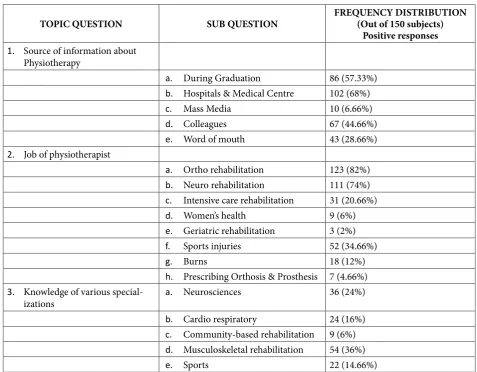
With regards to the different fields of physiotherapy, the orthopedic and neurological fields are most popular. Less commonly known fields included cardio respiratory and community-based rehabilitation. Among the various sources of awareness among the general practitioners, the predominant source was found to be during their gradua-tion.
Table 1: Frequency distribution of items examined in the questionnaire.
TOPIC QUESTION SUB QUESTION FREQUENCY DISTRIBUTION(Out of 150 subjects) Positive responses
1. Source of information about
Physiotherapy
a. During Graduation 86 (57.33%)
b. Hospitals & Medical Centre 102 (68%)
c. Mass Media 10 (6.66%)
d. Colleagues 67 (44.66%)
e. Word of mouth 43 (28.66%)
2. Job of physiotherapist
a. Ortho rehabilitation 123 (82%)
b. Neuro rehabilitation 111 (74%)
c. Intensive care rehabilitation 31 (20.66%)
d. Women’s health 9 (6%)
e. Geriatric rehabilitation 3 (2%)
f. Sports injuries 52 (34.66%)
g. Burns 18 (12%)
h. Prescribing Orthosis & Prosthesis 7 (4.66%)
3. Knowledge of various
special-izations a. Neurosciences 36 (24%)
b. Cardio respiratory 24 (16%)
c. Community-based rehabilitation 9 (6%)
d. Musculoskeletal rehabilitation 54 (36%)
DISCUSSION
The intent of the study, to determine the awareness of physiotherapy among general practitioners, was based on the belief that insight of doctors on important aspects of health care should be assessedat regular intervals.
According to the analysis of the obtained data, it was ob-served that of the total interviewed sample of 150 subjects, 100% were aware of physiotherapy, the results of which were similar to the study conducted by Acharya R S et al. (2011) [7]. Shimpi et al.(2014) [3] in their survey had a similar finding in which it was noted that the referring medical professionals had a good awareness of physiother-apy practices, apart from having some variations in the
ref-discussed separately.
Through the responses obtained, it was noted that 57% learned of the physiotherapy field while pursuing their graduation. This could be because many subjects had stud-ied from institutions which offered multiple courses in-cluding physiotherapy. Followed by this, information gath-ered next was through hospitals and medical centers (68%), colleagues (44%), word of mouth (28%) and the least was through mass media (6%). Since most of the general public is dependent on mass media for acquiring information on health and illness [8]and as our study also sheds light on the least form of informational source (i.e. mass media), it makes us realize that to have a better understanding of a physiotherapist’s job and to enlighten the masses, there is
4. Awareness of course duration a. Bachelor’s 110 (73.33%)
b. Masters 102 (68%)
c. PhD 12 (8%)
5. Interventions used by a
physiother-apist: according to general practi-tioners
a. Exercises 150 (100%)
b. Massage 80 (53.33%)
c. Electrical Modalities 99 (66%)
d. Mobilization 122 (81.33%)
e. Heat therapy 106 (70.66%)
f. Cryotherapy 89 (59.33%)
g. Drugs 30 (20%)
h. Pressure points 76 (50.66%)
6. Knowledge of physiotherapy
cen-ters in locality 82 (54.66%)
7. Role of physiotherapy in health
sector
a. Very important 82 (54.66%)
b. Important 50 (33.33%)
c. Not important 2 (0.1%)
d. Don’t know 4 (2.66%)
e. No response 12 (8%)
8. Need for physiotherapy centers in
hospitals 138 (92%)
9. Need for lectures on physiotherapy 134(89.33%)
10. Should patients visit physiotherapy
centers on references 54 (36%)
11. Are patients referred for
physio-therapy by the subjects? 131 (87%)
12. Cases referred for physiotherapy a. Orthopaedic 41 (27.33%)
b. Neurological 25 (16.66%)
c. Cardiorespiratory 10 (6.66%)
d. Geriatrics 0
e. Fitness 3 (2%)
f. Paediatrics 20 (13.33%)
g. Women’s health 11 (7.33%)
ing, newspapers, brochures among other forms of media. Regarding the field’s academical knowledge among the subjects, the study helped us to know that 73% were aware of the course duration of bachelor’s degree in physiother-apy, where as 68% were aware of the master’sprogram. Only 8% claimed to have an idea of the Ph.D.program sug-gesting that the doctorate course is not quite well known among the subjects. However, this assessment cannot be considered unfortunate, because, not all institutions offer-ing bachelor’s course offer post-graduation master’s and doctorate courses and hence, it can be assumed that phys-iotherapy as a profession and as a health care facility still has scope for development.
Additionally, when the subjects were asked to opine on what their perception of the role a physiotherapist was in the health care facility, it was observed that majority (82%) felt that the job of a therapist is to treat pre/pos toperative orthopedic patients. And although there are studies done in the past by Box et al. (2002) [9] which shows the ben-efits of post operative physiotherapy, a therapist’s role in the preoperative stage cannot be neglected as studied by Fransen (2002) [10], Deyle (2000) [11] and Sherin (2005) [12]. However, neuro rehabilitation is in demand among the subjects (74%) as they believe it to have a role in mak-ing patients functionally independent.
In developed countries, physiotherapy has a crucial part in the assessment and rehabilitation of patients in the ICUs[7], to manage cardio-respiratory, neurological and musculoskeletal complications. But surprisingly, accord-ing to our study, physiotherapists are not very popular in giving treatment to intensive care unit patients, as only 20% agree to therapists treating patients in intensive care, whereas as high as 79% were oblivious of patients bene-fiting from physiotherapy treatment in these setups. Thus, we can form a basis that the role of thephysiotherapist in cardiac and pulmonary conditions (as these are some of the major areas affected the most in critical patients), is less known. And hence, the need for physiotherapists to col-laborate further with cardiologists and pulmonologist, so that time references are given to plan an effective treatment strategy.
According to the current President of the Indian Associa-tion of Sports Medicine, Dr. Parag Sancheti, Sports Med-icine (which also includes physiotherapy), is not only for the elite sports persons of India but also at the grass-root level. However, for a country of sports enthusiasts, surpris-ingly, only 34% subjects agreed that physiotherapists play a role in treating sports related injuries. This makes us con-clude that the branch of sports physiotherapy, as a further specialization is not very well known in the country. Among the other, less known roles of a physiotherapist, knowledge of therapists treating women’s health issues like urinary incontinence or prolapsed is deficient since only 6% subjects stated that to be one of the many job descrip-tions of a therapist. Similarly, just 12% subjects were fa-miliar with the job of a physiotherapist in treating patients
with burns even though it is the 6th most noteworthy cause of accidental death in India [13].
The study subjects did not much support the idea of ther-apists prescribing prosthesis and orthosis; as, only 4% agreed with it, while the rest did not consider it as a role of a therapist. So, physicians need to be made aware that therapists, as a team working majorly for the rehabilitation of patients, have the knowledge and skill to decide the re-quirements of the patients.
A knowledgeable doctor can give timely references and reduce not just the extent of damage, but also time and fi-nances utilized for the health care. To see if the subjects were aware of the various specializations, so that references can be given to their field of expertise, subjects were asked to comment on the fields of work they were aware of, and it can be stated that as many as 96% were well-informed about the various fields with majority (36%) knowing about musculoskeletal rehabilitation, neurosciences (24%), cardio respiratory (16%), sports rehabilitation (14%), though only 6% subjects were aware of community-based rehabilitation.This puts forward the need for physiothera-pists to take initiatives to increase awareness for communi-ty-based rehabilitation and sports rehabilitation which can be achieved by conducting health camps for patients, sem-inars for doctors and practical sessions. Community-based rehabilitation, in which it was noted that just 8% subjects were aware of the role of a therapist, is more subjective and since it works on different systems of the body, a brochure or a pamphlet addressing different issues faced by the peo-ple, along with the idea of a therapist’s role, could help pro-mote this arena of specialization.
Our project study also intended us to know about the awareness in the interventions used by a physiotherapist. It was noted that physicians were unaware of the fact that for treatment protocols like ionotophorosis, drugs (80%) were used by the therapists. Other interventions used according to the subjects were: pressure points (50%), massage (53%), cold (59%), electrical modalities (66%), heat (70%) and mobilization (81%). However, all subjects (100%) agreed that physiotherapists use exercises to treat patients stating that to be the primary role of a physiotherapist.
Although physiotherapy as a topic was introduced to sub-jects (57%) during their graduation, of the total number of subjects,89% were of the opinion that physiotherapy lectures should be conducted for medical students. In an another study done by Al-Eisa et al. (2016) [14] it was re-ported that the concept and approach of administering physiotherapy among the medical students are low as they had received little formal education about the field and this suggests that the future of our health system needs more information about the physiotherapy services. If early on in their academics, the young minds are given an idea about physiotherapy, inappropriate beliefs about physiotherapy career can be avoided.
to become a physiotherapist. Whereas, 69% chose other-wise by mainly stating meagre pay scale, little knowledge amongst the patients, dependency on other doctors and considering it as a female dominated profession as the rea-sons for not favoring the noble profession. Additionally, however, when the subjects were asked to comment on the perception of therole of a PT in the health sector, 54% re-garded physiotherapy as very important, whereas 8% chose not to respond, thus showing us their hesitancy towards the field. Supporting this, only 40% subjects felt that there is a need for a family physiotherapist.
The majority of subjects (92%) consider physiotherapy centers as a must in all hospitals, but their knowledge of physiotherapy centers (54%) in their locality was found to be less. Nevertheless, all subjects gave a common opinion that physiotherapists contribute to the well-being of indi-viduals.
The idea of practicing first contact physiotherapy is an old debate as only 36% subjects believe that direct contact practice must be allowed. Many still are of the opinion that physiotherapy consultation should be given when the phy-sicians refer physiotherapy and not before. As to back this idea, 87% of our study subjects claimed that they recom-mend patients for physiotherapy, which is slightly more significant than the clinical doctors of Nepal, where the referral rate was found to be 63% as study conducted by Acharya et al.(2011) [7]. In our study, the cases referred for orthopedic rehabilitation (27%) was the highest.The result obtained is similar to studies conducted by Childs et al.(2005) [15], Cremin MC, Finn AM (2000) [16] and Acharya R S et al(2011) [7], in which it was reported that practitioners consider the art of physiotherapy to have a huge hand in the rehabilitation of musculoskeletal condi-tions.This also makes us realize that general practitioners are confident in a physiotherapist’s ability in managing musculoskeletal problems [7, 16, 17, 18]. The other cases referred for physiotherapy were neurological (16%), sports injuries (14%), paediatrics (13%), women’s health (7%), cardio-respiratory (6%) and fitness (2%). Based on the re-sults, we can conclude that poor referral system points to-wards knowledge deficit in evaluative procedures and mo-dalities. Even with having an awareness of physiotherapy among the subjects, there is not just a contradistinction, but also an inadequacy of referral systems [19].
The limitation of this study was that it was conducted in a constrained geographical area and the experience of the subjects was not co-related to the awareness in the study subjects.
The authors would like to suggest that mutual understand-ing is established between the general practitioners and physiotherapists so that timely references are given with effective marketing strategies to enhance the field fur-ther. Regular surveys should be done to know the extent of physiotherapy skill among the health care professions and communities so that the goal of maximum awareness
Thus, with this, we can formulate that overall physicians are aware of physiotherapy, but the role of a therapist and the knowledge of its various specialization and interven-tions is an arena which can be improved further. A com-bined effort by both physician and therapist can indirectly create an increased awareness within the publicand help draw bridges.
CONCLUSION
The study revealed that there is full awareness about phys-iotherapy among general practitioners. Musculoskeletal and neurophysiotherapy are popular amongst the subjects under study. Whereas community-based rehabilitation, es-pecially geriatric rehabilitation, and women’s health were least known. Also, it can be noted that there is less accuracy about the job of a physiotherapist, especially in treating pa-tients with burns or in intensive care units. Subjects believe that prescribing exercises is the main intervention used by a therapist and showed reduced awareness for the use of drugs. Even though there is a division of opinion, many practitioners still believe that patients should visit physio-therapy centers only on references.
ACKNOWLEDGEMENT
The authors would like to express their sincere gratitude to all the study subjects for participating in the study.
REFERENCES
[1] Silva, DM. Californian physician professional image of physiotherapy. Physical Therapy. 2015; 29(8): 1152-1156.
[2] Physical Therapy; c2017 [cited 2017 July 27]. Available from: https://en.wikipedia.org/wiki/Physical_therapy .
[3] Shimpi A, Writer H, Shyam A, Dadghav R. Role of Physiotherapy in India- A Cross- Sectional Survey to Study the Awareness and Perspective among Referring Doctors. JMT. 2014; 2(2): 18-22.
[4] wcpt.org [Internet]. UK: Policy statement: Description of physical therapy; c2017[cited 2017 Juy 27]. Available from: http://www.wcpt.org/policy/ps-descriptionPT .
[5] Deepa Abhichandani, Vidhi Radia. Awareness of Var-ious Aspects of Physiotherapy among Medical Resi-dents. IJSR.2015; 4(10): 1460- 1465.
[6] Odebiyi, D.O., Amazu, A.R., Akindele, M.O., Igwe, S.E., Olagun, M.O.B. Evaluation of the Mode of Refer-ral of ReferRefer-ral of Patients for Physiotherapy by Physi-cians. AJOL. 2010; 2(1): 14-20.
[7] Acharya R S, Khadgi B, Shakya N R, Ashikari S P, Basnet SMS, Sharma S et al. Physiotherapy awareness among clinical doctors in Nepal. Journal of Institute of Medicine. 2011; 33(2).
[8] Thusharika D. Dissanayaka, Shayama Banneheka. Awareness in Physiotherapy among High School Stu-dents. International Journal of Scientific and Research Publications. 2014; 4(7):1-5.
Citation
Agni, P., & Battin, S. (2017). AWARENESS OF PHYSIOTHERAPY AMONG GENERAL PRACTITIONERS: A PILOT STUDY. International Journal of Physiotherapy, 4(4), 253-261.
Cancer Research and Treatment. 2002; 75(1): 51-64.
[10] Fransen M, Crosbie J, Edmonds J. Physical therapy is effective for patients with osteoarthritis of the knee: a randomized controlled clinical trial. The Journal of Rheumatology. 2001; 28(1): 156-164.
[11] Deyle GD, Henderson NE, Matekel RL, Ryder MG,
Garber MB, Allison SC. Effectiveness of manual phys-ical therapy and exercise in osteoarthritis of the knee. A randomized, controlled trial. Ann Intern Med. 2000; 132(3): 173-181.
[12] Sherin K. Jarvis, Taryn K Hallam, Sanja Lujic, Jason A. Abbott, Thierry G. Vancaille. Peri-operative phys-iotherapy improves outcomes for women undergoing incontinence and or prolapse surgery: Results of a randomized controlled trial. The Australian and New Zealand Journal of Obsterics and Gynaecology. 2005; 45(4): 300-303.
[13] Jayanta Bain, Shyam Lal, Vijay Singh Baghel, Vinod Yedalwar, Rachna Gupta, Anil Kumar Singh. Deca-dorial of a burn center in Central India. Journal of Natural Science, Biology and Medicine. 2014; 5(1): 116-122.
[14] Einas S. Eisa, Hind Hoqail, Asma S.
Al-Rushud, Azhar Al-Harthi, Banan Al-Mass, Bashayer M. Al-Harbi et al. Awareness, perceptions and beliefs about physiotherapy held by physicians working in Saudi-Arabia: a cross-sectional study. J Phys Ther Sci. 2016; 28(12): 3435-3439.
[15] Childs J, Whitman J, Sizer P, Pugia M, Elynn T, Delitto A. A description of physical therapist’ knowledge in managing musculoskeletal conditions. BMC Muscu-loskeletal disorders. 2005; 6:32.
[16] Cremin MC, Finn AM. Referral to physiotherapy as
part of a general practitioners management of back pain. Ir Med J. 2000; 95: 141-142.
[17] Pinnington M, Miller J, Stanley I. An evaluation of prompt access to physiotherapy in the management of low back pain in primary care. Fam Pract. 2004; 21(4): 372-380.
[18] Clemancee M, Seamark D. GP referral for Physiother-apy to musculoskeletal conditions- a qualitative study. Fam Pract. 2003; 20: 578-582.
[19] O’ Donnell CA. Variation in GP referral rates: what can we learn from the literature? Fam Pract. 2000; 17(6): 462-471.
APPENDIX : 1 QUESTIONNAIRE
(Please ✓ in the appropriate box)
INFORMATION ABOUT THE RESPONDENT NAME:
AGE:
GENDER:M/F QUALIFICATION:
CLINICAL ADDRESS: Practicing Since ___ years
1. Are you aware about Physiotherapy? ☐ YES NO ☐
IF YES,
a. How did you know about Physiotherapy? ☐ During Graduation
☐ Through Hospitals/ Medical centers ☐ Mass Media
☐ Colleagues ☐ Word of Mouth
2. What according to you is the job of a physiotherapist?
YES NO DON’T KNOW
Manages Neuro rehabilitation
Manages Pre/Post-Operative Ortho rehabilitation Manages ICU patients
Prescribes Orthosis and Prosthesis Manages patients with Burns
Gives on-field treatment for Sports injuries Manages Geriatric rehabilitation
3. Was physiotherapy introduced to you as a topic during graduation?
☐ YES ☐ NO
4. Do you think there should be a lecture on physiotherapy for medical students?
☐ YES ☐ NO
5. Are you aware of the course duration of B.Pth in India?
☐ YES ☐ NO
If yes, how many years? _____ years.
6. Are you aware of Masters in physiotherapy?
☐ YES ☐ NO
7. Are you aware of Ph.D in physiotherapy in India?
☐ YES ☐ NO
8. Are you aware of various specializations in physiotherapy?
☐ YES ☐ NO
If yes,
☐ Physiotherapy in Neurosciences ☐ Physiotherapy in Cardio respiratory
☐ Physiotherapy in Community Based Rehabilitation ☐ Physiotherapy in Musculoskeletal Sciences
☐ Physiotherapy in Sports Rehabilitation
9. What according to you are the interventions used by a Physiotherapist? YES NO DON’T KNOW
Exercises Massage
By use of Electrical modalities Mobilization
Application of Heat Therapy Application of Cold Therapy Drugs
Pressure Points
10. Like a family physician, do you think there is a need of a family physiotherapist as well?
☐ YES ☐ NO
11. Do you think that Physiotherapy centers should be available in all hospitals?
☐ YES ☐ NO
12. What is your perception of the role of Physiotherapist in the health sector? ☐ Very Important
☐ Important ☐ Not Important ☐ Don’t Know
13. Do you think that Physiotherapists contribute to the well-being of individuals who seek their services?
☐ YES ☐ NO
14. Do you think a patient should visit a Physiotherapy center only on the reference of a doctor?
☐ YES ☐ NO
15. Do you recommend Physiotherapy services to your patients who need them?
☐ YES ☐ NO
☐ Orthopedic cases ☐ Neurological cases ☐ Cardio respiratory cases Other:
☐ Geriatrics ☐ Fitness ☐ Pediatrics ☐ Women’s health ☐ Sports Injury
16. Would you encourage your family members/friends to become a Physiotherapist?
☐ YES ☐ NO
17. Are you aware of any physiotherapy center in your locality?
☐ YES ☐ NO
ANY COMMENTS/ SUGGESTIONS WITH RESPECT TO PHYSIOTHERAPY? _______________________________________