BALSAMINA
K. L. ToKY, S. SAWHNEY and K. K. NANDA
Botany Department, Panjab University, Chandigarh-14, India
SuMMARY
Seedlings of Impatiens balsamina L., raised under continuous illumination, were subjected to varying photoperiodic and chemical treatments at 8-10 leaf stage.
Flowering was induced not only by gibberellins but also by 2, 3,5-triiodobenzoic acid (TIBA) under strictly non-inductive conditi-tions. The periods of floral-bud initiation with these chemicals, however, were much longer than under inductive photoperiods. Auxins inhibited flowering, the effect being more under sub-optimal photoperiodic conditions. Dormin, kinetin, ascorbic acid (AA) and o< tocopherol (vitamin E) neither induced flowering under non-induc-tive conditions nor exerted any promonon-induc-tive or inhibitory effect under inductive conditions.
The results have been discussed in the light of literature avail-able on the subject.
INTRODUCTION
The transformation of meristem from vegetative to reproductive condition is a consequence of various biochemical changes taking place under photo-inductive periods. Consi-derable work has been carried out on the effect of different growth regulators on flowering with a view to understanding the mechanism of this process. Thus, gibberellic acid (GA3) is
now known to induce flowering of long day and cold"requiring biennial plants under non-inductive conditions (See, e.g. Lang, 1965), promote it of short day ones under non-inductive and sub-optimal photoperiods and inhibit it under optimal conditions (e.g. Harder and Bunsow, 1956; Greulach and Haesloop, 1958; Barbat and Ochesanu, 1964). Gibberellins, however, have been shown to induce flowering of Impatiens balsamina under strictly
other hand auxins are reported to inhibit the flowering of short day plants (Bonner and Thurlow, 1949; van Sendon, 1951; Nakayama and Kikuchi, 1956), hasten that of long day ones under sub-threshold conditions (Liverman and Lang, 1956), and induce it in Kalanchoe rotundifolia, which is a long~short day plant (da Silva and Resende, 1956).
Studies carried out in this laboratory have shown that
Impatiens balsamina is an indeterminate, qualitative short day plant, requiring at least 3 short days for floral-bud initiation and 8 for their development into flowers (Nanda and Kumar, 1966; Nanda and Krishnamoorthy, 1967). It was considered interesting to investigate the effect of different growth regulators on flowering of this plant under inductive and non-inductive photoperiods with a view to understanding the mechanism of floral-induction.
MATERIALS AND METHODS
Seedlings of Impatiens balsamina var. Rose were raised from uniform seeds under continuous illumination and were exposed to different photoperiodic regimes at 8-10 leaf stage. For long day treatment, the natural light was supplemented by artificial light supplied from cool, white fluorescent tubes with a few incandescent lamps fitted on light banks in a room with tempera~ ture controlled at 26±1 °C, while for short day treatment, the plants were exposed to natural light from 8 a.m. to 4 p.m. and transferred to dark chambers for 16 hrs from 4 p.m. to 8 a.m. in the same air..:conditioned room.
Observations were recorded on the number and time of emergence of vegetative and floral buds. The periods of floral-bud initiation and flowering were calculated from these records. The details of experimentation are given separately under results.
ExPERIMENTATION AND RESULTS
Gibberellins, auxins, anti-'auxin in relation to flowering
Gibberellins
As,
AH7, A,3, and of (- )-kaurene induceflowering of this short day plant under strictly non-inductive conditions (Nanda et al., 1967; 1969); although
AH
7 wasmost effective of all and GA,3 and (- )-kaurene failed to enhance extension growth (Nanda et al., 1969). The following experi-ments were carried out to investigate if this plant differs from other short day plants in its response to auxins and anti-auxin as well.
Experiment I.-This experiment deals with the effect ofiAA, IBA and 2,4-D on flowering.
One hundred and forty pots, with 2 uniform plants in each, were divided into 4 lots to receive 0, 8, 16 and 60 short days, each consisting of 8 hrs of light and 16 hrs of dark. Each lot was sub-divided into 7 groups. While group 1 was treated with water to serve as control; groups 2-7 received 10 and 100 mg/1 each of IAA, IBA and 2,4-D, respectively.
The results presented in Table I show that floral buds were initiated in all the control as well as auxin-treated plants except those treated with 100 mg/1 2,4-D exposed to 8, 16 and 60 SDs but not in those exposed to continuous LDs. Plants treated with 100 mg/1 2,4-D did not survive. The floral -bud initiation was slightly delayed in plants treated with 100 and 10 mg/1 ofiAA and 2,4-D. Flowering was also delayed in plants treated with 100 mg/1 IAA and 10 and 100 mgfllBA exposed to 8 SDs and in those treated with 10 mg/1 2,4-'D receiving 16 SDs. In plants receiving 60 SDs, flowering occurred almost at the same time with different treatments, although the number of flowering plants decreased with auxin treatment, particularly with 2,4-D and in those receiving 8 SDs.
The number of floral buds and flowers decreased with auxin treatment, 2,4-D being more effective, and the effect being more in plants exposed to 8 and 16 than in those receiving 60 SDs in the respective treatments (Table I). ,
Table I. Effect
of
auxins on floweringof
Impatiens balsaminaexposed to varying photoperiodic cycles
Photo- Days to Days to Mean Mean Number Number
period Treatment floral- flower- number number ofpla-
ofpla-(Cycles) (mg/1) bud ing of flo- of flow- nts ini- nts
initia- raJ buds ers tiating
flow-tion floral ering
buds (out of!O)
Control IAA-10 IAA-100 IBA-10
C-LD IBA-100
2,4-D-10 2,4-D-100
Control 10·6 51·5 12·5 5·2 10 7
IAA-10 12·0 49·2 1·4 5·0 10 7
IAA-100 13·4 65·0 9·4 4·0 10 3
8-SD IBA-10 14·8 61·0 ll·l 4·0 10 3
IBA-100 12·0 62·0 14·1 2·0 10 5
2,4-D-10 13·6 14 ·1 10
2,4-D-100
Control 12·4 45·0 18·4 9·0 10 10
IAA-10 13·0 51·8 17·0 5·8 10 8
IAA-100 15·3 49·0 16·6 3·8 10 8
16-SD IBA-10 12·5 46·6 15·5 3·5 10 7
IBA-100 12·0 44·5 13·3 4·5 10 10
2,4-D-10 13·0 58·0 ll·3 4·0 10 3
2,4-D-100
Control 14·5 51·8 15·2 4·2 10 10
IAA-10 16·1 54·6 12·3 4·6 10 5
IAA-100 17·0 12·5 10
C-SD IBA-10 14·2 47·0 13·3 2·3 10 5
IBA-100 16·0 54·0 16·6 6·3 10 5
2,4-D-10 18·0 7·3 5
2,4-D-100
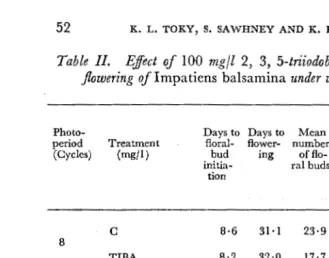
Experiment 2.--The previous experiment showed that auxins inhibited flowering of this plant. This experiment was designed to study the effect of the anti-auxin - TIBA-on flowering of this plant.
Thirty pots, with two uniform plants in each, were divided into 3 lots to be exposed to 8-, 16- and 24-hr photoperiods. Each lot was sub-divided into 2 groups to receive water (control) and 100 mg/1 TIBA, respectively.
Table II. Effect of 100 mgfl 2, 3, 5-triiodobenzoic acid ( TIBA) on flowering of Impatiens balsamina under varying plzotoperiods
Number Number Photo- Days to Days to Mean Mean ofpla- ofpla-period Treatment floral- flower- number number nts ini- nts (Cycles) (mg/1) bud ing of flo- of flow- tiating flow-initia- ral buds ers floral ering
tion buds
(out of 10)
c
8·6 31·1 23·9 15·1 10 10 8TIBA 8·2 32·0 17·7 11·0 10 9
c
16
TIBA 57·4 17·2 7
c
24
TIBA 55·0 5·0 5
- - - · - -- - -
-photoperiod only, in TIBA·treated ones the initiation occurred even under 16- and 24-hr photoperiods. The period of floral-bud initiation under 8~hr photoperiods did not differ from the control in TIBA4reated plants, although it took much longer under 16- and 24-hr photoperiods TIBA also decreased the number of floral buds. This point is interesting and will be dis-cussed later. Although 7 and 5 out of 10 TIBA-treated plants under 16- and 24-hr photoperiods, respectively, produced floral buds, these did not develop into flowers and the number of floral buds was less under 24- than under 16-hr photoperiods.
Experiments 3-6 deal with the effect of dormin, kinetin, AA and ex: -tocopherol on floral-'induction in this plant. Plants in each experiment were divided into two lots to be exposed to 8- and 24-hr photoperiods. _Each lot in experiment 3 was divided into 4 groups to receive 0, 2, 10 and 50 mg/1 dormin; in experiments 4-6 into 3 groups each to receive 0, 1 and 10 mg/1 kinetin in experiment 4; 0, 100 and 1000 mg/1 ex: -tocopherol in experiments 5 and 0, 100 and 1000 mgfl AA in experiment 6, respectively. The results are given in Tables III and IV. Floral buds were not initiated in water-treated controls or in
Table III. Effect of dormin (Expt. 3) and kinetin (Expt. 4) on flowering of Impatiens balsamina under two photoperiods
Photoperiod Treatment Days to Days to Mean Mean (hr) (mg/1) floral-bud flowering number of number of
initiatiOn floral buds flowers
c
7·9 35·9 30·4 11·2D-2 7·2 36·4 34·1 13·1
8 D-10 7·2 36·0 29·6 12·5
D-50 7·2 35·8 28·6 9·9
c
D-224 D-10
D-50
c
7·0 37·2 21·0 4·08 K-1 7·3 40·1 19·6 2·2
K-10 7·0 40·5 18·4 2·0
c
24 K-1
K-10
D=dormin; K=kinetin.
Table IV. Effect of ascorbic acid (Expt. 5) and a: -tocopherol (Expt. 6)
on flowering of Impatiens balsamina under two photoperiods
Photoperiod Treatment (hr) (mg/1)
c
8 AA-100
AA-1000
c
24 AA-100
AA-1000
c
8 T-100
T-1000
c
24 T-100
T-1000
Days to Horal-bud initiation 7·0 6·7 6·5 7·9 7·2 7·0 Days to flowering 30·7 30·1 31·2 35·9 34·0 35·9 Mean number of
floral buds
25·0 21·1 26·2 30·4 34·3 28·5 Mean number of flowers 12·3 10·3 11·1 11·2 12·3 10·6 ---~ ·---·---~· ·
-AA=ascorbic acid; T= oc-tocophero1 (vitamin E).
and also the number of floral buds and flowers did not differ with the treatment even under 8-hr photoperiods.
DISCUSSION
Gibberellic acid replaces the photo-inductive requirement of long day plants (See Lang, 1965), but fails to do so in short day ones except in Chrysanthemum morifolium (Barbat and Ochesanu, 1964). It is not known whether this plant is quali-tative or quantiquali-tative in its response to photoperiod. How-ever, gibberellins ~' AH7 and A,3 and even ( -)-kaurene
induce flowering of Impatiens balsamina under strictly non-indnc~
tive conditions (Nanda et al., 1967; 1969). The results presented in this paper demonstrate that apart from gibberellins, TIBA also induces flowering; while dormin, kinetin, AA and a:
-toco-pherol fail to do so.
The inhibition of flowering in short day plants by auxin reported by Bonner and Thurlow (1949); van Senden (1951); Liverman (1955); Hamner and Nanda (1956) and Nakayama and Kikuchi (1956) and its enhancement (Galston, 1947; Lona and Bacchi, 1955) or induction by anti-auxins reported by Khudairi and Hamner (1954) are suggestive of the involvement of endogenous auxin level in the process of floral-induction.
The delaying effect of auxins on flowering of this plant is in confirmity with its effect on other plants and, therefore, the induction caused by TIBA may be considered to have been caused by lowering of the level of endogenous auxin as is suggested by Galston (1947) in interpreting the promotive effect of TIBA on the flowering of soybean. But the induction caused by gibberellins (Nanda et al., 1969) cannot be explained on this basis as gibberellins are known to increase auxin level (Brian and Hemming, 1955; Kuraishi and Muir, 1964). The mechanism of TIBA-caused floral-induction of this plant can not, therefore, be due to a decrease in the level of endogenous auxin. De Zeeuw (1956) also pointed out that promotive effect of TIBA in flowering of tomato (Zimmerman and Hitchcock, 1949; V. Denffer, 1950) can not be explained by considering it as an auxin-antagonist, as it promoted flowering only in the presence of young leaves and inhibited it if these were removed.
non-inductive periods are much longer as compared to those under inductive photoperiods in both GA3 and TIBA-induced flowering, leads us to think that these regulators trigger of specific chains of biochemical reactions leading to a single common end product, responsible for the transformation of the vegetative
meristem into reproductive state. Moreover, the pace of these reactions seems to be controlled by certain environmental factors like temperature, as the time taken for induction by gibberellins varied with the season and these completely failed to induce flowering at high temperatures (Nanda et al.,
1970).
Dormin, known to occur in higher plants (Cornforth
et al., 1965a, b; 1966), induces flowering in some short day plants under non-inductive conditions and inhibits it in long day ones (Evans, 1966; El-Antably et al., 1967). Kinetin and vitamin E (a: -tocopherol) have been shown to induce flowering of Cichorium intybus, a cold-requiring plant (Michniewicz and
Kamienska, 1964) and in Arabidopsis thaliana, a long day plant
(Michneiwicz and Kamienska, 1965). Induction of flowering by cytokinins has also been reported in Woolfia (Maheshwari
and Venkataramn, 1966) and Lemna (Gupta and Maheshwari,
1969). But in this plant dormin, kinetin and vitamin E neither induced flowering nor had inhibitory or promotive effect under inductive conditions.
The exogenous application of AA also does not exert any effect on flowering. The increase in AA content in shoot apex of determinate plants (Chinoy et al., 1957; Chinoy, 1962; 1964) and in axillary meristems of indeterminate plant, Callistemon viminalis (Purohit and Nanda, 1966), suggests its possible role in
flowering. The lack of any promotive effect of exogenous application of AA, does not, however, rule out the possibility of its role in flowering of this plant as the exogenously applied AA may be oxidised before it can exert its effect, and to check this possibility studies on changes in its endogenous content with induction are needed which are in progress.
AcKNOWLEDGEMENTs
REFERENCES
Barbat, I. and Ochesanu, C. (1964). The action of gibberellin A3 on Chrysanthemum morifolium in non-inductive photoperiodic conditions. Naturwiss.,
51: 316-17.
Bonner, J. and Thurlow, J. (1949). Inhibition of photoperiodic induction in
Xanthium by applied auxin. Bot. Gaz., 110: 613-24.
Brain, P. W. and Hemming, H. G. (1955). The effect of gibberellic acid and auxins in pea internode extension. Ann. Bot., 22: 1-17.
Chinoy, J. J. (1962). Formation and utilization of ascorbic acid in the shoot apex of wheat as factors of growth and development. Indian J. Plant Physiol.
5: 172-201.
- - - - (1964). Ascorbic acid-nucleic acid-protein metabolism concept of flowering in plants. Proc. lOth Intern. Bot. Congr. Edinburgh.
- - - - , Nanda, K. K. and Garg, 0. P. (1957). Effect of AA on growth and flower-ing of Trigonella foenum-graecum and Brassica chinensis. Physiol. Plant.,
10:869-76.
Cornforth, J. W., Milborrow, B. V. and Ryback, G. (1965). Synthesis of (t) abscisin II. Nature (Land.), 206: 715.
- - - - , - - - - , and (1966). Identification and estimation of I+)-abscisin II ("Dormin") in plant extracts by spectro-polarimetry, Nature (Land.), 210:627-28.
- - - - , - - - - , and Wareing, P. F. (1965a). Identity of sycamore 'dormin' with abscisin II. Nature (Land.), 205: 1269-72.
Denffer, D. V. (1950) Bluhhormon oder Bluhhemmung? Naturwiss., 37: 296-301. El-Antably H. M. M., Wareing, P. F. and Hillman, J. (1967). Some physiological
responses to d, L, Abscisin (dormin). Planta (Berl.), 73: 74-90.
Evans, L. T. (1966). Abscisin II Inhibitory effect on flower induction in a long-day plant. Science, 151: 107-08.
Galston, A. W. (1947). The effect of 2,3,5-triiodobenzoic acid on the growth and flowering of soybeans. Amer. J. Bot., 34: 350-60.
- - - - , Greulach, V. A. and Haesloop, J. G. ( 1958). Influence of gibberellin on
Xanthium flowering as related to number of photo-inductive cycles.
Science, 127: 646--4 7.
Gupta, S. and Maheshwari, S. C. (1969). Induction of flowering in a short day plant
Lemna paucicostata by cytokinins. Plant & Cell Physiol., 10: 231-33. Hamner, K. C. and Nanda, K. K. (1956). A relationship between application of
indole-acetic acid and the high-intensity light reaction of photoperiodism.
Bot. Gaz., 118: 13-18.
Harder, R. M. and Bunsow, R. (1956). EinfluBdes Gibberellins auf die Bluten-bildung bei Kalanchoe blossfeldiana. Naturwiss., 43: 544.
Kuraishi, S. and Miur, R. M. (1964). The mechanism of gibberellin action in the dwarf pea. Plant and Cell Physiol. 5: 259-71.
Lang, A. (1965). Physiology of flower initiation. In: Encyclopedia of plant physiology
( W. Ruhland, ed.) Vol. 15, pt. 1, p. 1380-536. Berlin-Heidelberg-New York. Springer 1965.
Liverman, J. L. (1955). The physiology of flowering. Ann. Rev. Plant Physiol.,
6: 177-210.
- - - - and Lang, A. ( 1956). Induction of flowering in long-day plants by applied indole-acetic acid. Plant Physiol., 31: 147-50.
Lona, F. and Bocchi, A. (1955). Reduzione delle esigenze fotoperiodiche in
Perilla ocymoides Lour. var. nankinensis Voss. per ipoausinizzazione da Eosina. Beitr. Biol. Pflanzen, 31: 333--47.
Maheshwari, S. C. and Venkatarramn, R. (1966). Induction of flowering in a duck
weed-Woolfia-microscopica, by a new kinin, Zeatin. Planta (Berl.),
70: 304-06.
Michniewicz, M. and Kamienska, A. (1964). Flower formation induced by kinetin and vitamin E treatment in cold requiring plant (Cichorium intybus) grown under non-inductive conditions. Naturwiss., 51: 295-96.
Michniewicz, M.and Kamienska, A. (1965). Flower formation induced by kinetin and vitamin E treatment in long day plant (Arabidopsis thaliana) grown in
j-Nakayama, Sh. and Kikuchi, T. (1956). Experimental researches on photoperio-dism. (4) The effect of auxin application on flower formation. Miyazaki
Univ. Bull., I: 154-64.
Nanda, K. K. and Krishnamoorthy, H. N. (1967). Photoperiodic studies on growth and development of Impatiens balsamina. II. Floral-bud initiation, flower opening and extension growth. Plan/a (Berl.), 72: 338-43. - - - - , - - - - , Anuradha, T. A. and La!, K. (1967). Floral induction by
gibberellic acid in Impatiens balsamina L., a qualitative short day plant.
Ibid., 76:367-70.
- - - - , , Toky, K. L. and Lata, K. (1969). Effect of gibberellins, As, A4 +7• A,s and of (-)-kaurene on flowering and extension growth of
Impatiens balsamina under different photoperiods. Ibid., 86: 134-41. - - - - a n d Kumar, P. (1966). Photoperiodic studies on growth and development
of Impatiens balsamina L. I. Lateral bud development and its relation with senescence. Ibid., 69: 249-57.
- - - - , Toky, K. L. and Sawhney, S. (1970). Seasonal variations in GAs effects on flowering of Impatiens balsamina, a qualitative short day plant.
Physiologia Plant., 23 : 1085-88.
Purohit, A. N. and Nanda, K. K. (1966). Seasonal variation in ascorbic acid content of shoot apex and its relationship with extension growth of Callistemon
viminalis. Plant and Cell Physiol., 7(3): 499-501.
Senden, H. van (1951). Untersuchungen uber den EinfluB von Hetero-auxin und anderen Faktoren auf die Blutenbildung dei der Kurztagpflanze
Kalanchoe bloBfeldiana. Biol. Zhl., 70: 537-65.
Silva, M. H. T. da, Resende, F. (1956). Kalanchoe rotundifolia (PDIC) flores-cendo em permanente DC pela accao de auxinia (AlA), Rev. de Bol.
(Lisbon), I: 63-67.
De Zeeuw (1956). See in 'Auxins in flowering' by Anton Lang. In: Encyclopedia
of Plant Physiology (W. Ruhland ed.) Vol. 14, p. 909-50. Berlin-Gottingen Heidelberg: Springer 1961.