The Cryosphere, 12, 1939–1956, 2018 https://doi.org/10.5194/tc-12-1939-2018
© Author(s) 2018. This work is distributed under the Creative Commons Attribution 4.0 License.
Mercury in the Arctic tundra snowpack: temporal and spatial
concentration patterns and trace gas exchanges
Yannick Agnan1,2, Thomas A. Douglas3, Detlev Helmig4, Jacques Hueber4, and Daniel Obrist5,2
1Sorbonne Université, CNRS, EPHE, UMR Metis, 75252 Paris, France
2Division of Atmospheric Sciences, Desert Research Institute, Reno, Nevada 89523, USA
3US Army Cold Regions Research and Engineering Laboratory, PO Box 35170, Fort Wainwright, Alaska 99709, USA 4Institute of Arctic and Alpine Research, University of Colorado, Boulder, Colorado 80309, USA
5Department of Environmental, Earth, and Atmospheric Sciences, University of Massachusetts, Lowell, MA 01854, USA
Correspondence:Yannick Agnan ([email protected]) and Daniel Obrist ([email protected]) Received: 27 November 2017 – Discussion started: 12 December 2017
Revised: 19 April 2018 – Accepted: 21 May 2018 – Published: 6 June 2018
Abstract.In the Arctic, the snowpack forms the major inter-face between atmospheric and terrestrial cycling of mercury (Hg), a global pollutant. We investigated Hg dynamics in an interior Arctic tundra snowpack in northern Alaska during two winter seasons. Using a snow tower system to moni-tor Hg trace gas exchange, we observed consistent concen-tration declines of gaseous elemental Hg (Hg0gas) from the atmosphere to the snowpack to soils. The snowpack itself was unlikely a direct sink for atmospheric Hg0gas. In addi-tion, there was no evidence of photochemical reduction of HgIIto Hg0gasin the tundra snowpack, with the exception of short periods during late winter in the uppermost snow layer. The patterns in this interior Arctic snowpack thus differ sub-stantially from observations in Arctic coastal and temperate snowpacks. We consistently measured low concentrations of both total and dissolved Hg in snowpack throughout the two seasons. Chemical tracers showed that Hg was mainly asso-ciated with local mineral dust and regional marine sea spray inputs. Mass balance calculations show that the snowpack represents a small reservoir of Hg, resulting in low inputs during snowmelt. Taken together, the results from this study suggest that interior Arctic snowpacks are negligible sources of Hg to the Arctic.
1 Introduction
Mercury (Hg) is a neurotoxic pollutant of worldwide impor-tance that is transported over long disimpor-tances in the atmo-sphere as gaseous elemental Hg (Hg0gas) and thus reaches remote environments (Cobbett et al., 2007; Driscoll et al., 2013; Sprovieri et al., 2010). In the Arctic, modern atmo-spheric Hg deposition has increased about 3-fold from pre-industrialized background levels (Fitzgerald et al., 2005), similar to increases observed in temperate locations, al-though other studies suggest much stronger increases (e.g., Enrico et al., 2017). The increase in Hg loading has led to vulnerability of polar ecosystems to Hg contamination due to detrimental impacts to wildlife and humans, in particu-lar through biomagnification processes across trophic levels (Atwell et al., 1998).
2006). The snowpack accumulates nutrients, pollutants, and impurities that are deposited by snowfall and dry deposition processes, all of which can subsequently be transported to underlying ecosystems during snowmelt (Bergin et al., 1995; Uematsu et al., 2000).
The snowpack plays an important role for the cycling of Hg as well, including for atmospheric deposition, photo-chemical redox reactions, and associated phase changes be-tween solid and gaseous Hg that can volatilize Hg to the atmosphere (Douglas et al., 2008, 2012; Faïn et al., 2013; Mann et al., 2014; Steffen et al., 2013). In particular, tem-perate and Arctic studies have shown that the snowpack can serve as sink or source of Hg0gas, whereby photochemical reduction of snow-bound HgII can produce Hg0gas, and oxi-dation processes can reversely scavenge atmospheric Hg0gas in snow (Faïn et al., 2013; Lalonde et al., 2002; Mann et al., 2011). Photochemical reactions occur primarily in the top 10 cm of the snowpack, where sunlight radiation trans-mits and is absorbed and scattered by snow crystals (Faïn et al., 2007; King and Simpson, 2001). The degree of photo-chemical production of Hg0gas and subsequent atmospheric re-volatilization from the snowpack can be significant, as shown in temperate snowpacks with strong recurring day-time atmospheric emissions of Hg0gas throughout the winter season (Faïn et al., 2013). In global models, snowpack Hg0gas emissions can account for∼50 % of all snowpack Hg (Cor-bitt et al., 2011). The reverse process – oxidation of Hg0gasto HgII– has also been proposed to occur in the dark snowpack deeper in the snow profile (Faïn et al., 2007, 2013; Mann et al., 2015), resulting in concentration declines of Hg0gaswith depth in the snowpack. To our knowledge, however, no direct in situ measurement of snowpack Hg0gas dynamics is avail-able in the field in the interior Arctic snowpack.
In the Arctic and Antarctic, Hg cycling is also affected by atmospheric Hg depletion events (AMDEs), which are observed primarily in the springtime along coastal locations (Angot et al., 2016a; Dommergue et al., 2010; Schroeder et al., 1998; Steffen et al., 2008). During AMDEs, atmospheric Hg0gas concentrations fluctuate strongly due to atmospheric conversion of Hg0gas to oxidized HgII. Because HgIIis sub-ject to faster deposition (Schroeder and Munthe, 1998; Selin, 2009), AMDEs result in Hg temporarily deposited from the atmosphere to the Arctic ecosystems. AMDEs are consid-ered to be initiated by halogens (Brooks et al., 2008; Obrist et al., 2011; Steffen et al., 2008), such as bromine and chlorine radicals released from sea salt by photochemical processes (Simpson et al., 2007). AMDEs have been mainly observed along the coasts, e.g., at Barrow in Alaska (Douglas et al., 2008), Alert in Canada (Steffen et al., 2002), Ny-Ålesund in Svalbard (Ferrari et al., 2008), McMurdo in Antarctica (Brooks et al., 2008), and directly over the sea ice (Moore et al., 2014; Nerentorp Mastromonaco et al., 2016). The impact of AMDEs at inland sites is reduced with increasing distance
from the coast (Douglas and Sturm, 2004; Obrist et al., 2017; Van Dam et al., 2013).
The objective of this study was to characterize Hg dy-namics in the inland Arctic snowpack at Toolik Field Sta-tion and along a 170 km transect between this site and the Arctic coast. For the first time, we comprehensively linked trace gas fluxes of Hg0gas in interstitial snow air with the seasonal development of total Hg (Hgtot)and
dis-solved Hg (Hgdiss) bound in the snowpack to assess
con-versions between volatile and solid Hg in the Arctic snow-pack. We specifically aimed to assess (1) temporal and vertical Hg0gas patterns to quantify exchanges of Hg0gas in the atmosphere–snowpack–soil continuum; (2) impacts of springtime AMDEs on snowpack Hg deposition to and emis-sion from the inland Arctic snowpack; (3) temporal and ver-tical concentration and mass patterns of the snowpack Hgtot and Hgdiss to estimate Hg deposition throughout the snow accumulation period and pool of Hg available through snow melt; and (4) relationships of snow Hg concentrations with major ion concentrations and oxygen and hydrogen stable isotopes in precipitation to determine potential origins of Hg contained in the snowpack.
2 Materials and methods 2.1 Study site
Measurements were mainly performed at Toolik Field Sta-tion (Alaska, USA) over two full snow cover seasons from October 2014 to May 2016. The research station is located on the north slopes of the Brooks Range (68◦380N, 149◦360W) at an elevation of 720 m a.s.l, approximately 200 km south of the Arctic Ocean (Fig. 1, orange bullet). The area is charac-terized by gently sloping hills comprised of poorly drained silty loams underlain by continuous permafrost 250–300 m deep (Barker et al., 2014). Lithology is characterized by glacial till over Cretaceous sedimentary substrates (shale, claystone, siltstone, and sandstone; Alaska Division of Oil and Gas, 2008). The ecotype is classified as an acidic tussock tundra (Shaver and Chapin, 1991) with vegetation composed of scrubby plants (e.g.,Cassiope tetragona(L.) D.Don, Arc-tostaphylos alpinus(L.) Spreng.), shrubs (e.g.,Betula nana
L.,Salix pulchraCham.), tussock grasses (Carex), and a va-riety of mosses and lichens. The mean annual air temperature is−8.5◦C, and mean annual precipitation is 312 mm (Cherry et al., 2014). In the two measurement years, the tundra was covered by snow for 236 and 248 days (i.e., 65 and 68 % of the year) in the 2014–2015 and 2015–2016 seasons, respec-tively.
Y. Agnan et al.: Mercury in the Arctic tundra snowpack 1941
Figure 1.Study area in northern Alaska, including Toolik Field Station (orange bullet point) and the eight transect sites (yellow bullet points). Satellite images are true color images (Earthstar Geographics SIO, 2017).
north (20 m a.s.l.). All the sampled sites were characterized by similar ecosystems and lithology (including undifferenti-ated volcanic Upper Cenozoic beds to the north) as described above for the Toolik area.
2.2 Trace gas in the atmosphere, interstitial snow air, and soil pores
We continuously sampled and analyzed interstitial air of the tundra snowpack at Toolik using a snow tower (Fig. S1 in the Supplement) as described in detail by Seok et al. (2009) and Faïn et al. (2013). In summary, a snow tower consists of an air inlet manifold placed in the snowpack, so sampling of trace gases can be remotely alternated between various snow depths for undisturbed sampling of interstitial snow air throughout an entire snow season. The snow tower used at Toolik consisted of six 60 cm aluminum cross arms mounted at heights of 0, 10, 20, 30, 40, and 110 cm above the ground surface. Gas inlets were mounted to each cross arm, allowing vertical sampling of snow interstitial air for analysis for mul-tiple trace gases, including Hg0gas, CO2, and O3. Each cross
arm supported a pair of air inlets fitted with 25 mm syringe filters with 1 µm glass fiber membranes (Pall Life Sciences, Ann Arbor, MI, USA). Perfluoroalkoxy Teflon®tubing with equal lengths (35 m) were directed in a heated conduit to solenoid valves in the laboratory that allowed for sequential sampling of trace gases at the six different snowpack heights. The snow tower was deployed over the tundra in August of each year prior to the onset of snowfall. When the snow tower was subsequently covered by the accumulating snowpack, this setup allowed sequentially continuous sampling of snow
interstitial air without any disturbance. Inlets were sampled sequentially, 10 min at a time (i.e., averages of two individual measurements of 5 min), resulting in a 60 min sampling cy-cle. Corresponding trace gas sampling was performed below the snowpack in tundra soils at depths of 10, 20, and 40 cm using Teflon®soil trace gas wells (Obrist et al., 2014, 2017). Both organic and mineral soil profiles, at a distance of 5 m from each other, were considered in this study, as described in Obrist et al. (2017). Atmospheric air sampling was per-formed using the top snow tower air inlets which were always above the developing snowpack as well as on a nearby mi-crometeorological tower at a height of 3.6 m above ground. All interstitial snow, soil pore, and atmospheric inlets were connected by Teflon®tubing and solenoid valves to trace gas monitors in a nearby (10–30 m distance) field laboratory that were operated year-round.
due to power failures or other technical problems. Additional trace gases were measured along with Hg0gas, including con-centrations of CO2using a LI-840A (LI-COR Inc., Lincoln,
NE, USA).
2.3 Snow sampling and physical and chemical characterization
2.3.1 Snow sampling
At Toolik, we characterized Hg in the snowpack both over the undisturbed tundra and the adjacent frozen Toolik Lake (within 200 m of the tundra location). Two snow pits were sampled on five dates between October and May in the 2014–2015 season and on four dates between December and June in 2015–2016. For each pit, we vertically exca-vated snow samples using a stainless-steel snow cutter (RIP 1 cutter 1000 cc), clean latex gloves, and trace metal Nasco Whirl-Pak®(The Aristotle Corporation, Stamford, CT, USA) HDPE plastic bags. We sampled at 10 cm layer increments from the top to the bottom of the snowpack. Samples from two perpendicular walls of the pit were each pooled together per layer for analysis. Snow height, density, and temperature were measured for each layer, and frozen snow samples were stored in a cooler before transferring to a −20◦C freezer. Snow water equivalent (SWE), which represents the amount of water stored in the snowpack, was calculated using snow density measurements in incremental 10 cm layers, multi-plied by snow height. Additional sampling of surface snow was performed over the tundra for a total of 17 sampling dates. The top 3 cm of the snowpack was collected in trip-licate within a distance of 5 m into Nasco Whirl-Pak®plastic bags using clean latex gloves. Sampling along the south to north transect was performed over 2 days in March 2016. 2.3.2 Chemical analyses
In the laboratory, we melted snow samples overnight in the Nasco Whirl-Pak® bags at room temperature in the dark, and melted snow samples were subsequently analyzed for Hg. A fraction of snowmelt was directly transferred to 50 mL polypropylene tubes (Falcon®, Corning Incorpo-rated, Corning, NY, USA) for analysis of Hgtot. For Hgdiss, snowmelt water was filtered using 0.45 µm Acrodisc® fil-ter with polyethersulfone membrane (Pall Corporation, Port Washington, NY, USA) into 50 mL Falcon® polypropylene tubes. In addition, filtered meltwater was used in 60 mL high-density polyethylene tubes (VWR®, Radnor, PA, USA) for determination of major cations, anions, and stable isotopes (2H and18O). Total Hg and Hgdissconcentrations were de-termined using Tekran 2600 cold-vapor atomic fluorescence spectrometry (Tekran Instruments Corporation, Toronto, ON, Canada) using a bromine monochloride (BrCl) digestion and reduction by stannous chloride (SnCl2) following EPA
method 1631 (US EPA, 2002). The detection limits (DL),
de-termined as 3 times the standard deviation of blank samples, averaged 0.08 ng L−1. For statistic purpose, values below the
DL were included as 0.5×DL. Analyzer performance was determined by 5 ng L−1 standards analyzed every 10 sam-ples, and recovery averaged between 93 and 107 %. Labora-tory and field blanks were conducted, and we evaluated any potential metal contamination of the stainless-steel snow ter by analyzing Milli-Q water in contact with the snow cut-ter; all these blank determinations were below DL.
Major cation and anion concentrations were quantified at the US Army Cold Regions Research and Engineering Lab-oratory’s (CRREL) Alaska Geochemistry Laboratory in Fort Wainwright, Alaska, with a Dionex ICS-3000 ion chromato-graph. An AS-19 anion column and a CS-12A cation col-umn (Dionex Corporation Sunnyvale, California) were used, each with a 10 µL injection volume. A gradient method using potassium hydroxide (20 to 35 µmol L−1)was used for anion
analyses, while cation analyses used methane sulfonic acid eluent with a concentration of 25 µmol L−1in isocratic mode. The flow rate was 1 mL min−1 and the operating tempera-ture was 30◦C. The ion chromatograph was calibrated using standards with a range from 0.5 to 50 mg L−1. Repeat analy-ses of calibration standards from 0.5 to 50 mg L−1yielded a precision of±5 %. Peaks were identified using Chromeleon (Dionex) and verified visually.
Stable isotopes of oxygen and hydrogen were also mea-sured at CRREL Alaska using wavelength-scanned cavity ring-down spectroscopy on a Picarro L2120i (Sunnyvale, California). Standards and samples were injected into the an-alyzer for seven separate analyses. Results from the first four injections were not used to calculate the stable isotope val-ues to eliminate internal system memory. The mean value from the final three sample injections was used to calcu-late the mean and standard deviation value for each sample. Values are reported in standard per mil notation. Repeated analyses of five internal laboratory standards representing a range of values spanning the samples analyzed and analyses of SMOW, GISP, and SLAP standards (International Atomic Energy Agency) were used to calibrate the analytical results. Based on thousands of these standards analyses and of sam-ple duplicate analyses we estimate the precision is±0.2 ‰ forδ18O and±0.5 ‰ forδ2H.
2.4 Data processing and statistical analyses
us-Y. Agnan et al.: Mercury in the Arctic tundra snowpack 1943
Figure 2.Snowpack temperatures (red lines) and densities (blue lines) and dissolved Hg concentrations (green bars, including mean values and standard deviations) for five snow pits in the 2014–2015 season(a)and four snow pits in the 2015–2016 season(b)over the Arctic tundra at Toolik Field Station. The gray bars illustrate the average snow heights.
ing Quantum GIS 2.18 (Quantum GIS Development Team, 2017).
3 Results and discussion
3.1 Snowpack development and snowpack physics Due to high wind conditions in the Arctic tundra (Cherry et al., 2014), the physical development of the snowpack and its depth and the thickness of wind slab layers at Toolik were subject to significant drifts and changes in snowpack height and were thus highly variable spatially and temporally throughout the winter season. The average snow height over the tundra site (shown in gray bars in Fig. 2) was continu-ously measured in both winters using a camera set to record daily pictures and using reference snow stakes placed in the snowpack. In the 2014–2015 season, the average snowpack height was 37 cm, with a standard deviation of 12 cm and a maximum depth of 60 cm. In the 2015–2016 season, the
snowpack was almost half of that of the previous year, with an average snowpack height of 19 cm, a standard deviation of 7 cm, and a maximum depth of 35 cm.
Based on snow pit measurements in the 2014–2015 sea-son, we observed an increase of snow density with time, from an average of 0.18 g cm−3in October to 0.26 g cm−3in March (blue lines in Fig. 2). No clear temporal pattern was observed in the 2015–2016 season when average snow den-sity; it ranged between 0.28 and 0.30 g cm−3. Results showed
similar temporal evolution as snow heights, with maximum SWE observed in March in both snow seasons of 158 and 116 mm, respectively.
Minimum snowpack temperatures were recorded during the 26 January 2015 sampling event when air temperatures were −40◦C.
The snowpack over the adjacent frozen lake showed an average density of 0.23 g cm−3and temperatures ranged be-tween−18 and 0◦C. The snow height over Toolik Lake was much lower than that over the tundra, with snow heights con-sistently<15 cm for both seasons. The maximum SWE cal-culated above the lake was 40 and 42 mm for the two snow seasons, respectively.
The transect between Toolik and the Arctic Ocean per-formed in March 2016 showed snowpack height ranging be-tween 30 and 66 cm. The maximum height was observed at one site located 55 km from the Arctic Ocean where presence of dense shrubs up to 40 cm height induced accumulation of local drifting snow due to high roughness. Snow density (be-tween 0.19 and 0.26 g cm−3)and temperatures (between−20
and−10◦C) followed the same trends as observed at Too-lik with decreasing density and increasing temperatures with snowpack thickness. The calculated SWE averaged 104 mm and ranged between 70 and 164 mm.
3.2 Gaseous Hg0in the atmosphere–snowpack–soil continuum
3.2.1 Gaseous Hg0concentration profiles
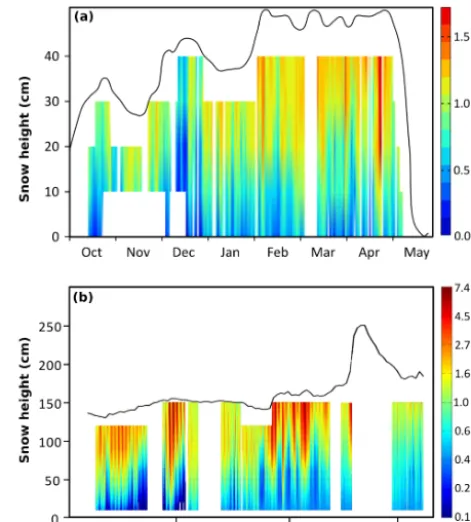
Gaseous Hg0concentrations were measured at Toolik over 2 years in the atmosphere, in snowpack interstitial air at up to five inlet heights, and in soil pore air in the tundra ecosys-tem. Data coverage was 183 and 207 days for the 2014–2015 and 2015–2016 seasons, respectively, with only a few peri-ods when system failures resulted in lack of data. A contin-uous temporal record of the Hg0gas concentration profile in the snowpack is presented in Fig. 3a for the 2014–2015 sea-son, i.e., when the snowpack was deeper compared to the 2015–2016 season, and compared to a similar record from a temperate snowpack based on published data (Fig. 3b; Faïn et al., 2013; note different y axis of figure panels). In ad-dition, full time-averaged atmosphere–snowpack–soil Hg0gas diffusion profiles are shown for the entire two winter seasons: 2014–2015 (Fig. 4a–c) and 2015–2016 (Fig. 4d–f). Gaseous Hg0concentrations were averaged for each season for three different periods, i.e., November to December (representing early winter and full darkness), January to February (repre-senting mid-winter and full darkness), and March to April (when sunlight emerged and when occasional AMDEs were active). Note that standard deviations indicate natural fluc-tuations in Hg0gas concentrations as observed in Obrist et al. (2017).
The Hg0gasmeasurements consistently showed strong centration gradients in the atmosphere–snowpack–soil con-tinuum with highest concentrations in the atmosphere (on average, 1.18±0.13 and 1.09±0.13 ng m−3, respectively) and lowest concentrations in soils (often below DL of
Figure 3.Gaseous Hg0concentration profiles in snowpack intersti-tial air during the snow-covered season from October 2014 to May 2015 over the Arctic tundra measured at Toolik Field Station based on continuous observations at up to five heights in the snowpack each hour, and interpolation of these data across the entire snow-pack(a). Missing data in the lower snowpack in 2014 were due to line freezing of the lowest inlet. For comparison, interpolated Hg0gas concentration profiles in snowpack interstitial air during the snow-covered season based on similar measurements at Niwot Ridge, Rocky Mountains, Colorado, USA, during the winter of 2009(b)
(adapted with permission; Faïn et al., 2013).
0.10 ng m−3). This pattern was consistent over two
Y. Agnan et al.: Mercury in the Arctic tundra snowpack 1945
Figure 4.Hg0gasconcentration profiles in the atmosphere, snowpack interstitial air, and soil interstitial air in early winter (from November to December;aandd), in winter (from January to February;bande), and in early spring (from March to April;candf) for 2014–2015(a–c)
and 2015–2016(d–f)snow-covered periods over the Arctic tundra measured at Toolik Field Station.
(e.g., Hg0gasconcentrations of 1.09 ng m−3in the atmosphere, 1.02 ng m−3at 20 cm, and 0.88 ng m−3at 10 cm height above ground). In a previous paper, we reported a small rate of con-tinuous Hg0gas deposition from the atmosphere to the tundra – measured by a micrometeorological tower – during much of the snow-covered season, with the exception of short time periods in spring when AMDEs occurred at Toolik (Obrist et al., 2017). Here, we show that these flux measurements are supported by consistent Hg0gas concentration gradients that existed through both seasons and that showed that snow-pack Hg0gas concentrations were consistently lower than at-mospheric levels above. In addition, snowpack Hg0gas de-clined with depth in the snowpack and were lowest in the underlying soil, showing evidence of a consistent Hg0gas con-centration gradient from the atmosphere to surface snow to tundra soils.
is that subsequent volatilization of the Hg0gasfrom the porous snowpack to the atmosphere can alleviate atmospheric depo-sition loads, and it is estimated that globally 50 % of snow-bound Hg is volatilized back to the atmosphere prior to snowmelt (Corbitt et al., 2011). Our trace gas concentration measurements showed that Hg0gas re-volatilization does not occur in this interior tundra snowpack during most of the winter. An absence of direct solar radiation likely explains the lack of photochemical Hg0gasformation and volatilization between December and mid-January. However, springtime is a photochemically active period in the Arctic when strong Hg0gas volatilization from snow has been reported further north along the Arctic Ocean coast (Brooks et al., 2006; Kirk et al., 2006). Even in late spring, however, when abundant solar radiation is present (400–600 W m−2), Hg0gas volatiliza-tion losses were rare and largely limited to periods of active AMDEs. We speculate that a reason for the general lack of Hg0gasformation and volatilization in snow is substrate lim-itation due to low snow Hgtot concentrations (Fig. 2). An alternative possibility may be that our sampling setup (be-tween 5 and 7 cm below the surface during the three main AMDEs) may have limited our ability to detect and observe photo-reduction processes that may occur only in the upper few centimeters of the snowpack surface (King and Simp-son, 2001; Poulain et al., 2004). However, using the same measurement system, Hg0gasconcentration enhancements in temperate snowpacks were large (up to 8 ng m−3)and de-tectable up to a depth of>90 cm from the snowpack surface (Fig. 3b). Unlike in Faïn et al. (2013), we did not observe Hg0gasformation after fresh snowfall, although it also is im-portant to note that snowfall amounts at Toolik were much lower than in temperate snowpack (Cherry et al., 2014).
During March and April, snowpack Hg0gas concentrations were highly variable (Fig. 4c and f) following Hg0gas concen-tration changes in the atmosphere above, indicating an ap-parently high snowpack diffusivity (Fig. S2). During these time periods, snowpack Hg0gas concentrations in the top of the snowpack at times exceeded concentrations in the at-mosphere above (less than 5 % of the time), and these oc-currences were mainly related to periods of AMDEs when Hg0gas depletion occurred in the overlying atmosphere. Our measurements of Hg0gas showed that early spring was the only time period when we observed small rates of Hg0gas for-mation in the uppermost snowpack layer, suggesting some photochemical reduction and re-volatilization of Hg0gas af-ter AMDE-Hg deposition. However, Hg0gas production was small, limited in time, and no photochemical Hg0gas produc-tion or re-emission was observed in deeper snow layers, sug-gesting that the process was limited to the snowpack sur-face. These patterns in March and April were also consistent with flux measurements when we observed periods of net Hg0gasemission from the tundra ecosystem to the atmosphere (Obrist et al., 2017), in support of the typical Hg
dynam-ics often reported during AMDEs (HgIIdeposition followed by photochemical reduction and Hg0gas re-emission; Ferrari et al., 2005). We propose that, in addition to relatively in-frequent and generally weaker AMDE activity, rapid photo-chemical re-emission losses of Hg following AMDEs render these events relatively unimportant as a deposition source of Hg in this interior Arctic tundra site. We provided support for this notion using stable Hg isotope analysis in soils from this site in Obrist et al. (2017), which showed that atmospheric Hg0gasis the dominant Hg source to the interior tundra snow-pack, accounting for over 70 % of Hg present.
3.2.2 Snowpack diffusivity of trace gases
A key question pertaining to the wintertime snowpack Hg0gas concentration profiles and measured deposition is whether the observed Hg0gasdeposition and concentration declines in the snowpack are driven by Hg0gassinks in the snowpack or by Hg0gasuptake by underlying tundra soils. Sinks of Hg0gas in the snowpack have been suggested in a few studies (Dom-mergue et al., 2003; Faïn et al., 2008, 2013) and have been attributed to dark oxidation of Hg0gasto divalent, non-volatile HgII, possibly including oxidation by halogen species, O3,
or related to NOx chemistry. To address this question, we compared the ratios of Hg0gasto CO2gradients in the
snow-pack to determine commonality or differences between sinks and sources of both gases. Because CO2in the atmosphere
is relatively stable in winter and soils are the only winter-time source, CO2 can be used to assess how the snowpack
affects diffusion and advective exchange processes between soils and the atmosphere. Comparing Hg0gas to CO2allows
assessment of whether Hg0gasconcentrations in the snowpack are driven by processes in the underlying soils (i.e., similar to CO2)or whether in-snowpack chemistry affects Hg0gas
con-centration profiles. The gas diffusion model, based on Fick’s first law of diffusion, is defined as follows:
F = −D
δC
δz
, (1)
where F is the molecular flux in the snowpack airspace (mol m−2s−1),Dis the diffusivity in the snowpack airspace (m2s−1), andδC/δzis the gas concentration gradient in the snowpack integrated in the snow depth (mol m−4).
Since diffusivity is determined by both snowpack poros-ity and tortuosporos-ity – both of which are poorly known and not directly measured – we used the flux ratios between Hg0gas and CO2to determine whether both gases show similar flux
behavior across the snowpack (Faïn et al., 2013): FHg0
gas
FCO2
= DHg0
gas
DCO2
× 1Hg0
gas
1CO2
, (2)
where1Hg0
gas and 1CO2 are the δC/δz gradients for both
diffusiv-Y. Agnan et al.: Mercury in the Arctic tundra snowpack 1947
Figure 5.Snow concentration profiles for Hg0gas(a)and CO2(b)concentrations and1Hg0
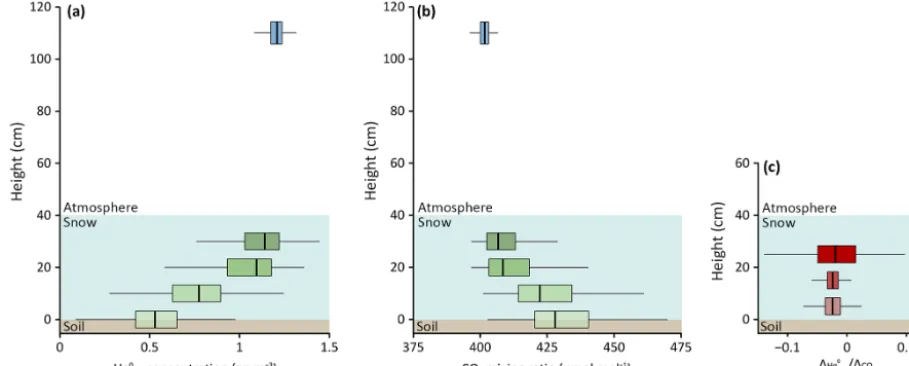
gas/1CO2 ratios for 0–10, 10–20, and 20–30 cm snowpack height based on daily averages(c)in January 2015 (snow height averaged 40 cm) over the Arctic tundra measured at Toolik Field Station.
ity for both Hg0gasand CO2, the ratio of concentration
gradi-ents of the two gases (1Hg0
gas/1CO2)gives direct information
about their respective flux ratios between different snowpack trace gas inlets. Please note that these fluxes are in the oppo-site direction.
We focused our analysis of Hg0gasand CO2concentration
gradients at Toolik for the month of January 2015, when the snow height was among the highest (approximatively 40 cm) and when strong decreases in interstitial Hg0gas con-centrations from the top to the bottom of the snowpack were present. At this time, soils still were a relatively active source of CO2to the snowpack (Fig. 5), facilitating a comparison to
the soil CO2source. In contrast to Hg0gas (Fig. 5a), profiles
for CO2showed strong increases in concentrations with
in-creasing depth in the snowpack (Fig. 5b). Highest CO2
con-centrations were present in the soil (up to 5000 µmol mol−1, data not shown), and these patterns are consistent with an ex-pected source of soils for CO2and diffusive and advective
mixing of CO2produced in snow through the snowpack with
the atmosphere (Liptzin et al., 2009; Oechel et al., 1997). Analysis of 1Hg0
gas/1CO2 ratios showed no statistically
sig-nificant differences from the top to the bottom of the snow-pack, as evidenced from calculated gradients between 0 and 10 cm, 10 and 20 cm, and 20 and 30 cm heights (Fig. 5c).
The constant and negative ratios between CO2and Hg0gas
and the fact that CO2is largely non-reactive in snowpack
in-dicate that Hg0gaswas also not subject to snowpack chemical reactions; both profiles are affected by underlying soil pro-cesses, i.e., soil sources for CO2 and soil sinks (for Hg0gas).
These wintertime atmosphere–snowpack–soil Hg0gas concen-tration profiles at Toolik were also consistent with a mea-sured net deposition of Hg0gas throughout winter using flux measurements (Figs. 2 and 4; Obrist et al., 2017). Both net
flux measurements, combined with snowpack Hg0gas concen-tration profiles, hence suggest that a soil Hg0gassink was ac-tive throughout the Arctic winter, notably under very cold wintertime soil temperatures as low as −15◦C. Such soil Hg0gas sinks were previously reported to occur in temper-ate soils (Obrist et al., 2014), although the mechanisms for the Hg0gas sinks are currently not clear. It is notable that 1Hg0
gas/1CO2 ratios in the upper snowpack (i.e., between 20
and 30 cm height) were more variable compared to lower snowpack heights, which we attribute to much smaller con-centrations differences for both CO2 and Hg0gas between
these inlets.
3.3 Snowbound mercury in the interior Arctic snowpack
3.3.1 Spatial patterns
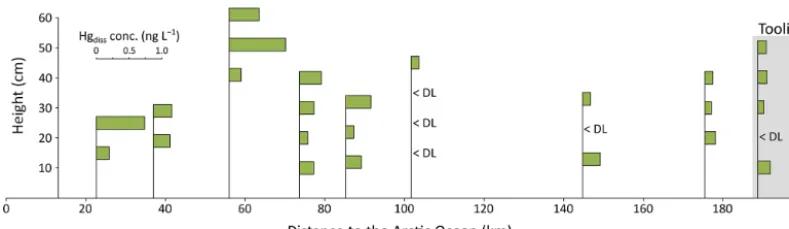
concen-Figure 6.Spatial pattern of dissolved Hg concentrations (Hgdiss)in snowpack profiles across the north slope transect on 27–28 March 2016, and comparison with Toolik Field Station (gray box) in 25 March 2016.
trations between 0.5 and 1.7 ng L−1)and at the low end of concentrations found in Arctic studies along the coastal zone (0.14–820 ng L−1, for both Hgdissand Hgtot; Douglas et al., 2005; Douglas and Sturm, 2004; Ferrari et al., 2004, 2005; Kirk et al., 2006; Nerentorp Mastromonaco et al., 2016; St. Louis et al., 2005; Steffen et al., 2002). The low concentra-tions we measured result in very small pool sizes of Hgdiss stored in the snowpack during wintertime compared to tem-perate studies (Pearson et al., 2015). At Toolik, snowpack pool sizes amounted to 26.9 and 19.7 ng m−2 during peak snowpack and prior to the onset of snowmelt in 2014–2015 and 2015–2016, respectively.
The snowpack sampled over the adjacent frozen lake showed Hgtot and Hgdiss concentrations of 0.80±0.61 and 0.15±0.08 ng L−1, respectively (Table S1). These values were not statistically different from concentrations measured in the tundra snowpack. Snowpack Hgdissloads on the frozen lake were lower (6.2±0.2 ng m−2), i.e., only about one-quarter, compared to snowpack Hgdiss load on the adjacent tundra (23.3±5.0 ng m−2). Three reasons may explain the
large difference between lake and tundra snowpack Hg loads: (1) the lake did not accumulate the snowpack on open wa-ter prior to the lake surface freezing in the early fall (Sturm and Liston, 2003); (2) low surface roughness over the lake likely prevent settling of snowfall and facilitate remobiliza-tion of snow by wind transport (Essery et al., 1999; Essery and Pomeroy, 2004); and (3) the lake ice is warmer than the tundra soil resulting in higher sublimation over the lake. The implication of the latter process is a reduction of direct at-mospheric deposition over Arctic lakes and is consistent with studies that estimated that annual Hg contribution to Arctic lakes via direct wet deposition is small, generally less than 20 % of total deposition (Fitzgerald et al., 2005, 2014). Spa-tial redistribution of snow across the tundra landscape further implies that both wet deposition and snow accumulation rates are variable, leading to spatial heterogeneity of snowmelt Hg inputs.
Most Arctic studies of snowpack Hg have been performed close to the coast (i.e., Alert and Barrow), and few studies in-clude inland sites such as Toolik (Douglas and Sturm, 2004).
In our study, measurements of Hgtotand Hgdissin the snow-pack across a large north slope transect (about 170 km from Toolik to the Arctic Coast) in March 2016 showed concen-trations of 0.70±0.79 and 0.24±0.20 ng L−1, respectively
(Fig. 6 and Table S3). Concentrations in Hgdiss of the five northernmost locations (<100 km distance from the Arctic Ocean) were statistically significantly (p <0.05, Kruskal– Wallis test) higher compared to those measured at the four stations located in the interior tundra (>100 km), which in-cluded the Toolik site where mean Hgdiss concentrations were 0.33±0.22 and 0.11±0.07 ng L−1for the same period, respectively. These patterns are consistent with previous ob-servations in Alaska in springtime that suggested an ocean influence leading to higher Hg deposition, possibly linked to the presence of halogens (Douglas and Sturm, 2004; Lan-ders et al., 1995; Snyder-Conn et al., 1997). We propose that low snowpack Hg concentrations (<0.5 ng L−1 for Hgdiss)
are common in inland northern Alaska areas and that the interior Arctic snowpacks exhibit lower levels compared to coastal locations that are subjected to more significant ocean influences and impacts by AMDEs.
3.3.2 Seasonal patterns
con-Y. Agnan et al.: Mercury in the Arctic tundra snowpack 1949
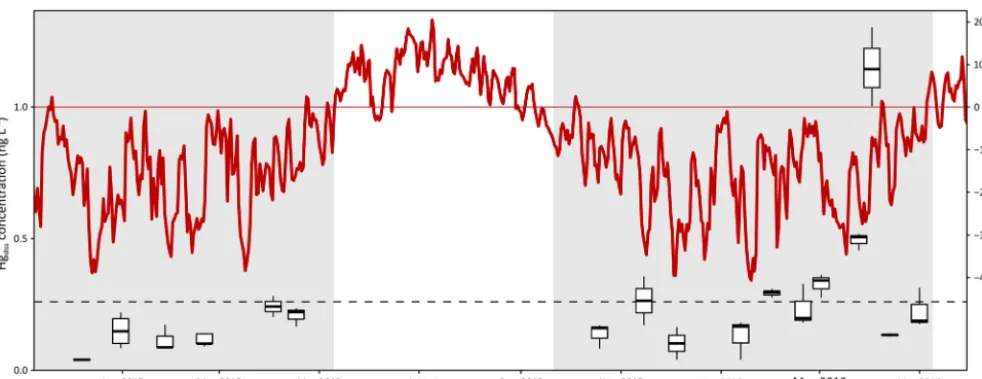
Figure 7.Temporal pattern of dissolved Hg (Hgdiss)concentrations in surface snow samples (top 3 cm) throughout the 2014–2015 and 2015–2016 snow-covered seasons (in gray) at Toolik Field Station. The broken line indicates the average surface snow Hgdissconcentration (0.26 ng L−1). The red line indicates the daily average air temperature.
centrations reported for Kodiak Island in Alaska during the same time period (National Atmospheric Deposition Pro-gram, 2017). Also, snowfall Hgdissconcentrations measured at Alert were between 100 and 200 times higher than in our measurements (Alexandra Steffen, personal communi-cation, 2017). Using median concentrations in the surface snow multiplied by the amount of wet deposition for each snow-covered season, we estimated the Hgdissload annually deposited by snowfall to 41.3 and 15.3 ng m−2in the 2014– 2015 and 2015–2016 winters, respectively. This is 1/100 of values recently provided from a coastal location 400 km northwest of our study site (Douglas et al., 2017) and 1/200 of long-term measurements from Alert between 1998 and 2010 (Alexandra Steffen, personal communication, 2017).
Little temporal variation in snowpack Hg concentrations was observed between the early season snowpack evolving mainly under darkness and the late season snowpack exposed to solar radiation (Figs. 2 and 6), although some temporal dif-ferences were evident during March and April when AMDEs were present in the region. Snowpack Hgdissconcentrations averaged 0.16 ng L−1 both during the completely dark pe-riod (i.e., December and January) and after 1 March. Such patterns support measurements of Hg0gasthroughout the win-ter that indicated the snowpack to be a relatively inert matrix with few redox processes affecting Hg concentrations (ox-idation of Hg0gas or reduction of HgII). An apparent trend in surface snow, however, emerged during springtime, when both Hgtotand Hgdissconcentrations exceeded 1 ng L−1(i.e., 4 times the average values observed through the rest of the season; Fig. 7). This was a period when AMDEs occurred at this site, as evident by depletions of atmospheric Hg0gas with formation and deposition of oxidized atmospheric HgII (Obrist et al., 2017; Van Dam et al., 2013). Surface snow Hg
concentration enhancements during AMDEs are commonly reported in polar regions, with at times Hg concentration en-hancements up to 100 times the base concentration in the Arctic (Lalonde et al., 2002; Lindberg et al., 1998; Poulain et al., 2004; Steffen et al., 2002). The presence of AMDEs gen-erally results in increased deposition of Hg to snow and ice surfaces, yet such additional deposition often is short-lived due to the photochemical re-emission of Hg0gas (Kirk et al., 2006). In our study, we did not have sufficient temporal res-olution of snow sampling during the period of AMDEs to closely track the fate of Hg deposition during AMDEs and subsequent re-emissions. However, we find that snow Hg en-hancements during AMDEs were much lower than at coastal sites (e.g., Steffen et al., 2014), but a coarse temporal sam-pling could just have missed peak snow Hg levels at this site. We also found that after AMDEs, snow Hgdissin surface snow declined to levels as was observed prior to AMDEs, and no concentration enhancements were observed deeper in the snowpack. This is consistent with observations of net Hg0gas volatilization during that time. The fact that we found no last-ing impact of AMDEs on snow Hg concentrations, which also were supported by stable Hg isotope analysis (Obrist et al., 2017), may be due to the large distance to the coast from our study site and the scarcity of AMDEs – and O3depletion
events – that occur at this inland Arctic location (Van Dam et al., 2013).
Table 1.Mean concentration (µg L−1), including standard deviation (italics), of cations and anions in tundra and lake snowpack and in surface snow at Toolik Field Station.
Location Mg2+ Ca2+ Na+ K+ Cl− NH+4 NO−3 SO24−
Tundra Surface 7.2 453.0 112.6 29.4 228.6 11.3 265.0 191.3
6.8 530.8 104.6 46.7 232.9 3.9 187.5 130.6
Snowpack 32.1 523.5 58.5 60.8 137.5 13.2 202.8 234.0
34.7 452.1 38.9 102.3 113.1 5.4 104.5 131.8
Lake 27.8 784.1 119.1 23.1 117.5 12.8 270.5 181.2
21.8 403.7 135.9 28.6 73.4 2.9 94.0 78.1
Table 2.Spearman’s coefficient correlations (ρ, in bold if≥0.5 or≤ −0.5) between chemical elements (dissolved Hg [Hgdiss] and major ions) in the tundra snowpack(a)and surface snow over the tundra(b).
(a)Tundra snowpack (b)Surface snow
Hgdiss Mg2+ Ca2+ Na+ K+ Cl− NH+4 NO−3 Hgdiss Mg2+ Ca2+ Na+ K+ Cl− NH+4 NO−3 SO24− −0.16 0.42 0.32 0.39 0.48 0.47 0.58 0.17 SO42− −0.08 0.54 0.14 0.16 −0.08 −0.04 0.74 0.74
NO−3 0.07 0.74 0.83 0.55 0.33 0.59 0.03 NO−3 0.14 0.62 0.28 0.08 0.07 −0.20 0.57
NH+4 −0.22 −0.04 0.03 0.15 0.35 0.30 NH+4 −0.02 0.45 0.24 0.18 −0.08 −0.04
Cl− −0.11 0.41 0.39 0.89 0.72 Cl− 0.63 0.35 0.69 0.82 0.86
K+ −0.10 0.34 0.33 0.70 K+ 0.62 0.45 0.80 0.78
Na+ 0.11 0.47 0.38 Na+ 0.30 0.68 0.56
Ca2+ −0.07 0.90 Ca2+ 0.80 0.39
Mg2+ 0.06 Mg2+ 0.08
times the average snowpack concentrations) were observed in the top 3 cm of the snowpack. Seasonal measurements at Toolik indicate a generic lack of atmospheric gaseous HgII during most of the year and very low amounts of total HgII deposition, i.e., wet, aerosols, plus gaseous HgII(Obrist et al., 2017). The lack of significant HgIIdry deposition would prevent a Hg enhancement in surface snow and also is con-sistent with the low pool sizes of Hg in this tundra snowpack. Further support of this notion that snow collected at the sur-face throughout the Arctic winter and spring was not statisti-cally different from snow Hg concentrations contained in the entire snowpack (0.26±0.26 vs. 0.17±0.10 ng L−1, respec-tively). Another factor to explain a lack of depth gradients in snow Hg concentrations may be that snow layers can be con-tinuously mixed and redistributed by wind gust (e.g., wind speed of Toolik were>5 m s−112 % of the time) across the landscape in the Arctic (Cherry et al., 2014).
3.4 Origin of mercury in the interior Arctic snowpack 3.4.1 Cation and anion concentrations
Major cations (Ca2+, K+, Mg2+, Na+, and NH+4) and an-ions (Cl−, NO−3, and SO24−) were measured in snowpack and surface snow samples at Toolik to assess the chemical composition and potential origins for Hg in the snowpack (Table 1). Concentrations of these compounds were compa-rable to other inland Alaskan sites and, similar to
concen-trations of Hg, were lower than data reported from several Arctic coastal locations (de Caritat et al., 2005; Douglas and Sturm, 2004). Surface snow samples (top 3 cm) generally showed somewhat higher Cl− and Na+ concentrations and lower Mg2+and K+concentrations than samples collected across the entire snowpack height, although only Mg2+and Na+ were significantly different (p <0.005 and p <0.05, respectively). Comparison between tundra and lake snow-pack locations showed no statistical differences in elemental concentrations.
Spearman correlation coefficient (ρ)between Hgdiss and major ion concentrations were calculated for tundra and lake snowpack samples and surface snow collected over the tun-dra (Table 2). Using a correlation matrix, three groups of correlated major ions could be determined in the snowpack over the tundra: (1) NH+4 and SO24−; (2) Ca2+, Mg2+, and NO−3; (3) Cl−, K+, and Na+. In the tundra snowpack, Hgdiss was not statistically significantly (−0.22< ρ <0.11) corre-lated to any of these major ion groups when considering the entire depth of the tundra snowpack. Relationships, however, were present in surface snow over the tundra where Hgdiss was correlated (ρup to 0.80) with Ca2+, Cl−, and K+, indi-cating that Hgdissmay have originated from a mix of natural sources possibly linked to both mineral dust (Ca2+) and sea spray (Cl−). The lack of strong correlation between Hgdiss and Na+ (ρ=0.30) in surface snow samples may indicate that a part of Cl−originated from mineral dust as CaCl2. A
obser-Y. Agnan et al.: Mercury in the Arctic tundra snowpack 1951
Figure 8.Ternary diagram of tundra surface snow (orange), tundra snowpack (blue), and lake snowpack (green) samples from Toolik Field Station ordered by dissolved Hg concentration between Ca2+, Cl−, and SO24−(proportions based on meq L−1).
vations that showed the highest Hg concentrations close to the Arctic Ocean related particularly to active bromine chem-istry (Fig. 6; Douglas and Sturm, 2004). In addition, local or regional dust from rock and soil weathering contributed to the wintertime Hg deposition, particularly at interior sites close to the Brooks Range where higher snow pH reported were from mineral dust that contained carbonates (Douglas and Sturm, 2004). Indeed, the mountain influence was dom-inant during the two snow-covered seasons at Toolik where 50 % of snow events and 80 % of dry periods (i.e., periods without snowfall, 90 % of the time) came from the south (i.e., Brooks Range). An additional group of correlated elements was identified in surface snow samples over the tundra: NH+4, NO−3, and SO24−. Note that the low number of lake snowpack samples (≤12) did not allow us to perform a meaningful cor-relation matrix analyses for lake snowpack samples.
To further visualize the relationships between analytes, we plotted a ternary diagram using three endmembers accord-ing to Garbarino et al. (2002), Krnavek et al. (2012), Poulain et al. (2004), and Toom-Sauntry and Barrie (2002) (Fig. 8). We considered Ca2+as one endmember to represent a poten-tial crustal signature, a second endmember with Cl−as a sea salt signature, and a third endmember with SO24−as a poten-tial anthropogenic signature, i.e., from regional or long-range transport. Since sea salt SO24− represented on average less than 1.2 % of total SO24−according to the calculation of Nor-man et al. (1999), we consider SO24−not indicative of a ma-rine source. The different snow types (surface snow over the tundra, tundra snowpack, and lake snowpack) are presented
with different colors in Fig. 8, and Hgdissconcentrations are represented by different symbol sizes. Relative concentra-tions of Cl−(i.e., sea salt influence) showed statistically sig-nificant differences between snow samples collected over the tundra and those collected over the frozen lake (on average, 14 and 24 % of proportion based on normality data, respec-tively;p <0.05). However, no statistically significant differ-ences were observed for relative concentrations of Ca2+and SO24− between tundra and lake locations. In general, snow surface samples showed low SO24−and Cl−relative concen-trations (<30 %) compared to integrated snowpack samples. Overall, Hgdiss concentrations were weakly correlated, ex-cept according to the SO24− relative concentrations: Hgdiss concentrations averaged 0.10 and 0.17 ng L−1for>30 and <30 % of SO24−, respectively (p <0.005). These patterns in-dicate that anthropogenic influences from combustion pro-cesses were minor or absent for snow Hg deposition. In fact, Alaska generally showed the lowest SO24− concentra-tions among Arctic sites (de Caritat et al., 2005). Norman et al. (1999) also reported relatively small contributions of anthropogenic SO24− in snow at Alert (Canada). From this, we propose that the Hg sources in the Arctic snowpack are mainly derived from local lithological erosion and that Arctic Ocean sources are minor contributions. However, this is not likely the case of Hg0gasin tundra soils which mainly derived from global sources (Obrist et al., 2017). It should be noted that the proximity of Toolik to the Dalton Highway may in-fluence our measurements, but this is difficult to evaluate.
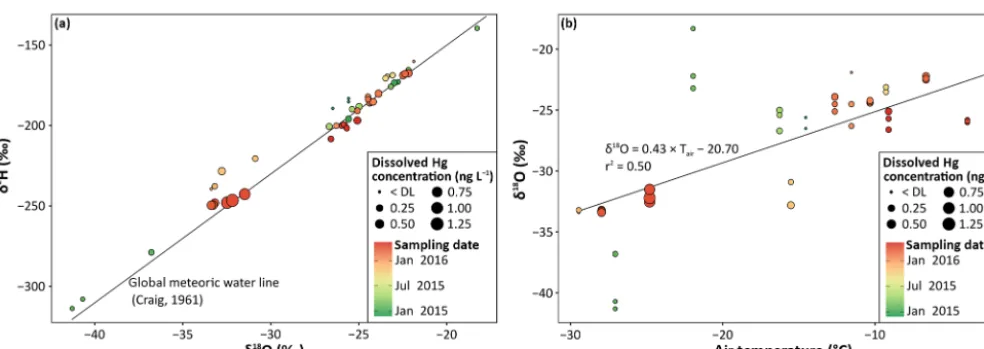
Figure 9.Dissolved Hg concentrations in surface snow samples for 2014 to 2016 in:(a)theδ2H vs.δ18O diagram and(b)a plot ofδ18O vs. air temperature (Tair)during the previous snowfall at Toolik Field Station.
depth (Table 2a) further suggests that initial snowfall Hg con-tent was maintained and largely unaltered after deposition, with no clear accumulation or depletion zones as found in other snowpacks (Ferrari et al., 2005; Poulain et al., 2004; Steffen et al., 2014). We found a small relative enrichment of alkaline earth elements in snowpack samples compared to surface snow, which indicates some additional contributions of local mineral dust, yet this did not result in a measurable increase in snowpack Hg levels. Hence, we suggest no sig-nificant additional deposition of Hg (e.g., by dry deposition of gaseous or particulate Hg) to exposed older snow consis-tent with the lack of correlation to pollution tracers (SO24− and NO−3). We also suggest an absence or minor importance of re-emission losses or elution losses from snowmelt as oc-curs in temperate snowpacks (discussed in Faïn et al., 2013, and Pearson et al., 2015). Elution losses are unlikely, given that no temperatures above freezing were present in the Arc-tic until May, and atmospheric re-emissions losses of volatile Hg0gaswere not important in this Arctic snowpack for most of the season as discussed above.
3.4.2 Stable oxygen and hydrogen isotope signatures Oxygen (18O) and hydrogen (2H) isotopes are frequently used as tracers for precipitation sources (Gat, 2010). The sta-ble isotope signatures in surface snow samples collected at Toolik are presented in a δ2H vs. δ18O diagram for differ-ent ranges of Hgdiss concentrations and different sampling dates (Fig. 9a). All the samples were distributed close to the global meteoritic water line (Craig, 1961). Despite a large variability in values (from−41.3 to−18.3 ‰ forδ18O and from −314 to−140 ‰ for δ2H), samples collected on the same date were relatively close (mean standard deviation of 0.88 and 6.5 ‰, respectively). No clear relationships were observed between isotope signatures and Hgdiss concentra-tions (with size scale in Fig. 9) across the entire spectrum
of values. However, samples with high Hgdissconcentrations (e.g., the three highest measured in 2 April 2016) and low Hgdissconcentrations (e.g., samples below the DL in 5 De-cember 2015) were found clustered together at similarδ18O andδ2H values. Theδ18O values were also plotted against air temperatures (Tair)during the snowfall events (Fig. 9b).
A statistically significant linear relationship was found be-tween the two variables (r2=0.50) with the lowest δ18O values being measured during the coldest temperatures. Nei-ther the origin of precipitation as shown by the wide range of stable isotope ratios nor the physical conditions that often cause isotopic variation in precipitation (e.g., air tempera-tures that explain up to 50 % of isotopic values via mass ef-fects; Siegenthaler and Oeschger, 1980) shaped the Hg con-centrations measured in the snowpack.
4 Conclusions
In this study, we investigated snow Hg dynamics in the in-terior Arctic tundra at Toolik Field Station, Alaska, simulta-neously analyzing Hg in (1) the gas phase (Hg0gas) of the at-mosphere, interstitial snowpack, and soil pores; and (2) the solid phase in snow (Hgtot and Hgdiss). Gaseous Hg0 in
Y. Agnan et al.: Mercury in the Arctic tundra snowpack 1953
from the snowpack in models, which should have differ-ent treatmdiffer-ent for the Arctic snowpack compared to temper-ate snowpacks. Small Hgdissenhancements were temporarily observed in surface snow during springtime, when AMDEs were present, reflecting the typical sequence of Hg depo-sition to the top snowpack followed by fast photochemical volatilization losses of Hg0gasduring that time. At this interior Arctic site, however, AMDEs, resulted in negligible deposi-tion loads. Low concentradeposi-tions of both Hgtotand Hgdisswere measured in the snowpack across this northern Alaska re-gion, resulting in a small reservoir of Hg stored in this snow-pack available for potential mobilization during snowmelt (<30 ng m−2for Hgdiss). These low values suggest that wet
Hg deposition via snow is not a major source of Hg to this in-terior Arctic site, a notion we previously supported by direct measurements and stable Hg isotopes that showed that two-thirds of the Hg source are derived from Hg0gas deposition. Multielement analysis of surface snow (top 3 cm) indicated that Arctic snowpack Hg originated from a mix of diffuse and likely natural sources, including local mineral dust (asso-ciated with Ca2+and Mg2+) and, to a lesser extent, regional marine sea spray (associated with Cl−and Na+).
Data availability. Snow chemistry data can be found in an Excel file in the Supplement.
Supplement. The supplement related to this article is available online at: https://doi.org/10.5194/tc-12-1939-2018-supplement.
Competing interests. The authors declare that they have no conflict of interest.
Acknowledgements. We thank Toolik Field Station staff for their support in this project over 2 years, especially Jeb Timm, Joe Franish, and Faye Ethridge for helping with snow collection. We also thank Martin Jiskra (Geosciences Environnement Toulouse) and Christine Olson (DRI) for their field support, Christopher Pearson, Olivia Dillon, and Jacob Hoberg (DRI) for their support with laboratory analyses, and Dominique Colegrove and Tim Molnar (University of Colorado) for helping with field work and data processing. We finally thank Alexandra Steffen for providing mercury snow data from Alert. Funding was provided by the US National Science Foundation (NSF) under award no. PLR 1304305 and cooperative agreement from National Aeronautics and Space Administration (NASA EPSCoR NNX14AN24A).
Edited by: Becky Alexander
Reviewed by: two anonymous referees
References
Alaska Division of Oil and Gas: Regional geology of the north slope of Alaska, 1/1 000 000, State of Alaska, Department of Natural Resources, Division of Oil and Gas, Anchorage, 2008.
Angot, H., Dastoor, A., De Simone, F., Gårdfeldt, K., Gencar-elli, C. N., Hedgecock, I. M., Langer, S., Magand, O., Mas-tromonaco, M. N., Nordstrøm, C., Pfaffhuber, K. A., Pirrone, N., Ryjkov, A., Selin, N. E., Skov, H., Song, S., Sprovieri, F., Steffen, A., Toyota, K., Travnikov, O., Yang, X., and Domgue, A.: Chemical cycling and deposition of atmospheric mer-cury in polar regions: review of recent measurements and com-parison with models, Atmos. Chem. Phys., 16, 10735–10763, https://doi.org/10.5194/acp-16-10735-2016, 2016a.
Angot, H., Magand, O., Helmig, D., Ricaud, P., Quennehen, B., Gallée, H., Del Guasta, M., Sprovieri, F., Pirrone, N., Savarino, J., and Dommergue, A.: New insights into the atmo-spheric mercury cycling in central Antarctica and implications on a continental scale, Atmos. Chem. Phys., 16, 8249–8264, https://doi.org/10.5194/acp-16-8249-2016, 2016b.
Atwell, L., Hobson, K. A., and Welch, H. E.: Biomagnification and bioaccumulation of mercury in an arctic marine food web: in-sights from stable nitrogen isotope analysis, Can. J. Fish. Aquat. Sci., 55, 1114–1121, https://doi.org/10.1139/f98-001, 1998. Barker, A. J., Douglas, T. A., Jacobson, A. D., McClelland, J.
W., Ilgen, A. G., Khosh, M. S., Lehn, G. O., and Trainor, T. P.: Late season mobilization of trace metals in two small Alaskan arctic watersheds as a proxy for landscape scale per-mafrost active layer dynamics, Chem. Geol., 381, 180–193, https://doi.org/10.1016/j.chemgeo.2014.05.012, 2014.
Bergin, M. H., Jaffrezo, J.-L., Davidson, C. I., Dibb, J. E., Pan-dis, S. N., Hillamo, R., Maenhaut, W., Kuhns, H. D., and Makela, T.: The contributions of snow, fog, and dry depo-sition to the summer flux of anions and cations at Sum-mit, Greenland, J. Geophys. Res.-Atmos., 100, 16275–16288, https://doi.org/10.1029/95JD01267, 1995.
Brooks, S., Lindberg, S., Southworth, G., and Arimoto, R.: Springtime atmospheric mercury speciation in the McMurdo, Antarctica coastal region, Atmos. Environ., 42, 2885–2893, https://doi.org/10.1016/j.atmosenv.2007.06.038, 2008.
Brooks, S. B., Saiz-Lopez, A., Skov, H., Lindberg, S. E., Plane, J. M. C., and Goodsite, M. E.: The mass balance of mercury in the springtime arctic environment, Geophys. Res. Lett., 33, L13812, https://doi.org/10.1029/2005GL025525, 2006.
de Caritat, P., Hall, G., Gìslason, S., Belsey, W., Braun, M., Goloubeva, N. I., Olsen, H. K., Scheie, J. O., and Vaive, J. E.: Chemical composition of arctic snow: concentration levels and regional distribution of major elements, Sci. Total Environ., 336, 183–199, https://doi.org/10.1016/j.scitotenv.2004.05.031, 2005. Cherry, J. E., Déry, S. J., Cheng, Y., Stieglitz, M., Jacobs, A. S.,
and Pan, F.: Climate and hydrometeorology of the Toolik Lake region and the Kuparuk River basin, in: Alaska’s changing arctic: ecological consequences for tundra, streams, and lakes, edited by: Hobbie, J. E. and Kling, G. W., 21–60, Oxford University Press, New York, 2014.
Corbitt, E. S., Jacob, D. J., Holmes, C. D., Streets, D. G., and Sunderland, E. M.: Global source-receptor relationships for mercury deposition under present-day and 2050 emis-sions scenarios, Environ. Sci. Technol., 45, 10477–10484, https://doi.org/10.1021/es202496y, 2011.
Craig, H.: Isotopic variations in meteoric waters, Science, 133, 1702–1703, https://doi.org/10.1126/science.133.3465.1702, 1961.
Dominé, F. and Shepson, P. B.: Air-snow interactions and atmospheric chemistry, Science, 297, 1506–1510, https://doi.org/10.1126/science.1074610, 2002.
Dommergue, A., Ferrari, C. P., Poissant, L., Gauchard, P.-A., and Boutron, C. F.: Diurnal cycles of gaseous mer-cury within the snowpack at Kuujjuarapik/Whapmagoostui, Québec, Canada, Environ. Sci. Technol., 37, 3289–3297, https://doi.org/10.1021/es026242b, 2003.
Dommergue, A., Sprovieri, F., Pirrone, N., Ebinghaus, R., Brooks, S., Courteaud, J., and Ferrari, C. P.: Overview of mercury mea-surements in the Antarctic troposphere, Atmos. Chem. Phys., 10, 3309–3319, https://doi.org/10.5194/acp-10-3309-2010, 2010. Douglas, T. A. and Sturm, M.: Arctic haze,
mer-cury and the chemical composition of snow across northwestern Alaska, Atmos. Environ., 38, 805–820, https://doi.org/10.1016/j.atmosenv.2003.10.042, 2004.
Douglas, T. A., Sturm, M., Simpson, W. R., Brooks, S., Lindberg, S. E., and Perovich, D. K.: Elevated mercury measured in snow and frost flowers near Arctic sea ice leads, Geophys. Res. Lett., 32, L04502, https://doi.org/10.1029/2004GL022132, 2005. Douglas, T. A., Sturm, M., Simpson, W. R., Blum, J. D.,
Alvarez-Aviles, L., Keeler, G. J., Perovich, D. K., Biswas, A., and John-son, K.: Influence of snow and ice crystal formation and accumu-lation on mercury deposition to the Arctic, Environ. Sci. Tech-nol., 42, 1542–1551, https://doi.org/10.1021/es070502d, 2008. Douglas, T. A., Loseto, L. L., Macdonald, R. W., Outridge, P.,
Dom-mergue, A., Poulain, A., Amyot, M., Barkay, T., Berg, T., Chéte-lat, J., Constant, P., Evans, M., Ferrari, C., Gantner, N., John-son, M. S., Kirk, J., Kroer, N., Larose, C., Lean, D., Nielsen, T. G., Poissant, L., Rognerud, S., Skov, H., Sørensen, S., Wang, F., Wilson, S., and Zdanowicz, C. M.: The fate of mercury in arctic terrestrial and aquatic ecosystems, a review, Environ. Chem., 9, 321–355, https://doi.org/10.1071/EN11140, 2012.
Douglas, T. A., Sturm, M., Blum, J. D., Polashenski, C., Stuefer, S., Hiemstra, C., Steffen, A., Filhol, S., and Prevost, R.: A pulse of mercury and major ions in snowmelt runoff from a small arc-tic Alaska watershed, Environ. Sci. Technol., 51, 11145–11155, https://doi.org/10.1021/acs.est.7b03683, 2017.
Driscoll, C. T., Mason, R. P., Chan, H. M., Jacob, D. J., and Pirrone, N.: Mercury as a global pollutant: sources, path-ways, and effects, Environ. Sci. Technol., 47, 4967–4983, https://doi.org/10.1021/es305071v, 2013.
Enrico, M., Le Roux, G., Heimbürger, L.-E., Van Beek, P., Souhaut, M., Chmeleff, J., and Sonke, J. E.: Holocene at-mospheric mercury levels reconstructed from peat bog mer-cury stable isotopes, Environ. Sci. Technol., 51, 5899–5906, https://doi.org/10.1021/acs.est.6b05804, 2017.
Essery, R. and Pomeroy, J.: Vegetation and topographic con-trol of wind-blown snow distributions in distributed and aggregated simulations for an arctic tundra basin, J.
Hy-drometeorol., 5, 735–744, https://doi.org/10.1175/1525-7541(2004)005<0735:VATCOW>2.0.CO;2, 2004.
Essery, R., Li, L., and Pomeroy, J.: A distributed model of blowing snow over complex terrain, Hydrol. Pro-cess., 13, 2423–2438, https://doi.org/10.1002/(SICI)1099-1085(199910)13:14/15<2423::AID-HYP853>3.0.CO;2-U, 1999.
Faïn, X., Grangeon, S., Bahlmann, E., Fritsche, J., Obrist, D., Dommergue, A., Ferrari, C. P., Cairns, W., Ebing-haus, R., Barbante, C., Cescon, P., and Boutron, C.: Di-urnal production of gaseous mercury in the alpine snow-pack before snowmelt, J. Geophys. Res., 112, D21311, https://doi.org/10.1029/2007JD008520, 2007.
Faïn, X., Ferrari, C. P., Dommergue, A., Albert, M., Battle, M., Ar-naud, L., Barnola, J.-M., Cairns, W., Barbante, C., and Boutron, C.: Mercury in the snow and firn at Summit Station, Cen-tral Greenland, and implications for the study of past atmo-spheric mercury levels, Atmos. Chem. Phys., 8, 3441–3457, https://doi.org/10.5194/acp-8-3441-2008, 2008.
Faïn, X., Obrist, D., Pierce, A., Barth, C., Gustin, M. S., and Boyle, D. P.: Whole-watershed mercury balance at Sagehen Creek, Sierra Nevada, CA, Geochim. Cosmochim. Acta, 75, 2379–2392, https://doi.org/10.1016/j.gca.2011.01.041, 2011.
Faïn, X., Helmig, D., Hueber, J., Obrist, D., and Williams, M. W.: Mercury dynamics in the Rocky Mountain, Colorado, snowpack, Biogeosciences, 10, 3793–3807, https://doi.org/10.5194/bg-10-3793-2013, 2013.
Ferrari, C. P., Dommergue, A., Boutron, C. F., Jitaru, P., and Adams, F. C.: Profiles of mercury in the snow pack at Station Nord, Greenland shortly after polar sunrise, Geophys. Res. Lett., 31, L03401, https://doi.org/10.1029/2003GL018961, 2004. Ferrari, C. P., Gauchard, P.-A., Aspmo, K., Dommergue, A.,
Ma-gand, O., Bahlmann, E., Nagorski, S., Temme, C., Ebing-haus, R., Steffen, A., Banic, C., Berg, T., Planchon, F., Barbante, C., Cescon, P., and Boutron, C. F.: Snow-to-air exchanges of mercury in an Arctic seasonal snow pack in Ny-Ålesund, Svalbard, Atmos. Environ., 39, 7633–7645, https://doi.org/10.1016/j.atmosenv.2005.06.058, 2005.
Ferrari, C. P., Padova, C., Faïn, X., Gauchard, P.-A., Dommergue, A., Aspmo, K., Berg, T., Cairns, W., Barbante, C., Cescon, P., Kaleschke, L., Richter, A., Wittrock, F., and Boutron, C.: At-mospheric mercury depletion event study in Ny-Ålesund (Sval-bard) in spring 2005, Deposition and transformation of Hg in sur-face snow during springtime, Sci. Total Environ., 397, 167–177, https://doi.org/10.1016/j.scitotenv.2008.01.064, 2008.
Fitzgerald, W. F., Engstrom, D. R., Lamborg, C. H., Tseng, C.-M., Balcom, P. H., and Hammerschmidt, C. R.: Modern and historic atmospheric mercury fluxes in Northern Alaska: global sources and arctic depletion, Environ. Sci. Technol., 39, 557– 568, https://doi.org/10.1021/es049128x, 2005.
Fitzgerald, W. F., Hammerschmidt, C. R., Engstrom, D. R., Balcom, P. H., Lamborg, C. H., and Tseng, C.-M.: Mercury in the Alaskan arctic, in Alaska’s changing arctic: ecological consequences for tundra, streams, and lakes, edited by: Hobbie, J. E. and Kling, G. W., Oxford University Press, New York, 287–302, 2014. Garbarino, J. R., Snyder-Conn, E., Leiker, T. J., and Hoffman,
Y. Agnan et al.: Mercury in the Arctic tundra snowpack 1955
Gat, J. R.: Isotope hydrology: a study of the water cycle, World Scientific, London, 2010.
King, M. D. and Simpson, W. R.: Extinction of UV radiation in arc-tic snow at Alert, Canada (82◦N), J. Geophys. Res.-Atmos., 106, 12499–12507, https://doi.org/10.1029/2001JD900006, 2001. Kirk, J. L., St. Louis, V. L., and Sharp, M. J.: Rapid
reduc-tion and reemission of mercury deposited into snowpacks during atmospheric mercury depletion events at Churchill, Manitoba, Canada, Environ. Sci. Technol., 40, 7590–7596, https://doi.org/10.1021/es061299+, 2006.
Krnavek, L., Simpson, W. R., Carlson, D., Domine, F., Dou-glas, T. A., and Sturm, M.: The chemical composition of surface snow in the Arctic: Examining marine, terrestrial, and atmospheric influences, Atmos. Environ., 50, 349–359, https://doi.org/10.1016/j.atmosenv.2011.11.033, 2012.
Lalonde, J. D., Poulain, A. J., and Amyot, M.: The role of mercury redox reactions in snow on snow-to-air mercury transfer, Environ. Sci. Technol., 36, 174–178, https://doi.org/10.1021/es010786g, 2002.
Landers, D. H., Ford, J., Gubala, C., Monetti, M., Lasorsa, B. K., and Martinson, J.: Mercury in vegetation and lake sedi-ments from the U.S. Arctic, Water Air. Soil Pollut., 80, 591–601, https://doi.org/10.1007/BF01189711, 1995.
Lindberg, S. E., Hanson, P. J., Meyers, T. P., and Kim, K.-H.: Air/surface exchange of mercury vapor over forests – the need for a reassessment of continental biogenic emissions, Atmos. Environ., 32, 895–908, https://doi.org/10.1016/S1352-2310(97)00173-8, 1998.
Liptzin, D., Williams, M. W., Helmig, D., Seok, B., Filippa, G., Chowanski, K., and Hueber, J.: Process-level controls on CO2 fluxes from a seasonally snow-covered subalpine meadow soil, Niwot Ridge, Colorado, Biogeochemistry, 95, 151–166, https://doi.org/10.1007/s10533-009-9303-2, 2009.
Mann, E., Meyer, T., Mitchell, C. P. J., and Wania, F.: Mercury fate in ageing and melting snow: development and testing of a controlled laboratory system, J. Environ. Monit., 13, 2695–2702, https://doi.org/10.1039/C1EM10297D, 2011.
Mann, E., Ziegler, S., Mallory, M., and O’Driscoll, N.: Mercury photochemistry in snow and implications for arctic ecosys-tems, Environ. Rev., 22, 331–345, https://doi.org/10.1139/er-2014-0006, 2014.
Mann, E. A., Mallory, M. L., Ziegler, S. E., Tordon, R., and O’Driscoll, N. J.: Mercury in Arctic snow: quantifying the kinetics of photochemical oxidation and reduction, Sci. Total Environ., 509–510, 115–132, https://doi.org/10.1016/j.scitotenv.2014.07.056, 2015.
Monson, R. K., Burns, S. P., Williams, M. W., Delany, A. C., Weintraub, M., and Lipson, D. A.: The contribution of beneath-snow soil respiration to total ecosystem respiration in a high-elevation, subalpine forest, Global Biogeochem. Cy., 20, GB3030, https://doi.org/10.1029/2005GB002684, 2006. Moore, C. W., Obrist, D., Steffen, A., Staebler, R. M.,
Dou-glas, T. A., Richter, A., and Nghiem, S. V.: Convec-tive forcing of mercury and ozone in the Arctic bound-ary layer induced by leads in sea ice, Nature, 506, 81–84, https://doi.org/10.1038/nature12924, 2014.
National Atmospheric Deposition Program: NRSP-3, NADP Pro-gram Office, Illinois State Water Survey, University of Illinois, Champaign, IL 61820., 2017.
Nerentorp Mastromonaco, M., Gårdfeldt, K., Jourdain, B., Abra-hamsson, K., Granfors, A., Ahnoff, M., Dommergue, A., Mé-jean, G., and Jacobi, H.-W.: Antarctic winter mercury and ozone depletion events over sea ice, Atmos. Environ., 129, 125–132, https://doi.org/10.1016/j.atmosenv.2016.01.023, 2016.
Norman, A. L., Barrie, L. A., Toom-Sauntry, D., Sirois, A., Krouse, H. R., Li, S. M., and Sharma, S.: Sources of aerosol sulphate at Alert: apportionment using sta-ble isotopes, J. Geophys. Res.-Atmos., 104, 11619–11631, https://doi.org/10.1029/1999JD900078, 1999.
Obrist, D., Tas, E., Peleg, M., Matveev, V., Faïn, X., Asaf, D., and Luria, M.: Bromine-induced oxidation of mercury in the mid-latitude atmosphere, Nat. Geosci., 4, 22–26, https://doi.org/10.1038/ngeo1018, 2011.
Obrist, D., Pokharel, A. K., and Moore, C.: Vertical profile measure-ments of soil air suggest immobilization of gaseous elemental mercury in mineral soil, Environ. Sci. Technol., 48, 2242–2252, https://doi.org/10.1021/es4048297, 2014.
Obrist, D., Agnan, Y., Jiskra, M., Olson, C. L., Colegrove, D. P., Hueber, J., Moore, C. W., Sonke, J. E., and Helmig, D.: Tundra uptake of atmospheric elemental mer-cury drives Arctic mermer-cury pollution, Nature, 547, 201–204, https://doi.org/10.1038/nature22997, 2017.
Oechel, W. C., Vourlitis, G., and Hastings, S. J.: Cold season CO2 emission from arctic soils, Global Biogeochem. Cy., 11, 163– 172, https://doi.org/10.1029/96GB03035, 1997.
Pearson, C., Schumer, R., Trustman, B. D., Rittger, K., John-son, D. W., and Obrist, D.: Nutrient and mercury deposition and storage in an alpine snowpack of the Sierra Nevada, USA, Biogeosciences, 12, 3665–3680, https://doi.org/10.5194/bg-12-3665-2015, 2015.
Poulain, A. J., Lalonde, J. D., Amyot, M., Shead, J. A., Raofie, F., and Ariya, P. A.: Redox transformations of mercury in an Arc-tic snowpack at springtime, Atmos. Environ., 38, 6763–6774, https://doi.org/10.1016/j.atmosenv.2004.09.013, 2004.
Schroeder, W. H. and Munthe, J.: Atmospheric mer-cury – An overview, Atmos. Environ., 32, 809–822, https://doi.org/10.1016/S1352-2310(97)00293-8, 1998. Schroeder, W. H., Anlauf, K. G., Barrie, L. A., Lu, J. Y., Steffen, A.,
Schneeberger, D. R., and Berg, T.: Arctic springtime depletion of mercury, Nature, 394, 331–332, https://doi.org/10.1038/28530, 1998.
Selin, N. E.: Global biogeochemical cycling of mercury: a review, Annu. Rev. Environ. Resour., 34, 43–63, https://doi.org/10.1146/annurev.environ.051308.084314, 2009. Seok, B., Helmig, D., Williams, M. W., Liptzin, D.,
Chowan-ski, K., and Hueber, J.: An automated system for continu-ous measurements of trace gas fluxes through snow: an eval-uation of the gas diffusion method at a subalpine forest site, Niwot Ridge, Colorado, Biogeochemistry, 95, 95–113, https://doi.org/10.1007/s10533-009-9302-3, 2009.
Shaver, G. R. and Chapin, F. S.: Production: biomass relationships and element cycling in contrasting arctic vegetation types, Ecol. Monogr., 61, 1–31, https://doi.org/10.2307/1942997, 1991. Siegenthaler, U. and Oeschger, H.: Correlation of18O in
precip-itation with temperature and altitude, Nature, 285, 314–317, https://doi.org/10.1038/285314a0, 1980.
Good-site, M. E., Heard, D., Hutterli, M., Jacobi, H.-W., Kaleschke, L., Neff, B., Plane, J., Platt, U., Richter, A., Roscoe, H., Sander, R., Shepson, P., Sodeau, J., Steffen, A., Wagner, T., and Wolff, E.: Halogens and their role in polar boundary-layer ozone depletion, Atmos. Chem. Phys., 7, 4375–4418, https://doi.org/10.5194/acp-7-4375-2007, 2007.
Snyder-Conn, E., Garbarino, J. R., Hoffman, G. L., and Oelkers, A.: Soluble trace elements and total mercury in arctic alaskan snow, Arctic, 50, 201–215, 1997.
Sprovieri, F., Pirrone, N., Ebinghaus, R., Kock, H., and Dommergue, A.: A review of worldwide atmospheric mer-cury measurements, Atmos. Chem. Phys., 10, 8245–8265, https://doi.org/10.5194/acp-10-8245-2010, 2010.
St. Louis, V. L., Sharp, M. J., Steffen, A., May, A., Barker, J., Kirk, J. L., Kelly, D. J. A., Arnott, S. E., Keatley, B., and Smol, J. P.: Some sources and sinks of monomethyl and inorganic mercury on Ellesmere Island in the Canadian high Arctic, Environ. Sci. Technol., 39, 2686–2701, https://doi.org/10.1021/es049326o, 2005.
Steffen, A., Schroeder, W., Bottenheim, J., Narayan, J., and Fuentes, J. D.: Atmospheric mercury concentrations: measure-ments and profiles near snow and ice surfaces in the Cana-dian Arctic during Alert 2000, Atmos. Environ., 36, 2653–2661, https://doi.org/10.1016/S1352-2310(02)00112-7, 2002. Steffen, A., Douglas, T., Amyot, M., Ariya, P., Aspmo, K., Berg, T.,
Bottenheim, J., Brooks, S., Cobbett, F., Dastoor, A., Dommergue, A., Ebinghaus, R., Ferrari, C., Gardfeldt, K., Goodsite, M. E., Lean, D., Poulain, A. J., Scherz, C., Skov, H., Sommar, J., and Temme, C.: A synthesis of atmospheric mercury depletion event chemistry in the atmosphere and snow, Atmos. Chem. Phys., 8, 1445–1482, https://doi.org/10.5194/acp-8-1445-2008, 2008.
Steffen, A., Bottenheim, J., Cole, A., Douglas, T. A., Ebing-haus, R., Friess, U., Netcheva, S., Nghiem, S., Sihler, H., and Staebler, R.: Atmospheric mercury over sea ice during the OASIS-2009 campaign, Atmos. Chem. Phys., 13, 7007–7021, https://doi.org/10.5194/acp-13-7007-2013, 2013.
Steffen, A., Bottenheim, J., Cole, A., Ebinghaus, R., Law-son, G., and Leaitch, W. R.: Atmospheric mercury specia-tion and mercury in snow over time at Alert, Canada, At-mos. Chem. Phys., 14, 2219–2231, https://doi.org/10.5194/acp-14-2219-2014, 2014.
Sturm, M. and Liston, G. E.: The snow cover on lakes of the Arctic Coastal Plain of Alaska, USA, J. Glaciol., 49, 370–380, https://doi.org/10.3189/172756503781830539, 2003.
Toom-Sauntry, D. and Barrie, L. A.: Chemical composition of snowfall in the high Arctic: 1990–1994, Atmos. Environ., 36, 2683–2693, https://doi.org/10.1016/S1352-2310(02)00115-2, 2002.
Uematsu, M., Kinoshita, K., and Nojiri, Y.: Scavenging of insoluble particles from the marine atmosphere over the sub-arctic north Pacific, J. Atmos. Chem., 35, 151–163, https://doi.org/10.1023/A:1006219028497, 2000.
US EPA: Method 1631: Mercury in water by oxidation, purge and trap, and cold vapor atomic fluorescence spectrometry, United States Environmental Protection Agency, 2002.