THE PRIVATE TUTORING MARKET IN THE JAPANESE, CANADIAN AND POLISH EDUCATION SYSTEMS: A COMPARATIVE ANALYSIS
Goretta Siadak
Kazimierz Wielki University, Poland
Abstract
The development of the private tutoring market is one of the most urgent problems of education which should become a subject of international theoretical debate. Therefore, the article will take a closer look at different types of private lessons which appear in the Japanese, Polish, and Canadian systems of education. Each of them displays certain distinct characteristics ranging from individual tutorials to group lessons in the form of courses offered by tutorial educational centers. The main aim of the article is to present an overview of studies on the subject and a comparative analysis of the private tutorial phenomenon in the Japanese, Polish, and Canadian educational systems based on its principal categories and the directions of its further development: the scale of the phenomenon of private tutoring in particular countries, organizational aspects of the private lessons market, the reasons for seeking help of a private tutor, and the results of using such services.
Key words: private tutoring phenomenon, shadow education, private tutor, juku schools, private tutoring center, shadow education center, learning center
1. INTRODUCTION
Private lessons are a widespread phenomenon both in European, American and Asian education. The determinants of its popularity situated in macro-, mezo-, and micro-systems can be categorized as: the reasons stemming from educational policy, improvement of socio-economic conditions, ways of achieving further stages of education (external exams and strict admission criteria set by universities) and reasons resulting from the functioning of particular participants of educational process (teachers, students, parents)
The research/studies of the scale of this phenomenon (among others, Putkiewicz E., 2005, Bray M., 2005, Davies S., Aurini J., 2006) confirm its widespread range and high frequency of occurrence. These studies also present, from various perspectives, the forms of private lessons, reasons ( divided into cultural, pedagogic and economic categories), the effects (positive and negative ones) of getting private lesson for the educational system, private tutors and students.
The purpose of this article is to present an overview of the studies and the comparative analysis of the private tutorial phenomenon in the Japanese, Polish and Canadian systems of education. It will be conducted on the basis of the following categories:
• the scale of the phenomenon in a particular country, the organizational aspects of the private tutoring market in a given country,
• reasons for using the services of private tutors,
• effects of getting private tutorials.
The juxtaposition of the private tutoring phenomenon in three systems of education (Japanese, Polish and Canadian) has been necessitated by the immense popularity of private tutorials and large variety of private educational services in these countries (Japan - individual tutorials, Juku tutorial schools, Poland - individual tutorials, Canada –learning centers, private tutoring centers). Therefore, these aspects enable to present an overview (of literature and empirical research) based on the differences in the functioning of the supplementary education industry which, depending on the organizational form of private lessons (tutorial schools, one-on-one lessons) operates in more or less concealed manner, creating a sort of a school shadow.
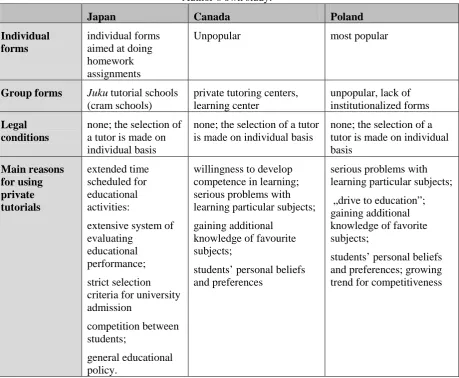
Table 1. Comparative analysis of selected aspects of private tutoring phenomenon. Author’s own study.
Japan Canada Poland
Individual forms
individual forms aimed at doing homework assignments
Unpopular most popular
Group forms Juku tutorial schools (cram schools)
private tutoring centers, learning center
unpopular, lack of institutionalized forms Legal
conditions
none; the selection of a tutor is made on individual basis
none; the selection of a tutor is made on individual basis
none; the selection of a tutor is made on individual basis
Main reasons for using private tutorials
extended time scheduled for educational activities:
extensive system of evaluating
educational performance; strict selection criteria for university admission
competition between students;
general educational policy.
willingness to develop competence in learning; serious problems with learning particular subjects; gaining additional
knowledge of favourite subjects;
students’ personal beliefs and preferences
serious problems with learning particular subjects; „drive to education”; gaining additional knowledge of favorite subjects;
students’ personal beliefs and preferences; growing trend for competitiveness
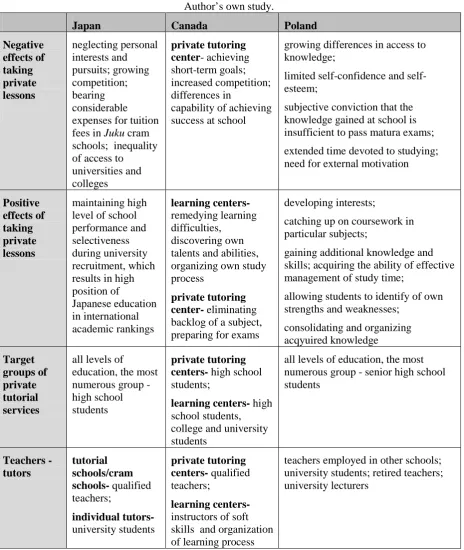
Table 2. Comparative analysis of selected aspects of the private tutoring phenomenon. Author’s own study.
Japan Canada Poland
Negative effects of taking private lessons neglecting personal interests and pursuits; growing competition; bearing considerable expenses for tuition fees in Juku cram schools; inequality of access to
universities and colleges private tutoring center- achieving short-term goals; increased competition; differences in
capability of achieving success at school
growing differences in access to knowledge;
limited confidence and self-esteem;
subjective conviction that the knowledge gained at school is insufficient to pass matura exams; extended time devoted to studying; need for external motivation
Positive effects of taking private lessons maintaining high level of school performance and selectiveness during university recruitment, which results in high position of Japanese education in international academic rankings learning centers- remedying learning difficulties, discovering own talents and abilities, organizing own study process
private tutoring center- eliminating backlog of a subject, preparing for exams
developing interests;
catching up on coursework in particular subjects;
gaining additional knowledge and skills; acquiring the ability of effective management of study time;
allowing students to identify of own strengths and weaknesses;
consolidating and organizing acqyuired knowledge Target groups of private tutorial services
all levels of
education, the most numerous group - high school students
private tutoring centers- high school students;
learning centers- high school students, college and university students
all levels of education, the most numerous group - senior high school students Teachers - tutors tutorial schools/cram schools- qualified teachers; individual tutors- university students private tutoring centers- qualified teachers; learning centers- instructors of soft skills and organization of learning process
teachers employed in other schools; university students; retired teachers; university lecturers
2. THE SCALE OF PRIVATE TUTORING PHENOMENON, ORGANIZATIONAL ASPECTS OF PRIVATE TUTORING MARKET IN JAPAN, POLAND AND CANADA
Private tutoring both in Japan, Poland and Canada is a widespread form of educational aid provided by private tutor. The private tutoring undoubtedly originated in Asia, with Japan leading the way. The results of research on the subject (e.g. PISA) indicate that the Japanese educational system occupies, in various rankings, the tops positions in the world, with students getting top scores in tests, and young Japanese scientists achieving success in the rapidly developing new fields of science such as IT and cybernetics. An average young Japanese devotes much more time for staying in an educational institution than a young European or American. The school schedule usually contains about six hours of classes a day and then all students perform various tasks such as tidying up repairs of school equipment and constructing teaching aids necessary for the classes taking place the next day. After an hour’s work students leave the school premises and head for private tuition classes in the afternoon at Juku cram schools. It is a common form of private tuition in Japan, with classes usually taking place in groups of several students, where the emphasis is put on goals connected with revision of regular school coursework and preparation for exams. After a few hours spent at Juku students return to their homes and do homework assignments for both types of schools. Classes at some schools also take place on Saturdays and numerous tutorial schools run classes throughout the week including Sundays (Szpak, 1993, s. 20-25).
While analyzing such extensive and busy daily schedule of the main subject of the Japanese educational system, it is necessary to ask a question: Why, despite so many hours spent in educational institutions, do they decide to attend private tutoring? The answer to this question can be given by an in-depth presentation of the functioning of the Japanese society, for which the paramount goal is to create and shape an individual that will later become a loyal, reliable employee, obedient and ready to make sacrifices for the sake of his job. In this respect, the education which enables to climb up the career ladder is of utmost importance. Particular emphasis is placed on attending one of the prestigious Juku cram schools.
A similar situation occurs with regard to the private tutoring market in Poland, which functions parallel to the formal system of education. According to research conducted by Goretta Siadak in 2011 on a test group of 400 students, 42.9% of senior high school students use the services of private tutor, 45.5% of whom receives private tuition in math and 33.2% in a foreign language. A prevailing form of private tuition are one-on-one lessons, occasionally classes are run for small groups. There are, however, no institutionalized forms. As a result of the IT development, the traditional tuition based on actual personal contact between the student and the tutor are gradually evolving towards on-line tuition which takes place in virtual reality, with the verbal and non-verbal communication being replaced by text. This process generates new chances and threats perceived by practicing private tutors. Widespread access to the Internet allows students to seek the help of a tutor regardless of the distance between the participants of the process. However, such help is limited, in many cases, to answering questions which have been assigned as homework. Another form of electronic private lessons, apart from online tuition, are tutoring sites (Internet platform) which allow contact between tutors and individuals seeking private lessons.
Annual reports presenting the scale of the private tuition phenomenon show an unwavering popularity of private tutoring which is documented by statistics of the steadily growing number of users visiting such sites and registered tutors. One of the most popular online platforms of this kind in Poland is E.korki.pl whose database contains several thousands of tutors representing 128 subjects. This data is regularly updated and the number are still growing.
The development of private tuition market is also noticeable in the Canadian system of education. Social changes taking place in Canada in recent years have been one of the factors contributing to the increased demand for extracurricular tutoring. The private education offer includes both individual and group tuition which are conducted by teaching according to school curriculum or author’s teaching programs. Research by Aurini and Davis (2006, p. 9) conducted in Ontario point out to the fact that 24% of parents of children in school age have recently hired a private tutor, and 50% of all
Canadian parents are convinced that their children will use the services of private tutors if such services are affordable. In Canada there are two parallel private tutoring models: private tutoring centers (referred to as “Shadow education”) and learning centers.
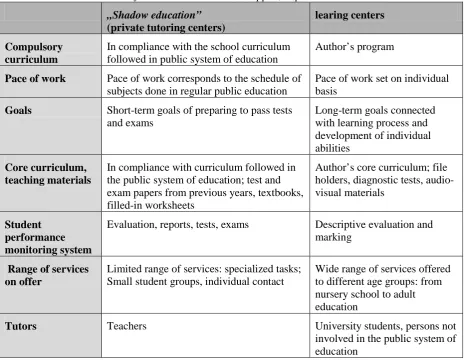
Table 3. Comparative analysis of private tutoring centers and learning centers.
Own study based on a source: Davies S., Aurini J.(2006).The Franchising of Private Tutoring: A View from Canada. Phi Delta Kappan,88,p. 9-21
„Shadow education” (private tutoring centers)
learing centers
Compulsory curriculum
In compliance with the school curriculum followed in public system of education
Author’s program
Pace of work Pace of work corresponds to the schedule of subjects done in regular public education
Pace of work set on individual basis
Goals Short-term goals of preparing to pass tests and exams
Long-term goals connected with learning process and development of individual abilities
Core curriculum, teaching materials
In compliance with curriculum followed in the public system of education; test and exam papers from previous years, textbooks, filled-in worksheets
Author’s core curriculum; file holders, diagnostic tests, audio-visual materials
Student performance monitoring system
Evaluation, reports, tests, exams Descriptive evaluation and marking
Range of services on offer
Limited range of services: specialized tasks; Small student groups, individual contact
Wide range of services offered to different age groups: from nursery school to adult education
Tutors Teachers University students, persons not
involved in the public system of education
Learning centers and private tutoring centers differ considerably in terms of functioning and the adopted approach to education. The former focus on the development of students talents and abilities and remedying the effects of learning difficulties. Due to the fact that they are, in particular, aimed at building the competence of independent acquisition of knowledge, the core curriculum is extended by adding author’s solutions and innovations. The offer reading comprehension courses, fast reading courses, public speaking, learning skills, time management, setting educational goals, exam preparation strategies, development of scientific paper writing skills, computer literacy (Davies, Aurini, 2006, p. 12). Learning centers give priority to the holistic development of a given student enabling them to improve their school performance by remedying learning difficulties, creating proper self-esteem, self-evaluation and discovering their own unique skills and abilities. Students are not obliged to follow the study schedule based on public school curriculum and their pace of work corresponds to their individual abilities, without setting deadlines. Private tutoring centers, however, follow the compulsory curriculum of public schools by offering revision and extension of the knowledge, preparing for particular exams or preparing, in advance, for the next class at school.
The analysis of the private tutoring phenomenon in the preselected systems of education indicates a similar level of its popularity in respective countries. The differences mainly concern forms of activities and classes; in Japan and Canada the predominant type are tutoring schools (cram schools) while in Poland it is one-on-one lessons with a tutor. In Poland and Japan private tutoring is frequently used as a support of the revision and preparation for exams, whereas in Canada this form of tutoring is complemented by learning centers offering soft skills courses and life-long learning. The comparison demonstrates the differentiation of the private tutoring market in particular countries, which stems from different reasons for seeking private tuition.
3. REASONS FOR SEEKING PRIVATE TUTORING
The determinants of seeking private tutoring by students are complex in many cases and their analysis allows for identifying their main categories: determinants stemming from the educational system and those connected with the subjects of education: parents, students and teachers. The reasons of using private tutoring by students correspond to their expectations for the tutors and their choice of private lessons.
In the Japanese system of education the main factors which contribute to the popularity of private lessons are:
(1) extensive system of monitoring academic performance, (2) multi-stage university entrance exams,
(3) limited number of admissions at universities,
(4) large school classes, extensive and demanding school curricula,
(5) large number of classes per day, atmosphere of competition between students fueled by students and teachers alike,
(6) domination of the teaching process over the learning process.
The possibility of individual preparation for such complex network of multiple-point monitoring of students knowledge of particular subjects is limited by overloaded curricula and large classes in which the number of student commonly exceed 40.
An additional element stimulating the development of private tuition market is the constantly growing competitiveness created by students and teachers, who treat it as a motivating factor to stimulate students to make a bigger effort in order to be admitted to one of the prestigious colleges which are gateways to successful professional career in the future. This awareness is used as a tool for exerting pressure on students as well as parents, who resort to private tuition to ensure that their offspring are well prepared for the “exam hell” that is to decide on their future fate. Candidates for state-run universities are obliged to take two exams: a nation-wide exam and internal entrance exams organized by particular universities (Gołąb- Meyer, 1992, s.19).
The number of applicants for some universities is so big that the first exam actually serves as element of pre-selection. In the case of private colleges the applicants take only one exam - the internal entrance exam. The high level of competition is the reason why large numbers of candidates get on the waiting lists (reserve lists) and they can try to find a place at another university or wait another year (or more) and take the next entrance exams in spring. Therefore, the main factors for increased popularity of private tuition are: high level of competition for access to college education, striving to take career positions which guarantee high social status, holding a stereotype of a good student and employee in social awareness, attaching great importance to education. The aforementioned determinants contribute to the flourishing market of private tuition in Japan and strengthening the role of Juku cram schools which form ever bigger and better organized corporations, supported, indirectly, by the public system of education (Gołąb- Meyer, 1992, p. 20).
The development of the private tutoring market in Poland, similarly to Japan, is deeply rooted in the educational policy (functioning of educational system) and the motives of the participants of education process. According to research conducted by Goretta Siadak in 2011 on the scale of private individual tuition in Poland, students of first year of senior high school stated that their main reason for seeking private tutoring (32.4 %) was filling the knowledge gap caused by different level of education in previous schools. The third year students quoted “better preparation for matura school-leaving exams” as their main motivation. The percentage of students opting for private tutoring in order to extend and deepen their knowledge and interests is low for both age groups and stands, respectively, at 8.1% in year one and 7.4% in year three. 24% of the first-year respondents and 46.2% of the year-three respondents agreed with the statement that using private tutorial is caused by too extensive contents of compulsory school curriculum (Siadak, 2013). Similar reasons of using private tutoring by students were identified in the study by Elżbieta Putkiewicz „Monitoring Private Tutoring” carried out in 2005 with particular emphasis on preparation for external exams. The overloaded curricula and knowledge taught at schools do not always correspond to the exam requirements (Bartosz, Błoch, 2009).
In Canada, however, the reasons for using private tutoring depend largely on the choice of model of private lessons. While making the decision, the students opting for Learning centers consider the wide range of subjects of the classes, long-term effects of using services of private tutors, comprehensive personal development, willingness to develop their soft skills, possibility to develop their own abilities and talents, and receiving help in developing them. Those individuals who choose to attend private tutoring centers predominantly base their decision on the need to prepare for exams set in the formal system of education (Davies, Aurini, 2006, p. 21).
4. THE EFFECTS OF USING PRIVATE TUTORING
Attending private lessons has its effects both in the process of learning and the position of a student in the class environment. Depending on the method of private tutoring, students’ expectations and the functioning of the educational system the effects can be negative or positive and accordingly influence the education process of particular individuals.
The social pressure to earn a university degree in Japan is so high that in the case of failure most adolescents make a decision to apply again, thus becoming „ronins” or “masterless samurai” (Gołąb- Meyer, 1992, p. 20).
Every year the press publishes stories of „ronins” who have made six or seven unsuccessful attempts before they were admitted to a university. It is a crucial issue for the Japanese, who greatly value hard work and perseverant striving to achieve the set goals. The educational offer aimed at the unsuccessful candidates who wish to reapply and go again through the recruitment process is provided by numerous preparatory schools known as “yobiko”. The curriculum is implemented in full scope throughout the year and involves frequent monitoring of students knowledge so that they are ready to take university entrance exams. In Japan the “ronin” phenomenon is so common that the educational system is often referred to as a structure with a built-in additional year for devoted exclusively to the preparation for college entrance exams (Doyon, 2001, s. 450).
The extreme cases of suicide attempts of those who were not admitted to universities demonstrate the seriousness of this situation. They consider it as an utter disgrace, as they believe to have betrayed the trust of the family who have high expectations of social advancement and who have invested large sums of money in private tuition (Doyon, 2001, 451). An additional element pushing students to take such drastic steps is the effort and hard work put into the preparation for exams which usually come at the expense of missing out on peer contact, giving up extracurricular interests and pursuits and the reduced amount of sleep and pushing their organisms to the limit.
The issue of entrance exams and the recruitment procedure at universities are subject of heated debate and discussion. There have been voices calling for the unification of the exam systems in all types of schools with the possibility of simultaneous application at various universities in the same year. The Ministry of Education has requested the university authorities to increase the number of places
available at particular faculties and courses and to take into account, during the recruitment process, the recommendations issued to the outstanding students. (Doyon, 2001, s. 452).
Despite numerous attempts at negotiating more favorable terms of admission, the changes have been introduced slowly and reluctantly, and only at some universities. This is mostly due to the fact that the limited number of admissions and difficult recruitment requirements are paramount to maintaining high prestige of universities. As a result of this selection process, only the best students are admitted, which allows for the development of the universities and later receiving academic staff of the highest quality, engagement, creativity and capacity for innovative solutions. (Doyon, 2001, s. 455). Summing up, one may conclude that Japanese students find themselves in a spiral which forces them to reach for private tutoring, which becomes an indispensable element of school reality and complements the public system of education.
Research by Elżbieta Putkiewicz (2005) conducted in Poland demonstrates both positive and negative effects of using private tutoring. Among the advantages of private lessons Putkiewicz lists: developing students’ interests, catching up on the schoolwork in a given subject, gaining additional knowledge and skills, breaking the barrier of taught helplessness connected with the lack of language skills, integration and organization of the acquired knowledge, adapting the pace of work to the abilities of a given student, which allows for better comprehension of schoolwork and contents (Siadak, 2013 from Putkiewicz, 2005).The negative effects of attending private lessons include: limited self-confidence in own abilities, reinforcing the subjective opinion the knowledge acquired through own work is insufficient to meet the exam requirements, shifting the blame for educational failure on the tutor, longer time devoted to schoolwork and study at the expense of reduced social activity (Siadak, 2013 from Putkiewicz, 2005). The results of using private tutoring in Canada depend on the choice of the form of private lessons and the methods of teaching used by tutors. The positive effects of using private educational learning centers include: remedying learning difficulties, discovering own talents and abilities, organizing own process of learning. As regards the private tutoring centers the advantages are: catching upon schoolwork in a given subject and preparation for exams. The negative effects of private tutoring which can be noticed with reference to the private tutoring centers include: achieving only short-term goals, development of competitiveness, inequalities in the possibility of achieving academic success.
The occurrence of positive and negative effects of attending private lessons is subject to various factors. It stems from biased opinions of students and parents on the phenomenon of private tutoring and the expectations held for private tutors. This, in turn, determines the reasons for using private tutoring, its organizational form and subject scope of the lessons.
In this context, the methods of teaching applied by private tutors become of great importance as they stimulate or hinder students’ autonomy, independent search for information, asking questions, attempts at finding solutions, development of learning competence. The configuration of these factors creates the complete image of the private tutoring phenomenon in the individual situation of a particular student and determines whether it becomes a catalyst or inhibitor of their learning process and development.
5. CONCLUSION
The analysis of the private tutoring phenomenon in Japan, Poland and Canada clearly shows that it is a crucial issue in the contemporary systems of education. The growing popularity of private lessons poses potential threats for the development of education faced by developed countries as well as developing ones where the funds for formal education are much lower and do not guarantee gaining education of a high standard. Moreover, it needs to be emphasized that private tutoring is no longer used exclusively by students with learning difficulties but also by good and very good students at every level of education. Therefore, it needs to be considered whether contemporary student can function at school without getting private lessons, prepare for classes on their own, and meet the exam requirements, which will largely determine their future. These issues should become the subject of
international discussion on this growing tendency, ways of solving the emerging disproportion in the access to knowledge, and the worrying cases of unethical practices of some teachers i.e. private tutoring of students they teach at schools and favoring them during regular lessons (Davies, Aurini, 2006, p. 21)
REFERENCES
Bartosz B. , Błoch B. (2009), „Korepetycje- norma w polskiej szkole?” [w]: „Psychologia w szkole”, nr 3, Kielce
Bray M. (2012). Korepetycje cień rzucany przez szkoły. Wydawnictwo: WOLTERS KLUWER,Bray M. Silova I. Budiene V.(2006). Education in a Hidden Marketplace: Monitoring of Private Tutoring. New York: Open Society Institute. p. 21-54
Davies S., Aurini J.(2006).The Franchising of Private Tutoring: A View from Canada. Phi Delta Kappan,88,p. 9-21
Doyon P. (2001). A Review of Higher Education Reform in Modern Japan, Higher Education, Kluwer Academic Publishers, p. 443- 470
Gołąb-Meyer Z. (1992). Kształcenie nauczycieli w Japonii. Fizyka w szkole, 1, p. 16-20
Putkiewicz E., (2005)„Korepetycje- szara strefa edukacji”, Instytut Spraw Publicznych, Warszawa Siadak, G. (2013). Students educational difficulties, as one of the main determinants of private tutoring phenomenon in Poland. W: R. Michalak, M. Wieczorek (red.), Obrazy dzieciństwa i dorastania. Wybrane problemy teoretyczne i empiryczne (s. 278–288). Poznań: Instytut Naukowo-Wydawniczy Maiuscula
Szpak D. (1993). Dylematy japońskiej edukacji. Problemy opiekuńczo-wychowawcze 1, p. 20-25