HARMONIZATION OF STUDENTS’ SKILLS AND REQUIREMENTS NEEDED FOR COMPUTER SCIENCE IN ACADEMIC AREA – RESULTS OF A SURVEY1
Gyöngyi Bujdosó
Faculty of Computer Science, University of Debrecen, 4028 Debrecen, Kassai 26, Hungary
Abstract
Students in higher education have to use many tools of the information-communication technology (ICT). The various types of teaching and learning methods require computer skills on many fields. Sometimes we see that students have problems in handling, managing the ICT tools, because they have not enough knowledge on these fields. In this paper we examine the ways of harmonization of skills that electronic materials require and the students’ knowledge on the field of using electronic learning materials in higher education. We show the result of a survey on the competences on using e-curricula, on the affinities of using information technology among the first-year students before they start their study at our university. The questionnaire was filled by four thousand six hundred students at the beginning of their studies at University of Debrecen, Hungary.
Key words: Computer skills, higher education, e-learning, electronic learning materials, electronic teaching
1INTRODUCTION
In the 21st century, students in higher education can work among better technical conditions in every year. They can use modern computers and many tools of information communication technologies (ICT), mobiles, tablets, laptops etc. Students can use many software applications, they can prepare many types of documents. Via the Internet, they can access to enormous big amount of data and many services. Learning materials are provided for them in various types, from printed books via multimedia applications to e-learning curricula. Learners in higher education can learn from these materials whenever and wherever they want.
Teachers in higher education have some basic assumptions about student’s habits, as written below: Students like the modern curricula types. They like new media during working. Students like using ICT more than the traditional media for getting and organizing information. Teachers use the modern ICT in teaching? Do we have to teach students how to use the new tools, or how to manage information that they get and collect?
In higher education, we can experience many times that the electronic curricula provided by teachers for their students are not as effective as they suspect (see e.g. Kiss 2008), however, huge amount of information resources students have to use in their study (see. e.g. Porshnev & Giest 2012). So we should always be looking for and analyze the problems and need to look the possible solutions.
2LACK OF TRAINING – A POSSIBLE PROBLEM
Teachers at universities should know what kinds of problem arise for students during their study. If curricula pay attention only on the subjects but ignore the technical problems, students waste (sometimes too much) time for getting knowledge on the technical details, and it has possibility that they can learn things in wrong way – the latter is difficult to correct. Students should have – not theoretical but practical – courses on the most important topics on ICT. It means that they should learn
1
This research was supported partly by the Hungarian Scientific Research Fund under Grant No. OTKA K-105262, and partly by the TÁMOP -4.1.2.B..2-13/1-2013-0009 project.
3REQUIRED SKILLS
An important problem is that the teachers’ expectations are too high concerning their students’ computer practices, their skills on computer science. Students have to have many computer skills for performing their exercises, preparing their homework, or only submitting them, and for writing their test papers or their dissertations. A general requirement from a student is that they should able to use those tools and applications which are necessary for their work.
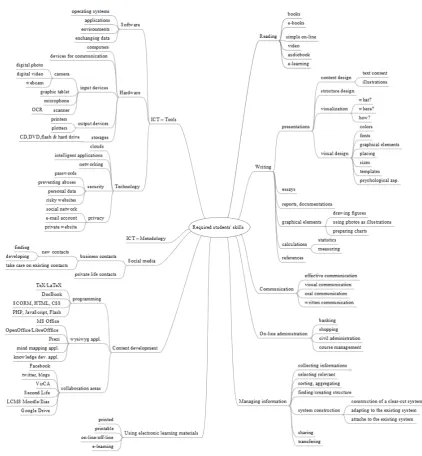
We collect and show some of these capabilities and skills in a mind map on Figure 1. The author of this paper is a teacher of computer science, so the list was collected on a computer science teacher’s point of view. The items of this list came from the daily experiences: from fields where students and teachers ask some help, and based on the experiences based on submitted materials. In this paper we can mention only some parts of this huge system of requirements.
A basic requirement at universities is that students in the 21st century have to be familiar with the use of many tools and services of modern ICT. Apart from computers, they have to know how to use phones tablets, projectors, etc. Of course, some of them do not belong to any curricula but parts of the studying process, because
• students need time for learning and exercising functions and applications on the device when they have e.g. a new phone,
• the pieces of the knowledge that they acquire in this way, they will use somewhere else in their study or later in their work for using and maintaining other new tools of the modern ICT.
It is similar to the teaching method of computer science when pupils have to learn and exercise some functions or services by using computer games.
Students have to handle, for example, their digital learning materials in various file formats on many platforms. Sometimes they have to convert files from one format to another, but they have to know how to install new drivers or software applications, too. There are many platforms with many services that they have to use, even if the logics of these platforms are quite different. As a result, students have to learn how to handle them. For example, students have to use some operating systems, and they have to use the basic software applications. They should learn about how to save and organize their thousands of files into folders and archives, and how to follow versions.
Of course, they have to know many services on the Web (Petrović at al. 2012). New Web 2 tools are involved into higher education; many teachers use new tools or services for communication (e.g. Twitter in Hussey 2011, or Facebook in Mazman & Usluel 2010), for submitting test papers (via e.g. Google Docs in Ó Broin & Raftery 2011, or simply e-mails), and managing portfolios and albums, writing blogs (Ebner et al. 2009) and comments. Students have to gather and share information, and they have to collaborate through different Web applications (see, e.g., O’Brien & Glowatz 2013). Many teachers use systems for managing their course materials, so students have to be familiar with e.g., Moodle, ILIAS or Blackboard. In most of the schools in higher education, the administrations are performed through a course management system, such as Neptun, where students have to join courses and have to manage other special pieces of information.
Figure 1: This mind map contains some of those computer skills that students need during their studies in higher education.
Every student has to know how to make presentations, reports or essays. There are WYSIWYG (what you see is what you get) editors such as the Microsoft Office applications, the LibreOffice or the on-line service of Prezi (see Fig. 2.a); and there are programmable applications or systems such as TeX (Bujdosó 2007) or DocBook. They should know the basic differences of document layouts designed for reading on screen or on paper.
Students have to know about how to collect data from the enormous big Internet, how to use libraries on-line and their contents on the Web. They have to know how to manage the big amount of information they have reached and collected, how to find the relevant and trusted contents, how to organize them and how to embed them into their own systems. Information has to be organized into clear-cut systems, pieces of information have to be shared or transformed through various services. Students must know how to make a mind map (Fig. 2.b) for organizing information during e.g. in presentation design.
Figure 2: Students need skills on the methodology of preparing many types of documents and they have to have knowledge about using computer software applications and services.
(a) Designing a presentation using Prezi, (b) Creating a mind map using Freeplane.
4OUR SURVEY AT THE UNIVERSITY OF DEBRECEN
If we would like to align the higher education to the student’s needs, we have to examine their skills of using ICT (Hakkarainen 2000), their attitudes to content development and management, we should know whether they like using ICT as a media of our curricula or not.
We have to know the level of their computer skills and we have to know where are those points where we should help them in their study and in their work. (See e.g. Porshnev & Giest 2012.) Do we have to pay enough attention on it (see e.g. Vekiri 2010)? How students manage new technologies of ICT? Do female students need other help or methods during their study than their male colleagues (see e.g. Meelissen & Drent 2007)? What other area of learning can be ameliorated together the ITC skills development? Does it have any effect on information processing or on information literacy (see e.g. Kocak Usluel 2007)?
As a first step in designing a method for supporting students, we perform a survey among students on their habits in usage of electronic learning materials and using ICT at the University of Debrecen (Debrecen, Hungary) in 2011. We asked those students who entered to the university in that year, so before their study at the university.
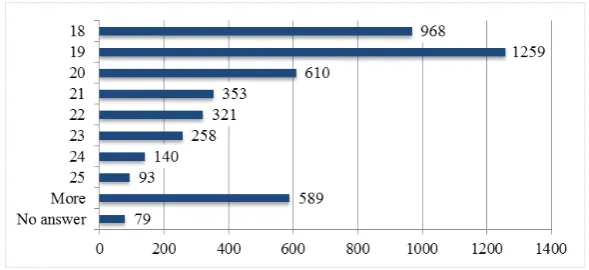
Figure 3: Participation by age
We got back and use 4670 properly filled questionnaire for analysing data. Among students who answered the question about their sex, there were more women (56.7%) than men (41.4%). Most of the students (26.9%) were 19 year old (see Figure 3), but the 12.6% of the students were older than 25 year. For the bachelor level 3133 (69.0%) students came, 786 (17.3%) came for master levels, only 7.5% entered to ungraded trainings (see Figure 4).
Figure 4: Levels of training where the students came
We intended to get information about their habits and attitudes concerning ICT tools for making a map on their habits, skills and knowledge (Bujdosó 2014a). Based on the data obtained, we can design a plan and develop a training method for ameliorating the students’ knowledge and skills on using electronic learning materials (Bujdosó 2014b).
5RESULTS OBTAINED 5.1ICT tools
We asked the students about the number of computers at home. 4553 students answered this question. There were 23 (0.5%) students who asked zero (Figure 5), which was a surprised for us – we supposed that there is at least one computer in every student’s home.
Figure 5: Number of computers at home
3.6% of students have no Internet access at home, which can be strong effect on their studies. We can say that it is not trivial that students can work in learning content management systems, e.g. Moodle, from home.
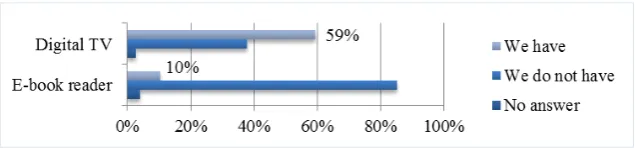
Figure 6: Two important ITC tools
Only 10% of the students answered that they have e-book reader. Of course, they can read documents on mobile, too, but it has not enough big screen for an effective learning.
5.2Contents on the Web
We asked students about how they use and how they read, learn and create contents on the Web, and how they communicate with their colleagues.
it before. Only 22.7% answered that they write posts into blogs at least once per month. For comments we got better results: 70.1% answer questions in forums at least once per month, 82.5% write comment to photos and 86.9% write comments to blog posts or news etc.
Social network:
As we expected, 75.7% of the students answered that they have accounts in Facebook. We got surprising result for the “none” option: 11.4% answered that they had no account in any social network.
Communication:
The most popular communication platform was the phone, it was followed by the Chat/Skype/MSN option, and the Facebook was only the third one with 16.8%.
Electronic learning materials:
We asked them about how often they learn from curricula provided on the Web. More than 30% of the students wrote that they learn from electronic learning material very rarely or never. Only 5.5% said that they use them almost every day. It turned out that most of them (77,3%) like to print their curricula, they prefer to learn from printed materials. Only 31.1% answered positively the question about that they would like to read learning materials on computer monitors. Less students would like to read them on e-book reader (28.9%) and less on phones (17.5%).
Reading literature:
We were interested in their information reading habits. Only few of students like to read literature on computer screen (12.0%), 16,1% would like to use e-book reader for this purpose and only 8.2% would use phones for reading literature. 82.5% would like to read printed literature.
5.3Some unexpected results
This survey gave some unexpected results. Here we give a short summary of them:
There are still students (0.5%) whose family has no computer or some other ICT tool at home that they should use in learning, and the 3.6% of the students had no Internet connection at home. 11.4% answered that they are not members in any social network. For communication, they prefer phone calls and chat providers, the Facebook was only on the 3rd place. Less than 30% would not like to arrange their official matters on computers. Only 5.95% answered that they do not want to print their digital learning materials at all, and 4.92% that they want to read curricula on computers, however, more than 50% want to print them all.
From these answers we suspect that students spend quite a lot of time by learning how to use electronic learning materials and how to use the electronic facilities and the online administrations. They waste time if they learn everything alone.
6A SOLUTION OFFERED AT HIGHER EDUCATION
As a consequence, we suggest that higher educational institution should offer courses for students on computer science. This has several benefits for students:
• They can learn easier the information they need.
• They get a professional point of view on this field that can help them in learning alone later.
• They do not learn wrong things (e.g. placing title into the centre by space characters).
• They get information about the services of software applications and ICT tools in general (for example that every word processor has a function “centre”).
• If somebody learnt computer science in the secondary school the new information can be built onto the previous knowledge; otherwise they will fit into the gaps.
7CURRICULA STRUCTURE SUGGESTION
Based on our survey and our daily experiences, the following main topics are suggested for a one semester long course:
• Basic information about computers. Main parts, types of input and output devices. Scanner – OCM. Printers, cameras, microphones. Data storages.
• Copying, moving files, folders. Archiving and versioning data.
• ICT technologies: clouds, intelligent applications. Students have to know about security, how they can prevent, e.g., abuses. Privacy should be an important field in this course.
• We have to show some areas which give possibilities for collaboration. Students should know more these services.
• Finding information: trusted places, finding information (methods of searches), checking, selecting and sorting relevant information.
• Professional communities – collecting and sharing information. • Basics of visual design.
• Word processing and designing presentations: basic general functions of applications, introduction of typography and visual design. Tools for effective information transferring.
• Paper/dissertation writing: content, structure, references.
• Preparing illustrations: Picture manipulation, drawing. Designing their content and structure. • Introduction to on-line administration.
• Calculations: introduction to statistics (programs, services and possibilities).
8SUMMARY
In this paper we examined the required skills on computer science of students in higher education. We gather the skills that students have to know for using the necessary software and hardware tools for preparing their documents, sharing and transporting them. We pointed out some fields that should be learned by students even if those not belong directly to the computer science. We presented results of a survey taken at the University of Debrecen that examined the affinity of students to electronic learning materials and their habits in computer use.
Based on the results obtained, we suggested a structure and content of curricula that should be introduced into every training in higher education. As a result of this course, students will have more time later because they will have basic skills for using the most common programs and they will capable to learn how to use new software applications and ICT tools without help in a shorter time. We hope teachers find this method useful for their students and for their trainings, too.
9REFERENCES
Bujdosó, Gy 2007, ‘New ways in typographical knowledge management’, (Hungarian), PhD Thesis, University of Debrecen, Debrecen.
higher education’, Proceedings of eight International Technology, Education and Development Conference, INTED, Madrid, Spain, pp. 4421-4426.
Ebner, M, Lienhardt, C, Rohs, M & Meyer, I 2009, Microblogs in Higher Education – A chance to facilitate informal and process-oriented learning? Computers & Education, vol. 55, pp. 92-100. Hakkarainen, K, Ilomäki, L, Lipponen, L, Muukkonen, H, Rahikainen, M, Tuominen, T, Lakkala, M, & Lehtinen, E 2000. ‘Students’ skills and practices of using ict: results of a national assessment in Finland’, Computers & Education, vol. 34, no. 2, pp. 103-17.
Hussey, J 2011, ‘Twitter in higher education: from application to alumni relations’, in LA Wankel, C Wankel (eds.), Higher education administration with social media (Cutting-edge technologies in higher education, Volume 2), Emerald Group Publishing Limited, pp. 249-272.
Kiss, G 2008, ‘The analysis of the computer science learning habits in the first year on the Budapest Tech.’, (Hungarian), Proceedings of Informatika a felsőoktatásban, Debrecen, Hungary, pp. 1-8. Kocak Usluel, Y 2007, ‘Can ICT usage make difference on student teachers’ information literacy self-efficacy’, Library & Information Science Research 29, pp. 92-102.
Mazman, SG & Usluel, YK 2010, ‘Modeling educational usage of Facebook’, Computers & Education 55, pp. 444-453.
Meelissen, MRM & Drent, M 2007, ‘Gender differences in computer attitudes: Does the school matter?’, Computers in Human Behavior, vol. 24, no. 3, pp. 969-985.
O’Brien, O & Glowatz, M 2013, ‘Utilising a social networking site as an academic tool in an academic environment: student development from information-sharing to collaboration and innovation (ICI)’, The All Ireland Journal of Teaching and Learning in Higher Education, vol. 5, no. 3, pp. 1-23, viewed 5 December 2013, <http://ojs.aishe.org/index.php/aishe-j/article/view/137/206>.
Ó Broin, D & Raftery, D 2011, ‘Using Google Docs to support project-based learning’, All Ireland Journal of Teaching and Learning in Higher Education, vol. 3, no. 1, pp. 1-11, viewed 3 November, 2013, <http://ojs.aishe.org/index.php/aishe-j/article/view/35/29>.
Petrović, N, Petrović, D, Jeremić, V, Milenković, N & Ćirović M 2012, ‘Possible educational use of Facebook in higher environmental education’, Proceedings of International Conference of Information Communication Technologies in Education 2012, Rhodes, Greece, pp. 335-62.
Porshnev, A & Giest, H 2012, ‘University students’ use of information and communication technologies (ICT) in Russia: A focus on learning and everyday life’, Seminar.Net – International Journal of Media, Technology & Lifelong Learning, vol. 8, no. 1, viewed 3 May 2013 <http://seminar.net/images/stories/vol8-issue1/Porshnev_Giest-article.pdf >.
Vekiri, I 2010, ‘Boys’ and girls’ ICT beliefs: Do teachers matter?’, Computers & Education, vol. 55, pp. 16-23.