EMPLOYMENT AND EMPLOYABILITY OF ENGLISH LANGUAGE AND LITERATURE TEACHER TRAINING STUDENTS IN SLOVAKIA
Marína Trnková
Department of English Language and Literature, Faculty of Education, Trnava University in Trnava
Abstract
The submitted paper discusses results of a research conducted among graduate English language and literature teacher training students, Department of English Language and Literature, Faculty of Education, Trnava University in Trnava. Graduates from the past four years (2009/2010, 2010/2011, 2011/2012, 2012/2013) were addressed in order the current situation of their employment was studied and the chances of employability of the future graduates were raised. Attention was paid to the year of their graduation, their second major studied at the faculty, the field of their current occupation, their position, a scale of the most beneficial courses completed and suggestion of specific fields of language study, more precisely, specific disciplines and courses that would lead to higher chances of employment or improve the quality of their work.
Key words: employment, employability, graduates, English language and literature
1. INTRODUCTION
The issue of both employment and employability are among the most discussed not only in the field of university education, but the whole society, too. Whatever the economic and political factors are or might be, in this paper I will concentrate predominantly on educational factors that are responsible for the employment rate of university leavers. Evaluation of universities, quantity and quality of education and research, including the rates of employment of the graduates, is conducted on regular basis by the state (relevant statistics are prepared by the Central Office of Labour, Social Affairs and Family), by independent agencies such as ARRA (Academic Ranking and Rating Agency) and by the universities themselves.
The submitted paper offers an insight into the situation of employment of the graduates of teacher training studies, specifically the graduates of English language and literature of the Department of English Language and Literature, Faculty of Education, Trnava University in Trnava, Slovakia. Graduates from the past four years (2009/2010, 2010/2011, 2011/2012, 2012/2013) were inquired in order to find out about the following:
- field of education, i.e. their second major (at the Faculty of Education, Trnava University in Trnava, Slovakia teacher training students study combination of two academic subjects; at present, English language and literature might be combined with Mathematics, Chemistry, Physics, IT Studies, Slovak language and literature, German language and literature, Ethics, Fine Arts);
- field of their present occupation (individual fields will be discussed in an individual subchapter); - position held (in case they work in the field of education);
- courses vital and beneficial for their present occupation (i.e. courses taken at the Department of English language and literature);
- suggested courses that would raise the chance of their employability.
More on the aim, methodology and outcomes of the research will be discussed in the following chapters.
2. EMPLOYMENT AS ONE OF THE CRITERIA OF ATTRACTIVENESS OF THE STUDY Due to the existence of relatively high number of universities in Slovakia (public universities: 20, state universities: 3, private universities: 13 and foreign universities: 4; source: Ministry of Education, Science, Research and Sport of the Slovak Republic, 2014) the competition among them is relatively high, too and prospective university students have the chance to apply several objective and subjective criteria while choosing the place of their university study. Among the objective ones, as one of the criteria of attractiveness of a university, is definitely employment of its graduates; or more specifically, the proportion of unemployed graduates in the total number of graduates. Other criteria, just to mention a few, might be related to institution as such (e.g. accreditation, research and partnership with business or industry, library or IT technologies), to a specific department and a specific study programme (e.g. degree completion requirements) or to extracurricular activities and community factors (recreation facilities, cost of living, etc.). ARRA (2013) introduces and assesses the following criteria related to the attractiveness of the study:
- proportion of the number of applicants to the number of planned number of accepted applicants; - proportion of the number of enrolled students to the number of accepted applicants;
- proportion of the number of foreign students to the number of all students;
- proportion of the number of students sent for Erasmus mobility to the number of all students; - proportion of the number of unemployed graduates to the number of all students.
The relatively high number of universities in Slovakia is naturally responsible for the relatively high number of university graduates. Taking into consideration the unemployment rate in Slovakia (12,80 % in May 2014; source: The News Agency of the Slovak Republic (TASR) as published at http://www.pravda.sk/trendove-temy/nezamestnanost/), the proportion of university graduates among the unemployed is also relatively high. However, statistics show that the length of unemployment of university graduates is the shortest one in comparison to the length of unemployment of secondary school graduates. On the other hand, according to the Central Office of Labour, Social Affairs and Family (2013), graduates have the handicap of the absence of practice and lack of working or professional skills and habits. Thus, one of the challenges of all universities is the highest rate of employed graduates as possible; in other words, universities, faculties, departments need to be aware of the importance of relating the study to the demands of labour market.
Since my research was carried out in the field education, i.e. teacher training graduates who are being prepared for the position of a primary school teacher or secondary school teacher, and the sector of primary and secondary education is primarily a state sector, the demands of labour market can be discussed only into a certain extent. Nevertheless, teacher training graduates find their employment also outside the field studied, or not directly linked to the field studied, other fields of employment were mapped and thus the needs of the labour market were taken into consideration.
3. EMPLOYMENT AND EMPLOYABILITY OF ENGLISH LANGUAGE AND
LITERATURE TEACHER TRAINING GRADUATES
Having the ambition of fulfilling one of the requirements of increasing the quality of education, the Department of English Language and Literature, Faculty of Education, Trnava University in Trnava, Slovakia carried out a research aimed at the employment and employability of English language and literature teacher training graduates. We are aware of the necessity of creating a link, feedback between the department and practice, i.e. schools and labour market in order to create a direct connection between the preparation of undergraduate students with the existing needs of the resort of education. The success of a higher education institution is not measured only by the number of applicants, but also by the number of employed graduates. I assume that this criterion will soon become one of the crucial ones in the set of criteria of a prospective applicant.
The intention was, therefore, twofold. On one hand, to have the data on the current rate of employment of our graduates and on the other hand, to increase the chances of employability of future graduate students. Once in 5 years a complex accreditation of universities takes place in Slovakia. Being in the process of preparation of new accreditation documents, the department has decided to consider and include suggestions of our graduates that would lead to the increase of the chances of their employability.
3.1 Methodology
At this point let me define the research sample as it followed from the intentions of my research. Research population is represented by graduates of English language and literature, Department of English Language and Literature, Faculty of Education, Trnava University in Trnava, Slovakia. Subset of population is represented by the graduates of English language and literature in the academic years 2009/2010, 2010/2011, 2011/2012, 2012/2013; Department of English language and Literature, Faculty of Education, Trnava University in Trnava. Sampling strategy that was applied is so called systematic sampling. Total sample size is represented by the number of 120 students.
Further on, research method and organization of the research will be discussed. In order to address quite a large sample I decided to create an electronic questionnaire that would cover all the specifications the department needed for further processing. Since the only contact the faculty keeps with majority of the graduates is an electronic mail, it was the most efficient way how to contact the graduates. The Study Department provided me with 120 email addresses. However, not all of them were still valid or current, since there is an assumption that the graduates use different email addresses related either to their new employment or because of various private factors. This caused a relatively low rate of the questionnaire return (40%).
The questionnaire was comprised of the following categories: 1. General data
a. year of graduation;
b. combination studied (it was already mentioned in the Introduction that teacher training students study combination of two academic subjects: English language and literature - Mathematics, English language and literature - Chemistry, English language and literature - Physics, English language and literature - IT Studies, English language and literature - Slovak language and literature, English language and literature - German language and literature, English language and literature - Ethics, English language and literature - Fine Arts);
2. Current employment
a. field of current employment (education; translation and interpreting; state administration; car industry; administration; economy; banking industry, insurance; tourism; information technologies; human resources management; marketing, PR; trade; services; telecommunication, media; other – with specification);
b. position held in the field of education (primary school teacher (1st grade); primary school teacher (2nd grade); deputy headmaster at primary school; headmaster at primary school; secondary school teacher; deputy headmaster at secondary school; headmaster at secondary school; other (with specification));
c. the most beneficial courses related to current employment (Introduction to Study of English Language; Phonetics and Phonology; Communication in English Language; Introduction into Study of British and American Civilisation; English Literature; Dynamics of Vocabulary; Creative Writing; General Linguistics; Morphology; Syntax; American Literature; Basics of Lexicography; Lexicology; Linguistic Characterisation of English Language; Theory and Practice of Teaching English Language and Literature; American English; Stylistics; Anglo-American Literature for Children and Young Adults; Sociolinguistics; British and Anglo-American
Cultural Studies; Outline of English Language Development; Teaching English in Pre-School Age and Younger School Age; Intercultural Communication).
3. Employability
a. courses with suggested increase in time allowance (Introduction to Study of English Language; Phonetics and Phonology; Communication in English Language; Introduction into Study of British and American Civilisation; English Literature; Dynamics of Vocabulary; Creative Writing; General Linguistics; Morphology; Syntax; American Literature; Basics of Lexicography; Lexicology; Linguistic Characterisation of English Language; Theory and Practice of Teaching English Language and Literature; American English; Stylistics; Anglo-American Literature for Children and Young Adults; Sociolinguistics; British and Anglo-American Cultural Studies; Outline of English Language Development; Teaching English in Pre-School Age and Younger School Age; Intercultural Communication).
b. suggested courses/disciplines that would increase chances of employability or quality of current profession.
The questionnaire consisted of closed questions (category 1a, 1b and 2c: respondents were asked to select an item from the given set of items; in 2c their selection was not limited by number of items), semi-open questions (category 2a, 2b, 3a: respondents were asked to select an item from the given set of items, however, in case their answer was not included in the set, they were asked to add it and specify it) and opened questions (category 3b: not limited by category or number of answers).
Considering the organisation of the research, the procedure was as follows. After completion of the design of the questionnaire, pilot research was conducted and since no changes were needed to be made to the individual items, the questionnaire was sent to all available email addresses. The questionnaire was sent in December 2013. December was chosen for the following reason. As Moravčíková (2011) claims, employment and unemployment of graduates has a cyclic character. The number of unemployed applicants is highest in September, decrease can be observed in the months that follow. July and August are typical for the increase in unemployment of applicants, culmination is reached in the already mentioned September. Considering university graduates, the culmination of their unemployment is in June; the rate of unemployment is still relatively high in July and August, but it decreases gradually. Therefore, the month of December was chosen for distribution of the questionnaire. After a period of two weeks, the returned questionnaires were subjected to analysis and statistic examination.
3.2 Results and Their Interpretation
The following tables demonstrate the obtained data, which will be discussed and possible correlations and connections will be drawn. Table 1 demonstrates that majority of teacher training graduates find their employment in the sector of education, namely 62%. Other relevant information is related to unemployment. It was discovered that only 4% of the respondents are currently unemployed.
Current field of employment Expressed in %
Education 62
Information technologies 8
Administration 10
Management 4
Human resources management 2
Tourism 4
Business 4
State administration 2
Unemployed 4
Table 1 Current Field of Employment
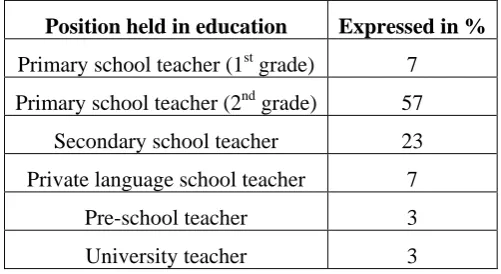
Results related to the current position held in education demonstrate that the graduates find their employment mainly as primary school teachers (2nd grade) and secondary school teachers. Positions of headmasters or deputy headmasters are not held by any of them (the length of their employment needs to be considered). 3 new positions were added that had not been counted with in the original questionnaire, namely the position of a private language school teacher, a pre-school teacher and a university teacher. However, representation of these positions is relatively low.
Position held in education Expressed in % Primary school teacher (1st grade) 7
Primary school teacher (2nd grade) 57 Secondary school teacher 23
Private language school teacher 7
Pre-school teacher 3
University teacher 3
Table 2 Position Held in Education
Ranking of the most beneficial courses related to current employment can be found in Table 3. Since the respondents were asked to select the most beneficial courses and were not limited by the number of choices, ranking according to their frequency seemed to be an effective way of processing these results. Naturally, two or more courses can share the same ranking. The selection of the most beneficial courses was obviously impacted by the field of current employment. Graduates employed in the field of education tended to select Theory and Practice of Teaching English Language the most. Primary school teachers, for example, selected Anglo-American Literature for Children and Young Adults frequently; the reason might be that the course covers topics like nursery rhymes, animal stories, picture books, etc., which are easily applicable with primary school students. Secondary school teachers, for example, tended to select courses like English and American Literature or Morphology and Syntax, too. It indicates that teachers at secondary school have greater opportunities to work with literary and linguistic analysis of a text. Graduates outside the field of education selected mainly courses like Intercultural Communication or Dynamics of Vocabulary or Stylistics. However, the most frequently selected course, no matter the current field of employment of the respondents, was Communication in English Language. The course is currently offered in four semesters. Development of all our language skills is encouraged, together with acquisition of new vocabulary and practice of selected grammar issues. Students` language competences are improved and they become active participants of various communicative situations and they are able to communicate effectively in the context of familiar and unfamiliar themes.
Ranking according to frequency The most beneficial courses related to current employment
1. Communication in English Language
2. Theory and Practice of Teaching English
Language and Literature
3. Intercultural Communication
4. Morphology; Syntax
5. Anglo-American Literature for Children and Young Adults; British and American Cultural Studies
6. American Literature; English Literature; Phonetics and Phonology; Teaching English in Pre-School Age and Younger School Age
7. American English
8. Introduction into Study of British and American Civilisation
9. Stylistics
10. Dynamics of Vocabulary
Table 3 The most beneficial courses related to current employment
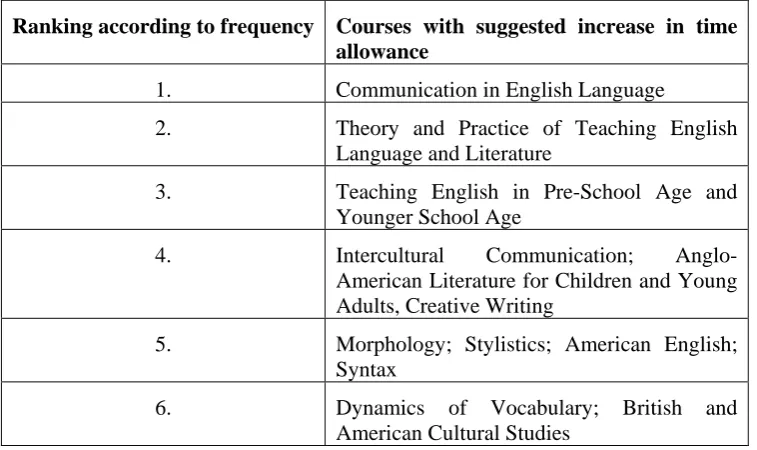
As it can be observed in Table 3 and Table 4, majority of courses that are held beneficial for their current employment by the respondents, can be found in both tables. These are the courses where the graduates would prefer increased time allowance. It can be clearly seen that in both tables the course Communication in English Language takes the first place. It means that in spite of the fact that the students are offered four semesters of Communication in English Language, they still feel the need to practice. The course was selected by graduates working in the field of education as well as graduates working outside the field of education.
Ranking according to frequency Courses with suggested increase in time allowance
1. Communication in English Language
2. Theory and Practice of Teaching English Language and Literature
3. Teaching English in Pre-School Age and Younger School Age
4. Intercultural Communication;
Anglo-American Literature for Children and Young Adults, Creative Writing
5. Morphology; Stylistics; American English; Syntax
6. Dynamics of Vocabulary; British and
American Cultural Studies
Table 4 Courses with Suggested Increase in Time Allowance
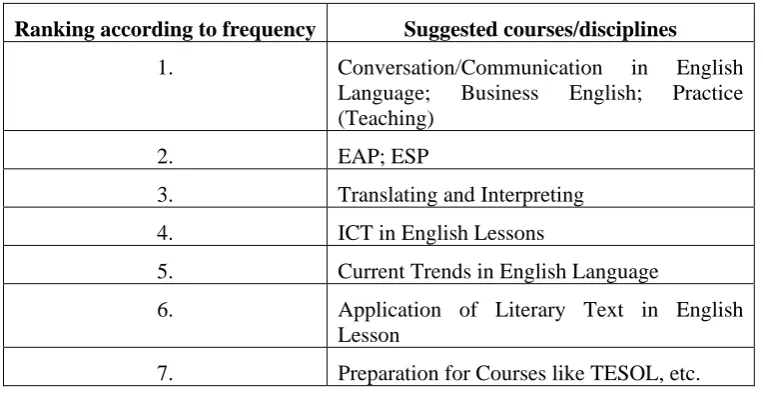
The final table - Table 5 - depicts suggestions of graduates related to courses or disciplines that would increase their employability or quality of current profession. Despite being asked to suggest disciplines or courses that are not currently present in the study programme, majority of students
suggested Communication in English Language and teaching practice. Both of these are currently part of the study programme offered to English language and literature teacher training students. Nevertheless, their preference was given a thorough consideration and the outcome is discussed in chapter 4. Among other suggested courses the following can be found: Business English, EAP and ESP, Translating and Interpreting, ICT in English Lessons, Current Trends in English Language, Application of Literary Texts in English Language or suggestion of preparation for courses like TESOL, etc. Considering the determination of the suggestion of a course and a field being currently employed in, connection like this were found: graduates working outside the field of education tended to suggest courses like ESP, Business English and Translating and Interpreting. On the other hand, graduates working in the field of education tended to suggest courses like EAP, application of literary texts in English class or ICT in English lessons. Discussion of these results is situated in the following Chapter 4 Impact of the Research Results on the Preparation of a New Study Programme.
Ranking according to frequency Suggested courses/disciplines
1. Conversation/Communication in English
Language; Business English; Practice (Teaching)
2. EAP; ESP
3. Translating and Interpreting
4. ICT in English Lessons
5. Current Trends in English Language
6. Application of Literary Text in English Lesson
7. Preparation for Courses like TESOL, etc.
Table 5 Suggested Courses/Disciplines
4. IMPACT OF THE RESEARCH RESULTS ON THE PREPARATION OF A NEW STUDY PROGRAMME
As it was suggested above, the Department of English Language and Literature, Faculty of Education, Trnava University in Trnava, Slovakia decided to apply the obtained results in new study programmes that are prepared for the complex accreditation.
Considerable changes could be summarised as follows:
1. Time allowance of Communication in English Language was increased and two more facultative courses related to communication and conversation, namely Communicative Language Skills and Conversation in English were added to the bachelor-degree programme.
2. The course English for Academic purposes that was piloted last year was transformed into the course English for Specific Academic Purposes in the new study programme. The need to attend such a course was expressed both by the students and the pedagogues, too. “Analysing target needs, we obtained data about the necessity of teaching EAP as the students who were expected to write their theses in English at the end of their bachelor-degree programme were not sufficiently familiar with the differences between spoken and written English. Apart from this, they were expected to read a lot of different materials in English, take notes, do referencing, summarize and do research; consequently to be able to present orally their viewpoints in the thesis defence.” (Bérešová, 2013: 28).
3. In cooperation with the Department of Mathematics and Informatics, Faculty of Education, Trnava University in Trnava, Slovakia a new course Application of ICT in ELT was designed and included
into the new study programme. The course reflects the demand of our students and graduates as well as the demand of contemporary society to incorporate IT into teaching-learning process. Present-day teachers are supposed and required to work with IT effectively in the classroom, e.g. to work with electronic board, various educational software, online educational programmes, etc.
4. The final change concerns creation of the facultative course Translation and Interpreting Seminar. Here, the students will be introduced to basic translation and interpreting techniques that will be practised at the seminar.
5. CONCLUSION
The submitted paper discussed the issue of employment and employability of university graduates from the theoretical as well as practical perspective. The first part of the paper dealt with the rate of unemployed graduates as one of the criteria of quality of higher education institution; other factors related to attractiveness of the study were outlined, too. The second part of the paper presented results of a research carried out among English language and literature teacher training graduates. The most fundamental findings were as follows. 62% of the graduates are employed in the field of education; the rest is spread in the fields of information technologies. Administration, management, human resources management, tourism, business, state administration, and 4% of all graduates are unemployed. Graduates who work in the field of education work mainly as primary school teachers (2nd grade) and secondary school teachers. The preferences of graduates in selecting the most beneficial course taken at the department of English Language and Literature varied according to the field of their current employment. However, all of the graduates agreed that the most beneficial course taken was Communication in English language. Similarly, Communication in English Language was selected as the course whose time allowance could be increased. The final part of the questionnaire impacted creation of new study programmes the most. Here, the respondents were asked to suggest specific disciplines or courses that would be beneficial either for their current employment or that would increase the chances of their employability. As a result of their suggestions, EASP course, Translating and Interpreting course and Application of ICT in ELT course were implemented into a new study programme. Time allowance of the course Communication in English Language was increased, too and two new courses, namely Communicative Language Skills and Conversation in English were added to the new study programme. In conclusion, it might be stated that employment and employability of university graduates is a current educational, economical and political issue that impacts the whole society and therefore, it demands increased attention and feedback.
References
Akademická rankingová a ratingová agentúra 2013, Hodnotenie fakúlt vysokých škôl 2013, pp. 35.
Also available online http://www.arra.sk/sites/arra.sk/files/file/Hodnotenie%202013/ARRA_Sprava_2013.pdf
Analýza absolventov stredných a vysokých škôl s pôsobnosťou v okresoch Nitra a Zlaté Moravce 2010, Nitra: ÚPSVR.
Bérešová, J 2013, 'EAP Courses – Enhancing Critical Thinking and Autonomy: Practical Insights for Slovak University Students' The International Language Conference on the Importance of Learning Professional Foreign Languages for Communication between Cultures 2013, Celje, Slovenia, pp. 26 – 32.
Moravčíková, D 2011, Správa o uplatnení absolventov SPU, Nitra, pp. 5
Zvalová, M 2007, Uplatnenie absolventov vysokých škôl v praxi. I etapa, Zamestnateľnosť a zamestnanosť absolventov vysokých škôl, Bratislava, Ústav informácii a prognóz školstva, Oddelenie analýz a prognóz vysokých škôl, pp. 55.
Online Sources
Central Office of Labour, Social Affairs and Family http://www.upsvar.sk/
Ministry of Education, Science, Research and Sport of the Slovak Republic https://www.minedu.sk/ Pravda online magazine http://www.pravda.sk/trendove-temy/nezamestnanost/