COACHING, MENTORING AND FEEDBACK: THE ‘HOW TO’ IN A SCHOOLING CONTEXT
David Lynch, Jake Madden
Southern Cross University, Hogbin Drive, Coffs Harbour, NSW 2450 Australia
Abstract
This article explores a whole of school strategy for improving the teaching performance of a school by focusing on the logistics of a pilot school improvement project. The central premise of this reporting and of this article more specifically is a focus on the work of the teacher through a coordinated mechanism of ‘leadership’ and ‘data driven decision making’ which are consolidated into a ‘coaching, mentoring and feedback’ regime for teaching improvement effect. This mechanism is referred to as the Talent Management Platform for Teaching (TMPT).
Key words:coaching, mentoring, feedback, teaching, school improvement
1. INTRODUCTION
In recent years Governments across the developed world have begun a focus on improving the educational outcomes of their education systems. Central to their focus is a benchmarking to international comparative studies of student achievement such as the Programme for International Student Assessment [PISA] (see OECD 2013a, 2013b 2010a, 2010b). Further, an interconnected global economic circumstance, intensified since the emergence of the Knowledge Economy of the 1990s, has created a competitive trade environment dependent upon a highly skilled workforce. This coupling of circumstance has begun to be intensified within schooling systems, with Heads having to develop appropriate plans for the remediation of poor student performance and publicly report on progress. The operational measure of poor performance is an array of standardised and benchmarked tests (predominately in literacy and numeracy) that students undertake each year. In Australia NAPLAN1 and the ‘My School’ website2 are examples of this public testing and reporting regime: as is OFSTED3 in the UK and KHDA4 in Dubai, UAE. This intensification has become pronounced on the backs of studies by Hattie (2012, 2011, 2009) and Hargreaves and Fullan (2012) which specifically implicate the teaching capacities of individual teachers in such student performance results (Lynch 2015) and by association, the need for a whole of school remediation strategy (Maughan, Teeman & Wilson 2012; Scheerens 2013; Smith & Lynch 2010) .
In this article we outline a whole of school strategy for improving the teaching performance of a school by focusing on the logistics of a ‘pilot’ school improvement project. The associated study findings are reported briefly in a later section. The central premise of this reporting and of this article more specifically is a focus on the work of the teacher through a coordinated mechanism of ‘leadership’ and ‘data driven decision making’ which are consolidated into a ‘coaching, mentoring and feedback’ regime for teaching improvement effect. This mechanism is referred to as the Talent Management Platform for Teaching (TMPT). In order to examine the TMPT and to present its central tenets as a viable insight into how schools might tackle their own school’s improvement, this article is organised into three sections: (1) what the pilot study found; (2) the Talent management Platform for Teachers; (3) and coaching, mentoring and feedback. I turn first to the findings from the pilot project for points of reference.
1
www.naplan.edu.au
2
http://www.myschool.edu.au/
3
https://www.gov.uk/school-performance-tables
4
https://www.khda.gov.ae/En/DSIB/Reports.aspx
2. WHAT THE PILOT STUDY FOUND
The TMPT was conceptualised and developed after a thorough review of the education literature. Researchers such as Hattie (2012, 2011, 2009), Hargreaves and Fullan (2012), Smith and Lynch (2010), Waters, Marzano and McNulty (2003), to name but a few (see Table 1 at article’s end for a full list), enabled the project team5 to design a pilot project focused on whole of school improvement. This pilot took place over five years in a primary school (2010 to 2014, n= circa 650 students, n = 29 classroom teachers) in regional Australia and used a variety of statistical calculations based on student performance to guide and judge teaching performance in the TMPT. Standardised tests were used to identify learning deficiencies in learning and which in turn was used as base, mid and end line data for the study. These tests include: Wadding Diagnostic Standard and Advanced Reading and Spelling tests (1 and 2)6; ACER ‘Progressive Achievement Test in Reading’7 and a teacher device and scaled writing task and associated marking rubric8 based on NAPLAN9.
The focus of the project was the teaching of English (reading, writing conventions, spelling and writing genres). The school as a pilot had no distinguishing demographic features aside from it being a faith based school. It is however an example of a ‘seed’ school. These are schools that “already have a strong capacity for change, where the staff is cohesive, excited about teaching, led by a visionary leader willing to involve the entire staff in decisions, and broadly aware of research trends and ideas being implemented elsewhere” (Slavin 1997, p.7). The study investigated this pilot school in the context of the TMPT.
The study indicated three key findings relevant to this article (Lynch 2015). First, there is evidence of improved student English outcomes as the TMPT project progressed. There is clear improvement in English Language and Writing tests according to national criteria in the same period. Second, there is evidence of better than average student academic outcomes indicated by Hattie’s d criterion in teacher-constructed tests. Hattie’s d criterion was used as a teaching development reference in the associated TMPT coaching, mentoring and feedback regime to measure the effect of teaching on student performance10. I elaborate the concept in a later section. Three, there is evidence that during the period of intense professional development and concentration on improved student literacy performance outcomes--- the coaching, mentoring and feedback regime--- indicators shifted in a positive direction. From these findings it is fair to say that the pilot study tends to indicate that the TMPT has had a positive impact on the learning outcome performance of students in this school (Lynch 2015). While the pilot has certain limits (for example, only one school in the study, no control school) these findings provide insight and direction to warrant its expansion and further investigation into more schools (Lynch 2015).
Having now located the TMPT within a framework of summary evidence we now discuss the TMPT in more detail.
3. THE TALENT MANAGEMENT PLATFORM FOR TEACHERS
At the outset it is important to define the TMPT as an evidence-based practice scheme coupled to a teaching team-based coaching, mentoring and feedback (CMF) regime. This CMF coupling provides the central mechanism through which the teaching performance of each teacher is assessed and where the strategy for improvement is planned and enacted. Diagram 1 illustrates this arrangement.
5
The project team comprised the school’s head, his leadership team and a team of education researchers from Southern Cross University, Australia.
6
http://www.wadd.com.au/files/Reading%20and%20Spelling%20Tests.htm
7
http://www.acer.edu.au/pat-reading
8
http://www.tesaustralia.com/teaching-resource/NAPLAN-Persuasive-Writing-Marking-Rubric-7001656/
9
http://www.nap.edu.au/naplan/naplan.html
10
http://visible-learning.org/hattie-ranking-influences-effect-sizes-learning-achievement/
Diagram 1: The Talent Management Platform for Teaching: key elements
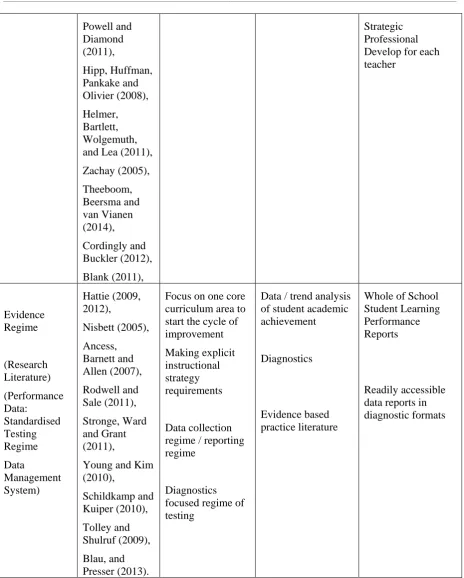
This evidence based mechanism is informed by a school-wide data collection and management system, where timely reports on student progress, using standardised testing results 11 and effect size calculations 12 are provided to each teaching team (evidence regime). This evidence based regime is further intensified by the use of published peer reviewed education literature which is referenced by teachers and the school’s leaders when making teaching decision. Table 1 (located at Article’s end) exemplifies the body of work at the heart of the TMPT.
The leadership of the School’s teaching, and thus the embodiment of the TMPT strategy, is consolidated in a series of teaching team leaders who in turn are directly supervised by the Head. An interesting observation is that the Head in the pilot school reconceptualised his role to be the ‘chief leader of teaching’ and thus the more traditional school administrative tasks (such as internal organisations, finance, facilities, HR and the like) normally assigned to the Head were delegated to other staff. His reference for such a decision was an extensive meta-analysis study that Marzano,
11
Inthe case of this study, data was collected about student performance in literacy using standardised tests in spelling, reading, writing language, conventions and writing capacities.
12
An effect-size provides a common expression of the magnitude of study outcomes for all types of outcome variables, such as school achievement. An effect size of d = 1.0 indicates an increase of one standard deviation on student achievement. A one standard deviation increase is typically associated with advancing a student’s achievement by two to three years or improving the rate of learning by 50%. When implementing a new program, an effect size of 1.0 would mean that, on average, students receiving that treatment would exceed 84% of those students not receiving that treatment. Hattie (1999,2009, 2012), having concluded from an extensive meta study of teaching research, proposed that anything with an effect size of over 0.4 is likely to have a visible, positive effect on student achievement. To put it another way, an effect size of 0.2 or less is low, 0.4 is medium and 0.6 or more is high. With these points in mind the Head focused his teachers to achieve >0.4 teaching effect on their students’ learning outcomes. The use of standardised tests in English provided an effective means through which to convey such performance to teachers.
Waters and McNulty (2005, pp. 11-27) conducted and which found a .25 correlation between a principal’s leadership and student achievement. If focused, the Head’s leadership could potentially increase student achievement up to 22% higher than the starting percentile (Marzano et al. 2005, p. 3).
While these aforementioned elements provide an insight into what can be described as the ‘visible day to day’ elements of the TMPT while in action, it is the elements of ‘leadership’ and ‘school readiness / capacities’ which feature prominently, especially in the TMPT’s early days, that enabled it to be conceptualised, implemented and refined into the school. I briefly describe and locate each element for reference purposes.
A key innovation in the TMPT is that the scheme extends the leadership functions of the school to a designated ‘expert teacher’ in each teaching team. This is a contrast to the traditional school establishment structure where the Head and his deputy (or faculty heads) oversee the work of the school, but chiefly from an administrative and organisational perspective: meaning not exclusively to ‘teaching’. The ‘expert teacher’ facilitates the enacting of the TMPT and its associated elements for teaching improvement effect in their teaching team. In the context of the pilot school these teams were constituted around a year or grade level (ie: all Year 1 teachers, n=4, students n= 100). The use of an ‘expert teacher’ is important in the TMPT because this teacher’s demonstrated expert level teaching capacities --- in other words the performance data for this teacher, on the various metrics used, indicates that they have acquired a high capacity to achieve sustained learning outcomes in their students--- is pivotal to building the required teaching capacities of the less able teaching team members. While they were deemed ‘experts’ they were called ‘teaching team leaders’ in the pilot school.
The final element to explain is the ‘schools readiness / capacities’. In simple terms this comes to represent a series of considerations and capacities that enable the school as a whole to develop, implement, sustain and review the TMPT. These considerations and capacities includes things such as an analysis of significant organisational challenges; the required communication mechanism within the school, a budget, etc, and of course an articulated and agreed school improvement vision (Hargreaves and Fullan 2012; Fullan 2006a, 2006b; Maughan, Teeman & Wilson 2012; Darling-Hammond 1997) as well as identifying the required first order and second order leadership arrangements (Marzano, Waters & McNulty 2005).
To this point the TMPT has been outlined from a key elements perspective. However, the engine room, as it were in the TMPT, is a regime of coaching, mentoring and feedback facilitated by the ‘expert teacher’ in each teaching team. In the third part of the article the mechanics of coaching, mentoring and feedback are discussed and elaborated upon.
4. COACHING, MENTORING AND FEEDBACK (CMF)
Mentoring has ancient origins, but modern day mentoring has roots in the European apprenticeship system, when the apprentice learnt skills from the master craftsman (Clutterbuck 1985). This legacy leads to many images of 'mentoring' that reflect the difficulty of exact definition (see Carter 2013; DfES 2005). While coaching in an organizational sense has traditionally been viewed as a way to correct poor performance and to link individual effectiveness with organizational performance (Ellinger et al. 2003), the distinction between coaching and mentoring has not been clear.
Organizations and the literature use the terms mentoring and coaching interchangeably. More specifically, coaching and formal mentoring are similar in nature but different in name (Joo, Sushko & McLean, 2012, p. 30). I follow this advice except where either mentoring or coaching is the core of the discussion. In addition, the construct teacher 'Professional Development' (PD) can be rendered as 'Continuing Professional Development' (CPD), teacher learning, school improvement and so on. In each of them, I argue that mentoring and coaching play a key role in their implementation. For references purposes, the DfES (2005) statement provides the following definitions for an education context:
“Mentoring is a structured, sustained process for supporting professional learners through significant career transitions;
Specialist Coaching is a structured, sustained process for enabling the development of a specific aspect of a professional learner's practice;
Collaborative (Co-) Coaching is a structured, sustained process between two or more professional learners to enable them to embed new knowledge and skills from specialist sources in day-to-day practice.”
Hamlin et al. (2006, p. 326) conclude, “Truly effective managers and managerial leaders are those who embed effective coaching into the heart of their management practice”. Cordingly and Buckler (2012, p. 221) make the point that for those studies showing a “positive impact on both teacher and learner outcomes” of mentoring and coaching, the most important messages are the processes involved: collaboration, sustained, embedded in real-life learning contexts, and supported by specialists. Moreover, in order to enable these things, school leaders need to focus much of their effort on the core business of teaching and learning (Robinson, Hohepa & Lloyd 2009) so that teaching leaders and teachers in the school also have a heightened awareness of the importance of inquiring into the impact of their teaching on student academic outcomes.
The key point is that when teachers develop their own inquiry skills and can apply them, it is more likely that there will be sustained improvement in teaching effectiveness (British Educational Research Association, 2014; Timperley et al. 2009). This is a key point that needs consideration in implementing the TMPT as a later section affirms. Thus, as MacBeath and Dempster (2009) point out, the teaching role is delineated as delivering a curriculum, but with systematic inquiry into curriculum and the art and science of teaching. For contemporary teachers, these concepts constitute professional knowledge, and leadership that leads to a successful amalgam of these at the teacher level is all about capacity building (Smith & Lynch 2010): the goal of coaching and mentoring in the TMPT. Mentoring and coaching, are fundamental in school settings where professional development is inextricably linked with the personal history of the individual teachers involved. Let me elaborate.
Each teacher has a personal angle on 'teaching' and teaching style, determined by accumulated knowledge and ideas, perceptions of the profession, and era in which they undertook teacher education (Lynch & Smith 2012; Kozloff 2005). Bringing this enormous array of differences and similarities to the table for disciplined dialogue is a priority for school leaders where the psychosocial functions present special challenges. In more simple terms a whole of school improvement strategy requires all teachers to be ‘aligned’ in their understanding of and their capacity for competent teaching: to be on the same page as it were (Schiemann 2009, 2012).
Nevertheless, the mentoring role is fraught not just for school leaders. Spaten and Flensborg's (2013) study of 15 middle managers trained to coach 75 employees found that the manager as coach has to be sensitive and empathetic in building the coaching relationship and should draw clear boundaries between their role as leader with a power relationship and supportive coach. Seibert (2013) in a study of 11 companies and 5,000 employees reports that where employees believed that their managers provided ongoing coaching and feedback to help them succeed, 93% reported a willingness to put in additional effort when needed, compared to only 33% of those who reported poor coaching and feedback. If this study is representative, it suggests that mentoring and coaching skills are a core capability for leaders and that even then, the processes can go wrong.
In the pilot school the ‘expert teacher’ in each team was co-opted as the ‘teaching team leader’ through the implementation of a new school leadership structure that focused on building teacher capacity through team-based coaching and mentoring. This small team arrangement was deliberate in that it set about firstly to humanise the process and thus make each member feel at ease, and secondly was presented to members as a teaching capacity strategy. Its direct link to each teacher’s work—a year or discipline level team-- had the additional effect of ensuring a focus on the core business of ‘teaching’ in the team. It was not sold to teachers as a strategy to identify poor performing staff, but as a means by which the teaching capacities of each teacher would be strengthened and the collective capacities of the team harnessed to deal with the multitude of challenges individual students posed: the mantra for
teachers was “a problem shared is a problem halved”13. For the pilot school’s Head, his mantra was enmeshed in a realisation that his school would only ever be as good as the sum of all of his teachers’ teaching capacities. Hence the focus on every teacher’s teaching.
The third arm to the pilot school’s coaching and mentoring schema is the premise of ‘feedback’. Feedback is intrinsically intertwined in the process of coaching and mentoring in that it is information about how well one is doing in their efforts to achieve a goal is revealed. Or as Hattie and Timperley (2007, p.81) state,
“…feedback is conceptualized as information provided by an agent (e.g., teacher, peer, book, parent, self, experience) regarding aspects of one’s performance or understanding. A teacher or parent can provide corrective information, a peer can provide an alternative strategy, a book can provide information to clarify ideas, a parent can provide encouragement, and a learner can look up the answer to evaluate the correctness of a response. Feedback thus is a ‘consequence’ of performance. (Bold added)
In the TMPT, feedback was incorporated into the coaching/ mentoring process by way of regular reports on student learning performance coupled to teaching observation reports, both oral and written (a template was used to focus the observer). These were also coalesced into a periodic report referenced and benchmarked to agreed performance goals and targets14. I hasten to add that feedback in the TMPT was not an end point, but an ongoing catalyst for teaching improvement. The process of feedback creates the required dialogue and the desire in the teacher (the mentee) and their coach/mentor (expert teacher) to decide what to focus upon next, while the agreed targets and goals provided the base from which to judge how well same is being achieved. Goals and targets in the TMPT were expressly student learning outcomes referenced, but included a series of other ‘teacher’ specific elements (from specific teaching skills to discipline knowledge and understanding) in a quest for the teacher to improve their teaching practice. The dynamics of the teaching team is also used to support the implications of such feedback. To this extent feedback, like the processes of coaching and mentoring, are framed in a sequential process of planning, organisation, instruction and leadership: or what is termed in the TMPT as ‘POIL’. POIL comes to represent the framework for recruiting and then aligning teachers into the process of coaching, mentoring and feedback. In simple terms POIL enables the team leader as chief coach/ mentor to focus on key teaching development objectives which are represented in each ‘frame’ of POIL and which are outlined in associated proformas for reference.15
5. A FINAL WORD
We make the comment that as the pressures to improve teaching and student outcomes increase, school Heads are daily faced with issues such as how teachers and their middle managers can be most effective at work, how their commitment to common goals determined both beyond the school and within can be encouraged and sustained. To participate in disciplined dialogue, coaching, mentoring and feedback (CMF) becomes an essential technique in Schools as it offers an approach to both the work place individual and the personal side of human development in so far as individuals can be helped to explore their potential. Hence, CMF is about the whole of an individual’s relationship to work and the ability to thrive within it rather than the transmission of a limited set of skills, important as these may be in some circumstances. The humanising approach that coaching and mentoring engenders, perhaps stripped of some any imposing terminology that may well threaten the sensibilities of educators, offers a resource to perceptive education leaders. The incorporation of TMPT as the overarching organiser and CMF implementation frames such as POIL provide a level of
13
http://www.usingenglish.com/reference/idioms/a+problem+shared+is+a+problem+halved.html
14
A designated administrative officer was charged with preparing required reports for teams and the school’s leadership
15
See for example http://www.aitsl.edu.au/australian-professional-standards-for-teachers
guidance that enables each required aspect or foundation for teaching improvement to be considered for effect.
Taken together what this Article seeks to illustrate are the following key points:
1. In any change process leadership is important. As an earlier section detailed the ‘pilot school’ was what can be described as a ‘seed’ school. These schools have a strong capacity for change, where the staff is cohesive and excited about teaching. The staff profile in the pilot school did not just emerge it was the product of the school’s leader. In a strategic teaching improvement decision leadership capacity in the school was expanded to team leaders who conducted a similar role, but at an intimate level. This is important in the CMF regime. I hasten to add though that without the Head’s staunch commitment and drive to improve the pilot school, the results of the pilot school would not have been as positive.
2. There are mountains of information currently available to schools: each seeking to define what good teaching is and how it can be achieved. The Talent Management Platform for Teaching (TMPT) consolidates this mountain into a series of organisational signposts, making the strategic considerations --- the evidence pathway---for such a project much clearer for the Head and others.
3. The thesis of this article is one that reaffirms the fundamental role that teachers play in achieving learning outcomes in students. Correspondingly the competence of teachers to teach is commensurate to their professional growth and development. To this end the process of coaching, mentoring and feedback (CMF) becomes a normalised process within a school such that teachers are engaged in a continual process of improvement. In more simple terms, to remain a competent teacher is to involve oneself in a process of CMF.
4. The premise of POIL (planning, organisation, instruction, leadership) provides a level of guidance as to what needs to impacted if CMF is to have traction with teachers and lead importantly to student learning improvements. To this end the application of these four frames provides a path on which teaching is continually improved for student learning effect.
5. Teachers having ownership of ‘team-based’ strategy in the TMPT agenda through a catalyst ‘student –based task’ is a consideration, especially in early days, when Heads are wanting to enable teachers to ‘come on board’ and thus position and locate the benefits of same into their teaching role.
Platform Attributes
Key Theory Alignment
Synchrony of people with the goals, clientele and brand of the organisation, wherever they are located within it.
Capabilities
The available knowledge, skill, information and resources available to people sufficient to meet the
organisation’s goals. Engagement Engagement includes people satisfaction, commitment and willingness to take action for the benefit of the organisation in a discretionary way School Readiness/ Capacities Hamel and Zanini (2014), Cochran-Smith and Donnell (2006), Anderson and Kumari (2009), Nuthall (2004), Darling-Hammond (1997), British Educational Research Association (2014), Maughan, Teeman and Wilson (2012). Analysis of significant organisational Challenges Problem- solution processes Inter-personal and intra-organisational communication skills/ mechanisms Strategic Organisational Arrangements Forthright / Courageous Conversations
Forums to discuss strategic issues / feedback progress
Leadership Marzano, Waters and McNulty (2005),
Marzano et al. (2005), Leithwood and Jantzi (2000a, 2000b), McWilliam and Haukka (2008), Organisation for Economic Co-operation and Development (2013), Costa, and
Vision for teaching excellence which is measured by student learning gains.
Long Term School Strategic Development Plan First Order Leadership Second Order Leadership Team-based Leadership
Whole of school community
agreements to plans
Enrolling Teaching Leaders [Involving teachers at all levels as leaders]
Kallick (1993), Robinson, Hohepa and Lloyd (2009), Purser, Knight & Bedenbaugh (1990). Leithwood, Harris and Hopkins (2008), Fullan (2006). Coaching, Mentoring and Feedback (Teacher Professional Development mechanism) Hattie (2009, 2012), Hargreaves and Fullan (2012), Opfer and Pedder (2011), Glazer and Hannafin (2006), Garet, Porter, Desimone, Birman and Yoon (2001), Avalos (2011), Timperley, Wilson, Barrar and Fung (2009), Borko (2004), Australian Institute for Teaching and School Leadership (2014a), Australian Institute for Teaching and School Leadership (2014b), Taylor, Yates, Meyer and Kinsella (2011), Individual Teacher Performance Audits Teacher Selection Criteria synchronised to the School’s Vision especially improving student achievement Team-based Teaching Plans Assigned Teaching Benchmarks and Targets Defined Teaching Knowledge Base
Defined Teaching Competencies ‘Round Table’ Teaching Planning Meetings’ Individual Teacher Professional Development Plans: -Agreed Teaching Targets / strategies / approaches and associated teacher Professional development elements -Scaled Teaching Performance Measures -Benchmarked Teaching Performance
Assigned Coach and Mentor
Powell and Diamond (2011), Hipp, Huffman, Pankake and Olivier (2008), Helmer, Bartlett, Wolgemuth, and Lea (2011),
Zachay (2005), Theeboom, Beersma and van Vianen (2014), Cordingly and Buckler (2012), Blank (2011), Strategic Professional Develop for each teacher Evidence Regime (Research Literature) (Performance Data: Standardised Testing Regime Data Management System) Hattie (2009, 2012), Nisbett (2005), Ancess, Barnett and Allen (2007), Rodwell and Sale (2011), Stronge, Ward and Grant (2011),
Young and Kim (2010), Schildkamp and Kuiper (2010), Tolley and Shulruf (2009), Blau, and Presser (2013).
Focus on one core curriculum area to start the cycle of improvement Making explicit instructional strategy requirements Data collection regime / reporting regime
Diagnostics focused regime of testing
Data / trend analysis of student academic achievement
Diagnostics
Evidence based practice literature
Whole of School Student Learning Performance Reports
Readily accessible data reports in diagnostic formats
Table 1: Talent Management Platform for Teaching16
16
Referenced to Schiemann, W. A. (2012). The ACE advantage: How smart companies unleash talent for optimal performance. Alexandria, VA: Society for Human Resource Management.
References
Australian Institute for Teaching and School Leadership 2014a, ‘Global trends in professional learning and performance & development’, Curriculum and Leadership Journal, vol. 12, no.9, viewed 21 May
2015, < http://www.curriculum.edu.au/leader/global_trends_in_pl_and_perf_devlt,37242.html?issueID=12885
>.
Australian Institute for Teaching and School Leadership 2014b, Global trends in professional learning and performance and development: some implications and ideas for the Australian education system, viewed 18 May 2015, <http://www.aitsl.edu.au/docs/default-source/default-document-library/horizon_scan_report.pdf>.
Anderson, S & Kumari, R 2009, ‘Continuous improvement in schools: understanding the practice’. International Journal of Educational Development, vol. 29, pp. 281-292.
Ancess, J, Barnett, E & Allen, D 2007, ‘Using research to inform the practice of teachers, schools, and school reform organizations’, Theory into Practice, vol. 46 no. 4, pp. 325–333.
Avalos, B 2011, ‘Teacher professional development in teaching and teacher education over ten years’, Teaching and Teacher Education, vol. 27, no. 1, January 2011, pp. 10–20.
Blank, S 2011 Mentors, coaches and teachers, viewed 18 May 2015,
<http://steveblank.com/2011/04/19/mentors-coaches-and-teachers>.
Blau, I & Presser, O 2013, ‘e-Leadership of school principals: increasing school effectiveness’, British Journal of Educational Technology, vol. 44, no. 6, pp. 1000–1011.
Borko, H 2004, ‘Professional development and teacher learning: mapping the terrain’, Educational Researcher, Vol. 33, No. 8, pp. 3-15.
British Educational Research Association 2014, The role of research in teacher education: reviewing the evidence. Interim report of the BERA-RSA inquiry Summary Document, view 18 May 2015, < https://www.bera.ac.uk/wp-content/uploads/2014/02/BERA-RSA-Interim-Report.pdf >.
Carter, S. J. (2013). An investigation into the nature of mentoring support in the development of teachers. International Journal of Social Science and Humanity, Vol. 3, No. 3, pp. 304-308.
Clutterbuck, D. (1985). Everyone Needs a Mentor: how to foster talent within the organisation, London: Institute of Personnel Management.
Cochran-Smith, M & Donnell, K 2006, ‘Practitioner inquiry: blurring the boundaries of research and practice’, in G Camilli, P Elmore & J Green (eds.) Complementary Methods for Research in Education, 2nd edn, AERA, Washington.
Cordingly, P & Buckler, N 2012, ‘Mentoring and coaching for teacher’s continuing professional development’, in S Fletcher, C Mullen (eds.) SAGE Handbook of Mentoring and Coaching in Education, SAGE Publications, London, pp. 215-227.
Costa, A & Kallick, B 1993, ‘Through the lens of a critical friend’, Educational Leadership, vol. 51, no. 2, pp. 49–51.
Darling-Hammond, L 1997, ‘The right to learn: a blueprint for creating schools that work’, Educational Researcher, vol. 33 no.8, pp.3–15.
Department for Education and Skills (2005) Mentoring and Coaching. CPD Capacity Building Project: National Framework for Mentoring and Coaching.
http://www.cureepaccts.com/files/publication/1219925968/National-framework-for-mentoring-and-coaching.pdf
Ellinger, A. D., Ellinger, A. E., & Keller, S. B. (2003). Supervisory coaching behavior, employee satisfaction, and warehouse employee performance: A dyadic perspective in the distribution industry. Human Resource Development Quarterly, 14, 435–458.
Fullan, M 2006a, Quality leadership, quality learning: proof beyond reasonable doubt, Paper prepared for the Irish Primary Principals’ Network, Líonra+, Glounthaune, Co. Cork.
Fullan, M 2006b, Turnaround leadership, Jossey-Bass, San Francisco.
Garet, M, Porter, A, Desimone, L, Birman, B & Yoon, K 2001, ‘What makes professional development effective? results from a national sample of teachers’, American Educational Research Journal, vol. 38, no. 4, p. 915.
Glazer, EM & Hannafin, MJ 2006, ‘The collaborative apprenticeship model: situated professional development within school settings’, Teaching and Teacher Education, vol. 22, pp.179-193.
Thompson, G & Cook, I 2014, ‘Education policy-making and time’, Journal of Education Policy, vol. 29, no. 5, pp. 700-715.
Hamel, G & Zanini, M 2014, Build a change platform, not a change program, McKinsey and Co
Publications, viewed 18 May 2015, <http://www.mckinsey.com/insights/organization/build_a_change_platform_not_a_change_program>.
Hamlin, R. G., Ellinger, A. E., & Beattie, R. S. (2008). The emergent “coaching industry”: A wake-up call for HRD professionals. Human Resource Development International, 11, 287-305.
Hargreaves, A & Fullan, M 2012, Professional capital: transforming teaching in every school, Teachers College Press, New York, NY.
Hattie, J 1999, Influences on Student Learning, Inaugural Address, viewed 18 May 2015
<http://www.education.auckland.ac.nz/webdav/site/education/shared/hattie/docs/influences-on-student-learning.pdf>.
Hattie, J 2009, Visible learning: a synthesis of over 800 meta-analyses relating to achievement, London, Routledge.
Hattie, J 2011, Challenge of focusing education reform, The Australian, viewed June 7 2011, <http://www.theaustralian.com.au/business/news/rethinking-education-the-challenge-of-focusing-reform/story-fn8ex0p1-1226069556190>.
Hattie, J 2012, Visible learning for teachers: maximizing impact on learning, Routledge, London and New York.
Hattie, J & Timperley, H 2007, ‘The power of feedback’, Review of Educational Research, vol. 77, no. 1, pp. 81–112.
Helmer, J, Bartlett, C, Wolgemuth, JR & Lea, T 2011, ‘Coaching (and) commitment: linking ongoing professional development, quality teaching and student outcomes’, Professional Development in Education, vol. 37, no. 2, pp. 197-211.
Hipp, KK, Huffman, JB, Pankake, AM & Olivier, DF 2008, ‘Sustaining professional learning communities: case studies’, Journal of Educational Change, vol. 9, 173-195.
Joo, B., Sushko, J. S., & McLean, G. N. (2012). Multiple faces of coaching: Manager-as-coach, executive coaching, and formal mentoring. Organization Development Journal, 30, 19-38.
Kozloff, M 2005, ‘Fads in general education: fad, fraud and folly’, in J Jaconson, R Foxx, & J Mulick (eds.), Controversial therapies for developmental disabilities: fad, fashion and science in professional practice, Psychology Press, New York, pp 159-173.
Leithwood, KA, Harris, A & Hopkins, D 2008, ‘Seven strong claims about successful school leadership’, School Leadership and Management, vol. 28, no. 1, pp. 27-42.
Leithwood, K & Jantzi, D 2000a, ‘The effects of transformational leadership on organisational conditions and student engagement’, Journal of Educational Administration, vol. 38, no. 2, pp. 112-129.
Leithwood, K & Jantzi, D 2000b, ‘Principal and teacher leadership effects: a replication’, School Leadership & Management, vol. 20, no. 4, pp. 415-434.
Lynch, DE 2012, Preparing teachers in times of change: teaching school, standards, new content and evidence, Primrose Hall Publishing Group, Brisbane, Qld.
Lynch, D & Smith, R 2012, Designing the Classroom Curriculum in the Knowledge Age. AACLMP Press, Brisbane, Qld.
Lynch, D 2015, ‘Coaching, mentoring and feedback: the ‘how to’ in a schooling context’, in DE Lynch, Madden, J. & Doe, T. (eds.), Creating Outstanding Schools, Oxford Global Press, London, UK,pp. 37 to 50.
MacBeath, J., & Dempster, N. (2009). Connecting leadership and learning. New York, NY: Routledge.
Marzano, R, Waters, T & McNulty, B 2005, School leadership that works, Alexandria, VA, Association for Supervision and Curriculum Development.
Maughan, S, Teeman, D & Wilson, R 2012, What leads to positive change in teaching practice, NFER Research Programme: Developing the Education Workforce, NFER, Slough.
McWilliam, E & Haukka, S 2008, ‘Educating the creative workforce: new directions for twenty-first century schooling’, British Educational Research Journal, vol. 34, no.5, 651–666.
Nisbet, S 2005, Using assessment data to inform planning and teaching: the case of state-wide
benchmark numeracy tests, viewed 18 May 2015,
<http://www98.griffith.edu.au/dspace/bitstream/handle/10072/2477/31483.pdf;jsessionid=4D0E8046 D5826FBF7A1DAD9B197CF4FC?sequence=1>.
Nuthall, G 2004, ‘Relating classroom teaching to student learning: a critical analysis’, Harvard Educational Review, vol. 74, no. 3, pp. 273-306.
Organisation for Economic Co-operation and Development 2013, Leadership for the 21st century learning, educational research and innovation, viewed 18 May 2015, <http://dx.doi.org/10.1787/9789264205406-en>.
Organisation for Economic Co-operation and Development 2013, Upgrading skills for current and future needs, in perspectives on global development 2013: industrial policies in a changing world, viewed 18 May 2015, <http:dx.doi.org/10.1787/persp_glob_dev-2013-10-en>.
Organisation for Economic Co-operation and Development 2010a, The high costs of low performance, OECD Publishing, Paris.
Organisation for Economic Co-operation and Development 2010b, Strong performers and successful reformers in education lessons from PISA for the United States, OECD Publishing, Paris.
Opfer, V & Pedder, D 2011, ‘Conceptualizing teacher professional learning’, Review of Educational Research, vol. 81, no. 3, pp. 376–407.
Powell, DR & Diamond, KE 2011, ‘Improving the outcomes of coaching-based professional development interventions’, in SB Neuman & DK Dickinson (eds.), Handbook of early literacy research, Guilford, New York, pp. 295–307.
Purser, SR, Knight, HV & Bedenbaugh, EH 1990, ‘The relationship between secondary principals' evaluation of teachers and pupil achievement’, Paper presented at the annual meeting of the American Educational Research Association, Boston.
Robinson, V, Hohepa, M & Lloyd, C 2009, School leadership and student outcomes: identifying what works and why, Ministry of Education, Wellington.
Rodwell, M & Sale, C 2011, ‘Using assessment information to inform evidence-based teaching’, Practically Primary, vol.16, no.1 p.37-39.
Scheerens, J 2013, What is effective schooling: a review of current thought and practice. International Baccalaureate Organisation, viewed 21 May 2015, <http://ibo.org/globalassets/publications/ib-research/whatiseffectiveschoolingfinal-1.pdf>.
Schiemann, WA 2009b, Reinventing talent management: how to maximize performance in the new marketplace, John Wiley & Sons, Hoboken, NJ.
Schiemann, WA 2012, The ACE advantage: how smart companies unleash talent for optimal performance, Society for Human Resource Management, Alexandria, VA.
Schildkamp, K & Kuiper, W 2010, Data-informed curriculum reform: which data, what purposes, and promoting and hindering factors, Teaching and Teacher Education, vol. 26, no. 3, Pages 482–496.
Seibert, J.H. (2013). Personal communication from J. Seibert from information from the Metrus Institute database.
Seibert, J. H., & Schiemann, W. H. (2010). Power to the people, Vol. 43, No. 4, Quality Progress, pp.24–30.
Slavin, RE 1997, Sand, bricks, and seeds: school change strategies and readiness for reform, Center for Research on the Education of Students Placed at Risk, Johns Hopkins University, viewed 21 May 2015, <http://www.successforall.org/SuccessForAll/media/PDFs/Sand-Bricks---Seedswabstrac.pdf>.
Smith, R & Lynch, D 2010, Rethinking teacher education: teacher education in the knowledge age, AACLM Press, Australia.
Spaten, O. M., & Flensborg, W. (2013). When middel managers are doing employee coaching. International Coaching Psychology Review, 8(2), 18-39.
Stronge, JH, Ward, TJ & Grant, LW 2011, ‘What makes good teachers good? a cross-case analysis of the connection between teacher effectiveness and student achievement’, Journal of Teacher Education, vol. 62, no. 4, 339-355.
Taylor, M, Yates, A, Meyer, L & Kinsella, P 2011, ‘Teacher professional leadership in support of teacher professional development’, Teaching and Teacher Education, vol. 27, no. 1, pp. 85–94
Theeboom, T, Beersma, B & van Vianen, AEM 2014, ‘Does coaching work? a meta-analysis on the effects of coaching on individual level outcomes in an organizational context’, Journal of Positive Psychology, vol. 9, no. 1, pp. 1-18.
Timperley, H, Wilson, R, Barrar, H & Fung, I 2009, Teacher professional learning and development, Ministry of Education, Wellington.
Tolley, H & Shulruf, B 2009, ‘From data to knowledge: the interaction between data management systems in educational institutions and the delivery of quality education’, Computers & Education, vol. 52, no. 4, pp. 1199–1206.
Waters, T, Marzano, RJ & McNulty, B 2003, Balanced leadership: what 30 years of research tells us about the effect of leadership on student achievement, A Working Paper, viewed 21 May 2015, <http://www.ctc.ca.gov/educator-prep/ASC/5031RR_BalancedLeadership.pdf>.
Young, VM & Kim, DH 2010, ‘Using assessments for instructional improvement: a literature review’, Education Policy Analysis Archives, vol. 18, no.19, pp. 1-40, viewed 21 May 2015, <http://epaa.asu.edu/ojs/article/view/809>.
Zachay, LJ 2005, Creating a mentoring culture: the organization’s guide, Jossey-Bass, New York.