following two methodology in this process. CEMLI is an extensive framework for developing and implementing for Oracle whereas OUM is business process and use case driven process which supports products, tool, technologies and documentation.
This paper have focused on analytical data, system automation functionality along with prototype designing. For this, analysts and administrators will collect and define calculation rule for data collection and measurement, deployment methods, dashboards and security features. This paper gives measure understanding of cloud technologies and their features like services (SaaS), deployment methods, security and ability to reduce overhead cost, downtime, and automate business processes with 360 degree review and analysis.
It consolidates data in one system with volumes of analog and interval data which facilitates new customer with offering and effective program. Also it maximizes return on investments and protects revenue through comprehensive exception management.
Index Terms: Meter data management, system architecture, Saas computing, CEMLI & OUM Method, Oracle
database etc.I.
INTRODUCTION
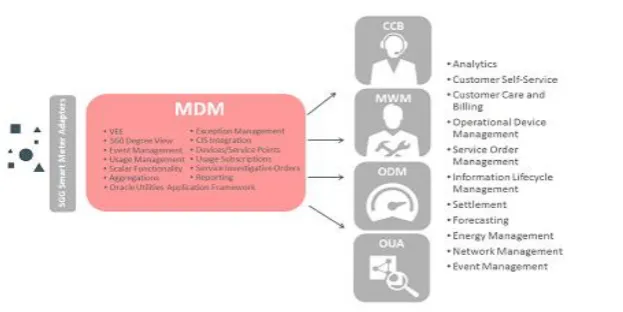
Figure 1. Oracle Utilities MDM capture massive data sets, validates and corrects data and allows data to be leveraged easily across multiple platforms.
A. Cloud Computing.
Cloud computing is derived from 'cloud' that refers to Internet and 'computing' that refers to computer technology. The Internet acts as a warehouse to store virtualized and scalable resources which are provided as a service. Cloud computing makes computing much more centralized and reduces the role of local computers. The resource provider is responsible for cloud management and handling security issues. Cloud computing is a highly efficient platform as it enhances innovation, development and business agility and thus reduces costing. On the basis of transactions, bandwidth consumed and data transferred, it inculcates the 'pay-per-use' concept. Users need not have knowledge of the implementation or control over the technology in the cloud. Cloud computing finds its application in emails, spreadsheets, data backup, word processors etc. However, storing and managing data in third party cloud makes it very prone to threats and attacks. Thus, security and privacy are key issues that envelope the cloud market today. New techniques to make the cloud computing.
II. LITERATURE SURVEY
Electric Energy is the driving force behind the growth of any country. With the abrupt increase in residential, commercial, and industrial consumers of electricity across the world, it has now become essential for utilities companies to design better, non-intruding, environment-friendly techniques of scaling utilities electricity usage so that correct bills can be produced and recorded. Traditionally, the electric meters are equipped on customer‟s premises and the consumption data is collected by meter-readers during their monthly visits to the consumer‟s premises.
This method of appraising the electricity usage has the following drawbacks:
Sometimes if the meters are fixed inside people‟s homes and, if the user is not there at home, then it‟s not possible for the meter-reader to record the monthly consumption and then the utility provider has to consider the average bill-amount of the prior months as a gauge of the likely consumption of the current month. This results in obstruction for both consumer and the utility company. There is a possibility that the consumer has not used similar amount of electricity in the current month compared to the previous months due to some reasons such as, enjoying vacations elsewhere or being treated in the hospital, etc. during that month, and sending him a bill for a greater amount formed on his history of electricity usage may result in his/her financial labour. This method of estimating the bills is also not suitable for the utility company because it gives inaccuracy in the consumer‟s bills and may finally result in fallacies in future planning by the utility company.
Hiring a number of meter readers for billing and providing means of transportation for their monthly visits to the consumers premises is an expensive load on the company‟s budgets. There is a possibility that the meter readers may do some
the traditional electric meters and communicate that information back to the utility providers for monitoring, controlling and billing purposes.
Smart Meter are the ones that
Collects and stores the energy consumption data at regular intervals Allows for two way communication between the utility provider and user.
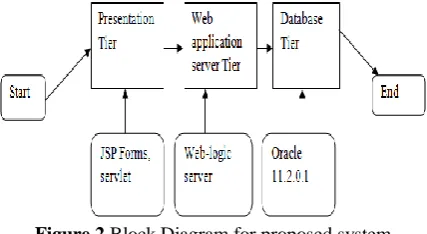
The proposed techniques are used for records of files. As a research work, web logic server by using confidence data reading to store in database. Block diagram for proposed work is stated in figure 2.
Figure 2.Block Diagram for proposed system
The proposed system is subdivided into following two modules: A : Desktop/Client, or Presentation Tier
This tier is implemented in a browser-based client. Users use a desktop client Web browser to log in two and use the Oracle Utilities Meter Data Management application.
B : Web Application Server, Business Application Server Tier
This tier is implemented in a Web application server, business application server, or the batch server. The business application component can be installed as part of the Web application server,
C: Database, or Persistence Tier
This tier is implemented in a database server. The database server stores data maintained by the Oracle Utilities Meter Data Management application. The database tier contains the data server files and database executables that physically store the tables, indexes, and other database object for your system.
IV. METHODOLOGY
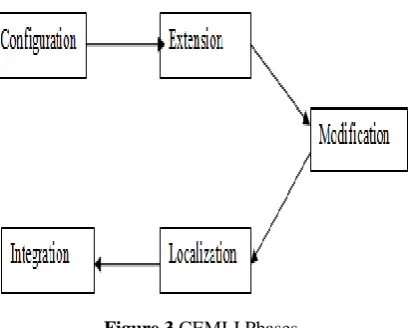
A. CEMLI MethodFigure 3.CEMLI Phases
Configurations : Configure the existing, pre-built application features according to your client‟s requirement. Changing setups and profile values can be the example of configurations.
Customization : Customization means altering/changing the standard objects or creation of custom object to meet client‟s business need. It may be Extensions or Modifications.
Extensions : Extension means creating custom code from scratch, existing objects (views, packages and java classes etc) can be used. It is having different behavior from seeded one.
Modifications : Modifications is enhancing/changing the existing code to meet the client‟s requirements. It is the modification of seeded behavior.
Localization : It is to define the different legislative support provided by oracle Applications based on country/region/language requirements.
B. OUM Method
The Oracle Unified Method (OUM) is Oracle‟s standards-based method that enables the entire Enterprise Information Technology (IT) lifecycle. OUM provides an implementation approach that is rapid, broadly adaptive, and business-focused.
Project Phases for Control
Projects are delivered by phase, in order to reduce risk. Each phase allows a checkpoint against project goals and measurement against quality criteria. OUM includes the following phases
Inception: The overriding goal of the Inception phase is to have concurrence among all stakeholders on the lifecycle objectives for the project.
Elaboration : The goal of the Elaboration phase is to move development of the solution from the scoping and high-level requirements done during the Inception phase to developing the detailed requirements, creating any necessary prototypes, and base lining the architecture of the system .
Construction: The goal of the Construction phase is to take the solution from detailed requirements models, through configuration of standard packaged software functionality, development and testing of custom components, and integration to a system.
Transition : The goal of the Transition phase is to take the completed solution from installation onto the production system through the acceptance test to launch of the live application, open, and ready for business.
Production : The goal of the Production phase is to operate the newly developed system, assess the success of the system, and monitor and address system issues.
C. Saas Cloud Computing
Figure 4.Software cloud service in cloud computing D. Oracle Database Architecture
A database is a collection of data treated as a unit. The purpose of a database is to store and retrieve related information. A database server is the key to information management. In general, a server reliably manages a large amount of data in a multiuser environment so that many users can concurrently access the same data. A database server also prevents unauthorized access and provides efficient solutions for failure recovery. Oracle Database is the first database designed for enterprise grid computing, the most flexible and cost-effective way to manage information and applications. Enterprise grid computing creates large pools of industry-standard, modular storage and servers. With this architecture, each new system can be rapidly provisioned from the pool of components.
The two most common database architectures are client/server and multitier. As internet computing becomes more prevalent in computing environments, many database management systems are moving to a multitier environment. This section includes the following topics:
Client/Server Architecture
Multitier Architecture: Application Servers
Multitier Architecture: Service-Oriented Architecture Client/Server Architecture
a) Client/Server Architecture : In this architecture, the database system has two parts: a front-end or a client, and a back-end or a server. The client is a database application that initiates a request for an operation to be performed on the database server. It requests, processes, and presents data managed by the server. For example, the client might not need large disk capacity, or it might benefit from graphic capabilities. Many clients can simultaneously run against one server. The Server The server runs Oracle Database software and handles the functions required for concurrent, shared data access. The server receives and processes requests that originate from client applications. The computer that manages the server can be optimized for its duties. For example, the server computer can have large disk capacity and fast processors.
b) Multitier Architecture: Application Servers A traditional multitier architecture has the following components: A client or initiator process that starts an operation
One or more application servers that perform parts of the operation.
An end server or database server that stores most of the data used in the operation This architecture enables use of an application server to do the following:
Validate the credentials of a client, such as a Web browser
Connect to an Oracle Database server Perform the requested operation on behalf of the client
V.
EXPECTED
RESULT
According to Proposed system, meter consolidates data in one system with volumes of analog and interval data which facilitates new customer with offering and effective program. Also it maximizes return on investments and protects revenue through comprehensive exception management. From above Figure 5. meter gives cost, downtime and automate business processes with 360 degree review and analysis.
Figure 5. Oracle Utilities MDM provides a 360 degree view of meter data.
VI.
CONCLUSION
In this paper, Meter data management system gives measure understanding of cloud technologies and their features like services (SaaS), deployment methods, security and ability to reduce overhead cost, downtime, and automate business processes with 360 degree review and analysis.
ACKNOWLEDGMENT
This is great pleasure and immense satisfaction to express my deepest sense of gratitude and thanks to everyone who has helped me in completing my work successfully. I would like to thank the Prof. Tanuja Sali for her valuable support and guidance as well as our department members. And of course my family for always being there for me. I also acknowledge the research work done by all researchers in this field.
REFERENCES
[1]. Smart Meters and Smart Meter Systems: A Metering Industry Perspective, an EEI-AEIC- UTC White Paper.
[2]. Abhinandan Jain, “Design and Development of GSM based Energy Meter”, International Journal of Computer Applications (0975 – 888) Volume 47– No.12, June 2012.
[3]. Irfan Quazi et al [2], “Pre-paid Energy Meter based on AVR Microcontroller”, International Journalof Engineering Research and Applications (IJERA) ISSN: 2248-9622www.ijera.com Vol.1,Issue 4,pp.1879-1884.
[4]. Shraddha Male et al “A Smart Wireless Electronic Energy Meter Reading Using Embedded
Technology”, International Journal of Engineering Research and Application, ISSN :2248-9622, Vol. 4, Issue 1 (Version3), January 2014, pp.145-14
[5]. Chunjuan WEI, Junjie YANG, “Implementation of Automatic Meter Reading System Using PLC and GPRS”, Journal of Information & Computational Science 8: 16 (2011) 4343–4350.
International Journal of Engineering Research and Development (IJERD)with Sl. No. 4739, Journal no. 48012.