POSITION SPACE INFORMATION DENSITY
Anil Kumar11. INTRODUCTION
Quantum information theory has potential implications for the conceptual foundations of quantum mechanics and forms the basis of cryptography and modern communication technologies.It is employed to study the concepts quantum computation, quantum communication and density functional theory. The probability distribution in position as well as in momentum space is measured in terms of information theoretic concepts. These concepts have been recently studied for different quantum mechanical systems [1-8]. The Shannon information entropy of the single particle distribution is
(1)
(2)
in position space and momentum space respectively. Here
(
r
)
and
(
p
)
are the probability densities in position space and corresponding momentum space. The different properties of the information theory in various fields, e.g. nuclear physics, mathematical physics, chemical physics, information theory, statistical physics, mathematics and other areas of physics [9-12] have been analyzed in recent times.The isospectral Hamiltonian approach is used to obtain the isospectral wave functions and study the various properties of information densities. For isospectral Hamiltonians, the energy eigenvalue spectrum and scattering matrix are exactly same, but the eigenfunctions and the quantities dependent on the eigenfunctions are different [13-14]. In this approach, we delete a bound state of the given potential and re-introduce it. Mathematically, to obtain the solution, a first order differential equation is solved, which admits a deformation parameter. Thus, a set of one-dimensional family of potentials can be constructed which have the exactly same energy spectrum as that of original potential. In general, for any one dimensional potential with n bound states, one can construct an n-parameter family of strictly isospectral potentials, i.e. potentials with eigenvalues, reflection and transmission coefficients identical to those for original potential. This approach has been used in different physical systems from various fields [15-16]. In this paper, position space information density for ground and excited states has been studied for the three-dimensional Hydrogen atom. Using supersymmetric quantum mechanics techniques, the isospectral potential and corresponding eigenfunctions have been constructed. These have been used to calculate the information density of isospectral potential. The contribution of the angular and radial part of the potential towards the information density has been exactly analyzed for different states in position space as well as momentum space. The concluding remarks are presented in the last section.
2. ISOSPECTRAL HAMILTONIAN APPROACH
The relation between the bound state wave functions and the potential is utilized in solving exactly for the spectrum of one-dimensional potential problems. The supersymmetric partner potentials V1(x) and V2(x) are related through superpotential
)] ( [ln )
(x 0 x
W dxd
as. ) ( )
( 2
2 , 1
dx dW x W x
V (3)
The one-parameter family of potentials
V
ˆ
1(
x
,
)
is calculated as)).
)
(
(ln(
2
)
(
)
,
(
ˆ
2 2
1
1
I
x
dx
d
x
V
x
V
(4)1
Dept. of Physics, JC DAV College, Dasuya-144205, Punjab, India
Abstract-The position space and momentum space information densities analyze the amount of information for quantum mechanical systems and used to study the characteristic properties of different systems. Using the isospectral Hamiltonian method, the isospectral eigenfunctions corresponding to three-dimensional hydrogen potential have been obtained. The position space information density concepts of isospectral three dimensional hydrogen potential have been studied and their properties have been analyzed. The radial and angular contributions of the information density are graphically analyzed for different states of the potential.
Keywords—Information Density, Entropy, Fourier Transform, Isospectral Hamiltonians.
DOI: http://dx.doi.org/10.21172/1.94.
21
,
)
(
)
(
)
1
(
)
,
(
ˆ
0 0
x
I
x
x
(5)where
(
0
,
1
)
. The excited state eigenfunctions for the potentialV
ˆ
1(
x
,
)
are given by,).
(
)
(
)
(
)
(
1
)
(
)
,
(
ˆ
1 1 11
W
x
x
dx
d
x
I
x
I
E
x
x
n n n n
(6)Using the similar procedure, the two-parameter ground state wave function can be obtained as
.
)
)
(
(
)
(
ˆ
)
(
)
,
,
(
1
)
,
,
(
ˆˆ
0 0 1 1 1 0 1 0 0 1 0 0
x
I
A
A
x
x
x
(7)The equations (4), (5) and (6) represent the one-parameter family of isospectral potentials and wave functions, which shall be used to calculate the information density. Further, the system can also be studied using two parameters using equation (7).
3. INFORMATION DENSITY OF ISOSPECTRAL HYDROGEN POTENTIAL
The information density measures the compactness of the quantum mechanical system in the form of amount of information. The three-dimensional Hydrogen atom is an interesting problem in quantum mechanics which is widely used to study the different systems in various fields. The ground and excited state eigenfunctions of the potential are [17],
(8)
Ylm(θ, φ)
Ylm(θ,φ) (9)
Using the isospectral Hamiltonian approach, the ground state wave function of the isospectral potential is calculated as
(10)
Using the formalism explained above, the excited state isospectral wave function for odd values of n has been obtained after some lengthy but straightforward calculations as
(11) Similarly, for even values of n, we obtain
(12)
The information density in position space for the ground state is obtained as
where t1=
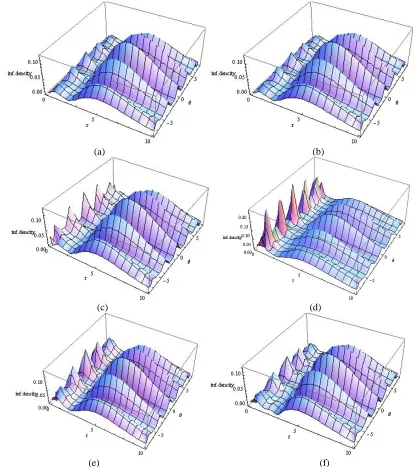
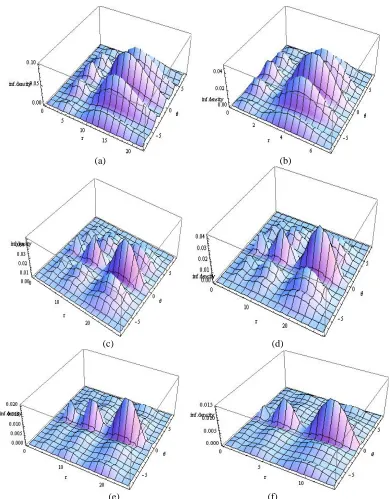
The information density in position space has been calculated for different states of the isospectral three-dimensional hydrogen potential and their features are graphically analyzed. The figures 1 and 2 explain the properties of information density in terms of deformation parameter for different levels of the isospectral potential.
(a) (b)
(c) (d)
(e) (f)
Figure 1: The information density in position space for isospectral three-dimensional Hydrogen potential describing radial and angular parts with 𝛂 =1, l=0 and (a) n=2, =20, (b) n=2, , (c) n=2, =0.1, (d) n=2, =0.05, (e) n=2, =0.045,
(a) (b)
(c) (d)
(e) (f)
Figure 2: The information density in position space for isospectral three-dimensional Hydrogen potential describing radial and angular parts with 𝛂 =1, l=0 and (a) n=3, =10, (b) n=3, =0.125, (c) n=5 =20, (d) n=5, , (e) n=7, =1.0, (f)
n=7, =0.1.
The position space information of the three-dimensional hydrogen potential have asymmetric shape which depends on the values of different quantum numbers. The radial and angular contribution of the isospectral potentials have been graphically demonstrated characterizing the specific properties. The different properties have been observed for small values of the deformation parameter, but for large values of the deformation parameter, the information density approaches the undeformed value.
4. CONCLUSION
5. REFERENCES
[1] Dong S, Sun GH, Dong SH, Draayer JP. Shannon Information Entropy for an Infinite Circular Well. Physics Letters A. 2014;378:124-130.
[2] Pooja, Kumar R, Kumar G, Kumar R, Kumar A. Quantum Information Entropy of Eckart Potential. International Journal of Quantum Chemistry.
2016;116:1413-1418.
[3] Atre R, Kumar A, Kumar CN, Panigrahi PK. Quantum-Information Entropies of the Eigenstates and the Coherent State of the Poschl-Teller Potential.
Physical Review A. 2004;69:052107(1-6).
[4] Kumar A. Information Entropy of Isospectral Poschl-Teller Potential. Indian Journal of Pure & Applied Physics. 2005;43:958-963.
[5] Serrno FA, Falaye BJ, Dong SH. Information Theoretic measures for a Solitonic Profile Mass Schrodinger Equation with a Squared Hyperbolic
Cosecant Potential. Physica A. 2016;446:152-157.
[6] Kumar A, Pooja. Information Density of Isospectral Potential. International Journal of Pure and Applied Physics, 2017;13(1):27-33.
[7] Sun GH, Dong SH, Launey KD, Dytrych T, Drraayer JP. Quantum Information Entropy for a Hyperbolical Potential Function. Int. Journal of Quantum
Chemistry. 2015;115:891-899.
[8] Pooja, Sharma A, Gupta R, Kumar A. Quantum Information Entropy of Modified Hylleraas plus Exponential Rosen-Morse Potential and Squeezed
States. International Journal of Quantum Chemistry. 2017;DOI: 10.1002/qua.25368.
[9] Jizba P, Dunningham JA, Joo J. Role of Information Theoretic Uncertainty Relations in Quantum Theory. Annals of Physics. 2015;355:87-114.
[10] March NH, Angilella GGN, Pucci R. Natural Orbitals in Relation to Quantum Information Theory: From Model Light Atoms Through to Emergent
Metallic Properties. International Journal of Modern Physics B. 2013;27:133021(1-26).
[11] Coles PJ, Kaniewski J, Wehner S. Equivalence of Wave–Particle Duality to Entropic Uncertainty.Nature Communications. 2014;5:5814(1-8).
[12] Narayanan KR, Srinivasa AR. Shannon Entropy based Nonequilibrium Entropic Temperature of a General Distribution. Physical Review E.
2012;85:031151(1-11).
[13] Khare A, Sukhatme U. Phase Equivalent Potentials obtained from Supersymmetry. Journal of Physics A: Math. Gen. 1989;22:2847-2860.
[14] Cooper F, Khare A, Sukhatme U. Supersymmetry and Quantum Mechanics. Physics Reports. 1995;251:267-385.
[15] Kumar A. Generalization of Soliton Solutions. International Journal of Nonlinear Science. 2012;13(2):170-176.
[16] Kumar A, Kumar CN. Calculation of Franck-Condon Factors and r-centroids using Isospectral Hamiltonian Approach. Indian Journal of Pure &
Applied Physics. 2005;43:738-742.