TiC
–
TiB2 composites: A review of processing, properties
and applications
Mitra Akhtari Zavareh1*, Dr.Ahmed Aly Diaa Mohammed Sarhan2, Malihah Amiri Roudan3, Parisa
Akhtari Zavareh4
1,2,3Department of Mechanical Engineering, Faculty of Engineering Building, University of Malaya, 50603
Kuala Lumpur, Malaysia
Abstract:- Ceramic-matrix composites (CMCs) based on TiC–TiB2 have attracted enormous interest during recent years because, in comparison to single phase ceramics, they exhibit superior properties including high hardness, good wear resistance and high fracture toughness. This paper presents the properties and application of TiB2-TiC. Much of the research effort has therefore focused on the synthesis, processing and fabrication of TiC–TiB2 is based primarily on self-propagating high-temperature synthesis (SHS).
Keywords: Composites; TiC–TiB2; Self propagation High-temperature Synthesis (SHS).
I. INTRODUCTION
The development of ceramic-matrix composites (CMCs) is of increasing interest because they can enhance the intrinsically low fracture resistance of monolithic ceramics. Typical ceramic systems that are of such interest are carbide–boride composites of transition metals as they are recognized as valid candidates for technological applications under extreme conditions due to their excellent combination of mechanical and electrical properties as well as their good corrosion and oxidation resistance at high temperatures[1]. Titanium diboride/titanium carbide (TiC-TiB2) is covalent compounds and possess excellent hardness and corrosion resistance.This composites are suitable for applications such as wear parts and high-temperature structural components. This composite has many characteristics such as high melting point and hardness, good thermal shock resistance and high temperature stability [2]. In comparison to conventional cermets based on WC and TiC, cermets based on TiC–TiB2 composites, exhibit a higher hardness and chemical stability at high temperatures and are regarded as a good alternative for wear-resistant applications[3].
In addition, the use of TiC–TiB2in non-structural applications like wall tiles in nuclear fusion reactors, cathodes in Hall–Heroult cells and vaporizing elements in vacuum-metal deposition installations has been under investigation[4, 5]. It has also been shown that the fracture toughness and wear resistance of TiC–TiB2 composites prepared from premixed TiB2and TiC powders were significantly higher than those of TiB2 and TiCsingle phases [6]. Table 1 compares measurements of the Vickers hardness between TiC–TiB2and single-phase TiC and TiB2[7]. It is apparent that the TiC–TiB2hardness measured at room temperature was lower than that of the single-phase materials. However, at 600◦C the hardness of the composite exceeds the hardness of monolithic TiC and TiB2.
TABLE 1 Vickers hardness at room and high temperature for TiC–TiB2composites and monolithic materials
Material Vickers Hardness (Gpa)
25ºC 600ºC
TiC 27.5 6.8
TiB2 28.5 7.8
TiC-TiB2 23.0 8.3
1.1 Properties and applications of TiC
Titanium carbide (TiC) has recently been receiving high commercial attention, due to a number of desirable properties. It is extremely hard, one of the hardest known metal carbides [8]. TiC shows excellent thermal stability and has a very high melting temperature of approximately 3100oC [9, 10 and 11]. Besides, this material displays relatively high thermal and electrical conductivity. Good thermal conductivity results in low temperature gradients, which reduces thermal stresses and cracking, making it suitable for high speed cutting tool applications [12, 13]. Furthermore, this material has good electrical conductivity that makes it suitable for electrical discharge machining, which helps overcome the problem of shaping such hard material [13]. TiC has a lower density, which is desirable for applications that demand lightweight materials. It also exhibits excellent chemical stability, so it reduces the type of chemical interaction between the cutting tool and the work piece which typically causes crater wear [14, 15].
TABLE 2 Bulk properties at room temperature of titanium carbide (disordered state) with FCC structure and composition near 50 at% C [16]
Lattice parameter (nm) 0.43
Density (g/cm3) 4.93
Melting point (◦C) 3067
Micro-hardness (GPa) 28
Young Modulus (GPa) 450
Heat conductivity (Wm−1◦C−1) 28.9 Linear thermal expansion coefficient (10−6 ◦C−1) 8.5
Electrical resistivity (µΩcm) 100
Due to the many characteristics of this material such as very high hardness, high melting temperature and excellent thermal and chemical stability, TiC is a suitable material for many commercial applications such as abrasive materials, cutting tools, grinding wheels and coated cutting tips [9, 10 and 11]. An overview of the most important properties of titanium carbide is presented in Table 2. TiC ceramic has been used worldwide as a high temperature ceramic in the cutting tools industry, in the form of a hard metal or cermets [17, 18 and 19]. In reality, TiC-based materials form the most important group of cutting tools after tungsten carbide-cobalt [20], conducting diffusion barriers in mechanical chemistry and the microelectronics industry, especially as a hardening phase of super alloys or reinforced particles in composites [17, 18 and 19].
TiC ceramic was traditionally synthesized and fabricated by various methods such as carbothermal reduction synthesis at elevated temperatures, powder metallurgy, mechanical alloying, reactive sintering and so on [17, 18 and 19]. However, most of these methods lead to the complexity of process and equipment, contamination of products, and even high temperatures being required for TiC-formation because of the relatively coarse raw powder mixtures [17, 18 and 19].
Despite the many advantages of this material, there are some limitations which obstruct its application. One limitation is difficulty in the production. Moreover, this material needs intensive energy and requires expensive, high temperature equipment for its production. For instance, current production methods involve reactions carried out at temperatures well above the melting point of titanium (1670°C). These high temperature production processes include carbothermal reduction of titanium dioxide, carburization of titanium by heating in the vapor of a suitable hydrocarbon and the direct reaction of titanium with carbon [10, 14 and 21].
1.2 Properties and applications of (TiB2)
TiB2 ceramics are of interest for applications such as cutting tools, wear resistant parts, armor material and electrode materials in metal melting, because of their excellent combination of properties including high hardness, elastic modulus, better strength to weight ratio, wear resistance, good thermal and electrical conductivity. From the perspective of oxidation resistance, TiB2 samples show parabolic oxidation kinetics below 1000oC as a result of the formation of TiO2and B2O3[22] and linear oxidation kinetics above 1000
TiB2exhibits superior mechanical properties with the lowest density and a relatively high coefficient of thermal expansion. However, poor sinter ability and relatively low fracture toughness of monolithic TiB2limit its wider use in many engineering applications [25].
TiB2melts congruently at 3225oC. Both TiB and TiB2 phases have a narrow homogeneity range. TiB2exists over a stoichiometry range of 28.5-30wt% B. The characteristics of high melting point and stability of TiB2 make it suitable for high temperature structural applications [17, 26]. Important factors that control the composition of borides are the ratio of atomic sizes of boron (B) to metal (M) atoms, and in general the B:M ratios vary from 1:4 to 12:1 [7, 27]. Table 3 summarizes some of the properties of TiB2.
TABLE 3 Properties of TiB2[7, 28]
Lattice parameter (nm) a = 0.3028; c =
0.3228
Density (g/cm3) 4.52
Melting point (◦C) 3225
Hardness HK0,1(kg/mm2) (>95% dense) 2600 (25◦C) 2400 (200◦C) 1800 (400◦C) 1050 (600◦C) 460 (1000◦C)
Young Modulus (GPa) 560
Heat conductivity (Wm−1◦C−1) 24-59
Linear thermal expansion coefficient (10−6 ◦C−1) 5.107+1.997×10⁻³T Electrical resistivity (µΩcm) 20.4 (25◦C)
26 (200◦C) 36 (400◦C) 46 (700◦C)
Friction coefficient 0.9
Wear coefficient 1.7×10⁻³
Weibull modulus 11
Increasing the number of B atoms leads to an increase in the B-B bond strength and results in an increase in melting temperature, hardness, strength and chemical stability. The M-B bond strength in diborides depends on the degree of electron localization around the M atoms. In metal borides, the outer electron configurations are sp2 and sp3, which promote strong covalent bonding [29]. Densification of monolithic TiB2also depends on the purity of the starting powders. Several investigators have carried out a comparative study on the sinter ability of TiB2 powders produced by various processing techniques [30]. Khanra reported that a maximum of 97% theoretical density was achievable with the nano-sized TiB2powders (obtained by SHS technique) after pressure less sintering at 1950oC for 30min [31]. Such high density is attributable to the finer particle size and high defect concentration of the SHS produced TiB2powders. Wang and his co-workers investigated the influence of hot pressing temperature and sintering time on densification, microstructure and mechanical properties of TiB2 ceramics [19]. Baik and Becher analyzed the detrimental effect of oxygen contamination, which gets introduced during synthesis and/or subsequent processing, on the densification of TiB2[32]. Ferber et all reported that the materials with anisotropic coefficient of thermal expansion (CTE), such as TiB2, often develop micro-cracks, relieving localized residual stresses generated during cooling from hot pressing temperature [33]. Such stresses arise primarily from the mismatch of thermal expansion between individual grains and anisotropic thermal expansion coefficient.
pure hot-pressed TiB2was found to be completely wetted by aluminum with a contact angle of zero in a cryolite melt at 980oC. As far as armor applications are concerned, TiB2 exhibits favorable properties such as high impact velocity for dwell/penetration transition and deformation induced hardening [36, 37].
These composites have been used as wear parts, cutting tools and heat exchangers. These electro-conductive toughened ceramics can be shaped by electro discharge machining to manufacture complex components, largely increasing number of industrial applications of these ceramic materials. Other applications of TiB2 were also attempted, such as electrical contact barrier for Si in the semiconductor industry [38].
II. PROPERTIES AND APPLICATIONS OFTIC–TIB2COMPOSITES
It is widely known that ceramic materials exhibit superior properties when compared to metals, in terms of thermal stability, corrosion and wear resistance. The ceramic-ceramic composites that combine boride and carbide offer an attractive combination of excellent mechanical and electrical properties and corrosion resistance, particularly at relatively high temperatures and/or in corrosive environments [39]. A summary of the mechanical properties of TiC–TiB2 obtained by various processing routes and reported in the literature is summarized in Table 4.
TiB2and TiC are covalent compounds and possess excellent hardness and corrosion resistance. TiB2and TiC are important materials for high-temperature applications because of their high melting points, hardness, elastic modulus and electrical conductivity, and relatively low coefficient of thermal expansion [32,40 and41].
Among these ceramics, TiB2 and TiC have been proposed as components for high refractory cermets and for super-hard cutting tools.
Several investigators reported the use of reactive sintering/in situ densification techniques to produce TiB2 -based composites [42, 43and 44].
Such processes are developed with an aim to lower the sintering temperature, densify the materials with or without use of sintering additives and reduce the processing costs, etc. Reactive sintering is a technique wherein both the chemical reactions of the starting powders and the densification occur in a single step [45] processed TiB2-TiC composites via reactive sintering by the chemical reaction between Ti and B4C powders after sintering at 1500oC for 1 hour. In another work, in situ toughened TiB2-TiCxcomposites were fabricated using reactive hot pressing of B4C and Ti powders at high temperatures (1700-1800oC) for 1 hour [44]. The composites possessed very high relative density and high fracture toughness of 12.2MPa/m1/2. Gotman produced in situ dense TiB2/TiC and TiB2/TiN composites from 2BN-3Ti and B4C-3Ti powder blends with or without the addition of Ni via reactive synthesis techniques at temperatures of≤1100oC [42].
The fabrication of TiB2and TiC ceramics by conventional sintering, hot pressing or hot isostatic pressing of TiB2and TiC powders is costly because of the time-consuming and facility-intensive nature of these processes [5, 39 and 43]. Cermets are produced traditionally by sintering which generally lasts for several hours. They are attractive for application in aircraft propulsion systems and space thermal protection systems, because of their high melting point, good thermal shock resistance and excellent high-temperature stability. They are also potential candidates for application in cutting tools, die, machine tool inserts, wear-resistant parts and lighter armor materials because of their high hardness, elastic modulus and light weight. Moreover, they can be used as cathodes for the Hall-Heroult cell due to their good electrical conductivity [32, 45].
The available data provide evidence that the combination of good wear resistance and relatively high thermal shock and oxidation resistance renders TiC–TiB2composites. However, no actual application of these materials is commercially available due to the fact that a cost-effective and reliable processing route allowing an accurate control of the microstructure has still to be established for this class of materials. Regarding this, the SHS process seems to offer a promising way provided an accurate control of the process parameters is achieved.
III. TIC–TIB2SYNTHESIS AND PROCESSING
public domain. More so than other materials, its manufacturing processes significantly affect the properties of TiB2-TiC. In conventional methods, ceramic are produced by compaction and sintering of chemically inert powders at high temperature to give consolidated products. Also considering production of TiB2-TiC composite for industrial purposes, near net shape fabrication processes are preferred due to the limited machine ability of the alloy. Furthermore Powder Metallurgy (PM) is a well-known process for its ability of providing semi-finished and net-shaped products. In addition to, material savings, energy savings, process automation, as well as precise control of the chemical compositions can be achieved by PM while avoiding problems associated with the melting procedures like segregation. Fabrication techniques for conventional processing method by metallurgy powder of this product can be categorized in four groups conventional sintering (CS), Hot Isostatic Pressing (HIP), Spark Plasma Sintering (SPS) and Self-propagating High Temperature Synthesis (SHS).
In conventional sintering (CS), a green compact of elemental Ti, B and C powders is prepared and further
sintered at near melting temperature of TiB2to yield in binary TiB from diffusion of Ti and B elements, because
the melting point of TiB2is higher than TiC. So conventional sintering requires long heating times and samples
are limited in shape and pore size. The porous structure is shown to be of small size and irregular shape.
Maximum porosity of 40% has been achieved with this procedure[47, 48].
Hot Isostatic Pressing (HIP) is a process that subjects a material simultaneously to both high temperature and high gas pressure. HIP can close internal porosity in a material without distorting the external geometry, consolidate powder materials to 100% of theoretical density or form perfect diffusion bonds between similar or dissimilar materials.The mixture of elemental powder particles is encapsulated in an evacuated gas-tight welded canister and undergoes simultaneous isostatic pressure and elevated temperature. Other than that, Argon gas can be used as an inert environment without the need for the airtight chamber. In this case, HIP can be used to compress and trap Ar gas bubbles in between the elemental powders. A subsequent high-pressure diffusion stage leads to Ar-filled pores. Sintering the product at reduced pressures causes the gas to expand and bring about near-spherical pores in the final product.
Typically, the temperature is selected to permit limited plastic deformation of the material being processed in the solid state at an argon gas pressure of 15,000, 30,000, or at times, 45,000 psi (1,000 to 3,000 atmospheres) is isostatically exerted on the heated parts for a period of time. The chamber is then slowly cooled, depressurized and the parts removed. Fig. 1 is shown the schematic of HIP.
Fig.1. Schematic drawing of the HIP device.
Fig. 2 . The typical procedure for a HIP cycle [49].
The capsule-free HIP process was shown to produce homogenous porous TiB2-TiC with near-spherical pores. The structure could show acceptable pseudo elasticity due to the removal of stress concentration in near-spherical pores. Controlling the porosity characteristics in a porous material has a great influence on the mechanical properties of the products [50].
HIP products now include automotive parts, pump bodies, valves, vacuum chambers, bearings, sterile enclosures, etc. anywhere residual porosity cause high rejection rates, unacceptable property levels and surface finishing problems after machining. Commercial alloy applications include steel, stainless steel and aluminum castings. Not limited to metals, the process is very versatile, having been used to densify ceramics, plastics, glasses and many other materials.
Generally the advantages of HIP processes include shorter solid state diffusion time, good control over the pore size (microstructure), and ability to manipulate various geometries, resulting in a thermodynamically stable. So Hot Isostatic Pressing can provide many benefits by stabilizing a material, removing residual stresses, densifying and eliminating voids and occlusions. The process "homogenizes" an alloy and in most cases, the properties of the material are enhanced, providing greater stability and wear characteristics [51].
Fig. 3 . Schematic drawing of the SPS device.
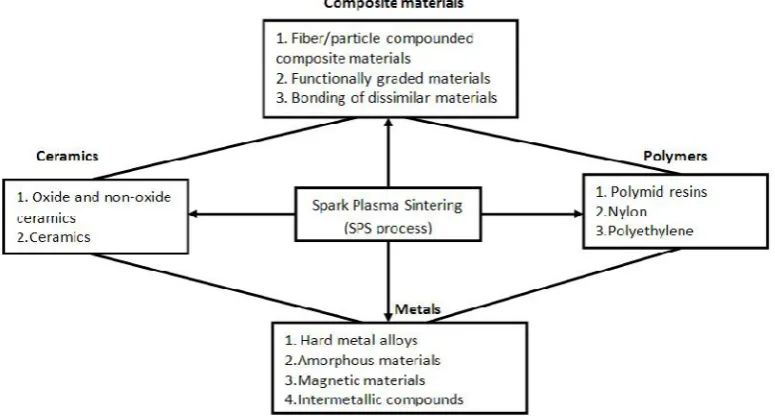
SPS systems offer many advantages over conventional systems using hot press (HP) sintering, hot isostatic pressing (HIP) or atmospheric furnaces, including ease of operation and accurate control of sintering energy as well as high sintering speed, high reproducibility, safety and reliability [55, 56]. The SPS process is expected to find increased use in the fabrication of functionally graded materials (FGMs), intermetallic compounds, fiber reinforced ceramics (FRC), metal matrix composites (MMC) and nanocrystalline materials, which are difficult to sinter by conventional sintering methods. However, little work has been done on the TiB2–TiC composites produced by SPS technique. Fig. 4 shows the materials covered by SPS processing.
Fig.4 .Typical examples of materials covered by SPS processing (Source: SPS Forum survey)
According to, high-temperature, short-period SPS sintering is expected to provide almost all ceramic materials with new characteristics and sintered effects which are different from those obtained by the HP and HIP processes [56-58]. The ceramic materials which can be sintered at high density include oxides such as A1203, mullite, Zr02, MgO, Hf02and SO2, carbides such as Sic, B4C, TaC and TiC, borides such as TiB2and HfB2and nitrides such as Si3N4, TaN, TiN and AIN.
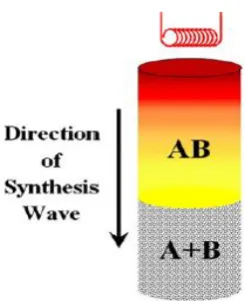
efficient.One of the difficulties with SHS is the inability to control the intermetallicphases [59]. A schematic representation of the SHS process is shown in Fig. 5.
Fig. 5. Schematic representation of the SHS process
The porosity of the SHS product depends on the original porosity of the green compact and synthesis parameters such as the change in the molar volume, the combustion front thermal gradients, and the gas evolution as a result of volatile impurity expulsion. The porosity and the mean pore size and the distribution of that can, to some extent, be controlled in SHS. Performing the reaction under a reduced pressure or adding a gasifying agent increases the porosity. Manipulating the reaction temperature by adding diluents to the initial mixture can be a way to control the pore size. Uniformity of the temperature profile within the sample greatly affects the homogeneity of the product.
The products of the combustion synthesis reaction are normally extremely porous, e.g. typically 50% of theoretical density of such porous materials may have some applications such as filters and catalytic support structures, and perform for liquid metal infiltration in the production of ceramic-metal composites [60].
The synthesis of TiB2-TiC with this method requires preheating of the sample to achieve self-sustained
combustion since the exothermicity of the reaction is relativelylow [61]. The preheating temperature affects the
amount of transient liquid phase present at the combustion front. Excessive pre-heating has been shown to have detrimental effects such as anisotropy in the pore structure [62]. The SHS reaction can be performed in two different approaches; first by locally initiating the reaction which will further propagate along the sample [59,62] and second by volume combustion [63] i.e., heating the entire sample up to the reaction temperature which will let the reaction take place simultaneously throughout the whole sample [62].
A bulk porous TiB2-TiC has been produced via SHS from Ti, B and c green compact with a pre-heating
temperature of 1200 °C.The porosity of the green compact, the transient liquid phase, and the volatilization of
the impurities followed by the escape of absorbed gases left three dimensionally interconnected pores in the product which formed banded channel structures along the propagation direction of the reaction [59].
As outlined by Merzhanov [64], the main advantages of SHS method are less energy and time consuming, the products are high purity. Also The process can be used not only for producing refractory powders but also to make near net-shape components by utilizing the exothermic heat with processes such as casting, consolidation and coating.
Beside the benefits of this method it has some limitation. Since this method is difficult to control because of the high reaction rates. However, some controls are possible by adding diluents which do not join in the reaction, but increase the thermal mass of the system and lower adiabatic temperature. This leads to a decrease in combustion wave velocity, and the reaction rate decreases as expected for solid-solid reactions [65].
So among these fabrication techniques for synthesizing the composites, SHS technology has attached much attention, because of its low energy consumption, high time efficiency and high product purity [66].
IV. CONCLUSIONS
rate. Reduction of the cooling rate following SHS has been observed to lead to grain growth. An interesting development is the use of the SHS-quench process which results in the formation of a met stable product. Upon heat treatment, morphological evolution of nanocrystalline phases has been observed. Evaluation of the properties of samples produced by these processes, have shown very promising improvements, principally with regard to wear resistance and fracture toughness.
REFERENCES
[1] Y. Yorozu, M. Hirano, K. Oka, and Y. Tagawa, “Electron spectroscopy studies on magneto-optical media and
plastic substrate interface,” IEEE Transl. J. Magn. Japan, vol. 2, pp. 740–741, August 1987
[2] H. Zhao,Y. Cheng, “Formation of TiB2–TiC composites by reactive sintering,”Ceram. Int 1999, vol. 25, pp. 353– 358.
[3] R. Licheri, R. Orrù ,G. Cao ,”Chemically activated combustion synthesis of TiC–Ti composites,”Mater. Sci. Eng., A, vol. 2,pp. 185–97, 2004.
[4] E.Y. Gutmanas, I.J. Gotman, “Dense high-temperature ceramics by thermal explosion under pressure,” . Eur. Ceram. Soc, vol. 19, pp. 2381–2393, 1999.
[5] X. Zhou, S. Zhang, M. Zhu, B. Chen,”Investigation of TiB2–TiC composites produced by SHS and their application in Hall–Heroult cells for aluminum electrolysis,” . Int. J. Self-Propag. High-Temp Synth, vol. 7,pp. 403–408, 1979.
[6] D. Brodkin, S. Kalidindi, M. Barsoum, M.Zavaliangos, “Microstructural evolution during transient plastic phase processing of titanium carbide–titanium boride composites,”A. J. Am. Ceram. Soc,vol. 79,pp. 1945–1952, 1996. [7] G. Wen, SB. Li, BS. Zhang, ZX. Guo, “Reaction synthesis of TiB2–TiC composites with enhanced toughness,”
Acta Metall ,vol. 41, pp.1463-1470, 2001.
[8] L. Contreras, X. Turrillas, GB. Vaughan, A. Kvick,MA, “RodriguezXRD study of TiC-TiB2composites obtained by SHS,”Acta Mater, vol. 52, pp. 4783–4790, 2004.
[9] LL. Ye, MX. Quan Synthesis of nanocrystalline TiC powders by mechanical alloying,”Nanostructured mater,
vol. 5, pp. 25-31, 1995.
[10] M. Eskandarany,EL. Sherif, “Synthesis of nanocrystalline titanium carbide alloy powders by mechanical solid state reaction,”Metall. Mater. Trans. A, vol. 27A, pp.2374-2382, 1996.
[11] M. Eskandarany, EL. Sherif, “Structure and properties of nanocrystaline TiC full-density bulk alloy consolidate from mechanically reacted powders,”J. Alloys Compd, vol.305,pp. 225-238, 2000.
[12] R. Koc, C. Meng, GA. Swift. Sintering properties of submicron TiC powders from carbon coated titanium precursor J. Mater. Sci. Lett 2000, 35, 3131-3141.
[13] HSP. Fard, HR. Baharvandi, H. Abdizadeh, B. Shahbahrami, “Chemical synthesis of nano-titanium diboride powders by borothermic reduction,” Int. J. Mod Phys B, vol. 22, pp. 3179–84, 2008.
[14] EY. Gutmanas, I. Gotman, ”Dense high-temperature ceramics by thermal explosion under pressure”. J. Eur. Ceram. Soc, vol. 19, pp. 2381-2393, 1999.
[15] JL. Ellis, CG. Goetzel , Cermets, ASM Metals Handbook, p. 978-1007, 1990.
[16] AM. Santhanam, P. Tierny, JL. Hunt, Cemented Carbides, ASM Metals Handbook, p. 950-977, 1990.
[17] LB. Nikzada, R. Licheria, MR. Vaezib, R. Orrùa, G. Caoa, “Chemically and mechanically activated combustion synthesis of B4C–TiB2composites,”Int. J. Refract. Met. Hard Mater, vol. 35, pp. 41–48, 2012.
[18] RR. Taylor, SA. Pirzada, ”Ceramic carbide powder synthesis in a non-transferred arc plasma flow reactor,”
Mater. Manuf. Processe, vol. 8, pp. 501-507, 2007.
[19] A. Biedunkiewicz, P. Figiel, U. Gabriel, M. Sabara, S. Lenart,”Synthesis and characteristics of nanocrystalline materials in Ti, B, C and N containing system,”Eur. J. Solid State Inorg. Chem, vol. 9, pp. 417–22, 2011.
[20] W. Wang, Z. Fu, H. Wang, R. Yuan, “Influence of hot pressing sintering temperature and time on microstructure and mechanical properties of TiB2ceramics,” Bioinformatics, vol. 22, pp. 1045-1049, 2002.
[21] M. Razavi, R. Ghaderi, MR. Rahimipour, R. Ostad Shabni, “Synthesis of TiC Master Alloy in Nanometer Scale by
Mechanical Milling Mater,” Manuf. Processes, vol. 27, pp. 1310-1314, 2012.
[22] L. Khusboo, VA. Sherbakov, ”Fabrication of in-situ Ti–Si–C fine grained composite by the self propagating high temperature synthesis (SHS) process,”Int. J. Refract. Met. Hard Mater, vol. 29, pp. 209-213, 2011.
[23] SR. Levine, EJ. Opila, MC. Halbig, JD. Kiser, M. Singh, JA. Salem, ”Evaluation of ultra-high temperature ceramics for aero propulsion use,” J. Eur. Ceram. Soc, vol. 22, pp. 2757-2767, 2012.
[24] B. Ghosh, SK. Pradhan,” Microstructure characterization of nanocrystalline TiC synthesized by mechanical alloying,” Mater. Chem. Physics, vol.120, pp. 537–45, 2010.
[25] R. Telle,G. Petzow, “Densification and Mechanical Properties of B4C with Al2O3as a Sintering Aid,” J. Am. Ceram. Soc, vol. 2, pp. 1155-1201, 2011.
[26] B. Basu, GB. Raju,AK. Suri, “Processing and properties of monolithic TiB2-based Materials,”Int. Mater. Rev, vol. 51, pp. 352-374, 2006.
[27] L. Guanghua, L. Jiangtao, C. Kexin, “Combustion synthesis of refractory and hard materials: A review,”Int. J. Refract. Met. Hard Mater, vol. 39, pp. 90-102, 2013.
[28] RA. Cutler, Engineering Properties of borides, in Engineered materials handbook, vol. 4, 1991.
[29]RG. Munro, “Material properties of titanium diboride,”J. Reinf. Plast. Compos, vol. 105, pp. 709–720, 2012. [30]W. Georg, “Electron deformation density in titanium diboride chemical bonding in TiB2,” J. Solid State Chem, vol.
[31] AK. Khanra, MA. Godkhindi, LC. Pathak, ”Process for in-situ preparation of aluminia-(Ti, Zr) borides composite,” Mater. Sci. Eng., A, vol. 281-287, pp. 454-455, 2007.
[32] AK Khanra, MM. Godkhindi, LC. Pathak, “Comparative Studies on Sintering Behavior of Self-Propagating High-Temperature Synthesized Ultra-Fine Titanium Diboride Powder,” J. Am. Ceram. Soc, vol. 88, pp. 1619-1621, 2005.
[33] M. Selva Kumar, P. Chandrasekar, Chandramohan, M. Mohanraj, “Characterisation of titanium–titanium boride composites processed by powder metallurgy techniques,”Mater. Charact, vol. 73, pp. 43-51, 2012.
[34] LU. Jianbang, S. Shili, Q. Feng, W. Yawei,J. Qichuan,”Compression properties and abrasive wear behavior of high volume fraction TiCx–TiB2/Cu composites fabricated by combustion synthesis and hot press consolidation,” Mater. Des, vol. 40, pp. 157-162, 2012.
[35] KD. Watson, JM. Toguri,”The wettability of carbon-titanium diboride composite materials by aluminum in cryolite melts,” Metall. Mater. Trans. B, vol. 22, pp. 617-621, 1991.
[36] M. Dionne,G. L’esperance,A. Mirchi, “Microscopic characterization of a TiB2-Carbon material composite: Raw materials and composite characterization,” Metall. Mater. Trans. A, vol. 32, pp. 2649-2656, 2001.
[37] [36] DP. Dandekar, DC.Benfanti, “Strength of titanium diboride under shock wave loading,” J. Appl. Phys, vol. 73, pp.673-679, 1993.
[38] AR. Keller, M. Zhou,”Effect of microstructure on dynamic failure resistance of titanium diboride/alumina ceramics,” J. Am. Ceram. Soc, vol. 86, pp. 449-457, 2003.
[39] BS. Du, P. Sameer,R. Narendra, B. Dahotrea,”Phase constituents and microstructure of laser synthesized TiB2– TiC reinforced composite coating on steel,” Scripta Mater, vol. 59, pp. 1147–50, 2008.
[40]MA. Janney, “Mechanical properties and oxidation behaviors of a hot-pressed SiC-15vol%-TiB2Composite”J. Am. Ceram. Soc, vol. 66, pp. 322-324, 1987 .
[41] Z. Lei, S. Ping, J. Qichuan, “The mechanism of combustion synthesis of (TiCx Ny-TiB2)/Ni from a Ni-Ti-C-BN system,” Powder Technol, vol. 205, pp.52–60, 2011.
[42] MW. Barsoum, B. Houng,” Transient plastic phase processing of titanium-boron-carbon composites,” J. Am. Ceram. Soc, vol. 76, pp. 1445-1451, 1993.
[43] G. Zhang,”Preparation of TiB2-TiC0.5 N0.5ceramic composite by reactive hot-pressing and its microstructure,” Ceram. Int , vol. 21, pp. 29-31, 1995.
[44] SP. Chen, QS. Meng, W. Liu,ZA. Munir,”Titanium diboride–nickel graded materials prepared byfield-activated, pressure-assisted synthesis process,” J. Mater. Sci. Lett, vol. 44, pp. 1121–1126, 2009.
[45] G. Wen, Li. SB, BS. Zhang,ZX. Guo, ”Reaction synthesis of TiB2–TiC composites with enhanced toughness,” Acta Mater, vol. 49, pp. 1463-1470, 2000.
[46] P. Shen, BL. Zou, SB. Jin,QS. Jiang,”Reaction mechanism in self-propagating high temperature synthesis of TiC-TiB2/Al composites from an Al-Ti-B-C system,”Mater. Sci. Eng., A , vol. 300-309, pp. 454–455, 2007.
[47] I. Gotman, NA. Travitzky, EY. Gutmanas,”Dense in situ TiB2–TiN and TiB2–TiC ceramic matrix composites: reactive synthesis and properties,” Mater. Sci. Eng., A, vol. 244, pp. 127–137, 1998.
[48]F. Hong, MH. Lewis,” Ceramic-matrix composites via in-situ reaction sintering,” Ceramic Engineering and Science Proceedings, vol. 14, pp. 699-706, 1993.
[49]FJ. Akhtar,”Microstructure evolution and wear properties of in situ synthesized TiB2and TiC reinforced steel matrix composites,” J. Alloys Compd, vol. 459, pp.491–7, 2008.
[50] B. Yuan, CY. Chung, XP. Zhang, MQ. Zen,GM. Zhu, “Control of porosity and superelasticity of porous TiC-TiB shape by hot isostatic pressing,”Smart Mater. Struct, vol. 14, pp. S201–6, 2005.
[51] M. Bram, A. Ahmad-Khanloua, A. Heckmannb, B. Fuchsa, HP. Buchkremera,D. Stovera,”Powder metallurgical fabrication processes for NiTi shape memory alloy parts,”Mater. Sci. Eng., A, vol. 337, pp. 254–63, 2009. [52] FH. Froesa, J. Hebeisenb., Hot isostatic pressing of titanium based materials, 1994, Pages 71–90.
[53] KQ. Feng, Y. Yang, M. Hong, JL. Wu, SS. Lan,” Intensified sintering of iron powders under the action of an electric field: effect of technologic parameter on sintering densification,”J. Mater. Process. Technol, vol. 208, pp.
264–269, 2008.
[54] Sh. Shili, Q. Feng, J. Shenbao, L. Jianbang, J. Qichuan,”Compression properties and work-hardening behavior of Ti2AlC/TiAl composites fabricated by combustion synthesis and hot press consolidation in the Ti–Al–Nb–C system,” J. Mater. Des, vol. 32, pp. 5061-5065, 2011.
[55] ZA. Munir, U. Anselmi-Tamburini, M. Ohyanagi,”The effect of electric field and pressure on the synthesis and consolidation of materials: a review of the spark plasma sintering method,”Mater. Des, vol. 20, pp. 41763–777, 2006.
[56] I. Song, L. Wang, M. Wixom,”Self-propagating high temperature synthesis and dynamic compaction of titanium diboride/titanium carbide composites,” J. Mater. Sci. Lett, vol. 35, pp. 2611-2617, 2003.
[57] N. Tamari, T. Tanaka, K. Tanaka, M. Kawahara, M. Tokitn., “Effect of Spark Plasma Sintering on Densification and Mechanical Properties of Silicon Carbide,” J. Mater. Res, vol. 103, pp. 740-746, 1995.
[58] T. Nishimura, M. Mitomo, H. Hirotsuru,M. Kawahara, “Fabication of Silicon Nitride Nano-ceramics by Spark Plasma Sintering,” J. Mater. Sci. Lett, vol. 13, pp. 1046- 1047, 2001.
[59] D. Vallauri,IC. At´ıas Adrian´a, A. Chrysanthou, “TiC–TiB2composites: A review of phase relationships, processing and properties,” J. Eur. Ceram. Soc, vol. 28, pp. 1697–1713, 2008.
[60]A. Biswas,”Porous TiB2by thermal explosion mode of SHS: processing, mechanism and generation of single phase microstructure,” Acta Mater, vol. 53, pp. 4015–25, 2005.
[62] C. Greiner, SM. Oppenheimer, DC. Dunand High strength, low stiffness, porous TiB2with superelastic properties . Acta Biotechnol 2005, 1, 705–16.
[63]AG. Merzhanov.,”History and recent developments in SHS,”Ceram. Int, vol. 21, pp. 371-379, 1995.
[64] AG. Merzhanov, “Solid flames: discovery, concepts and horizons of cognition,”Combust. Sci. Technol, vol. 98,
pp. 307–336, 1994.
![TABLE 3 Properties of TiB2 [7, 28]Lattice parameter (nm)](https://thumb-us.123doks.com/thumbv2/123dok_us/1388977.1649993/3.595.121.471.188.423/table-properties-tib-lattice-parameter-nm.webp)
![Fig. 2 . The typical procedure for a HIP cycle [49].](https://thumb-us.123doks.com/thumbv2/123dok_us/1388977.1649993/6.595.172.428.69.237/fig-typical-procedure-hip-cycle.webp)