ISSN (Online) 2249-6084 (Print) 2250-1029 www.eijppr.com
Development and Validation of a
Stability-Indicating RP-HPLC Method for the
Estimation of Aciclovir in Bulk and Ointment
Dosage Form
Gunasekar Manoharan
1*, Ramadan Abdel Wahed Mohamed
1, 21 Chemistry Department, Faculty of Science, Jazan University, Al-Rawda District, Jazan, Saudi Arabia. 2 Ceteral Laboratory for Elemental and Isotopic Analysis-Nuclear Research Center-Egyptian Atomic Energy Authority.
ABSTRACT
A simple, precise and gradient RP- HPLC method has been developed and validated for Aciclovir in bulk and ointment formulation. The proposed method was validated to obtain official requirements including stability, accuracy, precision, linearity and selectivity. The estimation was developed on C (18) column reversed-phase using the mobile phase composition as Acetonitrile: Methanol: Phosphate buffer (16:20:64 v/v). The flow rate was set as 1ml/minute, and the maximum absorption was observed at 290 nm using Shimadzu SPD-20A Prominence UV-Visible detector. The Aciclovir, drug showed a precise and good linearity at the concentration ranges of 20-100 μg/ml. The RP-HPLC assay showed the highest purity ranging from 99.79 % to 100.97 % for Aciclovir, ointment formulation, and 100.21 % was the mean percentage purity. The Aciclovir retention time was found to be 5.01 minutes. The method accuracy was shown by the statistical analysis. To examine the stability of the drug, various forced degradation studies were conducted on Aciclovir ointment. The developed
method was validated according to the ICH guidelines.
Key Words: Aciclovir, Methanol, Buffer, HPLC and UV.
eIJPPR 2019; 9(1):1-11 HOW TO CITE THIS ARTICLE: Gunasekar Manoharan, Ramadan Abdel Wahed Mohamed (2019). “Development and Validation of a Stability-Indicating RP-HPLC Method for the Estimation of Aciclovir in Bulk and Ointment Dosage Form”, International Journal of Pharmaceutical and Phytopharmacological Research, 9(1), pp.11-18.
INTRODUCTION
Aciclovir, 9-[(2-hydroxyethoxy)-methyl]-guanosine, is an acyclic guanosine derivative, which exhibits a selective inhibition of herpes viruses replication with the potent clinical antiviral activity against the herpes simplex and
varicella-zoster viruses [1, 2]. Aciclovir, is available as
tablet, ointment and IV injections. Aciclovir, is generally
considered safe for use in pregnancy with no harm having been observed [3]. It appears to be safe during breastfeeding. Aciclovir is a nucleic acid analogue made of guanosine. It works by decreasing the production of the
virus's DNA [4]. There are many works published for the
determination of Aciclovir, in biological fluids of
different species. Several HPLC methods have been
reported for the determination of Aciclovir, in human
serum using UV or fluorescence detection [5, 6]. According to the literature review, several methods have
been developed for Aciclovir, like UV spectroscopy,
fluorescence spectroscopy capillary electrophoresis, HPTLC, HPLC and voltammetry method [7-10]. Herein,
a sensitive and selective HPLC method for the Aciclovir,
has been presented for the first time. The method development and the validation of a stability-indicating
RP- HPLC method for the estimation of Aciclovir, were
new, which would fulfil all ICH guidelines requirements of validation. Increasing the importance of speed, time and reliability of analysis in pharmaceutical analytical laboratories, a new method for Aciclovir determination in the ointment formulation with a very short analysis time was described in this method. The proposed method was very fast, quick and accurate in terms of the chromatographic retention time and run time compared
Corresponding author:Gunasekar Manoharan
Address :Assistant Professor, Chemistry Department, Faculty of Science, Jazan University, Kingdom of Saudi Arabia.
E-mail:shekarphd @ yahoo.com
Relevant conflicts of interest/financial disclosures: The authors declare that the research was conducted in the absence of any
commercial or financial relationships that could be construed as a potential conflict of interest .
ISSN (Online) 2249-6084 (Print) 2250-1029 www.eijppr.com
12 with other reported methods. The proposed aim of this
study was to develop simple, accurate, specific and precise RP-HPLC method for the Aciclovir estimation in the bulk and pharmaceutical ointment formulation.
MATERIALS AND METHODS
Chemicals
The Aciclovir reference standard (RS) was purchased from Sigma, Germany. The Acivir ointment (Aciclovir 3% w/w) manufactured and marketed by Cipla Ltd, purchased from local Pharmacy from Vellore, India. The HPLC grade acetonitrile, water and methanol were purchased from Sigma, German.
RP-HPLC instrumentation
Shimadzu LC-20 AT HPLC system, using SPD-10 detector (SPD- M20A, Japan) was used. A Zorbax Eclipse Plus, Agilent Technology column (150mm x
4.6mm, 5μm) with Pore size of 95Å were also utilized.
The column temperature was maintained at a 29ºC, and the flow rate was 1ml/min. The sample injection volume was 20μl, and the wavelength was set as 250nm, and the HPLC run time was set for 15 minutes.
Preparation of Mobile phase
Accurately weighed 1.35g of KH2PO4 was transferred
into 1-liter volumetric flask and dissolved by 500 ml of HPLC grade water, and the pH was adjusted to 6 by the gradual addition of phosphoric acid, the resulting solution was filtered with 0.45μ membrane filter. The final mobile phase was prepared by adding the ratio of (16:20:64 v/v) Acetonitrile, Methanol and phosphate buffer.
Preparation of Aciclovir stock solution Standard Aciclovir solution
Accurately 2mg Aciclovir reference standard was taken in 100 ml volumetric flask, and mixed with 100 ml of mobile phase solution, and the resulted solution was kept in the sonicator for 5 minutes. The concentration of 20-100 μg/ml was achieved by diluting the standard stock solution with the mobile phase. Aciclovir powder was freely soluble in methanol.
Preparation of sample solution
0.5 gm of marketed sample of Acivir 3% w/w ointment was weighed accurately which was equivalent to 30 mg of Aciclovir transferred into 25ml volumetric flask and dissolved with 25 ml of mobile phase and filtered a through Whatman 1 filter paper. Further dilutions were made based on the required concentrations.
Solution stability
The prepared drug solution stability was analysed during the time of analysis, and also the same analysis method was repeated on the same day with different time intervels. The same analysis was repeated after 24 hrs by
keeping the drug solution under the laboratory temperature (37 ± 1°C) and in refrigeration (5 ± 1°C). Method validation
The proposed method was preceded to achieve a new, sensitive and easy method for the estimation of Aciclovir by RP-HPLC from the ointment formulation. The experimental analysis was validated according to the ICH guidelines recommendations and USP-30.
System suitability
The resolution, retention time, tailing factor and column theoretical plates parameters were performed by six replicates of standards and three replicates of the sample preparation.
Forced degradation study
Aciclovir ointment was put into different stress conditions to perform degradation studies. The degradation study was conducted to examine the proposed assay technique. Aciclovir is freely soluble in methanol and also methanol is the portion of mobile phase, so menthol was used as a solvent. In all the experiments, Aciclovir ointment contents equivalent to 2mg Aciclovir were weighed. The solution was prepared according to the stock solution procedure. 60 μg/ml of Aciclovir was taken for every analysis. The drug solution was treated with acid, base, oxidative stress, dry and wet heat and direct sun light (photolytic stress). According to the proposed method, the resulted drug samples were examined.
Acid degradation study
The stability of Aciclovir ointment in acidic state was examined by treating with different strengths of Hydrochloric acid 0.1N to 4N HCL. The solution of 60 μg/ml Aciclovir taken in this study was treated with 4N hydrochloric acid in presence of methanol. The treated
drug solution was kept in dark chamber at 35oC for 12
hours.
Alkali degradation study
The stability of the Aciclovir ointment in alkaline condition was examined by treating with different strengths of sodium hydroxide 0.1N to 4N NaOH. The solution of 60 μg/ml Aciclovir taken for this study was treated with 4N sodium hydroxide in presence of methanol. The treated drug solution was kept in the dark
chamber at 35oC for 12 hours.
Oxidation study
The stability of Aciclovir ointment under the oxidative condition using hydrogen peroxide was examined. The
solution of 60 μg/ml Aciclovir taken for this study was
treated using 20 % H2O2 in methanol. The treated drug
solution was incubated at 35ºC for 12 hours. Wet heat study
The solution of 60 μg/ml Aciclovir taken in this study was treated with HPLC grade water, and the resulted
ISSN (Online) 2249-6084 (Print) 2250-1029 www.eijppr.com
13 hours.
Dry heat study
To conduct a dry heat analysis, the drug solution was prepared by 2gm of Aciclovir ointment approximately in
a clean aluminum foil, and kept in an oven at 35oC for 12.
The resulted Aciclovir was weighed, and the solutions were prepared like the preparation of stock solution procedure; 60 μg/ml of Aciclovir was taken for the analysis.
Photo stability study (Sun light)
2gm of Aciclovir ointment was transfered in a glass dish, and exposed to the direct sunlight over a period of 4 hours. The resulted Aciclovir ointment was weighed, and the solutions were prepared like the preparation of stock solution procedure; 60 μg/ml of Aciclovir was taken for the analysis.
RESULTS AND DISCUSSION
Method optimization
Chromatogram with good shape peaks and good retention time showed a good resolution for Aciclovir, and forced the degradation of products. The proposed method was
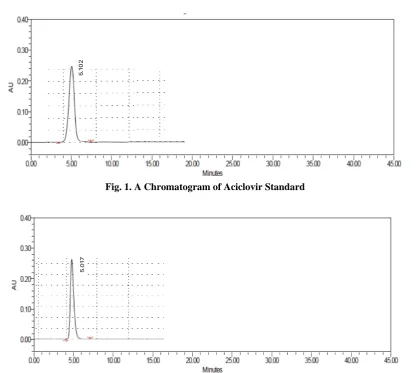
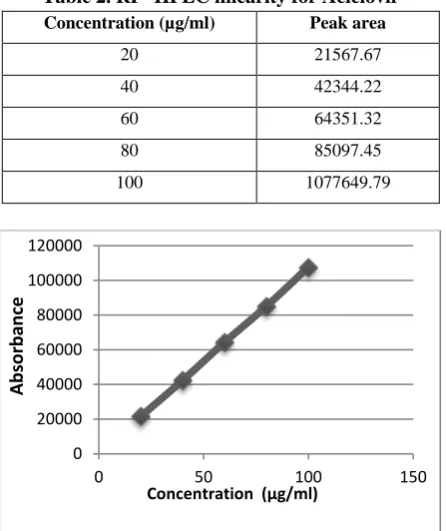
supposed to identify the number of the degradation products formed during the stressed conditions. The typical RP-HPLC conditions have been presented in Table 1. The good separation of Aciclovir and the products degraded under the stressed conditions showed the success of the method. The HPLC chromatograms of Aciclovir standard and Aciclovir ointment have been
presented in figure 1 and 2.
Table 1. RP-HPLC conditions for the estimation of Aciclovir.
Parameters Description
Column Zodiac C(18) column (50mm x 4.6mm,
5μm) Column
temperature 27 ± 1°C
Mobile phase (16:20:64 v/v) acetonitrile, methanol
and phosphate buffer.
Detection Photodiode array detection at 290 nm
Injection volume 20 μl
Flow rate 1 ml min-1
Fig. 1. A Chromatogram of Aciclovir Standard
ISSN (Online) 2249-6084 (Print) 2250-1029 www.eijppr.com
14
Method validation
The method was proceeded to achieve sensitive, easy and economical determination and estimation by HPLC from
the ointment formulation. Based on the ICH
recommended guidelines, the experimental was validated. Linearity
The proposed method’s linearity was examined for five concentrations. The concentration ranged from 20-100 μg/ml. The Aciclovir standard linearity was determined by the plotting graph concentration vs the absorbance. Absorbance as a function of analyte concentration linearity was evaluated for Aciclovir. The linearity graph has been presented in figure 3, and the data has been shown in Table 2. The system suitability was demonstrated by the linearity analysis.
Table 2. RP- HPLC linearity for Aciclovir
Concentration (µg/ml) Peak area
20 21567.67
40 42344.22
60 64351.32
80 85097.45
100 1077649.79
Fig. 3. Calibration graph of Aciclovir 20-100 μg/ml precision
Accuracy
The recovery experiment showed the accuracy of the method. The good recovery showed that the method was accurate. The analysis for the recovery was performed by the known amount of Aciclovir working standard added to the pre-analyzed solution of the formulation in the test concentration range of (40%, 60% and 100 %). For each recovery level, three samples were prepared and repeated for 3 consecutive days. The statistical results for the recovery study were well within the range (S.D. < 2.0). The Aciclovir ointment formulation recovery results have been presented in Table 3.
Table 3. Recovery studies of Aciclovir ointment formulation
Drug %
Level Amount Added (µg/ml) Amount Found (µg/ml) % Recovery Mean recovery Aciclovir
40 60 99.98 99.67
99.27
40 80 119 99.55
40 100 139 99.75
Precision
The experimental results to check the precision (repeatability) of the proposed method have been shown
in Table 4. In the proposed method, the intraday and
interday precisions were examined by analyzing the responses of the sample on the same day for 4 repetitions and 3 alternate days for 60-100 μg/ml concentration range of Aciclovir. The obtained results were represented in % RSD. The % CV of the proposed method was precise as the values of < 1.0 % for the repeatability study. The precision data have been presented in Table 5.
Table 4. Method precision data of Aciclovir by RP-HPLC method
Aciclovir 20μg/ml
(n=4) Retention time Area
1 5.11 59497.45
2 5.10 59897.75
3 5.07 59197.48
4 5.13 59297.40
Mean 5.10 59472.22
S.D a 0.0211 100.71
% CVb 0.57 2.02
n=4 observations
Table. 5. Intermediate precision data of Aciclovir by RP-HPLC method
Aciclovir
μg/ml
Inter-day measured mean
area ± S.D.a
%CVb
(nc=4)
Intra-day measured mean area ±
S.D.a
%CVb
(nc=4)
60 5457.25± 2.19 0.0772 4197.44± 4.65 0.0115
80 10919.75±2.22 0.0717 7672.75±2.15 0.0147
100 169613.12±2.11 0.0622 9776.12±4.26 0.1036
nc = 4 observations
Specificity
The standard reference and the drug formulation showed
the specificity of the method. The RP-HPLC
chromatogram of Aciclovir both bulk and the ointment
formulation have been presented in figure 1, 2. The bulk
and ointment formulation retention time was found to be
0 20000 40000 60000 80000 100000 120000
0 50 100 150
Abso
rba
nc
e
ISSN (Online) 2249-6084 (Print) 2250-1029 www.eijppr.com
15 5.1 minutes. For the ointment formulation, there was no
excipient interference detected, which showed the specificity of the method. The proposed method showed the ability to determine the analyte in presence of the excipients.
Limit of detection and quantitation
The limit of detection and the quantification for Aciclovir has been presented in table 6. The limit of detection (LOD) and the limit of quantification (LOQ): LOD and LOQ were examined by the minimum detectable peak area by injecting the known concentration of the drug solution. As per the International Conference on Harmonization guidelines, the results were multiplied thrice to get LOD and 10 times to get LOQ. LOD and LOQ were found at the concentrations of 0. 57μg/mL and 1.25 μg/mL, respectively. The limit of detection and quantification for Aciclovir has been presented in table 6.
Table 6. Limit of detection and quantification
Parameters Aciclovir
LOD (µg/ml) 0.57
LOQ (µg/ml) 1.25
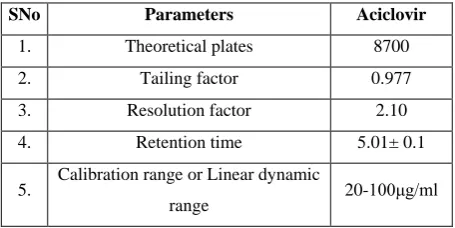
System suitability
For the system suitability parameters, five repeats of the standards and two repeats of the sample preparation were injected, the data has been presented in table 7. The Assay data of Aciclovir has been presented in table 8.
Table 7. Results of the system suitability parameters
SNo Parameters Aciclovir
1. Theoretical plates 8700
2. Tailing factor 0.977
3. Resolution factor 2.10
4. Retention time 5.01± 0.1
5. Calibration range or Linear dynamic
range 20-100μg/ml
Table 8. Quantitative estimation (Assay) data of Aciclovir
D
rug
Label claim (µg)
Amount found
(µg)
Mean amount
found (µg /ml)
Percentage purity (% w/w) Mean purity (%w/w) % D evi ati on A cic lo v ir 300 300.11 299.67 300.11 301.33 300.17 300.01 99.91 99.79 100.21 100.97 100.24 100.21 + 0.1 +0.2 +0.1 +0.1 +0.2
n= 4 observations
Statistical parameters
The assay’s obtained results were subjected to the coefficient of variation; and the statistical analysis, the regression equation and the standard deviation have been presented in table 9.
Table 9. Results of statistical parameters Force degradation of Aciclovir in formulation
SNo Parameters Aciclovir
1. Standard deviation (SD) 1.07
2. Relative standard deviation (RSD) 0.0676
3. % RSD 0.566
4. Standard error (SE) 0.02117
5. Correlation Coefficient (r) 0.9870
6. Slope (a) 5032.3
7. Intercept (b) 1102.9
Aciclovir showed slight and moderate degradation in dry
heat, oxidative and Photo stability (Sun light) condition
for a short period of time. Table 10 indicates the degradation of Aciclovir under different stress conditions. According to the ICH guidelines of the forced degradation, Aciclovir was examined.
Table 10.Summary of force degradation of Aciclovir by RP-HPLC method
SN
o Stress condition/ state Time % Assay ± S.D.
a(nb=5)
1 Acidic 4N HCL(35
oC)/
solution 12 hrs 98.27 ± 1.612
2 Alkali 4N NaOH (35
oC)/
solution 12 hrs 99.12± 0.7142
3 Wet heat (35 oC)/ solution 12 hrs 98.37±1.321
4 Dry heat (35 oC)/ solid 12 hrs 95.71±1.244
5 Oxidative 20 % H2O2 (35 oC) 12 hrs 98.67±1.138
6 Photo stability/ solid 4 hrs 83.76±1.349
ISSN (Online) 2249-6084 (Print) 2250-1029 www.eijppr.com
16
Alkali degradation
The stability of the Aciclovir ointment in alkaline condition was examined. There was no degraded product separated from Aciclovir. The chromatogram of alkali-degraded result was compared with the formulation and standard chromatogram. The result showed that around 1– 2 % of the Aciclovir drug was degraded, and in alkaline condition, the drug was highly stable.
Acid degradation
The stability of the Aciclovir ointment in acid condition was examined. The chromatogram of the acidic condition product was compared with the formulation and standard chromatogram. The results showed that around 1–2 % of
the Aciclovir drug was degraded. The results also showed that the drug in acidic condition was highly stable. Oxidation
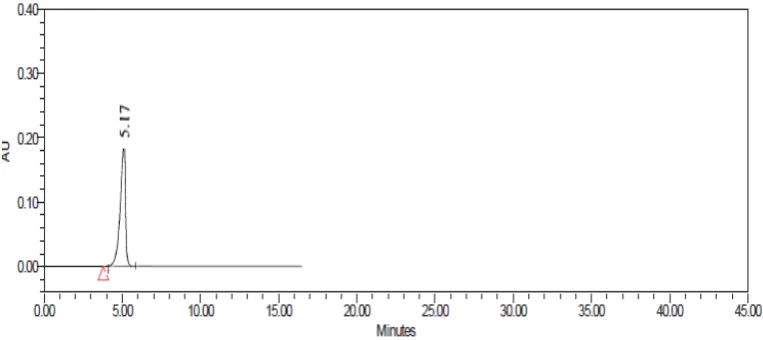
The stability of the Aciclovir ointment in oxidation condition was examined. It was observed that around 2-4% degradation was taken place on exposure to 20 %
H2O2 for 12 hrs. The chromatogram of oxidation product
was compared with the formulation, standard
chromatogram and blank H2O2. No degradation product
peaks were observed. The 20 % H2O2 peak time was
observed at RT 10.27 and in the peak height and area, no significant decrease with time was observed as presented in figure 4. The results showed that the drug was highly stable to the oxidative conditions.
Fig. 4: Chromatogram of Aciclovir under oxidation condition by RP-HPLC method
Wet heat (Hydrolysis)
The stability of the Aciclovir ointment in neutral condition was examined, 1–3 % drug degradation was observed after 12 hrs of the incubation at 35ºC. The chromatogram of wet heat degraded product was
compared with the formulation and standard chromatogram as presented in figure 5. In the wet degraded chromatogram Aciclovir peak area, the height was decreased and no degradation peak was observed.
Fig. 5: Chromatogram of Aciclovir under wet heat condition by RP-HPLC method
ISSN (Online) 2249-6084 (Print) 2250-1029 www.eijppr.com
17 The chromatogram for Aciclovir in dry heat showed that
the drug was slightly unstable as compared to acid, base and wet degradation. Around 3-7% drug degradation was observed. The chromatogram of dry heat degraded product was compared with the formulation and the
standard chromatogram. In the dry heat degraded chromatogram, the drug was decomposed into minor degradation product. The result showed no significant decrease in the peak height and peak area with time as presented in figure 6.
Fig. 6: Chromatogram of Aciclovir under dry heat condition by RP-HPLC method
Photo stability (Sun light)
The chromatogram of Aciclovir under photo stability study was found to be unstable after the exposure of the drug to direct sunlight for 4 hours. Almost 10-20% of the drug was degraded in 4 hours. One minor drug
degradation peak was observed at 12.5 minutes, and also there was a significant increase in the drug peak height, and a decrease in peak area was observed as presented in figure 7.
Fig. 7: Chromatogram of Aciclovir under Photo stability condition by RP-HPLC method
CONCLUSION
The force degradation study was performed according to the guidelines of the International Conference on Harmonization (ICH). The developed RP-HPLC method showed accuracy, sensitivity and stability. The developed method was rapid and reproducible. The developed
method can be used for the routine analysis of Aciclovir,
ointment formulations.
ACKNOWLEDGEMENT
The authors have been highly thankful to Jazan University for providing facilities needed for this research
work.
REFERENCES
ISSN (Online) 2249-6084 (Print) 2250-1029 www.eijppr.com
18
[2] Zovirax (acyclovir)., 2014. dosing, indications,
interactions, adverse effects and more. Medscape Reference WebMD.
[3] Acyclovir., 2015. The American Society of Health
Pharmacists.
[4] Prescribing medicines in pregnancy database,
Australian Government., 2014. Retrieved 22 April 2014.
[5] Swart, K.J., Hundt H.K.L., and Groenewald, A.M.,
1994. Automated high-performance liquid chromatographic method for the determination of acyclovir in plasma. Journal of Chromatography A, 663(1): 65 – 69.
[6] Poirier, J.M., Radembino, N., and Jaillon, P., 1999.
Determination of acyclovir in plasma by solid extraction and column liquid chromatography. Therapeutic Drug Monitoring, 21(1): 129 -133.
[7] Zeng, L., Nath, C.E., Shaw, P.J.; Earl, J.W., and
McLachlan, A.J. 2008. HPLC-fluorescence assay
for acyclovir in children. Biomedical Chromatography, 22(8): 879 – 887.
[8] Teshima, D., Otsubo, K., Yoshida, T., Itoh, Y., and
Oishi, R., 2003. A simple and simultaneous determination of acyclovir and ganciclovir in human plasma by high performance liquid chromatography. Biomedical Chromatography, 17(8): 500 –503.
[9] Tzanavaras, P.D., and Themelis, D.G., 2007.
High-throughput HPLC assay of acyclovir and its major impurity guanine using a monolithic column and a flow gradient approach. Journal of Pharmaceutical and Biomedical Analysis, 43(4): 1526 –1530.
[10]Manoharan, G., 2018. High-pressure liquid