Study of Various Enhancement Techniques
1
Palak Khandelwal,
2Gagandeep Kaur
1,2Dept. of ECE, Manav Rachna International University, Faridabad, Haryana, India
Abstract
As technology is evolving at a high rate in every field and in image processing as well. With the increasing need of high definition images, new techniques are emerging in image processing and for that image enhancement is playing a pivotal role. Images suffer from blurring, noise, poor contrast, poor brightness etc. which degrades the quality of the image so in order to overcome all this, image enhancement is used. Out of numerous complex techniques selection is done on the basis of area where processed image is required. It uses a ‘transform’ to improve the visual quality, contrast, brightness of an image. In medical, satellite, video conferencing, aerial images, real life photographs etc. improvement of the contrast of an image is demanded, soit can provide high quality images in different fields. A lot of work has been done by researchers in this very fieldMany methods and algorithms has been designed for the same. This paper provides an overview of various techniques used for image enhancement which includes spatial and frequency domain methods. This paper also involves other techniques falling under the category of spatial and frequency domain and compare their results as well.
Keywords
Image Enhancement, Spatial, Frequency, Histogram Processing, Contrast Enhancement.
I. Introduction
An image is better or not, this perception may vary from person to person. For one, a bright image is best but for other it may be not that good so there is no hard and fast rule to check quality of an image especially by its visual appearances. But the problem of noise which get added to an image while capturing or transferring it from device to device, may be reduced to a large extent. Moreover, contrast adjustment is also a way which proves to be a significant tool to improve the quality of an image. So image enhancement using different algorithms and techniques make an image subjectively looks better than the original image .In speech recognition , medical image processing , HDTV , video processing applications by altering the intensity pixel of an image , image enhancement can be improved .
The work done by various scientists and researchers have been discussed as M.knee et al 2015[1] , proposed an inversion technique which takes the negative of an image i.e. image inversion in which black pixels are mapped to white pixels and white to black pixels but the results were not satisfactory. Moreover, MSE is very high and PSNR is low. Hence, there was a need of a better technique.
S. Asadi et al 2011[2], proposed a gamma correction technique in which image is divided into overlapping window and gamma value is estimated. This method was quite good to increase the brightness of the image but both MSE and PSNR value were not good as former being very high and latter being very low. So, this was also not optimum hence need for much better technique was felt.
Min goo boon et al 2009[3], has used a sharp filter to achieve image enhancement. The method was successful enough to get low MSE and high PSNR value but side regions were not clearly
visible. This encouraged further research.
H. Hassan et al 2011 [4], has also used gamma adjustment technique and obtained satisfactory results in terms of MSE and PSNR values but again fail to achieve clear visibility of side regions.
Bhattacharya et al 2014[5], devised that contrast enhancement plays a pivotal role in this field but global enhancement lead to loss of information that’s why a technique was introduced to carry out localized image enhancement named as singular value decomposition, SVD.
Mohammed F.K[6] et al 2012, has proposed multi-histogram and by-histogram method in which one was preserving brightness at the cost of deteriorating natural display and the other was preserving natural display but was not able to maintain the intensity or contrast. So, input image was divided into different sectors thus reducing the decomposition error of input histogram.
II. Image Enhancement Types:
As image processing is an important field, and there is always a room for improvement in lieu of achieving better efficiency and more clearer, brighter and contrasted image [6]. Out of various techniques available, majorly classification is made into:
Spatial domain methods 1.
Frequency domain methods 2.
Fig. 1: Types of Enhancement Technique [6]
III. Spatial Domain Methods
It’s a technique whose implementation leads to individually altering the pixel values [14]. It alters the grey levels of pixels and thus improving the overall contrast of an image. These methods directly operate the pixel values. So these approaches can be classified into: intensity transformation function (point processing technique), spatial filter operations.
A. Point Processing Methods:
Intensity transformation is a technique which operate on single pixel alone where intensity value of processed pixels depends upon the original pixel value [19]. Formula for transformation
is given as
g(x,y) = T{f(x,y)}
1. Image Negative
Invert the pixels of an image i.e take negative of all the pixels that comprise an image [1]. For eg. in an image of size M*N, each pixel is subtracted from 255 as
In a normalized grey scale, This method is helpful majorly in enhancing grey and white details embedded in darker regions of an image. Thus, enhancing every details of an image.
Fig. 2: Original and Its Inverted Image
In an image with pixel having intensity level in between [0 L-1] then the intensity transformation would be given as s = L-1-r.
Fig. 3: Image Inversion Graph [1]
2. Image thresholding
It can be achieved as a normal threshold as either 0’s or 1’s so g(x,y) is often termed as binary image [7]. This technique is used to enhance required image from background for image segmentation.A global threshold is calculated, pixel values less than that are mapped to 0 and pixel values greater than that are set to 1. This enhances the image to a great extent.
To make this technique more efficient and to avoid loss of information, local threshold can also be set.
Fig. 4: Image Thresholding Graph [7]
3. Power Law Transformation
It’s a transformation technique which is used to enhance brighter and darker regions of an image [2]. It is stated as s =c r γ where c and γ are positive constants. Possible transformations on varying γ with c=1.
Fig. 5. γth power and γth root curves for c=1 [2]
This transformation technique can be classified as log and inverse log transformation as per the value of γ. So, here is a short review of these techniques.
Log transformation:It is one used to convert low range values to a wider range i.e expanding brighter values and compressing darker pixels [2]. Equation for log transformation is achieved as S= C log (1+ |r|)
Where C is a scaling factor, ‘r’ is input image and S is output image obtained after log transformation of r. Here, low range grey levels are mapped to wider range of grey levels i.e. expansion of brighter values and compression of darker values.
(i). Inverse log Transformation
As suggested by the name it is the inverse of above mentioned technique. Here, expansion is done for darker grey values while compression for the brighter ones. These techniques are useful for an image with extremely large and small range. By using fourier transform, it brings out the details of the image and thereby increases the detail of low intensity values.
Fig. 6: Original Image and it Transformed Image [4]
B. Spatial Filters
mask where pixels altered by non-linear filters are linearly not equal as original pixel values, that’s why they are termed as non-linear filters.
C. Piecewise Linear Transformation
Here pixel alteration is done through a random user defined transformation [10]. Stretching and contrasting is performed by changing original pixel values to new values hence making it more clearer, brighter and contrast adjusted.
Like here, different values of (r1,s1) and (r2,s2) produce transfor-mation which enhances the input image to new improved image.
Fig. 7: Original Image and Its Stretched Image [10]
Types of piece wise linear transformation
Contrast stretching
•
Intensity level slicing •
Bit plane slicing •
A. Contrast Stretching
This image enhancement technique improves the visual quality of an image [10] .The aim of contrast enhancement is to locally adjust pixel values and thus revealing the details of an image. By stretching the grey levels of an image to desired level using a transformation, a superior quality image can be obtained .If a, b are min and max values of f(x,y) and c,d are min and max values of g(x,y) , the scaling to obtain normalization is acheived as
S = (r-c)(b-a)/ d-c +a.
This contrast enhancement technique can be subdivided as direct methods and indirect methods. In direct method, technique directly improves the quality of an image by defining a contrast measure. Whereas in indirect methods, no contrast term is measured, it improves the quality using underutilized areas.
B. Intensity Grey Level Slicing
Thisis a technique which performs segmentation of certain grey levels from remaining image [15]. This feature is useful if, in an image different grey levels are being used for describing different features of an image. So, extraction of certain pixel improves the contrast of an image thus making it clear and better.
C. Bit Plane Slicing
It improves quality by altering values of specific bits [15]. Such operations are performed either on pixel or its neighbours. So it is called neighbourhood operations.
D. Histogram Processing
It’s a technique used in image enhancement whose result can also be used in image segmentation and compression like processing activities [6]. It’s a frequency plot having grey levels in between 0 to 255 . It’s an initial step , for better results, histogram equalization and histogram specification (matching ) are two methods that can
be used for modification . It gives us the value of pixels , inform us about their distribution . It is given as :
h (rk) = nk/N
Where rk are intensity level and nk = number of pixels in image with intensity respectively rk .
Below mentioned techniques are the various ways of obtaining histogram processed image.
1. Histogram Equalization
It’s a technique to improve visual appearance of an image [8]. Let say if an image is predominantly dark. Then its histogram will be towards lower grey scale and all the image is compressed into dark end . So we need to stretch out image at darker end with more uniformly distributed histogram to make image more clearer. It helps to distribute histogram over the whole grey level range of 0- 255. It adjusts the contrast for human perception as well as for image analysis. Based on different spacifications , new images can be obtained through this technique . It’s a global technique but is quiet easy and simple, for each new pixel, k is calculated. Main aim of histogram equalization is to find transform for input image f as T(f), to obtain equalized histogram .
2. Histogram Matching
As known, above mentioned technique was a global technique, so in order to obtain a more specified image, specific technique is there which is termed as histogram matching [8] . A specified transform which is not global,produces more efficient results. Steps involved to calculate this transform are:
First, find histogram Pr(r) of input image and calculate its 1.
transformation .
Through specified P2(r) of output image , a transform function 2.
is calculated .
Perform equalization in input image and have output image, 3.
for each pixel perform inverse mapping to have output pixel.
It matches grey scale distribution of one image to distribution of another image.
3. Local Enhancement
Even global histogram technique like histogram equalization and histogram matching were successful enough to a great extent but definitely the results could be far better [16].If a technique can define some image specific technique so here is local enhancement , a mask of shape as square , rectangle etc move over image from centre to other pixels . For each neighourhood, histogram is calculated, whether its histogram equalization or specification.
4. Histogram Statistics
An image having discrete intensities in the range of [0 L-1]and normalized histogram as p(ri), pdf is estimated [16].There can be global mean and variance for entire image as well as local meanand variance can also be calculated for sub-pixels and new image can be obtained
5. Gray Scale Transformation
It’s a technique that shifts the contrast of an image to enhance its visual quality [17].By adjusting the gray level and dynamic range of image, this transformation can be achieved.
6. Morphological Operators
Different operators are there, depending upon their way of extracting details from an image [19]. These operators can be classified as:
Top Hat Transformation •
Bottom hat Transformation •
(i). Top Hat Transformation
It is applied to extract minute details from image. It is broadly classified as
White top hat transformation : It gives the value which is •
the subtraction result of input image and it’s opening by structuring element
Black top hat transformation: It’s a sub result of closing by •
some structuring element and the input image.
Processing tasks like feature extraction, background equalization, image enhancement and else are performed using these technique.
Tw(I) = I – I°b , Where ‘° ’ is opening operator Tb(I) = I∙b – I , Where ‘∙’ is closing operator
(ii). Bottom Hat Transformation
It is used for images having dark objects over a light background. Input image is subtracted from morphological closed input .It is like black top hat transformation.
7. Unsharp Masking
In this enhancement is performed by adding a fraction of high pass filtered image to the original one [5]. Input output relation can be stated as :
X = x + YZ
Where X = output image x = input image
Y = fraction of high pass filtered Z = Image
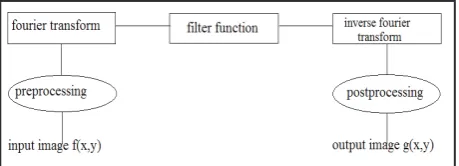
Image enhancement modifies the contrast and brightness of the pixel. In the frequency domain, pixel value is modified as per applied transfer function.In this, filtering is not rare to use. So this enhancement technique is based on DFT and is classified into low and high pass filtering.
Although simple, easy and efficient but it has a major drawback of enhancing noise as well. Moreover, enhancement of sharp transitions lead to excessive overshoot on sharp edges.
8. Image Pixel Interdependancy Linear Perceptron Network (IPILN)
It uses gaussian filter, curvelet transform and perceptron network [18]. This technique is composed on 3 steps:
(i). Image Filteration: It extracts a row image from input image via gaussian filter.
(ii). Image Transformation: It converts image content from one domain to another without any loss of information. Here, to alter the content of a row image, we are using multi resolution (multi directional) curvelet transform.
(iii). Perceptron Network: Using perceptron network, adjustment of weight is done. For this adjustment of weight, learning factor is also there whose value range between 0 to 1.
Table 1: A Brief survey of various spatial domain techniques
IV. Frequency Domain Technique
Various transformations like fourier transforms, Discrete Transforms (DWT) and Discrete Cosine Transforms (DCT) directly operate on transform coefficient of an image [15]. It directly performs mathematical operations on image pixels. Merit of frequency domain technique is low computaion involved,ease of viewing and frequency manipulation, availability of domain characteristic. But the points which overshadow all these merits is it’s being laborious and can’t work on all subdivisions simultaneously.
Image enhancement modifies the contrast and brightness of the pixel. In the frequency domain, pixel value is modified as per applied transfer function. In this, filtering is not rare to use, therefore this enhancement technique is based on DFT and is classified into low and high pass filtering.
Fig. 8: Frequency Domain Enhancement
V. Applications
Because of all above mentioned techniques ,image enhancement has achieved a great height and has gained paramount applications in numerous fields like CCTV footage , video conferencing , satellites and medical imaging etc .In the field of real time enhancement , a revolution is brought about by imparting good quality to read small print , face recognition etc , In the field of education , it prove useful for scanning .Medical uses it for reducing noise and sharpening to improve visual quality .In crime detection it’s a great need to have quality images as each and every minute detail has paramount importance as it can prove very useful for identification, contrast adjustment , sharpening , brightening are things which make images more vivid.
VI. Conclusion
spatial and frequency domain technique and these techniques are compared on the basis of the merits and demerits of these algorithms, their results , their future improvement . Output images are obviously better than the input image. Huge amount of work has already been done , still research is on , recent developments has endeavored more better results and had opened room for future development .
References
[1] Knee Manish, “A single-ended picture quality measure for MPEG-2,” in Proc. Int. Broad., Convention (IBC 2000), Vol. 34,Sep. 2015, pp. 95–100.
[2] AmiriS. Asadi,“Image quality enhancement using pixel-wise gamma correction via svm classifier”, IJE Transactions B: Applications Vol. 24, No. 4, December 2011, pp. 45-52. [3] Goo Choi Min, Jung Hoon,“Image Quality Assessment Using
Blur & Noise” World Academy of Science Engineering & Vol. 28, No. 12, pp. 56-63, January 2009, pp. 56-63. [4] Hassanpour H., S. Asadi Amiri,“Image quality enhancement
using pixel-wise gamma correction via svm classifier”, Vol. 24, No. 4, IJE, December 2011, pp. 67-72.
[5] Bhattacharya Saumik, Sumana Gupta, Subramanian Venkatesh K.,“Localized image enhancement”, In Communications (NCC), 2014 Twentieth National Conference, Vol. 5, pp. 1-6, IEEE, 2014, pp. 1-6.
[6] Khan Farhan, Ekram, Z. A. Abbasi,“Multi segment histogram equalization for brightness preserving contrast enhancement”, In Advances in Computer Science, Engineering & Applications, Springer Berlin Heidelberg, Vol. 11, 2015, pp. 193-202.
[7] Turaga D.S, Y. Chen, and J. Caviedes,“PSNR estimation for compressed pictures,” in Signal Process. Image Communication conference, Vol. 19, 2004, pp. 173–184. [8] Maini Raman, Aggarwal Himanshu,“A Comprehensive
Review of Image Enhancement Techniques”, In journal of computing, Vol. 2, March 2010, pp. 2151-9617.
[9] Chopra Henan, Wu, Yang Guang, XuZhonglin, Li Dejun, Yuan Yuwei,“Remote sensing image enhancement method based on multi-scale Retinex”, In Information Technology, International Conference on Computer Engineering and Management Sciences (ICM), Vol. 3, 2011, pp. 15-18. IEEE.
[10] Sharma, Juliastuti, E., L. Epsilawati,“Image contrast enhancement for film-based dental panoramic radiography”, In System Engineering and Technology (ICSET), 2012 International Conference, Vol. 8, 2012, pp. 1-5, IEEE. [11] Khan Mohd;Manish, Vohra; Rana K.;Vineet kumar,“A virtual
instrumentation based scheme for automatic gas burner drilling mechanism using lab view”, Journal of Information Systems and Communication, Vol. 3, Issue 1, 2012, pp. 35-37.
[12] Khan Hasikin, Khairunnisa, Ashidi Mat Isa,“Enhancement of the low contrast image using fuzzy set theory”, Computer Modelling and Simulation (UKSim), UKSim 14th International Conference, Vol.7, 2012, pp. 371-376. IEEE. [13] Wang, Lung-Jen, Ya-Chun Huang,“Combined opportunity
cost and image classification for non-linear image enhancement”. Complex, Intelligent and Software Intensive Systems (CISIS), 2012 Sixth International Conference, Vol. 98, 2012, pp. 135-140. IEEE.
[14] Kaushik Pooja, Yuvraj Sharma,“Comparison of Different Image Enhancement Techniques Based Upon Psnr & Mse”,
International Journal of Applied Engineering Research, Vol. 7, No. 11, 2012, pp. 28-32.
[15] Khandelwal, Rati,“Various Image Enhancement Techniques- A Critical Review”, In International Journal of Advanced Research in Computer and Communication Engineering Vol. 2, IEEE, March 2013, pp. 45-50.
[16] Grewal Raju, G., Madhu S. Nair,“A fast and efficient color image enhancement method based on fuzzy-logic and histogram”. AEU-International Journal of electronics and communications, Vol. 68, No. 3 , pp. 237-243, IEEE, 2014.
[17] Varnan, C.S; Jagan, A.; Jaspreet, Rao, D.S,“Image Quality Assessment Techniques”. International journal science & Technology, Vol. 2, No. 3, Sep. 2015, pp. 2108-2113, IEEE.
[18] Sawant, H.K; Deore, Mahentra,“A Comprehensive Review of Image Enhancement Techniques”. International Journal of Computer Technology and Electronics Engineering (IJCTEE) Vol. 1, Issue 2, 2015, pp. 39.
[19] Karunya, Praiseline,“Image Enhancement Techniques: A Review”. International Journal of Research in Engineering and Technology, Vol. 12, 2016, pp. 567- 572.
Palak Khandelwal is currently pursuing her M.Tech degree in electronics and communication from Manav Rachna International University, Faridabad, Haryana, India. She has completed her B.Tech in 2013 in Electronics & Communi-cation Engineering, from M.D.U, Rohtak. Her research interest includes Image Processing.
![Fig. 1: Types of Enhancement Technique [6]](https://thumb-us.123doks.com/thumbv2/123dok_us/1337698.1642321/1.595.303.561.397.526/fig-types-of-enhancement-technique.webp)
![Fig. 6: Original Image and it Transformed Image [4]](https://thumb-us.123doks.com/thumbv2/123dok_us/1337698.1642321/2.595.303.561.109.322/fig-original-image-and-it-transformed-image.webp)
![Fig. 7: Original Image and Its Stretched Image [10]](https://thumb-us.123doks.com/thumbv2/123dok_us/1337698.1642321/3.595.38.294.196.285/fig-original-image-and-its-stretched-image.webp)