VOLUME 7 | ISSUE 1 | 2012 | 275
Validity, reliability and exploratory factor analysis
of the dropout scale in sport centres
ALBERTO NUVIALA NUVIALA1 , MARÍA ROSARIO TEVA VILLÉN1, ALBERTO GRAO CRUCES1
,
RAQUEL PÉREZ ORDÁS1, JERÓNIMO GARCÍA FERNÁNDEZ2, ROMÁN NUVIALA NUVIALA11Departamento de Deporte, Universidad Pablo de Olavide, Spain
2Departamento de Educación Física y Deporte, Universidad de Sevilla, Spain
ABSTRACT
Nuviala A, Teva-Villén MR, Grao-Cruces A, Pérez-Ordás R, García-Fernández J, Nuviala R. Validity, reliability and exploratory factor analysis of the dropout scale in sport centres. J. Hum. Sport Exerc. Vol. 7, No. 1, pp. 275-286, 2012. Sport dropout is a complex problem, in which multiple reasons influence. One lacks an instrument of easy application for the sport centres, which there contributes relevant information about dropout motives, at the time that it expires with the properties that any measurement’s instrument must assemble. The aims of this work were to design, to validate and to verify the reliability of a useful instrument as way of evaluation of the motives of the dropout of the organized physical activity that provide the different sport centres. So, an inventory was made, a statistical analysis of the items was also made, so as an exploratory factor analysis and his validation and his reliability were analyzed. In conclusion, it can be stated that we have a valid and reliable tool to study the phenomenon of dropout in sport centres, which depends on five factors: leisure, enjoyment, satisfaction, practice and economic. The tool has 22 items in total, which makes its application easy. Key words: SPORT SERVICES, SPORT ORGANIZATIONS, DROPOUT MOTIVES, ABANDONMENT, QUESTIONNAIRE.
1 Corresponding author. Facultad del Deporte. Universidad Pablo de Olavide. Carretera de Utrera km 1. 41013 - Sevilla. Spain.
Email: [email protected] Phone: +34954977587
Submitted for publication February 2012 Accepted for publication March 2012
JOURNAL OF HUMAN SPORT & EXERCISE ISSN 1988-5202 © Faculty of Education. University of Alicante
276 | 2012 | ISSUE 1 | VOLUME 7 © 2012 University of Alicante INTRODUCTION
Nowadays, the increase of physical inactivity has turned in one of major public health concerns in industrialized countries (Guthold et al., 2008). This problem has derived in a progressive deterioration of the population’s health in recent years (Huang et al., 2007). Years in which have continued to proliferate evidences of the relationship between the insufficient physical activity (PA) and different health risks. Cardiovascular diseases (Lavie & Milani, 2011), metabolic syndrome, diabetes type 2 and some types of cancers (Church, 2011) have recently been linked with the lack of PA.
Large sums of money have been invested in health policy to promote citizens’ PA (Limstrand & Rehrer,
2008). Variety of programs have been designed and implemented with this goal. However, the high dropout of these exercise programs indicates that promotion plans are not having success (Haase & Kinnafick,
2007). Dropout is the main concern of the physical and sports practice (Gonçalves et al., 2007). This problem has been approached, mainly, from the application of the motivation’s theoretical models to the field of the PA and sport (Almagro et al., 2010; Cervelló et al., 2007).
Motivational orientation does not only has relationship with the onset of PA practice but affects the adherence and the dropout of PA (Deci & Ryan, 2000). Self-determination theory (Deci & Ryan, 1985,
2000) argues that individuals’ perceptions of behaviours are associated with different types of motivation, influenced by social environmental factors. Based on this theory, recent studies have shown that intrinsic motivation (which refers to engaging in an activity for the pleasure of the process) is a key factor to maintain exercise behaviour (Haase & Kinnafick, 2007; Jõesaar & Hein, 2011a; Jõesaar et al., 2011b) and predict the intention to be physically active in the future (Almagro et al., 2010). Intrinsically motivated behaviour has the highest self-determination, however, perceptions of not meeting the psychological needs for autonomy, competence and relatedness will facilitate non self-determined forms of motivation and amotivation which, in turn, may lead to dropping out of PA and sport (Jõesaar & Hein, 2011a).
Narrowly tied to self-determination theory is the achievement goal theory (Jõesaar et al., 2011b; Nicholls,
1989). Achievement goal theory postulates that individuals in achievement settings may interpret their success with respect to two orientations, learning or task orientation and performance or ego orientation. Individuals exhibiting a predominant task orientation tend to focus on improving performance relative to their own past performance rather than comparison with another. Individuals with a predominant ego orientation tend to judge their ability by using social comparison as a reference, so that the person feels successful when he shows more skills than others. The literature has pointed that task-oriented individuals tend to be more persistent under failure and intrinsically motivated. In contrast, an ego orientation has proved an indicator of sport dropout (Cervelló et al., 2007; Jõesaar et al., 2011b).
VOLUME 7 | ISSUE 1 | 2012 | 277 The barrier that supposes for the PA and sport practice the lack of time has been the dropout’s motive most argued in the previous studies. Motive invoked by more than the half of Havana’s citizens older than 15 years who had dropped out the practice in the study of Ruiz et al. (2007). Main reason for dropout in sport college (Gómez-López et al., 2011) and high school students (Macarro et al., 2010). Lack of time that shares importance with study when the motives of dropout are analyzed between the students of minor age (Bara & Guillén, 2008; Palou et al., 2005). Another of the main motives of dropout is the preference of other leisure activities, not physical-sports (Bara & Guillén, 2008; Macarro et al., 2010; Palou et al., 2005; Ruiz et al., 2007). Laziness and unwillingness have also been identified as some of the most pervasive motives of dropout in the physical-sports practice (Macarro et al., 2010; Ruiz et al., 2007).
Close to these main motives, there are others of diverse nature, as for example the health reasons (Macarro et al., 2007; Ruiz et al., 2007), that increase with individual’s age (Ruiz et al., 2007). Motives related to dissatisfaction with the practice’s development, with the different resources that surround the practice (Evans, 2008; Macarro et al., 2010; Ruiz et al., 2007) or aspects linked with the economic cost of the physical-sports practice (Ruiz et al., 2007), together with the absence of enjoyment (Evans, 2008; Macarro et al., 2010; Palou et al., 2005) and the influence of relatives, friends or pair (Macarro et al., 2010; Ruiz et al., 2007) are reasons that have to be had into account.
The knowledge of the motives that lead to the dropout is fundamental to be able to improve the management of a complex problem as the loyalty of the user in a sport centre (Martínez & Martínez, 2009). The knowledge of the origin or cause of the users’ experiences is essential in implementing any kind of service that seeks to improve the efficiency and effectiveness of its management and gain the loyalty of users (Martínez & Martínez, 2008). Users are increasingly more demanding (Martin & O’Neill, 2010), and as such their loyalty has become one of the most important achievements for any organisation (Tsitskari et al., 2006). So it is surprising that studies in the last years have appeared interested in knowing the motivation of the sport centres’ user (Martínez & Martínez, 2009; Muyor et al., 2009).
Nevertheless, the dropout studies are scanty in the specific field of the sport centres. Most of the results of dropout work are difficult to generalize (Cervelló et al., 2007). The majority of these studies have centred on studying the dropout of the competitive PA (Almagro et al., 2010; Jõesaar & Hein, 2011a). And the greatest part of the dropout’s works has attended exclusively to adolescence (Cervelló et al., 2007; Jõesaar et al.,
2011b). For what it turns out necessary to continue investigating on the dropout’s motives, with a view to
adopt measures in order to reduce this problem (Macarro et al., 2010).
Following a review of the instruments contemplated in the bibliography to assess the dropout’s motives, it is observed that the questionnaires that attend to this end are few, of which we do not know any exclusively designed to evaluate the dropout motives, unless they are open items (Bara & Guillén, 2008). The major part of the questionnaires related the foresaid purpose forms part of questionnaires of major extension (Gómez-López et al., 2011; Macarro et al., 2010), which includes in most cases together with items on the physical-sport practice’s reasons and of never having practised it (Gómez-López et al., 2011; Palou et al.,
278 | 2012 | ISSUE 1 | VOLUME 7 © 2012 University of Alicante One lacks therefore an instrument of easy application for the sport centres, which there contributes relevant information about dropout motives, at the time that it expires with the properties that any measurement’s instrument must assemble. Base to it, the aims of this work were to design, to validate and to verify the reliability of a useful instrument as way of evaluation of the motives of the dropout of the organized PA that provide the different sport centres.
MATERIAL AND METHODS
Participants
The sample consisted of 547 subjects aged between 15 and 70 (M= 30.62; SD= 9.98), who had quit training in a sport centre in the Comunidad Autónoma de Andalucía (Spain). Around 56% were men and 44% were women, and there were no significant statistical differences derived from age (p= 0.588). The most common training frequency per week for people who had quit, was 2-3 times per week (59.2%), the average time of training was between 60 and 90 minutes for 45% of people sampled. Finally, average resident time in the centre had been 13.03 months (SD=16.51)
Measures
In order to make the dropout rating scale in sport centres, it was necessary to decide what dimensions should be included or what dimensions were relevant to know the reasons of dropout from sport centres. Three different stages were followed:
1. Bibliographic research about dropout in sport practice.
2. Establishment of a discussion group composed of sport business professionals and experts in the development of research tools.
3. Making of a pilot research with 50 customers of sport centers who had quit sport training.
The resulting rating scale was composed of 7 factors and 51 items that could lead to dropout in sport training: (1) Enjoyment, with 6 items referred to the joy obtained from carrying out a physical activity; (2) Physical Appearance, composed of 5 items related to the physical look and its perception; (3) Social, 5 items that research into social relationships; (4) Leisure time, integrated by 10 items related to spending spare time by means of sport practice; (5) Fitness, composed of 6 items that deal with health and well-being; (6) Quality perception and satisfaction, integrated by 15 items related to material and human resources of the organization; (7) Economic, 4 items referred to economical questions that affect sport practice in the organization. Answers ranged between 1 (totally disagree) and 5 (totally agree).
VOLUME 7 | ISSUE 1 | 2012 | 279
Procedures
The fieldwork was carried out using a questionnaire managed by a group of survey takers who were previously trained. Participants were asked for their collaboration and they were also encouraged to ask any question they may had related to the items. Time taken in making the survey was around 10 minutes. Before proceeding to the data collection, managers of the organization where the survey was taken were asked for permission. In the same way, all survey takers agreed to participate voluntary in the research.
Analysis
The analysis of psychometrics properties of the scale was made using the software SPSS.20. First, the analysis of the items was made, and to do so they following tests were carried out: mean standard deviation, asymmetry, kurtosis and adjusted correlation coefficient item-total. Next, an exploratory factor analysis was made, as well as some different reliability tests. Later, the divergent validity was obtained by a calculation of correlations between the factors resulted from the exploratory factor analysis.
RESULTS
Statistical analysis of the items
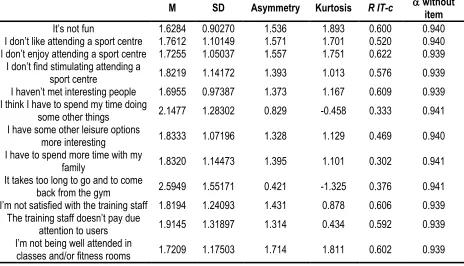
Table 1 shows metric values of the selected items, keep in mind that the scale was initially composed of 51 items in order to make the remaining tests. As it can be checked, the 22 items fulfil the necessary criteria to proceed with the analysis, guaranteeing the capacity to show the differences between the individuals, and maximizing the test variance at the same time. The reliability of the dropout scale of sport centers was evaluated with Conbrach’s alpha resulting a value of 0.941.
Table 1. Mean (M), standard deviation (SD), Asymmetry, Kurtosis, correlation item-total (R IT-c) and alpha if case any item is eliminated (α without item).
M SD Asymmetry Kurtosis R IT-c α without item
It’s not fun 1.6284 0.90270 1.536 1.893 0.600 0.940
I don’t like attending a sport centre 1.7612 1.10149 1.571 1.701 0.520 0.940 I don’t enjoy attending a sport centre 1.7255 1.05037 1.557 1.751 0.622 0.939
I don’t find stimulating attending a
sport centre 1.8219 1.14172 1.393 1.013 0.576 0.939
I haven’t met interesting people 1.6955 0.97387 1.373 1.167 0.609 0.939 I think I have to spend my time doing
some other things 2.1477 1.28302 0.829 -0.458 0.333 0.941
I have some other leisure options
more interesting 1.8333 1.07196 1.328 1.129 0.469 0.940
I have to spend more time with my
family 1.8320 1.14473 1.395 1.101 0.302 0.941
It takes too long to go and to come
back from the gym 2.5949 1.55171 0.421 -1.325 0.376 0.941
I’m not satisfied with the training staff 1.8194 1.24093 1.431 0.878 0.606 0.939 The training staff doesn’t pay due
attention to users 1.9145 1.31897 1.314 0.434 0.592 0.939
I’m not being well attended in
280 | 2012 | ISSUE 1 | VOLUME 7 © 2012 University of Alicante M SD Asymmetry Kurtosis R IT-c α without item I’m not satisfied with
reception/commercial staff 2.0783 1.43409 1.060 -0.338 0.400 0.941 Temperature is not adequate 1.8032 1.16174 1.391 0.906 0.512 0.940
There are not enough sport
equipment 1.9683 1.32848 1.200 0.159 0.549 0.940
The strength and cardio equipment
are not enough 1.8680 1.26561 1.357 0.630 0.597 0.939
I think price is too high 2.7358 1.51808 0.295 -1.373 0.402 0.941 I found a more economical gym 2.0812 1.41958 1.030 -.369 0.429 0.940 I think membership fees are very
expensive 2.7456 1.56299 0.286 -1.426 0.393 0.941
I can’t do the activity I like 2.0973 1.42461 1.042 -.355 0.457 0.940
It’s very crowded 2.5525 1.47829 0.451 -1.208 0.535 0.940
I’m not satisfied with the service 2.1615 1.42492 1.008 -0.382 0.524 0.940
Internal structure analysis
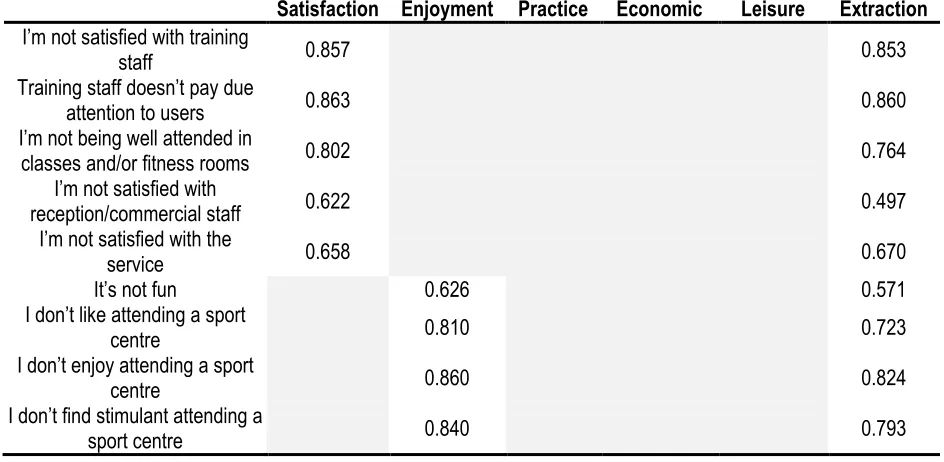
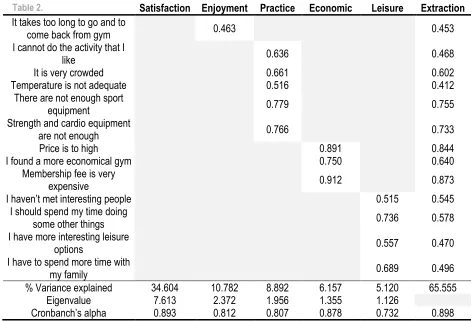
In order to know the factorial structure of the dropout scale of sport centres, an exploratory factor analysis was made about the 22 items resulted from the statistical analysis of the items, using the method of extraction of main components and subsequent Varimax rotation. Before making the analysis, the mean of sampling adequacy of Kaiser-Meyer-Olkin (KMO) and Bartlett’s sphericity test were calculated. The index KMO showed a value of 0.874 and Bartlett’s test was statistically significant (χ2231=5961.7560; p<0.001), what lead to the conclusion that the use of factorial analysis was appropriate. The resulting dimensional structure was composed of five factors (satisfaction, enjoyment, practice, economic and leisure and social relationships) that together explain 65.55% of the variance (Table 2).
Table 2. Factor structure rotated, communality, eigenvalues, Cronbach’s alpha and percentage of variance explained by each factor.
Satisfaction Enjoyment Practice Economic Leisure Extraction
I’m not satisfied with training
staff 0.857 0.853
Training staff doesn’t pay due
attention to users 0.863 0.860
I’m not being well attended in
classes and/or fitness rooms 0.802 0.764
I’m not satisfied with
reception/commercial staff 0.622 0.497
I’m not satisfied with the
service 0.658 0.670
It’s not fun 0.626 0.571
I don’t like attending a sport
centre 0.810 0.723
I don’t enjoy attending a sport
centre 0.860 0.824
I don’t find stimulant attending a
sport centre 0.840 0.793
VOLUME 7 | ISSUE 1 | 2012 | 281 Satisfaction Enjoyment Practice Economic Leisure Extraction
It takes too long to go and to
come back from gym 0.463 0.453
I cannot do the activity that I
like 0.636 0.468
It is very crowded 0.661 0.602
Temperature is not adequate 0.516 0.412
There are not enough sport
equipment 0.779 0.755
Strength and cardio equipment
are not enough 0.766 0.733
Price is to high 0.891 0.844
I found a more economical gym 0.750 0.640
Membership fee is very
expensive 0.912 0.873
I haven’t met interesting people 0.515 0.545
I should spend my time doing
some other things 0.736 0.578
I have more interesting leisure
options 0.557 0.470
I have to spend more time with
my family 0.689 0.496
% Variance explained 34.604 10.782 8.892 6.157 5.120 65.555
Eigenvalue 7.613 2.372 1.956 1.355 1.126
Cronbanch’s alpha 0.893 0.812 0.807 0.878 0.732 0.898
Reliability
The reliability of the resulting tool was measured with Cronbach’s alpha obtaining a value of 0.898. As a complement to this index of internal consistence other two indicators derived from the factorial analysis
were obtained: Carmine’s theta (Θ) (Carmines & Zeller, 1979) and Heise & Bohrnstedt’s Omega (ω) (1970). For the data we have been working with, Θ reaches a value of 0.90 and ω 0.96 (Table 3).
Table 3.Calculation made to obtain Carmine’s Theta (Θ) and Omega (ω).
𝜃 =𝑛 −𝑛 1�1−1∆�= 2221�1−7.6131 �= 0.90
𝜔= 1−𝑛𝑛 − ∑ ℎ+ (2∑ 𝑟2) = 1−22 + (136.814) = 0.9522−14.424
Divergent validity
In order to study the divergent validity a study of correlation between the five factors of the dropout scale in sport centers was made using the Pearson’s coefficient. The correlations between the factors that compose the rating scale have obtained positives and significant correlations between 0.640 and 0.202 (Table 4).
282 | 2012 | ISSUE 1 | VOLUME 7 © 2012 University of Alicante
Table 4. Correlation between factors and internal consistence (diagonal).
M SD Leisure Enjoyment Satisfaction Practise Economic
Leisure 1.8668 0.77159 (0.732) 0.505** 0.276** 0.324** 0.202**
Enjoyment 1.8840 0.86846 (0.812) 0.401** 0.417** 0.295**
Satisfaction 1.9049 1.08481 (0.893) 0.640** 0.357**
Practise 2.0193 0.98475 (0.807) 0.359**
Economic 2.4930 1.33922 (0.878)
Note. **. The correlation is significant at level 0.01 (bilateral).
DISCUSSION AND CONCLUSION
This problem has been approached, mainly, from the application of the motivation’s theoretical models to the field of the PA and sport (Almagro et al., 2010; Cervelló et al., 2007). Motivational orientation does not only has relationship with the onset of PA practice but affects the adherence and the dropout of PA (Deci & Ryan, 2000). However, a review by Biddle & Mutrie (2008) concluded that the predictive power of all these explanation theories is still modest. In fact, sport dropout is a complex problem, in which multiple reasons influence (Bara & Guillén, 2008; Ruiz et al., 2007). One lacks an instrument of easy application for the sport centres, which there contributes relevant information about dropout motives, at the time that it expires with the properties that any measurement’s instrument must assemble. Base to it, the aims of this work were to design, to validate and to verify the reliability of a useful instrument as way of evaluation of the motives of the dropout of the organized PA that provide the different sport centres.
After the qualitative design of the items was carried out, in accordance with the procedure described by Carretero-Dios & Pérez (2005), that had three different moments: checking of the literature, making of the group of experts for the design of the questionnaire and the pilot study, quantitative analysis of resulting items. This procedure’s aim is to guarantee that it has the capacity to show the differences existing between individuals. That is the reason why, the aim is to achieve a group of items that can maximize the variance of the test, selecting those with a high level of discrimination, high standard deviation and with average answering scores around the middle value of the rating scale (Bollen & Lon, 1993; Carretero-Dios & Pérez, 2005; Nunnally & Bernstein, 1995).
VOLUME 7 | ISSUE 1 | 2012 | 283 Once the selected items passed through initial filters, the next aim was to verify is these items were empirically put into groups, as theoretically had been predicted in the design of the questionnaire. At this moment, the target is exploring the internal structure of the rating scale, its dimensionality or the way items are put into groups (Elosua, 2003). The initial rating scale was made considering seven factors that could lead to the dropout in sport centres: enjoyment, appearance, social, leisure, fitness/health, quality perceived, satisfaction and economic. In order to verify the group, an exploratory factor analysis was used. That analysis provided us with the grouping of the variables that compose the questionnaire depending on mathematical criteria based on the correspondence between them, in order to be interpreted later. The exploratory factor analysis only group similar correlations, but this grouping may be due to more elements than those purely conceptual. There are several kinds of exploratory factor analysis that can be used, as several rotations too. With a number of items over 20, it is recommended the use of principal components analysis (PCA) (Cortina, 1993). The rotation procedure used was Varimax, despite of being recommended for studies where factors are not related. This procedure was chosen due to the theoretical interest of separating, if possible, the resulting factors, in spite of establishing the factors relation (Carretero-Dios & Pérez, 2007).
Before a correct application of exploratory factor analysis, it is necessary to verify that items must be found related between them, which means that the correlation matrix must allow finding relevant groups between variables. Therefore it is necessary, before the application of the analysis, to calculate some estimators that can ensure the adequate correlation matrix (Cortina, 1993), being the election tests those of Bartlett’s sphericity and KMO. The result of this test demonstrated the right choice of the process as its value was elevated.
The result of the statistical analysis of the items and the exploratory factor analysis, was the existence of five factors that explain the 65.55% of the variance, around which the following items were grouped: leisure, enjoyment, satisfaction, practice and economic. It attracted our attention the disappearance from the initial proposal of the questionnaire of two factors that a priori could be taken as dropout reasons in sport centers; these are the appearance and fitness/health. The items that composed these factors did not pass through initial filters, either because the asymmetry and kurtosis were very high, or because the correlation item-total was very low. It is possible that in addition to the low “quality” of the items, it might be necessary to mention the positive association of the adherence to physical practice for the reason of enjoyment and social, and negative for reasons of practice related to the appearance or health (Frederick-Recascino & Shuster-Schmidt, 2003; Ryan et al., 1997), results that strengthen those obtained in this work when not taking into account the reasons related to health and appearance, and maintain the factors enjoyment and social as factors that cause the dropout in sport centres.
It must be noticed the grouping made in the exploratory factor analysis of social and occupation of spare time reasons in only one factor, leisure. This result can be considered normal, given that the social relations and the occupation of that temporal gap occur in the same period of time: spare time. It is impossible to establish and/or maintain new social relationships if the place and the activity where we spend our leisure time does not satisfy users wishes.
284 | 2012 | ISSUE 1 | VOLUME 7 © 2012 University of Alicante value perceived, precedents of users fidelity in sport centers (Brady et al., 2005), opposite phenomenon to the one we try to provide with a researching tool.
The two other factors, enjoyment and economic, established in the qualitative design of the items, have been maintained after the two statistical analysis carried out which demonstrates the appropriateness of them in the research and the incidence they have in the phenomenon of dropout in sport centres.
The internal consistence of the rating scale was measured by Cronbanch’s alpha obtaining a value of 0.898. As a complement to this index of internal consistence two other indicators derived from factorial analysis were calculated: Carmines’ theta (Θ) (Carmines & Zeller, 1979) and Heise & Bohrnstedt’s Omega
(Ω) (1970), being both estimated coefficients higher than Cronbanch’s alpha. Results obtained confirm the
statement α < θ < Ω, what demonstrates a good reliability of the tool.
Next, the study of discriminated validity was made, and it was obtained by the correlations between the five factors of the rating scale by means of the Pearson’s coefficient. The correlations between them are positive, moderates and are significantly related, which demonstrates this kind of validity, given that results tell us they are similar but conceptually different (Bearden & Teel, 1983; McEvily & Zaheer, 1999). In the same way and following Luque’s criteria (2000), which states that none of the correlations is higher than 0.9; this corroborates the existence of this kind of validity. In conclusion, it can be stated that we have a valid and reliable tool to study the phenomenon of dropout in sport centres, which depends on five factors: leisure, enjoyment, satisfaction, practice and economic. The tool has 22 items in total, which makes its application easy.
REFERENCES
1. ALMAGRO BJ, SÁENZ-LÓPEZ P, MORENO JA. Prediction of sport adherence through the influence of autonomy-supportive coaching among Spanish adolescent athletes. Journal of Sports Science and Medicine. 2010; 9:8-14. Back to text]
2. ANNESI JJ, UNRUH JL. Effects of the coach approach® intervention on drop-out rates among adults initiating exercise programs at nine YMCAS over three years. Perceptual & Motor Skills.
2007; 104:459-466. doiBack to text]
3. BANDURA A. Self-efficacy: The exercise of control. New York: Freeman. 1997. [Back to text] 4. BARA MG, GUILLÉN F. Motivos do abandono no esporte competitivo: um estudo retrospectivo.
Revista Brasileira de Educação Física e Esporte. 2008; 22(4):293-300. Back to text] 5. BEARDEN WO, TEEL JE. Selected determinants of consumer satisfaction and complaint reports. J
Marketing. 1983; 20:21-28. doiBack to text]
6. BOLLEN KA, LONG JS. Testing structural equation models. Newbury Park, CA: Sage. 1993. [Back to text]
7. BRADY M, KNIGHT GA, CRONIN J, HULT G, KEILLOR B. Removing the Contextual Lens: A Multinational, Multi-Setting Comparison of Service Evaluation Models. Journal of Retailing. 2005;
81(3):215-230. doiBack to text]
8. CARMINES EG, ZELLER RA. Reability and Validity Assessment. Londres: Sage. 1979. [Back to text]
9. CARRETERO-DIOS H, PÉREZ C. Normas para el desarrollo y revisión de estudios instrumentales. International Journal of Clinical and Health Psychology. 2005; 5(3):521-551.
VOLUME 7 | ISSUE 1 | 2012 | 285 10. CARRETERO-DIOS H, PÉREZ C. Standards for the development and the review of instrumental
studies: Considerations about test selection in psychological research. International Journal of Clinical and Health Psychology. 2007; 7:863-882. Back to text]
11. CERVELLÓ EM, ESCARTÍ A, GUZMÁN JF. Youth sport dropout from the achievement goal theory. Psicothema. 2007; 19:65-71. Back to text]
12. CHURCH T. Exercise in obesity, metabolic syndrome, and diabetes. Progress in Cardiovascular Diseases. 2011; 53(6):412-418. doiBack to text]
13. CORTINA JM. What is coefficient alpha? An examination of theory and applications. Journal of Applied Psychology. 1993; 78:98-104. doiBack to text]
14. DECI EL, RYAN RM. Intrinsic motivation and self-determination in human behaviour. New York: Plenum. 1985. [Back to text]
15. DECI EL, RYAN RM. The “what” and “why” of goal pursuits: human needs and the self-determination of behaviour. Psychological Inquiry. 2000; 11:227-268.
doiBack to text]
16. ELOSUA P. Sobre la validez de los tests. Psicothema. 2003; 15(2):315-321. Back to text]
17. EVANS K. Dropping out and hanging out: Girls and organized sports participation. Australasian Parks and Leisure. 2008; 11(2):44-48. Back to text]
18. FREDERICK-RECASCINO CM, SCHUSTER-SMITH H. Competition and intrinsic motivation in physical activity: A comparison of two groups. Journal Sport Behavior. 2003; 26:240-254. [Back to text]
19. GÓMEZ-LÓPEZ M, GRANERO-GALLEGOS A, BAENA-EXTREMERA A, RUIZ-JUAN F. The abandonment of an active lifestyle within university students: Reasons for abandonment and expectations of re-engagement. Psychology in Belgium. 2011; 51(2):155-175. Back to text]
20. GONÇALVES CE, FINGUEIREDO A, SILVA MJC. Multidimensional analysis of dropout in youth basketball: 2-Year follow-up among Portuguese initiates. Acta Kinesiologiae Universitatis Tartuensis. 2007; 12:90-91. [Back to text]
21. GUTHOLD R, ONO T, STRONG KL, CHATTERJI S, MORABIA A. World-wide variability in physical inactivity: A 51-country survey. American Journal of Preventive Medicine. 2008;
11(2):44-48. Back to text]
22. HAASE AM, KINNAFICK FE. What factors drive regular exercise behaviour?: Exploring the concept and maintenance of habitual exercise. Journal Sport Exercise Psychology. 2007; 29:S165. [Back to text]
23. HEISE DR, BOHRNSTEDT GW. Validity, Invalidity and Reliability. In: EF Borgatta, G Bohrnstedt (Eds.). Sociological methodology (pp. 104-129). San Francisco: Jossey Bass. 1970. [Back to text] 24. LUQUE T. Técnicas de análisis de datos en investigación de mercados. Madrid: Pirámide. 2000.
[Back to text]
25. HUANG TT, BALL GD, FRANKS PW. Metabolic syndrome in youth: Current issues and challenges. Applied Physiology, Nutrition and Metabolism. 2007; 32:13-22. doi [Back to text]
26. JÕESAAR H, HEIN V. Psychosocial determinants of young athletes’ continued participation over time. Perceptual Motors Skills. 2011a; 113:51-66. doiBack to text]
27. JÕESAAR H, HEIN V, HAGGER MS. Peer influence on young athletes’ need satisfaction, intrinsic motivation and persistence in sport: A 12-month prospective study. Psychology Sport Exercise.
286 | 2012 | ISSUE 1 | VOLUME 7 © 2012 University of Alicante 28. LAVIE CJ, MILANI RV. Cardiac rehabilitation and exercise training in secondary coronary heart
disease prevention. Progress in Cardiovascular Diseases. 2011; 53(6):397-403.
doiBack to text]
29. LIMSTRAND T, REHRER NJ. Young people’s use of sports facilities: a Norwegian study on physical activity. Scandinavian Journal of Public Health. 2008; 36(5):452-459.
doiBack to text]
30. MACARRO J, ROMERO C, TORRES J. Reasons why higher secondary school students in the province of Granada dropout of sports and organized physical activities. Revista de Educación.
2010; 353:495-519. [Back to text]
31. MARTIN DS, O’NEILL M. Scale development and testing: A new measure of cognitive satisfaction
in sports tourism. Events Manager. 2010; 14:1-15. doi
[Back to text]
32. MARTÍNEZ JA, MARTÍNEZ L. Measuring perceived service quality in sports services; a first person approach. Rev. Int. Med. Cienc. Act. Fís. Deporte. 2008; 8(31):244-255. Back to text] 33. MARTÍNEZ JA, MARTÍNEZ L. A customer management model in sports services; a system
dynamics approach. Rev. Int. Med. Cienc. Act. Fís. Deporte. 2009; 9(36):431-453. Back to text]
34. MCEVILY B, ZAHEER A. Bridging ties: a source of firm heterogeneity in competitive capabilities.
Strategic Management Journal. 1999; 20:1133-1156. doi
Back to text]
35. MUYOR JM, ÁGUILA C, SICILIA A, ORTA A. Assessing user’s motivation in sport centers. Rev. Int. Med. Cienc. Act. Fís. Deporte. 2009; 9(33):67-80. Back to text]
36. NICHOLLS JG. The competitive ethos and democratic education. Cambridge: Harvard University Press. 1989. [Back to text]
37. NUNNALLY JC, BERNSTEIN IJ. Teoría psicométrica. Madrid: McGraw-Hill. 1995. [Back to text] 38. PALOU P, PONSETI X, GILI M, BORRAS PA, VIDAL J. Motivos para el inicio, mantenimiento y
abandono de la práctica deportiva de los preadolescentes de la isla de Mallorca. Apunts. Educación Física y Deportes. 2005; 81:5-11. Back to text]
39. RUIZ F, GARCÍA ME, DÍAZ A. Análisis de las motivaciones de práctica de actividad física y de abandono deportivo en la Ciudad de La Habana (Cuba). Anales de Psicología. 2007; 23:152-166.
Back to text]
40. RYAN RM, FREDERICK CM, LEPES D, RUBIO N, SHELDON KM. Intrinsic motivation and exercise adherence. International Journal Sport Psychology. 1997; 28:335-354. Back to text]
41. STREINER DL, NORMAN GL. Health measurement scales: A practical guide to their development and use (2ª ed.) New York: Oxford University Press. 1995. [Back to text]
42. TSITSKARI E, TSIOTRAS D, TSIOTRAS G. Measuring service quality in sport services. Total Quality Management and Business Excellence. 2006; 17(5):623-631.
doiBack to text]
43. VARELA J, RIAL A, GARCÍA E. Presentación de una escala de satisfacción con los servicios sanitarios de atención primaria. Psicothema. 2003; 15(4):656-661. Back to text]