530 | International Journal of Computer Systems, ISSN-(2394-1065), Vol. 02, Issue 12, December, 2015
Available at http://www.ijcsonline.com/
Novel Dimensionality Reduction Method for Symbolic Data using Coefficient of
Variation
Veerabhadrappa
Ȧ, Lalitha Rangarajan
ḂȦ
Department of Computer Science, University College, Mangalore University, Mangalore- 575001, Karnataka, India
ḂDepartment of Studies in Computer Science,University of Mysore, Manasagangothri, Mysore- 560 006, Karnataka, India
Abstract
In this paper, we propose a novel dimensionality reduction method of representing the set of features using smaller set of
symbolic features. The intersection of intervals of pair samples is computed and using which a similarity value is
generated. For these similarity values, the coefficient of variation is computed which is considered for subsequent
clustering. Experimental results on the standard datasets City Temperature and CORN SOYBEAN show that the
proposed method achieves better classification performance.
Keywords:
Dimensionality Reduction, intersection of intervals, symbolic data, Coefficient of variation,
Association,
disassociation, cluster tendency index.
I.
I
NTRODUCTION
In conventional data analysis, the objects are represented
by numerical vectors. The length of such vectors depends
upon the number of features, which leads to the dataset of
multi-dimensional feature space. As the dimensionality
increases, the problems of analysis and storage increase.
Hence a lot of importance has been attributed to the
process of dimensionality reduction or feature reduction,
which is achieved by sub setting or transformation
methods [12]. Typical data models which are part of the
classification and prediction systems encountered in data
mining may include thousands of variables and databases
with millions of entries. Feature selection based upon a
criterion and feature transformation methods are the two
primary methods of dimensionality reduction. Feature
selection and extraction algorithms seek to provide a lower
dimensional data representation that preserves most of the
available information. Many application domains often
require that knowledge extracted from the data be
comprehensible and compact. Finding the best subset of
variables relevant to the computational model is the goal
of feature selection, while feature transformation
synthesizes new features from the original features.
Symbolic data are extensions of classical data type. In
conventional datasets, the objects are individualized
whereas in symbolic objects they are unified by means of
relationship. Features characterizing a symbolic object
may take more than one value or interval values or may be
qualitative. In real life quite often we come across features
that are interval/duration/spread/span type. In the
conventional data analysis feature vectors of a numeric
type describe samples. However, more generalized
description of samples may be quantitative like intervals,
histograms, sets or qualitative. These complex data types
are termed as symbolic objects. An extension of classical
data analysis methods to such complex data is called
symbolic data analysis. Almost all methods of classical
data analysis are extended to many symbolic objects. The
the error of approximation between the fitted line and the
actual feature values may be more. If the number of
features is too many, a higher order regression curve may
be a better fit, but the reduction of features in this case
may be marginal. In this paper, we propose to transform
the original interval type data into the reduced interval
type data and thereby performing the dimensionality
reduction.
The rest of the paper is organized as follows. Section 2
proposes novel method of transforming the original set of
features to reduced symbolic features. The results of the
experiments conducted to reveal the efficacy of the
proposed method are presented in section 3 and section 4
provides the conclusion
II.
PROPOSED
METHOD
In this section, we introduce a novel method of representing the
set of features using smaller set of symbolic features. Let there be
n samples in m dimensional space. Each feature fj of sample i is
of symbolic interval type, I
1=
(f , f )
ij
ij
where 1≤i≤n; 1≤j≤m
and f
ijtakes a value in the interval
f
ijto
f
ij. Here we propose
to find the intersection of two intervals of two samples. The
intersection of intervals is computed as [Maximum (lower
bounds), Minimum (upper bounds)]. Let i =
(f , f )
ij ijand
k=
(f , f )
kj kjbe the j
thinterval of the samples i and k, then the
intersection of intervals i and k is given by Cj=
(h , h )
ij ij,
where
ij ij kj
h
max imum(f , f )
and
h
ij
min imum(f , f )
ij kjUsing this intersection of intervals, we then compute S
jij ij j
kj ij
h - h
Lenghth of intersection of interval
S
=
Maximum span of two intervals
f - f
=
Then compute the Coefficient of Variation (CV) of Sj’s as
CV
jj
Standard deviation of S
Mean of S
This is the final similarity between i and k. If there are 2*m
interval type values between samples i and k, then we get m Sj’s
between any pair of samples and thus it reduces the dimension by
50%. The coefficient of variation represents the ratio of the
standard deviation to the mean, and it is a useful statistic for
comparing the degree of variation from one data series to
another, even if the means are drastically different from each
other. This is only defined for non-zero mean, and is most useful
for variables that are always positive. The samples i and k are
similar if Sj values of all the m intersection of intervals are close
to 1. Note that all Sj’s are 0≤Sj≤1. If all m values of Sj are close
to 1 then the value of CV is less, since standard deviation of such
data is less and mean is high. The low value of CV indicates high
similarity among the pair of samples. This computation of CV is
repeated for all intervals of pair of samples. The standard
complete linkage clustering algorithm has been employed on
these transformed CV values to obtain the reliable clusters.
Algorithm: Computation of coefficient of variation
Input:
Interval type data of size N x D, where N is the no. of
samples and D is the no. of features
Output:
Coefficient of variation
Method:
1. For i=1 to N-1
2. For k=i+1 to N
3. Compute the intersection of j
thinterval of pair of samples i
ij
ij
(f , f )
and k
(f , f )
kj
kj
as
(h , h )
ij
ij
where
ij ij kj
h
max imum(f , f )
and
h
ij
min imum(f ,f )
ij kj4. Compute
ij ijj
kj ij
h - h
Lenghth of intersection of interval
S
=
Maximum span of two intervals
f - f
=
5. Compute the coefficient of variation (CV) of Sj’s as
j
j
Standard deviation of S
CV
Mean of S
For k ends
For I ends
Algorithm ends
III.
EXPERIMENTAL
RESULTS
In this section, we present the experimental results to corroborate
the success of the proposed model. The well-known existing
dimensionality reduction techniques such as PCA (Principal
Component Analysis) [9] and Regression method [10] have been
considered for comparative study. The superiority of the
proposed model is established through the parameters Cluster
Tendency index (CTI) for City Temperature data and Hubert
statistics Γ value for Corn Soybean data.
A. Experimentation with City Temperature data
The City Temperature data contains average daily minimum and
maximum temperature of each month of 37 cities all over the
globe. Each city contains 2 features (minimum, maximum) with
12 time steps (Jan, Feb,…,Dec). The complete dataset is given in
Appendix A. The Cluster validation is performed by computing
association (measure of nearness of elements in a cluster) and
disassociation (measure of distance between clusters). The
association of a cluster is given by C
S
, where C is the
Compactness of the cluster and Compactness of the cluster is
computed as,
1
D
where D is the average distance of cluster
elements from the cluster center. That is if d
kis the distance of
the k
thelement from the cluster center, then D
d
kN
where
N is the size of the cluster and S is the standard deviation of the
cluster elements from the cluster center which is given by
S =
2 kd
N
Disassociation between cluster i and j is given by
ij i jD ((DD ) / 2)
measurement can be done using Cluster Tendency Index (CTI) =
Average of association (of all clusters) + Average disassociation
(between all pairs of clusters).
From the table 1, it is observed that the proposed
method achieves higher value of CTI when compared to
other methods. The number of clusters obtained here is 6
and cluster labels are given in the table 2.
Table 1: Comparison of CTI value of various methods for
City Temperature data
Table 2: Clustering results of the proposed method
B. Experimentation with Corn Soybean data
Corn Soybean data is multi spectral, multi temporal data [12, 13]
collected to discriminate corn and soybean fields. This data is
available on unequal intervals of time, namely June 11, June 29,
July 16 and August 30 of 1979 in 6 T.M (Thematic Mapper)
bands. The data has 6 features and 4 time steps. The classes are
previously known to be corn or soybean field. 32 samples are
from corn field and 29 from soybean field. The complete dataset
is given in Appendix B. Four time step values of the j
thfeature
are converted to interval type. The lower bound of the interval is
minimum of 4 time step values and upper bound is maximum of
4 time step values.
Unlike the previous experiment, classes of this data are known a
priori. Hence we computed Hubert Γ statistics [8]. The Hubert Γ
statistics has been shown to be effective in assessing fit between
data and a priori structure. The abstract problem to which
Hubert’s Γ is applicable can be stated as follows: Let
X
= [X
(i,j)] and
Y
=[Y(i,j)] be two n x n proximity matrices on n
objects. The matrices must contain data having no built-in or
implied relationships. For example, X (i,j) could denote the
observed proximity between objects i and j and Y(i,j) could be
defined as
0
if objects i and jhave the same category label
Y(i, j)
1
if not
In normalized form, Γ is the sample correlation coefficient
between the entries of the two matrices. If m
xand m
ydenote the
sample means and S
xand S
ydenote the sample standard
deviations of the entries of matrices
X
and
Y,
the normalized Γ
statistics is
n 1 n
x y
i 1 j i 1
x y
[X(i, j)
m ][Y(i, j)
m ]
M S S
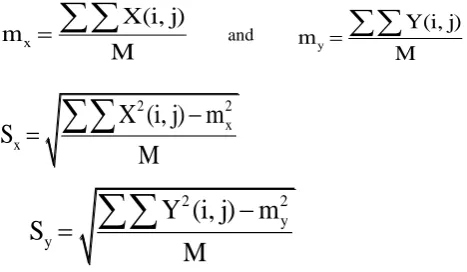
Where M =n(n-1)/2 is the number of entries in the double sum
and the moments are given by
x
X(i, j)
m
M
and
y
Y(i, j)
m
M
2 2 x xX (i, j) m
S
M
2
2
y
y
Y (i, j) m
S
M
All sums are over the set {(i,j): 1
i
n-1, i+1
j
n}. The Γ
statistics measures the degree of linear correspondence between
the entries of
X
and
Y.
The large absolute value of Γ suggests
that the two matrices agree with each other. The normalized Γ is
always between -1 and 1.
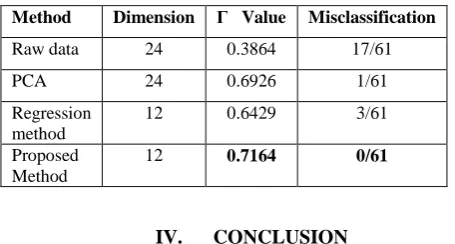
Table 3 gives summary of the results obtained from various
experiments on this data. The proposed method shows high Γ
value with no classification error.
Method
Dimension
Association
Disassoci
ation
CTI
Raw data
24
0.351
0.477
0.828
PCA
24
0.242
0.910
1.152
Regression
method
12
0.815
0.250
1.065
Proposed
Method
12
0.1687
1.0358
1.204
5
Partition
Cities
Cluster 1
Athens, Hongkong, Lisbon,
London, Madrid, Newyork, Paris,
Rome, San Francisco, Tokyo
Cluster 2
Bahrain, Bombay, Cairo, Calcutta,
Colombo, Dubai, Kuala Lumpur,
Madras, Manila, Mexico, New
Delhi, Singapore
Cluster 3
Frankfurt, Seoul, Zurich
Cluster 4
Amsterdam, Copenhagen, Geneva,
Moscow, Munich, Stockholm,
Toronto, Vienna
Table 3: Comparison of Γ value of various methods for
Corn Soybean data
IV.
CONCLUSION
In this chapter, a novel method of reducing the feature set
into symbolic features and a novel method of measuring
proximity between samples expressed as intervals is
introduced.
The
proposed
model
achieves
better
performance in terms of CTI for City Temperature data and
Hubert Γ statistics in case of CORN SOYBEAN data.
V.
REFERENCES
[1] Betrand P ,Goupil F, Descriptive statistics for symbolic
data, analysis of symbolic data, Bock H.H and Diday
E(eds) Springer, 1999.
[2] Bock H.H , Diday E, Analysis of symbolic data,
Springer Verlag, 2000.
[3] De Carvalho.F.A.T, Souza R, New metrics for
constrained Boolean symbolic objects, Proc of KESDA98,
Eurostat, Luxemberg 1998.
[4] Diday E, An introduction to symbolic data analysis,
Tutorial of 4th Conf of IFCS, Paris, 1993.
[5] Gowda.K.C ,Diday.E, Symbolic clustering using a new
dissimilarity measure, Pattern Recognition, Vol 24, no.6,
pp 567-578, 1991.
[6] Gowda.K.C ,Diday.E, Symbolic clustering using a new
similarity measure, IEEE Trans on SMC, Vol 22, No.2,
Mar/April 1992.
[7] Ichino.M, Yaguchi.H, Generalized Minkowsi’s metrics
for mixed feature type data analysis, IEEE Trans on SMC,
24(4), pp 698-708, 1994.
[8] Jain A.K, Dubes.R.C, Algorithm for clustering data,
Prentice Hall, pp 23-46, 143-220, 1988.
[9] Jolliffe.I.T, “Principal Component Analysis” Springer
Verlag, NY, 1986.
[10]
Lalitha Rangarajan ,Nagabhusha.P, Dimensionality
reduction of multi dimensional temporal data through
regression, Pattern Recognition Letters, Vol 25/8,
pp.899-910, 2004.
[11]Michalski R.S, Diday E, Stepp R.E, A recent advance
in data analysis: Clustering objects into classes
characterized
by
conjunctive
concepts,
Pattern
Recognition, vol.1, pp33-56, 1981.
[12]Nagabhushan P, Gowda K C and Diday E,
Dimensionality reduction of symbolic data, Pattern
Recognition Letters, Vol 16, pp 219-213, 1995.
[13] Nagabhushan P, An efficient method for classifying
remotely sensed data, incorporating Dimensionality
Reduction, PhD Thesis, University of Mysore, Mysore,
1988.
VI.
ABOUT
THE
AUTHORS
Veerabhadrappa obtained his M.Sc. and Ph.D, degrees in
Computer Science and Technology from the University of
Mysore, India, respectively in the years 1989 and 2011.
Currently he is working as Associate Professor and Head of
the department of Computer Science, University College,
Mangalore, India. He has authored 12 peer-reviewed
papers in journals and conferences. He is the reviewer of
the Journal of Neurocomputing and International Journal of
Computer Applications (IJCA). His area of research covers
dimensionality reduction, face/object recognition and
symbolic data analysis.
Dr. Lalitha Rangarajan is currently a Professor in
Department of Computer Science, University of Mysore,
India. She has two master degrees one in Mathematics from
Madras University, India and the other in Industrial
Engineering (specialization: Operations Research) from
Purdue University, USA. She has taught mathematics for
five years in India soon after the completion of masters in
mathematics. She is associated with the Department of
Studies in Computer Science, University of Mysore, soon
after completion of masters at Purdue University. She
completed her doctorate in Computer Science in 2004 and
since then doing research in the areas of image processing,
retrieval of images, bioinformatics and pattern recognition.
She has more than 40 publications in reputed conferences
and journals to her credit.
Method
Dimension
Γ Value Misclassification
Raw data
24
0.3864
17/61
PCA
24
0.6926
1/61
Regression
method
12
0.6429
3/61
Proposed
Method
Appendix A: Minimum and maximum temperature of 39 cities
Sample No.
Cities
Jan Feb Mar Apr May Jun Jul Aug Sept Oct Nov Dec 1 Amsterdam
[ -4, 4] [ -5, 3] [ 2, 12] [ 5, 15] [ 7, 17] [ 10, 20] [ 10, 20] [ 12, 23] [ 10, 20] [ 5, 15] [ 1, 10] [ -1, 4] 2 Athens [ 6, 12] [ 6, 12] [ 8, 16] [ 11, 19] [ 16, 25] [ 19, 29] [ 22, 32] [ 22, 32] [ 19, 28] [ 16, 23] [ 11, 18] [ 8, 14] 3 Bahrain [ 13, 19] [ 14, 19] [ 17, 23] [ 21, 27] [ 25, 32] [ 28, 34] [ 29, 36] [ 30, 36] [ 28, 34] [ 24, 31] [ 20, 26] [ 15, 21] 4 Bombay [ 19, 28] [ 19, 28] [ 22, 30] [ 24, 32] [ 27, 33] [ 26, 32] [ 25, 30] [ 25, 30] [ 24, 30] [ 24, 32] [ 23, 32] [ 20, 30] 5 Cairo [ 8, 20] [ 9, 22] [ 11, 25] [ 14, 29] [ 17, 33] [ 20, 35] [ 22, 36] [ 22, 35] [ 20, 33] [ 18, 31] [ 14, 26] [ 10, 20] 6 Calcutta [ 13, 27] [ 16, 29] [ 21, 34] [ 24, 36] [ 26, 36] [ 26, 33] [ 26, 32] [ 26, 32] [ 26, 32] [ 24, 32] [ 18, 29] [ 13, 26] 7 Colombo [ 22, 30] [ 22, 30] [ 23, 31] [ 24, 31] [ 25, 31] [ 25, 30] [ 25, 29] [ 25, 29] [ 25, 30] [ 24, 29] [ 23, 29] [ 22, 30] 8 Copenhagen [ -2, 2] [ -3, 2] [ -1, 5] [ 3, 10] [ 8, 16] [ 11, 20] [ 14, 22] [ 14, 21] [ 11, 18] [ 7, 12] [ 3, 7] [ 1, 4] 9 Dubai [ 13, 23] [ 14, 24] [ 17, 28] [ 19, 31] [ 22, 34] [ 25, 36] [ 28, 39] [ 28, 39] [ 25, 37] [ 21, 34] [ 17, 30] [ 14, 26] 10 Frankfurt [-10, 9] [ -8, 10] [ -4, 17] [ 0, 24] [ 3, 27] [ 7, 30] [ 8, 32] [ 8, 31] [ 5, 27] [ 0, 22] [ -3, 14] [ -8, 10] 11 Geneva [ -3, 5] [ -6, 6] [ 3, 9] [ 7, 13] [ 10, 17] [ 15, 17] [ 16, 24] [ 16, 23] [ 11, 19] [ 6, 13] [ 3, 8] [ -2, 6] 12 Hong Kong
Appendix B: Corn dataset
Sample No.
June 11, 1979 June 29, 1979 July 16, 1979 August 30, 1979 F1 F2 F3 F4 F5 F6 F1 F2 F3 F4 F5 F6 F1 F2 F3 F4 F5 F6 F1 F2 F3 F4 F5 F6
Appendix B: Soybean dataset
Sample No.
June 11, 1979 June 29, 1979 July 16, 1979 August 30, 1979
F1 F2 F3 F4 F5 F6 F1 F2 F3 F4 F5 F6 F1 F2 F3 F4 F5 F6 F1 F2 F3 F4 F5 F6