Competency Management in Engineering Institutions: an
Expert System based Knowledge Management
Perspective
Bhusry Mamta
Ajay Kumar Garg Engineering College Ghaziabad, India
Ranjan Jayanthi
Institute of Management Technology Ghaziabad, India
ABSTRACT
Competency is a key resource that all organizations possess. Proper channeling of organizational competencies leads to increased performance and better outcomes in order to meet the competitive edge.
A crucial feature of engineering institutions (EIs) is that they consist of many processes, each requiring the combination of various skills at different proficiency levels. A robust competency management (CM) system must reflect the need for competency development in the institution and cater to methods to achieve these.
This paper explores the need for CM in EIs and presents a conceptual framework for developing new competencies in the institution and refining the existing competencies for meeting the organizational goals. It focuses on enhancement of the competence of the human resource functions in the institutions through position fulfillment and career development mechanisms. It further proposes a layered architecture using Expert System for the implementation of the framework.
The framework is based on the competency domains of knowledge, research, administrative, interpersonal relations and behaviour (KRAIB). If adopted in EIs, the authors feel that the framework will lead to a better way to use the data on institutional competencies as a knowledge asset and apply it towards effective planning and actions for competency management.
Keywords
Competence, competency management, knowledge management, knowledge repository, expert systems
1.
INTRODUCTION
The processes of engineering education are immensely demanding in terms of skills and competency. The growing number of institutions offering engineering courses and the increasing performance requirements of the stakeholders has increased competition and the need for better outcomes. In order to achieve this, the institutions need to perform better. Competency is a key resource that all institutions possess and proper channeling of the institutional competencies can help to achieve the performance requirements and meet the competitive edge.
A crucial feature of engineering institutions is that they consist of many functions and processes, each requiring the combination of various skills at different proficiency levels. This implies that people in the institutions need to possess and develop multiple competencies for personal and institutional survival. This paves the way to recognize the need for competency management in EIs. A robust competency management (CM) system must reflect the competency
requirements in the organization and cater to methods to achieve these.
Competency management is becoming an area flourishing in importance and need in the current scenario. Organizations observe individuals as strategic assets. CM aims at integrating the competencies of individuals towards organization’s business strategy and processes [3]. CM involves the identification and measurement of available competencies of all employees and enables additional competencies that may be required towards effective individual and organizational performance. It consists of capturing, evaluating, mapping, assigning and updating the competencies of any organization according to business plans It has the primary objective to define and continuously maintain competencies according to the objectives of the organization [2].
In educational institutions human resource alone greatly contributes towards the success of the institution. Engineering institutions formulated on the basis of the competency of their employees, particularly faculty can achieve the competitive edge. The institutions employ people possessing a variety of competencies with different proficiency levels. The question is what value is added to the services they deliver through the effective use of their competencies. The institutions have to precisely identify the required competencies based on institutional goals and job profiles and the gap that exists between the expected and available level of competencies. Based on the data, the institutions need to modulate themselves to design strategies in order to develop the missing competencies and adapt the existing competencies to the required proficiency levels.
The aim of this paper is to explore the competency management in engineering education from a knowledge management perspective in order to achieve easy integration of the competencies required in the academia and their mapping to academic processes. Comprehensive knowledge of the availability and requirement of the competencies is critical to the overall performance of the organization. Competency domains and core competencies of the people are the knowledge entities that need to be identified, captured, stored and mapped to the job profiles they are most suitable for. This process will result in application of the “right competencies to the right job”, thereby contributing towards the overall growth of the institution.
requirement of the institution and deployment of
competencies to appropriate job profiles.
2.
Significant work has been done in the field of competencyRELATED WORK
management and competency modeling for achieving changes in educational and organizational perspectives.Sno. Authors Nature of Work Relevance for Proposed Work
1 [5]
Discussed the uses of competency management in terms of important skills and competencies, organizational culture, individual and organizational performance and evaluation processes
The understanding of the paper supported the importance of skills and competence and individual and organizational performance in organizations
.
2
[13]
Applied a systems approach to organizational learning and human performance technology towards achieving organizational accomplishments.
The paper helped to establish the role of human performance towards achieving organizational goals
3
[9]
Introduced a novel, goal oriented competency model which is used to capture best practices used by professional engineers wishing to increase their personal worth, companies wishing to improve their performance and by academic institutions needing to obtain a better understanding of industry’s expectations of new graduates.
The paper guided in the development of the competency management model with emphasis on career development and academic requirements.
4 [12]
Proposed an ontology based CommOn framework for developing operational knowledge based systems for competency management activities such as staff development and deployment, job analysis and economic evaluation.
The paper helped to develop a knowledge based competency management system to cater for employee development and job deployment.
5 [6]
Proposed an evaluation index system to give an overall evaluation of executives based on both subjective and objective information.
The paper helped to understand an indexing system for employee evaluation and this helped in mapping of competencies to work profiles in the current work
6 [10]
Applied an expert systems approach to develop human intellectual strategically and enable educational institutions to get the most benefit from their investments in both people and technology.
management.
8 [11]
Developed an expert system for competency management and subsequent performance assessment in educational institutions.
The work helped as guide to use expert systems in development of competency management system for educational institutions.
9 [8]
Introduced an agent-based framework for the dynamic refinement of employees’ competency profiles by analyzing and monitoring the collaborated activities in organizations.
The study of the paper helped to establish relationship between employee competency and organizational activities
10 [1]
Proposed a semantic web-based educational system within a social network system applied to the enterprise context in order to solve problems of managing employees’ competencies and sharing employees’ profiles across the organization in order to support competency finding.
The work helped in finding solution to competency management problems and competency finding across the institution.
11 [4]
Proposed a management method based on core competency ownership, where individuals are empowered to develop the organization’s core competencies.
The paper helped to understand the role of competency management in the organizational development
The survey of the available research literature shows the lack of a knowledge management approach to competency management. The paper is a modest attempt to fill this gap in order to achieve the goals of competency usage, competency development and competency acquisition.
3.
RESEARCH APPROACH AND
FINDINGS
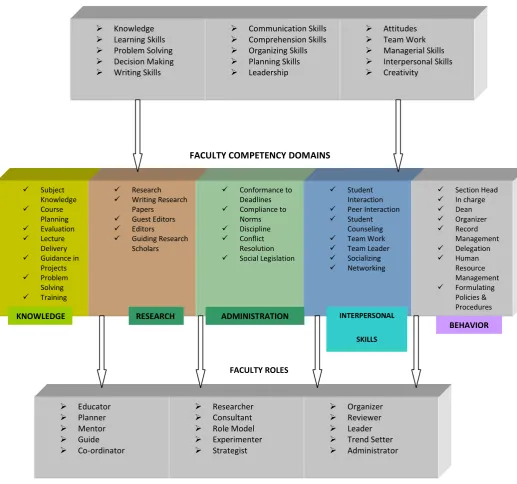
The research approach was qualitative in nature with a three-fold purpose : (1) identification of the generic competency domains required in engineering institutions; (2) identification of the core competencies in the competency domains and (3) roles performed by faculty in the EIs
Fig. 1 : Core Institutional Competencies and Faculty Competency Domains
The study also helped to discover the multiple roles performed by faculty and the 1:1 (one to one) and 1: many (one to many) mapping of competencies to the competency domains. The implication is that a competency can be used to
4.
KRAIB (KNOWLEDGE, RESEARCH,
ADMINISTRATION,
INTERPERSONAL RELATIONS AND
Subject
Knowledge
Course
Planning
Evaluation
Lecture
Delivery
Guidance in
Projects
Problem
Solving
Training
Research
Writing Research
Papers
Guest Editors
Editors
Guiding Research
Scholars
Conformance to
Deadlines
Compliance to
Norms
Discipline
Conflict
Resolution
Social Legislation
Student
Interaction
Peer Interaction
Student
Counseling
Team Work
Team Leader
Socializing
Networking
Section Head
In charge
Dean
Organizer
Record
Management
Delegation
Human
Resource Management
Formulating
Policies & Procedures FACULTY COMPETENCY DOMAINS
KNOWLEDGE
FACULTY ROLES
ADMINISTRATION INTERPERSONAL
SKILLS
KILLS
BEHAVIOR
Knowledge
Learning Skills
Problem Solving
Decision Making
Writing Skills
Communication Skills
Comprehension Skills
Organizing Skills
Planning Skills
Leadership
Attitudes
Team Work
Managerial Skills
Interpersonal Skills
Creativity CORE INSTITUTIONAL COMPETENCIES
Educator
Planner
Mentor
Guide
Co-ordinator
Researcher
Consultant
Role Model
Experimenter
Strategist
Organizer
Reviewer
Leader
Trend Setter
2 Evaluating the current competency level in the institution and identifying the missing competencies.
3 Developing the individuals for competencies that are missing through trainings, QIPs and developmental programmes.
4 Monitoring the performance of people for compliance to the identified competencies.
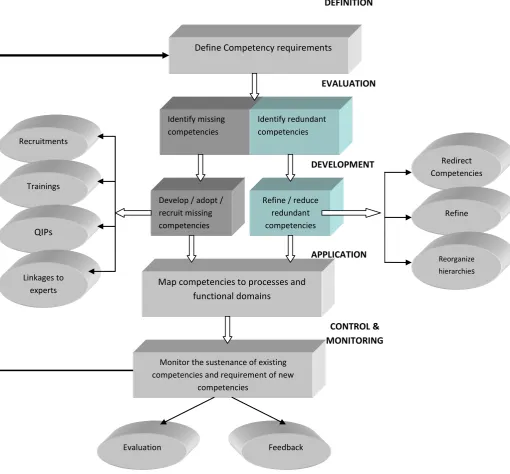
Based on the activities of competency management, the authors proposed a competency management life cycle (fig.2). It consists of four phases which aim at the continuous enhancement and development of the individual and organizational competencies.
Figure 2 : Competency Management Life Cycle
The first phase of competency definition aims to provide the institution with an extensive list of the competencies required in order to perform the processes in accordance with the institutional strategies for meeting the goals and targets. The second phase is the competency evaluation phase which encompasses the assessment of the current state of competencies available in the institution and the level of each competency available. A competency gap analysis may be required at this stage to identify the difference in the available and the required competencies and the redundancy in the existing competency levels.
The identification of the missing and the redundant competencies will clearly contribute towards the next phase of development and enhancement of competencies in the institution. The third phase aims at activities towards fulfilling the existing gap in competencies. This includes providing for the missing competencies, enhancing the existing competencies to the required proficiency level and
re-directing the redundant competencies to new directions. This can be achieved through recruitments, training and development programmes.
The competency monitoring phase ensures that the competencies developed and enhanced are maintained. A competency assessment mechanism comprising of feedback and evaluation can be adopted to achieve this. Feedback must be given at a regular basis and should lead to the required training, development and guidance. Evaluation is the outcome of feedback on performance at any point of time. It reinforces the need for additional competency development and refinement to perform a job.
Applying the competency management life cycle, the authors developed the KRAIB framework (fig.3) as the accomplishment of the tasks in any organization require one or more skills from the competency domains of KRAIB. The combination of these in the required proportions will facilitate the people to perform their jobs with proficiency.
Competency Definition
(list of competencies for organizational functional
domains)
Competency
Monitoring
(monitor the performance for competency compliance)
Competency Development
(develop and enhance the competencies)
Competency Evaluation
(measure of competency
level in organization)
Competency Management
Fig. 3 : KRAIB Framework
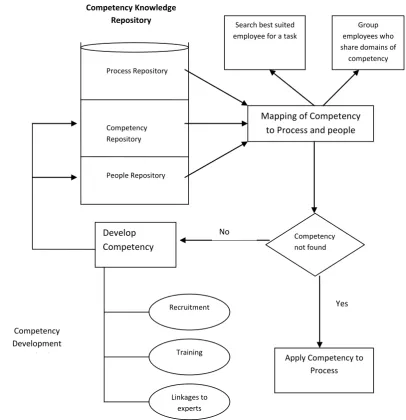
Fig. 4 illustrates the competency storage ad mapping mechanisms of the KRAIB framework. The information on people, processes and competency are stored in a knowledge repository which is a structured collection of competencies mapped to the jobs they are required for and the people who
competency knowledge of the organization. The mapping of the competencies to people and processes is a continuous process and facilitates the assignment of the right person to the right task.
CONTROL & MONITORING APPLICATION
EVALUATION
DEVELOPMENT
Define Competency requirements
Identify missing competencies
Identify redundant competencies
Develop / adopt / recruit missing competencies
Refine / reduce redundant competencies
Map competencies to processes and functional domains
Monitor the sustenance of existing competencies and requirement of new
competencies
Redirect Competencies
Refine
Competencies
Reorganize hierarchies Recruitments
Trainings
QIPs
Linkages to experts
Evaluation Feedback
Fig. 4 : Competency mapping
5.
IMPLEMENTATION OF THE
FRAMEWORK
Fig. 5 shows an expert system based layered architecture for the KRAIB framework to facilitate the identification, storage, mapping and development of the institutional competencies. The first layer depicts the knowledge identification and knowledge gathering process for the competency domains, functional activities and the required and available
competencies. The knowledge gathering is achieved through the medium of people, study of documents and observation of processes. The second layer describes the storage of knowledge in a knowledge repository. The knowledge repository is organized and maintained by knowledge engineers and consists of information on people, processes and competencies and represents all the knowledge in the required domains.
Process Repository
Competency Repository
People Repository
Mapping of Competency to Process and people
Develop Competency
Competency not found
Linkages to experts Training Recruitment
Search best suited employee for a task
Group employees who share domains of
competency Competency Knowledge
Repository
Apply Competency to Process
Yes No
Fig.5 : Expert System Implementation
Knowledge Repository Knowledge Identification and
Gathering
Required Competencies
Available Competencies
Process Information
Faculty Profile
People Competence Process
Working Memory Knowledge Storage
Knowledge Mapping
Decision Making
Expert System Inference Engine Input/Output
Interface
Queries from users
User Queries
6.
IMPLICATIONS
The implementation of the framework into IT based competency management system will offer multifold benefits.
6.1
Availability of knowledge on
institutional competencies
o Assigning the right people to the right jobo Designing reward systems for the deserving employees
o Developing collaborative work culture
o Constructing performance evaluation system for employees.
o Transforming job profiles according to new strategies and projects
6.2
Availability of knowledge on
competencies missing in the
institution
o Recruiting the right people for the right job. o Conducting training programmes for the
development of existing employees.
o Implementing changes in strategies, projects and organizational hierarchy due to lack of critical competencies.
o Planning outsourcing of tasks due to missing competencies and competencies difficult to develop
o Communicating competency requirements to current employees for individual development
o Communicating competency requirement to job seekers
6.3
Availability
of
knowledge
on
competencies redundant in the
organization
o Redirecting the competencies towards other jobs
o Reinforcing the critical competencies to higher levels through internal and external training programmes
o Reorganizing the organization by assigning employees to job profiles based on their competencies
7.
CONCLUSION
The paradigm shift in engineering institutions from individual to cross functional and cross organizational perspectives has increased the demands on the competency of people involved. Competency is a benchmark of performance of the employees in EIs.
The proposed work aims to assess the institutional competencies and take strategic decisions towards competency deployment, competency development and rewards and recognition. The authors have discussed in depth a novel approach to competency management explicitly aligned with strategic business needs and oriented to long term future success. The concept has been integrated with
expert systems approach for decision making and if implemented the architecture will yield benefits to define changes in the overall development of the institution and growth of the individual faculty. It will also promise fair appraisals and succession processes resulting in job satisfaction for all employees.
8. REFERENCES
[1] Acampora, G., et al., 2010, “Exploiting Semantic and Social Technologies for Competency Management”, 2010 10th IEEE International Conference on Advanced
Learning Technologies, pp. 297-301
[2] Berio, G., (2005, “Knowledge Management for Competence Management”,Proceedings of I-KNOW [3] Caetano, A., et al., 2007, “Representing Organizational
Competencies”, SAC’07, March 115, 2007, ACM 1-59593-480-4/07/0003, pp. 1257-1262
[4] Dawson, K., “Core competency Management in R&D Organizations”, 0-7803-0161-7/9 IEEE, pp. 145-148 [5] Hart, J., 1998, “Developing a Competency Based
Performance Management System”, 1998 ACM1-58113-066-6/98/0010, pp. 111-113
[6] Jibin, M., Baoqing, Z., 2008, “Model Designed for Selecting Top Executives of an Enterprise Based on Competency”, 2008 International Conference on Information Management, Innovation Management and Industrial Engineering, pp. 134-138
[7] Klett, F., 2009, “Competency Management and Assessment of the Inseparable Elements of a Quality Framework for Human Resources Development”, IEEE CCC Code : 978-1-4244-6019-9/09
[8] Loia, V., et al., 2010, “An Enhanced Approach to Improve Enterprise Competency Management”, IEEE 978-1-4244-8126-2/10
[9] May, R., Segal, A., 2002, “Encouraging Excellence in Engineering Through the Use of a Simple Competency Model to Focus Professional Development”, 2002 The Institution of Electrical Engineers
[10] Ranjan, J., Tripathi, P., 2008, “Measuring Competencies Using Expert System: Institutional Perspective”, Journal of Theoretical and Applied Information Technology, pp. 95-104
[11] Ranjan, J., Tripathi, P., 2009, “A Competency Mapping for Educational Institution: Expert System Approach”, International Journal of Computer and Communication Technology, vol. 1, no. 1, 2009, pp. 126-155
[12]Vladimir,R., et al., 2006, “CommOn:AFramework for Developing Knowledge Based systems Dedicated to Competency-Based Management”, 28th International Conference on Information Technology Interfaces ITI 2006, June 19-22, 2006, Cavat, Croatia, pp. 419-424 [13] Wright, P.C., Geroy, G.D., 2001, “Human