Writing Skills Development for Graduate Students: Workshop Intervention Using a
Student-Centered Learning Approach
Beverly P. Lyons, Ph.D., L.M.S.W.
Professor
MPA Program,
School of Business Public Administration and Information Sciences
LIU Brooklyn
Bakry Elmedni, PhD
Assistant Professor
MPA Program
School of Business Public Administration and Information Sciences
LIU Brooklyn
One University Plaza
H-700, Brooklyn, NY 11201
USA
Abstract
Writing deficiency is currently a major problem in higher education in the U.S.As such, institutions across the country have implemented initiatives to improve students’ writing skills. This article describes a writing workshop intervention developed and used by a program at a private higher educational institution. The study draws from quantitative and qualitative data from three years of past workshops grounded in student-centered learning and information literacy examining six key areas. The workshop employed the collaboration of facilitators across disciplines and included 156 incoming graduate students. Pre-and posttest means testing shows that the workshop made a significant difference in the writing skills knowledge gained.
Keywords:
Student-Centered Learning, Information Literacy, Non-traditional Students, Students of Color,Writing Workshop
1. Introduction
The increased use of electronic technology is accompanied by a steady decline in good writing skills. Indeed, it has been well established that good writing enhances grades in college, helps with academic mastery and supports career advancement (Graham, Harris & Mason 2005).These facts remain steadfast despite the technological revolution. One might ask: Are there critically important factors that motivate individuals to improve their writing skills in the face of competing technology? We speculate that important criteria in improving writing competency involve time, effort and desire on the part of budding writers. Such attributes are evident in those individuals who have embraced technology. Research on psychotherapy and behavioral change suggests that change is more likely to be long lasting among individuals who attribute change to their own effort (Larmbert& Bergin 1994). Additionally, studies in learning psychology indicate that learning is an intentional behavior (Boytzis& Kolb 1999; Goleman2001). As such, we believe that innovative, effective interventions such as student-centered learning (SCL) offer powerful and useful techniques to put students in the center of improving their writing skills.
SCL is argued to be more effective in terms of long-term retention, depth of understanding of course material, and the development of critical thinking (Cherian, GS, 2014; Rutkauksiene, Schreurs, Huet & Gudoniene 2010). Some SCL’s enthusiasts went even further to suggest that SCL can help students to become strategic learners, i.e. they learn how to learn (Mckeachie & Svinicki 2006). There are several methods and techniques used to promote SCL. Among them is formal collaborative learning in which students work in groups. Formal learning is defined as being intentionally coordinated by institutions and is frequently guided by a curriculum. It can be used in many ways and at present is widely used by institutions of higher education around the world (Eaton 2010).Our graduate program used SCL in the administration of the research and writing workshop aimed at strengthening students’ writing skills. Student-centered learning and the research and writing workshop will be described in greater detail later in this paper.
The purpose of this paper is to describe an innovative remedial research and writing workshop developed for graduate students—primarily students of color—in a private institution of higher education located in New York City (NYC).We predict that: the workshop intervention would influence and enhance the writing and research skills knowledge gained by participants. The paper outline follows. First, we provide background information including the context for the workshop; make the case that writing improvement initiatives are not only effective, but necessary; and, explain the importance of including information literacy. Second, we describe the SCL approach on which the workshop is anchored. Third, we provide information on the current state of college students’ writing abilities. Fourth, we describe the workshop content. Fifth, we explain our methodology. Sixth, we provide the response to program evaluation, and end with discussion and conclusions.
2. Background
2.1 Writing Deficiencies in Higher Education
Problems with written communication skills in four-year institutions of higher education have gained considerable attention in the past few years (Miller 2010). Only about one-quarter of the graduates of such institutions are considered to be excellent in many of the most important skills required for career success in the workplace, and more than one-quarter are perceived to be lacking sufficient preparedness in written communication (The Conference Board 2006). A recent national survey of undergraduate programs conducted by an accrediting agency found that only 32 percent of the participants required an administrative and/or technical writing course within or outside their respective program (Knox 2013). While not alarming, these results triggered concerns because graduate students across the country face extremely tough competition in the job market (Hobson 2013). There is no doubt that successfully completing a graduate program and securing a job afterwards require writing skills and other communication competencies.
It is apparent that to successfully complete a graduate degree, students must master basic writing skills. In addition to general writing skills, academic writers as well as graduate students must have knowledge about their specific disciplines and the communication practices that are common in their fields (Swales andFeak2012;Zhu 2004). There are many aspects of writing deficiencies facing undergraduate and graduate students. Among these deficiencies is lack of clarity; poor grammar and paragraph development; incorrect spelling; language barriers including limited vocabulary among students for whom English is a second language; and students for whom academic subjects present a challenge (Lea and Street1998, 2006).The aforementioned issues contribute to weak and problematic academic writing, which in turn may contribute to problems pertaining to retention and degree completion. Graduate students can also be weak in information literacy (IL). Rempel and Davidson (2008) place the issue of IL in a broader context because according to them: Library-based instructional services for graduate students have received limited attention to date. Faculty advisors assume that either their graduate students arrive at graduate school competent in research skills, or that these students should discover how to carry out research through a process of self-discovery (p.1).
Not surprisingly, a majority of students, including those in the program under study, lack the basic information literacy skills, such as how to effectively search for relevant information for academic research. It is fair to assume that librarians and instructors are equally responsible for equipping students with the necessary skills that are essential for conducting research.
By mastering writing and research skills, graduate students can become proficient in conducting research (Swales and Feak 2012) and these skills are useful on the job.
Indeed, scholars such as Monge and Frisicaro-Pawlowski (2014) suggest redefining and transforming the concept of IL. They argue that it is essential to abandon the notion that IL should be an isolated generic skill set and recognize that IL differs by context and is guided by the people and technology concerned. As such, instructors and librarians need to work collaboratively in instruction and assignment design in order to support the SCL approach (Monge and Frisicaro-Pawlowski 2014). Additionally, these scholars hypothesize that when combined with key methods, these changes can considerably redefine the role of IL by “establishing learning guidelines by discipline and course; …redesigning assignments to be collaborative and reflective of workplace projects; and creating opportunities for personal learning environments (p.66).” These modifications are necessary to create long-term knowledge of IL that is applicable to school and work.
An emerging effective model of teaching writing skills indicates that developing these skills is not only the role of the English department, but the responsibility of all disciplines to ensure that students are on the right path to becoming better communicators. On this point, some scholars have argued that instructors, regardless of their discipline, should share similar concern for students’ writing competency (Eblen 1983; Davis 1987; Cornell and Klooster 1990). Accordingly, instructors in graduate programs bear the responsibility of helping students develop research and writing skills. One cannot emphasize how critical those skills are for career success, which explains why accrediting agencies require inclusion and assessment of these competencies in the outcome assessment as part of the accreditation process. The responsibility of instructors becomes even more profound when they are faced with a body of students who are vastly underprepared in these areas due to their socioeconomic place in society. These factors constitute the framework for the development of our pilot workshop model anchored in SCL.
2.2 Student-Centered Learning Approach
There have been a variety of phrases used to describe a critical shift in the mission and purpose of higher education. Barr and Tagg (1995) suggested that the change came as a move from an “Instruction Paradigm” in which the purpose of instruction was to “transfer knowledge from instructors to students (p. 13)” to a “Learning Paradigm” in which faculty facilitate learning through “student discovery and construction of knowledge (p. 13).” Moreover, Huba and Freed (2000) used the phrase learning-centered assessment to emphasize transition in the focus of instruction and assessment from teaching to learning. Regardless of whether learning was more effective under the traditional model or the new paradigm, the language of student-centered learning caught on in almost every corner of higher education in the nation. Collins and O’Brien (2003) described the student-centered instruction (SCI) as:an instructional approach in which students influence the content, activities, materials, and pace of learning. This learning model places the student (learner) in the center of the learning process. The instructor provides students with opportunities to learn independently and from one another and coaches them in the skills they need to do so effectively. The SCI approach includes such techniques as substituting active learning experiences for lectures, assigning open-ended problems and problems requiring critical or creative thinking that cannot be solved by following text examples, involving students in simulations and role plays, and using self-paced and/or cooperative(team-based) learning. Properly implemented SCI can lead to increased motivation to learn, greater retention of knowledge, deeper understanding, and more positive attitudes towards the subject being taught (p. 343).
Using a report on learning synthesized by the National Research Council, Froyd and Simpson (2010) recommended organizing learning environments around four foci: knowledge-centered, learner-centered, assessment-centered, and community-centered. Such organization provides another view on student-centered learning and its mechanics. In addition to Collins and O’Brien’s description of SCL, other techniques and tools associated with the principles of SCL include active learning, collaborative learning, cooperative learning, problem-based learning, peer-led learning, project-based learning, and small group learning, just to name a few. Under each of these methods, there are a variety of tools and exercises that are available to instructors, but the central principle is that the students are in charge of their own learning.
Use of group exercises requiring collaborative team efforts for both research and writing is one way faculty may integrate SCL into graduate classes and thereby empower students and help to make them feel in charge of their own learning. One might wonder whether SCL technique is useful for graduate students in writing skills development.
Indeed, the SCL approach is appropriate for graduate students and should be embedded in writing workshops that foster improvement in students’ writing skills. According to Brocato, Furr, Henderson and Horton (2005), writing programs and workshops are ways of assisting students in overcoming writing deficiencies. These scholars also suggested that motivating students to engage in writing enhancement activities is the instructors’ responsibility. Eblen (1983) argued that a writing workshop can serve as an effective tool in evaluating the writing skills of incoming students. Alter and Adkins (2001) proposed that after admission decisions are made and prior to class enrollment, mandatory writing workshops are one method of evaluating students and distinguishing those with excellent writing skills from those who need assistance We believe that the SCL approach can also be used to identify students with excellent writing skills to serve as coaches for those who may need help.
3.
Methodology
This section explains the methodology used to develop this workshop. We begin with a brief summary of the pilot study, the workshop facilitators, the student participants, the workshop description—linking the activities of our model to SCL, and finally the workshop evaluation tools.
3.1 Pilot Study
Instructors in the department noticed that many students were not proficient in writing. With a tightly structured curriculum, the department could not add an additional course to the curriculum to address students’ deficient writing skills. Instructors also wanted to align this initiative with the institution’s motto Access and Excellence while avoiding an increase in the students’ educational financial burden, because ours is a private tuition-driven institution. In view of this dilemma in 2003, the Principal Investigator (PI) an instructor in the program piloted an innovative project informed by the literature and aimed at introducing new techniques that would enhance students’ writing skills. The project constituted a paradigm shift, using workshop format delivered by an interdisciplinary team of professionals and including IL techniques.
Initially, the project was offered to students in their final semester in conjunction with the capstone seminar and project. The results were very positive and student participants indicated that they would have appreciated this training when they first entered the program. The writing workshop team continued to develop the pilot model and decided to offer the workshop to incoming students. Eventually, the writing workshop model was submitted to the Teaching and Learning Initiative for Intramural grant funding in order to obtain financial resources to support the pilot project. It became evident that there were measurable differences in the quality of writing skills and abilities between those students who participated in the workshop and those who did not. After four semesters (fall and spring semesters only) of refining the model, the program’s instructors and school’s administrator agreed that the writing workshop model should be implemented as a mandatory component of the program for three reasons.
First, the workshop meets the competency based assessment required by the program’s accrediting agency. Second, the workshop leveled the playing field among a diverse range of incoming students. Finally, the workshop improved students’ confidence and enhanced overall performance throughout the program. In essence, the research and writing workshop for incoming students was determined to be an effective way of ensuring student learning, retention and completion of the program, all of which are exceptionally critical.
Facilitators. The facilitators included instructors, who are knowledgeable about the program’s curriculum; a
Participants. The pool of the incoming students to this private institution consists of non-traditional students and disadvantaged minorities, some of whom might be underprepared for graduate studies. For example, some students are relatively new immigrants of color; some are returning veterans; some have been in the workplace for some time (midcareer) and have not been in an academic setting since their undergraduate years; some are single parents balancing work, school and family life. Even though these backgrounds and experiences influence these students’ worldviews and problem-solving skills, their writing skills are underdeveloped. One feature of the program is that it reinforces the writing workshop content because most of its courses are writing-intensive. This ongoing attention to writing skills has-been helpful to students throughout their tenure, which is a specific outcome of program.
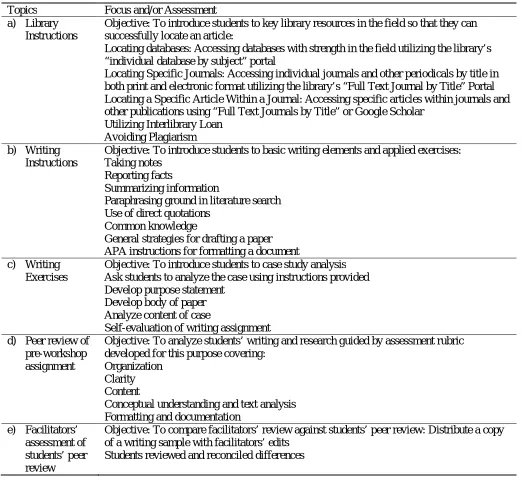
Workshop Description. Using SCL, different elements of the research and writing workshop are taught over two consecutive days. Students are informed of the workshop dates upon registration so as to have ample time to accommodate busy work and family schedules. The workshop is usually held one week prior to thefirst day of classes in fall and spring semesters. Approximately 4-6 weeks in advance of the workshop, students are emailed a writing assignment (consisting of an essay of 3-4 pages) and workshop outline, along with an abridged APA style guideand examples of purpose statements. Because of the importance of feedback by workshop facilitators, the students are asked to submit their completed essays by a certain date prior to the workshop. The activities conducted during the two-day period are not limited to the SCL approach but IL methods and techniques as well. Active learning is used during the research session, team-based method is used during information literacy session, and peer-led learning technique is employed in the writing assignment assessment where students are asked to analyze, evaluate and critique writing samples of other students. Workshop participants are also introduced to the writing center for ongoing assistance. At the conclusion of the workshop, students are asked to use the techniques and skills acquired during the workshop to revise and resubmit their essays to the workshop team for re-evaluation.
Table 1: Research and Writing Workshop Program Content
Topics Focus and/or Assessment a) Library
Instructions
Objective: To introduce students to key library resources in the field so that they can successfully locate an article:
Locating databases: Accessing databases with strength in the field utilizing the library’s “individual database by subject” portal
Locating Specific Journals: Accessing individual journals and other periodicals by title in both print and electronic format utilizing the library’s “Full Text Journal by Title” Portal Locating a Specific Article Within a Journal: Accessing specific articles within journals and other publications using “Full Text Journals by Title” or Google Scholar
Utilizing Interlibrary Loan Avoiding Plagiarism b) Writing
Instructions
Objective: To introduce students to basic writing elements and applied exercises: Taking notes
Reporting facts
Summarizing information
Paraphrasing ground in literature search Use of direct quotations
Common knowledge
General strategies for drafting a paper APA instructions for formatting a document c) Writing
Exercises
Objective: To introduce students to case study analysis Ask students to analyze the case using instructions provided Develop purpose statement
Develop body of paper Analyze content of case
Self-evaluation of writing assignment d) Peer review of
pre-workshop assignment
Objective: To analyze students’ writing and research guided by assessment rubric developed for this purpose covering:
Organization Clarity Content
Conceptual understanding and text analysis Formatting and documentation
e) Facilitators’ assessment of students’ peer review
Objective: To compare facilitators’ review against students’ peer review: Distribute a copy of a writing sample with facilitators’ edits
Students reviewed and reconciled differences
The writing assignment topics changed regularly over the semesters in order to keep the subject matter relevant to current issues in the field. The pre-workshop survey is usually administered in the morning of the first day of the workshop. It consists of closed and open-ended questions ranging from “have you ever used a library database to search for articles in order to write an academic paper or report” and “what are the Boolean operators.” A post-workshop survey is conducted at the close of the post-workshop. The survey was developed not only to observe before and after workshop responses, but also to elicit answers to questions such as “Thinking back on the peer review, what did you learn from reviewing another student’s essay,” “what kinds of writing do you do on the job” and “do you think knowing how to write professionally is an essential skill in your job.”
Both pre- and post-workshop surveys featured quantitative and qualitative questions. The surveys are the standard pre and post training assessment and therefore did not need IRB approval.
Data Processing. For the analysis of the closed-ended survey questions, descriptive statistics are used to assess the workshop quantitatively as shown in Tables 2a (bi-variate descriptive analysis) and 2bexamining differences between pretest and posttest responses, linked to our prediction that: the workshop intervention would influence and enhance the writing and research skills knowledge gained by participants. Table 3 provides a summary of the findings based on the open-ended qualitative questions. It should be noted here that the data analyzed for this paper include responses to workshop surveys for fall 2011, spring and fall 2012, and spring and fall 2013. The total sample consisted of 156 respondents (N=156).
4. Results
4.1 Quantitative Evaluation
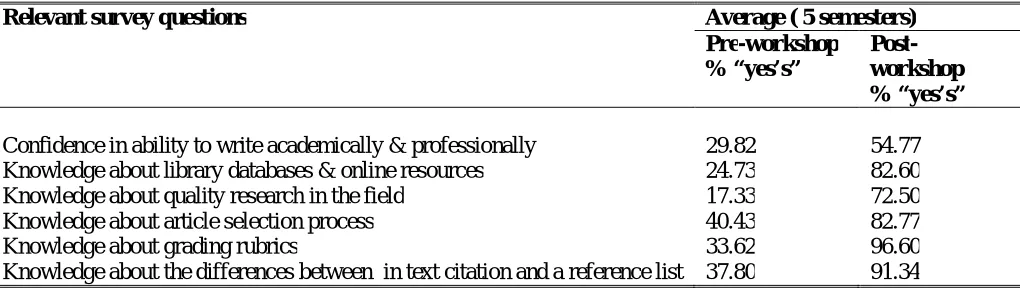
The quantitative questions from the anonymous survey (shown in Table 2a) included a number of questions requiring “yes” or “no” responses, only six of which pertain to the topics covered in this study. As expected, when bi-variate descriptive statistics were used to analyze the
Table 2a: Responses to the Quantitative Survey N= 156
Relevant survey questions Average ( 5 semesters)
Pre-workshop % “yes’s”
Post-workshop % “yes’s”
Confidence in ability to write academically & professionally 29.82 54.77 Knowledge about library databases & online resources 24.73 82.60
Knowledge about quality research in the field 17.33 72.50
Knowledge about article selection process 40.43 82.77
Knowledge about grading rubrics 33.62 96.60
Knowledge about the differences between in text citation and a reference list 37.80 91.34
data,the percentage of participants who responded “yes” to the pre-workshop survey questions ranged from 17% to 40%. Posttest workshop survey responses showed increases in the percentages of “yes” responses, whichranged from 55% to 97% reflecting some acquisition of knowledge. The data reported henceforth are reflective of the percentage of participants who provided “yes” responses. For example, with respect to the question on the participants’ confidence in their academic and professional writing abilities—pretest = 29.82%, posttest = 54.77%. On the question concerning knowledge about library database and online resources—pretest = 24.73%, posttest = 82.60%. Regarding responses to the question on knowledge about high quality research in the field— pretest = 17.33%, posttest = 72.50%.In terms of the article selection process via online search engine, when asked whether they knew which online sources are appropriate to cite for academic research, pretest = 40.43% and posttest = 82.77%. When asked about knowledge of grading rubrics—pretest = 33.62%,posttest = 96.60%. With respect to the question inquiring about the differences between in-text citation and reference lists, pretest = 37.80%, posttest = 91.34%.
Table 2b : t-Test: Comparison of Paired Two Sample Means
Variable 1 Variable 2
Mean 30.62167 80.09667
Variance 73.74894 222.2671
Observations 6 6
Pearson Correlation 0.410742
Hypothesized Mean Difference 0
Df 5
t Stat -8.77256
P(T<=t) one-tail 0.00016
t Critical one-tail 2.015048
P(T<=t) two-tail 0.000319
t Critical two-tail 2.570582
4.2 Qualitative Evaluation
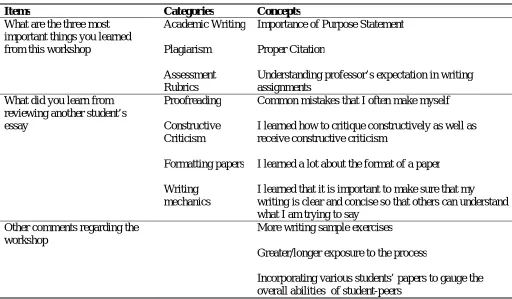
In responding to the open-ended questions (shown in table 3), when asked about the three most important things that they have learned from the workshop participants indicated that standards for academic writing, understanding plagiarism, and having assignment rubrics while writing the paper emerged as the most often mentioned categories. There is no doubt that academic writing requires obtaining and mastering threshold writing skills in areas pertaining to clarity, organization and formatting technique. In academic writing, clarity is measured by the existence and proper placement of purpose statement, use of effective and concise expressions in terms of sentence development, and the overall organization, i.e. formatting, subheading, paragraph length and sentence coherence. Participants’ responses made it clear that students have developed a better sense of and an understanding about these critical matters. Marked improvements in the quality of students’ writing were noted in evaluating revised and resubmitted workshop writing assignments, in their term papers and in their capstone papers—the culminating research and writing project in our program.
Table 3: Responses to Qualitative Evaluation N= 156
Items Categories Concepts
What are the three most important things you learned from this workshop
Academic Writing Importance of Purpose Statement
Plagiarism Proper Citation
Assessment Rubrics
Understanding professor’s expectation in writing assignments
What did you learn from reviewing another student’s essay
Proofreading Common mistakes that I often make myself
Constructive Criticism
I learned how to critique constructively as well as receive constructive criticism
Formatting papers I learned a lot about the format of a paper
Writing mechanics
I learned that it is important to make sure that my writing is clear and concise so that others can understand what I am trying to say
Other comments regarding the workshop
More writing sample exercises
Greater/longer exposure to the process
The PI, who initiated the writing workshop, conducted a subsequent qualitative study during thespring semester of 2014, examining non-Caucasian immigrant students’ perception of our program (unpublished study). This study involved focus group sessions the proposed contents of which were approved by our Institutional Review Board (IRB). A total of 23 students participated in the focus group sessions. During the focus group sessions, a number of comments emerged that were relevant to the writing workshop and a few will be reported here. When asked about any issues confronting them since joining our graduate program, the consensus was a resounding “learning how to write well.”
One student made a statement to this effect:
I was in the service and it has been almost ten years since I have actually picked up a book with some substance or did any academic writing…[as such] writing academic papers is really challenging for me.
Another student responded in a similar way:
I am not a good writer; at the undergraduate level, I used MLA style guide; in this program I am required to use APA style guide [which is different]. Also, the caliber of writing expected is on a higher level than that which I experienced before. Without the incoming student writing workshop, I would not have survived the first semester here.
Yet another student said (paraphrasing)
English is my second language. I obtained my bachelorette degree in a public college in in an ESL program and I was allowed to use my first language throughout my undergraduate college life. …My writing is poor and Iam very happy to have been a participant of the writing workshop. I have continued to receive feedback from some teachers in this program. Additionally, I use the writing center regularly.
In summary, the writing workshop results; the qualitative comments from workshop evaluation;the focus group sessions; reassessment of the workshop assignments that were revised and resubmitted; the general quality of students’ writing throughout their tenure in the program; and the capstone project suggest that the writing workshop and ongoing supports have been effective.
5.
Discussion
Writing skills are not only necessary for obtaining good grades in college and postgraduate studies, but also crucial for effective learning. In professional life and career development, one can barely get anywhere without meeting the threshold of mastering fundamental and foundational writing skills. One of the main purposes of education, be it K-12 or higher education, is to equip students with sufficient writing skills so that they can go on to becoming productive citizens in society. Students with good writing abilities learn effectively, receive better grades, and make grading written assignments enjoyable for faculty not a dreaded undertaking as often echoed by educators such as Miller (2010) who states that
Correcting students’ papers is tremendously time consuming. I constantly do battle with myself to spend less than 20 minutes on a paper. At meetings, instructors are often urged not to exceed 15 minutes, but I frequently end up spending double that. This can be a genuinely frustrating experience: 50 papers stacked on the coffee table, 10 in the finished pile, and an entire afternoon gone (p.1).
As we have discussed earlier, an innovative work has been done in undergraduate education. The pillars of such work is the realization and acceptance that improving students’ writing skills ought not be the domain of English departments alone, but a shared responsibility of all disciplines. Though graduate students face similar challenges with regard to academic writing, a review of the literature indicate that there is a paucity of researchonthe issue. The most valuable take-away for students from the workshop is accurate assessment of their writing abilities, strategies and tools to improve, and confidence. Research in human behavior suggests that people are likely to try harder when they know there is a chance for success. When you expect success, you are likely to behave in such a way as to emanate success. Anchored on SCL, the workshop model gives hope and expectance of success while clearly putting students in the center, which means they have to purposefully want to improve and that they control their destiny.
6.
Conclusion
Although our model is successful in helping non-traditional students improve their writing skills, we realize that the results might have been different with a different team of facilitators, different student cohorts, in a different institution, city and state and in using a different model. Additionally, our study is limited to the available data, institutional resources and writing samples that are generally monitored.
The research and writing workshop described here is not unique in its purpose. Other graduate programs provide writing assistance in many different forms. Some programs encourage their students to consult writing centers on all assignments throughout the first semester. What is unique about this model is its innovative design anchored on SCL, IL and its clear understanding of the students’ needs based on long-term examinations of their profile.
Using various modules, methods and techniques from the student-centered learning and bringing together a team of facilitators from the writing center, librarians, Writing across Curriculum (WAC), and instructors from our program turned out to be an effective model for addressing writing deficiencies of incoming students as early as possible. When students are able to identify their writing weaknesses, they are likely to do something about it instead of being surprised at the end of the semester when their term papers receive unfavorable remarks. Academic writing requires more than good sentence development and correct structure. The studied model put together comprehensive agenda that addressed the needs of academic writing and brought together teams of instructors who are familiar with each aspect required for effective academic writing. Professionally, students benefit as well because many of them work for service agencies, nonprofit organizations, and various sectors of the healthcare industry, where poor writing can lead to miscommunication, wasted time and potential legal ramifications. Another issue is that any attempt to improve students writing must consider the delicate balance between their current skills, work/family life, and extracurricular activities. Indeed, the model discussed here and the results illustrated in this paper underscore the importance of such balance. As suggested by our students in the focus group sessions, the workshops should be expanded to more than two days. Additionally, writing samples should be collected from students about one year after graduation to determine to what extent their writing quality remained good.
Acknowledgements
We recognize and thank all facilitators for their tireless support of the research and writing workshop over the years. We also thank the Teaching and Learning Initiative for funding this project.
References
Alter, C. & Adkins, C. (2001). Improving the writing skills of social work students. Journal of Social Work Education, 37(3), 493-505.
Barr, R. B., &Tagg, J. (1995). From teaching to learning: A new paradigm for undergraduate Education. Change, 27(6), 12-25.
Boyatzis, R.E., & Kolb, D.A. (1999). Performance, learning, and development as modes of growth and adaptation throughout our lives and career. In M. Peiperl, M.B. Arthur, R. Coffee, and T. Morris (Eds.).Career Frontiers: New Competencies of Working Lives (pp.76-98). London: Oxford University Press
Cassuto, L. (2013). Student-centered graduate teaching: Most academics dream of teaching doctoral seminars. Why do we spend so little time thinking about how to do it well? The Chronicle of Higher Education. http://facstaff.grad.uiowa.edu/sites/facstaff.grad.uiowa.edu/files/Student-Centered_Teaching.pdf
Cherian, J. & GS, P. (2014) Operational plan on teaching-earning at departmental level. Journal of Education and Social Policy, 1(2), 77-79
Collins, J. W., 3rd, & O'Brien, N. P. (Eds.). (2003). Greenwood Dictionary of Education. Westport, CT: Greenwood Press.
Coplin, W. (2012). Master the skills that matter: Ten things employers want you to learn in college. 2nd ed. New York, NY: Random House Publishing, Inc.
Cornell, C. &Klooster, D.J. (1990). Writing across the curriculum: Transforming the academy?WPA: Writing Program Administration14(1-2)7-16.
Davis, D. (1987). Eight faculty members talk about student writing.CollegeTeaching35(1), 31-35.
Eaton, S. E. (2010). Formal, non-formal and informal learning: The case of literacy andlanguage learning in Canada [Web log post].
http://drsaraheaton.wordpress.com/010/02/16/formal-non-formal-and-informal-learning-the-clase-of-literacy-and-language-learning-incanada/
Eblen, C. (1983). Writing across the curriculum: A survey of a university faculty's views and classroom practices.Research in the Teaching of English17(4), 343-348.
Froyd, J. & Simpson, N. (2010). Student-centered learning: Addressing faculty questions about student-centered learning.
http://ccliconference.org/files/2010/03/Froyd_Stu-CenteredLearning.pdf Golden, S. (2013). How best to assess. Retrieved on November 24 2014 from
http://diverseeducation.com/article/12510
Goleman, D. (2001). Emotional intelligence: Issues in paradigm building. In C. Cherniss& D. Goleman (Eds.).The Emotionally Intelligent Workplace: How to Select for, Measure, and Improve Emotional Intelligence in Individuals, Groups, and Organizations. San Francisco, CA: Josey-Bass.
Harris, K. R., Graham, S., & Mason, L.H. (2005, April). Improving the writing performance, knowledge, and self-efficacy of struggling young writers: The effects of self-regulated strategy development. Contemporary Educational Psychology, 30(2), 207-241.DOI:10.1016/j.cedpsych.2004.08.001.
Hobson, K. (2013) Look beyond finance, consulting for MBA Jobs: B-School grads can find work off the beaten path in the energy, pharmaceutical, and healthcare sectors. U.S News.com.
http://www.usnews.com/education/best-graduate-schools/top-business-schools/articles/2013/03/12/look-beyond-finance-consulting-for-mba-jobs
Huba, M. & Freed, J. (2000). Learner-Centered Assessment on College Campuses: Shifting the Focus from Teaching to Learning. Needham Heights, MA: Allyn & Bacon.
Knox, C. (2103). Teaching grammar and editing in public administration: Lesson learned from early offerings of an undergraduate administrative writing course. Journal of Public AffairsEducation 19(3), 515-536. Lambert, M. J. (1992). Implications of outcome research for psychotherapy integration. In J.C. Norcross & M.R.
Goldfried (Eds), Handbook of psychology integration (pp. 94-129). New York, NY: Wiley
Lambert, M.J. & Bergin, A.E. (1994). The effectiveness of psychotherapy. In A.E. Bergin & S.L. Garfield (Eds.).Handbook of Psychology and Behavior Change4th ed. (pp. 143-189). New York, NY: Wiley Lea, M. R. & Street, B. V. (2006). The "Academic Literacies" Model: Theory and Applications. Theory Into
Practice, 45,(4) 368-377.DOI:10.1207/s15430421tip4504_1. Retrieved on December 31, 2014
Lea, M. R. & Street, B. V. (1998). Student writing in higher education: An academic literacies approach. Studies in Higher Education, 23,(2) 157-172. DOI:10.1080/03075079812331380364. Retrieved on December 31, 2014.
Likkel, L. (2012). Calibrated peer review essays Increase Student Confidence in Assessing Their Own Writing. Journal of College Science Teaching, 41(3), 42-47.
Miller, K. (2010). Failure to communicate: The inability of many students to write clear, cogent sentences has costly implications for the digital age. Boston
Globehttp://www.boston.com/bostonglobe/editorial_opinion/oped/articles/2010/05/19/failure_to_commu nicate/
Monge, R. &Frisicaro-Pawlowski, E.(2014). Redefining information literacy to prepare students for the 21st century workforce. Innovative Higher Education Journal, 39, 59-73.
Rempel, H.G., & Davidson, J. (2008). Providing information literacy instruction to graduate students through literature review workshops. Issues in Science and Technology Librarianship. DOI:10.5062/F44X55RG. http://www.istl.org/08-winter/refereed2.html
Rutkauksiene, D., Schreurs, J., Guest, I., &Gudoniene, D. (2010). Train teachers in student-centered learning and teaching. ICL 2010, Conference Proceedings Hasselt, Belgium.
Swales, J.M., &Feak, C. (2012). Academic Writing for Graduate Students, 3rd Edition: Essential Tasks and Skills (Michigan Series in English for Academic & Professional Purposes). MI: University of Michigan Press The Conference Board (2006). Most young people entering the U.S. workforce lack critical skills essential for
success.