LOS IDENTIFICATION USING WI-FI
Issac Gaberiel. A 1, Dr Anita Jones Mary21. INTRODUCTION
Wi-Fi systems are ubiquitously conveyed indoors and act as more than a vehicle for communication. Some of the emerging applications are indoor localization [1], seeing through-walls [2], gesture recognition [3], are continuously revolutionizing the horizon [4]. The Non-Line-Of-Sight (NLOS) propagation is major concerns for the innovative designs excel in multipath – dense indoor scenarios. The severe and fickle attenuation of NLOS propagation decreases the communication link quality and degrades theoretical propagation models. The past decade has seen extensive research tbat such phenomenon [5],[6] , where the ability to identify the existence of the Line- Of – Sight (LOS)path serves as a primitive.
Many research domains also depend upon the presence of the LOS path. For instance, NLOS propagation induces a positive bias in ranging [5], and generates spurious angular peaks for angle estimation [7]. The ability of a clear and short-range LOS path also gives other applications like wireless energy harvesting by ensuring tight electromagnetic coupling and thus high charging efficiency [8]. In a brief, the awareness of LOS and NLOS conditions, and further disentangling the LOS component, enhances all these frameworks.
Achieving LOS/NLOS identification capability with commodity Wi-Fi infrastructure is a great challenge. Although many theoretical channel models have been proposed for LOS and NLOS propagation, a practical LOS identification scheme either requires channel profiles, which involves dedicated channel sounders, or assumes abundant randomness to bring the statistical models in effect. Towards more pervasive solutions, the most existing systems either employ extremely wideband signals like Ultra Wide Band (UWB), or resort to relatively long-range communications like cellular networks and often halt simulation.
The Wi-Fi operates with a bandwidth of only 20MHz. To find the differences between LOS and NLOS conditions with the Wi-Fi infrastructure, we exploit two key observations (1) the recently exposed PHY layer information on commercial Wi-Fi devices reveals multipath channel characteristics at the granularity of OFDM subcarriers [14], which is much finer-grained than the traditional MAC layer RSS. (2) The spatial disturbance induced by natural mobility tends to magnify the randomness of NLOS paths, while retaining the deterministic nature of the LOS path, thus facilitating LOS identification via the statistical characteristics of the received signals.
In this paper we propose the LOS identification system with commodity Wi-Fi infrastructure called Li-Fi. Utilizing the PHY layer channel state information reported by commercial Wi-Fi compatible Network Interface Card (NIC), we
(1) eliminate unnecessary noise and NLOS paths with high delays in time domain, and (2) misuse frequency diversity to find the spatial disturbances of NLOS propagation. Through extensive evaluation, LiFi achieves an overall LOS detection rate of 90.42%
with a false alarm rate of 9.34% for the temporal feature, and an overall LOS detection rate of 93.09% with a false alarm rate of 7.29% for the spectral feature. The combination of the two features achieves LOS and NLOS identification rates around 95%. Our scheme is powerful to different propagation distances, channel attenuation and blockage diversity.
1
Research Scholar, Karunya University, Coimbatore.
2Assistant Professor, Karunya University, Coimbatore
Abstract - wireless LANs, especially Wi-Fi have been pervasively conveyed and have cultivated myriad wireless communication services and ubiquitous computing applications. The main concern in designing these applications is to face harsh indoor propagation environments, especially Non- Line- Of- Sight (NLOS). The ability to find the presence of line-Of – sight (LOS) path acts as a key enabler for adaptive communication, cognitive radios, and robust localization. Empowering such capability on commodity Wi-Fi infrastructure on the other hand, is restrictive because of the coarse multipath determination with MAC-layer received signal strength. In this paper we propose two PHY-MAC-layer channel-insights based elements from both the time and recurrence areas. To further split away from the intrinsic bandwidth limit of Wi-Fi, We propose Li-Fi a statistical LOS identification scheme with product Wi-Fi infrastructure, and assess it in typical indoor environments covering an area of 1500
m2. The experimental results illustrates that Li-Fi accomplishes an overall LOS detection rate of 90.42% with a false alarm rate
of 9.34% for the temporal feature and an overall LOS detection rate of 93.09% with a false alarm rate of 7.29% for the spectral feature.
Key terms- wireless networks, wireless communication, communication technology.
In this paper, first we discuss about the Line Of Sight identification problem and existing approaches. We then discuss about feature extraction followed by detailed design and performances and finally we discuss limitations and conclude in last section.
2. THE LOS IDENTIFICATION PROBLEM A. Problem definition
Wireless signals are often propagate through multiple paths in indoor environments as shown in fig.1. This figure illustrates two common cases.
The LOS path is mixed with multiple NLOS paths.
The LOS path is too harshly attenuated to discernible against the noise floor.
The LOS identification problem is to perceive the availability of the LOS path in multipath propagation for each receiver location.
It can be formulated as Where H0& H1 are the hypothesis tests for the LOS and NLOS propagation respectively. P(LOS) and P(NLOS) denotes the probability of LOS and NLOS propagation respectively.
2.1 Existing approaches
The existing approaches can be cooperative or non- cooperative, and observe features in the time domain or the space domain. Our focus is mainly on single link LOS identification, where a Wi-Fi client infers conditions by analyzing received signals from one access point (AP). The single-link LOS/NLOS schemes categorized into three categories, i.e., range measurement based, channel characteristics based, and antenna array based. Table I provides a brief comparison of single link LOS identification schemes. The channel characteristics based single link LOS exhibits a reasonable trade-off between identification performance and system requirements. Hence we limit our scope to channel characteristics based approaches. The channel characteristics based approaches differentiate LOS and NLOS propagation through temporal channel characteristics. In theory, a multipath channel can be modeled as channel impulse response (CIR) h (τ):
Where ai is the amplitude of the ith path, θi is the phase of the ith path and τi is the time delay of the ith path. N is the total number of paths. δ (τ) is the Dirac delta function. Since the LOS path arrives above of NLOS path, the delay characteristics of received signals differ based on LOS and NLOS conditions. Hence various features depicts the power- delay characteristics, i.e., the shapes of CIR, are used for LOS or NLOS conditions. Tables II and III shows the shape-based and statistics- based features for LOS/NLOS identification using channel based characteristics, respectively. In general, the shape-based features give good performance with only one snapshot of the wireless channel which requires accurate CIR measurements. The statistics-based features are applicable to both narrow and wideband signals at the cost of multiple channel measurements.
2.2 Challenges
Despite large efforts on LOS identification, it remains an open issue how to design economical and Lght-weight LOS identification schemes with simply commodity Wi-Fi infrastructure.
• Physical Layer information Unexplored: For many years, commercial narrowband e.g., GSM and wide band e.g.,Wi-Fi devices only report single-valued MAC layer RSS to higher layers, so limiting the performance of LOS identification. it's solely recently that finer-grained physical layer data, i.e., Channel State data (CSI), has been exposed on Wi-Fi infrastructure [14], that brings new opportunities for pervasive LOS identification with simply Wi-Fi.
result of (1) Wi-Fi networks are becoming more and more standard in everyday mobile computing; (2) UWB-based schemes might not be directly adapted to the limited bandwidth of Wi-Fi.
3. FEATURE EXTRACTION AND MEASUREMENTS
3.1 Channel State information:
Towards a practical LOS identification scheme with commodity Wi-Fi infrastructure, we explore the recently available PHY layer information. Utilizing the readily available NTC and a modified driver, a trial version of Channel Frequency Response (CFR) within the Wi-Fi bandwidth is revealed to higher layers in the format of Channel State Information (CSI). Each CSI depicts the phase and amplitude of a subcarrier:
Where H(fk) is that the CSI at the subcarrier with central frequency fk and / H(fk) denotes the phase of
a subcarrier The CSI gives a finer- grained structure of wireless links when compared with the MAC layer RSS.
3.2. Measurements with CSI
Since CSI provides a sampled version of CIR, we conduct a measuring study on LOS identification using both shape-based and statistics-based channel characteristics with CSI.
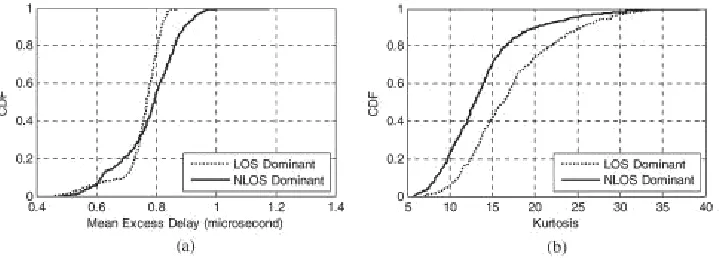
1) Shape-Based features With CSI: Shape-based features exploit the distinction in delay and power characteristics between LOS and NLOS propagation: Given a wireless link, signal transmitted through the LOS path perpetually arrive first.
If patent, the LOS path has weaker attenuation. The mean excess delay τm is defined as:
Fig. 2. CDFs of shape-based features extracted from CSI under LOS/NLOS propagation. (a) Mean excess delay of CIR. (b) Kurtosis of CIR.
Where h (τ) is the CIR. Kurtosis of CIR κ is calculated as:
Where E{.} represents the sampling expectation over delay. μ|h| and σ|h| denote the mean and variance of the CIR amplitude |h(τ)|, respectively. τm and κ approximate the weighted average and peakedness of the received signal power delay profile, and generally, LOS conditions have a smaller τm (shorter average delay) and a bigger κ (an additional sharply distributed power delay profile).
We extracted CSIs from 5000 packets measured underneath typical LOS and NLOS conditions, and calculated the respective CIRs via IFT. Fig. 2(a) and
(b) describes the CDFs of the mean excess delay and kurtosis of CIR. whereas CIRs derived from CSI have shorter mean excess delay and larger kurtosis, a threshold to discriminate LOS and NLOS conditions could cause high false identification rate.
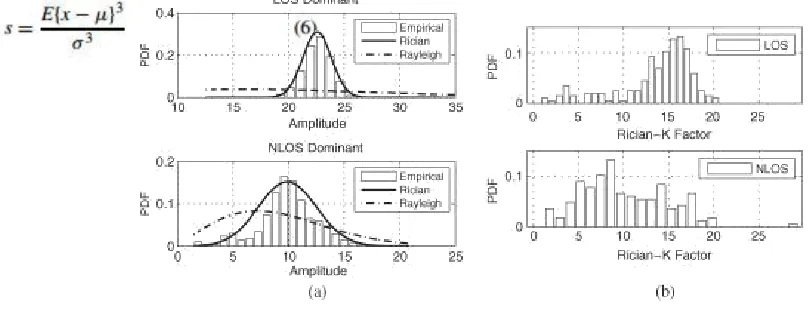
2) Statistics-Based options With CSI: Statistics-based options exploit the distinction of LOS and NLOS propagation in the spatial domain. Signals that are travelling along NLOS paths tend to behave more randomly compared with those on a clear LOS path. We have chosen one model-based feature (Rician-K factor [13]) in
The shape based features are unfeasible due to insufficient bandwidth of Wi-Fi . to enable LOS identification with commercial Wi-Fi , statistics-based features are compensated for the crude CIR measurements by integrating multiple observations. The Rician-k factor also yields large errors. The main problem is that restricted by particular indoor floor plans and the relatively shot transmission distances, the NLOS paths may not be random, thus decreasing the validity of theoretical models.
A key insight to induce additional randomness on NLOS paths is to involve mobility. As shown in fig.4, when the receiver1 moves from RX1 to RX’1, the LOS path experiences slight variation, whereas the NLOS path suffers notable changes in transmission distances, inward angles, and channel attenuation. Yet just in case of undeceivable LOS path, almost all paths would fluctuate significantly throughout Receiver2’s
Fig. 3.(a) An illustration of received envelope distribution. (b) Distribution of Rician-K factor with CSI.
1) Skewness of Dominant Path Power: when the mobility amplifies the fluctuation of NLOS paths, there are two challenges remain:
MAC layer RSS can be noisy, therefore irrelevant variations to the LOS path were induced. In mobile indoor environments, the selected features need to be light-weight and independent on specific distribution modeling owing to location changes and model degradation.
We therefore use skewness to quantify the skewed characteristics. Mathematically, skewness s is defined as:
Where x, μ and σ denotes the measurement, mean, and standard deviation, respectively. In general, the skewness feature under NLOS conditions exhibits larger positive trend and a threshold to differentiate LOS and NLOS conditions with high accuracy exists.
2) Kurtosis of Frequency Diversity Variation: The principle to leverage frequency diversity for LOS and NLOS identification on mobile links is as follows. Assuming a constant gain antenna, that is common for commodity Wi-Fi hardware. In LOS dominant scenarios, the channel fading is comparatively flat since the LOS path dominates. In NLOS dominant scenarios, the greater multipath superposition ends up in additional notable frequency selective attenuation. Consequently, the CSIs measured from one packet could vary even if normalized to a similar frequency. That is, we have a tendency to normalize the CSI amplitudes of one received packet to the central frequency f0:
Where H( fk) and Hnorm( fk) are the original and normalized amplitudes of the kth subcarrier. fk is that
the frequency of the kth subcarrier. STDs under LOS propagation distribute additional peaked whereas those under NLOS propagation demonstrate an additional flat distribution.
To quantify the peaked and flat STD distributions, we adopt kurtosis as a candidate feature. Kurtosis κ is defined as:
where x, μ and σ denotes the measurement, mean, and standard deviation, respectively.
4. PERFORMANCES
5. METHODOLOGY
Testing environments: The measurements campaigns are conducted in office environments include corridors and rooms, covering an area approximately 1500 m2. The room doors are kept open while taking the measurements. For the corridors, we can use CSIs for LOS, through- wall and around corner propagation with a maximum transmitter- receiver distance of 30m. For rooms, we can select a grid o 23 testing locations separated by 2and 2 AP locations. The direct link from one transmitter to one receiver is a clear LOS path, partially blocked by furniture, humans, etc.
Data collection: At the time of measurements, a TP-LINK TLWR741N wireless router is used as transmitter operating in IEEE802.11n AP mode at 2.4GHz. We use two receiver setups: a LENOVO laptop equipped with Intel 5300 NIC and a mini PC with external Intel 5300 NIC to take device diversity into consideration. The firmware is modified and the receiver pings packets from the AP to collect CSI measurements. A group of 30 CSIs are extracted from each packet and processed. To simulate natural human mobility, the receiver is placed on a wheeled desk of 0.8 m in height, and is pushed by two different volunteers. For each measurement, the receiver moves randomly within the range of 1m at a speed from 0.5 m/s to 2m/s. A Smartphone is attached to the receiver to record acceleration traces to measure the average speeds of movements. The ground truth is manually determined for each and every test location based on whether a direct straight line exists between transmitter and the receiver.
5.1 Overall identification performance
To calculate the overall LOS identification performances of the two features, we plot the ROC (Receiver Operating Characteristic) curves of the two features for (1) skewness feature of static links (2) kurtosis feature of static links (3) skewness feature of mobile links (4) kurtosis feature of mobile links.
The Roc curve is a plot between the LOS detection probability PD and the probability of false alarms PFA. It gives the tradeoff between false positives and false negatives of a detection algorithm for a wide range of thresholds.
Fig.5: ROC curve of skewness and kurtosis Fig 6: ROC curve of kurtosis
Static Links vs. Mobile Links: As shown in Fig. 5, the performance of LOS identification on mobile links notably outperforms that on static links, indicating mobility increases the spatial disturbances of NLOS paths. Mobile links are more robust to accidental disturbance since receiver motion dominates the changes of propagation paths. In contrast, static links may suffer environmental dynamics (e.g.,
pedestrians), thus degrading identification performance.
Skewness vs. Kurtosis: Given a constant false alarm rate of 10%, the LOS detection rates of both the skewness feature and the kurtosis feature exceed 90%. The more balanced LOS and NLOS detection
rates of the skewness feature are 90.42% and 90.66%, while those for the kurtosis feature are 93.09% and 92.71%. The kurtosis feature performs slightly better than the skewness feature. A partial explanation might be that the skewness feature relies on extracting the dominant paths, which is error-prone due to lack of synchronization. However, the kurtosis feature is more sensitive to mobility, as its performance dramatically deteriorates on static links.
Combining Skewness and Kurtosis: Since LOS propagation tends to have low skewness feature and high kurtosis feature, we combine the two features and plot a linear separator using Support Vector Machine in Fig. 6. The combination yields marginal performance gain, with the optimal LOS and NLOS detection rates of 94.36% and 95.98%.
5.2. Impact of Propagation Distance
We collect data in the corridor with transmitter-receiver distances ranging from 5 m to 30 m. There is no direct correlation between the LOS identification rates and propagation distances, indicating a single
5.3. Impact of Packet Quantity
To evaluate the real time performance of LiFi, we calculate the LOS and NLOS detection rate with different number of packets, ranging from 500 packets to 2000 packets per measurement. Since the receiver downloads 500 packets from the AP per second, this corresponds to a time range of 1 s to 4 s. As shown in Fig. 10, the LOS and NLOS detection rates of both features retain around 90% with 3 to 4 seconds of measurements. However, the kurtosis feature is more sensitive to the decrease of packet number. With 1 s of measurements, its LOS detection rate drops to below 70% while the NLOS detection rate hovers around 90%, indicating a smaller threshold for more balanced detection rates. This is partially because the kurtosis feature does not filter out NLOS paths with long delays the LOS path. Consequently, background instability and other NLOS paths (although LOS path dominates the propagation) may induce larger variation in case of insufficient packets. In contrast, the skewness
feature achieves reasonable LOS and NLOS detection rates of 77.65% and 82.5%, respectively, even with measurements of only about 1s and the degradation trends of LOS and NLOS detection rates are more consistent. In summary, since both features belong to channel statistics based features, stable estimations rely on adequate received samples, especially with mobile links, unpredictable human behaviors and uncertain background dynamics, which potentially make LOS propagation less deterministic. It suffices to yield satisfactory performance with about 3s of measurements.
5.4 Impact of Moving Speed
To evaluate the impact of moving speed, we calculate the LOS and NLOS detection rate with average speeds of 0.5 m/s, 1.0 m/s, 1.5 m/s and 2.0 m/s. As the receiver is moved by humans, we use a phone accelerometer to track receiver movements, and the volunteer listens to the beats generated by a metronome application to move the receiver back and forth at a certain speed. For each average speed, we collect 200 measurements for LOS and NLOS conditions. It is noticed that a slight performance fall at the moving speed of 2.0 m/s. The results indicate that our scheme is robust to Doppler effects. However, we fail to evaluate faster moving speeds due to the bulky receiver size. We envision CSI measurements on truly mobile devices for evaluation of the impact of Doppler effects within a wider receiver moving speed range.
6. CONCLUSION
In this study, we have explored PHY layer information to identify LOS conditions with WiFi. Noting that mobility magnifies the randomness of NLOS paths though holding the deterministic nature of the LOS component, we have explored channel statistics based features from both the time and the frequency domains in mobile links for LOS identification. We prototype LiFi, a statistical LOS identification scheme with off-the-shelf 802.11 NIC. Extensive evaluations demonstrates an overall LOS detection rate of 90.42% (93.09%) and a false alarm rate of 9.34% (7.29%) for the skewness (kurtosis) feature, whereas the combination of the two features achieves LOS and NLOS identification rates around 95%. We envision this work as an early step towards a bland, pervasive, and fine-grained channel profiling framework, which shows the way for WLAN based communication, sensing and control services in complex indoor environments.
7. REFERENCES
[1]. H. Liu et al., “Push the limit of WiFi based localization for smartphones,” in Proc. ACM Annu. Int. Conf. Mobile Comput. Netw., 2012, pp. 305–316. [2]. F. Adib and D. Katabi, “See through walls with Wi-Fi!,” in Proc. ACM SIGCOMM Conf., 2013, pp. 75–86.
[3]. P. Melgarejo, X. Zhang, P. Ramanathan, and D. Chu, “Leveraging directional antenna capabilities for fine-grained gesture recognition,” in Proc. ACM Int. Joint Conf. Pervasive Ubiquitous Comput., 2014, pp. 541–551.
[4]. Z. Zhou, C. Wu, Z. Yang, and Y. Liu, “Sensorless sensing with WiFi,” Tsinghua Sci. Technol., vol. 20, no. 1, pp. 1–6, Feb. 2015. [5]. K. Wu et al., “CSI-based indoor localization,”m IEEE Trans. Parallel Distrib. Syst., vol. 24, no. 7, pp. 1300–1309, Jul. 2013.
[6]. S. Sen, J. Lee, K.-H. Kim, and P. Congdon, “Avoiding multipath to revive inbuilding WiFi localization,” in Proc. ACM Int. Conf. Mobile Syst., Appl., Serv., 2013, pp. 249–262.
[7]. J. Xiong and K. Jamieson, “ArrayTrack: A fine-grained indoor location system,” in Proc. USENIX Symp. Netw. Syst. Des. Implementation, 2013, pp. 71–84.
[8]. J. Lin, “Wireless power transfer for mobile applications, and health effects,” IEEE Antennas Propag. Mag., vol. 55, no. 2, pp. 250–253, Apr. 2013. [9]. T. Rappaport, Wireless Communications: Principles and Practice, 2nd ed.. Englewood Cliffs, NJ, USA: Prentice-Hall, 2002.
[10].I. Guvenc, C.-C. Chong, F. Watanabe, and H. Inamura, “NLOS identification and weighted least-squares localization for UWB systems using multipath channel statistics,” EURASIP J. Adv. Signal Process., vol. 2008,no. 1, Aug. 2008, Art. ID. 271984.
[11].L. Mucchi and P. Marcocci, “A new parameter for UWB indoor channel profile identification,” IEEE Trans. Wireless Commun., vol. 8, no. 4, pp. 1597–1602, Apr. 2009.
[12].J. Borras, P. Hatrack, and N. Mandayam, “Decision theoretic framework for NLOS identification,” in Proc. IEEE Veh. Technol. Conf., 1998, pp. 1583–1587.
[13].F. Benedetto, G. Giunta, A. Toscano, and L. Vegni, “Dynamic LOS/NLOS statistical discrimination of wireless mobile channels,” in Proc. IEEE Veh. Technol. Conf., 2007, pp. 3071–3075.
[14].D. Halperin, W. Hu, A. Sheth, and D. Wetherall, “Tool release: Gathering 802.11n traces with channel state information,” ACM SIGCOMM Comput. Commun. Rev., vol. 41, no. 1, p. 53, Jan. 2011.