USAGE OF E-SERVICES OF SIB BY
ACCOUNT-HOLDERS:
A STUDY ON PURPOSES AND PROBLEMS
1 Dr. G. Madan Mohan,
2 G. Sophia Soundron1 Assistant Professor, 2 II. MBA
1 Department of Management Studies,
1 Pondicherry University
________________________________________________________________________________________________________
Abstract : This descriptive study has made an attempt to unearth the reasons for account-holders of South Indian Bank (SIB)
utilizing the bank's e-services and problems encountered by them while utilizing these services by administering a well designed questionnaire to 105 account-holders of the bank, selected using Convenience sampling method. Results of the study has revealed that e-services of the bank are heavily used for effecting online purchasing while fund transferring and cash withdrawals have also been good reasons. Account-holders of SIB are totally satisfied with compatibility of their debit/credit cards with the ATM machines and good quality of ATM machines in ATM centres. The problem of shortage of cash in ATM centres has been experienced by majority of account-holders.
IndexTerms - Account-holders, cash withdrawal, fund transfer, online shopping, Problems, Purposes
________________________________________________________________________________________________________
I.INTRODUCTION
Service industry has started utilising technology to utmost extent to attract and retain customers. Banks are no exception to this. In fact, banks are utilising techno-based services heavily to differentiate themselves from their competitors. They are utilizing technology to simplify banking transactions for customers as well as to enable their customers to avail banking services perennially.
1.1 Technology in Banking
ICT (Information & Communication Technology) has exerted strong impact on functioning of banks, their organizational structure, customer servicing and business tactics. Banks resorted to automation as early as during the 1950s with the installation of automated accounts maintenance machines. First ATM (Automated Teller Machine) came to the world in the US on 1968 for facilitating cash withdrawals (Burns, 2000). ATM services resulted in enormous cost saving for banks and time saving for their customers. ATM services currently enable people to effect online purchasing, withdrawing and depositing cash, checking deposit information and transferring funds between accounts of same bank.
1.2 Technology-Based Servicing by Indian banks
The Rangarajan committees of 1984 and 1989 laid strong footing for techno-based services of Indian banks. Recommendations of these two committees led to the RBI constituting a high level committee on 1994 to provide for up-gradation of technologies in banks. The Institute for Development and Research in Banking Technology was instituted in Hyderabad.This institute operates the INFINET (Indian Financial Network), carries forward research and development activities in banking sector and provides training, educational and consultancy services for banks. The institute has pioneered all innovation endeavors of banking sector which led to the provision of electronic-based services by banks such as CBS (Core Banking Services), Banking from Anywhere and Anytime through ATM, mobile and internet banking. Data Centre is functioning linking data of all branches of banks through a centralized server, updating businesses conducted by customers immediately through which banking transactions can be consolidated instantly. This has led to account-holders transformed as customer for the bank and not just a branch of the bank. Entry of private and foreign banks pushed the nationalized banks towards automation and almost all branches of nationalized banks have been computerized and automation has become the order of the day for these institutions (Chandrika,2009).
Liberalized economy has thrown open numerous prospects and problems for Indian banks and ICT enabled services help them to keep pace with global developments and establish a long-term CRM (Customer Relations Management) (Shastri, 2003).
Technology explosion has led to revolutionary changes in Indian banking sector with extensive network branching, ATM facilities, techno-based cash transfers and settlements and the PLR (Prime Lending Rate) concept have changed totally the Indian banking sector on its head which might lead to disappearance of physical bank branches and virtual banking taking over through ICT (PrabhakarRao, 2004).
With rapid explosion of mobile usage in the country, mobile banking services was offered by the Indian banks to utilize mobile technology in offering better and simplified banking services to customers (Hundal and Jain Abhay, 2006). As a result, banks have succeeded in winning over confidence and satisfaction of their customers in a large scale (Joseph et al., 1999).
Techno-enabled services of Indian banks have enabled them to serve customers in a better manner, positively contributing to economic growth of the country as well.
1.3 South Indian Bank
SIB is Kerala-based private bank started during the Swadeshi movement before India’s independence. The bank is operating throughout the country and has got many distinct features such as being the first private bank in Kerala to attain the status of scheduled commercial bank, the first private bank to open a currency chest and to start an industrial financing branch and the bank with third largest number of branches among private banks with all branches under Core Banking System since 2007. The bank has won the best award for utilization of banking technology on 2006 from the Institute for Development and Research in Banking Technology. Hence, account-holders of SIB, which has got many distinct features as a private bank, were selected as target population for this study.
II Objectives of the study
1. To assess the purposes for which the account-holders of SIB use E-Services;
2. To study the problems encountered by account-holders while using e-services;
2.1 Methodology
The proposed research is descriptive in nature, based purely on primary data, collected by administering a well designed questionnaire containing questions on demographic profile of respondents, purposes of using e-services of SIB and problems encountered during usage of the e-services. 105 account holders of SIB, Pondicherry, were selected for this study using Convenience sampling. Data collected were analyzed using SPSS, applying the statistical tools of Frequency, Percentage, Mean, ANOVA, Cluster Analysis and Cross tabs. Normality and reliability of data were established before proceeding with data analysis.
IIIDATA ANALYSIS
Demographic Profile of Account-Holders
Out of the 105 respondents selected for this study, 57.1% are males and 42.9% are females; 24.8% are aged less than 30, 44.8% are aged 30-50 and 30.5% are aged above 50 years; 7.6% are illiterates, 9.5% possess HSE qualifications, 55.2% are graduates, 22.9% are post-graduates and 4.8% are diploma-holders; 75.2% are married, 21.9% are unmarried and 2.9% are separated; 6.7% are government Employees, 75.2% are private Employees, 12.4% are house-wives, 4.8% are businessmen and there is a solitary student; 20.0% have monthly family incomes of less than Rs. 20,000, 40.0% of them have monthly income of Rs. 20,000-50,000 while 40.0% of the respondents have income of more than Rs. 50,000; 8.6% of them have account with SIB for a period of less than one year while 21% of them for 1-5 years and 70.5% for more than 5 years.
Factors Inducing Account-Holders to Use Technology-Based Services of SIB
The factors which are driving account-holders of SIB to utilize technology-driven services of the bank is depicted in table 1.
Table 1: Factors Inducing Account-Holders to Use Technology-Based Services of SIB
Factor Frequency Percent
Reduced time of transaction 26 24.8
Cost effectiveness 28 26.7
Ease of use 27 25.7
Technology capability 24 22.9
Total 105 100.0
Table 1 displays that 24.8% of account-holders seem to use technology-driven services of SIB due to saving of time while 26.7% are using to save cost. 25.7% of the account-holders are using technology-driven services due to simplicity of usage and 22.9% for utilizing their technology capability.
Usage of E-Banking Services
Purposes for which the account-holders are utilizing electronic services of SIB is depicted in table 2.
Table 2: Purposes for Utilizing E-Services of SIB
Purpose Mean
Net Banking Used for Money Transfer 3.9238
ATMs Used for Withdrawals & Checking Balance 3.8762
Debit/Credit cards used for Online Purchases 4.5048
Table 2 suggests that account-holders of SIB are heavily using their debit/credit cards for effecting online purchasing while they are using Net banking for effecting money transfers and debit cards for checking balances and cash withdrawals to a good extent.
Relationship Between Purposes for Usage of E-Services and Profile of Account-Holders
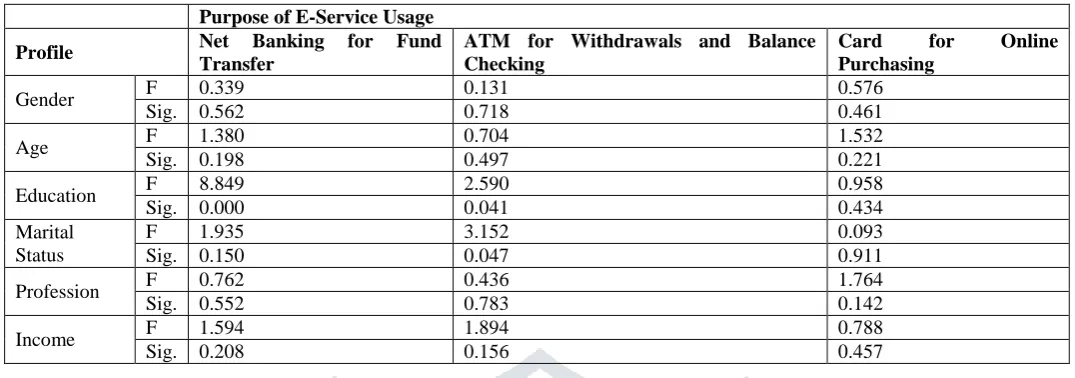
Table 3: Relationship Between Purposes for Usage of E-Services and Profile Purpose of E-Service Usage
Profile Net Banking for Fund Transfer
ATM for Withdrawals and Balance Checking
Card for Online Purchasing
Gender F 0.339 0.131 0.576
Sig. 0.562 0.718 0.461
Age F 1.380 0.704 1.532
Sig. 0.198 0.497 0.221
Education F 8.849 2.590 0.958
Sig. 0.000 0.041 0.434
Marital Status
F 1.935 3.152 0.093
Sig. 0.150 0.047 0.911
Profession F 0.762 0.436 1.764
Sig. 0.552 0.783 0.142
Income F 1.594 1.894 0.788
Sig. 0.208 0.156 0.457
Table 3 depicts that there is no significant difference in usage of ATM service for cash withdrawals, Net banking for fund transfer and debit/credit cards for online purchasing by the account-holders categorized on the basis of monthly family income, profession, age and gender. However, account-holders categorized on the basis of marital status differ in usage of ATM for checking balances and making withdrawals while those grouped on the basis of education differ in the usage of Net banking for fund transfer and ATM service for withdrawal and checking balance. The nature of such differences has been captured in tables 4&5.
Table 4: Relationship Between Education of Account-Holders and their Usage of ATM for Withdrawals and Net Banking for Fund Transfer
Education Net Banking ATM
Illiterate 2.0000 3.5000
Up to HSE 3.6000 3.6000
Degree 4.2069 4.1034
PG 3.9167 3.6667
Diploma 4.4000 3.4000
Total 3.9238 3.8762
Table 4 suggests that graduates and Diploma-holders largely use Net banking for fund transfer followed by post-graduates while those with HSE qualifications use net banking to an average extent while the illiterates do not use the service at all. Graduates use ATM service for making withdrawals and checking balances while account-holders possessing other educational qualifications use the service to a reasonable extent.
Table 5: Relationship Between ATM Used for Withdrawals by Account-Holders and their Marital Status Marital Status Mean
Married 3.9367
Unmarried 3.5652
Separated 4.6667
Total 3.8762
Table 5 suggests that separated account-holders utilize ATM service heavily for checking balances and making cash withdrawals followed by their married counterparts while the unmarried account-holders utilize ATM service to an average extent.
Grouping of Account-Holders Based on E-Services Usage
Based on usage of E-services by the account-holders of SIB, they have been grouped into three clusters using Cluster Analysis and the results are displayed in table 6.
Table 6: Grouping of Account-Holders Based on E-Services Usage
E-Service Usage 1 2 3 F Sig.
Fund transfer 4.46 4.58 2.45 111.289 0.000
Withdrawal and
balance checking 3.08 4.52 3.55
E-Service Usage 1 2 3 F Sig.
Fund transfer 4.46 4.58 2.45 111.289 0.000
Withdrawal and
balance checking 3.08 4.52 3.55
57.384 0.000
No. of Cases 26 38 41
Table 6 showcases the formation of three distinct clusters of account-holders based on their usage of e-services of SIB. All the three statements used to assess the usage of e-services by the account-holders play a significant role in the cauterization process as the F values in respect of the three statements is highly significant at one percent level. Further, based on mean values, the three clusters may be designated as Fund Transfer Users, Holistic Users and Online Purchasers, each engulfing 26, 38 and 41 account-holders respectively.
Demographic Characteristics of Clusters Formed on the basis of E-Services Usage
The demographic characteristics of clusters formed on the basis of e-services usage by the account-holders of SIB has been portrayed in table 7.
Table 7: Demographic Characteristics of Clusters Formed on the basis of E-Services Usage
Profile Fund Transfer Users Holistic Users Online Purchasers Total
Gender Males 14 26 20 60
Females 12 22 11 45
Age < 30 9 11 6 26
30-50 8 26 13 47
> 50 9 11 12 32
Education Illiterates 2 0 6 8
Upto HSE 2 4 4 10
Degree 13 33 12 58
PG 6 10 8 24
Diploma 3 1 1 5
Marital Status Married 15 35 29 79
Unmarried 11 10 2 23
Separated 0 3 0 3
Profession Government employees 1 3 3 7
Private Employees 21 37 21 79
Students 0 1 0 1
House Wives 4 6 3 13
Others 0 1 4 5
Monthly Income < 20,000 3 10 8 21
20,000-50,000 9 20 13 42
> 50,000 14 18 10 42
Table 7 portrays that majority of male account-holders are using e-services in a holistic manner followed by online purchasing and fund transfer while majority of female account-holders are using e-services in a holistic manner followed by fund transferring and online purchasing almost identically. Further, majority of young account-holders are using e-services in holistic manner followed by fund transfer and online purchasing while majority of middle aged account-holders are using e-services in holistic manner followed by online purchasing and then fund transfer. Majority of the old aged account-holders are using e-services in holistic manner as well as for online purchasing followed by fund transfer.
Further, majority of illiterate account-holders are using e-services for online purchasing followed by fund transferring while majority of under-graduates are using e-services in holistic manner as well as online purchasing followed by fund transferring. Bulk of graduates are using e-services in holistic manner followed by online purchasing and fund transferring in an identical margin while majority of post-graduates use e-services in holistic manner followed by online purchasing and then fund transferring. Majority of diploma-holders use services for fund transferring while there are one each diploma-holders using e-services for online purchasing and in a holistic manner.
Furthermore, majority of married account-holders use e-services in holistic manner followed by online purchasing and fund transferring while majority of unmarried account-holders use e-services for both fund transferring and holistic manner followed by online purchasing. All the three separated account-holders utilize e-services in a holistic manner.
Problems Encountered by Account-Holders in Availing E-Services of SIB
Account-holders opinion about problems encountered by them while availing E-Services of SIB has been obtained in three-point scale and the results are displayed in table 8.
Table 8: Problems in Availing E-Services
Problem Mean
Cards get Blocked 1.2857
Shortage of Cash in ATM Machine 1.7429
Machine Out of Order 1.3333
Table 8 suggests that account-holders of SIB have not encountered problems of their cards getting blocked or mal-functioning of ATM machine. However, they have encountered shortage of cash in ATM centers to a marginal extent.
Grouping Account-Holders Based on Problems Encountered by them while Availing E-Services
Proceeding further, the account-holders surveyed have been grouped on the basis of problems encountered by them while availing E-Services of SIB using Cluster Analysis and the results are portrayed in table 9.
Table 9: Clustering Account-Holders Using Problems in Availing E-Services
Problem C1 C2 C3 F Sig.
Cards get Blocked 1.55 1.16 1.19 4.466 0.000
Shortage of Cash in ATM Machine 1.03 1.53 2.18 95.467 0.000
Machine Out of Order 1.17 2.37 1.07 104.071 0.000
No. of Cases 29 19 57
Table 9 portrays the formation of three distinct clusters based on problems encountered by account-holders of SIB while availing E-Services of the bank. All the three problems studied play a significant role in the cauterization process as the F values are highly significant at one percent level. The three clusters so formed are designated as "Nil affected group", "Machine affected group" and "Cash shortage affected group", each encompassing 29, 19 and 57 account-holders respectively.
IV INFERENCES FROM THE STUDY
Account-holders of SIB are utilizing e-services of the bank due to simplicity and to save cost and time as well as to utilize their techno capabilities. This warrants banks to simplify their e-services and make their websites readily accessible on 365*7*24 basis. Account-holders of SIB are heavily using their debit/credit cards for effecting online purchasing while they are using Net banking for effecting money transfers and debit cards for checking balances and cash withdrawals to a good extent. This suggests that e-services of banks are heavily utilized for effecting online shopping. SIB should attract their customers through effective schemes such as cash back offers on utilization of cards for online shopping so that more people shall open accounts with them to avail these benefits.
SIB has to recognize that most of its customers are using its e-services for all the purposes of checking balances, effecting online purchases, fund transfer and cash withdrawals. Hence, the bank should ensure that it is offering the best e-services through updated technologies to retain its customers as well as to attract new customers.
Account-holders of SIB are totally satisfied with compatibility of their debit/credit cards with the ATM machines and good quality of ATM machines in ATM centers which is good news for the bank. The problem of shortage of cash in ATM centers has been experienced by majority of account-holders implying that the bank should ensure that its ATM centers are filled with adequate cash on a regular basis so that shortage of cash never happens.
V CONCLUSION
Technology has become order of the day. Techno-based services differentiates each of the banks from their competitors. Banks operate in a highly competitive environment and it is indispensable for them to retain each one of their customers and attract new customers to expand their market. Provision of efficient and effective electronic-based services alone can transform ordinary banks to successful ones. Otherwise, banks, especially the private ones, will have to encounter serious operational difficulties which might prove fatal for them.
REFERENCES
[1] https://www.southindianbank.com
[2] Burns, P.P. (2000). “Service consistency across channels is a key to success”. America Banker, Vol. 165, No. 68, pp. 4-6
[3] Chandrika K G (2009), “Evolution of Banking Technology: A Study of Public Sector Banks”, The Journal of Institute of
Public Enterprise Vol. 3 Jul-Dec, pp. 91-100
[4] Hundal BS. and Jain Abhay (2006), “Adoption if Mobile Banking Service in India”, The ICFAI Journal of Systems Management, Vol.IV No.2, pp. 63-72.
[5] Joseph M., McClure C. and Joseph B. (1999), “Service Quality in Banking Sector: The Impact of Technology on Service
Delivery”, International Journal of Bank Marketing. Vol.17, No.4, pp 182-191.
[6] Prabhakar Rao Ch. (Jan, 2004). "―Indian banking in 2010"; IBA Bulletin Special Issue, pp 170-173.