Design and Validation of a Science Inquiry Teacher Selection Instrument
Bobby Jeanpierre
University of Central Florida
School of Teaching, Learning and Leadership
University of Central Florida
Orlando, Fl 32816-1250
USA
Debbie L. Hahs-Vaughn
University of Central Florida
Department of Educational and Human Science
University of Central Florida
Orlando, FL 32816
USA
Abstract
Science inquiry continues to be an important science education topic. Even with the new emphasis in the U.S., on science practices in the Framework for K-12 Science Education: Practices, Crosscutting Concepts and Core Ideas (2011), it can be argued that a better understanding of science practices may lead to a better understanding of science inquiry. Science inquiry continues to be integral to effective science teaching. This article is focused on the design and validation of the Science Inquiry Teacher Selection Instrument (SITSI), which is used as a self-reporting tool for teachers’ perceptions of their use of science inquiry skills. The design and validation process resulted in a 12 item survey which can be used to select teachers for participation in professional development and research opportunities where the focus is on science inquiry.
Keywords
:
Science inquiry, instrument validation, teacher inquiry perceptions of practice1. Introduction
Science Inquiry Teacher Selection Instrument (SITSI) was developed to gather information about teachers’ perceptions of their inquiry instruction. Inquiry in science education is not new and over the years it has been defined in a myriad of ways. For this article, the National Science Education Standards (1996) also referred to as NSES, explanation of science inquiry and science research literature was used to guide the development of the inquiry instrument. Inquiry is describe as , “when children or scientists inquire into the natural world they: 1) ask questions about the natural world, 2) plan investigations and collect relevant data, 3) organize and analyze collected data, 4) think critically and logically about relationships between evidence and explanations, 5) use observational evidence and current scientific knowledge to construct and evaluate alternative explanations, and 6) communicate investigations and explanations to others” (National Science Research Council, 1996, p. 122 & 145). This description of inquiry includes practices that may be viewed as a combination of both simple and complex science skills.
Since the publication of these documents, a wealth of other inquiry-based teaching and learning publications, research articles, books, and methods have been developed. This has been both beneficial and challenging to developing an agreed upon conception of science inquiry.
It has been beneficial to see teachers have access to a variety of resources on inquiry to guide how they facilitate student active participation in doing science and challenging in that the numerous interpretations of inquiry may have impeded classroom teachers’ understanding of how to carry it out well with their students. Today, the Framework for K-12 Science Education: Practices, Crosscutting Concepts and Core Ideas (2011) has replaced inquiry with the term science practices as the key science instructional strategy. It is hoped that by providing a clear description of science practices, clarity as to what is meant by scientific inquiry can be achieved. In the new framework, it states, “We use the term “practices” instead of a term such as “skills” to emphasize that engaging in scientific investigation requires not only skill but also knowledge that is specific to each practice” (p.45).A number of challenges exist in conceptualizing and carrying out science inquiry in the classroom; yet, it has been a beneficial instructional strategy. Minner, Levy, & Century (2010) examined 138 inquiry studies and found that the impact of inquiry practices on student learning and retention has been shown to be positive in 51% of these studies. It can be argued that teachers’ implementing effective science inquiry is essential to promoting excellence in science teaching and learning in today’s classrooms.
2. Purpose
Science Inquiry Teacher Selection Instrument (SITSI) was developed to gather information about teachers’ self-reported perceptions of their inquiry instruction. The inquiry study was a five-year longitudinal case study that focused on how teachers carried out inquiry” in their classrooms. Prior to observations of teachers who were selected to participate in the longitudinal case study, an appropriate instrument to identify teachers’ perceptions of their inquiry practice was developed and later validated.
3. Method
The survey of teachers’ perceptions of their inquiry practices, Science Inquiry Teacher Selection Instrument (SITSI) was constructed based on descriptions of inquiry as stated in the National Science Education Standards (1996) which referenced science process skills teachers should promote in their classrooms if they are doing inquiry. Two science educators worked collaboratively to develop the instrument. The instrument consisted of two major parts. Part one consisted of teacher background information (i.e., name, year graduated the master’s program) and school information (i.e., school district, grade level, subjects taught, number of students, classroom space allocation, access to materials to conduct inquiry and/or problem), qualitative responses about specific inquiry projects and practices (i.e., identify project, length of time, where did the inquiry occur, the results of the inquiry, and how students’ worked was assessed). Part two of the survey focused on the science process skills. The inquiry process skills items used in the Science Inquiry Teacher Selection Instrument (SITSI) were derived from the National Science Education Standards (1996) explanation of science inquiry and science research literature. According to the National Science Education Standards definition/description of inquiry, it states, “when children or scientists inquire into the natural world they: 1) ask questions about the natural world, 2) plan investigations and collect relevant data, 3) organize and analyze collected data, 4) think critically and logically about relationships between evidence and explanations, 5) use observational evidence and current scientific knowledge to construct and evaluate alternative explanations, and 6) communicate investigations and explanations to others” (National Science Research Council, 1996, p. 122 & 145).
Facilitator may be an excessively used term in some educational circles, but we thought it provided a stronger representation of what we expected to see teachers doing in their classroom, if they used inquiry. Facilitator in this research is one who uses questioning and experiences to guide students in making sense of the learning activity at hand. We asked specific questions to identify whether teachers saw themselves as facilitators of student learning.
Example questions included: “I am a facilitator of students ’learning”; “I ask students what they are interested in learning”; “I use discrepant events to motivate students “; I use students’ interests as a guide when constructing my lessons; I do not depend on the textbook. Additionally, the survey included an item related to authentic inquiry. An example of an authentic research skill included in the survey was “students researching expert research reports as a part of their classroom inquiry.” Chinn and Malhotra (2002) argued that “…reading expert research reports play almost no role at all in simple forms of school science. At most, students conduct their own research and make some reports to each other” (p.186). The survey item which specifically addressed this concern was: “I have students read the research of others in the science community which relates to their own research interest prior to deciding on a research question.” At the conclusion of this process, 17 Likert-rated items were developed to describe teachers’ self-reported perceptions of inquiry and how often they used inquiry in their classroom. The Likert scale ratings used for each statement were: 5 (almost always), 4 (often), 3 (sometimes), 2 (seldom) and 1(almost never). The 17 items were divided into two sub-groups: general skill and complex skill. An example of general inquiry skill and complex inquiry skill. An example of a general skill is “develop research question; and example of more complex skill, “design research design and data collection method.”
The instrument components presented in this article represent the validation of the closed-end items related to inquiry science process skills and teacher instructional practices. The above stated survey items of science process skills and instructional practices are also listed in (Appendix A).The survey was piloted during spring 2005 with a group of teachers (n=12) enrolled in a master’s mathematics and science program at a large post-secondary institution in the southeast. The teachers’ input was reviewed and used to revise the original instrument. From the first pilot of the survey instrument, teachers’ comments focused on how long (wordy) several items were, and the lack of clarity of several items. After revisions, based on their suggestions, the instrument was piloted with a smaller sub-sample of K-8 master’s in mathematics and science program teachers (n= 5). Revisions were made to the instrument based on suggestions from the second pilot group. This follow-up review resulted in separating the open-ended survey items into distinct short response questions. To increase credibility of the sample for this study, pre-notifications were sent, teachers were targeted, and published e-mail addresses were used. (Shammon, Johnson, Searcy, & Lott, 2002).The developed inquiry survey was sent out twice. The first distribution was in 2005 to 338 k-8 science and mathematics program teachers. Approximately 5% of targeted e-mails returned undeliverable. Of the remaining 319 recipients (42%) visited the site, and 32% completed either all (28%) or parts (4%) of the survey. The most common reason for respondents not completing all parts of the survey was that they were no longer a classroom teacher (screening question). Teachers had two weeks to respond to the survey and a reminder was sent out at the end of week one. The second distribution of the developed inquiry survey was in 2008. Surveys were emailed to teachers in a large urban district in central Florida. Approximately 370 teachers were identified via e-mail addresses and sent information on the study and a request to complete the on-line questionnaire. Two hundred seventy one valid responses were obtained; of those responses 83 were identified as elementary education teachers and 95 were identified as middle school science teachers. The remaining 42 respondents were not instructing their own students but were elementary science specialists, science coaches or served in a support capacity to the regular classroom teacher. Many respondents completed all items; however, one response with very few answered questions was deleted and there were several other unusable surveys that were partially answered. Teachers had four weeks to respond to the survey and received weekly reminders. At the conclusion of week four, there were 88 usable surveys returned. The usable surveys were those that were answered completely. The validation analysis of survey is presented in the following section.
4. Construct Validity Analysis
4) I have students working on different research questions during a class period; and 5) I welcome students’ questions. Hence the original 17 items were reduced to 12. The analysis presented below is based on the remaining 12 items. The initial factorability of the remaining 12 items on the Science Inquiry Teacher Selection Instrument was examined using common criteria for determining the factorability of the items including reviewing correlation of items, Kaiser-Meyer-Olkin measure of sampling adequacy, Bartlett’s test of sphericity, and communalities.
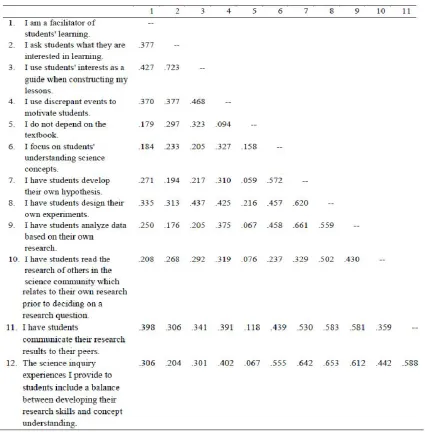
First, 11 of the 12 items correlated at least .30 with at least one other item (see Table 1). Second, the Kaiser-Meyer-Olkin measure of sampling adequacy was .871, larger than the recommended value of .6. Third, Bartlett’s test of sphericity was statistically significant [
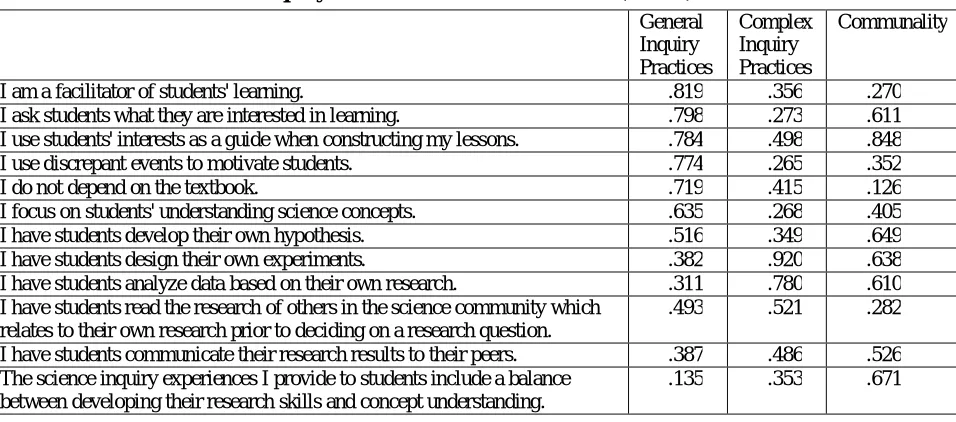
2 (66) = 440.56, p< .001]. Fourth, shared variance among the items as determined by communalities above the recommended value of .3 was examined. In reviewing communalities of the 12 items, there were three communalities below .3 (see Table 2). However, given the other criteria for determining factorability were met, it was determined that it was reasonable to proceed with determining the factor structure of the 12 items.Table 2: Factor Loadings and Communalities Based on Maximum Likelihood Analysis for 12 Item Science Inquiry Teacher Selection Instrument (N = 88)
General Inquiry Practices
Complex Inquiry Practices
Communality
I am a facilitator of students' learning. .819 .356 .270
I ask students what they are interested in learning. .798 .273 .611
I use students' interests as a guide when constructing my lessons. .784 .498 .848
I use discrepant events to motivate students. .774 .265 .352
I do not depend on the textbook. .719 .415 .126
I focus on students' understanding science concepts. .635 .268 .405
I have students develop their own hypothesis. .516 .349 .649
I have students design their own experiments. .382 .920 .638
I have students analyze data based on their own research. .311 .780 .610
I have students read the research of others in the science community which relates to their own research prior to deciding on a research question.
.493 .521 .282
I have students communicate their research results to their peers. .387 .486 .526
The science inquiry experiences I provide to students include a balance between developing their research skills and concept understanding.
.135 .353 .671
Maximum likelihood estimation with promax rotation was used to extract the factors from the data. Initial eigenvalues indicated the first two factors explained 42% and 14% of the variance respectively. The remaining factors did not have eigenvalues greater than one therefore solutions for more than two factors were not examined. The two factor solution, which explained 57% of the variance, was preferred due to: 1) theoretical support; 2) review of the scree plot which indicated the eigenvalues leveled off after two factors; and 3) difficulty in interpreting three or more factors. The correlation between the two extracted factors was .462. All items contributed to a simple factor structure and had a primary factor loading of .35 or above. There were three items that had a cross-loading above .3, however these items had strong primary loadings with one of the two factors so were retained in the factor structure. Table 2 provides the factor loading matrix for the final solution. The names for the two factors are: general inquiry practices and complex inquiry practices. The results of the factor analysis lend support to internal structure validity evidence supporting the conclusion that the scores from this instrument are a valid assessment of a person’s general inquiry practices and complex inquiry practices. General inquiry practices as defined in this research include teachers’ facilitation of student learning, interests, understanding, and motivation using discrepant events, non-dependence of textbook and developing hypothesis. The complex inquiry practices are those often less experienced by students in K-12 classrooms and include design their own experiments, analysis of data based on their own research, read research publications to guide develop of their own research questions and experience a balance between the development of their research ability and science conceptual understanding. Internal consistency for each of the subscales was examined using Cronbach's alpha and was .731 for general inquiry practices and .859 for [complex inquiry practices]. A substantial increase in Cronbach's alpha would not be achieved by deleting any items from the scales.Composite scores were created for the two factors by computing the mean of the items which loaded most strongly on each of the factors. Higher scores indicate more alignment with science inquiry methods. Descriptive statistics for the scales are provided in Table 3.
5. Discussion
Our current focus in the U.S. on science inquiry practices in the new Framework for K-12 Science Education Practices: Crosscutting Concepts and Core Ideas (2011), supports the need to continue to investigate teachers’ perceptions of science inquiry practices and how they carry them out in their classroom. In other words, what is the extent of congruence between teachers’ perception (what they think about their instruction) and implementation (how they actually carry out their instruction). This instrument is unique from the perspective that it was developed with the aim to pre-determine if teachers were suitable for participation in a study where their implementation of inquiry would be observed. Hence, it was intended to be an instrument to select teachers to participate in a longitudinal study based on their self-reported perceptions of their inquiry practice. It was also important to the study to determine if there was congruence between their reported self-perceptions of inquiry, how they implemented it, and NSES, 1996 descriptions of inquiry skills.
An instrument, which produces valid and reliable score which can assist in the selection process of teachers who say they use science inquiry is important. The results from this instrument provided insights as to how teachers viewed their inquiry classroom instruction prior to any observations of their instruction. The SITSI may facilitate science education researchers’ selection of participants for science inquiry research for it focuses on teachers perceptions of their use both science process skills ( I have students analyze data based on their own research.) and science knowledge, (I focus on students’ understanding science concepts). Observations of teachers’ instructional practices to identify congruence between what they report and what they actually do in the classroom, may provide clearer insights as to what they mean by “doing inquiry.” It is recommended that this instrument be coupled with teacher observations to obtain a clearer and more in depth picture of what teachers mean when they say they use inquiry practices. This is an important tool because when making decisions on selecting participants where financial resources are limited, it may facilitate and focus the participant selection process to obtain the intended study population pool. Also, where the focus is on inquiry practices, the SITSI may facilitate the process of participant selection for professional development and research opportunities. The preparation of this manuscript was funded by a grant from the National Science Foundation (NSF, Grant REC-0447676).
References
Anderson, R.D. (1983). A consolidation and appraisal of science meta-analyses. Journal of Research in Science Teaching, 20(5), 497-509.
Chinn, C.A. & Malhotra, B. A. (2002). Epistemologically authentic inquiry in
Schools: A theoretical framework for evaluating inquiry tasks. Science Education, 86(2). 175-218.
Cuevas, P., Lee, O., Hart, J., & Deakor, R. (2005). Improving science inquiry with elementary students of diverse backgrounds. Journal of Research in Science Teaching, 42(3), 337-357.
Dewey, J. (1910).Science as subject-matter and as method. Science, 121-127.
Minner, D. D., Levy, A. J., & Century, J. (2010). Inquiry-based science instruction—What is it and does it matter? Results from a research synthesis years 1984 to 2002. Journal of Research in Science
Teaching, 47(4): 474-496.
Minner, D.D., Levy, A. J., & Century, J. (2010). Inquiry-based science instruction- What is it and does it matter: Results from a review synthesis years 1984-2002. Journal of Research in Science Teaching, 47, 474-496. National Science Research Council. (2011). A Framework fork-12 Science Education: Practices, Crosscutting
Concepts, and Core Ideas. Washington, DC: National Academy Press.
National Science Research Council. (1996). National Science Education Standards. Washington, DC: National Academy Press.
NRC. (2000). Inquiry and the National Science Education Standards: A guide for teaching and learning. Washington, DC: National Academy Press.
Appendix A- Original SITSI
5= (Almost always), 4= (often), 3= (sometimes), 2= (seldom), 1 = (almost never) 1. I am a facilitator of students’ learning. 5 4 3 2 1
2. I welcome students’ questions. 5 4 3 2 1
3. I encourage students to seek answers to their own questions. 5 4 3 2 1 4. I ask students what they are interested in learning. 5 4 3 2 1
5. I use students’ interests as a guide when constructing my lessons. 5 4 3 2 1 6. I use discrepant events to motive 5 4 3 2 1 students.
7. I do not depend on the textbook. 5 4 3 2 1
8. I focus on students’ understanding science concepts. 5 4 3 2 1
9. I have students working on different research questions during a class period. 5 4 3 2 1 10. I have students develop their own hypotheses. 5 4 3 2 1
11. I have students design their own experiments. 5 4 3 2 1
12. I have students analyze data based on their own research. 5 4 3 2 1
13. I have students interpret their data based on their research evidence. 5 4 3 2 1
I4. I have students read the research of others in the science community which relates to their own research prior to deciding on a research question. 5 4 3 2 1
15. I have students communicate their research results to their peers. 5 4 3 2 1
16. I haves students share their research results in a formal out of class setting. 5 4 3 2 1 (science fair competition, Westinghouse Student competition.
17. The science inquiry experiences you provide to students include a balance between developing their research skills and concept understanding. 5 4 3 2 1
Validation SITSI Items
1. I am a facilitator of students' learning.
2. I ask students what they are interested in learning.
3. I use students' interests as a guide when constructing my lessons. 4. I use discrepant events to motivate students.
5. I do not depend on the textbook.
6. I focus on students' understanding science concepts. 7. I have students develop their own hypothesis. 8. I have students design their own experiments.
9. I have students analyze data based on their own research.
10. I have students read the research of others in the science community which relates to their own research prior to deciding on a research question.
11. I have students communicate their research results to their peers.