Journal of
Applied Research on Industrial Engineering
Journal of Applied Research on Industrial Engineering
Vol. 2, No. 2 (2015)120-138
Using DEMATEL – ANP hybrid algorithm approach to select the most
effective dimensions of CRM on innovation capabilities
Elahe Shariatmadari Serkani 1
1 Phd student,department of Industrial Engineering, Science and Research Branch, Islamic Azad University, Tehran, Iran ([email protected])
A B S T R A C T A R T I C L E I N F O
Customer relationship management (CRM) and innovation are widely considered to be valuable capabilities associated with competitive advantage. CRM is a comprehensive guideline and process of management and data sharing with key customers to prompt supreme values of partnership and customers. Innovation is an important factor in setting successful mature firms apart from their competitors. Innovation capability assessments are methods to evaluate the innovation capability of enterprises, in particular, for the identification of their strengths, the improvement of their potentials, and for a good basis for a sustainable improvement of the innovation capability. The propose of this study is choosing the most effective dimensions of CRM by using the hybrid approach of Decision Making Trial and Evaluation Laboratory (DEMATEL) and Analytic Network Process (ANP). Thus, based on experiences of the industry firm, we draw the causal relations among innovation capabilities using DEMATEL mathematical model and determine their effects on each other. Then based on these causal relations, we choose the most effective dimensions of CRM by using the ANP model. At the result, “long-term cooperation” has the best score and can be said that it is the most effective dimensions and And then respectively followed by Customer relationship management technology-oriented, Customer participation, information sharing and consultation on problems.
Article history :
Received: 5 June 2015 Received in revised format: 25 June 2015
Accepted: 10 July 2015 Available online: 10 September 2015
Keywords : CRM, Innovation capabilities, DEMATEL, ANP.
1.
Introduction
121
implementing this strategy. CRM is a multi-perspective business paradigm that is comprised of people, process and technology (Chen and Popovich, 2003). CRM can be seen as the consistent organizational activity under usage of integrated selling, marketing and service strategy. That is, trying to define the real need of the customer, by the enterprise integrating various process and technology, in asking internal product and service improvement, to dawn effort of enhancing customer satisfaction and loyalty (Kalakota and Robinson, 1999). In 2001, Kalakota and Robinson also offered the concept of CRM system to synthesize with functions of sales, customer service, and marketing activity, all based on customer orientation. The same idea also served as the developmental foundation of CRM system upgrades in the present.
At present, the growth and development of the technology have caused most of the organizations to provide customers their products and services with high quality and low prices. By changing role of the customer (customers changing role) for the organization, from state of following producers, to leading manufacturers and other innovators, such idea cannot be assurance company's success in this environment. In these situations the customer is considered as a reliable competitive advantage for organizations. Nowadays, in the competitive world with domestic and foreign complex markets, the aims of organizations satisfy audience and customers by providing the needs of them. In today's extensive market success or failure of each organization depends on the type of relationship with customer and satisfaction of him. As a result, organizations to obtain satisfy customer’s need and valuable competitive advantage, forced to promote innovation capabilities. But development and improvement of innovation capabilities to respond to demands of competitive markets have become an important issue for organizations. Customer is the core of any business activity. The study of relationship management procedures with customer of all organizations and industrial settings are believed to be the underlying need of modern society. On the other hand, all agreed that one of the most complex things facing organization is innovation. Selecting the most effective dimensions of CRM on the innovation’s capabilities in an organization is the aim of this study. In other words, we want to know which dimensions of CRM can transmit customer feedbacks more than the rest, in terms of upgrading the innovation capabilities in the organization. Because by increasing this dimension, company can be reach customer’s practical points faster than other competitors. Responding to these comments and hearing the voice of the customer is the way to achieve suitable innovation. In principle, finding the most effective dimensions will help us to know in which dimensions of innovation should be more investment. And hereby, and having this valuable information can make the most effective innovation.
To draw the causal relations between innovation capabilities and determine their effects on each other, Decision Making Trial and Evaluation Laboratory (DEMATEL) model was used. Then based on these causal relations, we ranked five dimensions of CRM and chose the most effective dimensions of CRM by using Analytic Network Process (ANP).
2.
Literature Review
2.1.
Customer relationship management and innovation capability
122
clients (Bose, 2002; Foss et al., 2008; Becker et al., 2009). CRM principally revolves around marketing and begins with a deep analysis of customer behavior (Kotler, 1997).
Generally, there are two streams of CRM literature, the process of developing CRM and the content of CRM. Reinartz et al. (2004) divided CRM process into initiation, maintenance, and termination from the points of process view. In contrast, CRM content is related to various activities to enhance customer relationships, For instance, Sin et al. (2005) showed that CRM involves activities that manufacturer practice to satisfy customer needs, identify customer preferences, resolve customer complaints, provide after-sale service, and establish long-term relationships with their customers. In addition, McEvily and Marcus (2005) suggested that firms have to build mutual trust, information sharing, and joint problem solving with their customers to acquire competitive capabilities.
Innovation is an idea, practice, or object that is perceived as new to an individual or another unit of adoption (Fruhling and Siau, 2007). Green et al. (1995) also showed that innovation is a multi-dimensional concept where manufacturers focus on product, process, and service to implement gradual modification (e.g. product line expansion, current function, and minor adjustments in operation activities). Innovation capability refers to the implementation or creation of technology as applied to systems, policies, programs, products, processes, devices, or services that are new to an organization (Chang and Lee, 2008; Damanpour and Evan, 1984). Innovation capability is also the ability of firms to assimilate and utilize external information for transfer into new knowledge (Cohen and Levinthal, 1990).
There are two key aspects of innovation: the degree of innovation and the scope of innovation. The degree of innovation is differentiated into radical and incremental innovation. Radical innovation is a dramatic breakthrough in a new product, new market, or new technology (Green et al., 1995). Weerawardena (2003) considered innovation to be modification of product, process, service, organizational systems, and marketing systems in order to create customer value. The scope of innovation capability consists of technical innovation and administrative innovation (Damanpour, 1991). Technical innovations include products, marketing, services, and the technology used to produce products, product sales, or render services directly related to the basic work activity of an organization (Damanpour and Evan, 1984; Daft, 1982). Administrative innovation pertains to organizational structure and administrative processes, indirectly related to the basic work activity of the organization and is more directly related to its management (Damanpour and Evan, 1984).
Janbozorgi et al., (2015) present a framework to evaluate the readiness of hotels in terms of inter-organizational factors in order to implement CRM using fuzzy approach. Parsian Esteghlal Hotel employees, managers and experts constituted the study population. The importance of the indicators using Fuzzy ANP and DEMATEL integrated approach. The results showed that the readiness of Parsian Esteghlal Hotel to implement CRM in dimensions of culture, processes, and hardware, software and information systems was desirable and in dimensions of staff and managers was not desirable.
Shahhosseini et al. (2015) comparised the performance of organizations on CRM implementation by using an integrative approach of Fuzzy ANP and DEMATEL. it was include that integrative technology was the most important dimension, then respectively other dimension, which are CRM process, customer and output CRM.
123
Table 1. CRM activities and innovation capabilities
Dimensions of CRM
Innovation capabilities
(1) Information sharing.
It refers to the sharing and exchange of essential and exclusive information through interactive activities between manufacturers and their customers (McEvily and Marcus, 2005; Mentzer et al., 2000). The commonly shared information includes market demand, customer preferences, sales promotion, and new product introduction (Mentzer et al., 2000).
-Market Information -Produce Information -Information Records - Programs offered Products -Event Information
(1) Product innovation.
It is the development and introduction of a new product to the market or the modification of existing products in terms of function, quality consistency, or appearance (Liao et al., 2007).
- New Product
-Production Supply Channel -New Markets
-Special Markets
(2) Customer participation
It is related to customer participation in new product development activities, technical meetings, supply chain annual conference, and market evaluation conferences. Customers normally provide market trend/direction and technical support in the process, which should lead to better understanding of future demands (Sin et al., 2005).
-Development of new products -Periodical review
-Product improvement -Market evaluation
(2) Process innovation.
It involves creating and improving the method of production, and the adoption of new elements to the firm’s production process (Damanpour, 1996).
-Process technology -Register patent -Design equipment -Process control Technology
-Advanced quality measurement system - Programmable devices
-Programmable equipment (3) Long-term cooperation.
It is a business relationship with trust and commitment between two firms. Both firms must share similar goals and pursue mutual profits on a reliable and dependable basis (Mohr and Spekman, 1994). Numerous studies have proven that a long-term partnership entails high degrees of commitment and mutual trust in which both parties are willing to provide resources, in a fair and dependable manner, in order to maintain and reach the goals of both parties (Handfield and Bechtel, 2002).
-Commitment -Confidence -Special products -Customer loyalty -Communication
-Long term communication development
(3) Marketing innovation.
It refers to market research, price-setting strategy, market segmentation, advertising promotions, retailing channels, and marketing information systems (Vorhies and Harker, 2000; Weerawardena, 2003).
Method of estimating price -Distributions methods -Market development Method -CRM advanced System
(4) Consultation on problems
It refers to collaboration between manufacturers and customers in solving problems together and sharing responsibilities when they encounter difficult or unexpected situations (McEvily and Marcus, 2005).
- Overcome problems -Sense of shared responsibility - Settle problems
(4) Service innovation.
It refers to manufacturers’ engagement in various innovation activities to enhance customer satisfaction, including after-sale services, warranty policy, maintenance routines, and order placement systems (Gopalakrishnan and Damanpour, 1997). Modern After sales Service System
-Modern procedure debts settlement -After and before sale services methods
(5) Customer relationship management technology-oriented
It involves manufacturers using computer technologies to facilitate various CRM activities and actively offer technology assistance to customers, including data storage, data mining, and CRM software systems (Sin et al., 2005).
-Information desk -Analyzed system
-Management information System
-Assessment performance system Customer Relationship Management
(5) Innovation in Sales -Sales management systems -Different strategies sales
(6) Administrative innovation.
It refers to changes in organizational structure or administrative processes, such as the recruitment of personnel, the allocation of resources, and the structuring of tasks, authority, and rewards (Damanpour, 1992; Gopalakrishnan and Damanpour, 1997). -Reward system
-New design
124
2.2.
DEMATEL (Decision Making Trial and Evaluation Laboratory)
A decision making trial and evaluation laboratory (DEMATEL) is developed by Battelle Memorial Institute (BMI) (Gabus and Fontela, 1973; Fontela and Gabus, 1976) applied to the resolution of sophisticated issues. The DEMATEL method uses digraphs to categorize the influencing factors into two groups: cause group and effect group. There are five steps to perform the DEMATEL process:
Step 1: Calculate the scores and Produce the direct-influence matrix.
Define the scale to show the impact levels. Respondents were asked to indicate the direct
effect that they believe each element i experts on each element j of others, as indicated by 𝑋𝑖𝑗,
using an integer scale (scores) arranging from 0 to 4; set the influence scales: 0 (no influence), 1 (low influence), 2 (medium influence), 3 (high influence), and 4 (very high influence). Next, the pair-wise comparisons are made according to influence and direction between criteria. Then, form the direct-influence matrix: a 𝑛 × 𝑛 matrix X, where 𝑥𝑖𝑗 expresses the level of how the
service attribute i affects service attribute j. The value of a diagonal line in this matrix is 0.
𝑋 =
[
0
x12…
x1n21
x
0
…
x
2n⋮
1 n
x
⋮
2 n
x
⋱
…
0 ]
⋮
(1)
Step 2:
Calculate the normalized direct-influence matrix.
The normalized direct-influence matrix D is obtained by Eqs. (2) and (3), the matrix D is
obtained by multiplying each element of A by the scalars. Note that each element dij of matrix
D is between zero and less than 1.
𝐷 = 𝑠. 𝐴 𝑆 > 0
(2)
Where
𝑠 = 𝑚𝑖𝑛 [
max 1𝑖 ∑ |𝑎𝑖𝑗| 𝑛 𝑗=1
,
1 max
𝑖 ∑ |𝑎𝑖𝑗| 𝑛
𝑖=1
] 𝑖, 𝑗 = 1, … . , 𝑛.
(3)
Step 3:
Compute the total relation matrix.
A continuous decrease of the indirect effects of problems along the powers of matrix D, e.g. 𝐷2, 𝐷3, … , 𝐷∞ guarantees convergent solutions to the matrix inversion similar to an absorbing
Markov chain matrix. Note that lim 𝐷
𝑚
𝑚 → ∞= [0]𝑛×𝑛 and lim(𝐼 + 𝐷 + 𝐷2+ 𝐷3+ ⋯ + 𝐷𝑚)
𝑚 → ∞ = (𝐼 − 𝐷)−1, where 0 is the n×n null matrix and I is the n×n identity matrix. The total relation matrix T is an n×n matrix and is defined as follow:
𝑇 = [𝑡𝑖𝑗] 𝑖, 𝑗 = 1,2, … , 𝑛 where
𝑇 = 𝐷 + 𝐷2+ 𝐷3+ ⋯ + 𝐷𝑚
(4)
= 𝐷(I + D + 𝐷 + 𝐷2+ ⋯ + 𝐷𝑚−1)
125
= (𝐼 − 𝐷)−1 , 𝑎𝑠 𝑚 → ∞We also define r and c as n×1 vectors representing the sum of rows and sum of columns of the total relation matrix T as follows:
𝑟 = [𝑟𝑖]𝑛×1= (∑𝑛 𝑡𝑖𝑗
𝑗=1 )𝑛×1
(5)
𝑐 = [𝑐
𝑗]
1×𝑛́ =(∑
𝑛𝑗=1𝑡𝑖𝑗)
1×𝑛́
(6)
Where superscript
denotes transpose.Let ri be the sum of i-th row in matrix T. Then ri shows the total effects, both direct and indirect, given by factor i to the other factors. Let 𝑐𝑗 denotes the sum of j-th column in matrix T. Then 𝑐𝑗 shows the total effects, both direct and indirect, received by factor j from the other
factors. Thus when 𝑗 = 𝑖, the sum (𝑟𝑖+ 𝑐𝑖) gives us an index representing the total effects both
given and received by factor i.
In other words, (ri+ ci) shows the degree of importance (total sum of effects given and
received) that factor i plays in the system. In addition, the difference (ri+ ci) shows the net effect that factor i contributes to the system. When (ri+ ci) is positive, factor i is a net causer, and when (ri+ ci) is negative, factor i is a net receiver (Tzeng et al. 2007; Tamura et al., 2002).
Step 4:
Set a threshold value and obtain the impact-relations-map.In order to explain the structural relation between the factors while keeping the complexity of the system to a manageable level, it is necessary to set a threshold value p to filter out some negligible effects in matrix T. While each factor of matrix T provides information on how one factor effects another, the decision-maker must set a threshold value in order to reduce the complexity of the structural relation model implicit in matrix T. Only some factors, whose effect in matrix T is greater than the threshold value, should be chosen and shown in an impact-relations-map (IRM) (Tzeng et al., 2007).
In this paper, the threshold value has been obtained by average of scores of T matrix. As long as the threshold value has been decided, the final result can be shown in an IRM. If the influence level of an element in matrix T is higher than the threshold value, then this element is included in the final impact relations map.
2.3.
Analytic Network Process (ANP) Method
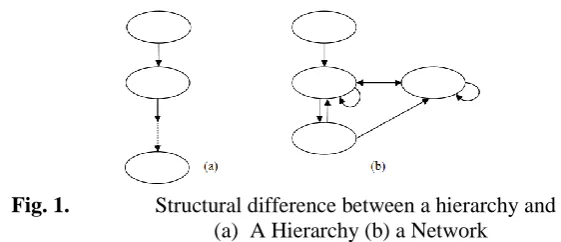
The ANP, a new theory extending from the AHP, is proposed by Saaty (1996). AHP model contains hierarchical relationship between overall goal, criteria, sub criteria and alternatives. But the problems don’t always show hierarchical structure. In such a case, ANP structures the problem as network instead of hierarchical modeling. However in ANP, criteria in the lower level may provide feedback to the criteria in the higher level, and the interdependence between the criteria in the same level is permitted .Another difference between AHP and ANP in calculation process is that a new concept “super-matrix” is introduced in ANP. The application steps of ANP are as follows (Saaty, T.L., 1999).The ANP is composed of four major steps:
Step 1: Identify the Decision Criteria.
Firstly, criteria, sub criteria and alternatives are defined. Step 2: Forming the Network Structure.
126
includes the goal and the decision criteria. The network level consists of the elements controlled by the control level. The structure can be obtained by the opinion of decision-makers through brainstorming or other appropriate methods. Network is formed based on relationship between clusters and within elements in each cluster. An example of the format of a network is shown in Figure 1(b).
Fig. 1. Structural difference between a hierarchy and a network.
(a) A Hierarchy (b) a Network
Step 3:
Forming Pair-wise Comparison matrices and obtaining priority vector.
Pair-wise comparisons are performed on the elements within the clusters as they influence each cluster and on those that it influences, with respect to that criterion. The pair-wise comparisons are made with respect to a criterion or sub-criterion of the control hierarchy. Thus, importance weight of factors is determined. In pair-wise comparison, decision makers compare two elements. Then, they determine the contribution of factors to the result (Saaty, T.L., 2001).In ANP, like AHP, it is formed pair-wise comparison matrices with use 1-9 scale of relative importance proposed by Saaty.1-9 scale of relative importance is given at Table 2.
Table 2. Scale of relative importance.
Intensity of Importance Definition
1 Equal importance
3 Moderate importance
5 Essential or strong importance
7 Very strong importance
9 Extreme importance
2,4,6,8 Intermediate value between adjacent scale values
A reciprocal value is assigned to the inverse comparison; that is, aij=a1
ji, where aij(aji)
denotes the importance of the ith (jth) element.
Like AHP, The values of pair-wise comparisons are allocated in comparison matrix and local priority vector is obtained from eigenvector which is calculated from this equation:
𝐴 × 𝑤 = 𝜆𝑚𝑎𝑥× 𝑤
(7)
Where A is the matrix of pair-wise comparison, w is the eigenvector, and 𝜆𝑚𝑎𝑥 is the largest
Eigen value of A. Consistency of pair-wise matrix is checked by consistency index (CI). For accepted consistency, CI must be smaller than 0.10.
𝐶𝐼 =𝜆𝑚𝑎𝑥−𝑛
𝑛−1 (8)
𝐶𝑅 =𝐶𝐼
𝑅𝐼 (9)
In the equations above, CI, RI and CR represent consistency indicator, random indicator and consistency ratio, respectively.
127
For evaluating the weights of elements, the AHP uses the principal eigenvector of comparison matrix, while the ANP employs the limiting process method of the powers of the super-matrix. The super-matrix concept is similar to the Markov chain process (Saaty, T.L., 2005). To obtain global priorities in a system with interdependent influences, the local priority vectors are entered in the appropriate columns of a matrix. As a result, a super-matrix is actually a partitioned matrix, where each sub-matrix represents a relationship between two nodes (components or clusters) in a system.
Step 5: Selection of the best alternatives.
It is able to determine importance weights of alternatives, factors and sub factors from limited super-matrix. The highest importance weight shows the best alternative.
2.4.
Research background
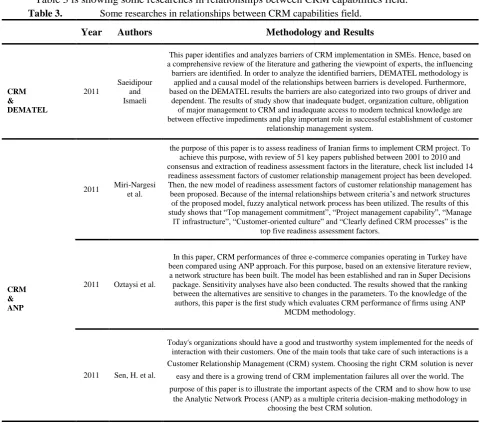
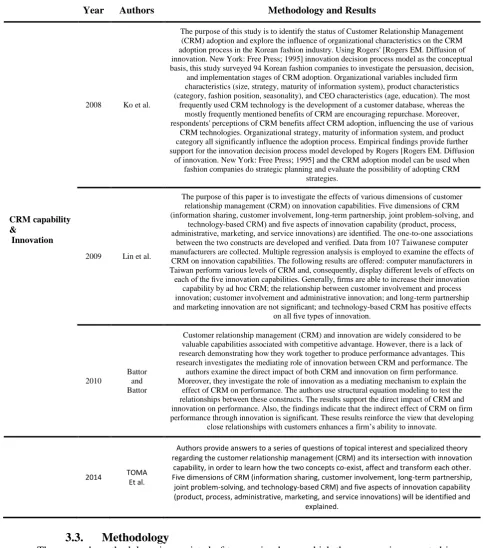
Table 3 is showing some researches in relationships between CRM capabilities field.
Table 3. Some researches in relationships between CRM capabilities field.
Year Authors Methodology and Results
CRM & DEMATEL 2011 Saeidipour and Ismaeli
This paper identifies and analyzes barriers of CRM implementation in SMEs. Hence, based on a comprehensive review of the literature and gathering the viewpoint of experts, the influencing barriers are identified. In order to analyze the identified barriers, DEMATEL methodology is
applied and a causal model of the relationships between barriers is developed. Furthermore, based on the DEMATEL results the barriers are also categorized into two groups of driver and
dependent. The results of study show that inadequate budget, organization culture, obligation of major management to CRM and inadequate access to modern technical knowledge are between effective impediments and play important role in successful establishment of customer
relationship management system.
CRM & ANP
2011 Miri-Nargesi et al.
the purpose of this paper is to assess readiness of Iranian firms to implement CRM project. To achieve this purpose, with review of 51 key papers published between 2001 to 2010 and consensus and extraction of readiness assessment factors in the literature, check list included 14 readiness assessment factors of customer relationship management project has been developed. Then, the new model of readiness assessment factors of customer relationship management has been proposed. Because of the internal relationships between criteria’s and network structures
of the proposed model, fuzzy analytical network process has been utilized. The results of this study shows that “Top management commitment”, “Project management capability”, “Manage
IT infrastructure”, “Customer-oriented culture” and “Clearly defined CRM processes” is the top five readiness assessment factors.
2011 Oztaysi et al.
In this paper, CRM performances of three e-commerce companies operating in Turkey have been compared using ANP approach. For this purpose, based on an extensive literature review, a network structure has been built. The model has been established and ran in Super Decisions package. Sensitivity analyses have also been conducted. The results showed that the ranking between the alternatives are sensitive to changes in the parameters. To the knowledge of the authors, this paper is the first study which evaluates CRM performance of firms using ANP
MCDM methodology.
2011 Sen, H. et al.
Today's organizations should have a good and trustworthy system implemented for the needs of interaction with their customers. One of the main tools that take care of such interactions is a Customer Relationship Management (CRM) system. Choosing the rightCRMsolution is never
easy and there is a growing trend of CRMimplementation failures all over the world. The purpose of this paper is to illustrate the important aspects of theCRMand to show how to use
128
Year Authors Methodology and Results
CRM capability &
Innovation
2008 Ko et al.
The purpose of this study is to identify the status of Customer Relationship Management (CRM) adoption and explore the influence of organizational characteristics on the CRM adoption process in the Korean fashion industry. Using Rogers' [Rogers EM. Diffusion of innovation. New York: Free Press; 1995] innovation decision process model as the conceptual basis, this study surveyed 94 Korean fashion companies to investigate the persuasion, decision,
and implementation stages of CRM adoption. Organizational variables included firm characteristics (size, strategy, maturity of information system), product characteristics (category, fashion position, seasonality), and CEO characteristics (age, education). The most
frequently used CRM technology is the development of a customer database, whereas the mostly frequently mentioned benefits of CRM are encouraging repurchase. Moreover, respondents' perceptions of CRM benefits affect CRM adoption, influencing the use of various
CRM technologies. Organizational strategy, maturity of information system, and product category all significantly influence the adoption process. Empirical findings provide further support for the innovation decision process model developed by Rogers [Rogers EM. Diffusion
of innovation. New York: Free Press; 1995] and the CRM adoption model can be used when fashion companies do strategic planning and evaluate the possibility of adopting CRM
strategies.
2009 Lin et al.
The purpose of this paper is to investigate the effects of various dimensions of customer relationship management (CRM) on innovation capabilities. Five dimensions of CRM (information sharing, customer involvement, long-term partnership, joint problem-solving, and
technology-based CRM) and five aspects of innovation capability (product, process, administrative, marketing, and service innovations) are identified. The one-to-one associations
between the two constructs are developed and verified. Data from 107 Taiwanese computer manufacturers are collected. Multiple regression analysis is employed to examine the effects of
CRM on innovation capabilities. The following results are offered: computer manufacturers in Taiwan perform various levels of CRM and, consequently, display different levels of effects on each of the five innovation capabilities. Generally, firms are able to increase their innovation
capability by ad hoc CRM; the relationship between customer involvement and process innovation; customer involvement and administrative innovation; and long-term partnership and marketing innovation are not significant; and technology-based CRM has positive effects
on all five types of innovation.
2010
Battor and Battor
Customer relationship management (CRM) and innovation are widely considered to be valuable capabilities associated with competitive advantage. However, there is a lack of research demonstrating how they work together to produce performance advantages. This research investigates the mediating role of innovation between CRM and performance. The
authors examine the direct impact of both CRM and innovation on firm performance. Moreover, they investigate the role of innovation as a mediating mechanism to explain the
effect of CRM on performance. The authors use structural equation modeling to test the relationships between these constructs. The results support the direct impact of CRM and innovation on performance. Also, the findings indicate that the indirect effect of CRM on firm performance through innovation is significant. These results reinforce the view that developing
close relationships with customers enhances a firm’s ability to innovate.
2014 TOMA Et al.
Authors provide answers to a series of questions of topical interest and specialized theory regarding the customer relationship management (CRM) and its intersection with innovation
capability, in order to learn how the two concepts co-exist, affect and transform each other. Five dimensions of CRM (information sharing, customer involvement, long-term partnership, joint problem-solving, and technology-based CRM) and five aspects of innovation capability (product, process, administrative, marketing, and service innovations) will be identified and
explained.
3.3.
Methodology
The research methodology is consisted of two main phases which the process is presented in figure 2:
Phase 1.Modeling and deployment of DEMATEL method.
In this phase the interrelations within innovations will be understood by deployment of DEMATEL method.
Phase 2.Deployment of ANP for select the most effective dimensions of CRM
129
4.
AN EMPIRICAL STUDY
In this section, DEMATEL method is first employed to develop the network structure. The ANP is further used to compute the limiting super-matrix to rank alternatives.
Fig. 2. Research methodology
Table 4. The direct-influence matrix A
Criterion Process Product Marketing Sales Service Administrative
Process 0 3 4 3 4 4
Product 4 0 3 4 4 4
Marketing 3 3 0 4 4 3
Sales 3 4 4 0 4 3
Service 4 4 3 4 0 3
Administrative 4 4 3 4 3 0
Table 5. The normalized direct-relation matrix D
Criterion Process Product Marketing Sales Service Administrative
Process 0 0.159 0.212 0.159 0.212 0.212
Product 0.212 0 0.159 0.212 0.212 0.212
Marketing 0.159 0.159 0 0.212 0.212 0.159
Sales 0.159 0.212 0.212 0 0.212 0.159
Service 0.212 0.212 0.159 0.212 0 0.159
Administrative 0.212 0.212 0.159 0.212 0.159 0
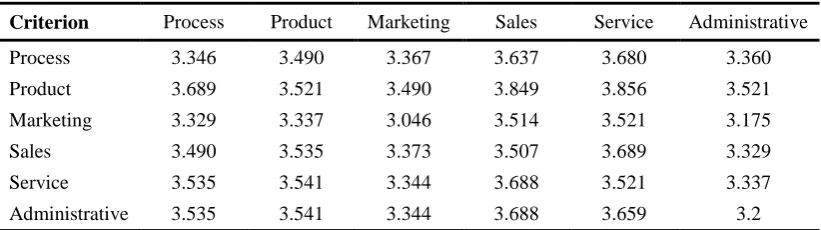
Table 6. The total-influence matrix T
Criterion Process Product Marketing Sales Service Administrative
Process 3.346 3.490 3.367 3.637 3.680 3.360
Product 3.689 3.521 3.490 3.849 3.856 3.521
Marketing 3.329 3.337 3.046 3.514 3.521 3.175
Sales 3.490 3.535 3.373 3.507 3.689 3.329
Service 3.535 3.541 3.344 3.688 3.521 3.337
130
Table 7. The sum of influences given and received on criteria.
Criterion
r
ic
ir
i+c
ir
i-c
iProcess 20.881 20.925 41.806 -0.44
Product 21.927 20.967 42.894 0.96
Marketing 19.922 19.964 39.886 -0.42
Sales 20.925 21.884 42.809 -0.004
Service 20.967 21.927 42.894 -0.96
Administrative 20.967 19.922 40.889 1.045
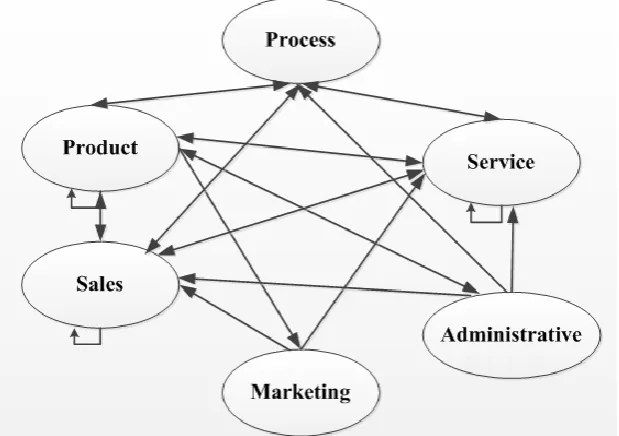
This case study the threshold value used in step 4 is to compute the average of the elements in matrix T, which is 3.489. Based on Table 6, there are four criteria which have the influence on process but the contribution of sales is the smallest. Thus, people are not a necessity. In contrast, product is the one more essential criterion to strengthen process. The findings based on Table 7 indicated that, product and service criteria with the same value of 42.894 are the important between other criteria, while Marketing is the least important criterion with the value of 39.886.
Whereas process, marketing, sales and service criteria are net receivers based on
r c
values.Also, base on this Table, in contrast to the product and administrative are net causer, the cause and effect diagram is showed in figure 3.
131
Fig. 3. Network relationship map based on the threshold value p = 3.489
132
Table 8. Pair-wise comparison matrix respect to alternatives
133
Table 9. Un-weighted Super-matrix.
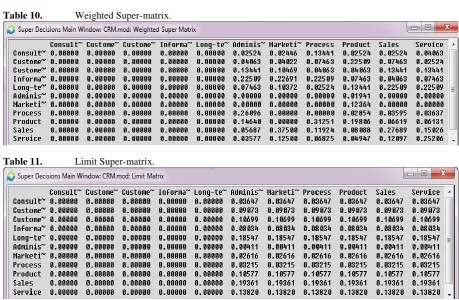
Table 10. Weighted Super-matrix.
Table 11. Limit Super-matrix.
5.
Findings
134
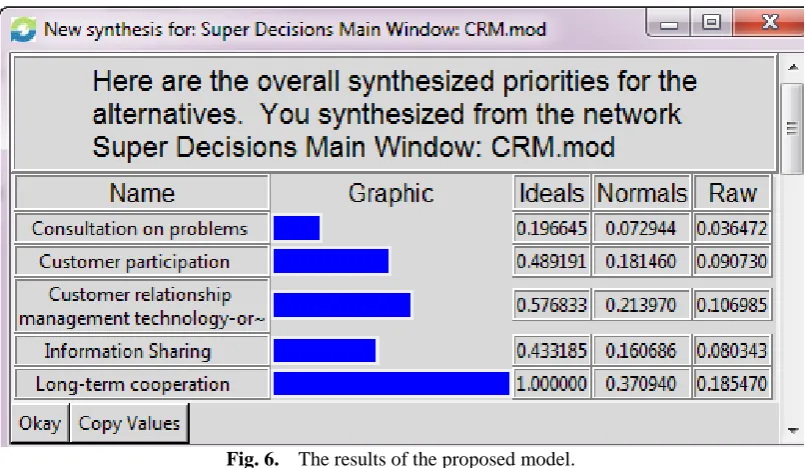
Fig. 6. The results of the proposed model.
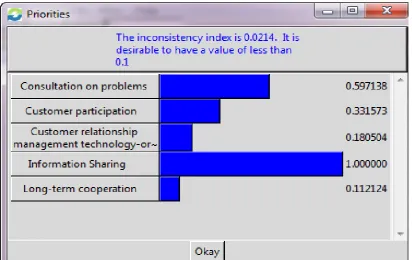
It can be clearly seen that “long-term cooperation” has the best score and can be said that it is the most effective dimensions and followed by customer relationship management technology-oriented, customer participation, information sharing and consultation on problems.
The findings show that long-term cooperation is the most effective dimensions of CRM on increasing innovation capabilities. Therefore, it is necessary to in corporate strategic planning consider customer managers as an important element of information and has a long time view of customer. Ramani and Kumar (2008) using CRM to engage in creating, maintaining, and fostering useful customer relationships and keeping long-term partnerships are important strategic elements for developing innovation capability. Intensive interaction between manufacturers and customers encourage customers to provide valuable suggestions for product development (Droge et al., 2004).
The second dimension in terms of its influence on increasing innovation capabilities is customer relationship management technology-oriented. Information technology through the ease and speed in establishing communication with the customers has the significant impact on long-term relationship with customers.
The third effective dimension is customer participation. Customer participation can be defined as the specific behaviors, degree of consumer’s effort and involvement, both mental and physical that relate to the production and delivery of a service. When a customer sees himself in position that is trusted by the company he will be encouraged to have long-term cooperation in the various fields. Engage key customers in the process of adopting the decisions of the company in the field of the development of new services, the revised operation of the company, improving services and periodic market assessment, technology of information processing can provide fields of increasing innovation capabilities in company. Customers partnership creates effective innovations for companies. Information received from customers at the continuous time is definitely much more effective in compared with sectional time.
135
The last effective dimension is partnerships between the Organization and customers to solve problems and to share responsibility when the incidence of the problem or face of the unexpected and difficult conditions.
6.
Conclusion
Relationship management procedures with customer and innovation are the concern of organizations. Therefore, selecting the most effective dimensions of CRM on the innovation’s capabilities in an organization is important topic that we study in this paper. CRM is as an imperative strategy to improve a firm’s innovation capability and to enhance a firm’s competitive advantage. Based on experiences of the industry firm, we draw the causal relations among innovation capabilities using DEMATEL mathematical model and determine their effects on each other. Then based on these causal relations, we ranked the improvement projects using ANP model. According to Table 7, administrative has highest (𝑟 − 𝑐)and it is the most direct effectiveness to others and also product and services is net receiver based on (𝑟 + 𝑐) values. At the result, in this paper via DEMATEL and ANP the most effective of dimensions of CRM has been selected. Finally, “long-term cooperation” has the best score and can be said that it is the most effective dimensions and followed by Customer relationship management technology-oriented, Customer participation, information sharing and consultation on problems. There were some limitations in this research project. For example, the effectiveness of five dimensions of CRM on innovation capabilities has been implemented in one industry firm, it is better to implement in several industries. If the model were implemented in more firms, the results were probably more accurate. Another limitation, were the direct-influence matrix (Table 4) and Pair-wise comparison matrix improvement projects respect to the criteria built based on the thoughts, comments, and suggestions of experts.
For the future research, someone can use VIKOR method instead of ANP in the third phase (Deployment of ANP for ranking the dimensions of CRM) and compare the results with the ones presented in this paper.
7.
References
Battor, M. and Battor, M. (2010). “The impact of customer relationship management
capability on innovation and performance advantages: testing a mediated model”, Journal
of Marketing Management. Vol. 26, No. 9–10, pp. 842–857.
Becker, J.U., Greve, G. and Albers, S. (2009). “The impact of technological and organizational implementation of CRM on customer acquisition, maintenance, and
retention”. Int. J. Res. Market, Vol. 26, No. 3, pp. 207–215.
Bose, R. (2002). “Customer relationship management: key components for IT success”.
Industrial Management and Data Systems, Vol. 102, No. 2, pp. 89-97.
Chang, S. and Lee, M.S. (2008). “The linkage between knowledge accumulation capability
and organizational innovation”, Journal of Knowledge Management, Vol. 12, No. 1, pp.
3-20.
Chen, I.J. and Popovich, K. (2003). “Understanding customer relationship management
(CRM): People processes and technology”. Business Process Management Journal, Vol.
136
Cohen,W.M. and Levinthal, D.A. (1990). “Absorptive capacity: a new perspective on learning
and innovation”, Administrative Science Quarterly, Vol. 35, No. 1, pp. 128-152.
Daft, R.L. (1982). Bureaucratic versus non-bureaucratic structure and the process of innovation and change, in Bacharach, S.B. (Ed.), Research in the Sociology of Organizations, Vol. 1, JAI Press, Greenwich, CT, 129-66.
Damanpour, F. (1991). “Organizational innovation: a meta-analysis of effects of determinants
and moderators”, Academy of Management Journal, Vol. 34, No. 3, pp. 555-590.
Damanpour, F. (1992). “Organizational size and innovation”, Organization Studies, Vol. 13,
No. 3, pp. 375-402.
Damanpour, F. (1996). “Organizational complexity and innovation: developing and testing
multiple contingency models”, Management Science, Vol. 42, No. 5, pp. 693-716.
Damanpour, F. and Evan, W.E. (1984). “Organizational innovation and performance: the problem of organizational lag”, Administrative Science Quarterly, Vol. 29, No. 3, pp. 392-409.
Droge, C., Jayaram, J. and Vickery, S.K. (2004). “The effects of internal versus external
integration practices on time-based performance and overall firm performance”, Journal
of Operations Management, Vol. 22, No. 6, pp. 557-573.
Fontela, E., Gabus, A. (1976). The DEMATEL Observer, DEMATEL 1976 Report. Switzerland, Geneva: Battelle Geneva Research Center.
Fruhling, A.L. and Siau, K. (2007). “Assessing organizational innovation capability and its
effect on e-commerce initiatives”, The Journal of Computer Information Systems, Vol.
48, No. 1, pp. 133-145.
Foss, B., Stone, M. and Ekinci, Y. (2008). “What makes for CRM system success or failure?”.
J. Database Market. Customer Strat. Manage, Vol. 15, No. 2, pp. 68–78.
Gabus, A. and Fontela, E. (1973). Perceptions of the world problematique: Communication procedure, communicating with those bearing collective responsibility, DEMATEL report No. 1. Geneva, Switzerland: Battelle Geneva Research Center.
Gopalakrishnan, S. and Damanpour, F. (1997). “A review of innovation research in
economics, sociology and technology management”, Omega, Vol. 25, No. 1, pp. 147-166.
Green, S.G., Gavin, M.B. and Aiman-Smuth, L. (1995). “Assessing a multidimensional
measure of radical technological innovation”, IEEE Transactions in Engineering
Management, Vol. 42, No. 3, pp. 203-214.
Handfield, R.B. and Bechtel, C. (2002). “The role of trust and relationship structure in
improving supply chain responsiveness”, Industrial Marketing Management, Vol. 31, No.
4, pp. 367-382.
Janbozorgi, F. and Moballeghi, M., (2015). “Evaluating the Readiness of Hotels in Terms of Inter-Organizational Factors In Order To Implement CRM Using Fuzzy Approach”.
International Journal of Review in Life Sciences, Vol. 5, No. 8, pp. 614-621.
137
Ko, E., Kim, S.H., Kim, M., and Woo, J.Y. (2008). “Organizational characteristics and the
CRM adoption process”. Journal of Business Research, Vol. 61, No. 1, pp. 65–74.
Kotler, P. (1997). Marketing management: analysis, planning, implementation and control. Englewood-Cliffs, NJ: Prentice-Hall.
Liao, S.H., Fei, W.C. and Chen, C.C. (2007). “Knowledge sharing, absorptive capacity, and innovation capability: an empirical study of Taiwan’s knowledge-intensive industries”,
Journal of Information Science, Vol. 33, No. 3, pp. 340-359.
Lin, R-J, Chen, R-H., Chiu, Kevin K-Sh. (2009). “Customer relationship management and
innovation capability: an empirical study”. industrial Management & data Systems, Vol.
110, No. 1, pp. 111-133.
McEvily, B. and Marcus, A. (2005). “Embedded ties and the acquisition of competitive
capabilities”, Strategic Management Journal, Vol. 26, No. 11, pp. 1033-1055.
Miri-Nargesi, S.S., Keramati, A., Haleh, H. and Ansarinejad, A. (2011). “Assessing organizational readiness to implement customer relationship management using fuzzy analytical network process: a case study”, international journal of academic research, Vol. 3, No. 3, pp. 409-418.
Mentzer, J.T., Min, S. and Zacharia, Z.G. (2000). “The nature of inter-firm partnering in
supply chain management”, Journal of Retailing, Vol. 76, No. 4, pp. 549-568.
Mohr, J. and Spekman, R. (1994). “Characteristics of partnership success: partnership
attributes, communication behavior, and conflict resolution techniques”, Strategic
Management Journal, Vol. 15, No. 2, pp. 135-152.
Oztaysi, B. and Ucal, I. (2009). Comparison of MADM techniques usage in performance measurement, In: Proceedings of 10th annual international symposium on the analytical hierarchy process.
Ramani, G. and Kumar, V. (2008). “Interaction orientation and firm performance”, Journal of
Marketing, Vol. 72, No. 1, pp. 27-45.
Reinartz, W., Krafft, M., and Hoyer, W.D. (2004). “The Customer Relationship Management
Process: Its Measurement and Impact on Performance”, Journal of Marketing Research,
Vol. 41, No. 3, pp. 293-313.
Saaty, T.L. (1996). Decision Making with Dependence and Feedback: The Analytic Network Process, Pittsburgh, PA: RWS Publications.
Saaty, T.L. (1999). Fundamentals of the Analytic Network Process, ISAHP, Kobe, August, 12-14.
Saaty, T.L. (2001). Making with Dependence and Feedback, 2nd edi., RWS Publication. Saaty, T.L. (2005). Theory and Applications of the Analytic Network Process: Decision
Making with Benefits, Opportunities, Costs, and Risks, RWS Publications, Pittsburg, PA, USA.
Saeidipour, B. and Ismaeli, S. (2011). “A study of how to implement a successful CRM by identifying challenges using DEMATEL method: An empirical study on small to medium
138
Šen, H., Begičević, N. and Gerić, S. (2011). Decision making on customer relationship management solution using the analytic network process, Proceedings of the International Conference on Information Technology Interfaces, ITI, Article number 92, 439-444. Shahhosseini bideh, S., morovati shariabadi, A. and zanjirchi, S., (2015). “The comparison of
organization's performance on Customer Relationship Management (CRM)
implementation using an integrative approach of Fuzzy ANP and DEMATEL”, New
Marketing Research. Vol. 4, No. 4, pp. 195-212.
Sin, L.Y.M., Tse, A.C.B. and Yim, F.H.K. (2005). “CRM: conceptualization and scale
development”, European Journal of Marketing, Vol. 39, No. 11/12, pp. 1264-1290.
Tamura, M., Nagata, H. and Akazawa, K. (2002). Extraction and systems analysis of factors that prevent safety and security by structural models. In 41st SICE annual conference, Osaka, Japan.
Toma, m., Mihoreanu, l. and Ionescu, a. (2014). “Innovation capability and customer
relationship management: a review”. Economics, management, and financial markets,
Vol. 9, No. 4, pp. 323–331.
Tzeng, G. H., Chiang, C. H. and Li, C. W. (2007). “Evaluating intertwined effects in Elearning programs: A novel hybrid MCDM model based on factor analysis and DEMATEL”.
Expert Systems with Applications, Vol. 32, No. 4, pp. 1028–1044.
Vorhies, D.W. and Harker, M. (2000). “The capabilities and performance advantages of
market-driven firms: an empirical investigation”, Australian Journal of Management,
Vol. 25, No. 2, pp. 145-171.
Weerawardena, J. (2003). “Exploring the role of market learning capability in competitive