DOI: 10.14738/abr.63.4075.
Asrar, Z., Azhar, T., & Hussain, M. (2018). Effect of Talent Management On The Success Of Organization Development. Archives of Business Research, 6(3), 90-103.
Effect of Talent Management On The Success Of Organization
Development
Zaeema Asrar
HOD & Assistant Professor,
Department of Commerce, University of Karachi
Tehseen Azhar
Senior Lecturer, Department of Management Sciences, DHA Suffah University, Karachi
Mudassir Hussain
Lecturer, Department of Commerce, Benazir Bhutto Shaheed University, Karachi,
ABSTRACT
This study is done to find the effect of talent management on organization success. The finding of the study is that the effective talent management does result in the success or development of organization. In this study, organization development is divided into two boarder categories, which are positive or negative growth of organization. Positive growth of Organization development was done by recruitment and selection, training and development whereas negative variables are considered employee retention, skill gap and skill shortage. Our study concluded that every employee has some unique talent which differentiates that employee with others which could be resulted in competitive advantage of organization and if that talent would be used for any other position it may cause for discomfort.
INTRODUCTION
Nobody can argue that talent is most critical source of successful organization. Talent management is very crucial strategy for organization development. Many organizations realized that talent management is a key success of modern organizations. Getting right people at the right place with the right skills and are engaged on the right activities would result into achieving targeted goal of the organization.
The concept talent management is coined by McKinsey & Company, 1997 investigation. McKinney & company exposed the term “war of talent”. Later the time book issued by Helen Handfield Jones, and Beth Axelrod. The relationship between human recourse development and organizational effectiveness has been established in the 1970’s. During the period of 1970s and 1980s the business function was responsible for employee was called "The Personnel Department". The systems which developed to support of this function were batch payroll systems. The personnel department was a well understand business function. During the period of 1980s and 1990s organizations realized that the HR function was in fact more important and the term “Strategic HR” merged with personnel department. The new concept introduced getting the right people at the right job, training and development of employees, compensation package which includes benefits and serving as a central point of communication for employee health and happiness.
which key factors of talent management could be effect on success of organization includes training and development, requirement and selection, skill gap and skill shortage performance evolution, motivation, ability, leadership quality, and area of interest of employee, competency management, training either on-the-job or off-the-job, educating, control retention of employee, workforce environment and culture of organizations.
Basically, the study is beneficial for those organizations that need to improve their workplace environment or maintain their competitive advantage. The productivity and organization culture directly related to their valuable human capital. The effective and talented employee add it the value additional to the productivity of organization and also reduce and save cost of productivity.
The data were collected from various private companies that were growing their performance with the induction of new and young talented employee to balance their competency management on organization environment. The objective of this study is to find out whether the success of organization depends on their human capital or not. Ultimately, the organization should considered talented employees more than other factors because there is no substitution of human capital or skillful employees.
Every employee have some unique talent which differentiate that employees to others and that talent suits for a particular job profile which could be result competitive advantage of organization and that talent would be used for any other position will be cause for discomfort. Transferring organization vision into it goal and fulfillment of required level of competencies should identification of right talent for suitable workplace that is primary aim of organization success.
Many studies showed that organization environment continuously changed so increasing demands on the workplace for better performance required to be multi-skilled employees. As technology continuously changed and breaking down the old rules of thumb methods ,new production technology methods introduced, shirking product life cycles so mostly organization changing their workplace environment according to the current environmental changes and recruiting young and talented and effective skillful employees to maintaining their competitive advantage. The successful organizations are those who adapt itself to environmental changes for long-term and create purposeful management strategy and develop their employee key competencies. Development countries depends their successful organization and organization success depends on employee’s competency.
Talented employee is valuable for organization. Mostly organization encourages their employee to stay their organization with the help of employee retention agreement. The outline designed between the employee and organization that the employee will remain at the organization but set the time duration of employee agreement. When organization facing market fluctuation, changing management and merger with other organization so employee agreement to entice talented employee remain at the organization to run their business operation.
maintain organization competency.
The study is beneficial for those organizations that need to improve their workplace environment or maintain their competitive advantage. The productivity and organization culture directly related to their valuable human capital. The effective and talented employee add it the value additional to the productivity of organization and also reduce and save cost of productivity.
LITERATURE REVIEW
The term “talent management” has become popular in late 90s, but “high potential employees” or simply “high potentials” were considered in management literature much later (i.e. Burke, 1996). Earlier ideas didn’t become popular because of the wrong time they appeared at beginning of the twenty first century which was characterized by high industrialization of China, and the need of remarkably good workers became apparent at that time. Thus, the work of three practitioners (Michaels, Handfield-Jones & Axelrod, 2001) became the research trigger and started to attract more and more awareness. An assortment of aspect of talent management are recruitment, selection, replacement planning ,on-boarding, mentoring, performance management, career development, leadership , development, career planning, recognition and reward (Boudreau and Ramstad, 2005; Romans and Lardner, 2006; Heinen and O’Neill, 2004; Scheweyer, 2004).
Talent management is the achievement of integrated strategies or systems designed to Increase workplace efficiency by increasing improved processes for attracting, developing, retaining and utilizing people with the necessary skills and capacity to meet current and future business needs. Talent management is the further management processes and opportunities that are made available to people in the organization who are considered to be ‘talent’ (Aston & Morton, 2005; Likierman, 2007).
The effective and efficient employees could be result organization success. The right ability and skillful employees selected for the right job, then the chances of result could be favorable for organization success because employee add it the value additional to the productivity of organization and also reduce and save cost. The process of recruitment and selection should be carefully on the basis of merit and the area of interest of employee. The human capital should be more considered as they do care like other resources but the employees are best resources. There is no replacement of human recourse. (De mars, 2002).
The successful organization always depends their good recruitment and selection policy .in the stage of recruitment and selection, Its includes all issues related to employees talent with high-skill, what kind of talented employee does the organization need it to recruit. How human recourse manager should plan for recruitment and selection process for determined positions? What sort of talent does the organization need in future for organization development (Brinkerhoff, 2009).
The impact of training sessions on the performance of employees could be positively as well as negatively. Training is systematic development of attitude/knowledge/behavior pattern required by an individual in order to perform adequately a given task or job. It is official ongoing process of learning activity for short period of time within an organization which designed according to need assessment of desired talent which enhanced the fulfillment desired performance of employee. (bartel, 1994; kalleberg and moody, 1994; Russel et al., 1985).
Organization more considered their talent employees rather than other factors of recourse because it doesn’t matter what strategy organization designed and what kind of challenges organization faced but the important is right talent which execute the strategy and deal with challenges (Gebelein, 2006).
Development countries depends their successful organizations and successful organization depends their core competency of employees which can said that economy development depends their talented people of the countries (Moaeri, 2002).
In modern and competitive environment the talented and skillful employee need always felt by many organizations and human resource manager not only solved employee problems but also designed succession planning of key positions of the organization. (Porkiani et al.2010). According to McGee (2007) and pool (Horvathova, 2009) effective task with skillful employee is basically on talent management strategy of organization that is screening organization strategy. Talent management strategy is managing, maintaining, training and developing existing human capital within availability at organization to contribute in achieving desired future needs of organization that is known as talent.
In practice, of course, employers can look for more lengthily through recruiting activities and more careful selection, and applicant can search actively by securing better information about vacancies. We also know that job requirements are not exogenous from the supply of applicants: A deficit of applicant that leads to higher wages in turn causes employers to substitute capital for labor in order to create new jobs with lower skill requirements. Empirical evidence indicates that employers also lower the skill requirements for given jobs when labor is relatively scarce and raise them when higher quality applicants are plentiful (Walsh 1977; Brencic 2010).
Talent management is used as a tool for organization success which help us organization in competitive marketplace to compete their competitors and get success. (Lockwood, 2006). Talent has become key factor which differentiator for HCM and for leveraging competency of organization within strategic HRM. (Gratton, 2000; Becker et al., 2001). The talent management of organization is one of the key factor that management of human resource playing strategically in organization (Bhatnagar, 2004).
Employee should be considered to be the best asset of organization for efficient and productive advance. It is very difficult to retain talented employee for long term benefit of organization to maintain required level of performance and competitive advantage. (Mehta et. Al., 2014).
Skill gap is incredibly essential factor should be identify at the time of recruitment to filter the pool of candidate to matched required skill to desired skill (Recruiting Experts Worldwide Report, 2011). Internal skill development of employees identified through skill gap and developed them through skill training programs (Muduli, A., 2008).
The reasons for low down turnover which workers have mentioned are work experience, career development and independence. All these motives of human resources help organizations to bring into line HR practices for that reason and help them with employee retention (Brigitte Kroon and Charissa Freese, 2013). Also employees must be able to see a clear occupation path in the organization, only then they will stay for long (Gaurav Bagga, 2013). Retention practice provide more importance to factors moving to cause employee turnover (career opportunities and economic rewards) than on those supposed to affect employee retention (social impression, job content, work-life balance). Profession opportunities have the strongest impact on employee commitment while the impact of financial rewards is less. Ways recommended for plummeting member of staff attrition are career development, considered to be one of the most important factors. Providing great career development opportunities makes the employees to stay in the company for long and at the same time enhances their loyalty to the firm. Also creating positive social work surroundings and adding content to the jobs and tasks to be done by the human resources enhances employee fulfillment and commitment (Meganck, 2007).
Skill shortage similar kinds of skill mismatch and skill gap could be a general from of mismatch, all kinds are collectively representing skill problems (peter cappeli, 2014). One of the most important topic of study in worldwide talent management has been roughly the notion of talent shortages (Manpower Group Talent Shortage Survey 2011) and the implication of talent shortages on the practice of human resource management in worldwide organizations(Collings & Mellahi, 2009; Farndale, Scullion, & Sparrow, 2010; Scullion, et al., 2010; Stahl, et al., 2012; Vaiman, et al., 2012).
The development of talent is one of the most significant importances over the past one and half decades which has been more focuses on effectively managing the individual employee which are more important to the fulfillment of strategic success of organization. (Ibraiz and Schuler, 2012)
Employee appointment and retention guide to higher client satisfaction and loyalty especially in the services sector. Reason that lead to employee engagement which not only include of pay/compensation and benefits but also factors like good working conditions, flexible work timings, cooperative teams, good bosses, culture and values of the organization (Devi, 2009).Organizations with excellent given name, way of life, values, good salary and benefits put together for their employees can also help employee retention (David, 2007).
talent gaps. Assume that one initiative will be to retain high performers in strategic and core roles. A decision model may assist together central HR and local leadership to identify actions appropriate to different routine segments. Talent management is a typical set of HRM/HRD function which includes recruitment and selection, learning and development. Management of human recourse should develop strategy about talent engagement, motivation and maintenance according to talent external and internal factors (Heinen and O’neill, 2004)
One of the biggest challenges in front of software companies all over the globe is building and behind a strong talent pipeline. The range of talent management issues facing multinational software organizations now is extremely broad. These originations must recruit and select talented people, train them, manage their performance, compensate and reward them and try to retain the strongest performers. The talent management software marketplaces at the moment more than ten years old, so far it is still a off-putting task to select the right solution. This market is both consolidating and expanding at the similar point. (N. Venkateswaran,
2012).
The new tendency of high employee turnover is due to a variety of reasons such as employees not being happy with the kind of job they do, lack of funds in training and development, lack of career enlargement and development opportunity, unfair and false performance appraisals, etc. Strategic ways for retaining top talent in the organization is by serving high possible employees have cross purposeful job for job and work related satisfaction, involvement in decision making, encouraging their ideas and helping them implement them, help in career development moves, skill building through effective and relevant training (Hay 2001).
On-the-job training opportunities and better training and development practices improve employee retention and assurance (Deery 2008).HR practices motivate and empower employees which guide the workers devotion to the organization.HR practices for recruiting and training do not essentially increase employee’s faithfulness to the organization. Such HR practices which attempt to bring skills in address or develop current employees actually increase turnover (Patrick M. Wright, Timothy M. Gardner and Lisa M. Moynihan, 2011).Admittance to training, adjusting training practices as for each older workers requirements and an age consciousness training program is required for better older employee retention (Marjorie Armstrong-Stassen and Andrew Templer 2004).
Employee retention is important to have a competitive advantage in today’s engagement. Providing exciting support and work life balance to employees helps organizations in low turnover (Osman, 2013). The role of work life balance has a straight relation in employee’s decision to stay or leave the organization. Job attitudes such as job satisfaction and commitment, personal reasons such as positive and depressing feelings, the role of WLB in employee attrition and, lastly, the strategies provide to cut high turnover rates. The recommendations mention include the require for norms on working hours, role models at the workplace, flexi work hours and arrangements, effective talent attainment and training practices. It has been experiential that stress and its different components like emotional exhaustion and job suffer exhaustion are the major causes of high employee turnover. Ways and methods suggested to improve employee retention and commitment in the hospitality sector include better recruitment and training & development practices to improve employee satisfaction with work and also have WLB (Deery 2008).
competitive in its atmosphere and what enables it to adapt and innovate in answer to change. Core competencies or organizational competencies have been described as things that organizations are best at. They are design components of an organization’s competitive strategy that are usually a result of mutual competencies (Haase, 2007: 43).
The quantity of organizational support employees recognize has been proved to influence employees ‘job attitudes. In adding up, Wayne et al. (2002) indicated that perceived organizational support reflect to a Large extent the excellence of the relationship between the organization and the employee (Konijnenburg ,2010).
Talent management practices settlement both the individual and organization. So the argument doesn’t categorize the individual and organizational settlement since they are interconnected in nature. Talent management arrangement to organizational strategy has a clear contact on the success of projects meeting their original goals and business intent.
Organizations in which talent management is united to organizational strategy include an average development success rate of 72 percent, even as organizations in which talent management is not successfully aligned to organizational strategy have an average project success rate of 58 percent. The difference of 14% project accomplishment rates equates to risking 50 % more programs dollars when talent management is not successfully aligned with strategy (Project Management Institute, 2013).
Performance evalution:
Effective talent management will have an indirect optimistic relationship with organizational performance; mediated by work motivation, organizational commitment, and additional role behavior substitute separately or in combination with one another (Collings & Mellahi, 2009). Talent management systems are deployed to elicit desired role behaviors among the Organization’s talent pool and help out in realizing the organizations (Lepak & Shaw, 2008). Talent management if given the proper development of skills and increased responsibility seeks to focal point on an worker‘s potential, meaning an employee‘s future performance (Hamid, Z. A., n.d.). Talent Management strategies develop innovation capability and achieve a high level of performance. Talent management exercise adds rigor and structure for a more meaningful discussion with superiors.
Developmental veiws:
Imitation and gaming will be used for workforce development, and performance management will come to a close to be based on yearly review. Instead, users will take delivery of continuous feedback based on business systems that monitor work. Development systems will use this information to make recommendation for advancement and/or corrective actions. With tools like Microsoft’s ESP, companies will take advantage of simulation and gaming to help with skills development.
METHODOLOGY Research design:
testing for quantitative factors. The study has to be structured in such a way so that it can produce best statistics for analysis and hard facts between both dependent and independent variable and also co-related variable of talent management. Often with quantitative study a sample of different private organization employees would be carried out with the help of questionnaires papers to testing the sample, this is matching the targeted talented employees of the organization.
Sampling:
This study considered talent management because success of organization depend their human capital so that the organization should be more considered talented employees rather than other factors because there is no substitution of human capital or skillful employees. The study specifically focuses on organization positive growth with the important factor which is talent employees. The data is collected different private companies that were growing their performance with the induction of new and young talented employee to balance their competency management on organization environment. The population of the research is not limited by organizations because the study is more focused on talent management but limited by private organizations and specified by banking sector, health and care sector and educational sector. The sample size not exactly designs but at least 400 questionnaires paper was prepared for the survey of the study. The technique used for data collection simple is sample random sampling.
Organization Development was used as dependent variable, and Talent management was used as Independent Variable, which divided further was divided in two board categories positively and negatively. Positive variable factors are ”Requirement and selection” right talent recruitment for right position, “Training and development” maintenance of talent through training session and Development programs of talent. The negatively variables factors which effect the success of organization includes ”Employee retention” how to retain talent within an organization, ”Skill gap” managed skill gap of desired talent and ”Skill shortage” how to managed when organization faced skill shortage in market.
The control other factors, control variables such as performance evolution, Motivation, Ability, leadership quality, and area of interest of employee, competency management, training either on-the-job or off-the-job, education, control retention of employee, Workforce environment and culture of organizations.
RESULTS AND ANALYSIS
Table 1: Age of Respondent
Age Group Frequency Percent Percent Valid Cumulative Percent
18-22 34 12.0 12.0 12.0
22-25 79 27.9 27.9 39.9
26-30 64 22.6 22.6 62.5
31-35 52 18.4 18.4 80.9
36-40 35 12.4 12.4 93.3
41-45 8 2.8 2.8 96.1
46-50 10 3.5 3.5 99.6
50+ 1 .4 .4 100.0
Total 283 100.0 100.0
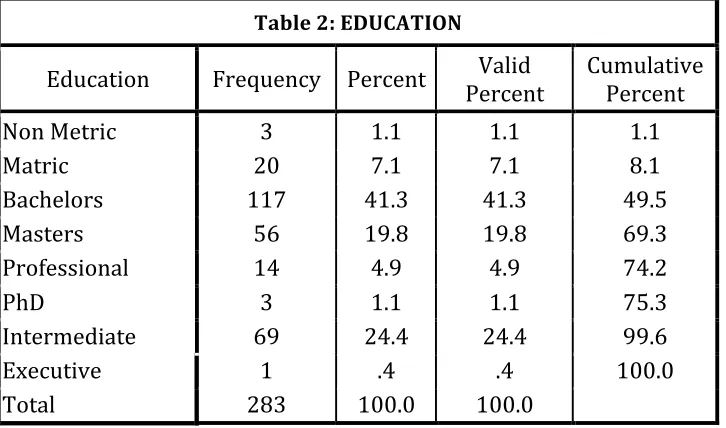
Table 2 shows the Education of our respondent around 40% of our respondent have done bachelors, and 20 % have done masters. So We can classify that around two third of our sample is educated enough to support the organization success.
Table 2: EDUCATION
Education Frequency Percent Percent Valid Cumulative Percent
Non Metric 3 1.1 1.1 1.1
Matric 20 7.1 7.1 8.1
Bachelors 117 41.3 41.3 49.5
Masters 56 19.8 19.8 69.3
Professional 14 4.9 4.9 74.2
PhD 3 1.1 1.1 75.3
Intermediate 69 24.4 24.4 99.6
Executive 1 .4 .4 100.0
Total 283 100.0 100.0
Table 3: EXPERIENCE
Level of Experience Frequency Percent Percent Valid Cumulative Percent
less than one-one year 34 12.0 12.0 12.0
1-3 year 63 22.3 22.3 34.3
3-5 year 55 19.4 19.4 53.7
5-8 year 51 18.0 18.0 71.7
8-11 year 37 13.1 13.1 84.8
11-14 year 11 3.9 3.9 88.7
14 to more than 31 11.0 11.0 99.6
EXP 1 .4 .4 100.0
Total 283 100.0 100.0
Table 4: CURRENT ORGANIZATION TIME PERIOD
Frequency Percent Percent Valid Cumulative Percent
One year 88 31.1 31.1 31.1
Two year 53 18.7 18.7 49.8
Three year 48 17.0 17.0 66.8
Four year 27 9.5 9.5 76.3
Five year 26 9.2 9.2 85.5
Six year 16 5.7 5.7 91.2
Seven year 3 1.1 1.1 92.2
More than seven
year 21 7.4 7.4 99.6
Total 283 100.0 100.0
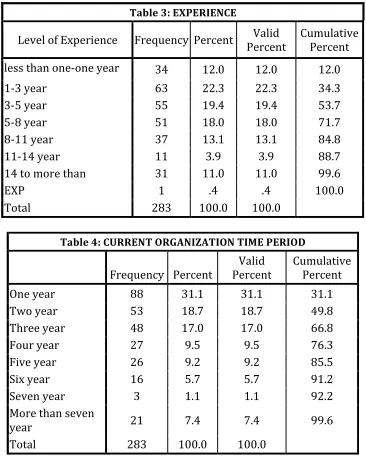
Table 4 explains the association of our respondent with their current organization. Most of 75% of our respondent just joined their current organization for 4 or less years.
Table 5: EMPLOYEES WORKING ON ORGANIZATION
Frequency Percent Percent Valid Cumulative Percent
4 1.4 1.4 1.4
10 to 20 9 3.2 3.2 4.6
21 to 30 18 6.4 6.4 11.0
31 to 40 8 2.8 2.8 13.8
51 to 60 18 6.4 6.4 20.1
61 to 70 77 27.2 27.2 47.3
70 to more
than 148 52.3 52.3 99.6
Table 5 shows the size of organization, almost 80% are having more than 60 employees. Our correlations between Talent management practices and organization success was 56.3% based on our survey results which was also significant at 99% Confidence Interval Level.
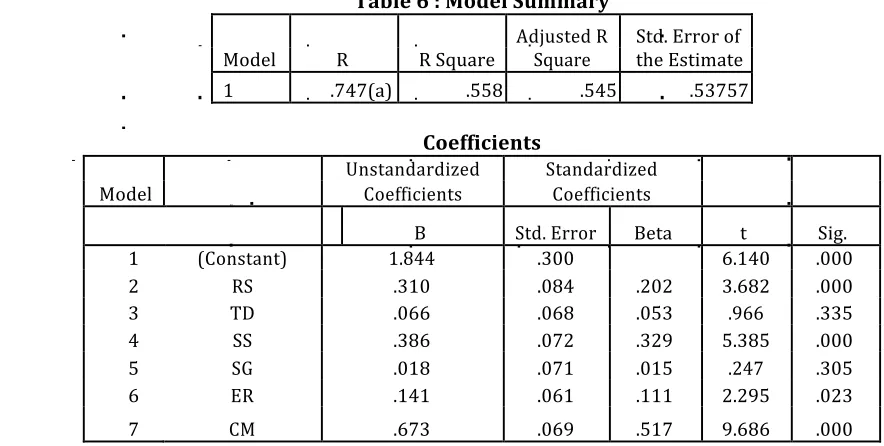
Table 6 shows the Regression analysis between Talent management practices and organization development. Our model summary shows the R Square of 55.8% and Adjusted R Square of 54.5%.
Table 6 : Model Summary
Adjusted R Std. Error of
Model R R Square Square the Estimate
1 .747(a) .558 .545 .53757
Coefficients
Unstandardized Standardized
Model Coefficients Coefficients
B Std. Error Beta t Sig.
1 (Constant) 1.844 .300 6.140 .000
2 RS .310 .084 .202 3.682 .000
3 TD .066 .068 .053 .966 .335
4 SS .386 .072 .329 5.385 .000
5 SG .018 .071 .015 .247 .305
6 ER .141 .061 .111 2.295 .023
7 CM .673 .069 .517 9.686 .000
a. Dependent Variable: Organization Development
b. Independent Variables: recruitement and selection(RS) ,training and development(TD) ,employee retention(ER),competency management(CM), skill gap(SG) and skill shortage(SS).
Above Table 6 shows that Training and Development and Skill Gap is not contributing towards Organization Development however, Significant Constant too shows that any important variable contributing to OD is still missing in our model. Our this table may conclude that Recruitment and Selection, Skill Shortage, Employee Retention and Competency Management do contribute in OD Success.
DISCUSSION
at the time of hiring employee but it may be cause of negative growth of organization or failure. In some multinational companies and private sectors organization, requirement and selection stage is very effective which identify during the tested of variables but in public sector there is unionization impact also influence on the hiring process of right talent. The other thing which employee retention is more focused on this study because usually the factor which faced by every organization because of employee are not entertained by organization. Mostly employee of the organization showed that other companies provide more facilities rather than current job position of existing organization. To control employee retention some organization contract with employee at the time of joining which showed that it is the best technique to control employee retention. At the time of research questioner’s conduction we observe the some organization hire least skillful staff which doesn’t match their qualification with desired skill. They only work to do those task which they usually doing on their daily routines task and nothing to do else. Organization success usually depend the employees effective and efficient workforce behavior. The right ability and skillful employees selected for the right job, then the chances of result could be favorable for organization success because employee add to the value additional to the productivity of organization and also reduce or save cost.
CONCLUSION
Every employee have some unique talent which differentiate that employees to others and that talent suits for a particular job profile which could be result competitive advantage of organization and that talent would be used for any other position will be cause for discomfort. Transferring organization vision into it goal and fulfillment of required level of competencies should identification of right talent for suitable workplace that is primary aim of organization success. The successful organization always depends their good recruitment and selection policy .in the stage of recruitment and selection, it includes all issues related to employees talent with high-skill. Mostly organization in private sector includes health and care, education and banking sector have it cost effective requirement of their staff. It is initial stage of talent and then mostly organization preferred to develop their key talented employee through training program with use of different methods. . The productivity and organization culture directly related to their valuable human capital. The effective and talented employee add it the value additional to the productivity of organization and also reduce and save cost of productivity.
Reference
Arifeen, N. U., Hussain, M., Kazmi, S., Mubin, M., Latif, S., & Qadri, W. (2014). Measuring Business Performance:
Comparison of Financial, Non Financial and Qualitative Indicators. European Journal of Business and
Management, 6(4), 38-45
Aston, C. and Morton, L. (2005) “Managing Talent for competitive advantage”, Strategic HR Review, 4(5), 28-31
ASTD. (2012). “Bridging the Skills Gap: Help Wanted, Skills Lacking. Why the Mismatch in Today's Economy?” American Society for Training and Development. http://nist.gov/mep/upload/Bridging-the-Skills-Gap_2012.pdf. Atkinson, Robert D. and Luke A. Stewart. 2013. The Real Story on Guestworkers in the Highskill U.S. Labor Market. Washington, D.C.: The Information Technology and Innovation Foundation.
http://www2.itif.org/2013-guestworkers-high-skill-labor-market.pdf.
AON Hewitt (2011) "Trends in global employee engagement". Emrald insight, www.aonhewitt.com,
Boudreau, J.W. and Ramstad, P.M. (2005) “Talentship, Talent Segmentation, and Sustainability: A New HR Decision
Science Paradigm for a new Strategy Definition”, Human Resource Management, 42, 129-36
Beheshtifar, M. & Nekoie-Moghadam, M., 2011, Talent Management: A Complementary Process for Succession
Planning, Life Science Journal, 8(4), 474- 478.
Benjamin R. Palmer, Gilles Gignac. (2012), "The impact of emotionally intelligent leadership on talent retention,
discretionary effort and employment brand". Industrial and Commercial Training, 44(1) 9-18
Journal of Manpower, 34(8), 899-917
Collings, D. G. & Mellahi, K., (2009). Strategic talent management: A review and research agenda, Human Resource
Management Review, 19, 305.
Cappelli P. (2001) “Making the most of Online Recruiting” Harvard Business Review, 139-146
Clayton Glen," Key skills retention and motivation: the warfor talent still rages and retention is the highground: Industrial and commercial training, VOL. 38 NO. 1 2006, pp. 37-45
Delery, J.E. and Doty, D.H. (1996) “Models of theorizing in strategic human resource management: tests of
universalistic, contingency, and configurational performance predictions”, Academy of Management Journal, 39,
802-835
Economist Intelligence Unit (2006) The CEO's role in talent management: How top executives from ten countries are
nurturing the leaders of tomorrow. London, The Economist.
Freeman, R.B. (2002) ‘The Labour Market in the New Information Economy’, Oxford Review of Economic Policy, 18:3, 288-305.
French GR. (2012), Recruitment and Selection. Managing and Developing 2012; 12-32.
Greenhouse J, Callanan G, Godshalk V., 2000, Career management. The Dryden Press, harcourt College Publish Hartmann, E., Feisel, E. & Schober, H., 2010, Talent management of western MNCs in China: Balancing global
integration and local responsiveness, Journal of World Business, 45, 170.
Hughes, J. & Rog, E., (2008), Talent Management: A Strategy for Improving Employee Recruitment, Retention and
Engagement within Hospitality Organizations, International Journal of Contemporary Hospitality Management, 20
(7), 746
Ian M. Taplin, Jonathan Winterton. (2007),"The importance of management style in labour retention".
International Journal of Sociology and Social Policy, 27(1-2), 5-18
IRS Employment Review (2005) ‘Online Recruitment in the UK: 10 Years Older and Wiser’, IRS Employment
Review, 822, [online](cited 19 June 2006)
John HB. (2003) Human Resource Management: An Experiemental approach. New Delhi: McGrawHill Julia Christensen Hughes, Evelina Rog. (2008), "Talent management- A strategy for improving employee
recruitment, retention and engagement within hospitality organizations". International Journal of Contemporary
Hospitality Management 20(7) 743 – 757.
Jund - Ming Wang, Brian H. Kleiner. (2004). Effective Employment Screening Practices. Management research news, Volume 27 Number 4/5 2004
Lockwood, NR., 2006, Talent Management: Driver for Organizational Success, SHRM® Research Quarterly, 2-4.
Michael Haid, (2008), "Four Key HR Practices That Drive Retention: Insights from India, Linkage.com, 2008 Marjorie Armstrong-Stassen, Andrew Templer. (2004),"Adapting training for older employees". Journal of Management Development Vol. 24 No. 1, 2005 pp. 57-67
Mubin, M., Vohra, M., Ijaz, S., Rafique, M., & Hassan, T. (2013). Cultural Mapping and Its Ascertainment: A Case Study of PTCL.
Mubin, M. et al., 2014. Cultural Mapping and Its Ascertainment: A Case Study of PTCL. European Journal of Business
and Management, 6(14), pp.83–94.
Nartey D. Recruitment and Selection Practises of organizatrions, A Case Study of HFC Bank (GH) LTD. Ghana: Kwame Nkrumah University of Science and Technology, 2012.
Nancy RL., 2006, Talent management: driver for organizational success, HR Magazine, June Issue.
Piyali Ghosh and Rachita Satyawadi," Who stays with you? Factors predicting employees’ intention to stay": International Journal of Organizational Analysis Vol. 21 No. 3, 2013 pp. 288-312
Sarah Leidner and Simon M. Smith, (2013), "Keeping potential job-hoppers’ feet on ground". Human Resource Management International Digest, 21(1), 31-33
Thompson, K. R. & Luthans, F. (1990), "Organizational Culture: A behavioral Perspective", Organizational Climate and Culture, Oxford: Jessey-Bass, Chapter 9
Wanous, J.P., and Reichers, A.E. (2000). New employee orientation Programs. Human ResourceManagement
Review, 10, 435-451
Zusman, R.R. and Landis, R.S. (2002) ‘Applicant Preferences for Web-Based versus Traditional Job Postings’,