Natural Gas Desulfurization Process By MEA Amine: The
preferable Engineering Design Procedure
Ribwar Abdulrahman
1, Ibtisam Kamal
2, Jagar Ali
31 Faculty of Engineering, KoyaUniversity, Kurdistan region, Iraq 2 Faculty of Engineering, SoranUniversity, Kurdistan region, Iraq 3 Faculty of Engineering, SoranUniversity, Kurdistan region, Iraq
Abstract — Natural gas may consider the most popular energy source in recent era and the demand for it in recent years has been dramatic. However, natural gas is existed in deep reservoirs so it may contents many impurities for instance, hydrogen sulphide, carbon dioxide and mercury. Indeed, these impurities may cause several technical problems for instance, corrosion and environment pollution. Therefore, raw natural gas should be purify before processing it to global gas markets and amine gas sweetening process may consider the most common technology to remove acid gases from natural gas stream. Thus, this study aims to treat a given composition natural gas stream with a moderate hydrogen sulphide contents about 2500ppm vie engineering mathematical calculations for MEA circulation rate that was about 490 gpm. The amine circulation rate is considered quite important amine gas sweetening parameters that should be at optimum value to achieve optimum acid gas removal and meet the product requirement. Thus, the amine circulation rate examined by material balance calculations for amine contactor tower. As a result, it is found that 490 gpm amine circulation rate is an effective value to reduce hydrogen sulphide contents to 4ppm which it meets the gas pipelines and gas sell contracts specification.
Keyword — Natural gas sweetening, amine solution,
amine circulation rate, acid gas, absorber tower.
I. Introduction
Natural gas has an important role in the recent world development. However, natural gas usually contents acid gases for example, H2S and CO2 that it needs to
be removed from natural gas to meet the gas pipelines specifications. Stewart and Arnold (2011) note that gas contracts restrict H2S content about 4ppm and CO2
about 2% in natural gas stream. Thus, many gas sweetening processes developed to remove acid gases from raw natural gas stream for example, chemical absorption, solid bet sweetening method and physical absorption method. However, amine gas sweetening is considered the most popular process among natural gas sweetening methods. In fact, amine gas sweetening process has several advantages for example, continues process, the ability to regenerate the process solvent. However, any amine process has many operation conditions for instance amine
contactor pressure, amine solution concentration and amine circulation rate. In fact, amine circulation rate is considered one of the most important amine process operation conditions that has huge effect on acid gas removal from natural gas stream. It quite important to adopt the correct amine circulation rate to achieve optimum acid gas removal and meet product requirement.
II. Basic amine process description
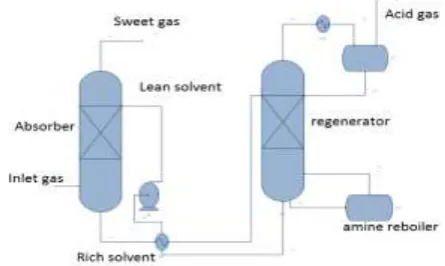
Amine gas sweetening process is shown in figure 1.Firstly, sour gas stream is usually enters to scrubber to remove sour gas constants. Secondly, sour gas enters to the bottom side of amine absorber tower and flow countercurrent to amine solvent and Sweet gas will leave the top of the contactor tower and need to be processed to dehydration process to remove saturated water. Moreover, Dirty or rich amine will leave bottom of contactor tower and need to be regenerate. Finally, Amine stripping tower (regenerator) is used to regenerate the dirty amine hot lean amine need to be cooled therefore it flows to amine heat exchanger and then back to contactor tower. The brief of amine process could be described as following:
Figure 1: General flow diagram for Amine plant
III. Case study
Table 1: Given Case study tow data.
Natural gas water content can be estimated by adopting the McKetta-Wehe Chart [3]. Therefore, the raw natural gas water content is about
.
Now, the new Natural gas composition could calculate and summarized as shown in table 2.
Table 2: natural gas composition.
IV. Amine circulation rate
Amine circulation rate is considered one of the most important parameters with regards the reduction of acid gas quantity in natural gas. Moreover, many researchers have developed numerous methods to calculate the circulation rate for amine gas sweetening. However, Campbell 1979 has put forth a useful procedure with which to calculate amine circulation rate. In this work MEA (15% w/w) will be used for the amine gas sweetening process. As Campbell (1979) and Kohl & Riesenfield (1997) recommend, a 75% approach to the equilibrium concentration should be used for the design propos. However, in contrast, Zapffe recommends 65%, whilst Campbell (1979) recommends using the average of both approaches. With these recommendations taken into account, 70% will be used. Moreover, As Khol & Riesenfield (1997) note, “rich amines can be adequately stripped with 0.9 to 1.2 pounds of steam per gallon of rich solution”. Therefore, for this work 0.9 . For given
gas composition the acid gas ratio is: Acid gas ratio
Figure 2: Residual H2S [4].
Figure 3: Residual CO2 [4].
From figure 2, residual H2S can be calculated by using
the ratio. Thus,
Dividing the above amount by MEA molecular weight
to obtain
Thus
Residual CO2 can also be calculated from the graph in
Figure 3, by maintaining the same procedure:
Dividing the above amount by MEA molecular weight to obtain
Thus
Total residual acid gas=
Density MEA at 38°C = 1003 Kg/ m3 (CHEM Group, 2012).
Density of water at 38°C = 999.3 kg / m3 (Claude, 2000)
Thus density of solution = (0.15 × 1003) + (0.85 × 999.3) =999.8
Taking the density of 15% of MEA to be ,
there will be:
,
Thus, moles of MEA=
Unstrapped H2S , Unstrapped
CO2
Assume ideal gas to calculate the partial pressure of H2S and CO2 in sour gas.
Partial pressure of H2S
Partial pressure for CO2
The ratio of acid gas partial pressure
Now calculate the concentration of MEA at the bottom:
Following this ascertain the equilibrium composition H2S at 144 mmHg and 50°C and Rv=0.216
Campbell (1979) recommends the assumption of rich amine temperature leaving the absorber at 60 C°. Thus, equilibrium composition of H2S in amine solution can
be derived from Figure 4 and Figure 5 as well.
Figure 1: Equilibrium data for H2S and MEA [4].
Figure 5: Equilibrium data for CO2 and MEA [4].
From Figure 4, moles of H2S per Moles of MEA =
0.07
From Figure 5, = 0.12. Thus moles of CO2 per
MEA = 0.07/0.12= 0.583
Using the 70% approach of equilibrium will reveal the concentration of H2S and CO2 in rich amine.
0.07 x 0.7 = 0.049 moles of H2S/ moles of MEA
0.583 x 0.7 =0.4 moles of CO2/ moles of MEA. Total
moles of acid gases per mole of MEA = 0.45
Net moles of H2S / mole of MEA pick up in absorber
= (concentration in rich MEA - concentration in lean
MEA) = 0.049 - = 0.045
Net moles of H2S / mole of MEA pick up in absorber
= (concentration in rich MEA - concentration in lean MEA ) = 0.4 – 0.145 =0.255
Therefore moles of acid gases pick up in absorber / mole of MEA= 0.045+ 0.255= 0.3
The total amount of acid gas to be removed is as follows:
First convert gas flow rate into SCFM=
Thus, H2S flow rate
CO2 flow rate x
, Or:
Moles of
H2S/min ,
Moles of
CO2/min
Therefore, the total moles of Acid per min= 2.65. Assuming all acid gases is absorbed by MEA
= 10
= 8.6
0.3 =
8.83
(Moles of MEA / min needed for H2S)/ Moles of
MEA / gal = = 500 gpm
(Moles of MEA / min needed for\or CO2)/ Moles of
MEA / gal= = 430 gpm
(Moles of MEA / min needed for total acid gas) / Moles of MEA / gal= = 441.5 gpm
Add 10% for safety (Stewart & Arnold, 2011). Thus, 441.5 x 0.1= 485.65 gpm
Therefore, the design circulation rate of 15% MEA solution will be 490 gpm = 111 m3/hr
V. Material balance
It is relatively important to achieve mass balance for the absorber column in order to examine all amine contactor streams and ascertain the acid gas composition in the sweet gas stream. As a result, mass balance will show whether or not the 15% MEA is active to remove acid gases from the sour gas stream. Estimating solubility of Methane and Ethan in 15% MEA [7].
Results Methane concentration 5.79 (lbmole /100000 lbs solution) & Ethane concentration 0.303 (lbmole /100000 lbs solution).
MEA solution flow rate = 490 gpm = 705600 gal/day, Density of MEA solution = 8.35 lb/US gal
705600 gal/day x 8.35 lb /US gal =5891760 lb/day Thus, the total amount of Methane soluble in MEA solution
Thus, the total amount of Ethane soluble in MEA solution
Now apply mass balance for acid gases
15 %( w/w) MEA is used. Thus, 85 % (w/w) water is used
Water flow rate =490 x 60x 24 x 0.85 x 8.35= 5007996 lb/day x 1kg/2.204lb = 2272230.5 kg/day MEA flow rate =490 x 60x 24 x
0.15x8.35==883764lb/day x1kg/2.204lb= 401710.9 kg/day
As Kohl & Riesenfeld (1999) noted, H2S normally
reduces to less than 25 grain per 100 SCF = 4ppm and for CO2 less than 2% (Stewart & Arnold, 2011). H2S
content in feed gas (sour gas):
Kmols of H2S / day = 317.88 kmols/ day (table 9).
H2S content in the gas out (sweet gas ) should be :
Thus H2S to be removed = 10832.136 - 17.1 =
10815.036 kg/day
Number of mole of day without acid gases = 125301.8078 kmoles / day
The volume = 125301.81 x 22.414 = 2808514.769 m3/ day
By using previous methods for gas water content it can be established that water content at pressure 71 bars, 38 C° is 965.5 Kg/ MMstd. m3. Water content
for sweet gas = x 965.5 Kg/
MMstd. M3 = 2711 kg / day
The above results are applied in MS Excel to establish whole system compositions and quantities (see results section for more results).
VI. Results
This case study examines a moderate sour gas stream which contains around 2500 ppm H2S and around
1.2 % CO2. Moreover, 15% MEA solution is used for
the sweetening process. As a result, the amine circulation rate calculated which is around 490 gpm (111 m3/hr). Moreover, this amine circulation rate is considered economical for the sweetening process and does not need excessive amounts of energy.
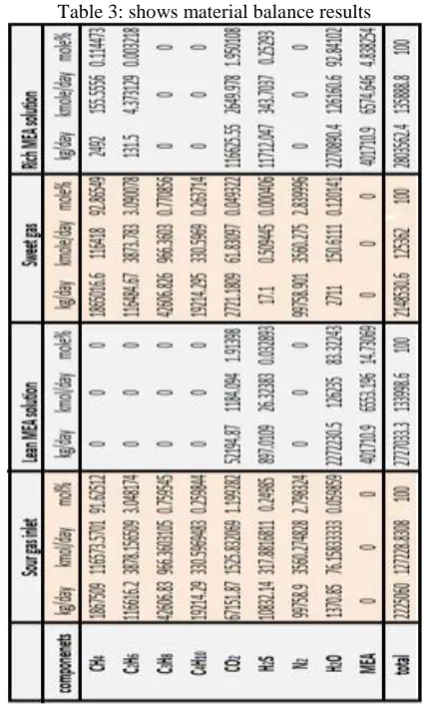
Table 3: shows material balance results
From table 3 results, it can be argued that the use of 15% MEA with 490 gpm (111m3/hr) amine circulation rate may be considered effective with regards the removal of acid gases from the natural gas stream. As is shown in the table above, the H2S content of the
sweet gas stream is around 4 ppm, thus meeting the gas pipeline specifications and gas sale contracts. In addition, CO2 content is approximately 0.049%, which
is also considered an acceptable value and comfortable values with gas pipeline specifications.
VII. Conclusion
In conclusion, natural gas is considered one of the most popular fuels of recent eras. However, most natural gas reservoirs around the world produce sour natural gases which contain several acid gases such as H2S and CO2. This study is examined gas removal
VIII. References
[1] Stewart, M. and Arnold, K. (2011) Gas Sweetening and
Processing Field Manual. Waltham: Gulf professional
publishing.
[2] Abdel-Aal, K. and Aggour, M. (2003) Petroleum and Gas
Field Processing. New York: CRC Press.
[3] Carroll, j. (2009) Natural Gas Hydrates: A Guide for
Engineers. Oxford: Gulf Professional Publishing.
[4] Maddox, R. (1982) Gas conditioning and processing: gas and liquid sweetening. Oklahoma: Campbell petroleum.
[5] GPSA (2004) Engineering data book. Tulsa: Gas Processors Suppliers Association.
[6] Kohl, L. & Riesenfeld, A. (1985) Gas purification. Oxford: Gulf Professional Publishing.
![Figure 2: Residual H2S [4].](https://thumb-us.123doks.com/thumbv2/123dok_us/8594666.1722140/2.595.310.542.75.380/figure-residual-h-s.webp)
![Figure 1: Equilibrium data for H2S and MEA [4].](https://thumb-us.123doks.com/thumbv2/123dok_us/8594666.1722140/3.595.70.295.61.678/figure-equilibrium-data-for-h-s-and-mea.webp)