http://www.sciencepublishinggroup.com/j/ijtam doi: 10.11648/j.ijtam.20190502.12
ISSN: 2575-5072 (Print); ISSN: 2575-5080 (Online)
On the Tractability of Transmuted Type I Generalized
Logistic Distribution with Application
Femi Samuel Adeyinka
Department of Mathematics, Obafemi Awolowo University, Ile-Ife, Nigeria
Email address:
To cite this article:
Femi Samuel Adeyinka. On the Tractability of Transmuted Type I Generalized Logistic Distribution with Application. International Journal of Theoretical and Applied Mathematics. Vol. 5, No. 2, 2019, pp. 31-36. doi: 10.11648/j.ijtam.20190502.12
Received: August 9, 2019; Accepted: August 29, 2019; Published: September 16, 2019
Abstract:
Transmutation of baseline distributions has gained popularity in the last decade and many authors have studied the some transmuted distributions such as exponential, Weilbul, gamma, Pareto, normal and many more. This article will focus on the transmutation of type I generalized logistic distribution using quadratic rank transmutation map to develop a transmuted type I generalized logistic distribution. The quadratic rank transmutation map enables the introduction of extra parameter into its parent model to enhance more flexibility in the analysis of data in various disciplines such as biological sciences, actuarial science, finance and insurance. The graphs of the probability density function (pdf) and cumulative distribution function (cdf) of the model for different values of parameters are illustrated respectively. The mathematical properties such as moment generating function, quantile, median and characteristic function of this distribution are discussed. The probability density functions of the minimum and maximum order statistics of the transmuted type I generalized logistic distribution are established and the relationships between the probability density functions of the minimum and maximum order statistics of the parent model and the probability density function of the transmuted type I generalized logistic distribution are considered. The parameter estimation is done by the method of maximum likelihood estimation. The flexibility of the model in statistical data analysis and its applicability is demonstrated by using the model to fit relevant data. The study is concluded by demonstrating the performance of transmuted type I generalized logistic distribution over its parent model.Keywords:
Logistic Distribution, Parameter Estimation, Order Statistics, Transmutation1. Introduction
Logistic distribution, like normal distribution, has been used over the years to model real life data in various fields of human endeavors such as medicine, Economics, Demography to mention a few.
This distribution has been generalized by many authors over the years to enhance its flexibility in data analysis. The distribution in its simplest form has its probability density function (pdf) and cumulative distribution function (cdf) as
, ∞ ∞
and
1 , ∞ ∞ (1)
respectively where is the location parameter and 0 is the scale parameter.
Balakrishnan and Leung [1] generalized (1) into type I, type II and type III generalized logistic distribution while type I is positively skewed, type II is negatively skewed and type III is symmetric in nature. The probability density function and cumulative distribution function of type I generalized logistic distribution are given by
!
"#$, ∞ ∞, & 0
and
1 ' !, ∞ ∞, b 0 (2)
Many works have been done on the transmutation of baseline distributions in view to ensuring better goodness of fit in data analysis from various disciplines. Shaw et al [2] suggested a quadratic transmutation map and applied it to probability models such as exponential, uniform and normal distribution. Aryal et al [3] worked on the transmuted extreme value distribution, Aryal et al [4] on transmuted Weilbul distribution, Aryal et al [5] on transmuted log-logistic, Merovci et al [6] on generalized transmuted family of distributions, Merovci et al [7] on transmuted Lindley-geometric Distribution, Merovci et al [8] on transmuted generalized Rayleigh distribution, Merovci et al [9] on transmuted Pareto distribution, Merovci et al [10] on transmuted Lindley distribution, AL-Kadim et al [11] on Cubic transmuted Weilbul distribution, Granzoto et al [12] on cubic transmuted distributions, Rahman et al [13] generalized the work of Shaw et al [1], Adeyinka et al [14] on four parameters transmuted generalized distribution, Adeyinka et al [15] on transmuted half logistic distribution, Adeyinka et al [16] on transmuted type I generalized half logistic distribution to mention a few.
The transmutation of (1) has been considered by Adeyinka [17]. The properties, estimation issue and the applicability of the model in the analysis of data have been established.
This work intends to study the transmutation of type I generalized logistic distribution for the purpose of achieving better performance of the model in the analysis of data in various disciplines.
2. Methodology
2.1. Derivation of Transmuted Type I Generalized Logistic Distribution
If a random variable X has the type I generalized logistic distribution with probability density function and its cumulative distribution function given in (2). The corresponding transmuted type I generalized logistic distribution, using the quadratic rank transmutation map,
) 1 * + , |*| 1 (3)
is given by
) - "" -, ∞ ∞, & 0 (4)
and the corresponding pdf is obtained by differentiating (4) with respect to to have
. ! / - "#$" +-0, ∞ ∞, & 0 (5)
Where & 0 is the shape parameter and * is the transmutation parameter.
2.2. Graphical Illustration of the Model
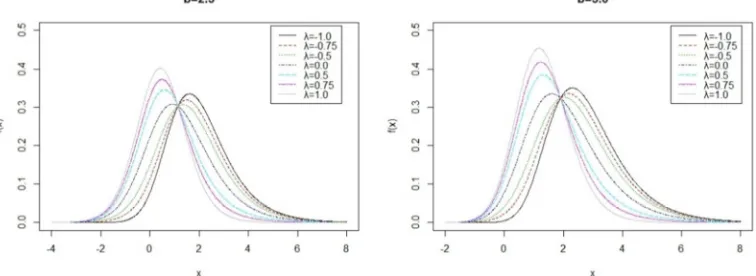
Figures 1 and 2 illustrate the graphs of pdf and cdf of transmuted type I generalized logistic distribution for some selected values of parameters & and λ respectively.
Figure 1. The probability distribution function of transmuted type I generalized logistic distribution.
3. Result
3.1. Moment Generating Function and Quantiles
The moment generating function of transmuted type I generalized logistic random variable 1, is given by
23 t E6 738 9;; 7'. : (6)
where . is the pdf of transmuted type I generalized logistic distribution. This implies
1 + *) 9;;( ($ <))"#$: − 2* 9
($ <)
( ) "#$
;
; : (7)
Setting > = ', = − ln > and : = −A:> . By
substituting these into (7) it becomes
(1 + *) 9B;( A)A <"#$:> − 2* 9 A <
( A) "#$
;
B :> (8)
Setting C = A, > = DDand :> = −D :>.
By substituting these into (8) it becomes
(1 + *) 9 (1 − C) 7C! 7
B :C − 2* 9 (1 − C)B 7C+! 7 (9)
The integral in (9) is a beta function given by
F(G, &) = H I B
(1 − )! :
F(G, &) =J(I)J(!)J(I !) and Г(L) = (L − 1)
Using these functional relationships (9) becomes
(1 + *)Г(! 7)Г( 7)Г(!) − *Г(+! 7)Г( 7)Г(+!) (10)
Similarly, the characteristic function transmuted type I generalized logistic distribution is given by
M3(NO) = (1 + *)Г(! P7)Г( P7)Г(!) − *Г(+! P7)Г( P7)Г(+!) (11)
The mean, variance, skewness and kurtosis of the transmuted type I generalized logistic distribution can be obtained from (10).
The Q7R-quantile of the transmuted type I generalized logistic distribution is given by
)3S TU = Q (12) Where )3( ) is the cdf of transmuted type I generalized logistic distribution. This implies
( -)( V)"
-( V) " = Q (13)
By solving for T in (13) it becomes
T= −WL XY - Z( -) [-T+T \
/!
− 1^ (14)
The median of transmuted type I generalized logistic distribution is obtained by setting Q = 0.5 in (14) to have
B.`= −WL aS1 + * − √1 + *+U /!− 1c (15)
3.2. Random Number Generation
Random numbers can be generated from the transmuted type I generalized logistic distribution by using the method of inversion as follows:
)3( ) = C (16) Where C~e(0,1) i.e C is uniformly distributed on (0,1) and )3( ) is the cdf of transmuted type I generalized logistic distribution. Therefore, (16) implies
( -)( )"
-( ) " = C (17)
By solving (17) for it becomes
= −WL XY - Z( -) [-D+D \/!− 1^ (18)
Random numbers can be generated from (18) when the value of parameterf & GL: * are known.
3.3. Order Statistics
We know that if 1( )≤ 1(+)≤ ⋯ ≤ 1(h) denotes the order statistics of a random sample 1 , 1+… 1h from a continuous population with cdf )3 ( ) and pdf .3 ( ), David [18] gave the probability density function of 1(j) as
.3(k) ( ) =l(j,h j )6)( )8j 61 − )( )8h j .( ) (19)
where m = 1,2, … L.
We have from (2) the pdf of the m7R order of the logistic random variable 1(j) given by
3(k) ( ) =
! /( )" 0n k
l(j,h j )( )"n#$ (20)
Therefore the pdf of the LOℎ order logistic statistic 1(h) is given by
3(n) ( ) =
h!
( )"n#$ (21)
and the pdf of the 1p7 order logistic distribution statistic 1( ) is given by
3($) ( ) =
h! /( )" 0n $
( )"n#$ (22)
Note that in a particular case of L = 2, (21) yields
3( ) ( ) =
+!
( ) "#$ (23)
3($) ( ) =+! /( ) " 0
( ) "#$ (24)
It can be observed that qG (1 , 1+) and qNL(1 , 1+) in (23) and (24) are special cases of (5) for * = −1 and * = 1
respectively.
The distribution of the order statistics for the transmuted type I generalized logistic variable.
The pdf of the m7R order statistics for the transmuted type I generalized logistic distribution is given by
.3(k) ( ) =
! /( -)( )" +-0/( -)( )" -0k $/( ) " r( -)( )" -s0n k
l(j,h j )( )"n#$ (25)
Therefore the pdf of the largest order statistic 1(h) is obtained when m = L in (25) and it is given by
.3(n) ( ) =h! /( -)( )
" +-0/( -)( )" -0k $
( ) "n#$ (26)
and the pdf of the smallest order statistic 1( ) is obtained when m = 1 in (25) and it is given by
.3($) ( ) =
h! /( -)( )" +-0/( )" r( -)( )" -s0n $
( ) "n#$ (27)
3.4. Estimation of Parameters
Given a sample 1 , 1+… 1h of size L from transmuted type I generalized logistic distribution with the probability density function given by
.( ; &, *) =& 'u(1 + *)(1 +(1 + ')+! ')!− 2*v, −∞ < < ∞, & > 0
where & > 0 is the shape parameter and |*| ≤ 1 is the transmutation parameter.
The likelihood function of transmuted type I generalized logistic distribution is given by
w =&h ∑nyz$'y∏ u(1 + *)(1 +hP| 'y)!− 2*v/ ∏ (1 +hP| ')+! (28)
The log-likelihood function of (28) becomes
WLw = LWL& − ∑hP| P− (2& + 1) ∑ WLhP| (1 + 'y) + ∑ WLu(1 + *)(1 +hP| 'y)!− 2*v (29)
The maximum likelihood estimate of the parameters & and * that are contained within the transmuted type I generalized logistic distribution function is obtained by differentiating
(29) with respect to parameter & and * respectively and equating the result to zero to have
}WLw
}* = ~ (1 +
'y)!− 2
6(1 + *)(1 + 'y)!− 2*8 = 0
h
P|
}WLw
}& =L& − 2 ~ WL
h
P|
(1 + 'y) + &(1 + *) ~ (1 + 'y)!
6(1 + *)(1 + 'y)!− 2*8
h
P|
= 0
The maximum likelihood estimator •€ = (&,• *€)‚ of parameters • = (&, *)‚ can be obtained by solving this non-linear system of equations. It is usually more convenient to use non-linear optimization algorithms such as quasi-Newton algorithm to numerically maximize the log-likelihood function in (29).
4. Discussion
4.1. Data Presentation
The data used in this work is extracted from Gupta et al [19]. It is a strength data originally considered by Badar and Priest [20]. The data which represent the strength measured in GPA, for single carbon fibers and impregnated
1000-carbon fiber tows. Single fibers were tested under tension at gauge lengths of 1, 10, 20 and 50 mm. Impregnated tows of 1000 fibers were tested at gauge lengths of 20, 50, 150 and 300 mm. For illustrative purposes we are considering the single fibers data set of 10 mm in gauge lengths with sample size 63. The data are presented below.
4.2. Data Analysis
A quasi Newton algorithm was implemented in R package and the performance of the models are shown in Table 1. Akaike Information criterion (AIC), Corrected Akaike Information criterion (AICC) and Bayesian Information criterion (BIC) were respectively used to compare the performance of transmuted type I generalized logistic distribution (TGLD) to its parent model (GLD) in (2).
ƒ„… = 2† − 2ww
ƒ„…… = ƒ„… +2†(† + 1)L − † − 1
and
F„… = 2log (L) − 2ww
Where k is the number of parameters in the model, n is the sample size and LL is the maximized value of log likelihood function.
Table 1. Performance of the models.
Model Estimates -LL AIC AICC BIC
TGLD &‰ = 2.76
*€=0.527 107.256 218.512 218.712 218.111
GLD &‰ =0.652 114.315 230.630 230.696 232.229
It can be concluded from the results in table 1 that the transmuted type I generalized logistic distribution (TGLD) performs better than its parent model which is the type I generalized logistic distribution (GLD).
5. Conclusion
In this article, we have introduced a new generalization of type I generalized logistic distribution called transmuted type I generalized logistic distribution. The distribution is generalized by the use of quadratic rank transmutation map. Some statistical properties such as moment generating function, quantile, median and characteristic function of the transmuted type I generalized logistic distribution are established and parameters estimation issues are addressed. The order statistics from the model are considered including the minimum and maximum order statistics and the relationships between the order statistics from its base distribution and the probability density function of the transmuted type I generalized logistic distribution for some selected values of transmutation parameter * are demonstrated. The subject model is used to fit relevant data to illustrate its applicability. We expect that this study will serve as a reference and help to advance future research in this area and other related disciplines.
References
[1] Balakrishan N. and Leung M. Y. (1988). Order Statistics from the Type I Generalized logistic distribution. Communications in Statistics simulation and computation. Vol 17 (1) 25-50.
[2] Shaw, W. T, and Buckley, I. R. (2009). Alchemy of Probability Distributions: Beyond Gram-Charlier and Cornish -Fisher Expansions, and Skewed- kurtotic Normal Distribution from a Rank Transmutation Map. arxivpreprint arxiv: 0901.0434. [3] Aryal, G. R, and Tsokos, C. P. (2009). On the transmuted extreme
value distribution with application. Nonlinear Analysis: Theory, Methods and Application.71 (12), el401-el407.
[4] Aryal, G. R, and Tsokos, C. P. (2011). Transmuted Weilbull distribution: A generalization of Weilbull probability distribution. European Journal of Pure and Applied Mathematics. 4 (2), 89-102.
[5] Aryal, G. R. (2013). Transmuted log-logistic distribution. Journal of Statistics Applications and probability. 2 (1), 11-20. [6] Merovci, F., Alizadeh, M., and Hamedani, G. (2016). Another
Generalized Transmuted Family of Distributions: Properties and Applications. Austrian Journal of Statistics. 45, 71-93. [7] Merovci, F., Elbatal, I. (2014). Transmuted Lindley-geometric
Distribution and its Applications. Journal of Statistics Applications and Probability. 3 (1), 77-91.
[8] Merovci, F. (2014). Transmuted Generalized Rayleigh Distribution. Journal of Statistics Applications and Probability. 3 (1), 9-20.
[9] Merovci, F., Puka, L. (2014). Transmuted Pareto Distribution. Probstat.7, 1-11.
[10] Merovci, F. (2013). Transmuted Lindley Distribution. International Journal of open Problems in Computer Science and Mathematics. 6 (2), 63-72.
[11] AL-Kadim, K. A. and Mohammed, M. H. (2017). The cubic transmuted Weibull distribution. Journal of University of Babylon, 3: 862876.
[12] Granzoto, D. C. T., Louzada, F., and Balakrishnan, N. (2017). Cubic rank transmuted distributions: Inferential issues and applications. Journal of statistical Computation and Simulation. [13] Rahman M. M, Al-Zahrani B, Shahbaz M. Q (2018). A
general transmuted family of distributions. Pak J Stat Oper Res 14: 451-469.
[14] Adeyinka F. S, and Olapade, A. K. (2019). On Transmuted Four Parameters Generalized Log-Logistic Distribution. International Journal of Statistical Distributions and Applications. 5 (2): 32-37.
[15] Adeyinka F. S and Olapade A. K. (2019). A Study on Transmuted Half Logistic Distribution: Properties and Application. International Journal of Statistical Distributions and Applications. 5 (3): 54-59.
[16] Adeyinka F. S, and Olapade, A. K. (2019). On the Flexibility of a Transmuted Type I Generalized Half-Logistic Distribution with Application. Engineering Mathematics. 3 (1): 13-18. [17] Adeyinka F. S. (2019). On the Performance of Transmuted
Logistic Distribution: Statistical Properties and Application. Budapest International Research in Exact Sciences (BirEx) Journal. 1 (3): 34-42.
[18] David, H. A. (1970) Order Statistics. New York: Wiley Inter-science series.