DOI: 10.14738/abr.78.4644.
Babalola, O., Afolabi, O., & Olusegun, A. (2019). A Model Linking Human Resources Management Practices With Employee’s Commitment To Core Values Of An Organisation. Archives of Business Research, 7(8), 114-118.
A Model Linking Human Resources Management Practices With
Employee’s Commitment To Core Values Of An Organisation
Oginni Babalola
Department of Economics and Business Studies, Redeemer’s University, Ede, Osun State, Nigeria
Ojo Afolabi
Department of Economics and Business Studies, Redeemer’s University, Ede, Osun State, Nigeria
Adesanya Olusegun
Department of Business Administration, Lagos State Polytechnic, Ikorodu, Lagos, Nigeria
ABSTRACT
The focus of the paper was on a model designed to explain the linkage between Human Resources Management practices and employee’s commitment to the core values of business organisation. The model place high premium on the business environment to be the major determinant in whatever happens in the business organisation. The values as well as beliefs and philosophies of founders must be congruent with business environment otherwise attainment of business objective will not be actualised. Similarly, the management of people in workplace through human resources management practices are contingent on human resources management policy which draws its strengths from business objectives and organisational policies. It is therefore evident from the model that where human resources management practices can herald positive perception and image, employees will be loyal and be willing to remain with the organisation over a long period of time thus ensuring commitment to core values of the organisation and the feedback framework is an avenue to evaluate the level of agreement between and among the business environment, employees’ expectations and focus of the organisation.
Key Words: HRM, Commitment, Core Values, HRM Model, HRM Policies and Practice, Perception and Image
INTRODUCTION
the driving force that propels the organisation into the future. In all, it represents the organisational highest priorities with deeply held beliefs on how the organisation wants to resonate with and appear to employees as well as the external world (Oginni, Erigbe, Ojo, ‘Laosebikan and Ogunlusi, 2018).
To this extent, one useful mechanism for understanding commitment behaviours in organisation is to consider the relationship between the employer and employee which is evident in human resource management practices (HRMP) i.e. the way an employer treat employees has a direct bearing on their performance, attitude and commitment to the organisation. Employee attitudes and behaviours, including performance, reflect their perceptions and expectations, reciprocating the treatment that they receive from the organisation. This demands that proper attention should be given to human resources management and its practices in order to have full level of its employees’ commitment for outstanding performance on long term basis.
Employees’ commitment derives its strength from the human resource management practices which is often geared towards management expectation in terms of behavioural patterns considered necessary to achieve overall objective of the organisation. This should also be developed to reflect societal and organisational differential values in other to create and foster favourable work atmosphere that would support employee’s commitment and retention (Oginni, 2017). Although, employees’ commitment in organisation derives its strength from the HRM practices prevailing in the organisation which is multifaceted and core value is the source of strength for HRM practices. In the views of Schwartz (2006) organisational core value is the junction box where every other thing springs up and by implication, core values would determine the prevailing atmosphere in the work environment in terms of policies, strategies and practices. There are many practices in the world of work but that which concern employees in the organisation is the people management dimension strategies at work known as human resource management practices (Oginni, Olabode and Ojo, 2018). For human resource management practices to support the realisation of the overall objective, the practices should be modified to reflect societal and organisational differential values such that a favourable atmosphere, condition and culture conducive for the attainment of organisational mission and overall objective are created to get employee’s loyalty, trust and reduction in labour turnover as well as appreciable level of satisfaction in order to make them committed to the core values of the organisation (Whitener 2001; Solkhe & Chaudhary, 2011).
LINKAGE OF HRM PRACTICES WITH EMPLOYEES’ COMMITMENT
There had been a lot of models developed to respond to the dictates of the business environment in order to help in the effective management of the human resources and also to gain competitive advantage through sound HRM practices. Some of these models include Harvard model, Michigan model, Guest model and Warwick model as well as Religious model etc. all explored and placed premium on how it can be geared towards employee’s commitment. In the views of Oginni (2017) understanding models in HRM is essential for any human resource practitioner for three reasons;
i. It provides a macro perspective of HRM practice in overall organisational set up.
ii. The unity and diversity of these models serve as vital inputs in drafting tailor made HRM model for organisations
iii. These models offer answers to quite a few dilemmas that practitioners encounter in their mission to pursue an organisational dovetailed and business aligned HR functions.
origins in Taylorism. Up until the 1980’s the main concerns of management were the organisation’s strategy and structure with an emphasis on the technical aspects of work. People were seen as a resource to be spent like any other i.e. man is seen as machine. Contrary to this view is the “soft” school of HRM. This view recognises that people are motivated by a complex set of factors that are interrelated, such as money, the need for affiliation or achievement and the desire for meaningful work (needs, feelings and attitudes). This view focuses on employees as potential talents and it is management’s responsibility to learn how best to attract and retain these resources (Akpor-Robaro and Oginni, 2018).
A shift in the thinking and values of managers during that period was coupled with various writers emphasising the importance of commitment i.e. such as the article written by Walton (1985) “From control to commitment” Walton (1985) saw a commitment strategy as a more rewarding approach to HRM in contrast to the traditional control strategy. He suggested that workers respond best not when they are tightly controlled by management, placed in narrowly defined jobs and told what to do but instead when they are given broader responsibilities and encouraged to participate. Similarly, other writers such as Peters & Waterman (1982) the culture-excellence approach focused on eight (8) attributes, which they said, were necessary for companies to “get their culture right”. The main focus was an emphasis on productivity through people.
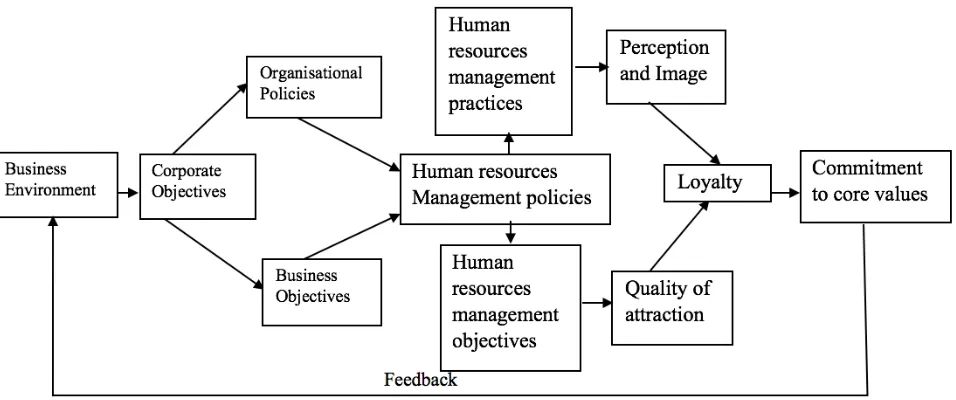
From the discussion of these linkages, the researcher has developed a model to link HRM practices with employee’s commitment as explained in the body of the work.
Fig 1: A Link between HRM Practices and Employee’s Commitment Model
Source: developed by the researchers, 2018 (Fig: 1 Link between HRM Practices with Employee’s Commitment)
is always stated in long term to capture the vision and mission of the organisation and it is on this basis that other sub units in the organisation would derive their focuses.
The business objective strategically defined the outlook of business in terms of the nature, scope, size and limitation as well as result to achieve while organisational policies speculate how things would be done in the organisation with respect to procedure and rules guiding all functional and residual operations. Since organisation is made up of man and material resources and the material resources would be interacted with by the man resources, the organisational policies and business objective would therefore determine the kind of human resource policies that would be in operation in the organisation. The human resource policies would reflect the belief, philosophy and culture of the organisation towards management of people in the work place.
Emerging from the human resources management policy would be the human resource management objective that would define the kind of workforce the organisation is planning to assemble in terms of competence and quality of people to attract. In addition to this, it is the application of the policies to the management of people in the workplace i.e. the practice. The practice of human resource management is a function of human resource management policies and the output of the practice is perception and image. How and method used in the course of managing people in the place of work would be viewed by members of the organisation as well as the outsider with the intention to come a conclusion about their opinion on how people are managed, thus, creating a mental image that may be positive or negative. The quality of attraction together with perception and image will lead to loyalty on the part of the employees; the loyalty that comes from these elements could be positive or negative depending on the degree in the quality of employees attracted and what the level of perception and image is vis – a – vis their personal evaluation (Oginni and Omoyele, 2018). It is the level of loyalty employees enjoyed at a particular time that would definitely determine what would be their level of commitment to the overall belief of the organisation. The commitment can be towards the bread and butter issue in the organisation (wages and salary) or towards the values of the organisation.
The implication of this model on the practice of human resource management is that the human resources management objective should be designed to attract suitable candidates during recruitment exercises. Qualifications, skills and endowment should be matched with the duties and responsibilities to be carried out from time to time. The human resources management policies should not be subjected to any iota of discrimination rather fairness, equity and justice should be of paramount importance in the wake of performing operative functions of human resources management to sustain positive image of the organisation. Management of business organisations should make investment in employees a matter of ultimate importance in form of training and development. This would induce a belief of self-importance and recognition on the part of employees and be the basis for being committed to the course of the organisation.
CONCLUSION
business environment to give direction for employers in the choice of what constitutes core values which will invariably herald what will be the atmospheric condition in the organisation and the last phase is measurement of employee’s commitment vis – a – vis core values and business environment. Of all the policies in the organisation emanating from core values, HRM policy which is concerned with management of people has been depicted to be the most influential policy as other resources in the organisation cannot do anything on their own without interaction from people recruited into the organisation. Therefore, the model informed about the essence of corporate objective and for the business objective to the actualised, human resources management policy should be the type that will create enabling atmosphere that will make the employees to be committed to core values of the organisation.
References
Oginni Babalola Oluwayemi (2017).Human Resources Management Practices and Employees’ Commitment to the Core Values of Private Universities in Southwestern Nigeria, unpublished Ph. D. degree thesis submitted to the Department of Management and Accounting. O. A. U., Ile – Ife, Nigeria
Oginni, B.O and Omoyele, O.S (2018): The role of labour turnover in organisational productivity in the manufacturing sector of Nigerian economy: The case of Cable industry in Lagos, Nigeria, Advances in Social Sciences Research Journal, Vol. 5(8) pp 294-305
Akpor-Robaro, M.O.M. and Oginni, B. O (2018): Organizational Behaviour, Management Theory and Organizational Structure: An Overview of the Inter – Relationship, Archive Business Review, Journal of Society for Sciences and Education, Vol. 4 (6), pp 1 - 10
Oginni Babalola O, Olabode Samuel and Ojo Afolabi (2018): The Functioning of Human Resource Management Practices as a Correlate of Economic Recession in Manufacturing Sector of the Nigerian Economy, Journal of Economics, Management and Trade, Vol. 21 (2), pp 1 – 11
Oginni Babalola Oluwayemi, Dunmade, Emmanuel Olaniyi and Ogunwole Aina Cecilia (2018) The Role of
Employee’s Work Expectations in Job Satisfaction and Labour Turnover in the Service Industry: A Case of Selected Organisations in Lagos, Ogun and Oyo States Nigeria, World Journal of Business and Management, Vol. 4 (1) pp 1 – 17
Oginni Babalola, Erigbe Patience, Ojo Afolabi, ‘Laosebikan Sola and Ogunlusi Femi (2018): Adoption of Human Resources Management Policies for Practices: Harvard Model Vs. Religious Model, Business and Management Research Journal, Vol. 7 (1), pp 51 – 60
Peters, Thomas J., and Jr. Waterman, Robert H. 1984. In Search of Excellence: Lessons from America’s Best-Run Companies. New York: Harper & Row, Publishers. xx,xxi – xxii,xxv
Petrescu, A. and Simmons, R. (2008). Human resource Management Practices and Workers’ Job Satisfaction,
International Journal of Manpower, 29(7), 651 – 667
Schwartz, S.H. (2006). Value orientations: Measurement, antecedents and consequences across nations. In Jowell, R., Roberts, C., Fitzgerald, R. & Eva, G. (Eds.) Measuring attitudes cross-nationally - lessons from the European Social
Survey London, UK: Sage 169-203.
Silva, P. (2006). Effects of disposition on hospitality employee job satisfaction and commitment. International
Journal of Contemporary Hospitality Management Decision, 18(4), 317-328.
Solkhe, A. and Chaudhary (2011). Human Resources Development Climate and Job Satisfaction: An empirical investigation, International Journal Contemporary Business research, 2(2), 34-41