Application Of Cloud Computing In The Field Of
Education: Google Apps As An Example
Dr. Batool M Ghanem
Al Quds Open University – Faculty of Education Palestine 970599735835
Abstract: Information technologies that have entered almost every area of our lives have an important role to play both in our daily work and in the realization of our business and educational activities. Cloud Computing as one of the innovative technologies we frequently heard about recently, is creating innovative services in the information technology industry. With the popular terminology known as infrastructure as a services (IAAS), platform as a services (PAAS) and software as a services (SAAS), compounding the operation of various applications and services on an internet server called cloud technology, and running these applications and services can be done with any device connected to the internet. As these services can be rented by the users on the basis of use (Pay as you use). Due to the advantages and importance of cloud computing, the use of this technology is increasing rapidly. Cloud technology that aims to respond to users' expectations and to the desired extent. It offers different alternatives in rapidly growing areas such as communication, communication and education. In this study, it has been analyzed how this technology can be used in education which supports different educational activities such as mobile learning, cooperative learning and active learning. Therefore, the integration of cloud technology and its applications into the education sector has been examined with the use of Google Apps that is free and easy to use.
Keywords: Cloud Computing, Educational Technology, Google Applications in Education
The world is witnessing every year a great and deep-rooted developments in the field of technology. From the first computer generation with limited functionality, to the line that extends towards high computing power with portable computers. The development of the Internet has also opened a new dimension in the field of computer and communication. The data stored at fixed points has been made available to the Internet with a wide range of users. Nowadays, usage rate is increasing rapidly and cloud computing is internet based technology. It is a distribution and information processing model that provides access to services and applications in service provider infrastructures based on internet and on demand. Unlike traditional information technology systems, cloud computing enables the transaction source and applications to be accessed as a platform-independent service in a dynamically scalable infrastructure. With the innovative and dynamic opportunities it offers the popularity of easy to use cloud computing as it is rapidly increasing and IT infrastructures are rapidly turning to cloud computing. The effects of this radical and rapid technological developments on the social and institutional structures in the age of information century are felt in almost all areas, including education systems. Taking into account establishment and management of a flexible IT infrastructure that will meet the expectations in every condition, creates an undesirable burden on the educational institution. And as a result, the educational institution cannot reach the expected quality. For this reason, educational institutions have entered new searches to manage their resources effectively Bala Kamalakharan )2014). In this context the implementation of cloud computing architecture infrastructure burden on the educational institutions is fully assumed by the service providers. Due to the dynamic scalability of cloud computing, the infrastructure is automatically dimensioned depending on the increase or decrease in service usage, and the expectations can be met without any bottlenecks. In this way, service disruptions can be prevented and the majority of the infrastructure is prevented from being in an idle state when expectations are decreasing (Sultan, 2010), Ercan, T. (2010). Therefore,
technology-oriented innovations in the social, cultural, political and economic fields affect the education sector and create systemic transformations. Nowadays, the technological tools that are still stable have gradually expanded the field of use and have begun to get rid of being constant Armbrust, M. et al., (2009). For individuals, the need to access information in an independent and on-the-go basis is increasing. As a result, individuals can work with different devices in different places. In this way, data access, data transfer, data sharing and data processing processes are made quickly and easily, independent of time and place. Therefore, Cloud Technology is one of the innovative technologies that support these processes and enable us to take maximum advantage.
Materials and Methods
First: Cloud Computing Model
Cloud computing system basically has the following characteristics:
Continuously growing infrastructure: Cloud computing provides users with ever-increasing processing power and storage. Users do not need to make capacity storage space and transaction infrastructure planning.
Dynamic scaling on demand: All cloud computing platforms offer the ability to expand existing infrastructure and add new services depending on the demand of users. A new application or a new server can be added to the existing system very quickly and ready for use, when the usage rate decreases, the unused resources are removed from the system and savings are provided.
Low cost and usage-based pricing: Cloud computing does not require pre-investment or large installation costs. Hardware and software received as a service from the service provider and it is paid based on the amount of usage.
Service-level agreement: Cloud computing providers offer service-level agreements that guarantee continuity and security of their service. R. Lakshminarayanan, et al., (2014). In the event of disruption of the activities of the cloud computing platform due to any reason, the service provider guarantees to repay the customers and to cover their losses.
Data centers are located in different geographies areas: Data centers of cloud computing service providers are located in different geographies around the world. In this way, users can host their applications and data in their geographies close to them or their target groups. In addition, the data of cloud service users are backed up by data providers in different geographic locations to reduce data loss risks. A. Ghazizadeh, (2012)
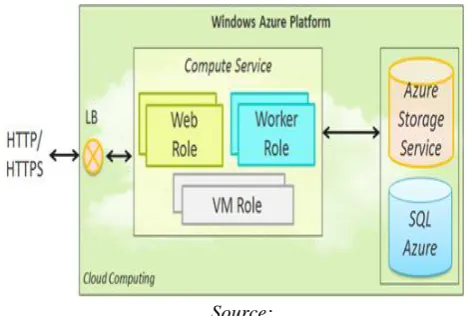
Windows Azure is a cloud computing service platform built on Microsoft data centers. It has a complex and multilayered structure which is formed by the combination of various equipment and applications (Figure 1). Ercan, T. (2010)
Source:
https://blogs.technet.microsoft.com/yungchou/2011/05/09/clo ud-computing-in-paas-with-windows-azure-connect-part-22/
Figure 1. Layers of the Windows Azure platform
The hardware creates the lowest layer on the Windows Azure platform. Servers include physical components, such as uninterruptible power supplies, generators, storage and backup units. The hardware infrastructure of Microsoft data centers is constantly being expanded, and nearly 10,000 new servers are added to the infrastructure each month. Krishnan, S. (2010). Servers in Windows Azure data centers are divided into multiple virtual machines using virtualization technology, thereby increasing the overall server efficiency. In order to allocate resources to virtual machines and to provide isolation between virtual machines running on the same physical hardware, a low-level system software called hypervisor is used. On the Windows Azure platform, there is an application software called a building controller that is deployed on all machines. The building inspector ensures that all equipment included in the infrastructure is continuously monitored, managed and coordinated. Microsoft data centers, which are formed by the combination of millions of servers and additional hardware, serve in close to one hundred points in different geographies. The service continuity of Microsoft data centers, which are physically and logically equipped with high-level security systems, and the data security of users are guaranteed by national and international agreements. Microsoft (2011)
SQL Azure Cloud Database Service
SQL Azure is a relational cloud database service built on Microsoft SQL Server technology operating in Microsoft data centers. SQL Azure allows you to create databases based on a web interface, easily and without the need for any application installation or configuration. Unlike other storage services, SQL Azure introduces a database logic to storage. It adds speed and flexibility to the application development process by supporting the technologies, tools and data models that developers are already familiar with, Krishnan, S. (2010).
Third: Data security and privacy
Fourth: Cloud Computing Background in Education
Cloud-based learning applications are a new and flexible solution for accessing data and services, enabling information and experiences to be shared effectively across the web and collaborating on projects. Unlike the traditional model, Cloud computing resources are part of a more social infrastructure. Cloud-based learning applications transfer the infrastructure installation, maintenance and management processes that are burdened by educational institutions to the control by cloud service providers, it enables them to move towards a higher quality education which is the main focus of educational institutions. Solutions and benefits of cloud-based learning applications can be listed as follows, Microsoft (2011):
It enables students to perform educational activities without limitation of time and place, to access library content and online resources electronically. The students ensures that their performance and
interrogation, grading are recorded electronically and according to the desired criteria.
Students are provided with regular feedback and progress.
Online communities can be created where students, educators and administrators can collaborate. Prepares the ground for sharing ideas and
experiences between educators and administrators. Ensures that students and institution employees can
access electronic resources independently from time and platform.
Web-based courses and class records can be made. Provides a good environment for students to
connect with educators and administrators. It allows to design and present daily or short-term
or long-term plans on the web.
Cloud Technology
During the sixtieth of the previous century, John McCarthy introduced the cloud computing model, the idea is that calculations will take place over large public networks in the future Buyya, R. et al (2009). The term cloud computing, was initially used to refer to networks in information and communication systems. The cloud symbol was used to symbolize the Internet until 1994 Mladen A. Vouk (2008). In 2007, Google, IBM and many universities worked on cloud computing on research projects, and in 2008 users of IT services; service providers witnessed such results. Therefore, it can be said that cloud computing concept emerged as a result of the companies' hardware and software, and to a certain number of models, that formed the services, C. Bulla, & S. Mehta (2016) The idea of cloud computing since the first days of the Internet has become more prominent in the last few years. Cloud computing provides many services such as computers applications accessed via the Internet, databases, file servers and e-mail service, and in this way aims to reduce the burden on personal computers, A. Naik, et al., (2013). This technology is a new model where big technology companies such as Microsoft, Google and IBM accelerate with their investments in the process of being used at the time and place required by making IT services accessible to the internet, Sultan (2010). Cloud Technology, which is defined as the operation of various applications and services on a server in the internet and running these
applications and services with any device connected to the internet, can be scaled according to the needs on common resources, ready to use, ready to use resources and easy to manage. It can also be expressed, as a cloud technology, with resources, software and data can be accessed and shared by other devices via computer and computer-based devices at the request of the user, as it is an internet-based structure Ercan, T. (2010). Cloud technology offers flexible and diverse services that can be used in accordance with the wishes and needs of the user rather than a strict and standard structure. These services, which are within the scope of cloud technology, consist of three structure terms in general, these are: Buyya, R. et al (2009).
Source:
https://simple.wikipedia.org/wiki/Cloud_computing
Infrastructure as a Service - IaaS
http://whatiscloud.com/cloud_delivery_models/infrastructure _as_a_service
infrastructure as a cloud service, the user can configure the
processor, storage, network resource and other basic IT resources and can install the operating system and applications on them. Although the user does not have full control over the infrastructure, but has complete command of the system at the operating system level and can manage some network components (firewall, network mapping, etc.) Nasir, U., & Niazi, M. (2011).
Platform as a Service - PaaS
https://www.360logica.com/blog/some-of-the-key-
benefits-of-platform-as-a-service-paas-cloud-computing-model/
The service provider, provides the user with an environment in which they can develop and run their own application, as well as a platform including complementary services and the necessary technological infrastructure. Apart from the application established by the user himself, there is no control and management possibility on the components of the platform infrastructure, Bala Kamalakharan (2014). This service can be considered as renting hardware, operating system, storage unit and network capacity over the internet, Katz et al. (2009). For example, services such as the Google Apps Engine, Microsoft Windows Azure, and the people or organizations that want to develop their applications are required to develop and test their applications in the form of cloud informatics.
Software as a service - SaaS
https://hackernoon.com/saas-software-as-a-service-platform-architecture-757a432270f5
In this service model where users can work by accessing applications on the cloud from any location connected to the internet without any installation to their systems in order to access the applications; The service provider's software runs on the cloud infrastructure. Applications can be accessed from various user devices (desktop, laptop, tablet, mobile phone, etc.) without time and location restrictions via interfaces such as web browsers via internet connection,
advantages of cloud technology is that more than one person
can edit simultaneously on the same document. For example, Google Docs application, multiple people can work on the same file (.doc, .xls, .ppt extension) at the same time. In addition, because the files are stored in the cloud instead of personal computers, users can access the most current version of the document at any time with any computer or mobile device having internet connection. With the correction history feature, changes to each document can be tracked, Google Apps for Education (2018). The problems of opening a document created by cloud technology on other computers are eliminated. For example, normally there are different versions of the same software application, in this case there is a need for extra software installation or conversion programs to enable a document created in Microsoft Office 2007, or 2013 to be opened in Microsoft Office 2003, Microsoft (2011). However, on cloud technology, these processes can be performed quickly and easily without any installation or conversion. One of the cloud technology applications called Zoho creator and currently has more than 10 million users, offers web-based services for small and medium-sized businesses. In these services, chats, documents, discussions, mail, meetings and collaborative applications can be realized; business applications including customer relations such as site, marketplace, order tracking programs; calendar, document creation, report creation (tables, graphics, etc.) provides the application of the sections. On the Zoho platform, users can create online documents and presentations, edit and combine the files they create, add tasks, add them to the calendar application (business calendar), and store them on Zoho's storage services. Customers use Zoho applications to manage their own information and work more efficiently without any prior coding experience or IT expertise, and without worrying about old hardware or software and their cost, with Zoho it its easy while in the office or on the go Zoho (2019). Another cloud technology application, is called “Open Cirrus Cloud”, is an application that is used by HP, Intel, and Yahoo companies and is a cloud technology based software platform test. This platform test enables companies to test new software and ensure the control of total quality management.
https://www.cs.cmu.edu/~droh/papers/opencirrus-ieeecomputer.pdf
Fifth: The contribution of cloud computing applications in education
Applications based on cloud computing are a new and flexible solution to access data and services, enabling the effective sharing of information and experiences across the web and project collaboration. Unlike the traditional model, cloud computing is part of a social infrastructure, Li and Chen, (2011). Applications based on cloud computing invest in infrastructure operations, with the maintenance, management, modernization, hiring and training of operators, rather than by educational institutions as they are controlled by cloud providers. This in turn enables educational institutions to progress towards higher quality education through the provision of infrastructure expenditures, a key focus of educational institutions.
The solutions and benefits of the applications based on cloud computing can be listed as follows, Microsoft (2011):
Enables students to conduct educational activities without specifying time and place, to access content and Internet resources electronically.
Students ensure their performance, and grades are recorded electronically according to required standards.
Students are provided feedback with different reactions and progress
.
Virtual communities can be created online where students, teachers and officials can collaborate within these communities.
Serve as a background for the exchange of ideas and experiences between teachers and administrators. Ensure that students and staff of the institution have
access to electronic resources independently in terms of time and place.
All lectures, records, and various files can be recorded on the Internet.
Provides a good environment for students to communicate and interact with teachers and administrators.
Allows the design and delivery of daily, short-term or long-term plans on the Internet
The need for education
hardware and software. In the same way as other fields in
education, ensuring the rapid development of the technological infrastructure requires making large investments in this field. In addition, traditional technological infrastructures in the education sector have difficulties in terms of cost and workload. For this reason, instead of organizing internal infrastructures in the education sector, choosing dynamic, scalable, flexible cloud computing infrastructures will provide an advantage in terms of time and budget. And it is possible to have access to information resources rapidly by eliminating the necessity of continuously investing in new infrastructure or getting licenses for new software in education. Nasir, U., & Niazi, M. (2011). Recently due to the increasing popularity of cloud technology, studies has been gradually increasing in the field of education. For example; According to a study conducted at North Carolina State University, the Virtual Computing Laboratory (VCL) whose foundations were laid in 2004 and equipped with open source code in 2008, with an application for educational activities, and infrastructure to access the powerful computing services to the undeveloped educational institutions as enough as it should be, as It allow student's computer to be used over a common infrastructure without the possibility of installing a separate application, Averitt et al., (2007), Students can access the application via web browsers at www.vcl.ncsu.edu, without the need for extra equipment in educational institutions, as the existing technology infrastructure and the performance-requiring applications can run, but not sufficiently developed. Therefore through this site programs can be run through a common infrastructure without the individual installation of each student's computer. In a study on the cloud e-learning platform called Blue Sky in China. In this platform physical machines are allocated to client e-learning systems. This platform offers reliable, scalable, low-cost e-learning environments in a simple way. The main purpose of the platform is to provide a wide range of education services in China in parallel with the traditional education, this platform also provides information sharing and collaboration among employees in the e-environment, Dong, B., et al., (2009). While sharing the advantages of cloud technology, information sharing also contributes to cooperative learning. Because cloud technology, working groups, and a common platform, provides the opportunity to work in collaboration on specific projects. Group members can work on the same task simultaneously, exchange ideas and information with each other, and evaluate the data obtained as a result of the work jointly. In a collaborative learning approach. Students can help each other learn in an academic subject for a common purpose by creating small mixed groups in each class and other environments, thus increasing self-confidence for individuals, developing communication skills, and participating more effectively in the learning process. Educational environments designed with cloud technology are believed to support collaborative learning, active learning and individual learning processes, Sultan, (2010). Different companies in the use of cloud technology offer opportunities in the field of education. Microsoft's new generation of cloud solutions for Education called Microsoft Office 365 has replaced Microsoft Live @ edu by the end of June 2012. A highly useful solution for academic institutions that are ready to take advantage of the cloud, Microsoft Office 365 offers free email, instant messaging, group video, voice chat and online document viewing and editing support. Students and
teachers can work in real-time on assignments and group projects, and can easily share information, view and edit documents in a browser without any additional programs,
Microsoft Office 365 (2019).
https://en.wikipedia.org/wiki/Office_365 Similarly, the free Google Apps “The Education Edition” is available as an integrated communication and collaboration solution to educational institutions. With Google Apps, which includes many applications, such as email, calendar, chat, site creation, and other google apps features, as students can organize their programs and share their events and calendars with friends. They can collaborate in real time with project teams or the school by sharing documents, spreadsheets and presentations Google Apps for Education (2018).
Sixth: Google educational applications; as an example
While Google Apps includes many applications, Gmail, Calendar, Google Drive, Google Docs, Google Spreadsheets, Google Slides, Google Sites, and Google Translate are among the most commonly used apps in education, Google Apps for Education (2018). Here are brief descriptions of these applications:
Gmail; It is an application that works on any computer or mobile device with a data connection and allows offline support to continue working even when there is no internet connection. This app, which is not only used as a mailbox, has the ability to view text chat, voice and video chat (Google Talk), online users can view documents shared by other users.
Calendar Sharing; It helps users working together to set time and recommends meeting times appropriate to everyone with intelligent planning.
Google Drive; The virtual drive, which can be accessed from computers and derivative devices, provides a single place for the current versions of the files. Google Docs are also stored in Google Drive. And the user can access his documents at any time and place. In addition, files and folders can be shared with other users and can be commented on.
Google Docs; files, tables, equations, drawings, links can be added and more and more can be created with rich documents. In addition, input can be collected with social comments and feedback can be used.
Google Spreadsheets; is a powerful table organizer. Lists with this app can be stored and shared. Similarly, projects can be monitored, data can be analyzed and results can be tracked.
Google Slides; embedded presentations, animations and dynamic slide transitions. Similarly, there are possibilities to share presentations and to allow others to view.
Google Sites; It is an application that makes it possible to create project sites without writing a single line of code. The site is open to specific people and hiding features are available.
Google Classroom Application, Google Classroom is a learning management system where the teacher can publish the specific course announcements and assignments, and students can also send assignments through Google Classroom. You can access: classroom.google.com
Google Keep, a great way to keep track of task lists, ideas, and more, and share your notes with others. This app on Android can gives you your feedback anytime, anywhere. Accessed by keep.google.com
Google Plus, Google Plus is a social network developed by Google in 2011 that shares views, posters, videos, and many more, and can create pages for specific groups that can be used in the learning process, accessible: plus.google. com.
The Google Hangouts app, a unified communications service that allows members to start and participate in text, voice, or video conversations, from person to person or within a group. They are located within Google Plus, in Gmail, and in mobile apps for iOS and Android devices.
Google Blogger or Blog, a free publishing platform run by Google. It's designed to be easy to use so you can upload content to your blog via email, Google Plus, and many other apps and programs.
Google Forms Application, Google Forms is a tool that allows users to gather information from a custom survey or test. The information is then automatically collected and connected to a spreadsheet. The spreadsheet is filled with survey responses and quizzes. It can be accessed: docs.google.com/forms
Google Apps, which includes many more applications, is a cloud solution that can be used in educational courses. For example; in a project assignment in which students of the same or different classes in the Teaching Method course can be grouped together; Students can organize their work in collaboration with Google Apps, through google calendar, they can organize a day and time that suits everyone. While communicating with each other through the Google Talk application, and all students in the group at the same time on the same document can make edits and corrections. Through Google a document or file can be translated in Google Translate application to different languages. In addition to that the work can be stored with the Google Drive application and can be accessed from home, mobile or school environment. While on a Google Site the teacher can make assignment, prepare questions, comments on the forums and do all job that students have accomplished. After that, on the other hand students can comments and even create an interactive environment, providing cooperative and active learning for all project members. Many educational institutions uses Google Apps as a platform for their education, such as Monash University – Australia, Brown University - USA , Benin University - Nigeria, Vanderbilt University – USA, and many other institutions, such as the Oakwood Junior School - UK, Saline Area School - USA, and the Oregon Department of Education – USA, New York Middle School – USA, use the Google Apps for Education Google Apps for Education (2018) One of these organizations, New York Middle School, stated that they provided an active learning environment with Google Apps,
the correct actions. Google tools provide an objective and
transparent feedback mechanism where teachers and students can see the same pages. As a result of the use of this technology, the mathematics achievement at school has increased from 22% to 47%. In addition, positive developments in students' behaviors, increase in class participation rates, and disciplinary penalties have decreased. https://www.nyssba.org As Google Apps for Education is a free application hosted by communication and collaboration applications designed for schools and universities, it contributed to the school budget, as it does not have expenses such as technological infrastructure renewal, stationery, printouts and photocopying costs. It can be said that Google tools have great potential in terms of educational activities, along with teaching, learning, social sharing, professional development, keeping records and more, (Google Apps for Education (2018) “Don’t Worry, Be Scrappy: Good, Cheap Tech for Schools, Cloud Computing and More;” By Jeffrey Hastings; School Library Journal, March 1, 2009
Results
In the era of the information society in the 21st century, ICTs are of great importance in line with the needs of individuals. And therefore economies geared to these technologies and jobs are formed and allocated in many sectors which are carried out easily and efficiently in line with these technologies. From this perspective, it is possible to provide better and faster service to members of the information society by using these technologies at the highest level in public institutions, Li G., Chen G. (2011), Liao, W., Ho, R. (2011). Cloud technology, is considered as one of the innovative technologies; Due to the opportunities and the advantages it offers, it is gaining importance in terms of being a technology and its growing rapidly like communication, educational interaction, and meeting the increasing needs in these fields. This study provides an overview of cloud technology and its integration into education through Google Apps. This integration brings a new approach to the use of educational technologies and offers a new option for academic development and an innovative education model that supports individual learning. Nowadays, the importance of reaching information independently of time and place, led to the increasing importance of individuals to access mobile data, data transfer, data sharing and data processing, as it can be performed quickly and easily. Cloud computing supports these processes and allows us to take maximum advantage, and the way to access various IT applications and services with any device connected to the internet in an easy way to be used. Some studies Alabbadi, M.M. (2011) Ercan, T. (2010) Sultan (2010), pointed out to the importance of education in every age, and that technology-based applications in education have gradually increased. It has become necessity to use the cloud information infrastructure in education to improve the quality of learning and meet learning outcomes. This infrastructure creates a significant reduction in budget expenditures and the workload required for procurement of hardware, software and technical facilities, especially for educational institutions. Because of this technique, low performance computers allow you to run different applications. With the development of cloud technology, it is possible to use different services (such as infrastructure, platform, software) effectively and efficiently.
In addition, since data is stored on many servers, data loss is greatly reduced and data transmission problems are eliminated, with many data accessible instantly (Internet, mobile phone, tablet, etc.). It was also pointed out, that cloud computing will have an important position in the education sector both in terms of mobile feature and in supporting learning processes, and thus the interaction between educators and learners are at high level, the availability of applications and their integration into education are discussed. It was also stated in the study that cloud technology tools can present a new instructional paradigm to classical teaching methods. Cloud Technology shows its existence in academic teaching and learning processes in the first steps. The basic characteristic of cloud technology is to allow learners to evaluate a learning process and to allow them to experience different learning experiences on an independent time and place. Nowadays, where access to information resources is very important, it is possible to learn more easily with the help of cloud technology, which enables students to make arrangements on the same document simultaneously and which provides important advantages in terms of both access and sharing. In fact, it combines many of its many applications that make cloud technology different from many other technologies. When examined in detail, these applications are identified as user-friendly applications that enable the creation of a digital work environment and the ability to store the documents that can be easily shared from the desired time and place. Therefore, it is thought that it is important for educators to try cloud technology applications, to create innovative teaching strategies and materials and to benefit from this technology in educational activities.
Conclusion and Recommendations
In line with the rapid changes and developments in technology, expectations in the field of education, and individual expectations in a timely and adequate manner, educational institutions has continuously improve their IT infrastructure. Creating a flexible infrastructure that can respond to all expectations in a timely manner that in return puts down a burden on labor and budget. As educational institutions are not able to focus entirely on the education process and the concerns about the technological infrastructure due to its expenditure. Furthermore, the use of the IT infrastructure of an educational institution shows irregularities over time. As a result, sometimes a large part of the infrastructure remains idle, and sometimes it cannot meet the increasing expectations. The following conclusions can be drawn up in detail:
Education is of great importance in every age and every aspect of life, and institutions must build on sound technological infrastructure so that educational services can be well implemented. In addition, it is necessary to continue to improve the infrastructure to respond to rapidly growing expectations in a timely manner.
The second big wave of the Internet called cloud
computing is a concept that is provided on the Internet, with the expression of real-time IT services and resources.
In the cloud computing model, the infrastructure is updated by service providers and users can use the services to meet their expectations without having to invest in infrastructure. Thus saving from the costs of infrastructure, and thus educational institutions have the opportunity to allocate more resources to the teaching process.
Cloud computing enables the addition of new resources to the system in line with dynamic scalability needs. In this way, in accordance with expected or unexpected increases in service utilization or other infrastructure expansion needs, the sustainability of the service is ensured uninterrupted.
Cloud computing has become more popular with the opportunities it offers, and its use in dynamic development areas such as education is increasing day by day. When flexible cloud computing solutions are combined with the economic dimension, educational institutions are increasingly geared towards cloud computing.
Reference
[1]. “Cloud computing services”, Available online: http://appsso.eurostat.ec.europa.eu/nui/show.do?dat aset=isoc_cicce_use&lang=en, Last Access: 17th May, 2017, 10:30 a.m.
[2]. Ghazizadeh, (2012), ”Cloud Computing Benefits and Architecture in E-Learning,” in Wireless, Mobile and Ubiquitous Technology in Education (WMUTE), 2012 I.E. Seventh International Conference, IEEE, 2012, pp. 199201.
[3]. Naik, A. Ajay and S. Kolhatkar, Applicability of cloud computing in academia, Indian Journal of Computer Science Engineering, vol. 4, no. 1, 2013.
[4]. Alabbadi, M.M. 2011. Cloud computing for education and learning: Education and learning as a service (ELaaS). Interactive Collaborative Learning (ICL) 2011 14th International Conference on, 589 - 594.
[5]. Al-Asmari, Rabb Khan, ”E-learning in Saudi Arabia: Past, present and future,” Near and Middle Eastern Journal of Research in Education, vol. 2, no. 1, pp. 1-11, 2014.
[6]. Armbrust M et al (2009) Above the clouds: a Berkeley view of cloud computing. UC Berkeley Technical Report.
[7]. Averitt, S., Bugaev, M., Peeler, A., Shaffer, H., Sills, E., Stein, S., el al. (2007). Virtual computing
laboratory (VCL). Proceedings of the International Conference on Virtual Computing Initiative (ss. 1-16). NC: IBM Corp., Research Triangle Park.
[8]. Bala Kamalakharan «The benefits of Cloud computing », January 30th, 2014.
[9]. Bouyer, A., Jalali, M., Arasteh, B., & Moloudi, M. (2013). The Effect of Cloud Computing Technology in Personalization and Education Improvements and its Challenges. Procedia - Social and Behavioral Sciences, 83(0), 655-658.
[10].Bouyer, A., Jalali, M., Arasteh, B., & Moloudi, M. (2013). The Effect of Cloud Computing Technology in Personalization and Education Improvements and its Challenges. Procedia - Social and Behavioral Sciences, 83(0), 655-658.
[11].Buyya, R. et al (2009). Cloud Computing and
emerging IT platforms: Vision, Hype and reality for delivering computing as the 5th Utility. Future
Generation Computer Systems.
http://www.buyya.com/papers/Cloud FGCS2009.pdf
[12].Bulla, B. Hunshal, and S. Mehta, ”Adoption of Cloud Computing in Education System: A Survey,” IJESC, vol. 6, no. 6, pp. 6375, Jun. 2016.
[13].Dong, B., Zheng, Q., Quiao, M., Shu, J. & Yang, J. (2009). BlueSky cloud framework: an e-learning framework embracing cloud computing. Lecture Notes in Computer Science, 5931, 577-582.
[14].Ercan, T. (2010), ―Effective Use of Cloud Computing in Educational Institutions, Procedural Social and Behavioral Sciences, 2, 938–942. Second: Windows Azure Platform.
[15].Google Apps for Education (2018), 10 Apps that Integrate with G Suite for Education,
https://console.cloud.google.com/getting-started?pli=1
[16].Katz et al. “Demystifying Cloud Computing for Higher Education.” ECAR Research Bulletin. Web.
Sep 22, 2009. Available at:
http://www.educause.edu/library/resources/demystif ying-cloud-computing-highereducation
[17].Kiran Yadav, “Role of Cloud Computing in Education”, International Journal of Innovative Research in Computer and Communication Engineering,Vol. 2, Issue 2, February 2014.
[19].Li G., Chen G. 2011. A novel enhanced education
application of Cloud computing. Cloud Computing and Intelligence Systems (CCIS), 2011 IEEE International Conference on, 526 - 529.
[20].Liao, W., Ho, R. 2011. Applying Observational Learning in the Cloud Education System of Art Education in an Elementary School. Advanced Learning Technologies (ICALT), 2011 11th IEEE International Conference on, 131 - 135.
[21].Microsoft. (2011). Cloud computing in education:
http://www.microsoft.com/education/en-us/solutions/Pages/cloud_computing.aspx
[22].Mladen A. Vouk,” Cloud Computing – Issues, Research and Implementations “,Journal of Computing and Information Technology - CIT 16, 2008, 4, 235–246 doi:10.2498/cit.1001391
[23].Nasir, U., & Niazi, M. (2011). Cloud computing adoption assessment model (CAAM) (pp. 34-37). Proceedings of the 12th International Conference on Product Focused Software Development and Process Improvement. New York, NY: ACM
[24].Nidal Hassan Hussein and Ahmed Khalid, “A survey of Cloud Computing Security challenges and solutions”, International Journal of Computer Science and Information Security (IJCSIS), Vol. 14, No. 1, January 2016, pp. 52-56.
[25].R. Lakshminarayanan, B. Kumar and M. Raju, Cloud Computing Benefits for Educational Institutions, Information Security and Computer Fraud, vol. 2, no. 1, pp. 5-9, 2014.
[26].Sultan, N. (2010). Cloud computing for education: a new dawn? International Journal of Information Management, 30(2), 109–116.
[27].Sunita Manro,Jagmohan Singh,Rajan Maro ,”Cloud Computing in Education: Make India Better with the Emerging Trends”, High Performance Architecture and Grid Computing Communications in Computer and Information Science Volume 169, 2011, p 131-139.