Ma r g a r e t K . Ha r r o p- Al l in
A thesis subm itted to the U niversity o f London
fo r the degree o f Doctor o f Philosophy
D ep artm en t of Space and C lim ate Physics
M illiard Space Science L ab o rato ry
University College London
ProQuest Number: 10797704
All rights reserved
INFORMATION TO ALL USERS
The qu ality of this repro d u ctio n is d e p e n d e n t upon the q u ality of the copy subm itted.
In the unlikely e v e n t that the a u th o r did not send a c o m p le te m anuscript and there are missing pages, these will be note d . Also, if m aterial had to be rem oved,
a n o te will in d ica te the deletion.
uest
ProQuest 10797704
Published by ProQuest LLC(2018). C op yrig ht of the Dissertation is held by the Author.
All rights reserved.
This work is protected against unauthorized copying under Title 17, United States C o d e M icroform Edition © ProQuest LLC.
ProQuest LLC.
789 East Eisenhower Parkway P.O. Box 1346
on work, to find and follow tru th , will (whatever he lights on) not miss
the hunter’s satisfaction; every moment of his pursuit will reward his
pains w ith some delight; and he will have reason to think his tim e not
ill spent, even when he cannot much boast of any great acquisition.”
Human Understanding
, John Locke.
• and I dream every night, not to speak of my autom atic writing,
which puts my absurd love for N ature in its place — for in reading
w hat I have w ritten, as it were in a trance, I can see how foolish it is
to give a thought to natu ral phenomena, which are, after all, nothing
bu t an accretion of accidents.”
Gormenghast
, Mervyn Peake.
“My joy in learning is partly th a t it enables me to teach.”
ABSTRACT
3This thesis investigates the accretion flows in polars: close binaries in which a red dwarf transfers m atter to a strongly magnetic, synchronously rotating white dwarf.
After an introductory chapter to establish the scientific context, I present a detailed review of our current perceptions of the accretion flow in polars, ending with a list of unanswered questions regarding the nature of the flow.
This is followed by an infrared spectroscopic study of V1309 Orionis. The K
-band continuum is dominated by cyclotron radiation from the accretion region on the white dwarf. I use models of the cyclotron continuum to deduce the bolometric luminosity of the system and hence the mass transfer rate through the stream.
I then develop a m ethod to construct images of the accretion stream in eclipsing polars using photometric eclipse profiles. The optim ization technique incorporates a genetic algorithm to maximize the chances of finding the global optimum in the multi-dimensional param eter space. The method is tested using synthetic data.
The indirect imaging technique is then applied to high accretion state UBVR data of HU Aquarii. The modelling procedure provides estim ates of the radius at which the accretion stream threads onto the magnetic field and hence the mass transfer rate in the stream. I also investigate the wavelength dependence of emission from different sections of the stream and its implications for the tem perature structure along the stream.
To explore changes in the accretion flow as a function of the overall accretion rate, I examine simultaneous intensity and polarization d ata of HU Aquarii obtained in a low state. The eclipses are modelled using the stream imaging technique, while the polarization light curves are modelled using Stokes Imaging, another genetic algorithm-based technique th a t uses cyclotron models to reconstruct the accretion region on the white dwarf.
A bstract 3
1 Scientific con text 14
1.1 Close binary s y s t e m s ... 14
1.2 The Roche geometry and mass t r a n s f e r ... 15
1.3 The identification of CVs as detached b i n a r i e s ... 20
1.4 CV e v o l u t i o n ...21
1.5 The classification of non-magnetic C V s ... 23
1.6 The CV period g a p ... 24
1.7 The magnetic C V s ... 25
1.7.1 Observational characteristics of polars and I P s ... 26
1.7.2 Origin of the observational characteristics ... 29
1.7.3 Measuring the field strength in m C V s ... 39
1.7.4 Systems with both polar and IP characteristics ... 42
2 The accretion flow s in polars 45 2.1 W hy study the accretion flows in p o l a r s ? ...45
2.2 The discovery of magnetically-controlled accretion in p o la rs ... 47
2.3 W here does the stream thread onto the field?... 49
2.4 The evidence for an inhomogeneous accretion f lo w ... 53
2.5 The causes of inhomogeneities in the accretion f l o w ...61
2.6 The properties of the threading region and the flow within . . . . 62
C O N T E N T S 5
2.7 The variability of the accretion f lo w ... 69
2.8 Emission from the accretion s t r e a m ... 71
2.8.1 Heating m e c h a n is m s ... 71
2.9 Cooling mechanisms ... 72
2.10 Models of the accretion f l o w ... 73
2.11 Unanswered questions ... 77
2.12 Tackling these issues using an observational a p p r o a c h ... 78
3 Infrared spectroscopy of V1309 Orionis 81 3.1 The polar with the longest orbital p e r i o d ... 81
3.2 UKIRT observations and d ata r e d u c t i o n ... 83
3.2.1 Details of observing p ro c e d u re ... 83
3.2.2 D ata r e d u c t i o n ... 84
3.3 R e s u lts ... 85
3.3.1 The emission lines ...87
3.3.2 The c o n tin u u m ... 88
3.4 D isc u ssio n ...94
3.4.1 The emission lines ... 94
3.4.2 The distance ...95
3.4.3 M and therm al equilibrium of the s e c o n d a ry ... 97
3.4.4 Synchronism ... 98
3.4.5 Is there an accretion disc in V1309 Ori? ... 100
4 Indirect im aging o f the accretion stream 101 4.1 Description of the m e t h o d ... 102
4.1.1 Previous w o r k ...102
4.1.2 Improvements to the m ethod of H95 ... 104
4.1.3 Stopping c r i t e r i a ... 107
4.1.4 Param eters ... 108
4.2.1 Ideal test c a s e s ...110
4.2.2 The effect of noise and decreased phase r e s o lu tio n ...113
4.2.3 The stability of the s o l u t i o n ... 124
4.2.4 Ambiguity of the model g e o m e try ... 124
4.2.5 The choice of la m b d a ... 129
4.3 Discussion and co n clu sio n s...129
4.3.1 Information obtainable from the stream i m a g e s ...129
5 H U Aquarii — high accretion state 132 5.1 O bservations... 132
5.2 R e s u lts ...134
5.2.1 The eclipse p r o f ile s ...134
5.2.2 The pre-eclipse d i p ...140
5.3 Indirect imaging of the accretion s t r e a m ... 142
5.3.1 Details of the m o d e l ...142
5.3.2 The stream brightness d is trib u tio n s ...144
5.4 D isc u ssio n ... 158
5.4.1 Consistency c h e c k s ... 158
5.4.2 The features in the cycle 3688 e c lip s e ... 160
5.4.3 The absorption dip and the movement of the stream ...161
5.4.4 Comparison with Doppler to m o g ra m s... 163
5.4.5 The mass transfer r a t e ... 165
6 Im provem ents to th e m odel 167 6.1 Subtracting the orbital t r e n d ...168
6.2 Comparison with previous r e s u l t s ...171
6.3 C o n c lu s io n s ... 175
7 H U Aquarii: low accretion sta te 176 7.1 The o b s e r v a tio n s ... 177
C O N T E N T S 7
7.1.1 The light c u r v e ... 178
7.1.2 P o la r im e tr y ...180
7.2 Indirect imaging of the accretion stream ... 182
7.2.1 Removal of the orbital t r e n d ... 182
7.2.2 Details of the m o d e l ... 183
7.2.3 Stream imaging r e s u l t s ... 188
7.2.4 Which is the b etter model of the low state accretion stream ? . 190 7.3 Stokes Imaging of the accretion region ... 192
7.3.1 Description of the m e t h o d ...192
7.3.2 Removing the stream contribution from the light curve . . . .1 9 5 7.3.3 Stokes Imaging r e s u l t s ... 197
7.4 D isc u ssio n ... 202
7.4.1 Photom etry and stream imaging re s u lts ... 202
7.4.2 Stokes Imaging r e s u l t s ...203
7.4.3 Comparison of results from the two imaging m e t h o d s ... 205
8 Summ ary and discussion 206 8.1 The blobby accretion flow in HU A q r ...206
8.2 The high and low accretion states of HU A q r ... 208
8.3 Cooling mechanisms for the accretion s tr e a m ... 210
8.4 The bright regions in the stream images ...214
8.5 Improvements to the stream imaging m e th o d ... 215
8.6 The m ajor findings of this s t u d y ... 217
R eferences 219
1.1 Roche equipotentials for a binary with a mass ratio of 2 /3 ... 17 1.2 The mass transfer rate of polars versus orbital period, from
Beuer-mann &; Burwitz (1995) ... 28 1.3 Cooling mechanisms for the post-shock flow in the lo g R - lo g L //
plane, from Lamb k, Masters (1 9 7 9 )... 37 2.1 Field lines of the prim ary magnetic field th a t are contained w ithin
the prim ary Roche lobe for q = 0.25 and three values of the magnetic colatitude (3: (a) (3 = 0°, (b) (3 — 45°, (c) (3 = 9 0 ° ... 50 2.2 The changing perception of the location of the threading region, from
Frank et al. (1985) and Frank et al. ( 1 9 9 2 ) ... 51 2.3 A tim e series of model drawings of HU Aqr to illustrate the origin of
absorption dips in high-inclination p o l a r s ... 56 2.4 Highly inhomogeneous accretion onto a magnetic white dwarf, from
Frank et al. (1992) ... 57
2.5 R O S A T PSPC light curves of UZ For, showing the structure in the
absorption dip which indicates a variable, highly inhomogeneous flow 60 2.6 The threading process as envisaged by Li (1 9 9 9 )... 66 2.7 A comparison from Potter (1998) of models of the accretion region of
V347 Pav deduced from fits to intensity and polarization light curves 68 2.8 Two successive eclipses of HU Aqr observed in a low accretion state . 70
L I S T OF FIGURES 9
2.9 The geometry of the accretion flow of HU Aqr in the high accre tion state, according to the ‘magnetic stripping’ model of Heerlein et al. (1999) ... 76 3.1 A -band spectra of V1309 Ori, the M 1V star (GL229) and the F 6V
star BS 2500 ... 86 3.2 O rbital phase-binned white light polarization and light curves from
Buckley & Shafter (1995) overlaid by a model of cyclotron emission from two diametrically opposed cyclotron emission p o i n t s ... 91 3.3 Observed and model cyclotron spectra of V1309 O r i ...93 4.1 Simulation for a stream accreting onto one footpoint of a (dipole)
magnetic field lin e ... I l l 4.2 As for Fig. 4.1 but for a stream accreting onto both footpoints of a
dipole magnetic field l i n e ... 114 4.3 The effect of lowering the phase resolution of the light curve is shown
for phase resolutions d0 of 0.0005 and 0 . 0 0 1 ... 115 4.4 The lack of artefacts in the stream image derived from an eclipse
profile generated a t low phase resolution bu t using a stream with a uniform brightness d istribution...119 4.5 As for Fig. 4.2 but for a light curve with added n o i s e ...121 4.6 As for Fig. 4.2 but for a light curve w ith added noise and reduced
phase re s o lu tio n ... 123 4.7 The stability of the solutions found by the optimizing algorithm for
noiseless d a t a ...125 4.8 As Fig. 4.7, b u t for noisy synthetic d ata ...126 4.9 F ittin g a synthetic light curve constructed from a stream accreting
4.10 The effect of the Lagrange multiplier A in solutions computed using
the noisy synthetic d a ta shown in Fig. 4.5 ... 130
5.1 Phase-folded light curves of HU Aqr in a high accretion state for the period 17-20 August 1993... 133
5.2 The eclipse profiles of cycle 3688, showing the suspected absorption features before and after eclipse...138
5.3 The variation in phase of the centre of the pre-eclipse dip a t <j> ~ 0.88 with tim e and with wavelength... 141
5.4 Model eclipse profiles and the corresponding images of the accretion stream for cycle 3688, using a stream th a t accretes onto both foot- points of a dipole field line...145
5.5 As Fig. 5.4 but for cycle 3700... 146
5.6 As Fig. 5.4 but for cycle 3722... 147
5.7 As Fig. 5.4 b u t for cycle 3723... 148
5.8 As Fig. 5.4 but for cycle 3724... 149
5.9 The wavelength dependence of the stream brightness distributions for cycle 3723, using the two-footpoint geometry (similar results are found for the other four cycles)...150
5.10 As for Fig. 5.4, but for a model stream th a t accretes onto only the footpoint of the field line above the orbital plane (on the same side of the orbital plane as the observer)... 153
5.11 As for Fig. 5.10, but for cycle..3700... 154
5.12 As for Fig. 5.10, but for cycle..3722... 155
5.13 As for Fig. 5.10, but for cycle..3723... 156
5.14 As for Fig. 5.10, but for cycle 3724... 157
L IS T OF F IG U R E S 11
5.16 The Doppler m ap from Schwope et al. (1997) showing th e Hen A4686 A
emission line components th a t originate in the accretion stream . . . .1 6 4 6.1 Subtracting the orbital trend in the high accretion state d a ta of HU
A q r ... 169 6.2 A comparison between the model fits obtained using the d a ta for
cycle 3723 in its original form and those obtained when th e underlying orbital tren d is subtracted prior to the application of the model . . .1 7 2 6.3 A comparison between the stream images obtained for the two-footpoint
model geom etry using cycle 3723 in its original form, and those ob tained when th e orbital trend has been subtracted from the data. . . 173 6.4 The wavelength dependence of the stream brightness distributions for
cycle 3723 after subtraction of the orbital t r e n d ... 174 7.1 Phase-binned, folded white light photom etry and polarization d a ta of
HU Aqr for 12, 13 and 14 October 1996... 179 7.2 Eclipse profiles of HU Aqr in a low accretion state on 12, 13 and 14
O ctober 1996 ... 181 7.3 S ubtracting the orbital trend in the low accretion state photom etry
of HU A q r ...184 7.4 The two stream configurations used to model the low state eclipse
p ro file s ... 187 7.5 Model eclipse profiles and the corresponding stream images for the
low state eclipses using the £ c o n fig u ra tio n ... 189 7.6 As Fig. 7.5 b u t for the LI co n fig u ratio n ... 191 7.7 C onstructing a mean stream light curve for the £ configuration stream
m o d e ls ... 194 7.8 As for Fig. 7.7, but for the LI configuration... 196 7.9 The Stokes Imaging model fits to the intensity and polarization light
List o f Tables
3.1 Log of o b s e rv a tio n s ...83 3.2 Wavelengths and equivalent widths of the principal lines in the K
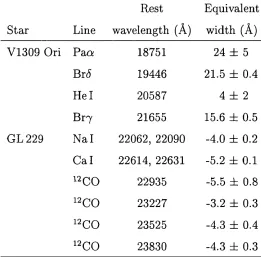
-band spectra of V1309 Ori and GL229 (M 1V). The rest wavelengths have been taken from Dhillon et al. (1997) and Lang (1974); the rest wavelengths of the 12CO lines refer to the band-heads... 88 5.1 Log of observations: HU Aquarii high-speed p h o t o m e t r y ...134 5.2 Mean spectral irradiances of the stream and the accretion region
(‘sp o t’) components during high state eclipse ingress (the uncertain ties quoted are 1-sigma errors), and the ratio of the fluxes of the stream to the spot flux. For comparison, the ratio of the stream flux to the spot flux in the low accretion state is listed; these values are taken from Hakala et al. (1993)... 136
Scientific context
1.1
Close binary system s
Most stars in our Galaxy are not single stars like the Sun, b u t occur in binary or multiple star systems. Of the seven nearest star systems (including the Sun), five are at least double (Allen 1976). The fraction of stars in the Galaxy th a t are binaries is significantly larger than 50 per cent. A bout half of these binaries are systems where the stellar components are very far apart, taking perhaps hundreds or thousands of years to complete a revolution about their common centre of mass. These stars interact only in the sense th a t they are gravitationally bound, and the evolutionary path of each component star is not affected by the other member of the system. O ther binaries, however, are sufficiently close th a t the evolutionary path of each of the components departs appreciably from the evolution of single stars. The two stars in a close binary can interact in a variety of ways, for instance via radiation (where a hot star can irradiate the face of the other component) or via tidal forces, where gravitational and centrifugal effects distort the shapes of one or both components. As a result of these interactions, close binary systems present intriguing problems of their own. The variety of fascinating phenom ena observed in close binaries, which have no counterparts among the single stars, are of m ajor
C H A P T E R 1. S C IE N TIF IC C O N T E X T 15
interest in m odern astronomical research.
This thesis examines the accretion flows in a group of close binaries, the polars
or AM Herculis stars. These are a subclass of the cataclysmic variables (CVs), in which a tidally-distorted red dwarf star transfers m atter to a white dwarf. I begin by outlining the classification of close binaries according to Roche geometry, and describe how mass transfer occurs by Roche lobe overflow from the mass donating star to the accreting star. This is followed by an outline of the m ain characteristics of the various CV subtypes, and a brief overview of our current understanding of CV evolution. I then describe the characteristics of the magnetic CVs, in particular the strongly m agnetic polars, in order to provide a context for the main them e of the thesis: the accretion flow in polars.
1.2
The Roche geom etry and mass transfer
In a binary system, the gravitational and centrifugal potential of the system can be described using equipotential surfaces. If both component stars can be approximated by point masses 1, the Roche approxim ation (Kopal 1959) can be used. The shapes of the Roche equipotentials are functions only of the mass ratio q of the binary, defined as q — M 2/M i, where M i is the mass of the prim ary star, and M 2 is the mass of the secondary2. The more massive star has the more extensive Roche surface. The scale of the system is determ ined by a, the separation between the centres of mass of the two stars. This is given by Newton’s generalization of K epler’s th ird law, which in a convenient form is
a = 3.53 x 10¹⁰M i/3(1 + q)1/3P„ (? cm (1.1) where P 0rb is the orbital period of the system in hours. W ithin a certain distance of
^ h i s approximation holds for CVs, because the white dwarf is small in comparison to its Roche
lobe, and the red dwarf star is similar to a main sequence star and is therefore centrally condensed.
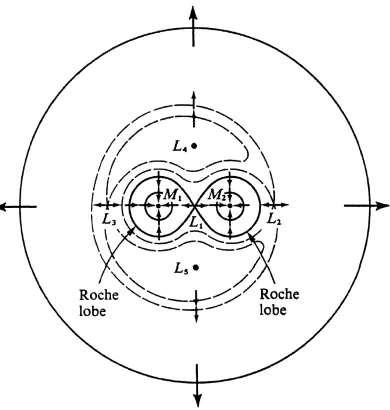
the centre of each star, the Roche surfaces are closed around th a t star. Beyond this distance, each equipotential surface encloses both components of the binary. The critical Roche surface is the unique double-lobed surface which ju st encloses both stars. The two lobes are in contact at the inner Lagrangian point (L i): this is one of the five Lagrangian points (see Fig. 1.1) where a test particle (one of negligible mass) will remain stationary in the binary frame unless perturbed by an external force. The points Iq , L 2 and L3 are points of unstable equilibrium.
Close binaries are classified according to the Roche model in the following way.
Detached binaries are systems where the envelopes of both stars lie well w ithin their
respective Roche lobes. Contact binaries are systems where the envelopes of both stars fill or exceed their Roche lobes (e.g. the W UMa stars). W hen one s ta r’s envelope coincides with its Roche lobe, and the other star lies within its Roche lobe, the system is a semi-detached binary. CVs are members of this last category: the white dwarf is the (detached) primary, and the red dwarf the (Roche lobe-filling) secondary.
The concept of a critical Roche surface fixed in the binary frame is applicable only when the binary orbit is circular, since an elliptical orbit introduces a time- dependent potential and thus a tim e-dependent critical surface. However, in CVs, the effects of tidal interaction on the secondary cause its rotation to synchronize with th a t of the orbital revolution, and any initial eccentricity of the binary orbit is removed on a tim e scale much shorter th a n the lifetime of the CV. Most CVs (and certainly those with P0Tb <C 1 d) can be assumed to have circular orbits and synchronously ro tatin g secondaries.
C H A P T E R 1. SC IE N T IF IC C O N T E X T 17
l a
•
\ \
M \ / M i
Roche Nv
lobe
Roche
lobe
Figure 1.1: Roche equipotentials for a binary w ith a mass ratio of 2/3. The arrows show the local direction of the effective gravitational field as experienced by a test particle in the ro tatin g frame of the binary. The effective gravity vanishes a t the five Lagrangian points Li, • • • ,L 5. The double-lobed ‘figure 8’ passing through the
The transfer of mass from the secondary to the prim ary will change the mass ratio q of th e system, leading to changes in a and P orb because of the redistribution of angular m om entum in the system. Since a and q determ ine the Roche geometry, changes in these quantities tend to shrink or enlarge the critical Roche lobe. For conservative mass transfer (i.e. where all the the mass lost by the secondary is accreted by the prim ary), it can be shown th a t if q > | , the Roche lobe of the mass-losing star shrinks in response to mass loss (Frank, King & Raine 1992) — the precise figure depends on the mass-radius relation of the secondary. Unless the secondary is able to contract rapidly to keep pace w ith the shrinking Roche lobe, the overflow will become a runaway process and will proceed on a dynam ical or therm al tim e scale (depending whether the s ta r’s envelope is convective or radiative).
If q < | , however, the Roche lobe expands in response to mass transfer, and stable mass transfer is possible. However, mass transfer will soon cease unless the stellar envelope can be kept in contact w ith the Roche lobe, either by the expansion of the secondary, or by the loss of angular m om entum from the system as a whole. The former case can occur where the secondary is evolving off the m ain sequence, expanding on a nuclear tim e scale determ ined by hydrogen shell burning. However, in CVs, where th e secondary is a low-mass star, its main sequence lifetime is longer th an the Hubble tim e, and this mechanism cannot be operating. Stable mass transfer in CVs is therefore possible only if the system can lose orbital angular momentum. In short period systems (Porb ~ 2 h), orbital angular momentum loss is thought to proceed by gravitational radiation (Faulkner 1971). In this case the mass transfer rate M of the system will be given by
(Faulkner 1971; W ickramasinghe & Wu 1994). In longer period systems (with P orb ~ 3 h), the mechanism for orbital angular m om entum loss is magnetic braking (Verbunt
M & 2.0 x 10¹⁷
M?Mo
( M l - M 2) ( M l + M 2y i* \ VlOOmin
- l ( 1.2 )
C H A P T E R 1. SC IE N T IF IC C O N T E X T 19
star co-rotates on m agnetic field lines out to the Alfven radius 100 R 0 ; see section 1.7.2). This brakes the rotation of the secondary, and since the secondary’s rotation is coupled tidally to the primary, this brakes the system as a whole (see also section 1.6).
Having established the mechanisms whereby stable mass transfer could occur in CVs, we now consider the results of the mass transfer process. Because the m atter from the secondary possesses angular m om entum due to the binary rotation, it cannot accrete directly onto the surface of the primary. If the prim ary does not have an appreciable magnetic field th a t disrupts the flow3, the stream is able to flow past the prim ary and collide with itself at a point well inside the prim ary’s Roche lobe. The relative kinetic energy of the im pact is radiated away, and the mass transfer stream forms a ring around th e primary. In the presence of viscous effects, the ring subsequently spreads into a disc.
In the absence of a strong white dwarf field, the distance of closest approach of the initial mass transfer stream to the white dwarf, R mm, can be calculated from single particle trajectories (Lubow & Shu 1975) and is approxim ated to an accuracy of 1 per cent by
= 0.0488q - ° m , 0.05 < 5 < 1.0 (1.3)
a
(W arner 1995). The radius of the initial ring of gas, Rr, is the smallest outer radius any disc can theoretically possess. An approxim ate expression for R T is
— = 0 .08 5 9 q~0A26 (1.4)
a
for 0.05 < q < 1, accurate to 1 per cent (Hessman & Hopp 1990). The properties of accretion in system s with a white dwarf prim ary th a t does have an appreciable magnetic field are introduced in section 1.7.2 and are reviewed in detail in chapter 2.
3In CVs, an “appreciable” magnetic field strength is B « 5 — 10 MG for a system where the
Useful expressions for the radius of the white dw arf as a function of its mass are
is the Chandrasekhar mass (Mch = 1.44 M0 ).
1.3
The identification of CVs as detached binaries
The cataclysmic variables (CVs) include dwarf novae, recurrent and classical novae, and the nova-like variables. Their name refers to the o u tbursts th a t characterize the class — outbursts which are violent, but not fatal to the star. The realization th a t CVs are close binary systems was a result of the introduction (in the mid-1940s) of the 1P21 photom ultiplier, enabling light curves w ith a tim e resolution shorter th an a m inute to be recorded. A.P. Linnell’s 1949 study of UX UMa (which was, at the time, the eclipsing binary with the shortest known orbital period) revealed low-amplitude flickering in the light curve, and a complex and variable eclipse pro file (Linnell 1949; Linnell 1950). A photom etric survey of CVs carried out in the early 1950s by M.F. Walker revealed rapid brightness variations in a num ber of nova rem nants, dwarf novae and nova-like variables (Walker 1954a,b). D uring this sur vey, Walker discovered eclipses in the classical nova DQ Her (Nova Her 1934), and speculated th a t all novae might be close binaries (Walker 1954b). A num ber of CVs were subsequently shown to be binary systems following an intensive programme of spectroscopic observations (e.g. Joy 1954a; Joy 1954b; Crawford & K raft 1956; K raft 1962; K raft 1964; Krzeminski & K raft 1964). This lead to the suggestion by K raft (1963) th a t all cataclysmic variables are close binaries.
CVs are now known generally to comprise a w hite dw arf and a late-type dwarf star on or near the main sequence in a close binary configuration. A part from a
R 9 = 0.73 M f 1/3, 0.4 < M 1 < 0.7 (1.5)
0.7
< M
i < 1.3 (1.6)C H A P T E R 1. SC IE N TIF IC C O N T E X T 21
few exceptions like GK Per (with an orbital period P orb ~ 2 d ), the T CrB systems (with giant secondaries and P orb ~ 200 d), and the helium-rich double-degenerate AM CVn stars (with P orb ~ 0 .5 h), CVs have orbital periods between 1.3 and 10 hours, and the separation of the stellar com ponents is ~ 2R0 . A pproximately 320 CVs are now known. The most recent catalogue of CVs is Downes, Webbink & Shara (1997). A recent catalogue of CVs and related objects such as low mass X-ray binaries (with neutron star or black hole prim aries) is R itte r & Kolb (1998).
1.4
CV evolution
Before providing a more detailed description of the subclasses of CVs (sections 1.5 and 1.7), I outline the current understanding of th e origin of CVs and their evolu tionary path. In particular, we need to identify possible evolutionary paths for CVs which have strongly magnetic primaries.
Ever since their identification as close binaries, there has been considerable dis cussion as to how CVs form. The m ain problem is how a close binary could contain a white dwarf, since w hite dwarfs are formed only a t the cores of red giant stars which are considerably larger (50-500 Rq) than the orbital separation of the CV system (~few R q ). CVs can develop only from wide binaries in which the prim ary is able to develop into a white dwarf undisturbed. The system m ust then somehow lose angular m om entum and energy in order to draw the com ponent stars together. The two braking mechanisms mentioned earlier (gravitational radiation and magnetic braking) are inadequate to provide the reduction in angular m om entum required to produce a CV w ithin the age of the Galaxy: a much more efficient mechanism is required.
transfer will thus begin from the red giant to the companion. This mass transfer will be dynam ically unstable (as discussed in section 1.2) since the mass donor is more massive th an th e accreting star (i.e. q > 1), and because a giant w ith a convective envelope tends to expand in response to mass loss. T he dynam ically unstable mass transfer rates are so high th a t the secondary is unable to adjust its structure at the rate at which mass is arriving. The transferred m a tte r fills th e com panion’s Roche lobe until further mass transfer is prevented, and the system becomes a common-envelope binary. Both components experience a strong drag force as they revolve around th eir common centre of gravity w ithin the giant envelope, and the two cores spiral together towards the centre of the envelope. The heat deposited in the envelope eventually exceeds the envelope’s binding energy, and the whole envelope is ejected as a planetary nebula. The binary now consists of a m ain sequence secondary orbiting a hot subdw arf primary. The lifetime of th e common envelope phase is ~ 103y (Iben & Livio 1993).
C H A P T E R 1. S C IE N T IF IC C O N T E X T 23
shortest orbital periods. This mechanism may explain why there are more magnetic w hite dwarfs in CVs than in field white dwarfs (about 20 per cent of CVs have m agnetic prim aries while only 3-5 per cent of field white dwarfs are m agnetic). The mechanism may, however, have trouble in accounting for systems such as V1309 Ori (with its exceptionally long 8 h orbital period and relatively high 60 MG prim ary field strength), and A R UMa (with a prim ary field strength of 230 MG).
The progenitors of CVs are relatively rare: approxim ately 1-2 per cent of main sequence binaries w ith prim ary masses greater th an 0.95 Me will evolve into cata clysmic variables (Kolb 1995). The space density of CVs in the G alaxy is about 10- 5-1 0 ~4 p c-3 (de Kool 1992).
1.5
T he classification of non-m agnetic CVs
T he various subclasses of non-magnetic CV are defined as follows. Classical no vae are novae which have shown only one outburst, with an am plitude of up to 20 mag. Recurrent novae have more th an one nova outburst. The outbursts in no vae are probably therm onuclear runaways in the hydrogen-rich m aterial accreted onto the surface of th e white dwarf primary. Nova-like variables are an inhomoge neous group of non-eruptive CVs which include pre- and post-novae, stars whose observational baseline is too short for their outbursts to have been observed. The nova-like variables show slow variations in brightness b u t no outburst behaviour. They are thought to possess steady-state discs w ith a high rate of mass transfer through the disc.
to the norm al outbursts) unusually bright and long superoutbursts in which the maximum brightness exceeds the usual o u tbu rst m axim um by ~ 0.7 mag. A large fraction (0.3 - 0.4 mag) of the extra superoutburst light is m odulated as prom inent periodic humps — superhum ps — w ith periods a few percent in excess of th e orbital period.
In addition to the hydrogen-rich systems described above, there is also a small subclass of helium-rich CVs, the AM CVn stars. The AM CVn stars comprise a de generate helium-rich secondary transferring m a tte r to a DB w hite dwarf. They have orbital periods between 17 and 46 m inutes, and are therefore even more compact th an their hydrogen-rich counterparts, resulting in a variety of phenom ena which are probably caused by the strong tid al interactions between th e outer accretion disc and the secondary (as seen in the SU UMa dw arf novae) and by irradiation-driven mass transfer (as observed in the VY Scl stars). A review of the AM CVn stars is given by W arner (1995b). The first candidate for a strongly m agnetic AM CVn star has now been identified (Cropper et al. 1998, see section 1.7.4).
1.6
The CV period gap
C H A P T E R 1. SC IE N TIF IC C O N T E X T 25
cessation of mass transfer. The system rem ains as a low luminosity, detached binary until sufficient orbital angular m om entum has been lost (by gravitational radiation and any residual magnetic braking) to bring the secondary into contact with its Roche lobe once again; this occurs at P0rb ~ 2.3 h.
There is evidence th a t systems w ith strongly m agnetic prim aries do not have as significant a period gap as those w ith weakly or non-m agnetic prim aries (see section 1.7.1).
1.7
The m agnetic CVs
In almost a quarter of CVs, the prim ary has a sufficiently large m agnetic field to disrupt, completely or partially, the form ation of an accretion disc. These are the m agnetic CVs (mCVs), of which there are two subclasses: the polars (or AM Herculis stars) and the interm ediate polars (IPs). Comprehensive reviews of polars may be found in Cropper (1990) and W arner (1995 chapter 6); reviews of IPs include W arner (1995 chapter 7) and Patterson (1994).
There is no strict division between the non-m agnetic CV and th e mCV classifi cations — many systems have characteristics of bo th classes. For example, V1500 Cyg is a classical nova (Nova Cygni 1975) b u t has a prim ary w ith B ~ 25 MG, and is classified as a polar (Stockman, Schmidt & Lamb 1988). The IP GK Per was Nova Per 1901. GK Per, together w ith the IPs TV Col, XY Ari and EX Hya, show dw arf nova outbursts (Kim, W heeler & Mineshige 1992; Hellier 1993; Hellier, Mukai &; Beardmore 1997). TV Col, in addition, shows superhum ps (Hellier 1993). R X J1914.4+2456 (Cropper et al. 1998) is probably a double-degenerate polar, a m agnetic analogue of the AM CVn stars.
section 1.7.3). The distinguishing characteristics of polars and IPs are described in section 1.7.1 and the physical causes of these differences are outlined in section 1.7.2.
1.7.1
O bservational characteristics o f polars and IPs
Polars
Polars are characterized by powerful X-ray emission and strong, variable linear and circular polarization at optical and infrared wavelengths. Polars also have high excitation UV, optical and infrared spectra w ith strong, variable m ulti-com ponent emission lines (the strengths of H e ll A4686 A and H/3 are usually com parable). No observational signatures of accretion discs have been found in polars.
In most systems, polarim etric and photom etric m odulations occur only a t the orbital frequency (and occasionally harmonics thereof). In particular, the principal period derived from radial velocity variations or eclipse studies (the orbital period) and th a t from polarim etry (the white dw arf spin period), are identical to w ithin a very small tolerance. Biermann et al. (1985) find th a t in D P Leo, th e fractional error between the two is less th an 2 x 10⁻⁶ . In V1309 Ori, Buckley & Shafter (1995) find a difference between the orbital period (obtained from eclipse observations) and the spin period (deduced from circular polarim etry) of less th an 10“ 3. Since very few intensive long-term m onitoring campaigns on polars have been carried out, it is not certain w hether polars are synchronized over long periods of tim e (~ years). Most systems, however, are synchronized within the observational uncertainties. There are exceptions to th is rule, which are discussed in section 1.7.4.
C H A P T E R 1. S C IE N T IF IC C O N T E X T 27
Polars show large-am plitude brightness variations on a tim e scale of m onths to years. The variations are probably due to a reduction in th e mass transfer rate from the secondary star, and are thus usually referred to as ‘high accretion’ and ‘low accretion’ states (e.g. Liebert & Stockm an 1985). In polars, a reduction in M
from th e secondary has an im m ediate effect on th e overall lum inosity of the system because polars lack accretion discs which would act as tem p orary reservoirs of gas4.
Most polars have orbital periods below the period gap. P rior to the launch of
R O S A T, a significant fraction of known polars had periods clustering in a “spike”
near 114 min. The significance of the spike has subsequently diminished due to the discovery of over 30 new polars by R O S A T and other X -ray satellites, and the period distribution of polars is now more uniform. Interestingly, there are several systems
in the period gap: these include R X J0531.5-4624 (Reinsch et al. 1994), QS Tel (W ickram asinghe et al. 1993) and R X J0803.4-4748 (Schwarz & Greiner 1999).
Mass transfer rates in polars below the orbital period gap are low, M ~ 2.5 x 10¹⁵g s -1 (W arner 1995), in agreement w ith the rate expected for gravitational ra diation alone (equation 1.2). The mass transfer rates for systems above the period gap, however, are much higher — V1309 Ori has a m ass transfer rate greater th an ~ 1017g s _1 (see chapter 3). Beuerm ann & Burw itz (1995) have estim ated the mass transfer rates for several polars, and find a clear correlation of M with P orb (see Fig. 1.2): the long period systems have accretion rates which exceed those of the short-period systems by typically an order of m agnitude. The highest mass transfer rates for polars are less th a n the highest values of M obtained for non-magnetic systems.
4 It is probable that the rate of mass transfer from the secondary undergoes fluctuations in most
CVs, but in most cases these changes are not obvious because of the disc reservoir. A possible
10
'm 7 0 MG
0.1
^ J 1007
x «
• ( A M ) x
3 0 MG
^ 0 1 3 2 • » “ >
t I M4
7 MG
0.01
- 1 - 0 . 5
l o g P o rb ( d )
Figure 1.2: The mass transfer rate of polars versus o rbital period. The long-period system s have accretion rates which exceed those of th e short-period systems by typically an order of m agnitude. From B euerm ann & B urw itz (1995).
In term ed iate polars
M ost IPs have hard X-ray spectra w ith no soft X-ray blackbody com ponent, most have orbital periods above the period gap, and m ost do not show detectable polar ization. There are, however, exceptions to all of these: see section 1.7.4. The optical sp ectra of IPs resemble those of polars, bu t th e H e l l A4686 A emission is usually weaker relative to H(3.
IPs show m ultiple periodicities in their light curves. M ost system s have three periods: two distinct periods and the b eat period between th e two. Some systems have periods th a t appear in the X-ray and optical light curves (e.g. AE Aqr: de Jager 1991; P atterso n 1979, FO Aqr: O sborne & M ukai 1989; N orton et al. 1992, EX Hya: Jablonski & Busko 1985), and in others th e X-ray and optical periodicities are distinct (e.g. V1223 Sgr: Osborne et al. 1985). TV Col has shown as many as four periods in its X-ray and optical light curves (Hellier 1993).
C H A P T E R 1. S C IE N T IF IC C O N T E X T 29
accretion disc. Emission line profiles of EX Hya are double-peaked; in addition, there is a strong S-wave com ponent which is a ttrib u te d to a bright spot a t th e edge of a disc (Hellier et al. 1987). O ther systems showing S-wave com ponents include FO Aqr (Hellier, Mason & C ropper 1990), AO Psc (Penning 1985) and T X Col (Buckley & Tuohy 1989). Doppler tom ogram s of th e H(5 emission line of DQ Her show a clear ring stru cture caused by emission in an accretion disc (Kaitchuck et al. 1994).
The fact th a t several systems show dw arf nova o u tb u rsts is clear evidence th a t accretion discs are present in IPs. The increase in am plitude of the X-ray pulsations in XY Ari in o u tb u rst is explained in term s of a tru n c a ted disc whose inner radius decreases in response to the enhanced M of th e o u tb u rst (Hellier et al. 1997). D uring the outbursts of EX Hya, its eclipses become broad and shallow, consistent w ith an expanded disc (Reinsch h Beuerm ann 1990). O ther IPs, however, show evidence of discless accretion: RX J1712.6-2414 (Buckley et al. 1995, Buckley et al. 1997) is a good candidate for a discless accretor. The observational evidence suggests, therefore, th a t there is a much wider variety of accretion modes in IPs th a n in polars.
Most IPs have orbital periods above the period gap, and no known IP has an o rb ital period in th e gap. The accretion rates deduced for IPs are in general much larger th an for polars, requiring m agnetic braking as a driving mechanism. This suggests th a t the orbital evolution of IPs is sim ilar to th a t of th e non-m agnetic systems, and dissim ilar to th a t of the polars.
1.7.2
Origin o f th e observational characteristics
In polars, the p rim ary ’s m agnetic field is sufficiently strong (B ~ 10-230 MG) to synchronize the ro tatio n of the white dw arf w ith th a t of th e binary5. This is the reason why only one m odulation period is usually found in polars. In the IPs, the
white dw arf is not in synchronous ro tatio n w ith th e binary. The three frequencies seen in many IPs correspond to the spin frequency of th e w hite dwarf, the orbital frequency, and th e b eat frequency between the two.
The strength of th e m agnetic field on the w hite dw arf determ ines to a large extent the accretion modes and the energy distrib u tion of a given system. It also determ ines w hether th e w hite dw arf’s rotation is synchronized w ith th a t of the binary.
A ccretion m od es
The stream of m aterial transferred from the secondary falls initially on a ballistic trajecto ry towards the w hite dwarf6. At some point betw een th e two stars, the white dw arf field will begin to oppose the m otion of the stream plasm a, since the stream is (at least partially) ionized. The boundary between th e region in which th e stream follows a ballistic trajectory, and the region in which th e m agnetic field strongly affects the flow of mass, energy and angular m om entum (the magnetosphere), is thought to occur where the m agnetic pressure of th e field becomes com parable to the ram and gas pressure of the accreting m aterial. This equilibrium radius is known as the Alfven radius.
It is generally assumed th a t the field is a dipole; even if it is not, th e dipole term of the field will dom inate a t large distances from th e w hite dw arf surface. The m agnetic field stren g th of a dipole field varies as
B (r) = £ (1.7)
where B (r) is th e m agnetic field strength a t a radial distance r and p is the m agnetic m om ent of th e w hite dw arf (given by B R\ , where R \ is th e w hite dw arf radius and
6There is evidence to suggest that the initial trajectory of the stream in polars may not be
purely ballistic (Heerlein, Horne k Schwope 1999). This is because the initial mass transfer stream
may be subject to a magnetic drag force that acts transversely on the stream before the material
C H A P T E R 1. S C IE N T IF IC C O N T E X T 31
B is the polar field strength of the dipole field). The m agnetic pressure of this field is B 2( r ) /87r. The ram pressure of th e stream is p v2, where v is the velocity of th e infalling m aterial and p is its density. The infall velocity is assumed to be the free-fall velocity: v = va — { 2 G M i/r)1/ 2.
For spherically sym m etric infall, the balance between m agnetic pressure and ram pressure is
B 2 M vff a
8^ = p V = l ^ (L 8 )
where M is the (isotropic) mass transfer rate. This implies an equilibrium radius
R»,sPh given by
R»,sPh = 9.9 x 10¹⁰^ 4 TM r 1/7M f62/7 cm (1.9) where /i34 is the m agnetic mom ent of th e w hite dw arf in units of 1034 G cm 3 and M i6 is the mass transfer ra te in units of 1016g s _1. For accretion by a stream (as opposed to spherically sym m etrical infall), th e right-hand side of equation 1.8 becomes M v ^ /n c r2, where a is the radius of the stream . T his implies an Alfven radius R tu given by
= 1.45 x lO10^ 11^ 4/ 1^ , -1711^ 2711 cm (1.10)
(Mukai 1988) where <jg is the radius of th e stream in un its of 109cm (the cross section of the stream is assumed to be circular). Values of a can be obtained from Lubow & Shu (1975) or from m easurem ents of th e w idth of the pre-eclipse dip in systems th a t show this feature (as in W atson et al. 1995 and chapter 5).
For a fixed M , the Alfven radius for spherical accretion is much larger th a n for stream accretion, i.e. for stream accretion, th e accretion flow will be able to travel much closer to the w hite dw arf before being disrupted by th e field.
orbital plane to follow the field lines down onto th e w hite dwarf. The details of the threading of the stream depend on a large num ber of factors (plasm a instabilities, field distortion and reconnection, w hether the m agnetosphere is ro ta tin g w ith respect to the incoming stream , and so on). These are discussed in chapter 2. Threaded m aterial in the m agnetosphere is often referred to as th e ‘accretion funnel’ in the case of polars and the ‘accretion c u rta in ’ in IPs; this term inology reflects the fact th a t threading is thought to occur over a wide range of azim uths (often from a tru ncated disc) in IPs b u t from a (relatively) smaller thread in g region in polars.
The radius R ^ can be used as a first approxim ation to determ ine w hether or not an accretion disc can form in a given system. This is done by com paring the radius RM to the radii R x and R mjn (see equations 1.4 and 1.3). If RM < R mjn, a disc can certainly form, th e inner edge of which is tru n cated by the field. If > R min
there are two possibilities, depending on th e size of R x. If R ^ > R x, the in itial mass transfer stream cannot orbit the white dw arf w ithout being disrupted, and a disc cannot form. If R m\n < R ^ < R x there is a possibility th a t a disc may form, provided th a t some of the stream can pen etrate closer to th e w hite dw arf to survive p ast R m\n
and initiate a disc.
There is an added com plication in cases where th e system is asynchronous, par ticularly if the w hite dw arf is spinning rapidly. K ing (1993), W ynn & K ing (1995) and W ynn, King & Horne (1997) point out th a t th e criteria for disc form ation in these systems m ust include a consideration of th e spin ra te of th e accreting star. W hen the flow is m odelled as inhomogeneous and diam agnetic, theory indicates th a t a substantial fraction of the m atter transferred from th e secondary can be ejected from the system. This could explain why the long-period IP AE Aqr (which should have a disc, given the large orbital separation of th e com ponents and a relatively low magnetic m om ent, hence R x > R mjn i?^), shows no evidence of one (W ynn, King & Horne 1997).
C H A P T E R 1. S C IE N T IF IC C O N T E X T 33
observations of th e IP TX Col, in which th e relative power of th e spin and beat m odulations changes dram atically from m onth to m onth. T he presence of a strong b e at m odulation in an IP is thought to be an indicator of discless accretion, since accreting m aterial from the inner edge of a tru n c a ted disc should have no ‘m em ory’ of th e orbital phase. T he changes in th e relative power of th e spin and b e at m odulations thus indicate th a t the accretion mode can change on a tim e scale of less th a n a m onth.
O rb ital ev o lu tio n o f polars
T he existence of several polars w ith orbital periods in th e period gap suggests th a t th e period gap m ay not be as significant for polars as for more weakly m agnetic systems. Since th e period gap is thought to be caused by the cessation of m agnetic braking, it would ap p ear likely th a t th e m agnetic field of th e prim ary disrupts the m agnetic braking mechanism in some way. It has been a m a tte r of debate w hether a strong p rim ary m agnetic field inhibits or enhances m agnetic braking, thereby speeding up or slowing down the evolution of a given system from longer to shorter o rb ital periods. Liebert & Stockm an (1985), King (1985) and H am eury et al. (1987) suggest th a t th e m agnetospheres of b o th stars could contribute to the m agnetic braking, leading to accelerated orbital evolution.
1998).
M agnetic braking m ust still be operating in th e long-period polars, since th eir m ass transfer rates are several orders of m agnitude higher th a n those predicted by gravitational radiation-driven orbital evolution (Fig. 1.2). Since th e mass transfer rates for the polars w ith the longest values of P Qrb are still an order of m agnitude lower th a n non-m agnetic systems w ith sim ilar o rb ital periods, this suggests th a t m agnetic braking is suppressed (but not elim inated) in highly m agnetic systems.
C on d ition s for synchronism
T he angular m om entum of accreting m aterial tends to increase th e angular velocity of the w hite dwarf. T he fact th a t stable equilibria betw een th e o rb ital and the spin period exist in IPs, and th a t m ost polars are observed to have P spin = P 0rb5 indicates th a t there are synchronizing torques th a t counteract th is accretion torque.
The synchronizing torque is due to the p rim ary ’s m agnetic field, and is magne- tohydrodynam ical in n atu re. Lamb et al. (1983) describe a m odel in which the field lines of an asynchronously ro tatin g prim ary are wound up and th read th e secondary (if the secondary does not have an appreciable field) or connect w ith the secondary field lines (if it does). T his causes large currents along th e field lines and generates m agnetic stresses which are able to synchronize an in itially asynchronous system. T his m echanism cannot m aintain synchronism, since a t least a slight asynchronicity is required to generate th e torque. The additional force th a t is required to m aintain synchronism arises in th e interaction between the intrinsic fields of th e p rim ary and secondary (C am pbell 1989; Wu & W ickram asinghe 1993; C am pbell 1997; W arner 1997). The secondaries in CVs are likely to have field stren g th s of the order of hundreds to th o u san d s of Gauss (e.g. Saar 1990).
C H A P T E R 1. S C IE N T IF IC C O N T E X T 35
discless system is th a t the accretion torque should be less th a n th e synchronizing torque, which leads to
jli33~0.14M i6 (1-11)
(W arner 1997), where ^33 is th e m agnetic m om ent of th e p rim ary in units of 1033 G c m 3. This equation takes into consideration th e dipole-dipole interaction between the m agnetic m om ents of the prim ary and th e secondary star.
T h e energy d istrib u tion
T he plasm a in the m agnetosphere will fall along th e field lines tow ards th e w hite dw arf surface a t highly supersonic velocities. Since th e m aterial is th read ed onto th e field, the flow is channeled onto a small fraction of th e w hite dw arf surface near th e m agnetic poles. In the accretion region, th e m aterial is decelerated strongly and forms a shock as it reaches th e w hite dw arf surface, w here th e specific kinetic energy of infall = G M1/ R 1 is random ized and tu rn e d into th erm al energy. Since, in general, the gas below th e shock cannot cool as fast as it is heated by th e shock, the post-shock flow expands, and the shock is raised above th e w hite dw arf surface until such a volume is reached th a t the post-shock m aterial can cool (the stand-off shock and the post-shock flow are often referred to as th e ‘accretion colum n’). T he density of the flow increases by a factor of ~ 4 from before the shock to th e post-shock flow; th e velocity of the flow decreases by the same factor by continuity. T he tem p eratu re of the post-shock flow emission depends on the am ount of energy deposited there: th is is determ ined prim arily by th e mass of th e w hite dw arf (the deeper th e po ten tial well, the more kinetic energy will be deposited on th e w hite dw arf surface by the accretion flow). The tem p eratu re and density stru c tu re of th e post-shock flow has been m odelled by Cropper, R am say & Wu (1998) to determ ine w hite dw arf masses in polars.
removed at th e sam e rate as it arrives, implying the existence of efficient cooling mechanisms in the post-shock flow. Since the tem p eratu re of the plasm a immedi ately after th e shock is ~ few x 108 K, a significant fraction of the emerging radiation will be brem sstrahlung (from decelerated free electrons) a t ~ few x lOkeV. The shock also cools via cyclotron radiation from threaded electrons spiralling around the m agnetic field lines, and C om pton cooling through scattering of lower energy photons by th e shocked electrons.
T he height of the shock above the w hite dw arf surface depends on the tim e taken for th e post-shock m aterial to cool radiatively (via brem sstrahlung and cyclotron radiation) and by C om pton cooling. The relative efficiency of these mechanisms depends prim arily on the white dw arf field stren gth and th e specific accretion rate (the accretion ra te per unit area in the accretion region) which is proportional to
L / f , where L is the to tal accretion lum inosity and / is the fraction of th e white
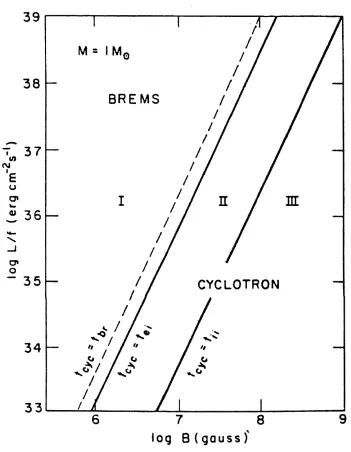
dw arf surface onto which the accretion occurs. Three regimes in the lo g B -lo g L /f
plane have been identified by Lamb & M asters (1979) (see Fig. 1.3). Above a critical line brem sstrahlung dom inates the radiative cooling. In this region (labelled I in Fig. 1.3), the tem p eratu re of the ions and electrons in th e plasm a are comparable, and th e the plasm a can be treated as a single fluid. Two-fluid effects become im p o rta n t in region II, where cyclotron cooling dom inates brem sstrahlung (cyclotron rad iatio n cools th e electrons b u t not the ions). In region III, cyclotron cooling is so effective th a t th e velocity distribution of the ions becomes non-Maxwellian. In the extrem e case (where th e field strength is high and the mass transfer rate low), the cyclotron cooling will dom inate and a stand-off shock stru ctu re does not form, since all th e accretion energy is radiated away in the shock itself. Solutions of th e flow in this regime are called ‘bom bardm ent’ solutions (e.g. K uijpers & Pringle 1982; Thom pson & C aw thorne 1987; Woelk & Beuerm ann 1992, 1993, 1996) because the flow consists of a low density stream of ions which impinge directly onto th e white dw arf (w ithout first passing through a post-shock flow).
brems-C H A P T E R 1. Sbrems-C IE N T IF Ibrems-C brems-C O N T E X T 37
39
38
BREMS
CMI
a*
o
CYCLOTRON
3 4
3 3
log B(gauss)'
strahlung and cyclotron radiation a t UV, optical and infrared wavelengths. There is a th ird m ajor contributor to the accretion region emission. The h ot post-shock flow is situ ated on the surface of the prim ary, and nearly h alf its emission is intercepted by the prim ary. Some brem sstrahlung photons w ith k T ~ 20keV are reflected from the white dw arf photosphere, b u t th e lower energy brem sstrahlung photons are absorbed, therm alized and re-em itted by th e w hite dw arf photosphere. This produces an approxim ately blackbody spectrum in the EUV a n d /o r soft X-ray region w ith k T ~ few x 10 eV. The tem p eratu re of the EUV emission is related to the accretion rate and th e size of the accretion region on th e w hite dwarf.
This theoretical framework accounts for th e energy d istribution of polars, b u t it rem ains to be explained why IPs (typically) have hard X-ray spectra and very little or no soft X-ray component (e.g. O sborne 1988 — b u t see section 1.7.4 for exceptions). T he lack of soft X-rays in IP s is thought to be due to local absorption in the system. Because the threading of the m aterial typically occurs over a wide range of azim uths in the orbital plane (e.g. from th e inner edge of a tru n cated disc), this leads to a significant am ount of m aterial in the m agnetosphere th a t can locally absorb the soft X-ray component. Since m aterial couples onto a larger num ber of adjacent field lines in IPs th an in polars, th e accretion region(s) on the w hite dw arf are generally much larger (by factors of ~ 100-1000) th a n in polars (W arner 1995). T he absence of detectable soft X -ray/E U V com ponents in IPs m ay be due to the fact th a t the more extended accretion regions would em it radiation at a tem p eratu re too low to be detected. Such low tem p eratu re emission is particularly susceptible to interstellar absorption.
C H A P T E R 1. SC IE N T IF IC C O N T E X T 39
first is the ‘bom bardm ent solution’ of K uijpers & Pringle (1982), m entioned above. In these solutions, th e cooling of the flow is so effective th a t no post-shock flow is formed, and th e incoming gas will therm alize in a th in layer a t th e w hite dwarf surface. This yields a spectrum appreciably softer th a n in the conventional shock solution (K uijpers & Pringle 1982, Thom pson Sz Caw thorne 1987).
T he second model proposed to account for th e observed soft X-ray excesses in po lars (also by K uijpers & Pringle 1982) is th a t the accretion flow is non-homogeneous and incorporates dense blobs or clumps of m aterial. This scenario is discussed more fully in chapter 2 because it is directly related to th e n atu re of th e accretion flow.
1.7.3
M easuring th e field stren gth in m C V s
M agnetic field strengths in polars can be deduced using observations of Zeeman split ting of th e w hite dw arf photospheric and accretion flow ‘halo’ absorption features, cyclotron harm onics in optical and infrared spectra, and by m odelling polarization light curves. In systems where B has been determ ined using more th a n one m ethod, the results are in good agreem ent (e.g. V834 Cen: W ickram asinghe, Tuohy & Vis- vanathan 1987; Schwope & Beuerm ann 1990, M R Ser: W ickram asinghe et al. 1991, EF Eri: Achilleos, W ickram asinghe & Wu 1992; Ferrario, Bailey & W ickramasinghe 1996, D P Leo: C ropper et al. 1990).
features around the orbit provides a means of m easuring th e geom etry of the field, b u t it is no t straightforw ard to deduce the field strength in th e accretion region
itself. O bservations of Zeeman split photospheric features are com plicated by th e fact th a t low states in polars cannot be predicted in advance. In addition, since polars in low accretion states can become very faint, large telescopes are required to obtain sp ectra of the signal-to-noise required for th e Zeeman split features to be visible.
Zeeman split absorption features have also been observed during bright, cyclotron- dom inated phases. These features disappear when th e accretion region rotates out of view, indicating an origin in th e accretion region, and not the photosphere of the white dwarf. They are thought to arise from a cool ‘h alo’ of of unshocked gas surrounding th e cyclotron emission region, which absorbs the cyclotron continuum from th e post-shock flow (W ickramasinghe, Tuohy & V isvanathan 1987; Achilleos, W ickram asinghe & Wu 1992).
A widely applicable m ethod is based on observations of th e broad cyclotron harm onic features (‘hum ps’) in optical and infrared spectra. A lm ost all polars show cyclotron hum ps, provided th e wavelength coverage and signal-to-noise ratios are sufficient (C ropper et al. 1989). The m ethod has the added advantage of m easuring directly the field in the cyclotron-em itting region, which occurs predom inantly in the post-shock flow where the therm al velocities of the gyrating electrons are highest. The m ethod is thus a direct probe of the field in the accretion region.
Field strengths in polars can also be deduced by modelling intensity and po larization light curves (e.g. C ropper & W arner 1986; Ferrario & W ickram asinghe 1990; P o tte r et al. 1997; see also chapter 3 and chapter 7). These models are based on detailed cyclotron emission calculations such as the constant tem p eratu re m od els of M eggitt & W ickram asinghe (1982) and W ickram asinghe & M eggitt (1985). The field strengths obtained in this way are less secure th an those obtained using cyclotron hum ps, since the fits are model-dependent.
C H A P T E R 1. S C IE N T IF IC C O N T E X T 41
field estim ates are not possible. This is because only th ree IPs show polarization, and no detections of cyclotron hum ps have been made. Also, it has no t yet been possible to ob tain a spectrum of the photosphere of an IP prim ary during a low accretion state to search for Zeeman features.
Since IPs are tho u g h t to have low field strengths (~ 1 0 M G), searches for cy clotron hum ps have been m ade in infrared spectra where the cyclotron harmonics are closer to th eir fundam ental frequency and would therefore be more easily resolv able. A ten tativ e detection of a cyclotron hum p in a A -b a n d spectrum of BG CMi was reported by D hillon & M arsh (1993); this has subsequently tu rn e d out to be a m is-identification (Dhillon et al. 1997). F u rth er A -b an d observations by Dhillon et al. (1997) of P Q Gem, BG CMi and EX Hya fail to reveal any secure cyclotron features — if any cyclotron emission is present in these IPs, it contributes less than ~ 3 per cent of the infrared continuum flux.
Deducing B from polarization m easurem ents of IPs is more com plicated than in the polar case due to possible sources of diluting flux. In polars, th e emission from other p arts of the system (such as th e accretion stream ) are generally assumed to be negligible (but see chapter 7). In IPs, however, a tru n c a ted disc and accretion curtain (s) could contribute substantially to th e intensity variations and would di lute any polarization present. In addition to the com plications of interpreting the polarization modelling, there are only three IPs which show detectable polarization. These are PQ Gem (e.g. Mason et al. 1992), BG CMi (e.g. Penning, Schmidt & Liebert 1986; W est, B errim an & Schmidt 1987) and R X J1 7 1 2 .6-2414 (Buckley et al. 1995). Field estim ates using polarization light curve m odelling are in the ranges 9-21 MG for P Q Gem (Piirola, H akala & Coyne 1993; V ath , C hanm ugam & Frank 1996; P o tter et al. 1997), 2-5 MG for BG CMi (W ickram asinghe, W u & Ferrario 1991) and 8-27 MG for R X J17 1 2 .6-2414 (Buckley et al. 1995; V ath 1997).