802 |
P a g e
AN EFFICIENT ENERGY ROUTING METHOD FOR
WIRELESS SENSOR NETWORKS USING FAF
A.Gnanaguruvathal
1, J.Jayavel
21
PG Scholar,
2Teaching Assistant, Dept. of IT,
Anna University Regional Centre Coimbatore, TamilNadu (India)
ABSTRACT
Wireless sensor networks are made of sensor nodes with restricted battery life and transmission capability. Existing algorithms such as LEACH and FAF-EBRM do not have effective node selection mechanisms. To overcome this issue a Fuzzy logic rule based approach (FAF-EBRM) is proposed in this work and has been found to be more suitable of using fuzzy is to manage tolerance fuzzy logic implementation. Here Fuzzy logic rule is used to select the next hop node to transmit the data. The advantage of using fuzzy logic is to manage tolerance for imprecision and low cost of computation.
Index terms: Energy Balance Forward Aware Factor (EB-FAF), FuzzyLogic (FL)
I INTRODUCTION
WSN is an emerging technology that can modernize communication technology. Absolutely it has the potential to
significantly change the way we live. The power of WSN lies in creating a persistent environment capable of remote
sensing, monitoring and control. In the present scenario of global warming, WSN can enable fine grain remote
monitoring of components. A radio, a processor sensors and battery. A WSN is formed by closely deployed sensor
nodes in an applications. In most of the deployments, the sensor nodes have self-organizing capabilities, to create an
appropriate structure in order to collaboratively perform a particular task. Wireless Sensor Networks are found more
suitable for applications such as vigilance, precision cultivation, smart homes, automation, vehicular traffic
management, environment monitoring, and disaster detection. In the wireless sensor networks, each sensor node
collects signal from a limited region. This signal is getting processed in that sensor node. Information is generally
transmitted to the observers.
Sensor nodes consume energy while receiving, processing and transmitting the information. In most of the cases, the
sensor nodes are equipped with batteries which are not rechargeable. Therefore, energy competency is one of the
important design goal in wireless sensor network. Nodes can be distributed into a number of small groups, called
803 |
P a g e
which coordinates the data gathering and aggregating process in a particular cluster. Each cluster member forwardits data packets to the cluster-head. Clustering in wireless sensor networks guarantee the basic performance
achievement with a large number of sensor nodes. In other words, clustering improves the scalability of wireless
sensor networks. This is because clustering minimizes the need for central organization and promotes local
decisions.
The major benefits of clustering are:
1) Clustering provides the spatial reuse of resources to increase system capacity. For example, if the clusters are not
neighbor, they can use the same frequency for wireless communication.
2) Routing informations of a cluster is shared with only other cluster-heads or cluster gateways. This restriction
reduces number of transmissions performed for distributing routing information, By using the advantage of
clustering, more energy efficient routing protocol have been implemented. When cluster structure is used in WSN,
the local changes need not be reflected to entire network. This reduces information processed by the sensor nodes
and stored in sensor nodes.
3) However, generally sensor nodes are deployed randomly by throwing them to the target region. Hence, this
approach is not a practical one for real environments in most of the case. Some of the clustering algorithms employ
uncertainties in the Wireless Sensor Networks. So, fuzzy logic rule can be used to avoid uncertainty. Basically, a
fuzzy logic for blending a different clustering parameters to elect cluster heads according to the defuzzified output of
fuzzy if-then rules. In the next section, we briefly discuss about the existing protocols available.
II RELATED WORK
Energy dissipation over the network. LEACH also performs local data compression in cluster heads to decrease the
amount of data that is forwarded to the base station. (2), Geographic routing is an attractive localized routing scheme
for wireless sensor networks (WSNs) due to desirable scalability and efficiency. Maintaining neighborhood
information for packet forwarding can achieve a high efficiency in geographic routing changes frequently due nodes
mobility and availability.
Here, a novel on line routing scheme is proposed, called Energy-efficient Beaconless geographic
Routing(EBGR),which can provide loop free, fullystateless, energy efficient sensor-to-sink routing at a low
communication overhead without the help of prior neighborhood knowledge. In EBGR, each node first calculates its
ideal next-hop relay position on the straight line toward the sink based on the energy-optimal forwarding distance,
and each forwarder selects the neighbor closest to its ideal next-hop relay position as the next-hop relay using the
804 |
P a g e
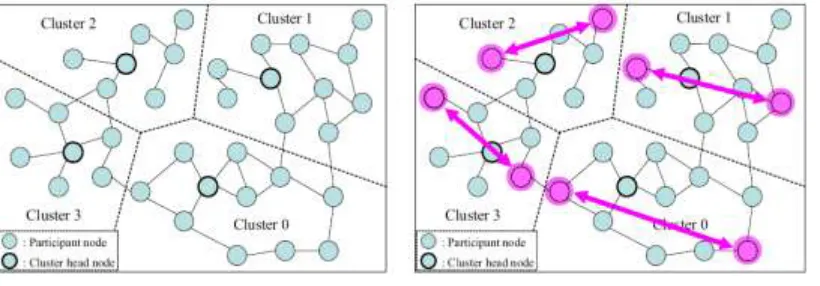
Fig 1 Cluster in WSN
The application of sensor networks are endless, limited only by human imaginations. It also has some issues. Each
sensor node has limited life time. So the network to be formed to avoid the data lost. For that the nearby nodes are
formed as clusters. Among the nodes, one node is selected as the cluster head. Distance between the nodes and the
cluster head also to be minimized for effective transmission of data.
Life time of sensor node is very less. To avoid the data lost in destroy of one sensor node, the additional node is
needed to transmit data of the corresponding sensor node. For managing all the nodes, one head is needed. So all the
sensor nodes are grouped in to clusters and cluster head is selected to forward the message to the nodes. The major
challenges is how to forward the message with minimum energy.
III EXISTING SYSTEM
BBV model is widely used to analyze the real complex networks such as scientist collaboration network and
worldwide airport network. Similar to SCN and WWAN, there are numerous nodes and community structures
(Clusters) In WSN, importantnodes (cluster heads) have more connections than common nodes. Many researches
on “energyhole “show that the data flow on each connection .varies considerably in WSN because of these different
distances to the sink node. Thus it is not suitable represent a connection as connected(“1”) or connection less(“0”).
Global information is limited in WSN of IA sensors exchange information in their “localworld”. The overall
805 |
P a g e
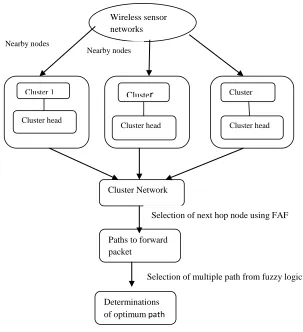
Fig 2 Block Diagram Of a fuzzy logic based path determinations.
IV PROPOSED SYSTEM
A fuzzy clustering approach to the WSNs is analyzed to maximize its lifetime. This approach is a distributed
competitive algorithm. It selects the cluster-head via energy based competition among the tentative cluster heads
which are selected using a probabilistic model. This approach mostly focuses on wisely assigning competition
ranges to the tentative cluster heads. In order to make wise decisions, it utilizes the residual energy and distance to
the base station parameters of the sensor nodes, In performance Analysis of Clustering protocol handle uncertainties
in competition ranges to the tentative cluster-heads which have higher residual energy levels, because they can serve
as larger region. The system is implemented using the following.
4.1 Cluster Network Formation
Minimum number of cluster heads is identified to optimize energy in cluster formation for handshaking mechanism
stateless, energy-efficient sensor-To-sink routing at a low communication overhead without the help of prior Wireless sensor
networks
Cluster 1
Cluster head
Cluster head Cluster head
Cluster
Cluster Network
Paths to forward packet
Determinations of optimum path
Selection of next hop node using FAF
Selection of multiple path from fuzzy logic Cluste
r
Nearby nodes
806 |
P a g e
neighborhood knowledge. In(4) T-LEACH stands for threshold based LEACH because it replaces cluster headsbased on the threshold value of residual energy on the sensor nodes.In traditional protocols relating to the cluster
optimization, the authors proposed that the number of cluster heads be reduced to decrease energy consumption or
that energy efficiency base optimal cluster sizes be constructed to extend the survival time of the network.
A set or randomly scattered wireless sensors.Sensors within a cluster are expected to be communicating with a
cluster head only.The cluster heads summarize and process sensor data from the clusters and maintain the link with
the base station. The clustering is driven by the minimization of energy for all the sensors.
Most clustering algorithms utilize two techniques which are selecting cluster heads with more residual energy and
rotating cluster heads periodically to balance the energy consumption of the sensor nodes over network. These
clustering algorithm do not take the location of the base station into consideration causes hot spot problems in
multi-hop WSNs. Thecluster heads near the base station die earlier, because they will be in heavier relay traffic than the
cluster-heads which are relatively far from the base station .in order to solve this problem and to balance energy
consumption of clusted-heads,next module is raised.
4.2 Optimization of energy
After cluster network formation, Optimization of energy is done based on fuzzy logic rule. It is applied to select the
next hop node for routing the data from one node to another node. It is achieved by considering the following
parameters in selecting the next hop node .They are
Time factor Node factor Threshold value
Time factor
The base station broadcasts the information to the node at time (t1), the acknowledgement received from the node at
time (t2), then the Time Factor is calculated using
Time Factor=t2-t1
Threshold value
Let p be path from the source to any destination and let r be the energy level of the ith node in the path p. The
cluster-heads are stochastically selected. Inorder to select the cluster heads, each node generates a random number
between 0 and 1.If the number is smaller than the threshold, T, the node becomes a cluster round. The threshold is
807 |
P a g e
PT=
1-PX(r mod1/P)
P is the number of the nodes becoming the cluster-heads and r is the number of current round. If a node once has
been a cluster-head in the last 1/P rounds, it cannot be a cluster-head again.
Node Factor
Node factor for each node is determined. Node factor for each node is determined. Node Factor for nodes taking less
time to communicate with base station.
V PROPOSED ALGORITHM
Wireless Sensor Networks uses Forward Aware Factor routing algorithm for static data collection and event
detection. The algorithm is implemented as follows.
Determine the path from the source to the sink and also the next hop node for all the nodes in the
corresponding path.
It determine the set of all of the nodes that has destination as the node i
Select the nodes that closer to Sink which constitutes the set of all of the possible next-hop nodes and the
furthest node determine the path.
Energy density is determined for the next hop node To calculate the weight of edges between i and each nodes.
VI CONCLUSION
The proposed method uses the fuzzy logic for selection of next hop is based for the transmission because the crisp
logic is not possible in imprecision situation. The results show that the node with higher remaining energy,lower
distance has more probability.Being selected as the next node in forwarding the data to base station. In the
experimental results show that FAFEBRM outperforms both. The proposed one balances the energy consumption,
prolongs the function lifetime, and guarantees high QoS for Wireless Sensor Networks.
VII ACKNOWLEDGEMENT
The authors would like to thank the department of Information technology in regional center of Anna University
808 |
P a g e
REFERENCES
[1] Degan Zhang,Member,IEEE,Guang Li,Member,IEEE, Zhao-hua Pan,Member,IEEE “An Energy balanced
Routing Method Based on Forward-Aware Factor for Wireless Sensor Networks IEEE Trans.Industrial
Informatics,vol.10,No.1,Feb 2014 .
[2] Zhang H.B and Shen H(June 2010),”Energy-Efficient Beaconless Geographic routing in Wireless Sensor
Networks.’IEEE Trans.Parallel Distrib.Syst.,vol.21,no.6,pp.881-896.
[3] Meenakshi B, P.Anandhakumar “Optimization of Energy Consumption by Fuzzy Based Routing In Wireless
Sensor Network.pp.31-35
[4]. Ruela A.S. et al.(2009),”Evolutionary design of wireless sensor networks based on complex networks[A],’in