International Food and Agribusiness Management Review Volume 21 Issue 4, 2018; DOI: 10.22434/IFAMR2017.0047
Received: 24 May 2017 / Accepted: 27 December 2017
Improving market success of animal welfare programs through key
stakeholder involvement: heading towards responsible innovation?
Special issue: Responsible innovation in the agri-food sector
RESEARCH ARTICLE
Nina Purwins a and Birgit Schulze-Ehlersb,c
aResearch Assistant and PhD Candidate, and bGuest Researcher, Göttingen University, Department of
Agricultural Economics and Rural Development, Platz der Goettinger Sieben 5, 37073 Goettingen, Germany
cSenior Lecturer, Lincoln University, Faculty of Agribusiness and Commerce, Department
of Global Value Chains and Trade, Lincoln 7647, Christchurch, New Zealand
Abstract
Despite frequent public criticism of modern husbandry practices, many animal welfare programs lack acceptance among both farmers and consumers. We contend that this lock-in originates from a lack of market orientation and consequential neglect of key stakeholders’ preferences in program design. Considering the case of a retailer-owned meat brand, we demonstrate the relevance of stakeholders’ inclusion when establishing animal welfare programs for pigs. Surveys among 62 farming members of a pig trading cooperative and 692 supermarket customers reveal the heterogeneity of beliefs and acceptance within both groups. While a Responsible Innovation approach, including key actors from the initial criteria selection, could be effective for raising acceptance, it would likely lead to lengthy time-to-market, prohibiting first-mover advantages. We suggest instead that beliefs and acceptance among farmers may be influenced through a communication strategy based on survey results and experimental research, as well as facilitating positive word-of-mouth.
Keywords: responsible innovation, pig welfare, willingness-to-participate, willingness-to-buy, preference heterogeneity
JEL code: O30, O33, Q13, Q19
Corresponding author: [email protected]
1. Introduction
Farm animal welfare is socially perceived as being inadequate in many European countries (Böhm et al., 2010; Moynagh, 2000; Vanhonacker et al., 2008; WBA, 2015; Weible et al., 2016). The Scientific Advisory Board on Agricultural Policy (WBA), the scientific advisory group to the German government, asserts that modern methods of pig farming do not have a future due to lack of social acceptance (WBA, 2015). In addition to stronger regulations, private, as well as public solutions, are sought to overcome the problem of insufficient animal welfare standards (Thorslund et al., 2016). Although there are various labeling strategies (Roe and Marsden, 2007; Thorslund et al., 2017, 2016), the establishment of specific animal welfare programs with the involvement of various stakeholders, including industry players, science-based members and non-governmental organizations (NGOs), is key. Given the poor market success of extant animal welfare initiatives in Germany, however, the question arises as to what needs to be changed in the innovation and development processes.
Regarding stakeholder inclusion, it is uncertain whether the sole reliance on interest groups (including NGOs, as well as farmer associations) in the development of animal welfare programs is appropriate. The programs which have thus far been designed through discussions among these parties clearly do not meet the requirements of those who actually need to adopt the new practices and products. It can thus be postulated that the development process needs to explicitly include all supply chain actors, especially farmers and consumers. This premise extends the current ‘market orientation’ research (Kohli and Jaworski, 1990; Liao
et al., 2011), which perceives the alignment of value chain activities with end-consumers’ expectations as the critical driver of total chain success, to a ‘supply chain orientation’ (Mentzer et al., 2001; Schulze-Ehlers
et al., 2014), by emphasizing the necessity of considering farmers’ constraints in fulfilling these needs. Furthermore, with increasing popularity of concepts such as Responsible Innovation (RI) (Von Schomberg, 2013), which aim towards stakeholder inclusion from the seminal stages; additional discussions are needed to determine at which stage of the development process these stakeholders should be included. The current evaluation adds to the respective literature and proposes subsequent steps that could be influential in achieving market success in an RI process.
Moreover, the scientific literature still has many gaps with respect to animal welfare programs: first, there is a general lack of empirical analysis regarding the link between animal welfare attitudes, evaluation of individual measures and willingness-to-participate in an animal welfare program. Second, few attempts have been made to directly compare farmers’ and consumers’, or average citizens’, attitudes with evaluations of animal welfare measures (Deimel et al., 2012; Te Velde et al., 2002; Vanhonacker et al., 2008). Consequently, there is a lack of sufficient empirical evidence to rely on when designing animal welfare programs.
The present article discusses the relevance of farmers’ and consumers’ direct inclusion in the development process and proposes a methodology to provide empirical insights for developing effective communication strategies. Further, the investigation contrasts consumers’ and farmers’ evaluation of animal welfare measures and analyzes farmers’ willingness-to-participate in, along with consumers’ willingness-to-buy products from an animal welfare program for pigs. The proposed measures include, among others, ban of tail docking and castration, provision of roughage and organic playing materials and increased space. These measures are at the core of several extant initiatives (e.g. see Heise et al., 2014 for a comparative list of current measures of selected animal welfare labeling schemes in Germany). To the authors’ best knowledge, however, there is no existing empirical evidence regarding the actual acceptance of such a program among farmers and consumers, specifically not with the explicit suggestion of all measures to be compulsorily implemented.
The remainder of the paper is organized as follows: following the description of animal welfare experiences and initiatives with respect to stakeholder involvement in Europe, the article presents selected public and private strategies to increase pig welfare in Germany. The selected strategies are intended to give readers an understanding of the national context in which this case study is situated and stress the uniqueness of the situation in Germany. The literature review presents consumers’ evaluation of animal welfare measures, as
well as farmers’ drivers and barriers to upgrade pig production methods with the intent of improved animal welfare. This is followed by the proposed approach to foster an effective program implementation, with supporting evidence from two surveys among farmers and consumers, respectively. Measurement strategy, data collection and analysis are then briefly explained and the results are reported to the extent that they serve this article’s purpose. Finally, results are discussed with respect to their implications for the successful implementation of animal welfare programs; namely, the method of stakeholder inclusion is reviewed and potentials of an RI approach are discussed.
2. Animal welfare concern and policy
The topic of animal welfare is of crucial interest in many European countries (Moynagh, 2000). The general awareness and public concern with animal welfare has steadily increased since the early 1990s (Kjœrners and Lavik, 2007), which dates close to the outbreak of the bovine spongiform encephalopathy (BSE) crisis in 1992. However, rising consumer concern has not yet led to market differentiation with significant product developments and demands (Kjœrners and Lavik, 2007).
2.1 Experiences and initiatives in Europe
Animal welfare concerns amongst western European citizens’ has demanded the establishment of improved animal welfare initiatives. Regulations and European law has initiated initial attempts towards an increase in animal welfare awareness by implementing the Treaty of Amsterdam (1997) (EUR-Lex, 2017a); the treaty declared animals as full sentient beings and thus demands full regard to animals’ welfare in EU regulations (Kjœrners and Lavik, 2007).
A special focus on animal welfare concerns lies in the pork industry. Decades of setting extensive production targets in terms of economics and efficiency has led to lacking animal welfare standards. Moreover, ongoing structural change in the EU pork sector has led to a decreasing number of farms and an increasing number of pigs. It is unlikely that efficiency within modern production methods will be further increased, yet severe environmental and animal welfare costs continually force pig farmers to seek creative and innovate solutions (Tepic et al., 2012). Additionally, since citizens and consumers are increasingly concerned about current production standards (WBA, 2015), the pork sector is being forced to meet their demands.
EU regulations describing important pig production standards can be found in EU-Directive 2001/88/EC (EUR-Lex, 2017b). In addition to those minimum requirements, national animal welfare regulations, as in the Netherlands, the UK, Sweden and Norway, add to more advanced standards. Of these countries, Norway and Sweden are in the lead for having the strictest regulations in terms of implemented animal welfare measures (Kjœrners and Lavik, 2007). As with organic farming, Norwegian and Swedish law prohibit tail docking and straw bedding or other bedding materials are required (Bock and van Huik, 2007b). Countries such as the Netherlands, Denmark and the UK have further implemented animal welfare labels and initiatives. The UK, in the middle stance for animal welfare approaches, is relatively strict with animal welfare legislation and has a specific animal welfare scheme (ibid.). Animal welfare initiatives in France and the Netherlands are mainly driven by the market (Bock and van Huik, 2007b). In Sweden, producer brands offer a great variety of animal welfare-friendly products. Though Swedish cooperatives and their brands are dominant in the market for animal welfare-friendly products, retailer manufacturer brands are becoming increasingly important (Roe and Marsden, 2007). Marketing strategies that focus only on animal welfare, however, are scarce. Retailers in the UK, France and Sweden began using animal welfare claims in-store. In the UK, Italy and the Netherlands, animal welfare is often a component of a retailer’s own brand or private brand; increasing consumer concerns in these countries will demand that the pork supply chain further integrates to consumers’ preferences (ibid.). According to Cechin et al. (2013), however, vertical coordination can be costly since farmers may lose autonomy and must be customer-oriented.
Thorslund et al. (2016, 2017) argue that a promising strategy for implementing animal welfare products into the market is to develop the animal welfare scheme in accordance with a market-driven approach. Regarding the market for animal welfare pork in Europe, one can clearly differentiate between public and private initiatives, as well as labelling and non-labelling strategies. A prominent example of such initiatives is that of Beter Leven, as developed by the Dutch animal welfare society (Dierenbescherming), with retailer Albert Heijn and meat company Vion; the initiative successfully uses a multi-level animal welfare label for the marketing of products. Beter Leven labeled meat is sold at moderately higher prices (Tepic et al., 2012); the success of this private initiative lies in the retailer’s power and communicative support (ibid.).
Despite, or due to, Germany’s leading role in pork exports, however, it can be argued that Germany is greatly lagging in its animal welfare approach in terms of successfully implementing animal welfare measures on farms or participating in labeling or non-labeling animal welfare initiatives. Kjœrners and Lavik (2007) have determined that there are national differences in various societies’ degree of concern surrounding animal welfare, as well as farmers’ attitudes towards animal welfare. This paper will therefore focus on the important features of the pork industry’s situation in Germany.
2.2 Animal welfare policy and labeling in Germany
In March 2015, a critical report released by the WBA, the scientific advisory group to the German government, asserted that modern methods of pig farming do not have a future due to lack of social acceptance (WBA, 2015). Debates about a nation-wide German animal welfare strategy are ongoing, but have thus far been without consensus among politicians, researchers, sector experts and important stakeholders in terms of, e.g. the set of animal welfare measures. Furthermore, the discussion related to whether such initiatives should be mandatory, quasi-mandatory or voluntary is still up for debate. As a result, the entire meat sector has been alienated by frequent, varying announcements made by, e.g. the food industry and the government while the often announced ‘National Animal Welfare Strategy’ (BMEL, 2017a) still vaguely describes future approaches for increasing animal welfare on the farm-level.
In terms of stakeholder-driven approaches, a nation-wide and federally supported animal welfare program was started in 2013 with the introduction of the Animal Welfare Label of the German Association for Animal Protection (TSB). The endeavor was launched at Goettingen University in 2010 and has a multi-stakeholder advisory group from various backgrounds, including science, agriculture, processing and the retail sector. The program is based on an entry (silver) level and a premium (gold) level, each of which require farmers to implement varying degrees of animal welfare (husbandry) measures. The label, which was developed to market meat, is supported by the TSB, which governs the entire process from certification at farm level to label licensing. According to dlz (2013), premiums for participation can vary between 15 and 20 euro cent (EURcent) per kilogram (kg) slaughter weight.
Since the beginning of the German BSE crisis in November 2000, industry initiatives in the meat sector have evolved substantially. The German industry standard QS (‘QS. Quality scheme for food’) covers compliance with general husbandry regulations and good management practices along the meat supply chain. In 2015, the sector moved to implement the ‘Initiative for Animal Welfare’. Therein, retailers committed to paying 4 EURcent per kg of sold pork meat into a central fund which is used to incentivize participating farmers to adopt various animal welfare measures from an optional-mandatory set (Heise et al., 2014). The payments differ depending on the chosen criteria and the initiative is limited to a certain number of participating farms (due to budget constraints). Instead of labeling the meat as coming specifically from participating farms, a generic label is used for pre-packed meat stating that by purchasing a package of meat, the consumer’s transaction will contribute towards more animal-friendly husbandry. As this initiative is mainly driven by economic actors, external stakeholders argue that the additional benefit to animal welfare is limited and there is a lack of transparency for consumers. Due to criticism of the program, the TSB withdrew from the advisory board in September 2016. The current bonus period lasts until the end of 2017, with an additional bonus period planned from 2018 to 2020, to which farmers can apply for until the end of September 2017.
The announcement of the launch of a public German Animal Welfare Label by the Federal Ministry of Food and Agriculture in January 2017 underlines the impression that neither of the existing approaches lives up to expectations in terms of diffusion in the market. Thus far, however, aside from discussions relating to possible animal welfare measures (BMEL, 2017b), no further attempts have been made to implement the label in the market. Additionally, the current state of the debate is that the German Animal Welfare Label will be a voluntary initiative for farmers to participate in and its production standards will be closely related to the animal welfare scheme of the branch initiative ‘Initiative for Animal Welfare’ (BMEL, 2017a). Other attempts by the Ministry to improve farm animal welfare include the regulatory ban of castration of male piglets without anesthesia which will come into force in January 2019. Tail docking is already legally banned, but has not been widely enforced due to the extensive use of exemptions. Again, practicable feasible alternatives are still under discussion (BMEL, 2017b).
It can be argued that the prior focus on achieving efficiency gains has evolved over time in directions which are no longer accepted by the public (WBA, 2015), all while increasingly alienating citizens from farming endeavors. To the authors’ understanding, this implies that RI could be a promising tool to account for the impact of social demands on the future changes within the sector. The aforementioned stakeholder approaches intended to reconcile the different views on animal husbandry and to develop animal welfare programs seem to be unsound, however: the industry-driven ‘Initiative for Animal Welfare’ lacks acceptance in society and is constantly at risk of losing retailer support, while the NGO-led, TSB label has not been successful in the market.
It can therefore be argued that the lack of diffusion of both labeling approaches implicates the neglect of the most crucial stakeholders when following such a market-oriented goal, namely farmers and consumers, who represent the actual supply and demand side. In the following, a review of the current state of knowledge regarding consumers’ and farmers’ attitudes towards animal welfare, along with acceptance of respective programs is introduced to underline the research gap.
2.3 Literature review on consumer preferences for farm animal welfare
Understanding the concerns, as well as the demand for animal welfare products is at the heart of crafting adequate industry responses (Blokhuis et al., 2003). Few studies focus on consumers’ perception of animal welfare measures on farms. Animal welfare measures can be grouped into two categories, namely those appealing to management and environment (resource-based) (e.g. size of stalls, feedstuff and space) and animal-based measures (e.g. abnormal behavior, level of stress, symptoms of disease) (Hubbard et al., 2007; Johnsen et al., 2001). Animal-based measures, however, are less apparent and thus more difficult to communicate to consumers; further, such measures are also difficult to monitor in an animal welfare program. Thus, resource-based animal welfare measures have the potential to further differentiate animal welfare products using these hard facts in a communication strategy to later place the product in the market.
Liljenstolpe (2008) uses a willingness-to-pay analysis where animal welfare measures are modelled as product attributes to evaluate their importance in relation to other animal welfare measures. Other researchers, such as Vanhonacker et al. (2009), ask citizens about their perceived importance of and their evaluations of dozens of individual animal welfare measures. Their findings indicate that citizens rate animal welfare measures that contribute to natural behavior as being more important than measures that are more related to housing facilities (Vanhonacker et al., 2009). In these studies, however, the evaluation of measures is not related to the evaluation of a particular animal welfare scheme.
Findings by Vanhonacker et al. (2008) and Schulze and Deimel (2012) suggest that consumers and farmers do agree to a certain extent on appropriate animal welfare measures, but are also discordant on issues related to animal welfare measures that are associated with natural behavior, namely free-range husbandry. Nevertheless, consumers’ perception of particular animal welfare programs and their evaluation of particular animal welfare measures are still under-researched.
Furthermore, though consumers state that they are willing to pay more for animal welfare products (e.g. see Lagerkvist and Hess, 2011 for a meta-analysis), the market share of improved animal welfare meat in Germany is still rather small. While this is often attributed to an attitude-behavior gap (Peattie, 2001), it can also be at least partially explained by supply factors: 62% of German respondents to a Eurobarometer survey state that there is no adequate choice of animal welfare products available (European Commission, 2016; Kjœrners and Lavik, 2007). Moreover, 64% of European citizens claim to want more information on husbandry conditions (European Commission, 2016). In addition to reliable information that is readily available and sufficient, prices must be affordable (Kjœrners and Lavik, 2007).
2.4 Farmers’ attitudes towards farm animal welfare and willingness-to-participate in animal welfare programs
Regarding general attitudes towards animal welfare, Hansson and Lagerkvist (2014) summarize that there are two groups of farmers: the first group deems animal welfare to be important in order to achieve economic goals, in that, e.g. only healthy animals are efficient. The second group evaluates animal welfare as being important due to their own desire to satisfy personal moral and ethical motives and attitudes. Franz et al.
(2012) found three clusters of farmers, deemed ‘Undecided’, ‘Opponents to the behavior-orientated approach’ and ‘Open minded combiners’ based on their general attitudes towards animal welfare. All three clusters tend to reject participation in the fictitious animal welfare program proposed by the researchers, with the ‘Open-minded combiners’ being the least negative. A specific evaluation of single measures was not included in the survey, nor was it related to a specific animal welfare scheme. Thus, the reasons for farmers’ rejection of the proposed program remain unclear.
Moreover, findings by Franz et al. (2012) and Deimel et al. (2012) indicate that current husbandry practices fulfill farmers’ requirements to a large extent, with respect to animal welfare. It is acknowledged that there are ‘black sheep’ who mistreat their animals, but overall, it is perceived that the past decades have not only brought progress in terms of genetic performance potential, but also in husbandry and management systems which ultimately contribute to animal welfare (Deimel et al., 2012). Farmers often view rapid growth as a sign of animal welfare and deem hygiene as being crucial (Deimel et al., 2012; Franz et al., 2012). Requests from NGOs to provide outdoor facilities are perceived as exaggerated and not necessary to ensure adequate animal welfare (Deimel et al., 2012; Gocsik et al., 2016). Kauppinen et al. (2012) find sub-groups of farmers based on, among others, their attitudes toward the importance of treating animals humanely or toward their own well-being. Additional studies have shown that farmers often feel rejected by society, as well as feeling trapped between economic pressures and social demands which they are requested to fulfill without compensation or reward (Deimel et al., 2012). Again, research shows that farmers’ reluctance to adopt animal welfare programs is caused, to a considerable extent, by mistrust in consumers’ willingness-to-pay and the fear of economic risks (Bock and van Huik, 2007b; Hubbard et al., 2007).
In terms of specific animal welfare programs, few studies which try to identify drivers and barriers to adoption exist. With respect to drivers of farmers investing in improved husbandry systems, there are studies related to both pig (Kauppinen et al., 2012; Kirchner et al., 2014; Spooner et al., 2014) and dairy farms (Bruijnis et al., 2013; Hansson and Lagerkvist, 2015). Barriers to change at the farm level have been found to include both economic (cost of adoption and lack of consumers’ willingness-to-pay) and behavioral (awareness, attitudes and habitual) motives. Bock and van Huik (2007b) indicate little knowledge of welfare schemes, practical implementation problems, fear of losing independence, worries about working conditions and doubt of effectiveness as barriers of farmers’ willingness-to-participate in animal welfare schemes. Additional barriers that can determine farmers’ participation in an animal welfare program may include farmers’ fear of administrative burdens (Kirchner et al., 2014). Key drivers for participation, on the other hand, are better prices and improved market access. The expectation that measures of the program could be subject to upcoming regulations further drives farmers’ willingness-to-participate (Bock and van Huik, 2007a; Escobar and Buller, 2014). Major barriers include a disbelief in market potential, i.e. consumers’ willingness-to-buy and to-pay (Bock and van Huik, 2007a, Dwane et al., 2013; Escobar and Buller, 2014; Franz et al., 2012),
which creates a lock-in situation; without access to animal welfare products, consumers are unable to credibly express their willingness-to-buy. Bock and van Huik (2007b) and Hubbard et al. (2007) stress the importance of the retailer’s role in terms of willingness-to-invest in animal welfare: farmers need to trust the retailer in order to develop an effective animal welfare strategy, as well as to pay fair prices to producers.
Although farmers are generally positive towards animal welfare concerns, and stress that animal welfare is an important issue (Franz et al., 2012, Hubbard et al., 2007, Spooner et al., 2014), they may still refuse the implementation of certain animal welfare measures (Bock and van Huik, 2007a), and thus decline to participate in schemes which include them as mandatory. Bock and van Huik (2007b) evaluated farmers’ attitudes towards animal welfare in seven different European countries. Results indicate that most farmers complain about specific animal welfare regulations and measures that they are required to implement due to EU or national legislation. Points of critique are also centered around the disbelief that certain animal welfare measures actually improve animal welfare. Farmers’ evaluations of individual husbandry requirements have mainly been captured by qualitative approaches (Bock and van Huik, 2007a,b; Dwane et al., 2013; Spooner
et al., 2014), leaving room for further investigation, particularly with respect to program participation.
Based on the literature review, it is possible to identify two major research gaps which imply the importance of matching perceptions and preferences. First, there is a lack of empirical analysis regarding the link between animal welfare attitudes, evaluation of individual measures and willingness-to-participate in an animal welfare program. Second, few attempts have been made to directly compare farmers’ and consumers’, or citizens’, attitudes and animal welfare measure evaluations (Deimel et al., 2012; Te Velde et al., 2002; Vanhonacker et al., 2008). Te Velde et al. (2002) have argued for the existence of a tacit agreement of collective non-responsibility between farmers and consumers, where both sides delegate their responsibility to their counterpart and nothing has to be changed in their own behavior before the other party makes a move. This again underlines the aforementioned lock-in situation. In the following case, these research gaps are addressed as part of a project intended to demonstrate the possibilities of a chain-wide approach to increase animal welfare standards in a private, retailer-driven program. Specifically, the individual criteria of the respective program are evaluated by both parties and linked to farmers’ willingness-to-participate and consumers’ willingness-to-buy.
3. Responsible innovation and the success of animal welfare programs
As previously, stakeholder involvement is not a new concept when developing animal welfare initiatives; further, multi-stakeholders have commonly been involved in German animal welfare attempts in the past. The success of these initiatives, however, seems limited thus far and allows for further evaluation of strategies with differing degrees of stakeholder involvement, or even RI approaches.
With increasing skepticism towards scientific innovations such as nuclear power, genetic modification or nanotechnology, the social impacts of innovation are of growing interest for research institutions, as well as for companies and policy makers who trigger innovation through private and public investment. In this context, Von Schomberg (2013:19) defines Responsible Research and Innovation as ‘a transparent, interactive process by which societal actors and innovators become mutually responsive to each other with a view to the (ethical) acceptability, sustainability and societal desirability of the innovation process and its marketable products in order to allow proper embedding of scientific and technological advances in our society.’ This approach goes beyond standard open innovation processes in which companies deliberately open up the contents of their innovation to receive ideas from lead users, along with broader stakeholder groups (Chesbrough, 2003) in that mutual responsibility is underlined and a particular focus is placed on social concerns (Blok and Lemmens, 2015). Typically, four dimensions – responsiveness, anticipation, reflexivity, and inclusion – are indicated as being critical for achieving innovation with the least possible harm to society. Bruijnis et al.
(2015) have exemplarily addressed RI to an animal welfare case, and discussed different ethical dimensions that can drive or concern stakeholders when developing socially accepted solutions of the moral lock-in case of killing day old chicks.
Although this paper generally acknowledges the usefulness of the RI concept to balance societal and industry interest (Von Schomberg, 2010), it is crucial to stress the importance of including economic decision makers when it comes to innovation beyond the hi-tech sector. Furthermore, it is important to gather different types of information to realize the capacity of new innovations. Important stakeholders hoping to innovate a pork chain organization are typically actors from universities or innovation centers, technology developers, members of society, animal welfare and environmental organizations, and chain actors (Tepic et al., 2012). Hubbard et al. (2007) stress that animal welfare promotions by organizations should not be at farmers’ cost, but should respect farmers’ views.
4. Material and methods
4.1 Animal welfare upgrade for a retail pork brand
This article exemplarily focuses on a specific private label pork supply chain consisting of a retail chain with its own meat processing facility as the focal enterprise which uses contracted slaughterhouses and a pig trading cooperative to bundle contract farmers. The private label has thus far promised an increased meat quality level, as well as regional procurement (a maximum transportation duration of 6 hours for the pigs from farm to the slaughterhouse).
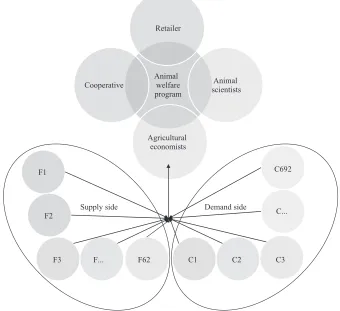
The criteria for a potential animal welfare upgrade of the private label were defined in a mutual research project conducted by the retail chain, the cooperative and animal scientists, as well as agricultural economists with a focus on behavioral research (Figure 1 presents the project’s approach). These stakeholder groups have indicated that the animal welfare scheme should include the following measures: increased space (10%),
Figure 1. Approach to include farmers’ and consumers’ views in the development of an animal welfare program. F1-Fx = farmers; C1-Cx = consumers.
Animal welfare program Retailer
Animal scientists
Agricultural economists Cooperative
F1
C1 C2 C3
C... C692
F62 F...
F3
F2 Supply side Demand side
organic playing material, roughage, air cooling systems, functional areas, partially closed floor, no castration and no tail docking. These measures are not innovative as such since they have already used in other animal welfare programs (Heise et al., 2014). The attachment to an existing and regionally limited brand based on an extant supply chain collaboration is new, however. Furthermore, to the authors’ best knowledge, no existing studies have addressed the question of both farmer and consumer acceptance of a program including these mandatory measures, on which one could draw for program design. A stakeholder dialogue was considered as being too narrow in this stage of program design, as it would have included only a few participants. Two surveys were therefore designed to elicit potential barriers to adoption and purchasing, as well as to derive measures to overcome these barriers, by either omitting certain requirements or addressing concerns through communication and extension.
Defining a fixed set of future non-negotiable animal welfare measures rather than a list of elective measures should enable the supply chain actors to clearly communicate the animal welfare requirements of the brand, as well as achieve premium prices. This, however, depends on both farmers’ willingness-to-participate and consumers’ willingness-to-buy, which we assume is based on their respective evaluations of the included measures. In the following, the empirical strategy, along with the employed measurement instruments and methods of analysis are briefly explained. Results are presented in an aggregated manner to serve the objectives of this article, focusing on measure evaluation and willingness-to-buy or -pay, respectively.
4.2 Measurement of consumer preferences
In summer 2015, computer aided personal interviews focusing on measure evaluation and willingness-to-buy were conducted in ten of the retail chain’s stores (five urban and five small town or rural locations). Customers were then questioned about their households’ meat consumption behavior, purchasing habits and attitudes towards animal welfare in general, as well as their preferences towards specific measures. In order to measure consumers’ willingness-to-buy the branded pork with and without an animal welfare upgrade, including all of the aforementioned measures, a choice experiment with an information treatment was conducted to assess the effect of a fictitious flyer. This flyer explains that the current brand’s quality program will be further improved in terms of animal welfare concerns by implementing specific animal welfare measures on farms1.
For this study, the focus is on the studies’ sub-sample of pork consumers (N=692) and their evaluation of individual animal welfare measures. Participants had to indicate how they would allocate the premium paid to the animal welfare measures using a 100-point rating scale. They were also given the choice of not paying a premium at all. The animal welfare measures were shortly described with one neutral sentence for consumers. To make these statements understandable to consumers (e.g. the difference between organic playing material and roughage proved to be difficult to understand in pretests), the aforementioned eight animal welfare measures were reduced to five (increased space, functional areas and partially closed floor, organic playing material, no tail docking and no castration); additionally, the maximum transportation duration to slaughterhouse (6 hours) was included, as this is already part of the program. A pre-study on the perceived content of the quality program scheme showed, however, that many consumers were not aware of this fact.
4.3 Measurement of farmers’ willingness-to-participate
A standardized online survey targeted to have a complete inventory count of all members (N=139) of the pig trading cooperative which supplies the retail chains’ private label program. In autumn 2015, 97 farmers declared that they are potentially willing to participate in the survey; in total, 62 fully completed questionnaires (44.6% response rate) were obtained. The majority of items for animal welfare attitudes are taken from the above-cited literature. Farm and farmers’ characteristics cover the usual elements. Additionally, current participation in the retail chains’ quality program was incorporated. The questionnaire was pre-tested with pig farmers from other regions to check for potential comprehension problems.
1 Unpublished data from authors’ earlier research.
The willingness-to-participate in the program was measured twice at two distinct points in the questionnaire. Initially, a list of all eight animal welfare measures was presented and farmers were asked to state the likelihood of their subscribing to such a program (on a 7-point-Likert-type scale ‘very unlikely’ (1) to ‘very likely’ (7)), when all their additional costs would be covered. A block of items then captured farmers’ individual drivers to implement the single animal welfare measures. The measures for these drivers are based on the framework of Theory of Planned Behavior (Ajzen, 1991), i.e. behavioral beliefs, subjective norm, and perceived behavioral control (Ajzen and Fishbein, 2005). Farmers’ overall attitude towards the various measures were indicated by judging the inclusion of each measure in an animal welfare program on a semantic differential from ‘very bad’ (1) to ‘very good’ (7). Following this block of questions, a reverse auction (Rutström, 1998) was implemented as an additional measure of willingness-to-participate in order to create an incentive compatibility when asking for required compensation. Farmers were informed that only 50% of all suppliers could participate in the program and only those with the lowest bids would be accepted. They then had to indicate whether they would be willing to participate, and if yes, what would be their required compensation.
5. Results
5.1 Sample descriptions
The consumer sample consists of 692 pork consuming customers of the supermarket chain. 26% buy most of their food or buy food exclusively in the test supermarket. 59% of the respondents are female and 41% are male. On average, the participants are 44 years old, with a minimum age of 17 and a maximum of 83 years. The median household size is 2.5 people. Thus, the sample’s socio-demographics are comparable with the Northern German and the German average (Eurostat, 2012).
The farmer sample is comprised of 62 conventional farmers from Northern Germany. 96.8% are male respondents, with age ranging from 20 to 64 years with a mean of 47 years. The majority of the farmers are owner-managers (90.3%). The rest of the sample consists of farm successors (8.1%) and non-family farm employees (1.6%), who also state that they have significant impact on future farm development. 62.9% are specialized in pig fattening only and 95.2% are full-time farmers. On average, the farmers operate 133.9 ha of arable land and 10.3 ha of grassland. 1,976 pigs and 186 sows are kept on average. While these values are characteristic for members of this cooperative and mirror the situation in Northern Germany, they are above the German average farm sizes.
5.2 Comparison of animal welfare preferences among farmers and consumers
Contrasting preferences, as shown in Table 1, indicate that consumers and farmers more or less agree on the ranking of important animal welfare measures. The left-hand side of the data shows the consumer ranking. Increased space is indicated as being the most important animal welfare measure (24.70 points on average), followed by maximum transport duration (21.88) and partially closed floor (19.53). Ranked second to last is no tail docking (11.21) and last is no castration (7.28). The right-hand side of the data in Table 1 presents farmers’ mean evaluation of the eight animal welfare measures. Increased space (mean of 5.45) and organic playing material (4.77) are the most favored animal welfare measures based on overall attitude, followed by roughage (3.75) and functional areas (2.78). Ban of castration ranks second to last (2.23) and ban of tail docking last (1.68). As can be seen from the standard deviations, neither consumers nor farmers are homogeneous in their evaluations.
5.3 Willingness-to-buy and willingness-to-participate
With respect to consumer acceptance, the choice experiment reveals a positive effect for the introduction of the animal welfare upgrade to the private label1, and a shift of choices from pork with regional claim to the
private label (Schulze-Ehlers and Purwins, 2016).
The rate of farmers’ stated willingness-to-participate increases from the first to the second scenario: in the first scenario, 21.0% would rather likely ((5) or (6)) and 11.29% would very likely (7) participate in the program at full compensation of incurred costs. The second scenario resulted in 53.2% of the respondents being willing to participate, as long as their individually demanded bonus is paid. Overall, bonuses demanded by those who indicated a willingness-to-participate, fit the range of other animal welfare programs (as previously mentioned). Differences between the two scenarios might be based on either the elicitation method or the intermediate block of animal welfare related questions which may have raised farmers’ involvement. For the remaining analyses, the answers to the two willingness-to-participate questions were combined into one ordinal variable with three levels, with 1=declined twice (1-3 in scenario 1 and ‘no’ in scenario 2), 2=undecided; if answers differed in the two scenarios or if the first scenario was answered neutral (4), and 3=twice positive answer (5-7 in scenario 1 and ‘yes’ in scenario 2). The three levels thus represent three groups of farmers which were labelled as ‘refusing’ (N=24), ‘undecided’ (N=20), and ‘acquiescing’ (N=18).
A multinomial logit regression was conducted to identify determinants that show the distinction between the two extreme groups of farmers from the ‘undecided’ farmers. Results indicate that the aggregated socio-psychological drivers of the single animal welfare measures play an important role in terms of identifying determinants of farmers’ willingness-to-participate1. The drivers to implement increased space and to feed
roughage significantly affect the probability of acquiescing. The higher the driver to ban tail docking, the more likely the farmer will participate. The same holds true for the driver to implement air cooling systems. Among the socio-demographic variables, being the successor of the farm significantly increases the probability of being acquiescing. Delivering into the quality program and having larger herd sizes, drives farmers’ willingness-to-participate in the animal welfare program.
The following will discuss the implications of these findings with respect to both program design and the process of stakeholder involvement.
6. Moving towards responsible innovation to develop animal welfare programs?
In light of the above reported diverging beliefs that farmers hold with respect to the animal welfare measures, it can be suggested that a change of the proposed measures is not necessarily the best way of moving forward. Rather, the results reveal some potential to influence farmers’ beliefs through extension and communication efforts. Expected ease of implementation, doubts about the contribution to animal welfare and upcoming
Table 1. Contrasting consumer rating and farmers’ overall attitude towards animal welfare measures.
Animal welfare measure Consumer rating1 Farmers’ overall attitude2
Ranking Mean (SD) Ranking Mean (SD)
Increased space (10%) 1. 24.70 (15.46) 1. 5.45 (1.85)
Maximum transportation duration to slaughterhouse
(6 hrs) 2. 21.88 (16.15) Not assessed
Functional areas and
Partially closed floor 3. 19.53 (12.21) 4.5. 2.78 (1.66)2.55 (1.97)
Air cooling systems Not assessed 6. 3.22 (1.78)
Organic playing material 4. 15.40 (13.67) 2. 4.77 (1.95)
Roughage Not assessed 3. 3.75 (2.17)
No tail docking 5. 11.21 (11.44) 8. 1.68 (1.50)
No castration 6. 7.28 (9.87) 7. 2.23 (1.79)
1 Participants were asked to distribute 100 points in total by giving the most points to the animal welfare measure that they evaluate
most important; n=692.
2 Participants were asked to state their overall attitude by judging the inclusion of the animal welfare measure in an animal welfare
program on a scale from ‘very bad’ (1) to ‘very good’ (7); n=62.
regulations play an important role, especially for measures that require long-term commitments. Farmers who have already implemented some of the measures or those who have prior experience in participating in retailer-driven quality programs have a stronger tendency to participate. This is in line with the findings of Bock and van Huik (2007b), in which farmers who are already engaged in production programs or animal welfare schemes are more likely positive towards endeavors of further tightening animal welfare regulations. These farmers could be used as multipliers in communicating the program: as peers, they are important for information exchange and collaboration with other farmers, but also other supply chain actors along the innovation process (Tepic et al., 2012). Furthermore, they could be perceived as being more credible than advisers who are paid by other chain actors. This, however, has to be verified in future studies.
An important finding with respect to the acquiescing group, is that these farmers exhibit a tendency to be more proactive, while the undecided feel more like victims of social pressure. Assuming an s-shaped adoption curve (Rogers, 2003) for participation in the animal welfare program, the undecided could be considered to be followers who need to see proof of the functionality of the program before actively participating. To increase the probability of success of the animal welfare program, efforts should first be made to include farmers that already have experience producing for a quality program, and successors. Based on the experiences of these ‘pioneer’ farmers, further arguments can be generated to attract farmers from the undecided group. This is in line with findings by Tepic et al. (2012), in that there is a relationship of farmers’ network behavior and the level of innovativeness. Still, farmers need to trust the supply chain actors; they especially need to trust retailers to develop an animal welfare strategy and to pay fair prices (Bock and van Huik, 2007b).
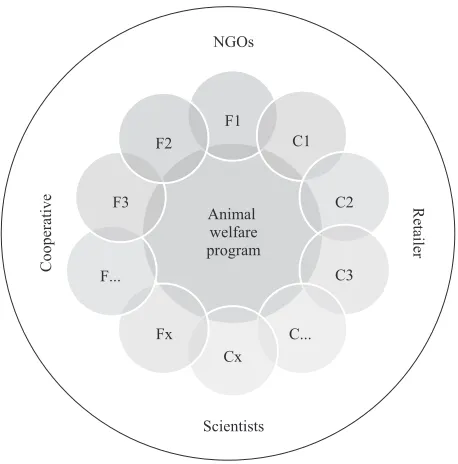
In terms of the process of stakeholder involvement, this research utilized animal welfare measures which were pre-defined by the representatives of a retail company and a livestock trading cooperative, as well as scientists. One might argue that an approach which is closer to the concept of RI might be more promising. Such a strategy would mean that, instead of pre-defining a set of animal welfare measures and then asking for farmers’ and consumers’ willingness-to-invest, or -buy, respectively, they could already be involved upfront during the selection and definition of criteria (Figure 2). This could potentially save both time and money in the phase of implementation, and lead to a higher market acceptance of the developed program.
Figure 2. A Responsible Innovation approach to develop animal welfare programs. F1-Fx = farmers; C1-Cx = consumers.
Animal welfare program
F1
C1
C2
C3
C... Cx
Fx F...
F3 F2
NGOs
Retailer
Cooperative
Scientists
However, the time-to-market might considerably increase as finding consensus among a higher number of stakeholders is likely to be more time consuming. Furthermore, as shown by Bruijnis et al. (2015) in their analysis of the moral lock-in with respect to the practice of killing day-old chickens, attempts to balance different views and anticipate (moral) consequences does not necessarily deliver straightforward solutions. It can therefore be suggested that the approach used in this article, involving surveys and experiments among farmers and consumers could be a suitable intermediate path to better account for the immediate stakeholders to the process.
7. Conclusion and practical implications
Considerable evidence related to social discontent with current pig husbandry approaches suggests that research and development, e.g. related to husbandry and breeding, have bypassed important stakeholders’ needs. Some of the currently implemented animal welfare programs have been developed in collaborative processes that include various interest groups, but they still lack acceptance among both farmers and consumers in the market place; this indicates the neglect of these key stakeholders in program design efforts. The literature review shows that while there are numerous studies which investigate different aspects of consumer preferences and farmers’ attitudes towards animal welfare, there are no existing studies which directly compare farmers’ and consumers’ view of specific animal welfare measures in pig husbandry and address the question of program acceptance with respect to an actual market case.
Moreover, some of the currently used animal welfare programs have been developed according to RI-like processes by including various interest groups. However, lack of acceptance in the market place among both farmers and consumers is common. This article suggests that RI processes can generally be implemented in such programs, despite being beyond the standard innovation approaches to which RI is usually applied. Since these programs aim at immediate market entry, however, a sole reliance on social and industrial stakeholders seems inappropriate; thus, actual economic decision makers should be included as stakeholders. The aim of this study is to understand both consumers’ and farmers’ preferences regarding animal welfare measures which should be included in an optimal animal welfare program. Contrasting preferences indicate that consumers and farmers more or less agree on the ranking of important animal welfare measures. Establishing mandatory requirements facilitates the communication of such a program to consumers, but poses significant barriers, especially if long-term commitments are required.
The empirical studies conducted in this particular case study of a retail meat brand exemplarily show how a better understanding of both consumers’ and farmers’ preferences regarding animal welfare measures can further influence the program design process. The case of this brand can be considered a RI case, since the improvement towards more animal friendly production standards is a sustainable and responsible subject. Consumers and farmers typically do not differ widely in their perceived relevance of particular measures. However, there is considerable heterogeneity within both groups. It is important to note that this study was conducted for the case of one particular, retailer-driven meat supply chain; thus the findings are not representative for German pig farmers due to the focus on a Northern German cooperative. The small sample size, however, represents approximately one half of the cooperative’s members and gives important insight into drivers and barriers affecting the acceptance of animal welfare programs. Given a very low level of knowledge about animal husbandry at the consumer level, it remains an open issue as to whether or not it is necessary to validly link evaluation of individual measures to acceptance in the market.
It can therefore be postulated that the approach of a science-and-industry-led pre-definition of criteria with a subsequent involvement of (lead-)consumers and farmers to understand potential pitfalls is a promising alternative to including these stakeholders in the seminal stages of program design. The heterogeneity of farmers’ beliefs surrounding various animal welfare measures indicate that measures are generally feasible, but farmers lack sufficient positive examples to validate their beliefs. This suggests that the facilitation of positive word-of-mouth among farmers, rather than extensive changes of the proposed program, could be utilized to increase acceptance. Furthermore, the results indicate that farmers’ perception of their own role,
namely their responsibility for animal welfare and the perception of being a victim of social pressures are important issues to tackle through extension and communication.
Acknowledgements
The data stem from a project which is supported by funds of the Federal Ministry of Food and Agriculture (BMEL) based on a decision of the Parliament of the Federal Republic of Germany via the Federal Office for Agriculture and Food (BLE) under the innovation support program. We acknowledge support by the German Research Foundation and the Open Access Publication Funds of the Göttingen University.
References
Ajzen, I. 1991. Theories of cognitive self-regulation. The theory of planned behavior. Organizational Behavior and Human Decision Processes 50(2): 179-211.
Ajzen, I. and M. Fishbein 2005. The influence of attitudes on behavior. In: The handbook of attitudes, edited by D. Albarracín, B.T. Johnson, and M. P. Zanna. Erlbaum, Mahwah, NJ, USA, pp. 173-221. Blok, V. and P. Lemmens. 2015. The emerging concept of responsible innovation. Three reasons why it is
questionable and calls for a radical transformation of the concept of innovation. In: Responsible innovation 2: concepts, approaches, and applications, edited by B.-J. Koops, I. Oosterlaken, H. Romijn, T. Swierstra en J. van den Hoven. Springer International Publishing, Cham, Switzerland, pp. 19-35.
Blokhuis, H.J., R.B. Jones, R. Geers, M. Miele and I. Veissier. 2003. Measuring and monitoring animal welfare: transparency in the food product quality chain. Animal Welfare 12: 445-56.
Bock, B.B. and M.M. van Huik. 2007a. Animal welfare: the attitudes and behaviour of European pig farmers.
British Food Journal 109(11): 931-944.
Bock, B.B. and M.M. van Huik. 2007b. Pig farmers and animal welfare: a study of beliefs, attitudes and behavior of pig producers across Europe. In: Attitudes of consumers, retailers and producers to farm animal welfare. welfare quality reports no. 2, edited byU. Kjœrners and M. Miele. Cardiff University, Cardiff, UK, pp. 73-124.
Böhm, J., M. Kayser and A. Spiller 2010. Two sides of the same coin? Analysis of the web-based social media with regard to the image of the agri-food sector in Germany. International Journal on Food System Dynamics 1(3): 264-278.
Bruijnis, M.R.N., V. Blok, E.N. Stassen and H.G.J. Gremmen. 2015. Moral ‘lock-in’ in responsible innovation: the ethical and social aspects of killing day-old chicks and its alternatives. Journal of Agricultural and Environmental Ethics 28(5): 939-960.
Bruijnis, M., H. Hogeveen, C. Garforth and E. Stassen. 2013. Dairy farmers’ attitudes and intentions towards improving dairy cow foot health. Livestock Science 155(1): 103-113.
Cechin, A., J. Bijman, S. Pascucci and O. Omta. 2013. Decomposing the member relationship in agricultural cooperatives: implications for commitment. Agribusiness 29(1): 39-61.
Chesbrough, H.W. 2003. Open innovation: the new imperative for creating and profiting from technology. Harvard Business School Press, Boston, MA, USA.
Deimel, I., A. Franz and A. Spiller. 2012. Animal welfare: an empirical analysis of agricultural frames.
German Journal of Agricultural Economics 61(2): 114-26.
dlz. 2013. Mästen für das Tierschutzlabel. dlz agrarmagazin. Available at: http://tinyurl.com/y8bm8f3k. Dwane, A.M., S.J. More, M. Blake, K. McKenzie and A.J. Hanlon. 2013. Farmers’ self-reported perceptions
and behavioural impacts of a welfare scheme for suckler beef cattle in Ireland. Irish Veterinary Journal 66(1): 1-11.
Escobar, M.H. and Buller. 2014. Projecting social science into Defra’s animal welfare evidence base: a review of current research and evidence base on the issue of farmer behaviour: a report to the Department for Environment. Department for Environment, Farming and Rural Affairs, London, UK.
EUR-Lex. 2017a. Treaty establishing the European Community (consolidated version) D. Protocols annexed to the Treaty establishing the European Community. Protocol (No 33) on protection and welfare of animals (1997). Available at: http://tinyurl.com/ychf2s85.
EUR-Lex 2017b. Council Directive 2001/88/EC of 23 October 2001 amending Directive 91/630/EEC laying down minimum standards for the protection of pigs. Available at: http://tinyurl.com/y74k9o6h. European Commission. 2016. Special Eurobarometer 442. Attitudes of Europeans towards Animal Welfare
2016. European Commission. Available at: http://tinyurl.com/y8dnmj9p.
Eurostat. 2012. Eurostat statistics explained. Agricultural census in Germany. European Commission. Available at: http://tinyurl.com/ycgphv7r.
Federal Ministry of Food and Agriculture (BMEL) 2017a. Nutztierhaltungsstrategie. Zukunftsfähige Tierhaltung in Deutschland. Available at: http://tinyurl.com/y978xw6p.
Federal Ministry of Food and Agriculture (BMEL) 2017b. Schritte zu mehr Tierwohl. Availble at: http:// tinyurl.com/y95b8f5z.
Franz, A., I. Deimel and A. Spiller. 2012. Concerns about animal welfare: a cluster analysis of German pig farmers. British Food Journal 114(10): 1445-1462.
Gocsik, E., I.A. van der Lans, A.G.J.M. Oude Lansink and H.W. Saatkamp. 2016. Elicitation of preferences of Dutch broiler and pig farmers to support decision making on animal welfare. Wageningen Journal of Life Sciences 76: 75-86.
Hansson, H. and C.J. Lagerkvist. 2014. Defining and measuring farmers’ attitudes to farm animal welfare.
Animal Welfare 23(1): 47-56.
Hansson, H. and C.J. Lagerkvist. 2015. Identifying use and non-use values of animal welfare: evidence from Swedish dairy agriculture. Food Policy 50: 35-42.
Heise, H., W. Pirsich and L. Theuvsen. 2014. Improved process quality through certification systems: an assessment of selected animal welfare labels. Proceedings in Food System Dynamics 5: 1-11. Hubbard, C., M. Bourlakis and G. Garrod. 2007. Pig in the middle: farmers and the delivery of farm animal
welfare standards. British Food Journal 109(11): 919-930.
Johnsen, P.F., T. Johannesson and P. Sandøe. 2001. Assessment of farm animal welfare at herd level: many goals, many methods. Acta Agriculturae Scandinavica, Section A – Animal Science 51(sup030): 26-33. Kauppinen, T., K.M. Vesala and A. Valros. 2012. Farmer attitude toward improvement of animal welfare is
correlated with piglet production parameters. Livestock Science 143(2-3): 142-150.
Kirchner, M.K., H.S. Westerath-Niklaus, U. Knierim, E. Tessitore, G. Cozzi, C. Vogl and C. Winckler. 2014. Attitudes and expectations of beef farmers in Austria, Germany and Italy towards the Welfare Quality® assessment system. Livestock Science 160: 102-112.
Kjœrners, U. and R. Lavik. 2007. Part I farm animal welfare and food consumption practices: results from survey in seven countries. In: Attitudes of consumers, retailers and producers to farm animal welfare. welfare quality reports no. 2, edited byU. Kjœrners and M. Miele. Cardiff University, Cardiff, UK, pp. 1-30.
Kohli, A.K. and B.J. Jaworski. 1990. Market orientation: the construct, research propositions and managerial implications. Journal of Marketing 54: 1-18.
Lagerkvist, C.J. and S. Hess. 2011. A meta-analysis of consumer willingness to pay for farm animal welfare.
European Review of Agricultural Economics 38(1): 55-78.
Liao, S.-H., W.-J. Chang, C.-C. Wu and J.M. Katrichis. 2011. A survey of market orientation research (1995-2008). Industrial Marketing Management 40(2): 301-310.
Liljenstolpe, C. 2008. Evaluating animal welfare with choice experiments: an application to Swedish pig production. Agribusiness 24(1): 67-84.
Mentzer, J.T., W. DeWitt, J.S. Keebler, S. Min, N.W. Nix, C.D Smith and Z.G. Zacharia. 2001. Defining supply chain management. Journal of Business Logistics 22: 1-25.
Moynagh, J. 2000. EU Regulation and consumer demand for animal welfare. The Journal of Agrobiotechnology Management and Economics 3(2&3): 107-114.
Peattie, K. 2001. Towards sustainability: the third age of green marketing. The Marketing Review 2(2): 129-146.
Roe, E. and T. Marsden. 2007. Analysis of the retail survey of products that carry welfare-claims and of non-retailer led assurance schemes whose logos accompany welfare-claims. In: Attitudes of consumers, retailers and producers to farm animal welfare. Welfare Quality Reports No. 2, edited byU. Kjœrners and M. Miele. Cardiff University, Cardiff, UK, pp. 33-69.
Rogers, E.M. 2003. The diffusion of innovations. 5th edition. Free Press, New York, NY, USA.
Rutström, E.E. 1998. Home-grown values and incentive compatible auction design. International Journal of Game Theory 27(3): 427-441.
Schulze, B. and I. Deimel. 2012. Conflicts between agriculture and society: the role of lobby groups in the animal welfare discussion and their impact on meat consumption. Available at: https://ageconsearch. umn.edu/record/269543.
Schulze-Ehlers, B. and N. Purwins. 2016. Does having a choice make a difference? Market potential of the animal welfare label in Germany. Proceedings in Food System Dynamicsand Innovation in Food Networks 2016: 389-395.
Schulze-Ehlers, B., N. Steffen, G. Busch and A. Spiller. 2014. Supply chain orientation in SMEs as an attitudinal construct: conceptual considerations and empirical application to the dairy sector. Supply Chain Management 19(4): 395-412.
Scientific Advisory Board on Agricultural Policy (WBA). 2015. Pathways to a socially accepted livestock husbandry in Germany. Executive Summary and Synthesis Report. WBA, Berlin, Germany. Spooner, J.M., C.A. Schuppli and D. Fraser. 2014. Attitudes of Canadian pig producers toward animal
welfare. Journal of Agricultural and Environmental Ethics 27(4): 569-589.
Te Velde, H., N. Aarts and C. Van Woerkum. 2002. Dealing with ambivalence: farmers’ and consumers’ perceptions of animal welfare in livestock breeding. Journal of Agricultural and Environmental Ethics 15(2): 203-219.
Tepic, M., J.H. Trienekens, R. Hoste and S.W.F. Omta. 2012. The influence of networking and absorptive capacity on the innovativeness of farmers in the Dutch pork sector. International Food and Agribusiness Management Review 15(3): 1-33.
Thorslund, C.A.H., M.D. Aaslyng and J. Lassen. 2017. Perceived importance and responsibility for market-driven pig welfare: literature review. Meat Science 125: 37-45.
Thorslund, C.A.H., P. Sandøe, M.D. Aaslyng and J. Lassen. 2016. A good taste in the meat, a good taste in the mouth – Animal welfare as an aspect of pork quality in three European countries. Livestock Science 193: 58-65.
Vanhonacker, F., W. Verbeke, E. Van Poucke, S. Buijs and F.A.M. Tuyttens. 2009. Societal concern related to stocking density, pen size and group size in farm animal production. Livestock Science 123(1): 16-22. Vanhonacker, F., W. Verbeke, E. Van Poucke and F.A.M Tuyttens. 2008. Do citizens and farmers interpret
the concept of farm animal welfare differently? Livestock Science 116(1-3): 126-36.
Von Schomberg, R. 2010. Organising for collective responsibility: on precaution, codes of conduct and understanding public debate. In: Understanding Nanotechnology, edited by U. Fiedeler, C. Coenen, S.R. Davies, A. Ferrari. AKA, Heidelberg, Germany, pp. 61-70.
Von Schomberg, R. 2013. A vision of responsible research and innovation. In: Responsible innovation: managing the responsible emergence of science and innocation in society, edited by R. Owen, J. Bessant and M. Heintz. John Wiley & Sons, Ltd., Chichester, UK, pp. 51-74.
Weible, D., I. Christoph-Schulz, P. Salamon and K. Zander. 2016. Citizens’ perception of modern pig production in Germany: a mixed-method research approach. British Food Journal 118(8): 2014-2032.