International Ayurvedic Medical Journal, (ISSN: 2320 5091) (August, 2017) 5(8)
CLINICAL EVALUATION OF EFFECT OF MUSIC WITH CREATIVE VISUALIZATION
ON FOETAL GROWTH AND MATERNAL PHYSIOLOGY WITH SPECIAL
REFER-ENCE TO E.C.G
Vaishnav Mauli1, Usha V.N.K.2
1
Final year PG Scholar, Department of PrasootiTantra and StreeRoga
2
Professor and HOD, Department of PrasootiTantra and StreeRoga
Shree DharmasthalaManjunatheshwara College of Ayurveda, Udupi- 574118 Karnataka, India
Email:[email protected]
ABSTRACT
Pregnancy is the divine period of the woman’s life where she requires intensive physical as well as
psychological care. Nada in form of music provides a spiritual experience to communicate with the foetus-in-utero and Drushya in form of creative visualization is an intellectual exercise adopted by mother to sustain enlightenment, tranquilisation and creativity which potentiate the Garbhachaitanya to reform the foetus into the ‘ShreyasiPraja’. Objectives: To study the role of Satwa and
GarbhiniSadvrutta on the mother and foetus by the intervention of Music with Creative
visualiza-tion. Method: A clinical study where 30 healthy singleton pregnant women, 20 weeks onwards, were selected and categorized into control group and trial group. Patients of trial group were subjected to music and visualization. Assessment was done on the basis of foetal movement, foetal kick count, ECG, maternal weight gain, sleep, appetite, thoughts, and neonatal reflexes.Results: In the trial group, foetal movement and foetal kick observed in half an hour had significant response. ECG and psychological evaluation of mother showed reduction in the heart rate and perceived stress respec-tively. The neonates of trial group had significantly better neonatal reflexes. Conclusion: Music and creative visualization has better effect on maternal psychology, physiology and the cognitive devel-opment of the foetus.
Keywords: Music, Creative Visualization, ShreyasiPraja, ECG, Neonatal reflexes.
INTRODUCTION
Human body is an epitome of the universe, so also the fetus1. The universe is perceived by
and efficient conveyers from exterior to inte-rior. Drushya and Shravana have strong
im-JOURNAL
International Ayurvedic Medical Journal, (ISSN: 2320 5091) (August, 2017) 5(8)
CLINICAL EVALUATION OF EFFECT OF MUSIC WITH CREATIVE VISUALIZATION
ON FOETAL GROWTH AND MATERNAL PHYSIOLOGY WITH SPECIAL
REFER-ENCE TO E.C.G
Vaishnav Mauli1, Usha V.N.K.2
1
Final year PG Scholar, Department of PrasootiTantra and StreeRoga
2
Professor and HOD, Department of PrasootiTantra and StreeRoga
Shree DharmasthalaManjunatheshwara College of Ayurveda, Udupi- 574118 Karnataka, India
Email:[email protected]
ABSTRACT
Pregnancy is the divine period of the woman’s life where she requires intensive physical as well as
psychological care. Nada in form of music provides a spiritual experience to communicate with the foetus-in-utero and Drushya in form of creative visualization is an intellectual exercise adopted by mother to sustain enlightenment, tranquilisation and creativity which potentiate the Garbhachaitanya to reform the foetus into the ‘ShreyasiPraja’. Objectives: To study the role of Satwa and
GarbhiniSadvrutta on the mother and foetus by the intervention of Music with Creative
visualiza-tion. Method: A clinical study where 30 healthy singleton pregnant women, 20 weeks onwards, were selected and categorized into control group and trial group. Patients of trial group were subjected to music and visualization. Assessment was done on the basis of foetal movement, foetal kick count, ECG, maternal weight gain, sleep, appetite, thoughts, and neonatal reflexes.Results: In the trial group, foetal movement and foetal kick observed in half an hour had significant response. ECG and psychological evaluation of mother showed reduction in the heart rate and perceived stress respec-tively. The neonates of trial group had significantly better neonatal reflexes. Conclusion: Music and creative visualization has better effect on maternal psychology, physiology and the cognitive devel-opment of the foetus.
Keywords: Music, Creative Visualization, ShreyasiPraja, ECG, Neonatal reflexes.
INTRODUCTION
Human body is an epitome of the universe, so also the fetus1. The universe is perceived by
and efficient conveyers from exterior to inte-rior. Drushya and Shravana have strong
im-JOURNAL
International Ayurvedic Medical Journal, (ISSN: 2320 5091) (August, 2017) 5(8)
CLINICAL EVALUATION OF EFFECT OF MUSIC WITH CREATIVE VISUALIZATION
ON FOETAL GROWTH AND MATERNAL PHYSIOLOGY WITH SPECIAL
REFER-ENCE TO E.C.G
Vaishnav Mauli1, Usha V.N.K.2
1
Final year PG Scholar, Department of PrasootiTantra and StreeRoga
2
Professor and HOD, Department of PrasootiTantra and StreeRoga
Shree DharmasthalaManjunatheshwara College of Ayurveda, Udupi- 574118 Karnataka, India
Email:[email protected]
ABSTRACT
Pregnancy is the divine period of the woman’s life where she requires intensive physical as well as
psychological care. Nada in form of music provides a spiritual experience to communicate with the foetus-in-utero and Drushya in form of creative visualization is an intellectual exercise adopted by mother to sustain enlightenment, tranquilisation and creativity which potentiate the Garbhachaitanya to reform the foetus into the ‘ShreyasiPraja’. Objectives: To study the role of Satwa and
GarbhiniSadvrutta on the mother and foetus by the intervention of Music with Creative
visualiza-tion. Method: A clinical study where 30 healthy singleton pregnant women, 20 weeks onwards, were selected and categorized into control group and trial group. Patients of trial group were subjected to music and visualization. Assessment was done on the basis of foetal movement, foetal kick count, ECG, maternal weight gain, sleep, appetite, thoughts, and neonatal reflexes.Results: In the trial group, foetal movement and foetal kick observed in half an hour had significant response. ECG and psychological evaluation of mother showed reduction in the heart rate and perceived stress respec-tively. The neonates of trial group had significantly better neonatal reflexes. Conclusion: Music and creative visualization has better effect on maternal psychology, physiology and the cognitive devel-opment of the foetus.
Keywords: Music, Creative Visualization, ShreyasiPraja, ECG, Neonatal reflexes.
INTRODUCTION
Human body is an epitome of the universe, so also the fetus1. The universe is perceived by
and efficient conveyers from exterior to inte-rior. Drushya and Shravana have strong
Present day both of these strong perceptions are not scrutinized. When the pregnant woman gets exposed to indecent versions of these sensations, they may affect the foetus psychologically and physically, as these dread-ful experiences may cause harsh impact on cardiovascular and central nervous systems of the woman. Acharya Vagbhatta has quoted
“Apriyavlokanashravanadaya”2 in
Garbhopa-ghatakarabhava to support same view. During
the period of pregnancy the words and sounds heard by mother along with the visual percep-tion have a persuasive effect on the mother as well as the developing foetus in the womb. Acharya Sushruta has propagated the same thought and stated that the pregnant woman should not be exposed to“Durdarshana”3.
Pregnancy is the divine period of the woman’s
life. This is the period in which she requires extensive care, healthy diet, rest and along with these a stress-free healthy environment. Now-a-days, due to changes in lifestyle, bur-den of profession, household workload, a
hu-man’s cardiovascular and central nervous sy s-tems seems to be under pressure which ulti-mately results into psychosomatic disorders like stress, depression, hypertension etc. The condition becomes worse in Pregnancy as the stress of the mother directly affects the foetus and interferes in development.
Music can be good preventive therapy and remedy for them. Music loaded with positive thoughts (Brahmaghosha4 etc.) in soothing
tunes act as anti-depressant and mood stabi-lizer. Certain Indian classical ragas has proven potency to reduce stress, calming the mind and create a peaceful environment. If with this mu-sic, visual perception is added, it can prove to
be more beneficial. By creative visualization mind can be dragged towards the direction of good thoughts and pleasant atmosphere which can increase power of positivity. All these fac-tors when conjoined with each other can help in reduction of stress and ultimately may play a pivotal role in the development of healthy progeny.
Along with this background, utilizing strong windows like Drushya and Shravana with positive thoughts were applied on pregnant women so that the effect could be analysed on foetal growth and maternal physiology with special reference to ECG.
AIMS& OBJECTIVES
1) Conceptual study of role of Satwa and
Garbhini Sadvrutta on foetal development
and personal health of the mother.
2) To study the effect of Music with Creative visualization on the growth of foetus and physiology of expectant mother w.s.r. to cardiac activity evaluated by ECG.
MATERIALS AND METHODS
It was an open randomized control clinical study carried out at Prasutitantra & Streeroga Department, S.D.M. Ayurvedic Hospital, Udupi.
Study design:
evening daily. Mothers randomized to trial group were given a pre-recorded music audio CD and posters for visualization. All mothers received standard antenatal care. Study was carried out until delivery and in post natal period till day 2. Minimum period of study was 2 months. On first sitting Patients of Trial group were exposed to music and visu-alization for half an hour. ECG was taken just before starting session and after session. Foe-tal heart sound and foeFoe-tal movements were checked and recorded during the session.
Interventions
Music: Certain Indian Classical Ragas like Raga Kalyana, Raga Kedara, and Raga
Bhoopali with antidepressant property were
selected in instrumental form and
Atmashata-kam – a composition consisting of 6 fold Shlokas written by AadiShankaracharya.
Atmashatakam reminds the soul its true nature
i.e. truth (Sat), knowledge (Chit), internal joy (Anand).
Visualization: For selection of creative visu-alization, pictures with positive thoughts like blossoms, natural sceneries and cute babies were used. Patients were provided guidance to create a visual imagery with the help of the pictures and concentrate upon positive thoughts. Pictures were given with the pre-dominance of colours specifically green and blue which gives joy and relaxing effect to the mind.
Inclusion criteria
Primi and multigravida who were under-going simple antenatal care with normal course of pregnancy.
Age groups between 18-35 years were selected.
Pregnant women with gestational age of 20 weeks to 32 weeks.
Exclusion criteria
Previous cesarean section.
Patients with multiple pregnancy & IUGR.
Patients with history of ante partum he-morrhage or placenta previa.
Systemic disorder like hypertension, Di-abetes mellitus, tuberculosis etc.
Grand multigravida.
Patients with incompetent cervix.
Patients with previous history of con-tracted pelvis.
Severe anemia, eclampsia, pre-eclampsia.
Assessment criteria
The response of the patient was assessed on the basis of antenatal parameters including ECG, foetal kick count, foetal movement, increase in weight, appetite, sleep, mood and thoughts. Post natal assessment was based on foetal birth weight, APGAR Score, and neo-natal reflexes.
Investigations
Routine Antenatal investigation like Hb%, Blood grouping with Rh type, BT, CT, RBS, Platelet count, HIV, HBsAG, VDRL, Urine routine and ECG was done during antenatal period.
Statistical analysis
(CI). The study was approved by institutional ethics committee.
RESULT
A total of 30 pregnant woman including
primigravida and multigravida attending
ante-natal clinic at a gestation of 20 weeks to 32 were the subject of the study. The females of trial group were randomized to receive expo-sure of music and creative visualization in ad-dition to standard antenatal care (intervention arm, n = 15) and female of control group re-ceived standard care alone (control arm, n = 15). Analysis was done on the basis of Foetal movement, foetal kick count, ECG, Increase in weight, Appetite, Sleep, Mood, thoughts in trial and control group. Changes in ECG were evaluated only in trial group before and after the ½ hour session of music and creative visu-alization on first visit. The groups were com-parable at baseline (Table 1).
Statistical analysis revealed that the maximal beneficial effect was seen in the parameters Foetal movement (95% CI, χ2 = 26.500, P<0.001), foetal kick count (95% CI,χ2 = 26.800, P<0.001), maternal mood (95% CI, χ2
= 30.000, P<0.001) and Thoughts (95% CI,χ2
= 30.000, P<0.001) during pregnancy in the trial group. Data of ECG taken before and af-ter the session revealed significant changes on theRate (95% CI, t = 13.679, P<0.05). Except from that there were no significant changes found on other parameters of ECG. On mater-nal weight, appetite and sleep there were no significant difference observed in both groups.
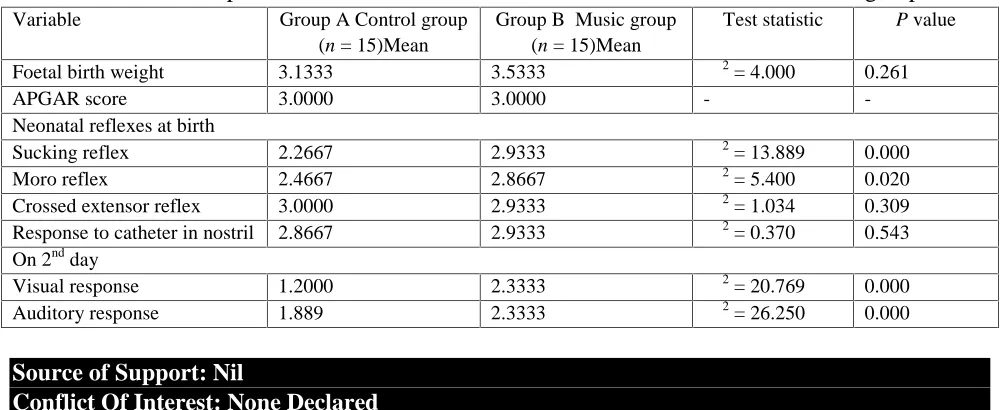
The baseline comparison of neonatal parame-ters (Table 2) depict that the new-borns of trial group showed a significant response towards better sensory and motor performance includ-ing Suckinclud-ing reflex (95% CI, χ2 = 13.889, P<0.001), Moro reflex (95% CI, χ2 = 5.400, P<0.05) at the time of birth and visual re-sponse (95% CI, χ2 = 20.769, P<0.001) and auditory response (95% CI, χ2 = 26.250, P<0.001) on the 2ndday. There was no signifi-cant difference found on the parameters like Foetal birth weight, APGAR score, Crossed extensor reflex and Response to catheter in nostril.
DISCUSSION
Music is an energy form which leads to spiri-tual experience and enlightening which affects
wave in the brain, 8which provides pacifica-tion to the mother. As the sound is an energy form not in matter form, it does not give any impact on the maternal weight gain. Appetite and sleep are physiological process of human body which can be influenced by psychologi-cal factors like stress and depression. As in present study stress level of the patients was mild to moderate level, there were no signifi-cant effect on these factors found. A study car-ried out in Institute of Medical Science, Tri-pura shows that acute mental stress causes ECG changes such as increase in heart rate, decrease in PR interval, decrease in QT inter-val and prolongation of QTc interinter-val because of increased sympathetic activity. 9With this background present study was carried out to evaluate any possible changes in ECG with the anti-depression and stress reducing interven-tion i.e. music with creative visualizainterven-tion in the pregnant woman as a new experiment. In this study, the pregnant women included, were having healthy heart condition and mild to moderate stress level. Therefore all the ECG parameters may found within normal limits before and after the session.
Creative visualization is the cognitive process of purposefully generating visual mental im-agery with intent to experience a subsequent beneficial psychological and physiological ef-fect. The process involves intentional sustain-ing or maintainsustain-ing of imagery, participation of direct attention across and around the image and increased degree of mental aptitude and physical ability. 10When the music is com-bined with creative visualization, the effect of them on human body can be magnified. These effects may include reduction in stress and
anxiety, enhanced positivity, emotional stabil-ity, higher intellectual function such as strengthening of memory and quick learning ability.11
In this study observation of foetal birth weight and APGAR in both groups were found within normal limits, as in this study the patients were healthy, with good dietary supplements and keen observation throughout gestational period. Observation of good neonatal reflexes indicates that the foetus is able to learn and remember familiar auditory stimuli in the womb. Music given in the gestational period plays a crucial role in the maturation of neuro-logical connectivity which further leads to bet-ter intellectual capacity and memory. These memories include predetermined experience of sensory factors like sound, test and odour and motor functions i.e. movement of limbs, head, jaw, eyelids etc. in the foetal life which are represented in new born by neonatal reflexes. A good primitive reflex represents a well-developed brain with function individual,
which ultimately indicates “MedhaVruddhi” in
the baby.
Music with creative visualization given in ges-tational period can provide these beneficial effects to the mother as well as to the foetus. Hence in present study, we have utilised com-bination of sound with mental imagery along with routine antenatal care to analyse effect on maternal physiology, psychology, foetal growth and neonatal outcome.
CONCLUSION
ma-ternal physiology, psychology and for the cognitive development of the foetus. Music with creative visualization gives pacification & emotional stability, thus an effective inter-vention for increase positivity and acts as mood stabilizer. Study indicates that on ECG parameters rate reduces. Other than that there are no changes in any parameter of ECG. Good neonatal reflexes indicate towards abil-ity of the foetus to learn and remember audi-tory stimuli which was given in the foetal life & the baby is habituated to that specific music which his mother was listening during gesta-tional period. This study was carried out with evaluative parameters specifically ECG with routine ANC investigation. For better knowl-edge of the subject EEG, MRI and Doppler study can be included in the further study.
REFERENCES
1. Acharya Agnivesha. Charak Samhita with
VidyodiniHindi commentary edited by
ShastriKashinath, ChaturvediGorakhnath. 3rd Ed. Reprint. Varanasi:Chaukhambha Bharti Academy; 2005.P. 871. Pp. 1024. 2. Acharya Vrudhdha Vagbhatta.
Ashtanga-Samgraha with “Shashilekha” Sanskrit commentary By Indu edited by Sharma Shivprasad. 4th Ed. Varanasi: Chaukhamb-ha Sanskrit Series; 2006.P. 274. Pp. 965. 3. Acharya Suhruta.Sushruta Samhita with
“SushrutarthSandeepana”Commentary by Kaviraj Haranchandra Chakravarti. First Ed. Reprint. Varanasi: Chaukhamba Surb-harti Prakashana; 2000. P. 30. Pp. 408. 4. Sayeed Ausal. Trends in Indian Culture
and Heritage. New Delhi: Har Anand Pub-lications Pvt. Ltd; 2012.P. 80.Pp. 579.
5. Valorie N Salimpoor, Robert JZatorre. Neural Interactions That Give Rise to Musical Pleasure. American psychological associan;2013.
http://www.zlab.mcgill.ca/docs/Salimpoor _&_Zatorre_PACA_2013.pdf-Accessed on 23 July 2017
6. Campbell Don G. The Mozart Effect: Tap-ping the Power of Music to Heal the Body Strengthen the Mind and Unlock the Crea-tive Spirit. Noida: Harper Collins
Publish-ers; 1997.
http://www.superconsciousness.com/topics /art/how-music-affects-body-Accessed on 26 July 2017
7. Minna Huotilainen. Foetal learning – a bridge over birth. University of Helsinki. Finland.
https://www.edu.helsinki.fi/lapsetkertovat/
lapset/In_English/Huotilainen.pdf-Accessed on 24 July 2017
8. Campbell Don G. The Mozart Effect: Tap-ping the Power of Music to Heal the Body Strengthen the Mind and Unlock the Crea-tive Spirit. Noida: Harper Collins Publish-ers; 1997.
http://www.superconsciousness.com/topics /art/how-music-affects-body-Accessed on 26 July 2017
10. Gwain Shakti. Creative visualization. 1st Ed. California: Nataraj publishing a divi-sion of new world library Novato; 1998. P.4. Pp.194
11.Campbell Don G. The Mozart Effect: Tap-ping the Power of Music to Heal the Body
Strengthen the Mind and Unlock the Crea-tive Spirit. Noida: Harper Collins
Publish-ers; 1997.
http://www.superconsciousness.com/topics /art/how-music-affects-body-Accessed on 26 July 2017
Table 1:Baseline comparisons of relevant maternal variables between music and control groups
Variable Group A Control group
(n = 15)Mean
Group B Music group (n = 15)Mean
Test statistic P value
Foetal movement in ½ hour 2.4667 5.5333 χ2= 26.500 0.000
Foetal kick count in ½ hour 0.6667 3.0000 χ2= 26.800 0.000
Changes in Rate of ECG (before & after the session) mean ± SD
84.533 ± 6.005, 78.800 ± 6.005
- t = -3.679 0.002
Increase in weight 2.1333 2.3333 χ2= 0.561 0.755
Appetite 2.0000 2.0000 -
-Sleep 1.0000 1.0000 -
-Mood 2.0000 1.0000 χ2= 30.000 0.000
Thoughts 2.0000 1.0000 χ2= 30.000 0.000
Table 2:Baseline comparisons of relevant neonatal variables between music and control groups
Variable Group A Control group
(n = 15)Mean
Group B Music group (n = 15)Mean
Test statistic P value
Foetal birth weight 3.1333 3.5333 χ2= 4.000 0.261
APGAR score 3.0000 3.0000 -
-Neonatal reflexes at birth
Sucking reflex 2.2667 2.9333 χ2= 13.889 0.000
Moro reflex 2.4667 2.8667 χ2= 5.400 0.020
Crossed extensor reflex 3.0000 2.9333 χ2= 1.034 0.309
Response to catheter in nostril 2.8667 2.9333 χ2= 0.370 0.543
On 2ndday
Visual response 1.2000 2.3333 χ2= 20.769 0.000
Auditory response 1.889 2.3333 χ2= 26.250 0.000
Source of Support: Nil
Conflict Of Interest: None Declared