POLICY STATEMENT
Child Life Services
abstract
Child life programs are an important component of pediatric hospital– based care to address the psychosocial concerns that accompany hospitalization and other health care experiences. Child life special-ists focus on the optimal development and well-being of infants, children, adolescents, and young adults while promoting coping skills and minimizing the adverse effects of hospitalization, health care, and/or other potentially stressful experiences. Using therapeutic play, expressive modalities, and psychological preparation as primary tools, in collaboration with the entire health care team and family, child life interventions facilitate coping and adjustment at times and under circumstances that might otherwise prove overwhelming for the child. Play and developmentally appropriate communication are used to: (1) promote optimal development; (2) educate children and families about health conditions; (3) prepare children and families for medical events or procedures; (4) plan and rehearse useful coping and pain management strategies; (5) help children work through feelings about past or impending experiences; and (6) establish therapeutic relationships with patients, siblings, and parents to support family involvement in each child’s care.Pediatrics 2014;133:e1471–e1478
CHILD LIFE PROGRAMS
During the 1920s and 1930s, early hospital play programs were ini-tiated at several children’s hospitals, including Mott Children’s Hos-pital, Babies and Children’s Hospital of Columbia Presbyterian, and Montreal Children’s Hospital. In 1955, Emma Plank, under the di-rection of Dr Frederick C. Robbins (Nobel Laureate), developed the
first Child Life and Education division at Cleveland City Hospital. Plank is considered a founding“mother”of the profession, and her landmark publication, Working With Children in Hospitals,1 served to educate many about the unique needs of children in the health care setting.
Today, hospitals specializing in pediatric care routinely include child life programs, with more than 400 programs in operation in North America.2Child life services are recommended and offered to varying degrees in community hospitals with pediatric units, ambulatory clinics, emergency departments (EDs), hospice and palliative care programs, camps for children with chronic illness, rehabilitation settings, and some dental and physician offices.3–7 In cases of hos-pitalized or ill adults, certified child life specialists (CCLSs) may be consulted to work with children of adult patients, particularly in end-of-life cases, trauma, and critical care. Child life programs are not
COMMITTEE ON HOSPITAL CARE and CHILD LIFE COUNCIL KEY WORDS
child life, play, patient- and family-centered care, preparation, psychological preparation, therapeutic play
ABBREVIATIONS
CCLS—certified child life specialist ED—emergency department
This document is copyrighted and is property of the American Academy of Pediatrics and its Board of Directors. All authors havefiled conflict of interest statements with the American Academy of Pediatrics. Any conflicts have been resolved through a process approved by the Board of Directors. The American Academy of Pediatrics has neither solicited nor accepted any commercial involvement in the development of the content of this publication.
The recommendations in this statement do not indicate an exclusive course of treatment or serve as a standard of medical care. Variations, taking into account individual circumstances, may be appropriate.
All policy statements from the American Academy of Pediatrics automatically expire 5 years after publication unless reaffirmed, revised, or retired at or before that time.
www.pediatrics.org/cgi/doi/10.1542/peds.2014-0556
doi:10.1542/peds.2014-0556
PEDIATRICS (ISSN Numbers: Print, 0031-4005; Online, 1098-4275).
Copyright © 2014 by the American Academy of Pediatrics
FROM THE AMERICAN ACADEMY OF PEDIATRICS
such as the United Kingdom, Japan, Kuwait, the Philippines, South Africa, Serbia, New Zealand, and Australia.2
The provision of child life services is a quality benchmark of an integrated patient- and family-centered health care system, a recommended component of medical education, and an indicator of excellence in pediatric care.8–10An ex-perimental evaluation of 1 child life program model showed that child life interventions resulted in less emotional distress, better overall coping during the hospital stay, a clearer under-standing of procedures, and a more positive physical recovery as well as posthospital adjustment for children enrolled.11Patients spent less time on narcotics, the length of stay was slightly reduced, and parents were more sat-isfied. Other studies have found that child life interventions play a major role in calming children’s fears and result in higher parent satisfaction ratings of the entire care experience.12,13
There are a number of variables to consider in identifying adequate child life staff–to–patient ratios. Although a ratio of 1 full-time CCLS to 15 inpatients14 is useful as a guideline, a number of factors should influence specific
staf-fing allocations. Generally speaking, child life services should be available to meet identified patient or family needs 7 days a week. In hospitals with very small pediatric units and low out-patient volume, 1 CCLS may provide services in both the inpatient and outpatient areas, including consulta-tion services to the ED. In hospitals with high-volume pediatric emergency services, more than 1 CCLS is gener-ally required to enable 7-day coverage of the ED. In larger hospitals, 1 or more CCLSs are typically assigned to each in-patient unit or outin-patient area, including standing and/or rotating schedules to provide weekday, evening, and
week-tions in anticipated and unanticipated staff absences, seasonal swings in patient census, and nonclinical com-munity activities (eg, increased visits and in-kind donations during the hol-iday season, variations in individual patient and family needs).
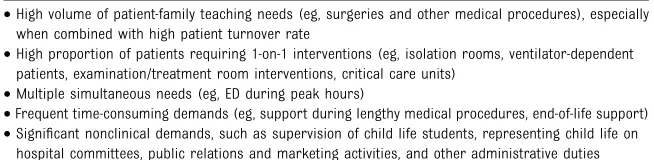
Child variables (temperament, coping style, and cognitive abilities), family variables (parental anxiety, presence, and involvement), and diagnosis/ treatment variables (the number of invasive procedures) are known to affect psychosocial vulnerability and thus influence the child’s particular child life intervention needs.15A com-bination of psychosocial risk assess-ment, medical/treatment variables (eg, the proportion of patients with isolation precautions, the volume of patient/family teaching needs), and the time requirements associated with particular interventions directly affect operational staff-to-patient ra-tios in both inpatient and outpatient settings.16,17 Table 1 lists variables that typically require child life inter-ventions of greater frequency, dura-tion, or complexity, thus influencing effective CCLS-to-patient ratios.
The credentials of a CCLS currently include the minimum of a bachelor’s degree in child life, child development, or a closely related field; the suc-cessful completion of a 480- to 600-hour child life internship under the supervision of a CCLS; and passing a standardized certification examina-tion.18,19Advanced degrees in child life
related to the patient populations they serve.
In some settings, child life services are augmented by child life assistants (or activity coordinators or child life technicians). Child life assistants are typically required to have core college coursework, such as an associate’s degree in child development, and ex-perience with children in group set-tings. They generally focus on the
“normalization” of the health care experience, providing play activities, coordinating special events (eg, com-munity visitors, holiday celebrations), and maintaining the playroom envi-ronment. Both CCLSs and child life assistants actively participate in the orientation, training, and supervision of volunteers, thereby contributing to volunteer effectiveness, satisfaction, and retention. This collaboration ena-bles the CCLS to conduct an assess-ment and delegate as appropriate, allowing patients with varying de-grees of psychosocial vulnerability and activity levels to be supported by the team member whose skills and knowledge are most closely aligned with patient/family needs. Although volunteers are a valuable supplement, they can never be considered an ad-equate replacement for trained/ certified professionals.
CCLSs are part of an interdisciplinary, patient- and family-centered model of care, collaborating with the family, physicians, advance practice pro-viders, nurses, social workers, and
TABLE 1 Factors Necessitating or Supporting a Lower Ratio of Patients to CCLSs
•High volume of patient-family teaching needs (eg, surgeries and other medical procedures), especially when combined with high patient turnover rate
•High proportion of patients requiring 1-on-1 interventions (eg, isolation rooms, ventilator-dependent patients, examination/treatment room interventions, critical care units)
•Multiple simultaneous needs (eg, ED during peak hours)
•Frequent time-consuming demands (eg, support during lengthy medical procedures, end-of-life support)
other members of the health care team to develop a comprehensive plan of care. Child life contributions to this plan are based on the patient’s and family’s psychosocial needs, cultural heritage, and responses to the health care experience. For example, child life specialists can participate in the care plan by teaching a child coping strategies for adjusting to a life-changing injury, promoting coping with examinations for alleged abuse, assisting families in talking to their children about death, facilitating nonpharmacologic pain management techniques, and communicating the child’s developmental and individual needs and perspective to others. These interventions are most effective when delivered in collaboration with the entire health care team.
THE THERAPEUTIC VALUE OF PLAY
Play is an essential component of a child life program and of the child life professional’s role. In addition to play’s developmentally supportive ben-efits and as a normalizing activity for children and youth of all ages, it is particularly valuable for children who are anxious or struggling to cope with stressful circumstances.20Erikson writes,
“To play out is the most natural auto-therapeutic measure childhood affords. Whatever other roles play may have in the child’s development . . . the child uses it to make up for defeats, suf-ferings, and frustrations.”21
Play in the health care setting is ad-apted to address unique needs based on developmental level, self-directed interests, medical condition and phy-sical abilities, psychosocial vulnera-bilities, and setting (eg, bedside, playroom, clinic). Play as a therapeutic modality, including health care play or“medical play,” has been found to reduce chil-dren’s emotional distress and help them cope with medical experiences.22 Research has shown that physiologic
responses, such as palm sweating, ex-cessive body movement, tachycardia, and hypertension, can be reduced with therapeutic play interventions.23
Play can be adapted to address the developmental and psychosocial needs of patients in every pediatric age group. For example, infants and tod-dlers benefit from exploratory and sensorimotor play, and preschool-aged children enjoy fantasy play and creative art activities.24Opportunities for parents to engage in play activities with their young children are benefi -cial to both patient and family, allevi-ating some feelings of helplessness in parents and assisting in the child’s hospital adjustment.25 School-aged children and adolescents seek play that contributes to feelings of mastery and achievement, which is one reason video games are so popular with this age group.26Patients in this age group also benefit from activities that allow them to maintain relationships with peers and establish new connections through, for example, online network-ing and the availability of teen activity rooms in the hospital setting.27
Auxiliary programs, such as animal-assisted therapy, infant massage in-struction, use of therapeutic clowns, performing arts, and artist-in-residence programs, often used in conjunction with child life services, provide addi-tional outlets for patients of all ages and their families.28,29Live, interactive programming, such as hospital bingo or patient-produced videos (broadcast over a closed-circuit television sys-tem), can be a particularly effective way to engage patients restricted to their rooms for infection control or medical reasons. Expressive thera-pies, such as those provided by dis-tinctly certified play therapists, music therapists, and art therapists, can be offered to complement child life pro-grams and to provide support for particularly vulnerable patients.30,31
PSYCHOLOGICAL PREPARATION
Preparing children for hospitalization, clinic visits, surgeries, and diagnostic/ therapeutic procedures is another important element of a child life pro-gram. It is estimated that 50% to 75% of children develop significant fear and anxiety before surgery, with recog-nized risk factors such as age, tem-perament, baseline anxiety, past medical encounters, and parents’level of anx-iety.32 Children’s anxiety in the peri-operative environment is associated with impaired postoperative behav-ioral and clinical recovery, including increased analgesic requirements and delayed discharge from the recovery room.33 More than 50 years of re-search and experience support 3 key elements of the preparation process: (1) the provision of developmentally ap-propriate information; (2) the encour-agement of questions and emotional expression; and (3) the formation of a trusting relationship with a health care professional.34 A recent system-atic review of preparation effective-ness evidence concluded that children who were psychologically prepared for surgery experienced fewer nega-tive symptoms than did children who did not receive formal preparation. In addition to reducing anxiety and pro-viding a more positive experience for the patient and family, research de-monstrates that preparation and cop-ing facilitation interventions decrease the need for sedation in procedures such as MRIs, resulting in lower risks for the child and cost savings in per-sonnel, anesthesia, and throughput-related expenses.35–37
Preparation techniques, materials, and language must be adapted to the developmental level, personality, and unique experiences of the child and his or her family. Learning is enhanced with “hands-on” methods versus ex-clusively verbal explanations. Photo-graphs, diagrams, tours of surgical or
models (eg, dolls, puppets) are used to reinforce learning and actively en-gage the child.32,38 Interpreter ser-vices are used as appropriate to ensure understanding in patients or families who do not speak English or for whom English is a second lan-guage. Most parents have a strong desire for comprehensive information about their child’s care and should be included in the preparation process. In cases in which children demon-strate avoidant preferences or when preparation before the event is not possible, the CCLS’s focus may change from that of imparting information to other supportive strategies, such as teaching behavioral coping skills and preparing parents to support their child during a medical procedure.
PAIN MANAGEMENT AND COPING STRATEGIES
When combined with preparation and appropriate pharmacologic interven-tions, nonpharmacologic strategies for pain and distress management have proven successful in terms of patient/ family experience, staff experience, and cost-effectiveness.13,39–40Strategies such as swaddling, oral sucrose, vibratory stimulation, breathing techniques, dis-traction, and visual imagery have been shown to decrease behavioral distress and pain experience in children during invasive medical procedures.41–43In ad-dition to advocating for the appropriate use of analgesics, CCLSs are often directly involved in the utilization of nonpharmacologic pain management techniques and coaching or support-ing patients and families before and/ or during distressing medical proce-dures.44,45 They can also provide val-uable education and training to nursing, medical, and other personnel and stu-dents, thus supporting health care team member competencies in the
Multifaceted institution-wide protocols such as the “Ouchless Place” and other similar programs incorporate the standard utilization of both phar-macologic and nonpharphar-macologic tech-niques, preparation of patient and family, environmental considerations, and train-ing of all health care team members.48,49
Research has demonstrated that children are less fearful and dis-tressed when positioned for medical procedures in a sitting position, rather than supine.50 CCLSs are often in-volved in facilitating the use of “ com-fort holds”: techniques for positioning children in a parent/caregiver’s lap or other comforting position. In addition to reducing the child’s distress and gaining his or her cooperation, these techniques generally require fewer staff to be present in the room, facil-itate safe and effective accomplish-ment of the medical procedure, decrease parent anxiety, and increase parent satisfaction.51–53With a goal to limit the use of papoose boards and alleviate the practice of multiple staff members holding a child down, these techniques provide a viable and more humane alternative in most cases.
CCLSs may also develop“comfort kits” for use in treatment areas to include age-appropriate distraction items such as bubbles, pop-up and sound books, light-up toys, and other visual or au-ditory tools.54 There is emerging evi-dence that mobile devices can be effective in minimizing patient per-ceptions of pain and anxiety during distressing medical procedures.55CCLSs can also advocate for a more wel-coming environment in treatment and examination rooms on pediatric units as well as outpatient settings. Their background and training are helpful in designing settings that are appro-priately stimulating, nonthreatening, and interactive.
family members is a fundamental component of patient- and family-centered care and has a significant positive effect on a child’s adjustment to the health care experience.56When parents or other family members are highly anxious about the child’s illness or diagnostic and treatment regimens, such anxiety is easily transmitted to the patient.57 CCLSs help facilitate the family’s adjustment to the child’s ill-ness and health care experience. They can help family members understand their child’s response to treatment and support caregiving roles by promoting parent/child play sessions and sharing strategies for comforting or coaching the child during medical procedures.
Siblings of pediatric patients present with their own unique anxieties and psychosocial needs, needs that are of-ten not assessed or addressed. Siblings, much like children of adult patients, can be helped to comprehend a family member’s illness via therapeutic play and educational interventions or by offering support during hospital visits, including critical care and end-of-life situations.58 CCLSs are often involved in providing grief support or legacy activities, such as hand molds or memory boxes for siblings and other family members in the event of the death of pediatric or adult patients.
RECENT DEVELOPMENTS IN CHILD LIFE SERVICES
palliative care, and neonatal intensive care has become more prevalent.59,60 The increase in patients diagnosed with autism spectrum disorders has presented opportunities for child life specialization in supporting this pop-ulation in the medical setting.61
Over the past several years, child life programs have adapted to the great variety of patients and illnesses seen in pediatrics. Younger, less mobile patients who have more complex medical conditions may need greater individualization of care from the CCLS, for example, when group interaction is not possible. Activities that enable social interaction, such as Internet connectivity and closed-circuit televi-sion programming, are particularly helpful for patients who are isolated for infection control or confined for monitoring reasons. Given the in-creasing survival rate of patients with cysticfibrosis, cardiac conditions, and other chronic illnesses, more teen-agers and young adults face the challenging transition to adult health care.62 Acknowledging team goals to normalize the transition process and address patient and family anxieties or questions, CCLSs can assist in this transition by providing education and helping patients to communicate their needs, fears, hopes, and expec-tations.63–65
Although evidence supports the value of child life programs, financial pres-sures in many health care settings have threatened the growth and sustainability of this essential service. Recent literature has demonstrated the benefits of child life interventions in reducing sedation-related costs,35 and additional research is underway to further evaluate the cost-effectiveness of child life services.
Child life programs are recognized as contributing to a culture of patient-and family-centered care as well as to customer satisfaction measures, in-creasingly important from an
incentive-based reimbursement and accredita-tion standpoint as well as marketing and public reporting of outcomes. Child life and ancillary services, such as creative arts therapy, often attract a segment of the population that may otherwise not be inclined to provide philanthropic support to a hospital. Child life leaders are regularly involved in community outreach, public relations, and funding of development activities.
ADDITIONAL CONSIDERATIONS
Child life services contribute to an organization’s efforts to meet the standards set forth by The Joint Commission with regard to effective communication, patient- and family-centered care, age-specific compe-tencies, and cultural competence.66 The CCLSs’ psychosocial and de-velopmental expertise and their keen awareness of the benefits of patient-and family-centered care provide a useful perspective at the systems level. Child life representation is often incorporated into hospital commit-tees, such as ethics, patient/family satisfaction, safety, environmental de-sign, and bereavement. In many cases, child life professionals provide lead-ership for activities such as patient and/or family advisory councils and hospital-wide staff education.
Child life expertise has applications beyond conventional hospital care. Interventions can help children tran-sition back to their home, school, community, and medical home.*,67
CCLSs often collaborate with local school districts to arrange hospital or homebound education, and hospital-based teachers may be incorporated into child life program administration.
For hospitals or other health care settings considering the initiation or expansion of child life services, the Child Life Council offers a consultation service to support existing program review and development, new program start-up, interdisciplinary education, and written standards of care.68 In community hospital settings with few pediatric beds and minimal pediatric outpatient or ED visits, the provision of full-time child life services may not be financially feasible. In such cases, it is recommended that part-time or consultative services of a CCLS be obtained to assist in the ongoing ed-ucation of staff, students, and volun-teers as well as to advise on a psychosocially sound, development-ally appropriate, patient- and family-centered approach to care.
CONCLUSIONS
Child life services improve quality and outcomes in pediatric care as well as the patient and family experience. Al-though more research is needed, there is evidence that child life services help to contain costs by reducing the length of stay and decreasing the need for sedation and analgesics. Patient/family satisfaction data and interdisciplinary team member feedback further
con-firm the positive effects of child life programs on children, families, and staff. It remains essential for child life services to adapt and grow with the changing health care delivery system in support of the highest possible quality of care for children and their families.
RECOMMENDATIONS
1. Child life services should be deliv-ered as part of an integrated pa-tient- and family-centered model of
*The American Academy of Pediatrics (AAP) believes that the medical care of infants, children, and adolescents ideally should be accessible, continuous, comprehensive, family centered, co-ordinated, compassionate, and culturally effective. It should be delivered or directed by well-trained physicians who provide primary care and help to manage and facilitate essentially all aspects of pediatric care. The physician should be known to the child and family and should be able to develop a partnership of mutual responsibility and trust with him or her. These characteristics define the “medical home.”
for children and families in health care settings.
2. Child life services should be pro-vided directly by certified child life specialists in pediatric inpatient units, emergency departments, chronic care centers, and other diagnostic/ treatment areas to the extent appro-priate for the population served. In hospitals with a small number of inpatient or outpatient pediatric visits, ongoing consultation with a certified child life specialist is rec-ommended to educate health care team members and support devel-opmentally appropriate, patient-and family-centered practice.
3. Child life services staffing should be individualized to address the needs of specific inpatient and out-patient areas. Child life
specialist-complexity of patients served, in-cluding psychosocial and develop-mental vulnerability as well as family needs and preferences.
4. Child life services should be included in the hospital operating budget as an essential part of hospital-based pediatric care. Advocacy forfi nanc-ing of child life services should oc-cur at the facility, community, state, and federal levels.
5. Additional research should be con-ducted to evaluate the effects of child life services on patient care out-comes, including patient and family experience/satisfaction, staffing ratios, throughput, and cost-effectiveness.
LEAD AUTHORS
Chris Brown, MS, CCLS Maribeth B. Chitkara, MD, FAAP
James M. Betts, MD, FAAP Maribeth B. Chitkara, MD, FAAP Jennifer A. Jewell, MD, FAAP Claudia K. Preuschoff, MD, FAAP Daniel A. Rauch, MD, FAAP Richard A. Salerno, MD, FAAP
LIAISONS
Chris Brown, MS, CCLS–Child Life Council Charlotte Ipsan, MSN, NNP–American Hospital Association
Lynne Lostocco, RN, MSN–National Association of Children’s Hospitals and Related Institutions Charles D. Vinocur, MD, FAAP – Section on Surgery
CONSULTANTS
Matthew Scanlon, MD, FAAP – Hospital Ac-creditation Professional and Technical Advisory Committee, The Joint Commission
STAFF
S. Niccole Alexander, MPP
REFERENCES
1. Plank EN. Working With Children in Hospi-tals. Cleveland, OH: Western Reserve Uni-versity; 1962 (2nd ed, 1971)
2. Child Life Council. Directory of child life programs. Available at: http://community. childlife.org. Accessed June 18, 2013 3. Sigrest TD; American Academy of
Pediat-rics Committee on Hospital Care. Facilities and equipment for the care of pediatric patients in a community hospital. Pediat-rics. 2003;111(5 pt 1):1120–1122
4. Fein JA, Zempsky WT, Cravero JP; Commit-tee on Pediatric Emergency Medicine and Section on Anesthesiology and Pain Medi-cine; American Academy of Pediatrics. Relief of pain and anxiety in pediatric patients in emergency medical systems. Pediatrics. 2012;130(5). Available at: www. pediatrics.org/cgi/content/full/130/5/e1391 5. American Academy of Pediatrics, Commit-tee on Bioethics, CommitCommit-tee on Hospital Care. Palliative care for children. Pediat-rics. 2000;106(2 pt 1):351–357
6. Corrigan JJ, Feig SA; American Academy of Pediatrics. Guidelines for pediatric
cancer centers. Pediatrics. 2004;113(6): 1833–1835
7. Hicks M, ed.Child Life Beyond the Hospital. Rockville, MD: Child Life Council; 2008 8. National Association of Children’s Hospitals
and Related Institutions. Pediatric Excel-lence in Health Delivery Systems. Alexandria, VA: National Association of Children’s Hos-pitals and Related Institutions; 1996 9. Accreditation Council for Graduate Medical
Education. Program Requirements for Graduate Medical Education in Pediatrics. Chicago, IL: Accreditation Council for Graduate Medical Education; 2007. Available at: www.acgme.org/acgmeweb/Portals/0/ PFAssets/ProgramRequirements/320_pedi-atrics_07012007.pdf. Accessed June 18, 2013
10. Olmsted MG, McFarlane E, Murphy J, et al. Methodology: US News & World Report’s Best Children’s Hospitals 2011-2012. Re-search Triangle Park, NC: RTI International; 2011. Available at: http://static.usnews.com/ documents/health/best-childrens-methodology. pdf. Accessed June 18, 2013
11. Wolfer J, Gaynard L, Goldberger J, Laidley LN, Thompson R. An experimental evalua-tion of a model child life program. Child Health Care. 1988;16(4):244–254
12. Madhok M, Milner D, Teele M, Finkelstein M. Child life services and patient satisfaction in emergency department. Pediatr Emerg Care. 2007;23(10):764
13. Gursky B, Kestler LP, Lewis M. Psychosocial intervention on procedure-related distress in children being treated for laceration re-pair.J Dev Behav Pediatr. 2010;31(3):217–222 14. Association for the Care of Children’s Health.Child Life Position Paper. Rockville, MD: Association for the Care of Children’s Health; 1983
15. Koller D.Child Life Council Evidence-Based Practice Statement: Child Life Assessment: Variables Associated with a Child’s Ability to Cope with Hospitalization. Rockville, MD: Child Life Council; 2008
17. Hollon E, Skinner L. Assessment and docu-mentation in child life. In: Thompson R, ed. The Handbook of Child Life: A Guide for Pediatric Psychosocial Care. Springfield, IL: Charles C. Thomas; 2009:116–135 18. Child Life Council.Standards for Academic
and Clinical Preparation Programs. Rockville, MD: Child Life Council; 2002
19. Child Life Certifying Committee.Child Life Professional Certification Candidate Man-ual. Rockville, MD: Child Life Council; 2011 20. Brown CD. Therapeutic play and creative
arts: helping children cope with illness, death, and grief. In: Armstrong-Dailey A, Zarbock S, eds.Hospice Care for Children. 3rd ed. Oxford, UK: Oxford University Press; 2009:305–338
21. Erikson EH. Studies in the interpretation of play. Genet Psychol Monogr. 1940;22:561 [Cited in: Petrillo M, Sanger S. Emotional Care of Hospitalized Children: An Environ-mental Approach. Philadelphia, PA: JB Lippincott; 1980:159]
22. Fereday J, Darbyshire P. Making the wait easier: evaluating the role of supervised play in a surgical admission area.Neonat Paediatr Child Health Nurs.2008;11(1):4–9 23. Koller D.Child Life Council Evidence-Based Practice Statement: Therapeutic Play in Pediatric Health Care: The Essence of Child Life Practice. Rockville, MD: Child Life Council; 2009
24. Hughes FP. Children, Play, and De-velopment. 4th ed. Thousand Oaks, CA: Sage Publications; 2010
25. Melnyk BM, Alpert-Gillis L, Feinstein NF, et al. Creating opportunities for parent empowerment: program effects on the mental health/coping outcomes of critically ill young children and their mothers. Pe-diatrics. 2004;113(6). Available at: www.pe-diatrics.org/cgi/content/full/113/6/e597 26. Olson C. Children’s motivations for video game
play in the context of normal development. Rev Gen Psychol. 2010;14(2):180–187 27. Nicholas DB, Darch J, McNeill T, et al.
Per-ceptions of online support for hospitalized children and adolescents.Soc Work Health Care. 2007;44(3):205–223
28. Rollins JA. The arts in children’s health-care settings. In: Rollins JA, Bolig R, Mahan C, eds. Meeting Children’s Psycho-social Needs Across the Health-Care Con-tinuum. Austin, TX: Pro-Ed; 2005:119–174 29. Kaminski M, Pellino T, Wish J. Play and pets:
the physical and emotional impact of child-life and pet therapy on hospitalized chil-dren.Child Health Care. 2002;31(4):321–335 30. Avers L, Mathur A, Kamat D. Music therapy in pediatrics.Clin Pediatr (Phila). 2007;46 (7):575–579
31. Councill T. Medical art therapy with chil-dren. In: Malchiodi C, ed.Handbook of Art Therapy. New York, NY: Guilford Pub-lications; 2003:207–219
32. William Li HC, Lopez V, Lee TL. Effects of preoperative therapeutic play on outcomes of school-age children undergoing day surgery.Res Nurs Health. 2007;30(3):320– 332
33. Kain ZN, Caldwell-Andrews AA. Preoperative psychological preparation of the child for surgery: an update.Anesthesiol Clin North America. 2005;23(4):597–614, vii
34. Koller D.Child Life Council Evidence-Based Practice Statement: Preparing Children and Adolescents for Medical Procedures. Rockville, MD: Child Life Council; 2009 35. Khan JJ, Donnelly LF, Koch BL, et al. A
pro-gram to decrease the need for pediatric sedation for CT and MRI.Appl Radiol. 2007; 36(4):30–33
36. de Amorim e Silva CJ, Mackenzie A, Hallowell LM, Stewart SE, Ditchfield MR. Practice MRI: reducing the need for sedation and general anaesthesia in children undergoing MRI. Australas Radiol. 2006;50(4):319–323 37. Raschle NM, Lee M, Buechler R, et al.
Making MR imaging child’s play—pediatric neuroimaging protocol, guidelines and procedure.J Vis Exp. 2009;(29). pii: 1309. 38. Goldberger J, Mohl AL, Thompson R.
Psy-chological preparation and coping. In: Thompson RH, ed.The Handbook of Child Life: A Guide for Pediatric Psychosocial Care. Springfield, IL: Charles C. Thomas; 2009:160–198
39. Cohen LL. Behavioral approaches to anxiety and pain management for pediatric venous access.Pediatrics. 2008;122(suppl 3):S134– S139
40. Eldridge C, Kennedy R. Nonpharmacologic techniques for distress reduction during emergency medical care: a review. Clin Pediatr Emerg Med. 2010;11(4):244–250 41. Srouji R, Ratnapalan S, Schneeweiss S. Pain
in children: assessment and nonpharma-cological management.Int J Pediatr. 2010; 2010. pii: 474838
42. Uman LS, Chambers CT, McGrath PJ, Kisely SR. Psychological interventions for needle-related procedural pain and distress in children and adolescents.Cochrane Data-base Syst Rev. 2006;(4):CD005179 43. Baxter AL, Cohen LL, McElvery HL, Lawson
ML, von Baeyer CL. An integration of vi-bration and cold relieves venipuncture pain in a pediatric emergency department. Pediatr Emerg Care. 2011;27(12):1151–1156 44. Bandstra NF, Skinner L, Leblanc C, et al. The role of child life in pediatric pain
man-agement: a survey of child life specialists.J Pain. 2008;9(4):320–329
45. Heckler-Medina GA. The importance of child life and pain management during vascular access procedures in pediatrics. J Assoc Vasc Access.2006;11(3):144–151
46. Lawes C, Sawyer L, Amos S, Kandiah M, Pearce L, Symons J. Impact of an education programme for staff working with children undergoing painful procedures. Paediatr Nurs. 2008;20(2):33–37
47. Pederson C. Nonpharmacologic interventions to manage children’s pain: immediate and short-term effects of a continuing educa-tion program.J Contin Educ Nurs. 1996;27(3): 131–140
48. Schechter NL. From the ouchless place to comfort central: the evolution of a concept. Pediatrics. 2008;122(suppl 3):S154–S160 49. Leahy S, Kennedy RM, Hesselgrave J,
Gurwitch K, Barkey M, Millar TF. On the front lines: lessons learned in implementing mul-tidisciplinary peripheral venous access pain-management programs in pediatric hospitals. Pediatrics. 2008;122(suppl 3):S161–S170 50. Lacey CM, Finkelstein M, Thygeson MV. The
impact of positioning on fear during immunizations: supine versus sitting up.J Pediatr Nurs. 2008;23(3):195–200 51. Stephens BK, Barkey ME, Hall HR.
Techni-ques to comfort children during stressful procedures. Adv Mind Body Med. 1999;15 (1):49–60
52. Sparks LA, Setlik J, Luhman J. Parental holding and positioning to decrease IV distress in young children: a randomized controlled trial.J Pediatr Nurs. 2007;22(6): 440–447
53. Cavender K, Goff MD, Hollon EC, Guzzetta CE. Parents’ positioning and distracting chil-dren during venipuncture. Effects on children’s pain, fear, and distress.J Holist Nurs. 2004;22(1):32–56
54. Blaine S.Coping Kits and Distraction Tech-niques. Rockville, MD: Child Life Council; 2009 55. Borges L, Huber D, Lugo S. Harnessing the power of digital devices to cope with pain and anxiety. Children’s Hospitals Today. Available at: www.childrenshospitals.net/ AM/Template.cfm?Section=Search3&template=/ CM/HTMLDisplay.cfm&ContentID=56212. Accessed June 18, 2013
56. Committee on Hospital Care. American Academy of Pediatrics. Family-centered care and the pediatrician’s role. Pediat-rics. 2003;112(3 pt 1):691–697
57. Lewindowski L, Baranowski MV. Psycholog-ical aspects of acute trauma: intervening with children and families in the inpatient setting.Child Adolesc Psychiatr Clin N Am. 1994;3(3):513–529
59. Brewer S, Gleditsch SL, Syblik D, Tietjens ME, Vacik HW. Pediatric anxiety: child life intervention in day surgery.J Pediatr Nurs. 2006;21(1):13–22
60. McGee K. The role of a child life specialist in a pediatric radiology department. Pediatr Radiol. 2003;33(7):467–474
61. Seid M, Sherman M, Seid A. Perioperative psychological interventions for autistic children undergoing ENT surgery. Int J Pediatr Otolaryngol. 1997;40(2–3):107–113 62. Scal P. Transition for youth with chronic
conditions: primary care physicians’
Cystic Fibrosis from Pediatric to Adult Care: A Lifelong Process. Rockville, MD: Child Life Council; 2009
64. American Academy of Pediatrics; American Academy of Family Physicians; American College of Physicians; Transitions Clinical Report Authoring Group,, Cooley WC, Sagerman PJ. Supporting the health care transition from adolescence to adulthood in the medical home. Pediatrics. 2011;128(1):182–200
65. Center for Health Care Transition Improve-ment. Got Transition. Available at: www. gottransition.org. Accessed June 18, 2013
Roadmap for Hospitals. Oakbrook Terrace, IL: The Joint Commission; 2010. Available at: www.jointcommission.org/Advancing_Effective_ Communication/. Accessed June 18, 2013 67. Medical Home Initiatives for Children With
Special Needs Project Advisory Committee. American Academy of Pediatrics. The medical home.Pediatrics.2002;110(1 pt 1): 184–186
DOI: 10.1542/peds.2014-0556 originally published online April 28, 2014;
2014;133;e1471
Pediatrics
COMMITTEE ON HOSPITAL CARE and CHILD LIFE COUNCIL
Child Life Services
Services
Updated Information &
http://pediatrics.aappublications.org/content/133/5/e1471 including high resolution figures, can be found at:
References
http://pediatrics.aappublications.org/content/133/5/e1471#BIBL This article cites 42 articles, 11 of which you can access for free at:
Subspecialty Collections
http://www.aappublications.org/cgi/collection/public_health_sub Public Health
y_sub
http://www.aappublications.org/cgi/collection/psychiatry_psycholog Psychiatry/Psychology
l_care
http://www.aappublications.org/cgi/collection/committee_on_hospita Committee on Hospital Care
http://www.aappublications.org/cgi/collection/current_policy Current Policy
following collection(s):
This article, along with others on similar topics, appears in the
Permissions & Licensing
http://www.aappublications.org/site/misc/Permissions.xhtml in its entirety can be found online at:
Information about reproducing this article in parts (figures, tables) or
Reprints
DOI: 10.1542/peds.2014-0556 originally published online April 28, 2014;
http://pediatrics.aappublications.org/content/133/5/e1471
located on the World Wide Web at:
The online version of this article, along with updated information and services, is
by the American Academy of Pediatrics. All rights reserved. Print ISSN: 1073-0397.