Putting the Pediatrics Milestones Into Practice:
A Consensus Roadmap and Resource Analysis
abstract
The Accreditation Council for Graduate Medical Education has part-nered with member boards of the American Board of Medical Spe-cialties to initiate the next steps in advancing competency-based assessment in residency programs. This initiative, known as the Mile-stone Project, is a paradigm shift from traditional assessment efforts and requires all pediatrics residency programs to report individual resident progression along a series of 4 to 5 developmental levels of performance, or milestones, for individual competencies every 6 months beginning in June 2014. The effort required to successfully make this shift is tremendous given the number of training programs, training institutions, and trainees. However, it holds great promise for achieving training outcomes that align with patient needs; developing a valid, reliable, and meaningful way to track residents’development; and providing trainees with a roadmap for learning. Recognizing the resources needed to implement this new system, the authors, all residency program leaders, provide their consensus view of the com-ponents necessary for implementing and sustaining this effort, in-cluding resource estimates for completing this work. The authors have identified 4 domains: (1) Program Review and Development of Stakeholders and Participants, (2) Assessment Methods and Valida-tion, (3) Data and Assessment System Development, and (4) Summa-tive Assessment and Feedback. This work can serve as a starting point and framework for collaboration with program, department, and institutional leaders to identify and garner necessary resources and plan for local and national efforts that will ensure successful transition to milestones-based assessment. Pediatrics2014;133:898– 906
AUTHORS:Daniel J. Schumacher, MD, MEd,a,bNancy D.
Spector, MD,cSharon Calaman, MD,cDaniel C. West, MD,d
Mario Cruz, MD,cJohn G. Frohna, MD, MPH,eJavier
Gonzalez del Rey, MD, MEd,fKristina K. Gustafson, MD,
MSCR,gSue Ellen Poynter, MD,fGlenn Rosenbluth, MD,d
W. Michael Southgate, MD,gRobert J. Vinci, MD,a,band
Theodore C. Sectish, MDa,h
aBoston Combined Residency Program in Pediatrics (Boston
Children’s Hospital/Boston Medical Center), Boston, Massachusetts;bDepartment of Pediatrics, Boston University
School of Medicine, Boston, Massachusetts;cDepartment of
Pediatrics, Drexel University College of Medicine/St Christopher’s Hospital for Children, Philadelphia, Pennsylvania;dDepartment
of Pediatrics, Benioff Children’s Hospital/University of California, San Francisco, San Francisco, California;eDepartments of
Pediatrics and Medicine, University of Wisconsin School of Medicine and Public Health, Madison, Wisconsin;fDepartment
of Pediatrics, Cincinnati Children’s Hospital Medical Center, Cincinnati, Ohio; andgDepartment of Pediatrics, The Medical
University of South Carolina, Charleston, South Carolina; and
hDepartment of Pediatrics, Harvard Medical School, Boston,
Massachusetts
KEY WORDS
competency-based assessment, pediatrics milestones, residency training
ABBREVIATIONS
ACGME—Accreditation Council for Graduate Medical Education CCC—clinical competency committee
Dr Schumacher took the primary role in leading the effort, drafted the initial manuscript, and took the primary role in editing the manuscript; Drs Spector and Vinci helped lead the effort, and reviewed and revised the manuscript; Dr Calaman participated in all parts of the group effort, led the data analysis effort for the time estimates, and reviewed and revised the manuscript; Drs West, Cruz, Frohna, Gonzalez del Rey, Gustafson, Poynter, Rosenbluth, and Southgate participated in all parts of the group effort, and reviewed and revised the manuscript; Dr Sectish conceptualized this effort, helped lead the effort, and reviewed and revised the manuscript; and all authors approved thefinal manuscript as submitted.
At its core, competency-based edu-cation seeks to link learner eduedu-cation and assessment to training outcomes needed to care for patients.1 The
Ac-creditation Council for Graduate Medi-cal Education (ACGME)first partnered with the American Board of Medical Specialties to move in this direction in the late 1990s, defining 6 competency domains.2Taking the next step in
ad-vancing competency-based education and assessment, the ACGME again partnered with the American Board of Medical Specialties to create the Mile-stone Project, which further delineates development within each competency area and defines expected “ mile-stones”of achievement.3In pediatrics,
4 to 5 developmental levels of perfor-mance, or milestones, have been developed for each of the 48 compe-tencies within the 6 ACGME competency domains.4–7Through efforts to focus on
a more practical number, 21 of these competencies have been selected for initial reporting purposes.6,8Beginning
in June 2014, all pediatrics residency programs will be required to report individual resident progress on these competencies to the ACGME semi-annually.3
IMPLEMENTING THE PEDIATRICS MILESTONES: AN ADAPTIVE CHALLENGE
Implementing milestones-based assess-ment focused on achieving the necessary outcomes of training is an adaptive challenge, requiring a paradigm shift in which simply tweaking the current system will not suffice.9,10This is true
of the broader landscape of 21st cen-tury medical education, which must evolve to meet the changing compe-tencies required of physicians.11,12 As
an adaptive challenge,9,10 several
im-portant truths emerge about imple-menting milestones:
1. ways to change will not always be easy to identify and will require
in-novative thinking and willingness to abandon what is tradition and feels most comfortable,
2. necessary changes will require fundamental shifts in approach to learner assessment so that train-ing outcomes match the needs of patients and society,
3. commonly held values and beliefs about assessment must change to ensure methods actually help learners develop into physicians with necessary skills and abilities, 4. those on the front lines of assess-ment as well as those responsible for learner assessment at the pro-gram level must share the respon-sibility of determining how change will occur to facilitate successful implementation,
5. changes in several areas of the work-ing and learnwork-ing environment must occur to ensure experiences develop competencies required of 21st cen-tury physicians and not just those valued by outmoded faculty, and 6. new study and experimentation
must be undertaken for successful change to be achieved.
For residency programs, most of which have limited resources and funding, there is no clear path to meet these challenges. National efforts in pediat-rics seek to develop new data man-agement and assessment systems, with
a notable focus on assessment methods and validity study.13 Although these
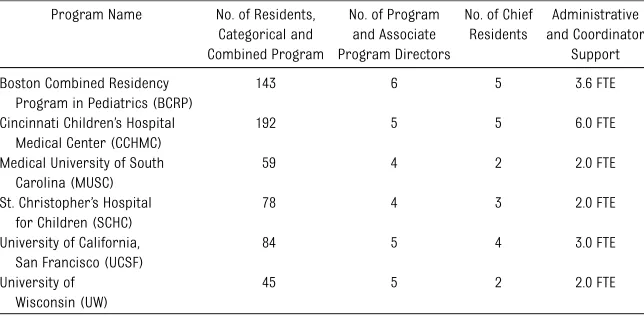
efforts are of tremendous benefit and hold unparalleled promise for the fu-ture, individual programs must de-termine how to both contribute to such multi-institutional efforts while simul-taneously making changes in their own residency programs until such resources are available to address the needs that accompany milestones-based assessment implementation and the shift toward focusing on attaining the outcomes important to patient care. To address this issue, 13 pediatric residency leaders from 6 programs representing a range of program sizes (see Table 1) developed a consensus view of necessary requirements to fully implement and sustain assessment and reporting based on the Pediatrics Milestones. In this article, we report this view, with explanation of ratio-nale and importance. The goal for this work is to serve as a roadmap to in-form the efforts and resource allo-cations of program, department, and institutional leaders as they seek to implement and sustain milestones-based assessment.
DEVELOPMENT OF CONSENSUS ROADMAP AND RESOURCE ESTIMATES
From November 2012 until July 2013, the authors developed a consensus
TABLE 1 Characteristics of Programs
Program Name No. of Residents, Categorical and Combined Program
No. of Program and Associate Program Directors
No. of Chief Residents
Administrative and Coordinator
Support
Boston Combined Residency Program in Pediatrics (BCRP)
143 6 5 3.6 FTE
Cincinnati Children’s Hospital Medical Center (CCHMC)
192 5 5 6.0 FTE
Medical University of South Carolina (MUSC)
59 4 2 2.0 FTE
St. Christopher’s Hospital for Children (SCHC)
78 4 3 2.0 FTE
University of California, San Francisco (UCSF)
84 5 4 3.0 FTE
University of Wisconsin (UW)
roadmap for implementing and sus-taining milestones-based assessment in pediatrics residency programs. We began by brainstorming the necessary components and then used an iterative review process. Through this work, we determined the components for implementing and sustaining this effort fall into 4 major domains with sub-categories as shown in Fig 1: (1) Pro-gram Review and Development of Stakeholders and Participants; (2) As-sessment Methods and Validation; (3) Data and Assessment System Devel-opment; and (4) Summative Assess-ment and Feedback. Some activities identified already have time dedi-cated to them in current residency structure; however, many compo-nents, or at least their requirements, are new.
To place additional context around the required activities, authors represent-ing each program estimated the time resources that will be required to im-plement and sustain efforts in each domain. We used the Delphi method to repeat the estimates until no to little change was observed in the repeat estimates from previous ones (1–4 it-erative cycles per domain). For each round of estimates, all programs pro-vided time estimates for their own
program for each topic in each domain (see Fig 1) for both implementing and sustaining efforts for each of the fol-lowing categories of people: (1) pro-gram leaders, (2) rotation directors and faculty, and (3) staff. Some steps had only implementing or sustain-ing components, whereas most had both. Implementation estimates were provided as 1-time efforts to begin milestones-based assessment, and sustaining estimates were provided as yearly totals after successful imple-mentation.
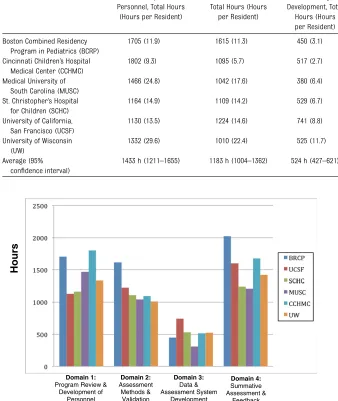
Table 2 shows the total time estimates for each domain for each program (Fig 2). Our 2 largest programs had the lowest estimate per resident, where-as our 2 smallest programs had the highest estimate. Domains 1 and 4 were estimated to require the most effort, with domain 3 requiring the least. Domain 3 may be the lowest because, unlike other domains, it is composed of activities that focus pri-marily on implementation, with little sustaining effort. We believe the range of time estimates represent appropri-ate variation based on differences in program size, institutional structure,
financial support, educational philos-ophy, and approach to implementing milestones-based assessment.
Although this consensus effort was developed by residency program lead-ers, future vetting and collaboration with department chairs, designated institutional officials, hospital and medical school administrators, and trainees across the educational con-tinuum will be necessary to make the broad-based, sweeping changes needed. However, we feel our current effort provides the foundation on which future collaboration can be built as well as a reasonable starting point and framework to begin to garner resources to help program leaders plan their own efforts as well as participate in national efforts that benefit all. To provide meaningful context to these activities, we devote the remainder of this article to discussing each of the 4 domains identified and provide an analysis of the component steps, im-portance, and resources needed to achieve them.
DOMAIN 1: PROGRAM REVIEW AND DEVELOPMENT OF STAKEHOLDERS AND PARTICIPANTS
Mapping Milestones to Educational Experiences
Implementing milestones-based as-sessment requires focus on 2 impor-tant areas: (1) optimizing utility of assessment, and (2) aligning areas of assessment with desired training out-comes. Focusing on the former, van der Vleuten proposed that the utility of an assessment method arises from the product of its acceptability, educational impact, validity, reliability, and cost, to which others have proposed adding feasibility as a sixth variable.14,15
Apply-ing this framework, we suggest limitApply-ing the number of competencies assessed during each educational experience, such as a rotation or continuity clinic, to optimize the acceptability and feasibility of milestones-based assessment among busy assessors with limited time and variable motivation. This will also allow
FIGURE 1
the alignment of competencies to the educational experiences where they are best developed and assessed while ensuring a more complete composite when individual educational experiences are combined to describe learners’ development every 6 months. Beyond faculty- and program-driven goals and objectives, this mapping must consider the necessary and desired training outcomes to meet patients’needs and map competencies that correlate with those outcomes to educational experi-ences in which residents are most likely
to develop them and assessors are most likely to observe them.1 For
ex-ample, the continuity clinic is likely well-positioned to develop and assess the milestones in the “coordinate patient care within the health care system rel-evant to their clinical specialty” com-petency of the systems-based practice competency domain.
Faculty and Resident Development
One of the strengths in the current it-eration of the Pediatrics Milestones is their ability to provide a shared mental
model for what physician development looks like.6 This provides a learning
roadmap to inform curriculum as well as supervisors’efforts to help trainees take the next steps in their develop-ment.16–18
Milestones-based assessment is a par-adigm shift from current assessment methods that rely heavily on faculty judgments of resident performance based on their level of training.19With
milestones, assessors will be required to match observed behaviors in trainees with descriptions of those behaviors along a developmental milestones tra-jectory independent of training level. Therefore, a developmentally “on tar-get” resident may appropriately be at the third of 5 milestone levels for some competencies at the completion of his or her residency. Educating residents and faculty about this developmental approach to assessment will be critical and require significant time and effort. Fortunately, initial evidence suggests that both residents and faculty under-stand the milestones-based assessment framework when oriented to it.18,20,21
Staff and Other Assessor Development
Program and support staff will need to be trained to administer milestones-based
TABLE 2 Time Estimates
Program Name Domain 1: Program Review and Development of Personnel, Total Hours
(Hours per Resident)
Domain 2: Assessment Methods and Validation,
Total Hours (Hours per Resident)
Domain 3: Data and Assessment System Development, Total
Hours (Hours per Resident)
Domain 4: Summative Assessment and
Feedback, Total Hours (Hours per Resident)
Total All Domains, Total Hours (Hours per Resident)
Boston Combined Residency Program in Pediatrics (BCRP)
1705 (11.9) 1615 (11.3) 450 (3.1) 2025 (14.2) 5795 (40.5)
Cincinnati Children’s Hospital Medical Center (CCHMC)
1802 (9.3) 1095 (5.7) 517 (2.7) 1677 (8.7) 5091 (26.4)
Medical University of South Carolina (MUSC)
1466 (24.8) 1042 (17.6) 380 (6.4) 1209 (20.4) 4097 (69.2)
St. Christopher’s Hospital for Children (SCHC)
1164 (14.9) 1109 (14.2) 529 (6.7) 1240 (15.9) 4042 (51.7)
University of California, San Francisco (UCSF)
1130 (13.5) 1224 (14.6) 741 (8.8) 1600 (19) 4695 (55.9)
University of Wisconsin (UW)
1332 (29.6) 1010 (22.4) 525 (11.7) 1420 (31.6) 4287 (95.3)
Average (95% confidence interval)
1433 h (1211–1655) 1183 h (1004–1362) 524 h (427–621) 1529 h (1284–1774) 4668 h (4124–5212)
FIGURE 2
assessment systems, provide support to faculty leaders and assessors, and help answer questions from residents and faculty regarding the program’s milestones-based assessments. In addi-tion, members of the interprofessional health care team as well as patients and families should ideally assess competencies they are well positioned to observe, such as communication skills, professionalism, and humanism. To achieve this, these groups will need to be trained or oriented to use as-sessment tools, which underscores the importance of developing tools that are clear, focused, and easily un-derstood.
Clinical Competency Committee Formation and Activity
Performance is context-dependent, so trainees will display different levels of milestone development for the same competency in different educational experiences. Culling the range of as-sessment data across experiences, deciding what milestone level will be reported to the ACGME every 6 months, and determining if residents are de-velopmentally on track, precocious, or delayed will be the responsibility of clinical competency committees (CCCs).3We recommend the ideal
com-position for the CCC would include program leaders, core faculty, noncore faculty, and potentially nonphysician members to represent the range of perspectives and baseline knowledge of residents. This composition would hope to balance intimate knowledge of residents to flesh out performance details as well as unbiased“outsider” observations that could otherwise be unintentionally missed or minimized. The CCC will need to meet with sufficient regularity to review milestones-based assessment data, track residents, and ensure those who are in need of addi-tional assistance are receiving the help necessary to advance their develop-ment.
Additional responsibilities that could be considered for the CCC include assist-ing in, or even beassist-ing the primary drivers of, promotion, graduation, and remedi-ation decisions, as well as recom-mending and monitoring professional development plans. Given their unique perspective to identify common defi -ciencies across a residency program, the CCC also could serve a role in program improvement efforts, working closely with and informing the new Program Evaluation Committee.22
Educate Departmental and Institutional Leaders/Garner Resources
As discussed previously, advancing competency-based assessment using milestones is an adaptive challenge, not a technical problem.9,10Therefore, the
scope and breadth of this effort will require personnel, time, andfinancial resources at the local and national levels to achieve success. On the local level, departmental and institutional leaders will need to support resident and faculty development, modifications of the working and learning environ-ment to facilitate the execution of new efforts and focus on new and emerging competencies of physicians required to care for patients in the 21st century, and time for faculty to participate in “innovation incubator” work as well as contribute to national efforts to develop assessment tools and sys-tems. Perhaps most importantly, there must be a plan for how this support will be sustained. On the national level, organizations with an invest-ment in milestones-based assessinvest-ment
and training outcomes must
pro-vide mechanisms and funding for multi-institutional study and experimentation. The study efforts of the Association of Pediatric Program Directors and the National Board of Medical Examiners address the use of milestones to assess readiness to care for patients in an in-patient setting and are now broadening
their scope to other core areas of phy-sician practice, demonstrating the com-mitment and investment needed from national organizations.6,21
Domain 1: Bottom Line Practical First Step
This first domain has several compo-nents. An “easy win” and important
first step could be mapping compe-tencies to educational experiences. This aligns competencies to where they are best developed and assessed, which is important to achieving de-sired training outcomes. It is also rel-atively easy to complete. A focused meeting between rotation directors and program leaders can identify the competency areas for each educa-tional experience. This partnership en-sures rotation directors are assigned areas they feel best primed to assess and develop while also guaranteeing all areas are adequately covered across the entire residency curriculum.
DOMAIN 2: ASSESSMENT METHODS AND VALIDATION
Some milestones have rich evidence in the literature to build on, whereas others have a paucity of information informing how development should progress in that area.4,5 Thus, the
milestones in their current form can stimulate discussions and reflections
about physician development and
competence; however, further study and adaptation will be needed before using them for high-stakes assess-ment and training year advanceassess-ment decision-making.6This study will need
to include validating, and adapting where necessary, the behavioral descriptions that comprise the milestone levels and establishing normative ranges for the transitions from one milestone level to another.6 Studies will also need to
Perhaps most importantly, research will need to focus significant effort and resources on generating validity evi-dence to allow for the high-stakes interpretations of assessment data for which the Pediatrics Milestones are intended.6As discussed previously, this
work should focus not only on gener-ating validity and reliability evidence, but also on acceptability, educational impact, cost, and feasibility.14,15 For
example, an assessment tool that is too long and detailed will fail to be ac-ceptable or feasible for the assessors; however, a tool that is overly simple so as to not collect meaningful infor-mation will fail to have optimal educa-tional impact.
Study of the Pediatrics Milestones will be best carried out through multisite, national efforts, as only activities of this scope will garner the depth and breadth of evidence to produce trans-formative change. Fortunately, the Pe-diatrics Milestones are currently being studied in such a manner through a col-laborative effort of the Association of Pediatric Program Directors Longitudi-nal Education Assessment Research Network and the National Board of Medical Examiners.21 Plans for future
study include further collaboration with the American Board of Pediatrics.6,13
In the absence of nationally developed assessment tools with sufficient validity and reliability, individual programs must not only commit themselves to participate in the development of such tools through multi-institutional ef-forts, but also develop and/or identify currently available tools and mecha-nisms for assessing milestones in their programs until such tools are available. This dual effort represents an enor-mous challenge and time commitment.
Domain 2: Bottom Line Practical First Step
The focus in this domain needs to be on national, collaborative efforts. This is
necessary to move the entire pediatrics community toward the common goal of truly meaningful assessment as quickly as possible. Although leading these efforts is not an “easy win,” partici-pating in them is. For example, sharing milestone data and participating in multi-institutional study of assessment methods are examples of low-resource commitments on the local level that scale to large data sets on the national level if most programs participate.
DOMAIN 3: DATA AND ASSESSMENT SYSTEM DEVELOPMENT
There is hope that future study will al-low the competencies assessed to be combined or serve as proxies for one another.6 Absent this currently,
as-sessment of milestones even for just the 21 reporting competencies has the potential to generate hundreds to thousands of data points for all resi-dents across a program. These data will need to be collected efficiently, synthesized, and presented in a man-ner that is meaningful and facilitates review and interpretation by the CCC. With such a wealth of data to gather, there is a critical need for efficient data management. This effort will need to be supported by electronic assessment systems, ideally mobile applications that support real-time assessment on devices designed to facilitate data transfer to central servers for distri-bution to residents and faculty and for collation for CCC and program leader review.
Develop/Identify Data Management Systems to Collect and Report Milestones Assessment Data (Including Those With Novel Interfaces)
The systems that collect milestones-based assessment data may or may not be the same as those that assimilate the data. Commonly used current
pro-prietary assessment systems focus on assimilating data from multiple as-sessment sources and creating sum-mary reports. As program leaders, we hear frequent complaints from the end-users who complete assessment forms in these systems, such as log-in diffi -culties, suboptimal user interface and layout, and limited interface capa-bilities with smart phones and tablet computers. We believe optimal future systems will provide a clear layout with easy navigation on handheld electronic devices that feature saved passwords and wirelessly sync to central data-bases. Interfaces should be easy and intuitive to navigate, readily provide summary reports that synthesize and provide appropriate weight to perfor-mance assessments across settings and learning activities, and feature user-friendly layouts for use in both resident feedback and performance review by CCC members. Importantly, these systems also should have the ability to directly upload milestones reporting to external organizations, such as the ACGME. Although new sys-tems provide promise, programs must still navigate with currently available resources.23
Develop Initial Standards for Milestone Achievement
Through study, normative ranges of milestones achievement as well as levels associated with critical transition points, such as becoming a supervising resident on an inpatient general pedi-atrics service, will be delineated.4,6In
practice. We suggest that core faculty and CCC members work closely with program leaders to determine initial standards for individual educational experiences and the overall program.
Establish Policies and Professional Development Plans
For residents whose development falls behind established standards, pro-fessional development policies and mechanisms to ensure these residents are ready to be placed in specific ed-ucational experiences must be estab-lished. For example, a resident whose milestones-based development does not meet the standards for being a su-pervisor on the wards but has an impending ward supervisory rotation would need a schedule change and a professional development plan. This will require schedule flexibility and faculty members who are well versed in the development of professional de-velopment plans and in providing di-rect, specific feedback on current performance that is coupled with a discussion of future steps.
Develop Reporting Mechanism
Thefirst reporting of milestones to the ACGME will occur in June 2014. This will require significant time for programs to enter information for 21 competency areas for all residents in their pro-gram at that time and every 6 months thereafter. Thus, a mechanism for local assessment systems to easily interface with national reporting systems to upload local data must be part of future assessment systems. Only systems fulfilling this need will support, rather than thwart, efforts to avoid adminis-trative complexity that misappropri-ates time spent“checking the box”of milestones reporting with the more important effort of providing mean-ingful assessment information to resi-dents. Although emerging systems provide promise in this area, programs
must still navigate currently available resources.23
Domain 3: Bottom Line Practical First Step
The “easy win” in this domain is adapting professional development plans to incorporate the language of the milestones. After the first 1 or 2 reviews that CCC members and pro-gram leaders complete for all resi-dents, each program will likely have these individuals as a core group of faculty that will be facile with the con-tent and language of the milestones. This will allow them to use this knowl-edge to provide residents with the next steps to advance their developmental progression.
DOMAIN 4: SUMMATIVE ASSESSMENT AND FEEDBACK
Develop Processes to Provide Feedback and Make Advancement and Remediation Decisions
Feedback arising from milestones-based assessment data has the po-tential to facilitate the professional development of residents, underscor-ing the importance of presentunderscor-ing this information in a learner-centered manner. Although initial evidence pro-vides insight into best practices,18,21
including emphasizing current and next steps in development, further study will be needed. Optimal milestones-based assessment will also require longitudinal relationships that allow adequate time and contact to identify current developmental level, define next steps in development, and effect behavior change from feedback.24–26
To address summative assessment, national studies are under way to identify normative ranges for milestone development that will inform common expectations.6Until this information is
available, each program must develop its own standards for advancement to
new levels of responsibility and train-ing, remediation for those whose per-formance falls below the lower limit of appropriate development, and cri-teria for graduation. We recommend training programs begin by adapting their current policies to incorporate milestones-based assessment data as an additional element to inform ad-vancement and remediation decisions.
Use Milestones-based Assessment Data to Plan Individualized Curricula
The new ACGME requirements for pe-diatrics residency training include the equivalent of 6 months of individualized curriculum focused on career devel-opment for each resident.27Although
some competencies may be more or less important to certain careers, the milestones have great potential to in-form the development of individualized curricula. A focus on the competency areas of greatest importance to resi-dents’future careers during individu-alized curricula will not only ensure that development in these areas is not lagging but also facilitate more rapid development to an advanced milestone level(s) in those areas.
Modify Educational Experiences Based on Deficiencies Uncovered
Milestones-based assessment will in-herently uncover exemplar and
overlapping work between the CCC and the Program Evaluation Committee.
Domain 4: Bottom Line Practical First Step
Similar to the previous domain, an early “easy win”for programs in domain 4 is using milestones to define and shape professional development plans for individual residents, providing resi-dents with a tailored roadmap for their learning. Once CCC members and pro-gram leaders develop facility with the content and language of the mile-stones, this application to resident development will be readily made.
CONCLUSIONS AND NEXT STEPS
In this article, we provide a consensus opinion of residency program leader-ship for the domains of effort and time estimates that will be required to im-plement and sustain each domain.
Al-though we recognize that the domains, and especially the time estimates, do not include the opinions of all important stakeholders, they do represent a good starting point for understanding what will be required to reach the full po-tential of milestones-based residency training. Implementing and sustaining milestones-based assessment represents an adaptive challenge of implementing and sustaining milestones-based as-sessment that will require significant effort and study. To achieve success, departmental and institutional lead-ers must support this work through time, money, and a commitment to achieving training outcomes that meet the needs of patients. Equally impor-tant, the pediatrics medical education community must engage in national sharing, study, and collaboration to develop valid, reliable, feasible, ac-ceptable, and cost-effective methods
of milestones-based assessment that have a meaningful educational impact by facilitating the professional devel-opment of residents.14,15Stakeholder
organizations should continue to take the lead in these efforts and help programs accomplish the necessary steps we have delineated. Without broad-based investment and resources, the next 10 years in competency-based as-sessment efforts risk mirroring the
first decade in which slow progress was made. Furthermore, we may fail to reach our ultimate goal of determining learner training outcomes as thefirst step in linking educational and patient care outcomes.1
ACKNOWLEDGMENTS
The authors thank and acknowledge Jennifer Vodzak, MD, of St Christopher’s Hospital for Children for her assistance with developing Figure 2.
REFERENCES
1. Frenk JCL, Chen L, Bhutta ZA, et al. Health professionals for a new century: trans-forming education to strengthen health systems in an interdependent world. Lan-cet. 2010;376(9756):1923–1958
2. Swing SR. The ACGME outcome project: retrospective and prospective.Med Teach. 2007;29(7):648–654
3. Nasca TJ, Philibert I, Brigham T, Flynn TC. The next GME accreditation system—rationale and benefits.N Engl J Med. 2012;366(11): 1051–1056
4. Hicks PJ, Schumacher DJ, Benson BJ, et al. The pediatrics milestones: conceptual framework, guiding principles, and ap-proach to development.J Grad Med Educ. 2010;2(3):410–418
5. Hicks PJER, Englander R, Schumacher DJ, et al. Pediatrics milestone project: next steps toward meaningful outcomes assess-ment.J Grad Med Educ. 2010;2(4):577–584 6. Englander R, Burke AE, Guralnick S, et al.
The pediatrics milestones: a continuous quality improvement project is launched— now the hard work begins!Acad Pediatr. 2012;12(6):471–474
7. Pediatrics Milestone Project Working Group. The Pediatrics Milestone Project. 2012.
Available at: https://www.abp.org/abpweb-site/publicat/milestones.pdf. Accessed Feb-ruary 12, 2012
8. Carraccio C, Benson B, Burke A, et al. Pe-diatrics milestones.J Grad Med Educ. 2013; 5(1 suppl 1):59–73
9. Heifetz RA, Linsky M. Leadership on the Line: Staying Alive through the Dangers of Leading. Boston, MA: Harvard Business Review Press; 2002
10. Heifetz RA, Laurie DL. The work of leader-ship.Harv Bus Rev. 1997;75(1):124–134 11. Combes JR, Arespacochaga E. Physician
competencies for a 21st century health care system.J Grad Med Educ. 2012;4(3):401–405 12. Pershing S, Fuchs VR. Restructuring medi-cal education to meet current and future health care needs.Acad Med. 2013;88(12): 1798–1801
13. American Board of Pediatrics. Foundation Support of Milestones Study. 2013. Avail-able at: https://www.appd.org/pdf/Founda-tionSupportofMilestonesStudy.pdf. Accessed February 25, 2012
14. Van Der Vleuten CP. The assessment of pro-fessional competence: developments, research and practical implications.Adv Health Sci Educ Theory Pract. 1996;1(1):41–67
15. Postgraduate Medical Education and Train-ing Board. DevelopTrain-ing and maintainTrain-ing an assessment system—a PMETB guide to good practice. 2007. Available at: www.gmc-uk.org/Assessment_good_practice_v0207. pdf_31385949.pdf. Accessed February 27, 2014
16. Dath DIW, Iobst W; International CBME Collabo-rators. The importance of faculty development in the transition to competency-based med-ical education. Med Teach. 2010;32(8):683– 686
17. Holmboe ESWD, Ward DS, Reznick RK, et al. Faculty development in assessment: the missing link in competency-based medi-cal education.Acad Med. 2011;86(4):460– 467
18. Schumacher DJ, Lewis KO, Burke AE, et al. The pediatrics milestones: initial evidence for their use as learning road maps for residents.Acad Pediatr. 2013;13(1):40–47 19. Kogan JR Jr, Conforti L, Bernabeo E, Iobst
W, Holmboe E. Opening the black box of clinical skills assessment via observation: a conceptual model.Med Educ. 2011;45(10): 1048–1060
Obtaining Faculty Perspectives Through Cognitive Interviewing. Council on Medical Student Education in Pediatrics/Association of Pediatric Program Directors National Conference; 2013; Nashville, TN
21. Poynter S, Turner T, Chaffinch C, Hicks PJ, for the APPD LEARN-NBME Pediatrics Mile-stones Assessment Group. Learner Feedback on the Pediatrics Milestones Assessment Project. Orlando, FL: Accreditation Council on Graduate Medical Education; 2013
22. Weiss KB, Bagian JP, Nasca TJ. The clinical learning environment: the foundation of
graduate medical education. JAMA. 2013; 309(16):1687–1688
23. Data Commons, LLC. Data Commons home page. Available at: http://mydatacommons. org. Accessed December 3, 2013
24. Hirsh DAOB, Ogur B, Thibault GE, Cox M.
“Continuity”as an organizing principle for clinical education reform. N Engl J Med. 2007;356(8):858–866
25. Holmboe EGS, Ginsburg S, Bernabeo E. The rotational approach to medical education: time to confront our assumptions? Med Educ. 2011;45(1):69–80
26. Schumacher DJ, Englander R, Carraccio C. Developing the master learner: applying learning theory to the learner, the teacher, and the learning environment. Acad Med. 2013;88(11):1635–1645
27. Accreditation Council for Graduate Medi-cal Education. ACGME program require-ments for graduate medical education
in pediatrics. 2013. Available at: www. acgme.org/acgmeweb/tabid/143/Program- andInstitutionalGuidelines/MedicalAccredi-tation/Pediatrics.aspx. Accessed August 17, 2013
(Continued fromfirst page)
www.pediatrics.org/cgi/doi/10.1542/peds.2013-2917
doi:10.1542/peds.2013-2917
Accepted for publication Feb 11, 2014
Address correspondence to Daniel J. Schumacher, MD, MEd, One Boston Medical Center Place, Boston, MA 02118. E-mail: [email protected]
PEDIATRICS (ISSN Numbers: Print, 0031-4005; Online, 1098-4275).
Copyright © 2014 by the American Academy of Pediatrics
FINANCIAL DISCLOSURE:The authors have indicated they have nofinancial relationships relevant to this article to disclose.
FUNDING:No external funding.
POTENTIAL CONFLICT OF INTEREST:The authors have indicated they have no potential conflicts of interest to disclose.
DOI: 10.1542/peds.2013-2917 originally published online April 14, 2014;
2014;133;898
Pediatrics
Sectish
Poynter, Glenn Rosenbluth, W. Michael Southgate, Robert J. Vinci and Theodore C.
Cruz, John G. Frohna, Javier Gonzalez del Rey, Kristina K. Gustafson, Sue Ellen
Daniel J. Schumacher, Nancy D. Spector, Sharon Calaman, Daniel C. West, Mario
Services
Updated Information &
http://pediatrics.aappublications.org/content/133/5/898 including high resolution figures, can be found at:
References
http://pediatrics.aappublications.org/content/133/5/898#BIBL This article cites 19 articles, 0 of which you can access for free at:
Subspecialty Collections
g_-_development_sub
http://www.aappublications.org/cgi/collection/practice-based_learnin
Practice-Based Learning & Development
e_management_sub
http://www.aappublications.org/cgi/collection/administration:practic
Administration/Practice Management
dev_sub
http://www.aappublications.org/cgi/collection/teaching_curriculum_
Teaching/Curriculum Development
b
http://www.aappublications.org/cgi/collection/medical_education_su
Medical Education following collection(s):
This article, along with others on similar topics, appears in the
Permissions & Licensing
http://www.aappublications.org/site/misc/Permissions.xhtml in its entirety can be found online at:
Information about reproducing this article in parts (figures, tables) or
Reprints
DOI: 10.1542/peds.2013-2917 originally published online April 14, 2014;
2014;133;898
Pediatrics
Sectish
Poynter, Glenn Rosenbluth, W. Michael Southgate, Robert J. Vinci and Theodore C.
Cruz, John G. Frohna, Javier Gonzalez del Rey, Kristina K. Gustafson, Sue Ellen
Daniel J. Schumacher, Nancy D. Spector, Sharon Calaman, Daniel C. West, Mario
Resource Analysis
Putting the Pediatrics Milestones Into Practice: A Consensus Roadmap and
http://pediatrics.aappublications.org/content/133/5/898
located on the World Wide Web at:
The online version of this article, along with updated information and services, is
by the American Academy of Pediatrics. All rights reserved. Print ISSN: 1073-0397.