http://www.sciencepublishinggroup.com/j/aap doi: 10.11648/j.aap.20180301.11
ISSN: 2471-9692 (Print); ISSN: 2471-9714 (Online)
The Study of Effect of Amphetamine on Passive Avoidance
Learning in Wistar Male Rats
Milad Rezazadeh
1, Mehdi Ahmadifar
2, 3, *, Meysam Ahmadi Manesh
41
Department of Biology, Tehran North Branch, Islamic Azad University, Tehran, Iran 2
Department of Stem Cells and Developmental Biology, Cell Science Research Center, Royan Institute for Stem Cell Biology and Technology, Tehran, Iran
3
Department of Animal Biology, Faculty of Biological Sciences, Kharazmi University, Tehran, Iran 4
Department of Animal Sciences, Faculty of Agriculture and Natural Resources, Gonbad Kavous University, Gonbad-e Kavus, Iran
Email address:
*
Corresponding author
To cite this article:
Milad Rezazadeh, Mehdi Ahmadifar, Meysam Ahmadi Manesh. The Study of Effect of Amphetamine on Passive Avoidance Learning in Wistar Male Rats. Advances in Applied Physiology. Vol. 3, No. 1, 2018, pp. 1-7. doi: 10.11648/j.aap.20180301.11
Received: January 25, 2018; Accepted: February 16, 2018; Published: May 29, 2018
Abstract:
Methamphetamine is sometimes prescribed by doctors for specific diseases that with the entering the central nervous system caused by a sudden release of categulamine and particularly dopamine in the brain. It stimulates brain cells, enhancing aggressive mood and increased body movement. The purpose of this study was to investigate, has been the effects of methamphetamine on passive avoidance learning and memory in adult male Wistar rats. Male Wistar rats of rats in the weight range (180-220gr) (N=6) was Divided into healthy group - control group (saline received) and dose received groups (1.5, 3, 5 mg/kg). Half an hour before the test, intraperitoneally injection was done and after the test, every day at specific times for long-term memory test for one week Injection was done. Results have shown that the incidence of passive avoidance between healthy and control groups there was no significant difference but there is a significantly decreased between the control group and the group receiving methamphetamine. Increase learning and short-term memory and reduced long term memory and passive avoidance learning mechanism is probably due to the involvement of the hippocampus in learning and memory consolidation and short term memory convert to long-term memory could potential mechanism of methamphetamine-induced damage to hippocampal neurons, particularly CA1 neurons. Meanwhile, short-term memory-enhancing effects of methamphetamine can result in Increase cortisol is also a short-term strengthens to the memory but in long term it will damage and weaken the memory.Keywords:
Methamphetamine, Passive Avoidance Learning, Male Rat1. Introduction
Learning and memory is one of the highest functional levels of the central nervous system. Learning is a neurological phenomenon, and learning can be observed as exposing the organism to varities of information [1]. Amphetamines and many of their derivatives are very diverse in terms of their composition and physiological effects [2]. The most important effect of amphetamines is the extracellular increase in the concentration of catechol amines and, in general, monoamines (epinephrine, norepinephrine, dopamine and serotonin) and serotonin by a mechanism
[5]. These materials are usually in the form of white powder, sometimes bright brown, crystalline or yellowish browns liquid. One of its psychological complications is the development of mental illness similar to schizophrenia, including visual and auditory illusions, and phobia and aggression. Feeling worse is an illusion that is common among amphetamine users, which is due to the effect of the stimulant on the brain [6]. The illusion of worms and the presence of worms that are all over the body and face so much that it may cause a person to experience a severe illness in the Crystal-like illness, which sometimes leads to hospitalization [7]. The combined use of crystal with skin infections and severe tooth decay has led to a rumor spreading the body's creaminess [8]. The worst affected Meth Mouth addicts are one of the most severe oral infections and dental caries. The effect of this infection (vasoconstrictor) on methamphetamine And its side effects, such as dryness of the mouth, laziness and induldge, heavy drinking and drinking for dehydration and crystal disposal, are the main causes of these infections and They do not know [9]. Consumption of amphetamine or low purity crystal, which is more susceptible to be blended with other substances, such as sugar or sweetener, than pure amphetamine. Rupture of the veins, muscle cramps and skin infections, or inwardly, are complications. Meanwhile, deaths due to overdose in this type of substance are higher than the cost of the substance, as it is possible that without the knowledge of the person, the narcotics that the anonymizer has prepared has a higher or higher dose than the usual one [10].
2. Materials and Methods
Animals and maintenance: In this study 30 wistar male rat were used, they were 180-220gr. No experiment was performed on them until 1 week after the introduction of the animal in order to become accustomed to the new conditions. The rats were kept in standard laboratory conditions with proper water and food, as well as the normal rhythm of brightness - daytime darkness, the brightness was at 7am to 7pm and the darkness was 7pm to 7am. and they kept in 23°C ± 2°C. Before choosing the treatment groups, due to the lack of sufficient information in the available literature on the lethal dose and the tolerable dose of methamphetamine for rats, also given the unclear degree of purity of the drug, at first the tolerable dose of the drug is tested on a number of rats.
Determine the tolerable dosage for the rat: Prior to determining and injecting doses of 1.5, 3 and 5 mg/kg, doses of 10 and 20 were also tested but after injection of these doses the rats died because of overe increasing of heart beat. again gave the same number of doses as gavage rats were given that later signs were seen but still led to the death of the rats. It turned out that these two doses are for mice to be sedated. Immediately after the death of the rats, an autopsy was performed on the chest wall of the rats and a heart attack was observed. Other symptoms before death were: 1. Increased respiratory rate, tachypnea 2. Increased heart rate,
tachycardia 3. Nerve seizures - severe muscle that, after exposure to the animal's diaphragm, caused respiration and immediate death. 4. Behavioral changes in animals - Including first coughing of the cage corner, then starting to move backward, spin, restlessness, tachypnea, tachycardia, neuromuscular seizures and immediate death within less than 1 or 2 hours. The symptoms in 20 mg/kg dose were more severe than those of the 10 mg/kg dose.
Treatment of animals: Injections for each group continued for 4 weeks, once daily, via intraperitoneal injection, before the passive avoidance learning test. The time of drug injection was at 9-12 am to reduce the effect of circadian rhythm. During the examination water and food was provide. The dosage was different for each rat depending on the weight. The treatment of animals in different groups was done by intraperitoneal injection using insulin syringe (ip). In the control group (intact), the substance was not injected, and only normal saline (0.5 cc) of sterile inject able was used in the control group (solvent receptor). and in 3 experimental groups, injections of 1.5, 3 and 5 mg/kg of methamphetamine were performed.
Groups: The rats were 5groups. In this groups, the stage of stabilization of passive avoidance learning process was examined and tested. This 5 groups grouped in 1 intact group, 2 control groups (nothing and saline recipients), and 3 experimental groups (receiving methamphetamine supplements 1.5- 3.5 - 5 mg/kg) were selected randomly. In the classified groups, the studies were as follows: No1 The intact group was injected non-inactivated by teaching a passive avoidance learning test No2 Control group, This group was administered with intraperitoneal injections of saline. The 3rd group was intraperitoneally injected with methamphetamine 1.5mg/kg for 30 minutes before the test. No 4 group was subjected to intraperitoneal injection of methamphetamine 3mg/kg 30 minutes before the test. Group 5 was intraperitoneally injected with methamphetamine 50mg/kg 30 minutes before the test.
Group 1: No injection of 6 large male rat (group intact) Group 2: Intraperitoneal injection of normal saline once before the test at around 9-12 noon to 6 large male rat (control group, pre-test)
Group 3: Intraperitoneal injection of the drug at a dose of 1.5 mg/kg once before the test at about 9-12 noon to 6 large male rats
Group 4: Intraperitoneal injection of the drug at a dose of 3 mg/kg once before the test at around 9-12 noon to 6 adult male rats
Group 5: Intraperitoneal injection of the drug at a dose of 5 mg/kg once before the test, at 9-12 noon, to 6 large male rats
Then, after testing with a shuttle box (to measure long-term memory):
Group 1: No injections of 6 large male rat
Group 2: Intraperitoneal injection of normal saline every day at about 9-12 noon to 6 male large rat
Group 3: Intraperitoneal injection of the drug at a dose of 1.5 mg/kg every day once at 9-12 noon to 6 male large rat
3mg/kg every day at around 9-12 o'clock at 6 o'clock to 6 large male rat
Group 5: Intraperitoneal injection of the drug at a dose of 5mg/kg every day, at around 9-12 o'clock, to 6 male large rat
2.1. Passive Avoidance Learning
The shuttle box were used to measure the learning and memory of adult rats. This device is made up of two bright rooms, 20 cm x 20 cm in size, made of transparent and dark plastic with walls covered with non-transparent plastic. Between the two rooms, the door is sliding a size (8cm 8 inches) that is controlled with wire. Both rooms are covered with stainless steel bars. Each rod is 2mm thick and each rod is spaced 1cm apart. The dark floor can get electricity by connecting to a power supply. The amount of power received and the adjustable time, in this test, was 1.5 mA and 3 seconds, the intensity was 50 HZ. Two days before test the animals placed in the laboratory, they would be familiar with the laboratory environment to minimize their stress during testing. Two days before test the animals were in the laboratory, they would be familiar with the laboratory environment to minimize their stress during testing. Passive avoidance method was used to investigate memory in laboratory mice for 5 consecutive days. The first four days were considered as days of training and the fifth day was regarded as test day.
2.2. Training stage
At this stage, the animal was placed in a bright environment and allowed to get familiar with this environment within 10 seconds, after 10 seconds the door was opened and immediately after the animal arrived, it was closed and 10 seconds to The animal was given time and after 10 seconds the mouse was removed from the dark part of the machine and placed inside the corresponding cage.30 minutes later these actions were carried out in the same way. Given the intrinsic tendency of animals to enter the dark part, after a short time, the bright part entered the dark part of the device. It should be noted that mice that were delayed for more than 120 seconds in entering the dark part were deprived of the test. After 30 minutes, the animal was transferred to the brigh part of the device again, and after 10 seconds the gate opened to allow the animal to enter the dark part. Entering the dark part, the door was closed and the animal was subjected to an electric shock (1.5 milliamps and for 3 seconds, transmitted by the stapler to the dark floor steel bars of the machine). Given the colosed roof's closure, the animal could not avoid electric shock (inevitable shock).
20 seconds after the excitation period, the animal was removed from the machine and moved to its cage. After 2 minutes, the second stage of the training was performed on the rat (shocked rat). The rats placed to the bright room and the gate was opened and the seconds were recorded for late arrival to the dark part. If the rat have 120 seconds delay, so successful learning was recorded and dropped out of the machine, but if the rat entered the dark part of less than 120 seconds, after entering the dark section of the gate, the gate closed and rat received a shock for the second time and was retested after removing it from the device and passed again for 2 minutes. Maximum training for each rat was set three times. The training continued for 4 days.
2.3. Testing Stage
The test stage was performed 24 hours after the training stage, and the test was done on the fifth day of the experiment on the animals. The test did not take place at the test of electrical stimulation. To monitor memory, each rat was placed on bright section like the first day. The door was opened after 10 seconds and the lag time of the animal was entered into the dark part of the device as a criterion for measuring the memory. The maximum delay was 300 seconds. A mouse which remembers being shocked in the dark part of the device and could have inhibited her tendency to enter the dark part (avoidance method), the delay in entering the dark part, than that which on the day of training, it was noticeably increased, and thus had a better memory.
3. Results
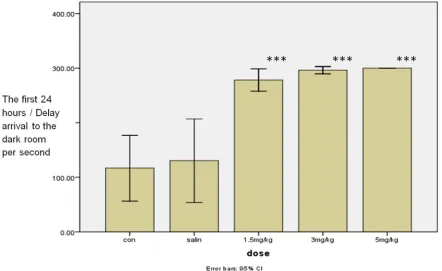
The results of the study of the effect of intraperitoneal injection of methamphetamine (1.5-3-5 mg/kg) on passive avoidance learning during the first day (for measuring short-term memory) and seventh day (for measuring long-short-term memory). The initial latency in the entrance to the dark room and the duration of stay in the dark room are as follows. It should be noted that no test performed between the first and the seventh days, and only injections were done every day.
Diagram1: The effect of intraperitoneal injection of methamphetamine (1.5-3-5 mg/kg) on the delay in entering the dark room during the first day of the test in male Wistar rats
Figure 1. The effect of peritoneal injection of methamphetamine in male Wistar rats has been shown late arrival to the dark room in the learning of passive avoidance learning in the first day of test. Infusion was performed half hour before the test. The results are as mean ± standard error (SEM) and the number of samples in each group is 6 and the sign ** * represents P≤0.001 compared with the control group and saline group. In all doses, P≤0.001 has a significant increase in comparison to the control group and saline.
Figure 2: The effect of intraperitoneal injection of methamphetamine (1.5-3-5 mg/kg) on the delay in entering the dark room during the seventh day experiment in male Wistar rats
The results showed no significant difference between saline and control groups. However, methamphetamine injection reduces the latency of entering the dark room (in seconds) seventh day at all doses, which is seen to decrease significantly at a dose of 5 mg/kg. P≤0.05.
Figure 3: The effect of intraperitoneal injection of methamphetamine (1.5-3-5 mg/kg) on the duration of stay in the dark room on the first day of the test in male Wistar rats.
The results showed there is that there was a significant increase between control and saline groups (P≤0.0). There was a significant decrease between the groups receiving methamphetamine and the control group as well as saline (p≤0.001).
Figure 3. Effect of methamphetamine intraperitoneal injection in male Wistar rats on the duration of stay in the dark room in the learning of passive avoidance on the first day of the test. Infusion was performed half hour before the test. The results are as mean ± standard error (SEM) and the number of samples in each group of 6 and the *** sign represents P≤0.001 compared to the control group and the sign of ** represents P≤0.01 in comparison with the group Saline is in control. In all doses with P≤0.001 compared to the control group and saline group, there is a significant decrease in saline injected group with P≤0.01 compared with control.
Figure 4: The effect of intraperitoneal injection of methamphetamine (1.5 - 3 - 5 mg/kg) on the duration of stay in the dark room on the seventh day of the test in male Wistar rats
The results showed no significant difference between saline and control groups. Significant increases have been shown between the groups receiving methamphetamine and saline and control groups. The duration of stay in the dark room (in seconds) in the recipient group at doses of 3.5 mg/kg is p≤0.01 and at a dose of 1.5mg/kg is p≤0.05.
4. Discussion
In 1981, the first role of dopamine in memory and learning and its pharmacological evidence was observed [11]. Introini et al. In 1992, Locus serveleus, amygdala and hippocampus were identified as important sites in the regulation of noradrenergic receptors in the recognition process [21]. In 1992, Squire introduced the hippocampus as part of the prefrontal cortex in the mammalian brain, which, according to scientists, is the main structure of space learning and consolidation for the formation of conscious memory [12]. Jager and Sireling used the leaves of this plant to express excitement and relieve tiredness and loss of appetite. It became habitual and induced paranoid and other behavioral disorders [13]. Nail-Boucherie, in a study, said dopamine receptors D1 increased inactivity and improved cognitive performance in mice, and did not affect learning [14]. Also, Bergman et al., in 2001, found that large amounts of exogenous B-thymidine-derived fatty amines, or those obtained by inhibiting MAO-monoamine oxidase, have amphetamine-like psychedelic responses [10]. Lathe in 2001 stated that the hippocampus and the cerebellum are only parts of the brain that have a cell division after birth, and many of the actions of the hippocampus are related to this feature. The role of the hippocampus facilitates spatial memory and draws a three-dimensional design from the surrounding environment [14]. In 2002, Chang, in a visual study of the brains of glass consumer users, showed that neurotransmitter carriers of dopamine in the brain of these individuals greatly reduced and caused cognitive impairment. In 2003, Jay suggested dopamine as a potential substrate in the synaptic ductility and memory mechanisms [5]. Suggested that amphetamine release more dopamine in the prefrontal cortex (prefrontal, a cognitive activity site) and indicated that it affects behaviour and work memory [15]. In 2003, Demian Barbas suggested that serotonin receptors (5-HT3) be expressed within the limbic system and contribute to the release of mediator mediated carriers. Expression of this receptor in the forebrain increases hippocampal learning and accuracy, and ultimately improves memory and learning [16]. Cadet In 2003, the shrinking brain hippocampus and cell death of neurons were shown by glass [17]. during World War II studies reported on US, German, Japanese and British forces, used this medication to increase the soldiers' alertness level and were used by pilots. I illusions between consumers, especially those with COMT enzyme mutations, have been reported [22]. stated in a trial that the hippocampus is referred to as three distinct but related structures: 1. Cornu Ammonis main hippocampus; 2. dentate gyrus; 3. subiculum, dividing the hippocampus Main to multiple locations CA1-CA2-CA3-CA4 In a 2012 study, Gonçalves said that methamphetamine would interfere with cognition, which would be affected by the effect of neuropeptide Y [18]. reported methamphetamine as a disturbance, whose effect was demonstrated by a significant reduction in prefrontal cortex [19]. Reported in 2013 that methamphetamine
disrupted learning, as well as a significant relationship between insanity and monoaminergic learning signals of abnormal regulation in the cingulate cortex at the forehead [8]. injected a dose of 1 mg/kg into mice, facilitated spatial memory after shock, while injection of this dose did not affect spatial memory half an hour before the test [20].
5. Conclusion
Increased learning and short-term memory, and long-term memory and passive avoidance learning. Probably due to the involvement of the hippocampus in learning and memory consolidation and the transformation of short-term memory into long-term memory, the possible mechanism of methamphetamine effect can be attributed to the destruction of the hippocampal neurons, especially CA1 neurons This effect can be a result of the specific effect of methamphetamine, or through the creation of a kind of chemical stress in the animal's brain, increasing the activity of the axis of HPA. Consequently, increased cortisol concentration in the bloodstream, CA1 neuronal toxicity, neurotoxicity, and destruction of neurons in this region. Meanwhile, the effect of short-term memory enhancement of methamphetamine can also be due to increased cortisol, which in the short term strengthens memory, but in the long run it weakens and degrades.
References
[1] Hansson, O., Zetterberg, Buchhave, P., Londos, E., Blennow, K., and Minthon, L., 2006. Association between CSF biomarkers and incipient Azheimer's disease in patients with mild cognitive impairment: a follow-up study. Lancet Neurol5, 228-234.
[2] Gonçalves J, Baptista S, Olesen MV, Fontes-Ribeiro C, Malva JO, Woldbye DP, Silva AP. 2012. Methamphetamine-induced changes in the mice hippocampal neuropeptide Y system: implications for memory impairment. J Neurochem; 123 (6):1041-53. doi: 10.1111/jnc.12052. Epub 2012 Nov1.
[3] Elmi, A. S., 1983. The chewing of khat in Somalia. J. Ethnopharmacol. 8, 163–176.
[4] Assuncao, M., Santos-Marques, M. J., Carvalho, F., and Andrade, J. P., 2010. Green tea averts age-dependent decline of hippocampalsignaling systems reated antioxidant defenses and survival. Free RadicBiol Med 48, 831-838.
[5] Assuncao, M., Santos-Marques, M. J., Carvalho, F., Lukoyanov, N. V., and Andrade, J. P., 2009. Chronic green tea consumption prevents age-relaared changes in rat hipppcampal formation. Neurobiol Aging.
[6] Banks, W. A., and Farr, S. A., 2004. Antiaging methods and medicines for the memory. ClinGeriatr Med 20, 317-328.
[8] Bernacer J, Corlett PR, Ramachandra P, McFarlane B, Turner DC, Clark L, Robbins TW, Fletcher PC, Murray GK, 2013. Methamphetamine-Induced Disruption of Frontostriatal Reward Learning Signals: Relation to Psychotic Symptoms. Am J Psychiatry.
[9] Barnes, C., 1998. Memory changes during normal aging: neurobiological correlates. Neurobiology of learning and memory, 247-287.
[10] Bergman, J., Yasar, S., Winger, G., 2001. Psychomotor stimulant effects of Berry, M. D., 2004. Mammalian central nervous system traceamines. Pharmacologic amphetamines, physiologic neuromodulators. J. Neurochem. 90, 257–271.
[11] Yin, S. T., Tang, M. L., Su, L., Chen, L., Hu, P., Wang, H. L., Wang, M., and Ruan, D. Y., 2008. Effects of Epigallocatechin-3-gallate on lead-induced oxidative damage. Toxicology 249, 45-54.
[12] Zarrindast MR, Shendy MM, Ahmadi S. Nitric Oxide modulates state dependency induced by lithium in an inhibitory avoidance task in mice. behavepharmacol 2007; 18:289-95.
[13] Zarrindast, M. R., Hajian-Heydari, A., & Hoseini-Nia, T. (1992). Characterization of dopamine receptors involved in apomorphine-induced pecking in pigeons. General Pharmacology, 23, 427-430.
[14] Lathe, R., 2001. Hormones and the hippocampus. J Endocrinol 169, 205-231.
[15] Shoblock, J. R., Maisonneuve, I. M., Glick, S. D., 2003a. Differences between D-methamphetamine and D-amphetamine in rats: working memory, tolerance, and extinction. Psychopharmacology (Berl.) 170, 150–156.
[16] Demian Barbas, L. D., 1, 2 Vincent F. Castellucci, 2, 3 Thomas J. Carew, 4, 5 and a. p. Marinesco4 (2003). "Multiple
Serotonergic Mechanisms Contributing to Sensitization in Aplysia: Evidence of Diverse Serotonin Receptor Subtypes." learnmem 10: 373-386.
[17] Cadet, J. L., Jayanthi, S., Deng, X., (2003). Speed Kills: Cellular and Molecular Bases of Methamphetamine-induced Nerve Terminal Degeneration and Neuronal Apoptosis, FASEB J. 17, 1775-1788.
[18] Rendeiro, C., Spencer. J. P., Vauzour, D., Butler, L. T., Ellis, J. A., and Williams, C. M., 2009. The impact of flavonoids on spatial memory in rodents: from behavior to underlying hippocampal mechanisms. Genes Nutr.
[19] Kosheleff AR, Rodriguez D, O'Dell SJ, Marshall JF, Izquierdo A. 2012. Comparison of single-dose and extended methamphetamine administration on reversal learning in rats. Psychopharmacology (Berl). 2012 Dec; 224 (3):459-67. doi: 10.1007/s00213-012-2774-1. Epub 2012 Jul 4.
[20] Cao G, Zhu J, Zhong Q, Shi C, Dang Y, Han W, Liu X, Xu M, Chen T. 2012. Distinct roles of methamphetamine in modulating spatial memory consolidation, retrieval, reconsolidation and the accompanying changes of ERK and CREB activation in hippocampus and prefrontal cortex. Department of Forensic Medicine, Xi'an Jiaotong University, School of Medicine, Xi'an, Shaanxi 710061, PR China.
[21] Introini-Collison, I. B., Saghafi, D., Novack, G. D., & Mc Gaugh, G. L. (1992). Memory-enhancing effects of post-training dipivefrin and epinephrine: Involvement of peripheral and central adrenergic receptors. Brain Research, 572, 81-86.