Fonterra Research Centre, Palmerston North, New Zealand
1%
s
t
Enough?
Prepared by Ellen Bartlett
Acknowledgements
The author wishes to thank and acknowledge Dr Jeremy Hill, Dr Robert Norris and Dr John Smith, all from Fonterra Innovation and Dr Don Otter, Senior Scientist at Ag Research for their time given helping me to gain understanding in the Research and Development area and
their inputs and comments that have assisted in this report.
Executive Summary
Table of Contents
Acknowledgements Page 2
Executive Summary Page 3
F onterra And The Research and Development Dollar Page 5
Looking Where The Money Is Spent Page 6
What Do Shareholders Think About The Amount Spent? Page 13
How Much Are Other Like Companies Spending? Page 15
Conclusion - Is The R&D Dollar Enough? Page 18
Introduction
Fonterra And The Research And Development Dollar
The purpose of this report is to examine the way that Fonterra spends its Research And
Development (R&D) Dollar and whether is it enough.
It is easy to say that 1 % of turnover is not enough for Fonterra to spend on R&D. The
question is does the amount spent show a satisfactory return on the investment to make more
R&D worthwhile. Shareholders ofthe company, which is a co-operative, may not want any
more spent on R&D because 90% oftheir income from Fonterra comes from Commodity
Milk Powders and not from the value-added products which goes into dividend. Also, they
already put money for research in to Dairy NZ and Beef & Lamb through levies.
The questions I believe need to be answered
are:-• Who decides where the money used for R&D is spent and are they happy with that
amount or feel it is not enough
• What is spent by other like companies - is it more or less than F onterra spend
• Are Shareholders happy with the amount spent
From the answers to these questions perhaps some understanding will be gained into whether
the amount spent is adequate. Therefore the report will go through these questions and the
Part One
Looking Where The Money Is Spent
Fonterra is the world's leading exporter of dairy products responsible for more than a third of
int€rnational dairy trade. Fonterra Co-operative Group was formed in 2001 and is owned by
its 10,500 supplying shareholders. Fourteen billion litres of milk are collected by the tanker
fleet from shareholders' farms annually, processed at the dairy factories and 95% of this dairy
product is exported to customers in over 140 countries. F onterra sells over 2 million metric
tonnes of product a year and has an annual turnover ofNZ$16 billion~ Around one percent of
this turnover is spent on Fonterra Research & Development (R & D) Programme making
Fonterra one of the largest investors in dairy-based research and innovation in the world::
Fonterra Strategic Innovation Group is chaired by Fonterra CEO Andrew Ferrier, ensuring
innovation receives the highest level of support in the company. The team oversees
innovation activities, the balance of portfolio product and the capability and resources to
support these.
The budget for money being spent by Fonterra for R&D is overseen by Dr Jeremy Hill,
Group Director of Technology, who then passes this on for approval by the Executive
Committee of Management. Dr Hill, who is based at F onterra Research Centre in Palmerston
North, was questioned to find out where and why the R&D spend decisions are made. Some
of the following key points were
discussed:-•
That first and foremost Fonterra is a business and that means needing to make a profit• The new technology being looked at needs to be able to be made into the product so
there is no point looking if there is not the availability of plant to produce it
For these reasons Dr Hill is happy with the amount being spent. "It is all about getting the
balance right," he said.
Figure 1.0 Balance of Products
Speciality products
Ingredients and brands
Commodities
Speciality Products - (e.g.Clear proteins, lactoferrins) these are very niche market products
commanding very high dollar values but only small quantities of these sold to specialist
comparues
Ingredients and brands - (e.g.Dairy foods and yogurts) value is added to commodity milk
with these
Commodities - (e.g.Whole milk powder and skimmed milk powder) largest amount sold but
lower dollar value. Most money is made from these
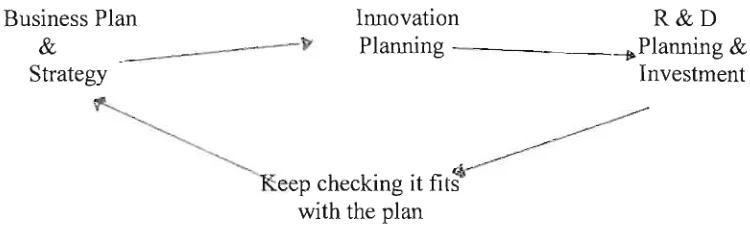
This is worked on to get a balanced portfolio of spend - like building blocks getting the
The need is for a good Business Plan along with R&D Plan.
Figure 1.1 Fitting Together
Innovation R&D
Business Plan &
Strategy
__
---iI"
Planning - - -_ _ _ ~Planning & Investmenteep checking it
fits
~
with the plan
The investment has to be put in fIrst and a balance of short to longer term projects are
included but the need is for more shorter term, as the longer term projects involve large
time/value of money costs, the present value of money vs future value of likely return, and are
therefore higher risk.
There are 350 staff, including over 100 world-class scientists, employed at Fonterra
Innovation, the research hub in Palmerston North, as well as smaller centres in Australia,
Malaysia, Germany and America. The smaller labs develop new products for the markets
they are situated in, allowing innovation to be tailored to the needs of customers within these
markets, whilst most of the fundamental research is carried out in New Zealand. The research
is split into Manufacturing, which is involved with fInding ways to lower the costs involved
in the manufacture or product, and Brands Innovation and Ingredients which are involved in
developing product to make profit through value add. Some recent innovations to come out
of Palmerston North include a technique to condense fresh milk without affecting quality
Mozzarella cheese for pizzas, a process which usually takes three months to manufacture, in
eight hours; and an award winning reduced-salt Cheddar cheese which won the International
Dairy Federation Best New Cheese award - a cheese for health conscious consumers who
want lower salt but do not want to compromise on taste. Also a medical ice-cream, named
Recharge, has been developed along with the University of Auckland, which has shown
potential to combat some of the side effects of Chemotherapy treatment.
There have been 300 new product registrations in the last year from Innovations, with 45 in
December alone.
Research expenses are put to a Marketing and Innovations balance sheet within each business
unit but then consolidated for the figure of R&D investment which is given in a quarterly
report to the Executive Team to give visibility of the return of the companies R&D
investment, which gives comfort that this spend is well monitored.
Vialactia Biosciences is a biotechnology company operating as a fully-owned subsidiary of
Fonterra. Their goals are to find and commercialise methods of selection of genes which are
important to the dairy industry including those affecting pasture grasses, milk composition
and production and animal health. This adds value to shareholders by mixing Fonterra's
knowledge of markets and farmers' on farm practices with Vialactia's in-house research and
alliances with other scientific researchers. This is of interest to show that investment in
animal and crop genomics will improve production and efficiency by better selection of cows
and grasses improving future production which will be vital to keep up with world population
growth and the need to feed this population in the future. The funding for this in included in
Fonterra also belongs to a network called Innovation Exchange where Intellectual Property (I P) is disclosed with potential innovation partners to find new products and technologies faster. This is known as Open Innovation, the sharing of information with others which can give opportunities to obtain innovation from many different sources, not normally considered or available, and to partner with different companies to find innovation for the betterment of both.
One of the issues which would arise if more money was put to R&D is that there is a lack of food scientists coming through the system to undertake research. To help ensure that there are future generations of scientists, the company is the major sponsor of the Sciences
Roadshow that visits schools around the country. Fonterra sponsors a number of science and technology fairs nationwide, takes on undergraduates on a summer programme every year and has science graduates in the Fonterra Graduate Programme. Historically scientists have been better paid overseas so we lose many of New Zealand's prospective scientists this way. Conversely bringing in scientists from overseas is expensive because we need to offer the high salaries commanded in other countries to attract the best people. Also although in New Zealand F onterra' s innovation work is well known, it is not a company immediately
recognised overseas so we may not attract the top people which is what we need to continue to flourish and grow. So the question must be asked whether it is advisable to pay top salaries to keep people working in New Zealand, which would take more R&D money.
research" (research without a specific target or aim) and because of this, innovative
oppOliunities may be lost. There is a very fine line in getting this balance right.
To better explain the issue of plant needed for process and the expenses involved with these,
the following example is used:
It takes 10,000 litres of milk to get I gram of lactoferrin. Only 100 tonnes of lactoferrin, a
protein of milk, is made worldwide annually. It is believed by scientists to have
immune-enhancing and anti~cancer properties. The price of it is a closely guarded secret but thought
to be up to $1,000 a kilo.
Fonterra is only ol1wf six big lactoferrin processors, having built a $15 million factory at
Hautapu, in the Waikato, six years ago. Most of the lactoferrin is now sold as an ingredient
for infant formula and it has flat line sales at present but new scientific discoveries for its use
could trigger a wave of demand to push up production. That trigger could be ReCharge
ice-cream mentioned above. Trials for ReCharge are being carried out in New Zealand hospitals
by Cancer Trials New Zealand to see if it works on humans as well as it has worked in animal
studies. Trials in animals showed a protective effect on the intestine preventing diarrhoea, a
side effect of chemotherapy treatment. These trials are about to go overseas, probably to the
U.K. and U.S., to get population scales needed to convince regulators in other countries that
the product works as claimed. F onterra has spent $2 million getting trials to this stage and
will n6ed a partner for overseas trials as they are very expensive to run. The potential
revenues are unknown if the trials are successful, but what works in animals does not always
translate to humans. It comes down to how potent the ReCharge works out to be. Does it
prevent anaemia or limit anaemia by preventing diarrhoea or limiting diarrhoea? If the trials
a need for massive capital outlay to build enough plant to make all required, and is that ~ I ;, ..
available?
All this goes to show how uncertain the world of research is.
Part Two
What Do Shareholders Think About The Amount Spent?
Are the Shareholders of the company happy with the amount spent on Research & Development or would they want less or more is a question that needs answering.
They have levies taken for Dairy NZ at 0.036c/kg milk solids which is 0.5%/kg at $6.10 but this is soon to be reviewed with the aim of going up. Also there is a 2% disease levy on stock killed and cattle meat levy of 0.5% per head. All of these are for industry good, which
includes R&D, and with 1 % of turnover of their co-operative going to R&D also, would this all be seen as enough?
To understand this, members of Fonterras Shareholders Council were asked the following:-As a Shareholder in Fonterra, do you think that 1 % or less of turnover spent on Research & Development is
a) too much and should be less b) enough and happy with this
c) not enough and would be happy with more
and were there any other comments they wanted to make.
Figure 2.0 Survey Results
The results of those who responded are as
follows:-Don't Know 1
Survey of Shareholders Councillors Too Much
o
Enough 5
Though this is a small amount surveyed Council are a good cross-section of the
Shareholder base, represent shareholders from the whole country and have an
informed view having visited Innovations Centre this year. This suggests that the
Shareholders are happy with the amount being spent, but more were keen to see a
larger amount being spent as long as the benefits of the additional spending were seen
and translated into additional profits for the company.
Some general comments
-• One comment was the amount of money spent on R&D adds little to the bottom line
of payout - advertising and promotion spend could add more
• If the company wants to be leading edge and value add/profit driven and we need to
increase our human capability to do this, then more spend will be needed
• Happy with this given that the Board has authorized spend to the level on
recommendations from Management about cost/benefit considerations coupled with
financial position and overall strategy
• We need to take a world-leading position with our customers. If the returns are there
let's step it up, but are they?
• While the research spend has discovered many revenue earning opportunities, if this
was doubled to 2% in line with other company research spend, then more potential
"winners" could be developed
II Yes but would need to see more accountability of this
• Some concerns around there not being enough time for blue sky research and
Part Three
How Much Are Other Like Companies Spending?
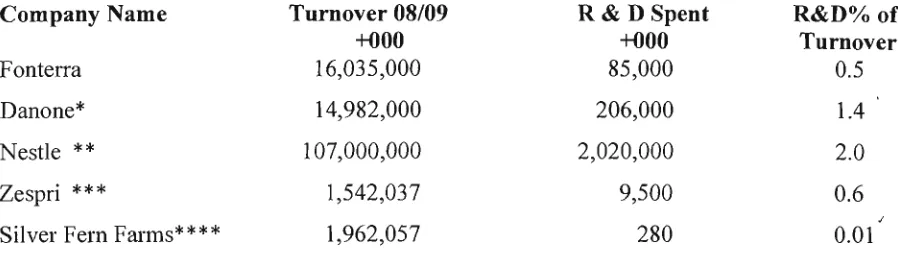
It is useful to look at similar companies to see what they are spending for comparison. With the volatility of the milk price and the exchange rate, Fonterra's total turnover can fluctuate greatly year on year. Because of this, the percentage amount spent on R&D can vary, for example in 2009 with the spike in the milk price the spend on R&D at $85 million was nearer 0.5%. Historically though Fonterra's spend is around 1% of turnover. These percentages work as a useful tool to benchmark against other companies.
Figure 3.0 Research and Development Percentages Against Turnover
Company Name Turnover 08/09 R&D Spent R&D%of
+000 +000 Turnover
Fonterra 16,035,000 85,000 0.5
Danone* 14,982,000 206,000 1.4
Nestle ** 107,000,000 2,020,000 2.0
Zespri *** 1,542,037 9,500 0.6
/
Silver Fern Farms**** 1,962,057 280 0.01
*Danone is the world number one seller, in volume, of fresh dairy products, number two in bottled water and baby nutrition and the European leader in medical nutrition.
**Nestle is the largest consumer packaged goods company in the world. Its product range includes baby food, coffee, dairy products, confectionary, breakfast cereals, bottled water, ice"cream, performance and healthcare nutrition and pet foods.
***Zespri is a New Zealand company marketing Kiwifruit worldwide.
****Silver Fern Farms is a New Zealand company that processes and markets lamb, beef and
venison to the world.
These two were used to show Fonterra spend against other New Zealand companies.
ArIa, Parmalat and Friesland Campina are dairy producers who process some of their milk in
to their own products as Fonterra do. When talking to Koert Liekelema, General Manager of
Fonterra Europe, he explained that Fonterra's spend on R&D is around the same percentage
as these other companies.
Given that Danone and Nestle are food companies, once could argue that if looked at on a like
basis 2/3rds of Fonterra products are commodity milk powder sold to the likes of these
companies who spend their money on its R&D. Therefore the remaining value added
portion gets three times as much so is then comparable to these larger companies.
The Ministry of Research Science and Technology (MORST) run a survey every two years on
"Research and Development in New Zealand" looking at R&D investment within New
Zealand and against the "Organisation for Economic Co-Operation & Development" (OECD)
a group of 33 developed countries. The statistics for this are that New Zealand spends about
1.2% of Gross Domestic Product (GDP) on R&D against the OECD of2.2% which would
add to the validity ofthe above figures. It is to be noted that the government funding is
higher than the OECD average while business expenditure is significantly lower"';
This being the case the R&D spend is alongside the New Zealand average but is almost half
on primary production which tends to cost less than other types that some OECD countries make, such as automotive or technology driven e.g.Aerospace, should be a factor in this.
The recently announced Primary Growth Partnership (PGP) is a government/industry
initiative that invests in significant programmes of research and innovation to boost economic
growth and sustainability of New Zealand's primary forest and food sectors. More than half
the funding of this seven year programme, totaling $170 million, will come from primary
industry, with $29 million coming from Dairy NZ, $47 million coming from Fonterra and $9
million from other P.G.P. partners which are Synlait, Landcorp, LIC, Young Farmers,
Agricultural Services and Zespri.
"This major investment will create the biggest change in decades in research training and
knowledge transfer to increase the innovation on both sides of the farm gate, all of which can
be leveraged to benefit New Zealand wider primary industries" Quote from Dr Tim Mackie
DairyNZCEO
Whether this will make any difference to the above percentages remains to be seen but it is a
real boost to on-farm productivity and sustainability as well as post-farm gate research in
areas of nutrition, food structure and manufacturing and supply chain processes which the
Part Four
Conclusion
Management of Fonterra are happy at present with the amount being spent on R&D, though going forward feel it may not be enough and will need to spend more.
The number of other countries beginning to produce milk powder at a lower cost than New Zealand can means that Fonterra will need to keep finding ways to keep the cost of
production down whilst finding more innovative ways to add value to keep profits up. This will mean that at least the same, and probably more, will need to be spent on R&D in the future. It would seem that shareholders would be happy with this though, as the return on investment figures are commercially sensitive, they have to trust that the Management and Board of Directors are certain they are getting a good return.
It would seem that because some other companies are spending more than F onterra, there is a risk that Fonterra could be left behind in the innovation race, therefore a close eye must be kept on this by the company.
References
Part One
i)
ii) As above
iii) Fast Innovation - Michael George, James Works and Kimberly Watson-Hill McCraw-Hill 2005 chapter 5 Page 93
iiii) Dominion Post Article Fonterra trials benefit oflactoferrin by Andrea Fox 4/11/2010
v) Personal conversation with Andrew Ferrier
Part Three
i) Fonterra Annual Results 200812009 Page 50 ii) \YW\\. Danone.co111.:en.~comJ)(my·ol.l(COrnpaIlY
iii) \\ .. \\'\\. \\' i k j peel ia .(m~. \\-ik i .11\:'St le.co rn
iiii) Zespri Annual Report 2008/2009 Page 64
v) Silver Fern Farms Annual Report 200812009 Page 76
vi) Minitry Of Research and Technology. Research and Development in New Zealand - A Decade in Reveiw Page 16
Part Four
i) Personal conversations held with Andres Ferrier CEO, Jonathon Mason CFO, Koert Liekelema General Manager Fonterra Strategy Europe,Jeremy Hill Group Director of Technology. All said they were happy with the amount being spent at present
Further Readings
Research and Development in New Zealand - A Decade in Review. A report by the Ministry of Research and Technology (2006)
The Future of Foods - Riddet Institute annual report (2009)
Statistics New Zealand Research and Development Survey (2008)