Information & Communication Technology for Development
tism.msu.edu/ict4d
An Analysis of e-Learning
Impacts & Best Practices in
Developing Countries
With Reference to Secondary School Education in Tanzania
Jennifer Olson
urt deMaagd
1,
Eric Tarkleson
3, Julie Sinclair
2, Suengyun Yook
1and
Rhonda Egidio
21
, Joseph Codde
2, K
October 2011
1The College of Communication Arts and Sciences, ng 2The College of Education, 3The College of Engineering The ICT4D Program, 209 Communication Arts & Sciences BuildiAn Analysis of e-Learning Impacts & Best Practices
in Developing Countries
With Reference to Secondary School Education in Tanzania
Jennifer Olson, Joseph Codde, Kurt deMaagd,
Eric Tarkelson, Julie Sinclair, Suengyun Yook and Rhonda Egidio
Michigan State University
October 2011
The ICT4D Program
209 Communication Arts & Sciences Building Michigan State University. East Lansing, MI 48824 USA
http://tism.msu.edu/ict4d +1 517.355.8372
The Information & Communications Technology for Development (ICT4D) Program at Michigan State University (MSU) conducts research, teaching and outreach related to the role of ICTs in fostering economic, social and environmental change. Since 2008, it has been partnering with the University of Dodoma and the University of Dar es Salaam to build a sustainable broadband network and solar powered computer systems in schools in Tanzania. It is also conducting research and outreach programs in India, Malawi and other African countries, and in underserved communities in rural and urban Michigan. The ICT4D program offers undergraduate and graduate level courses, an undergraduate specialization, a study abroad program in Tanzania, and research and outreach opportunities in engineering and telecommunications. http://tism.msu.edu/ict4d
The ICT4D program gratefully acknowledges the support of the Tanzania Education Trust/ MasterCard Foundation, the Bill & Melinda Gates Foundation, IDRC, the National Science Foundation, the Dow Chemical Company, the Lenovo Corporation and MSU.
The College of Education at MSU offers several graduate programs focused on the use of technology in education, including the Educational Technology Certificate Program, the Teacher Endorsement Program, a Masters of Arts in Educational Technology, and a PhD program in Educational
Psychology and Educational Technology. These prepare teachers, administrators and other educational professionals for the use of technologies to support teaching and learning drawing on current theories of learning and development. http://edutech.msu.edu/
Table of Contents
Table of Contents ... i
Executive Summary ... iii
I. Introduction ...1
II. E-Learning solutions...2
A. Pedagogical principles and e-learning ...2
1.Conceptualizing technology in relation to teaching...2
2.ICT as a tool to foster learning ...3
B. e-Learning Solutions ...5
1.Approaches to using technologies in e-learning classrooms ...5
2.e-Learning technologies and configurations in schools...6
C. Transition towards e-learning in developing countries...9
1.Growth in Information and Communications Technologies (ICT) ...9
2.Transitions in educational systems ...10
3.Physical factors affecting e-learning technologies in schools ...12
III. The impact of e-learning ...14
A. Educational impacts of e-learning ...14
1.Impact of e-learning on students...15
2.Impact of e-learning technologies on the teacher and classroom ...17
B. Economic benefits of e-learning ...19
1.The economic benefits of education ...20
2.The economic benefits of a high tech workforce ...21
3.Assessment of the benefits of e-learning ...23
C. Societal impacts ...24
1.The rural-urban divide ...26
2.Culture and language ...27
3.Gender and e-learning...29
IV. Best practices ...31
A. Case studies...31 1.Algeria...31 2.Lebanon...33 3.Pakistan ...34 4.Chile...35 5.Malaysia...35 6.South Africa ...35
B. Key components of successful programs...37
1.Teacher training and professional development ...37
2.Standards – What teachers need to know and be able to do ...38
3.Community of practice – Connecting the educational community ...39
References ...42
Annexes 1: Internet availability by continent. ...48
2: Enabling and constraining features of ICT in the Tanzanian educational system ... 49
3.Tanzaniasecondary school education graphs ...50
4: International e-learning actors in developing countries...51
5. Technology standards for teachers ...53
Tables 1. Traditional and new learning environments ...5
Executive Summary
Objectives of the Study
This study has been conducted under a contract with the Tanzanian Education Trust (prime) and the MasterCard Foundation (sponsor) to provide information regarding the potential of
e-learning to impact e-learning, society and the economy in developing countries with a particular reference to secondary schools in Tanzania. This paper also discusses e-learning solutions and challenges, and presents case studies and best practices of e-learning programs.
Approach
This study consists of a review of studies undertaken over the past fifteen years on education, e-learning and Information and Communication Technologies (ICT) in Africa, in other developing countries and, to provide additional context, in the U.S. In the study, we seek to provide a global and regional context to address the above objectives. Where ever possible, publications
presenting results of empirical research are consulted. Research documenting the impact of e-learning in developing countries is, however, in its infancy due to the newness of programs. The study is informed by the authors’ over ten years experience implementing e-learning programs and conducting teaching training programs in East and North Africa, and in the Middle East. This study presents aspects related to learning solutions including the educational context of e-learning and pedagogical principles which inform e-e-learning approaches, examples of e-e-learning approaches and technologies, and the rapid changes being experienced in educational systems. It then provides a summary of what is known about the impacts of e-learning on education, the economy and society. Issues such as gender, the impact of e-learning on the workforce, and impacts on educational attainment are discussed. Finally, case studies and key best practices are provided.
Main Findings
Improving secondary education in Africa and other developing countries had until recently been overshadowed by programs focusing on national economic and infrastructure development. Recently, however, important investments by governments and donors are being made to expand the number of schools and student enrollment including in secondary education. In conjunction with this, the modernization of secondary education to produce a workforce capable of leading countries into globalized, knowledge-based economies has become a key goal. Many new policies and projects have begun to introduce information and communications technologies and related teaching approaches, known collectively as electronic or e-learning, into schools.
The expectations for these projects to affect student achievement and national economic development are often high. They are being introduced into educational systems that are experiencing critical challenges such as poor infrastructure, a lack of teachers and learning material, and poorly prepared students. The key question is how e-learning approaches can help address these challenges, and provide students a leap forward in their school learning and in their future employment opportunities. e-Learning programs in Africa and in other developing
countries are still often small, experiential pilot projects with little documented history of their successes and impacts. Nevertheless, a body of literature is emerging that analyzes e-learning programs.
Integrating e-learning into existing educational systems
Educational systems are thus looking to e-learning programs to help address these challenges and to substantially improve the quality and content of their education. Integrating e-learning into existing secondary educational system can, however, be a major challenge. Secondary
educational systems in developing countries are undergoing rapid change, particularly an
increase in the number of schools and rise of student enrollment related to the recent emphasis of universal primary education. A consequence of this development, being experienced in Tanzania and elsewhere, is a significant shortfall in the number of teachers, particularly subject-specialty teachers, a declining student/teacher ratio, a lack of learning materials, and declining or
stagnating test scores. Infusing technology into this context could be powerful method to partially address these shortfalls (see below).
Investment in e-learning is, however, not an alternative to investment in education generally; the two should be seen as being complementary. Integrating e-learning programs into existing educational systems can promote, however, a transformation. Implementing a comprehensive e-learning program would mean changes to the curriculum, infrastructure, teacher professional development, textbooks, and exams. A major benefit of integrating e-learning into governmental educational systems would be, however, a long-term commitment to growing and maintaining the program, with fewer e-learning initiatives ending when donor funding stops.
Many studies of e-learning programs have concluded that the key to ensuring successful outcomes is to blend more traditional classroom approaches with those that use technology. e-Learning approaches should be treated as a powerful tool that teachers can use, but teachers need to learn how student learning changes with e-learning, and how to alter their teaching
methodologies with pedagogical approaches that take advantage of the opportunities afforded by e-learning. A blended approach mixing face-to-face classroom methods with
technology-mediated activities seems to provide the highest learning outcomes. In African countries where secondary teachers have little prior experience with computers or similar technologies, all this can be a significant undertaking. In-service and pre-service e-learning teacher training programs have been designed and tested, however, with these goals in mind.
The potential of e-learning
e-Learning is a broad term that encompasses many teaching approaches, types of technologies and administrative practices. A challenge in analyzing e-learning is that the technologies and their educational applications are developing extremely rapidly. An additional challenge is that its newness and the excitement around their utility are leading to many suggestions for how to use technologies in and outside of the classroom. Nevertheless, the paper summarizes some e-learning solutions that have been applied and tested in developing countries. Some of the important potential contributions of e-learning programs in such educational systems include:
1. Addresses the shortage of teachers, especially science and other specialty teachers. It can do this by providing high quality teaching materials, such as videos, interactive software or information from a “cloud” on the Internet or a local computer. In a distant classroom or video conferencing approach, the number of students who receive live instruction from teachers in specialty subjects can be much larger.
2. Addresses the shortage of learning material such as textbooks for students. The material could be made available on hand-held devices such as e-readers or mobile phones. Interactive features such as quizzes or games could improve the level of learning and understanding.
3. Improves the quality of education by providing improved informational content and learning approaches. Interactive, communicative e-learning may promote the
development of skills in students (so called “21st Century Skills”) such as critical thinking and problem solving, communication, collaboration and creativity.
4. Provides students information and communications technology skills. The graduates will be better equipped to contribute to the knowledge-centered globalized economy of their counties.
The impact of e-learning
The potential of e-learning to significantly affect education in developing countries is thus significant. Identifying the actual impact that e-learning programs have had on students, schools and their countries is, however, difficult. Because of the newness and diversity of the programs and the complexity of factors affecting outcome, measuring e-learning’s impact is an emerging science. Nevertheless, some direct and indirect outcomes can be discerned. They are presented below by e-learning’s impacts on students, teaching, the economy and lastly on society.
1. The impact of e-learning on student achievement is complex and mediated by a range of other factors affecting achievement. It is clear, however, that:
a. Their effectiveness is closely related to how the technology is used as an
educational tool. Students learn best with e-learning when interactively engaged in the content. Using technology can motivate students, particularly under-achieving students, to learn.
b. Teachers report that tutorials in subjects such as math and science significantly improve student performance. Word processing software improves writing skills. c. Providing technology on its own has little impact on achievement. Substantial
effort must be put into infrastructure, teacher training, curriculum development, assessment reform, and formative evaluation.
2. The effect of e-learning on teachers and teaching parallels that of students. It includes: a. The pedagogy often shifts from a teacher - centered classroom environment to a
more learner - centered environment, allowing more effective use of technologies. b. Teachers report that they gain confidence, self-esteem and renewed motivation in
e-learning environments.
c. There are significant barriers to teachers in developing countries that need to be overcome including their lack of ICT skills and ICT-related pedagogical skills.
3. The economic impact of learning can be examined by first, identifying the impact of e-learning and improvements in education on the workforce and employment, and second, the effect of a high tech workforce on the national economy.
a. An improvement in education positively affects economic growth, both in terms of an increase in GDP and an increase in income for workers. This is clear in both developed and developing countries.
b. As technology and knowledge spillovers are the foundations of modern economic growth, it is important to ensure that the workforce has the skills to meet the need of these 21st Century jobs.
c. The average increase in annual income for each additional year of schooling, especially secondary education, for an individual is 10%. The affect is stronger in developing countries than in developed countries.
4. The impact on society of e-learning programs is similarly difficult to separate out from the multitude of other factors affecting society. The potential impacts of e-learning— providing underserved-groups access to quality education, for example, can be important. What is known about the impacts in developing countries include:
a. The “digital divide” between those people and countries with access to digital technologies and those without, is narrowing as information and communications technologies become increasingly available and less expensive. African countries are catching up fast, but from a lower base than other developing countries. Some of the widest digital divides are within countries: between rural and urban centers, and between rich and poor communities. This is unfortunately parallel to statistics of student enrollment in secondary schools. e-Learning has the potential to
address this gap by bringing quality education to rural and other underserved schools, but poor infrastructure and other challenges are greater in those areas than in the better served urban areas, and experience to date is that these areas are underserved with e-learning as well. e-Learning programs that overcome these challenges thus have the potential to have large impacts on learning.
b. e-Learning technologies could potentially play an important role in reducing the gap in access to education and in achievement by girls and other underserved communities in developing countries. Currently, the gap in access to education of girls and underserved students is mirrored by a gap of them using the Internet and other ICT technologies, partly due to societal norms and partly due to their economic situation. Introducing e-learning technologies into schools can assist girl and other underserved students improve their ability to participate and thrive in schools. Governments and international organizations are designing e-learning programs to deliberately address the gender gap.
c. Language proficiency can be an impediment for students and teachers to take full advantage of e-learning’s benefits. Off-the-shelf educational software and most websites are in English or another global language, and students in Tanzania and
elsewhere whose main language is not a global language may need to become proficient a second (or third) language. The ubiquity of English on the Internet has been found to be a strong motivator for young people in many countries to learn English. In schools where a global language is not the language of instruction, however, it is important to customize educational software. d. The prevailing pedagogical culture in countries mediates how e-learning is
adopted. In Eastern countries, for example, e-learning approaches run against educators’ preferences for expositive teaching and authoritative delivery, in which case computers are simply used to deliver content. The potential transformative role of e-learning to develop 21st century skills in many countries may require, thus, integrating e-learning into the system from curriculum development to teacher professional development.
Taking advantage of e-learning’s potential
Despite the numerous e-learning models and technologies available, a few key, common
elements in successful e-learning programs have emerged. Case studies and the literature provide clues to what has and has not been successful. For example, countries that successfully integrated a sustainable e-learning have executed a multi-level program from the national policy level to the classroom that included developing e-learning related curriculum, teacher standards, and
infrastructure.
Case studies and the authors’ experience indicate that there are some particular activities in e-learning programs that are remarkably successful and encourage educators to sustain and expand their use of e-learning. The activities that have been found to work well include:
1) the full integration of e-learning into the curriculum, textbooks and tests 2) a strong program of training teachers to both use and teach with technologies, 3) the establishment of a pedagogical foundation for e-learning to assist teachers in
integrating it into their teaching
4) providing ongoing support for teachers 5) educators joining a community of practice.
Concluding remarks
The goal of improving the educational quality and economic impact of secondary school education is coming to the front in many developing countries as their efforts to expand the number of schools and students are bearing fruit. Improving quality and gaining impact is, however, perhaps more difficult as it may require a transformation of the educational system itself. Many countries in Africa and elsewhere are turning to e-learning programs to assist with this transformation, and to fill some immediate gaps in their schools such as a lack of teachers and learning materials.
This report represents a collation of informational resources that document the potential of e-learning in developing countries, factors affecting its impact on education, the economy and society, and what experience has shown to lead to a successful integration of e-learning into educational systems. It discusses the non-insubstantial challenges related to introducing
e-learning into classrooms in developing countries, and issues related to change management in the institutions. Despite the complexities, however, the authors feel that enough has been learned from a pedagogical, technical and socioeconomic perspective to be able to design a successful learning program that methodically addresses the challenges, and that provides a platform for e-learning’s transformative effect.
I. Introduction
Improved, modern education in developing countries provides the promise of meaningful employment for graduates, movement towards a knowledge-based economy, and rapid national economic growth. For this reason, parents, governments and donors are investing heavily in education. This building of the physical infrastructure as well as the knowledge infrastructure base such as teacher training, teaching materials and Internet facilities are necessary before the full benefits of the educational investments can be realized. Meanwhile, African countries lag behind other developing countries in educational attainment and other aspects of the human capital development required in our knowledge-based, global economy. Secondary school enrolment rates are, for example, 50 percentage points below other developing country averages. New programs in Africa promoting universal primary school enrollment are leading to increased demand for secondary schools, and a rapid expansion of secondary schools and students. The time to equip these secondary school students and schools with a strong knowledge infrastructure base for a knowledge-based economy is thus now.
Indeed, Africa has recently been leapfrogging communications technologies at a level and pace unlike any other continent. This rapid adoption may be partly responsible for the “African renaissance” and recent rise in economic growth rates. The rapid rate of adoption of cell phone technology among even rural and poor regions, for example, has been a surprise. It is providing new prospects for rural and other disadvantaged areas and people.
This phenomenon brings hope to the possibility of schools being able to use new technologies to leapfrog over many of their problems such as a shortage of teachers, school books and low achievement levels, and to train their students in technologies and to have “21st century skills” such as creative thinking and problem solving. e-Learning may assist with this transformation. The term “e-learning” originates from electronically-assisted learning, or learning with and through the use of technologies. Other commonly used terms include online learning, computer-assisted learning or ICT in education. e-Learning incorporates both content (curriculum) and instruction (pedagogy). e-Learning has become a term representing a new model of education that may incorporate an “ecosystem” of networked communities and a variety of learning resources.1 In education, it involves revised curriculum, infrastructure,
teacher professional development, textbooks, and exams (e.g., Uden, Wangsa & Damiani, 2007). This paper discusses these issues in developing countries with a focus on Africa. It provides examples with information from Tanzania, a country that is at the cusp of transforming its secondary school educational system including incorporating e-learning. The situation of Tanzania reflects many countries in Africa and elsewhere that are changing rapidly, and where the government, citizens and international institutions see opportunities to help shape its future in exciting directions.
This report provides a summary of e-learning solutions available, and discusses the potential and challenges of teaching and learning with these approaches in a developing country context. It then summarizes what is known about the effect of e-learning on education, economics, and
1
“A digital ecosystem is a self-organizing digital infrastructure aimed at creating a digital environment for networked organizations that supports the cooperation, the knowledge sharing, the development of open and
society. Finally, it provides some case studies and summarizes what has been found to be key components of successful programs.
II. E-Learning Solutions
A. Pedagogical Principles and e-Learning
“Research suggests that simply putting computers into schools is not enough to impact student learning. That said, specific applications of ICT can positively impact student knowledge, skills and attitudes, as well as teaching practices, school innovation, and community services (pg. 1, Kozma, 2005).”
The concept of e-learning integration into an educational system begins with the teacher and the ways in which teachers teach. This section thus starts with pedagogy – the art and science of teaching children. The academic approach to this subject discusses the theoretical perspectives of behaviorism versus constructivism and, for the purposes of this paper, how they apply to a technological secondary school classroom. A simplistic description of the view is that of “chalk and talk” and the teacher as the ultimate authority and purveyor of knowledge – the “sage on the stage”. This compares to the constructivist model or method where students work collaboratively and socially construct new knowledge. In a technological classroom there will most likely be elements of both perspectives blended in a way that makes teaching comfortable for the teacher and takes advantage of new tools and opportunities.
The challenge for many if not most teachers, particularly in developing countries, is changing their practice of teaching in ways that accommodate the use of technology. Blending how they have traditionally practiced teaching with the use of technology beings to create e-learning solutions. In e-learning, technology is simply a tool that educators may use in a number of ways within the new environment that can impact student learning and outcomes.
A teacher deciding to use technology needs to consider how it may provide a solution to a particular problem of practice they have within their learning environment. An example of addressing a problem of practice could be the use of e-readers to address a lack of textbooks. Another could be how to help children understand “big ideas” or concepts in science education. A third could be helping students, working alone or in groups, to use computer simulations to manipulate the environment and immediately see the outcomes. Rather than just being told about a certain theory, they can experience the theory, which enhances their learning and enables them to retain the concepts for longer.
1. Conceptualizing Technology in Relation to Teaching
In this blending of technology, pedagogy, content and knowledge, a theoretical principle has evolved known as TPACK which reflects the intersection among three domains of teacher knowledge: content, pedagogy and technology (Mishra & Koehler, 2006, 2008)2. Research has shown that teachers can move from seeing content, pedagogy, and technology as independent
2
This conceptualization draws heavily on the work of MSU faculty Mishra and Koehler, for example, as published as the keynote chapter of the 2008 AACTE Handbook of Technological Pedagogical Content Knowledge for Educators.For additional resources on TPACK, see
domains of knowledge to recognizing the transformative potential of the interdependence among the three domains. In this framework, the starting point is an analysis of both the complexities of teaching and the nature of technology. The framework was developed as an extension of
Shulman’s influential conceptualization of pedagogical content knowledge. The
conceptualization highlights what good teachers know about how to teach a particular subject matter in addition to their knowledge of what to teach.
.
In considering the relationship between technologies, pedagogy, and content, it is important to explore how teaching and learning can change as the result of using a particular technology. For example, the use of inexpensive digital cameras or cell phones with integrated cameras can shape decisions about content and pedagogy. Students can use these cameras to build their own bridges between content within the school environment and their daily lives. Students can
explore the presence of geometric shapes in places that teachers would not have anticipated, thus creating their own applications of the ideas being taught in the classroom. Inevitably students will find new connections that teachers (and project designers) did not anticipate, connections that feed their natural curiosity and honor their contributions to the learning environment..
.
Communities of Practice. Experience suggests that teachers most readily adopt and adapt
technology when they join a community of practice under the guidance of mentors. This involves them in inquiry and problem solving, anticipating the complexities with which teachers and learners are faced and the need to enable teachers and students to respond flexibly and creatively. Participants learn about technologies when and only when they need these technologies to
complete their projects rather than being taught technologies in case they may someday have opportunity to use them.
A central strategy is thus to create communities of practice among educators. The importance of a grassroots approach has been repeatedly shown by research. It builds on collaboration and community building at all levels, and lowers the levels of resistance compared to when
authorities simply mandate ICT use. When teachers and other educators work within their peer groups, the rate of adoption is much higher.
Teacher Networking. Mobile or internet-based networks will provide a critical impetus for teachers and mentors to use the computers in a creative and thoughtful mode, to try new approaches, and to communicate their successes and challenges. These networks have the dual advantage of 1) promoting information exchange among teachers and mentors that is interactive and tailored to individuals' needs, and 2) stimulating the use of ICT by teachers for purposes that go beyond simple cookbook applications. Research indicates that teacher networking
significantly increases the interest in and use of new technology and other pedagogical approaches.
2. ICT as a Tool to Foster Learning
To foster learning through the use of technology, it is useful to examine the pedagogical principles behind teaching and learning with ICT. Technology is a powerful and effective tool, but if teachers use it only as a delivery vehicle, the outcomes will be less than its potential. The challenge is to make full use of technology so that it doesn’t become simply a substitute teacher. Indeed, instructional content can be embedded in the technology and then delivered to the
student with the assumption that if you deliver content the students will learn. But by blending the use of technology with teaching by the teacher, students have been shown to have much higher learning outcomes.
Technology should thus be used as an engager and facilitator of thinking and knowledge construction. Useful roles for technology to support effective pedagogy include (Jonassen, Peck, Wilson 1999):
• Technology as tools to support knowledge construction:
o For representing learners’ ideas, understandings, and beliefs
o For producing organized, multimedia knowledge bases by learners. • Support learning-by-constructing:
o For accessing needed information
o For comparing perspectives, beliefs, and world views. • Technology as context to support learning-by-doing:
o For representing and simulating meaningful real-world problems, situations and contexts
o For representing beliefs, perspectives, arguments, and stories of others for defining a safe, controllable problems space for student thinking.
• Technology as social medium to support learning by conversing:
o For collaboration with others
o For discussing, arguing, and building consensus among members of a community
o For supporting discourse among knowledge-building communities. • Technology as intellectual partner to support learning-by-reflecting:
o For helping learners to articulate and represent what they know for reflecting on what they have learned and how they came to know it
o For supporting learners’ internal negotiations and meaning making
o For constructing personal representations of meaning for supporting mindful thinking.
• Technology as information vehicles for exploring knowledge.
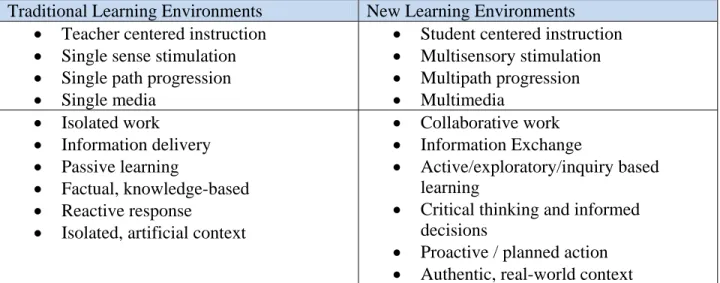
The US Department of Education (1998) developed a simple visual that has become standard of the basic changes that occur in a shift from traditional to e-learning (Table 1). These are the basics behind teaching students what has become known as 21st Century learning and innovation skills (critical thinking and problem solving, communication, collaboration and creativity) (Partnership for 21st Century Skills, 2009).
Table 1. Traditional and New Learning Environments. Source: DOE 1998. Traditional Learning Environments New Learning Environments
• Teacher centered instruction • Single sense stimulation • Single path progression • Single media
• Student centered instruction • Multisensory stimulation • Multipath progression • Multimedia • Isolated work • Information delivery • Passive learning • Factual, knowledge-based • Reactive response
• Isolated, artificial context
• Collaborative work • Information Exchange
• Active/exploratory/inquiry based learning
• Critical thinking and informed decisions
• Proactive / planned action • Authentic, real-world context
Considering the relationship between technology and pedagogy thus leads to understanding how teaching can change as the result of using a particular technology. As such, new
technologies encourage teachers to confront basic educational issues in new ways. The range of e-learning technologies and their uses are described in the following section.
B. e-Learning Solutions
1. Approaches to using Technologies in e-Learning Classrooms
e-Learning is a thus broad term that covers teaching, learning and the enabling educational environment. It can use a range of pedagogical approaches and electronically supported technologies. Some examples of using technologies in e-learning classrooms are below:
• One-to-Many (communication between the teacher and the class as a whole):
o Online classes. Content can include lecture notes, assignments, message boards, linked bibliographies of readings and websites, quizzes, and chats
o The viewing of TV shows, videos or other previously prepared material at a central location
o The teacher in a multi-media classroom projecting content using a projector or screen, or using an interactive whiteboard. The content can range from
PowerPoint slides, news broadcasts, interactive websites, the teacher drawing graphics, to educational software demonstrating a virtual chemistry experiment.
o Distant learning classroom or video-conferencing, in which a teacher is broadcast live to a single or to multiple remote classrooms. The distant rooms can
communicate to the teacher and others through text or audio chatting, or video. • One-to-One (student and teacher communicate)
o Teachers monitors individual student activity and progress using a feedback program
• One-Alone (student alone with course content, self-paced)
o E-reading devices with textbook or other reading material
o Interactive lessons, exercises, quizzes, games or other software that a student accesses through a computer, mobile phone, tablet or other. Applications may predict and suggest content based on student behavior and progress.
o Student conducted research, writing and other homework preparation on a laptop or other computer.
• Many-to-Many (students communicate among themselves)
o Students communicate in a class discussion group, share information or communicate with people outside the classroom
o Student group presentations. • Teacher Training
o Teachers access training materials, exercises and take tests using online or hosted material and software
o Teachers form a “community of practice” to share experiences, get ideas in a social media type of environment.
• School Administration
o Learning management system
o Computer aided assessments (tests, grades).
This list of possible approaches using technology in learning and teaching must, again, be placed into an educational context (Koory, 2003). There are no conclusive research results for the US much less developing countries indicating that one type of e-learning approach is more effective than another, or that strictly online learning is more effective than strictly face-to-face learning. However, recent large, meta-analyses have found that learning outcomes are somewhat improved with a “blend” or hybrid of face-to-face learning with a teacher combined with
technology-mediated learning (e.g., Means et al., 2010; Roblyer and Doering, 2009). A combination of approaches and content type is best. Pedagogical principles also impact the effectiveness of e-learning especially for K-12 students—e-learning is enhanced by giving students control of their interactions with the media, by embedding feedback mechanisms. When the software triggers student activity such as reflection or self-monitoring, there is a positive impact on learning. This holds true when students are working as individuals but not necessarily when in groups (Means et al., 2010).
Each of the approaches described above could be accomplished using various e-learning settings in schools, and using different technologies. Below is a summary of these school settings, followed by a brief description of technologies available.
2. e-Learning Technologies and Configurations in Schools
There are many e-learning settings and technologies available to use in schools, each with their own advantages and applications. Often the best solution is a combination of technologies depending on the particular need and learning environment.
Multimedia Classroom
In a multi-media classroom, educational content is delivered to students in a one-to-many approach. This is cost efficient per pupil, and can provide a large amount of educational resources to students. Classrooms would be equipped with a projector, screen (or large LCD), speakers and a classroom computer. The teacher could display various types of content that is housed either on the classroom computer or on the teacher’s laptop or other device. The teacher would be able to adapt and project various content (e.g., videos, Powerpoint slides, augmented reality, multimedia presentations, the teacher drawing a graph, etc.). A connected classroom would have wireless or wired communications to a “cloud” of resources. The teacher would thus have access to a wide range of content from the library on the cloud. The computer housing the content could be locally based at the school (which would obviate the need for inter-school communications, and be reliable), at a district or national educational headquarters, or elsewhere.
Connected multi-media classrooms would permit distant classroom teaching, in which a teacher in one school or from a studio could deliver live, interactive lectures to classrooms in other schools. The distant classrooms would need to be outfitted with video cameras and microphones, as well as projectors and speakers, to communicate with the distant teacher. Computer Lab
A computer lab is among the most recognizable form of e-learning technologies. A computer lab usually consists of many single personal computer stations. This is a common arrangement found in schools throughout the world. There are many educational software packages available that could be installed for student use. Separate stations permit individual students to move at their own pace through material. Teachers can also lead students or student teams through guided exercises, with each following on their own station. Free computer time itself is a valuable educational resource.
Installing separate computers is an easy to set up, since it is simply single stations behaving independently. Computer labs can be, however, more expensive per student due to the individual computers and software licenses. They may also have higher power consumption demands, depending on the computer or device, necessitating low-cost power solutions.
Multi-seat computing consists of using one powerful personal computer with extra video cards to support up to eight independent “seats” (each with its own monitor, keyboard and mouse running separately). They can be put in a computer lab for students or teachers to use, or in classrooms. There are several commercially available multi-seat operating system software options including by Microsoft and Linux. This system has the advantage of using much less power than other options. It is usually the least expensive per user as well.
Single Station, Personal Computers
A variety of types of single station devices are available.
1) Personal computer (PC). A PC is a common approach for using computers in homes and offices. It consists minimally of a computer, one or two monitors, a keyboard and mouse. Each computer has its own operating system and software programs. From a setup and maintenance standpoint this type of system is advantageous. It is easy to maintain and does not generally require a specially trained computer technician to fix most hardware
and software problems. However, if each student were to have a computer, this would be among the more costly options to implement, particularly in rural areas reliant on solar power. This would be useful particularly for teacher stations or single stations in the back of classrooms.
2) Micro Computer. A microcomputer is similar to a standard single station except that is uses a small form factor case with a generally slower processor. Power consumption can be much lower than a single station, and thus suitable when power is limited. The
computers are, however, difficult to repair and may be prone to theft and overheating; the lifespan of these devices is not yet known. Software maintenance is similar to a standard single station.
3) Laptop or notebook. Laptops and notebooks are among the easiest educational solution to set up. They usually come with software preinstalled and only a power outlet is needed to begin using the system. The power consumption is low compared to a personal computer. Hardware maintenance can be difficult, but software maintenance is standard. One of the disadvantages is product lifespan; they are easy to steal and are prone to accidents (a spill on the keyboard can easily destroy it; new rugged laptops reduce this risk). New design and battery technologies are lengthening battery life in some machines. Laptops may be an excellent solution for teachers. Teachers could bring a laptop to work from home, and then connect it to the classroom projector.
Small, Personal Devices
Small, personal devices such as tablets, smart phones and e-readers are similar in that they are all relatively new technologies. They are rapidly gaining popularity due to their declining price, large number of web-based software applications, powerful graphics, and enjoyment of use. Educational uses could include listening to audio lessons or audio books, gaming, watching videos, and reading. Writing is more difficult if the device doesn’t have a keyboard. Schools and teachers can develop teaching material applications for mobile devices using existing software. An example of how rapidly this is occurring is that over 10,000 pieces of content (learning materials) for U.S. schools are already available from one education company (Study by App). As discussed in the ICT section above, penetration of mobile cellular Internet is rising rapidly in Africa and other developing countries because of the availability and relatively low cost of Internet access, text and voice through cellular networks, especially compared to broadband Internet. Because of this, the World Bank, USAID and other donors are actively investigating the potential role of mobile phones and e-learning devices in education in Africa (World Bank 2011; USAID 2011).
Nevertheless, the maintenance requirements and lifespan of smart phone and other small devices in difficult environments are not yet known. Similar to laptops, they can be easily lost or stolen, and are prone to accidents. A difficulty in adapting educational software is that the various brands and styles have different operating systems and screens, and each may require separate configuration. Their batteries need to be frequently recharged, but individual external solar panels could be used. The cost of Internet or telecommunications time for teachers, students or schools may also be a limiting factor. Some of these challenges are being addressed by private companies and others who are designing engineering solutions and new software for the devices.
1. Tablet. A tablet personal computer is similar to a laptop but with a touch screen, and often a smaller hard drive and screen. Tablets may or may not have a keyboard. A touch screen permits a new form of human-machine interaction, the uses for which are
becoming increasingly apparent. As educational software is developed to take advantage of touch screens, tablets may become useful for e-learning.
2. Mobile Phone/Smart Phone. Today, cellular Internet coverage is often available, even in rural areas (especially compared to broadband). With the rapidly declining cost and increasing features of mobile phones, there is potential to use mobile phones as a web-based e-learning technology. They can also, for example, be used by students in the classroom as a virtual clicker (to answer questions teachers ask in class), or for games or quizzes by using text messaging interfaced to an instructor’s computer or phone. They may be used as an e-reader, or for communicating with other students or teachers. 3. E-Readers. E-Readers are becoming popular as a relatively low-power, inexpensive
replacement for traditional textbooks. Their purchase price is declining. One e-reader could contain multiple textbooks or other readings, and the content could be easily updated. E-readers often have high resolution, monochrome screens making them good for reading text but not for multimedia applications. Where books are expensive, hard to find or need to be frequently updated, e-readers may be very useful. It would be easy to upload in-class “handouts” to student e-readers as well. Copyright agreements and revenue sharing would need to be arranged with the book’s publisher.
C. Transition Towards e-Learning in Developing Countries
To meet the promises and potential of e-learning in developing countries, many challenges must be addressed in its implementation. These include underlying economic, governance and infrastructure problems, and difficulties faced by the educational systems themselves. At the individual country level, investments in primary and tertiary education in developing countries continue to be low relative to the need. Only a few African countries allocate more than five per cent of their budgets to education (ITU 2011b). However, many countries are now implementing ambitious strategic frameworks to support their human capital initiatives. These are often
focused on areas such as social inclusion, the health of school age children, nutritional support, programs to support girl education, and modernization of the curriculum including technology skills. If not addressed, the challenges existing in schools, however, could restrict the e-learning technologies’ effectiveness and particularly their sustainability in schools over the long term. The following section briefly describes the challenges that many educational programs are facing and how e-learning and ICT initiatives are expanding despite these. Indeed, e-learning and ICT are being employed in some cases to address these challenges.
1.Growth in Information and Communications Technologies (ICT)
e-Learning and information-based technologies are all based on the sharing of information and knowledge through the Internet or other communications systems, collectively known as Information and Communications Technologies. Access to communications technologies is, thus critical for e-learning and related educational and economic success. African countries, however, have a comparably weak physical and knowledge infrastructure base, exacerbated by poor
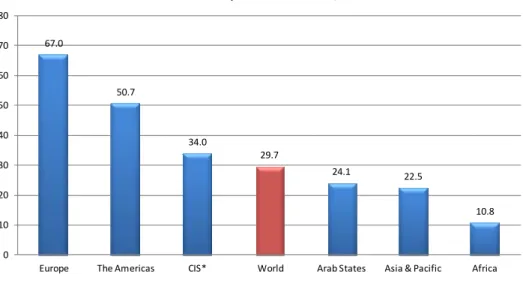
computer, telecommunications and Internet facilities (Annex 1). The lag in the development of computer and ICT infrastructure within Africa and between Africa and other developing
countries has the danger of increasing their exclusion from the global economy. The reasons for the low levels of facilities and skills are often attributed to: 1) low per capita income levels, and 2) low levels of knowledge and physical infrastructure (Oyelaran-Oyeyinka and Lal 2005).
However, Africa has recently been leapfrogging communications technologies at a level and pace unlike any other continent. This rapid adoption may be partly responsible for the “African renaissance” and recent rise in economic growth rates. The rapid rate of adoption of cell phone technology among even rural and poor regions, for example, has been a surprise. African countries are among the leaders in developing innovative uses of the cell phone, such as the current use of cell phones in East Africa for banking, wireless Internet and other informational services. Approximately half of the population in Tanzania, for example, already owns a cell phone, and voice network covers most of the country. This is providing new prospects for rural and other disadvantaged areas and people. It provides a growing opportunity for new educational approaches that have direct economic and social development impacts to meet the requirements of an increasingly globalized society (UNCTAD 2007).
Although the mobile sector is important, other communications technologies, such as broadband Internet, computers and the host of related information products and services commonly available in developed countries, have thus far lagged.
2. Transitions in Educational Systems
African countries lag far behind other developing countries in educational attainment and other aspects of human capital development required in an increasingly knowledge-based global economy. Data indicate that secondary school enrolment in African countries averages only about 30%, compared to 65% for developing countries worldwide, and close to 100% in East Asia. Education quality in most cases is not where it needs to be, either, with outdated curricula. Meanwhile, in middle-income economies, quality and quantity of secondary and tertiary
graduates are among the driving factors behind economic and social performance (Verspoor 2008). The indicators suggest that African countries are falling behind other developing countries in spite of the significant progress in access to education made since independence. The vast majority of the population is either rural based, or recent migrants to urban areas. The degree of economic retrogression in these countries during the past few decades, and the lag between these countries and other developing countries in terms of the stock of human capital, is likely to widen in the face of the rapid advances in science and technology in the more developed societies (Oyelaran-Oyeyinka and Lal, 2005).
Tanzania can be used as an example of how governments have responded to the need to improve educational attainment of their citizens by transitioning their educational system. The Government of Tanzania is currently implementing an ambitious policy to rapidly increase the number of secondary schools throughout the country (Table 1 and Annex 3). This increase, almost a doubling from between 2004 and 2008 to now around 4,000, has occurred without sufficient numbers of new teachers or other educational resources. A declining teacher to student ratio, from 1:23 to 1:37, occurred in only four years. Schools have reacted by having larger class sizes, by rotating teachers (having classes work without teachers), and by sharing trained
specialty teachers between schools (teachers travel between schools). Shortages of trained specialty teacher are particularly severe in subjects such as math, physics, chemistry, science and English, all vital subjects for Tanzania’s economic growth.
Table 2. Secondary School Education Enrollment and Performance in Tanzania, 2004-2008. Source: Ministry of Education and Vocational Training.
Table 2.1: Difference in Tanzania Secondary Schools Statistical Data from 2004 to 2008
Description 2004 2008 Difference %Increase
Enrolment (Form I-IV) 401,598 1,164,250 762,652 190 Enrolment (Form V-VI) 31,001 58,153 27,152 88 Total Enrolment (Form I-VI) 432,599 1,222,403 789,804 183 Enrolment (Teaching Staff) 18,754 32,835 14,081 75 Number of Registered Secondary
Schools
1,291 3,798 2,507 194
Govt. 1:23 1:37 14 Students More
Teacher-to-Student Ratio Non-Govt. 1:23 1:41 18 Students More Source: Basic Education Statistics in Tanzania (BEST) of 2008 from Ministry of Education and Vocational Training
(MoEVT)
Table 2.2: Situation of Form IV O-Level Performance from 2003 to 2007 Year
Division Obtained
2003 2004 2005 2006 2007
I-III in % 38 38 34 36 36
IV and 0 in % 62 62 66 64 64
Total Number of Students Examined 62,359 63,487 85,292 85,865 125,288 Source: Basic Education Statistics in Tanzania (BEST) of 2008 from Ministry of Education and Vocational Training
(MoEVT)
Table2.3: Form VI National Examination (ACSEE) Performance Year Subject Pass Grade
1999 2000 2001 2002 2003 2004 Grades A, B, and C in % 30 14 14 19 17 19 Grades D, E, and F in % 70 86 86 81 83 81 Physics
Total Number of Students Examined 2,480 2,580 2,954 3,154 3,300 3,534 Grades A, B, and C in % 24 21 22 19 23 39 Grades D, E, and F in % 76 79 78 81 77 61 Advanced Mathemati
cs Total Number of Students Examined
1,547 2,065 2,102 2,288 2,499
Source: Basic Education Statistics in Tanzania (BEST) of 1995-2004 from Ministry of Education and Culture (MoEC)
A summary of e-learning challenges secondary schools in Tanzania and in many other developing countries thus face include (Hennessy, 2010; ITU 2011b; Alemneh and Hastings 2006):
• Severe shortage of teachers, particularly in specialty science and other subjects • Teachers insufficiently trained in their own subjects, and have little to no computer
experience
• Large class sizes (average 60 students but often higher)
• Poorly equipped classrooms, dormitories and kitchens. Lack of teacher housing, especially in rural areas. Most rural schools are not on the electrical grid.
• Expensive and slow Internet connections. Very few schools have an Internet connection. Most schools with computers are not using them as a medium of instruction.
• Shortage of text books for students, and extremely limited teaching materials for teachers • Reference books, labs, teaching and learning aids are in short supply
• Outdated curricula
• Students are often ill-prepared for the switch from learning in Kiswahili in primary schools to English as the language of instruction in secondary schools
• Declining enrollment of girls in each year of secondary school due to early marriage, safety concerns and family or social obligations
• School fees are often beyond the reach of poor and particularly rural parents • Pass rates for the national exam are low and stagnant or declining
• Insufficient funding.
In response to these challenges and with the goal of improving educational outcomes and educating a workforce, the Tanzanian government is looking to the potential role of ICT. ICT along with other interventions is seen as providing an opportunity to enhance and improve quality of delivery of education, as stipulated in the National ICT Policy of 2003 and the
Information and Communication Technology (ICT) Policy for Basic Education in 2007 which
incorporates the integration of ICTs in pre-primary, primary, secondary and teacher education, as well as non-formal and adult education (Hare 2007). The Information and Communication Technology (ICT) Policy for Basic Education addresses strategic use of ICT in teaching and learning as well as administration and management of schools. The Government, through the Ministry of Education and Vocational Training is thus implementing projects introducing ICT in government teachers’ colleges, secondary and primary schools and its agencies. Integration of ICT technologies in schools would require significant pre-service and in-service teacher training in basic computer literacy as well as how to teach with e-learning technologies (Calder 2009). Meanwhile, in-service teacher ICT skills are low. A survey of teachers in secondary schools in northern Tanzania that the authors (DeMaagd and Olson) conducted showed that less than 10% had ever touched a computer. A table summarizing the enabling and constraining factors of ICT integration in Tanzanian schools is provided in Annex 2.
Although Tanzania is used as an example, its experience is common in other African and many other developing countries. Governments in many countries have ambitious plans to increase the percentage of children in schools, to improve the quality of education and rise achievement levels, and to modernize the system including with e-learning approaches.
3. Physical Factors Affecting e-Learning Technologies in Schools
In addition to educational system challenges, difficult physical environments and electrical power conditions in developing countries can exacerbate the implementation of successful e-leaning programs and reduce the lifespan of technological devices. These conditions may include:
• Extreme heat, humidity, and dust. Materials corrode and equipment ages rapidly. Fine dust enters the inner workings of machines, and covers solar panels.
• School buildings: roof leaks, no ceilings, no glass in windows, lack of student desks, insecure.
• Pest problems—rodents chewing through Ethernet wires, insects entering computer housing, bees taking residence in the classroom, to cattle scratching themselves on communications towers
• Theft of and non-malicious (curious) tampering with equipment
• Relative isolation of many rural schools due to long distances and poor roads
• Electrical power: the electrical grid may be over-extended, and have frequent black outs. The power itself is fluctuating with frequent spikes and dips that can destroy computer and other equipment. Solar systems may be expensive to initially purchase, so low power draw by the system is critical.
• Broadband connectivity may be increasing in the near future to major towns and cities. In the meantime and outside urban centers, Internet can be accessed only through expensive satellite systems or cellular networks
• Computer viruses are often rampant, software is often pirated
• Shortage of trained ICT professionals particularly in rural areas to conduct the required, continual maintenance
• High cost of imported equipment and tools; repair and replacement costs can be high.
Some private and non-profit computer manufacturing companies and international institutions are addressing some of these environmental and educational challenges with the design of rugged and low-power technologies, and educational software (Annex 4). The
environmental and technical problems are often a common cause of the breakdown and eventual abandonment of technologies in schools.
The authors (deMaagd, Olson and Tarkelson) as part of a team of faculty and students at Michigan State University, USA and University of Dodoma, Tanzania have been designing, installing and testing e-learning solutions in primary and secondary schools in northern Tanzania since 2008 to learn how to address these environmental and other challenges. The environmental challenges in northern Tanzania are common to those across other rural areas and towns. They include extreme heat and dust, no Internet connectivity, no or unreliable electrical power, pests and poor infrastructure.
To address these, a low-power, rugged and flexible system was designed and has been refined based on a solar-powered, multi-seat computer system. One personal computer serves six independent seats, reducing power consumption while permitting full PC software applications. Internet is provided by a solar powered central satellite dish and is linked to the other schools via a system of point-to-point Wi-Fi and Wi-Max, wireless technologies. In the schools on solar power, the system monitors and manages energy generation to maintain optimal efficiency. Mobile phones can be recharged on the solar system as well. In the schools on the electrical grid, power is regulated to guard the safety of the equipment and work of the users. Additional e-learning approaches, including tablet-style laptops and classroom projectors, are being tested. Teacher training, student involvement and content development have been a key part of the program. The systems are being used for various activities including social and professional networking, research, class preparation, class and school administration, tutorials and educational games. Computer clubs in the secondary schools have been extremely popular.
Lessons learned by the project include those related to addressing the environmental challenges such as energy efficient design, reducing the risk related to dust, heat and pests, the use of wireless technologies for medium-distance internet connectivity, and maintenance approaches. A critical aspect of the process ensuring continuity and growth, however, has been the involvement of district and school administrators, teachers, students, and community leaders and members in all stages of the project from initial planning decisions, to digging trenches for cables, to attaining computer training.
III. The Impact of e-Learning on Education, the Economy and Society
The necessity to become proficient in modern communications and information technologies, and the need to improve the quality of their education sector, have driven many African and other developing countries and donors to sharply increase their investments in e-learning. The impact of these investments on learning, on the economy and on society has yet to be
quantifiably documented, partly due to the recent nature of the programs, and partly due to the newness of the ICT4D research field. Most literature consists of what could be expected from e-learning programs, or are small case studies that are difficult to compare. There have been important efforts to compare the rare empirical studies in meta analyses but the authors caution that there is as yet insufficient data or clear trends to make solid conclusions about the impact of e-learning on learning or societal factors (Hennessy et al. 2010; Means et al. 2010; Farrell and Isaacs, 2007; Hare, 2007). Nevertheless, this section will summarize the information that exists to describe some developments that e-learning is influencing.
A. Educational Impacts of e-Learning
This section reviews what has been found of the impact of e-learning on educational systems, and on students and the teaching practices.
From an analysis of several international ICT integration plans (IETE, 2011), the long run adoption of ICT into education systems has been successful when done as an integral and holistic component of education. Technology plans, whether they are at a national level or local level, need to address policy, curriculum integration, professional development, community
engagement, infrastructure, and access. Today the approach is no longer simply putting
computers in the classroom and connecting to the Internet. Indeed, a critical area at the system level to highlight is the pedagogical aspects of technology as a tool for learning, integrated into all aspects teaching and learning. Technology should become a student’s intellectual partner, and the focus should be on how students learn with technology (Peck et al. p.12). Understanding how students learn with technology emphasizes the process of how teachers teach with technology.
Before investing in new ICT programs, it is key to decide on the main goals of the program. Authors of the SITES report on South Africa (Howie, Muller, & Patterson, 2005) noted that secondary school principals reported the following goals for their ICT programs:
• To prepare students for future jobs • To improve student achievement • To promote active learning strategies
• To individualize student learning experiences
• To develop student independence and responsibility for own learning • To give students drill and practice exercises
• To make the learning process more interesting and engaging.
These goals include using e-learning for more traditional efforts to improve student academic performance as well as newer objectives related to the development of technical and social skills important in the marketplace. Thus e-learning programs are expected to influence a broad array of skills, and due to their potential to affect the educational system—from pedagogy to
curriculum—their integration needs to be done at multiple levels of the educational system.
1. Impact of e-Learning on Students
It is expected that the most direct impact of e-learning would be on the learning achievement of students. The results of large, cross-national studies show that the effects on learning are complex and closely related to how the technology is used as an educational tool, and other factors. Putting technology into a school is not the simple solution to improving learning. Kozma (2005) notes “the most pronounced finding of empirical studies on ICT impact is that there is no consistent relationship between the mere availability of ICT and student learning”.
Another author, Kulik (2003) conducted a meta analysis of studies to identify the impact of e-learning on student outcomes. He identified the following trends:
• Students who used computer tutorials in mathematics, natural science, and social science score significantly higher on tests in these subjects compared to students who did not use computers. Similarly, students who used simulation software in science also scored higher. However, the use of computer- based laboratories alone did not result in higher scores.
• Primary school students who used tutorial software in reading scored significantly higher on reading scores. Very young students who used computers to write their own stories scored significantly higher on measures of reading skills
• Students who used word processor or otherwise used the computer for writing scored higher on measures of writing skill.
These are similar to the conclusions of Means et al. (2010) who noted, albeit with many caveats as to the statistical strength of the relationship, that their meta-analysis showed that e-learning is enhanced by giving students control of their interactions with the device, by for example embedding feedback mechanisms. When the software triggers student activity such as reflection or self-monitoring, there is a positive impact on learning. They found that this effect holds true when students are working as individuals but that the impact is not clear when students work in a many-to-many group situation.
Indeed, an increasing body of literature shows that students learn best when they are actively engaged with the curriculum and content (McGraw Hill, 2011). Teachers are challenged to develop curricula of an exploratory nature that engages students with hands-on, inquiry-based learning. The results are students with higher levels of motivation and engagement. Computer based strategies help students develop higher-order thinking and problem-solving skills. Participation in real-life applications allows students to draw analogies, infer relationships, predict outcomes and analyze data.
From these and other studies, it is interesting to note that e-learning can also have a positive impact on less tangible aspects of learning, particularly student motivation. e-Learning affects student attitudes towards technology, instruction, and subject matter. Codde, an author of this white paper, made an interesting observation in a three-year program in Algeria that linked Algerian high schools with US high schools. He noted that lower achieving students were becoming more engaged in their learning. Their teachers reported improvements in other subjects as well. Similar observations were made in a study in Kenya in which two randomly assigned physics classes used computer-based instruction, whereas a third equivalent group did not. At the end of the lessons, students in the computer sections had learned physics concepts better and expressed more positive attitudes about their physics learning (Kulik, 2003).
One widely-promoted e-learning initiative in the US and globally is the one-to-one laptop program. Research on its effectiveness, although limited, is growing. Factors related to its success include teacher professional development, access to technology support, and positive teacher attitudes towards the use of technology and laptops in the classroom (Penuel, 2006). Not all the research is favorable, however. The most notable laptop projects is Nick Negroponte’s One Laptop Per Child (OLPC). For a project of this nature to succeed, whether it be in
developing or developed countries, a substantial effort should be put into infrastructure, teacher training, curriculum development, assessment reform, and formative evaluation (Warschauer & Ames, 2010). Negroponte’s approach has been to give every child a laptop, and then assume that students will learn even without the project implementing other elements shown to be important for successful e-learning programs. Although the project has succeeded in placing the topic of ICT in education and the needs of developing countries in the news, it has failed to accomplish its goal of putting laptops into the hands of millions of children around the world, including those in the most impoverished nations.
Positive elements of laptop programs in general are highlighted in research done by Gulek and Demirtas (2005) in their evaluation of Microsoft’s Anywhere Learning Project. Their research demonstrated positive results on student learning and curriculum delivery. The evaluation of student and teacher outcomes are summarized below:
Student Outcomes:
• laptops lead to more student writing and to writing of higher quality
• laptops increase access to information and improve research analysis skills. Laptop Students…
• spend more time engaging in collaborative work than non-laptop students • participate in more project-based instruction
• become collaborators (interact with each other about their work) • direct their own learning
• report a greater reliance on active learning strategies • readily engage in problem solving and critical thinking
• consistently show deeper and more flexible uses of technology • spend more time doing homework on computers.