ETSI EN 319 411-1
V1.1.1
(2016-02)
Electronic Signatures and Infrastructures (ESI);
Policy and security requirements for
Trust Service Providers issuing certificates;
Part 1: General requirements
Reference
DEN/ESI-0019411-1
Keywords
e-commerce, electronic signature, extended validation certificate, public key, security,
trust services
ETSI
650 Route des Lucioles
F-06921 Sophia Antipolis Cedex - FRANCE Tel.: +33 4 92 94 42 00 Fax: +33 4 93 65 47 16
Siret N° 348 623 562 00017 - NAF 742 C Association à but non lucratif enregistrée à la
Sous-Préfecture de Grasse (06) N° 7803/88
Important notice
The present document can be downloaded from:
http://www.etsi.org/standards-search
The present document may be made available in electronic versions and/or in print. The content of any electronic and/or print versions of the present document shall not be modified without the prior written authorization of ETSI. In case of any existing or perceived difference in contents between such versions and/or in print, the only prevailing document is the
print of the Portable Document Format (PDF) version kept on a specific network drive within ETSI Secretariat. Users of the present document should be aware that the document may be subject to revision or change of status.
Information on the current status of this and other ETSI documents is available at
https://portal.etsi.org/TB/ETSIDeliverableStatus.aspx
If you find errors in the present document, please send your comment to one of the following services:
https://portal.etsi.org/People/CommiteeSupportStaff.aspx Copyright Notification
No part may be reproduced or utilized in any form or by any means, electronic or mechanical, including photocopying and microfilm except as authorized by written permission of ETSI.
The content of the PDF version shall not be modified without the written authorization of ETSI. The copyright and the foregoing restriction extend to reproduction in all media.
© European Telecommunications Standards Institute 2016. All rights reserved.
DECTTM, PLUGTESTSTM, UMTSTM and the ETSI logo are Trade Marks of ETSI registered for the benefit of its Members.
3GPPTM and LTE™ are Trade Marks of ETSI registered for the benefit of its Members and
of the 3GPP Organizational Partners.
Contents
Intellectual Property Rights ... 5
Foreword ... 5
Modal verbs terminology ... 5
Introduction ... 5
1 Scope
... 7
2 References
... 7
2.1 Normative references ... 7
2.2 Informative references ... 8
3 Definitions,
abbreviations and notation ... 9
3.1 Definitions ... 9
3.2 Abbreviations ... 11
3.3 Notation ... 12
4 General
concepts ... 12
4.1 General policy requirements concepts ... 12
4.2 Certificate policy and certification practice statement ... 12
4.2.1 Overview ... 12
4.2.2 Purpose ... 13
4.2.3 Level of specificity ... 13
4.2.4 Approach ... 13
4.2.5 Certificate Policy ... 13
4.3 Other Trust Service Providers statements ... 14
4.4 Certification services ... 14
5
General provisions on Certification Practice Statement and Certificate Policies... 15
5.1 General requirements ... 15
5.2 Certification Practice Statement requirements ... 16
5.3 Certificate Policy name and identification ... 16
5.4 PKI participants ... 17
5.4.1 Certification Authority ... 17
5.4.2 Subscriber and subject ... 17
5.4.3 Others ... 18
5.5 Certificate usage ... 18
6
Trust Service Providers practice ... 18
6.1 Publication and repository responsibilities ... 18
6.2 Identification and authentication ... 19
6.2.1 Naming ... 19
6.2.2 Initial identity validation ... 19
6.2.3 Identification and authentication for Re-key requests ... 21
6.2.4 Identification and authentication for revocation requests ... 22
6.3 Certificate Life-Cycle operational requirements ... 23
6.3.1 Certificate application ... 23
6.3.2 Certificate application processing ... 23
6.3.3 Certificate issuance ... 23
6.3.4 Certificate acceptance ... 25
6.3.5 Key pair and certificate usage ... 26
6.3.6 Certificate renewal ... 27
6.3.7 Certificate Re-key ... 27
6.3.8 Certificate modification ... 27
6.3.9 Certificate revocation and suspension... 28
6.3.10 Certificate status services ... 28
6.3.11 End of subscription ... 29
6.3.12 Key escrow and recovery ... 29
6.4 Facility, management, and operational controls ... 29
6.4.2 Physical security controls ... 29
6.4.3 Procedural controls ... 30
6.4.4 Personnel controls ... 30
6.4.5 Audit logging procedures ... 30
6.4.6 Records archival ... 31
6.4.7 Key changeover ... 31
6.4.8 Compromise and disaster recovery ... 31
6.4.9 Certification Authority or Registration Authority termination ... 32
6.5 Technical security controls ... 33
6.5.1 Key pair generation and installation ... 33
6.5.2 Private key protection and cryptographic module engineering controls ... 34
6.5.3 Other aspects of key pair management ... 35
6.5.4 Activation data ... 35
6.5.5 Computer security controls ... 36
6.5.6 Life cycle security controls ... 36
6.5.7 Network security controls ... 37
6.5.8 Timestamping ... 37
6.6 Certificate, CRL, and OCSP profiles... 37
6.6.1 Certificate profile ... 37
6.6.2 CRL profile ... 37
6.6.3 OCSP profile ... 37
6.7 Compliance audit and other assessment ... 37
6.8 Other business and legal matters ... 37
6.8.1 Fees ... 37
6.8.2 Financial responsibility ... 37
6.8.3 Confidentiality of business information ... 38
6.8.4 Privacy of personal information... 38
6.8.5 Intellectual property rights ... 38
6.8.6 Representations and warranties ... 38
6.8.7 Disclaimers of warranties ... 38
6.8.8 Limitations of liability ... 38
6.8.9 Indemnities ... 38
6.8.10 Term and termination... 38
6.8.11 Individual notices and communications with participants ... 39
6.8.12 Amendments ... 39
6.8.13 Dispute resolution procedures... 39
6.8.14 Governing law ... 39
6.8.15 Compliance with applicable law ... 39
6.8.16 Miscellaneous provisions ... 39
6.9 Other provisions ... 39
6.9.1 Organizational ... 39
6.9.2 Additional testing ... 39
6.9.3 Disabilities ... 39
6.9.4 Terms and conditions ... 40
7
Framework for the definition of other certificate policies ... 40
7.1 Certificate policy management ... 40
7.2 Additional requirements ... 40
Annex A (informative):
Model PKI disclosure statement ... 41
A.1 Introduction
... 41
A.2 The PDS structure ... 41
A.3 The PDS format ... 42
Annex B (informative):
Revisions made since previous versions ... 43
Annex C (informative):
Conformity assessment checklist ... 44
Annex D (informative):
Bibliography ... 45
Intellectual Property Rights
IPRs essential or potentially essential to the present document may have been declared to ETSI. The information pertaining to these essential IPRs, if any, is publicly available for ETSI members and non-members, and can be found in ETSI SR 000 314: "Intellectual Property Rights (IPRs); Essential, or potentially Essential, IPRs notified to ETSI in
respect of ETSI standards", which is available from the ETSI Secretariat. Latest updates are available on the ETSI Web
server (https://ipr.etsi.org/).
Pursuant to the ETSI IPR Policy, no investigation, including IPR searches, has been carried out by ETSI. No guarantee can be given as to the existence of other IPRs not referenced in ETSI SR 000 314 (or the updates on the ETSI Web server) which are, or may be, or may become, essential to the present document.
Foreword
This European Standard (EN) has been produced by ETSI Technical Committee Electronic Signatures and Infrastructures (ESI).
The present document is part 1 of a multi-part deliverable covering policy requirements for Trust Service Providers issuing certificates, as identified below:
Part 1: "General requirements";
Part 2: "Requirements for trust service providers issuing EU qualified certificates"; Part 3: "Policy requirements for Certification Authorities issuing public key certificates".
The present document is derived from the requirements specified in ETSI TS 102 042 [i.6] "Policy requirements for certification authorities issuing public key certificates" that has been updated as detailed in annex B.
National transposition dates
Date of adoption of this EN: 22 February 2016
Date of latest announcement of this EN (doa): 31 May 2016
Date of latest publication of new National Standard
or endorsement of this EN (dop/e): 30 November 2016
Date of withdrawal of any conflicting National Standard (dow): 30 June 2017
Modal verbs terminology
In the present document "shall", "shall not", "should", "should not", "may", "need not", "will", "will not", "can" and "cannot" are to be interpreted as described in clause 3.2 of the ETSI Drafting Rules (Verbal forms for the expression of provisions).
"must" and "must not" are NOT allowed in ETSI deliverables except when used in direct citation.
Introduction
Electronic commerce, in its broadest sense, is a way of doing business and communicating across public and private networks. An important requirement of electronic commerce is the ability to identify the originator and protect the confidentiality of electronic exchanges. This is commonly achieved by using cryptographic mechanisms which are supported by a Trust Service Provider (TSP) issuing certificates, commonly called a Certification Authority (CA). For participants of electronic commerce to have confidence in the security of these cryptographic mechanisms they need to have confidence that the TSP has properly established procedures and protective measure in order to minimize the operational and financial threats and risks associated with public key cryptographic systems.
The present document is aiming to meet the general requirements of the international community to provide trust and confidence in electronic transactions including, amongst others, applicable requirements from Regulation (EU) No 910/2014 [i.14] and those from CA/Browser Forum, BRG [5].
Bodies wishing to establish policy requirements for TSPs issuing certificates in a regulatory context other than the EU can base their requirements on those specified in the present document and specify any additional requirements in a manner similar to ETSI EN 319 411-2 [i.5], which builds on the present document requirements so as to benefit from the use of generally accepted global best practices.
1 Scope
The present document specifies generally applicable policy and security requirements for Trust Service Providers (TSP) issuing public key certificates, including trusted web site certificates.
The policy and security requirements are defined in terms of requirements for the issuance, maintenance and life-cycle management of certificates. These policy and security requirements support six reference certificate policies, defined in clause 5.
A framework for the definition of policy requirements for TSPs issuing certificates in a specific context where particular requirements apply is defined in clause 7.
The present document covers requirements for CA hierarchies, however this is limited to supporting the policies as specified in the present document. It does not include requirements for root CAs and intermediate CAs for other purposes.
The present document is applicable to:
• the general requirements of certification in support of cryptographic mechanisms, including digital signatures and seals;
• the general requirements of certification authorities issuing TLS/SSL certificates;
• the general requirements of the use of cryptography for authentication and encryption.
The present document does not specify how the requirements identified can be assessed by an independent party, including requirements for information to be made available to such independent assessors, or requirements on such assessors.
NOTE: See ETSI EN 319 403 [i.2] for guidance on assessment of TSP processes and services. The present document references ETSI EN 319 401 [8] for general policy requirements common to all classes of TSP services.
The present document however provides in annex C, a checklist of the policy requirements specific to TSP issuing certificates (as expressed in the present document) including the generic requirements which are independent of the type of service (as expressed in ETSI EN 319 401 [8]).
The present document includes provisions consistent with the requirements from the CA/Browser Forum in EVCG [4] and BRG [5].
2 References
2.1 Normative
references
References are either specific (identified by date of publication and/or edition number or version number) or
non-specific. For specific references, only the cited version applies. For non-specific references, the latest version of the referenced document (including any amendments) applies.
Referenced documents which are not found to be publicly available in the expected location might be found at http://docbox.etsi.org/Reference.
NOTE: While any hyperlinks included in this clause were valid at the time of publication, ETSI cannot guarantee their long term validity.
The following referenced documents are necessary for the application of the present document.
[1] ISO/IEC 15408 (parts 1 to 3): "Information technology -- Security techniques -- Evaluation criteria for IT security".
[2] ETSI EN 319 412-4: "Electronic Signatures and Infrastructures (ESI); Certificate Profiles; Part 4: Certificate profile for web site certificates".
[3] ISO/IEC 19790:2012: "Information technology -- Security techniques -- Security requirements for cryptographic modules".
[4] CA/Browser Forum (V1.5.5): "Guidelines for The Issuance and Management of Extended Validation Certificates".
[5] CA/Browser Forum (V1.3.0): "Baseline Requirements for the Issuance and Management of Publicly-Trusted Certificates".
[6] ISO/IEC 9594-8/Recommendation ITU-T X.509: "Information technology - Open Systems Interconnection - The Directory: Public-key and attribute certificate frameworks".
[7] IETF RFC 5280: "Internet X.509 Public Key Infrastructure Certificate and Certificate Revocation List (CRL) Profile".
[8] ETSI EN 319 401: "Electronic Signatures and Infrastructures (ESI); General Policy Requirements for Trust Service Providers".
[9] ETSI EN 319 412-2: "Electronic Signatures and Infrastructures (ESI); Certificate Profiles; Part 2: Certificate profile for certificates issued to natural persons".
[10] ETSI EN 319 412-3: "Electronic Signatures and Infrastructures (ESI); Certificate Profiles; Part 3: Certificate profile for certificates issued to legal persons".
[11] IETF RFC 6960: "X.509 Internet Public Key - Infrastructure Online Certificate Status Protocol - OCSP".
[12] FIPS PUB 140-2 (2001): "Security Requirements for Cryptographic Modules".
2.2 Informative
references
References are either specific (identified by date of publication and/or edition number or version number) or
non-specific. For specific references, only the cited version applies. For non-specific references, the latest version of the referenced document (including any amendments) applies.
NOTE: While any hyperlinks included in this clause were valid at the time of publication, ETSI cannot guarantee their long term validity.
The following referenced documents are not necessary for the application of the present document but they assist the user with regard to a particular subject area.
[i.1] Directive 1999/93/EC of the European Parliament and of the Council of 13 December 1999 on a Community framework for electronic signatures.
[i.2] ETSI EN 319 403: "Electronic Signatures and Infrastructures (ESI); Trust Service Provider Conformity Assessment - Requirements for conformity assessment bodies assessing Trust Service Providers".
[i.3] IETF RFC 3647: "Internet X.509 Public Key Infrastructure - Certificate Policy and Certification Practices Framework".
[i.4] ISO 19005 (parts 1 to 3): "Document management - electronic document file format for long-term preservation".
[i.5] ETSI EN 319 411-2: "Electronic Signatures and Infrastructures (ESI); Policy and security
requirements for Trust Service Providers issuing certificates; Part 2: Requirements for trust service providers issuing EU qualified certificates".
[i.6] ETSI TS 102 042: "Electronic Signatures and Infrastructures (ESI); Policy requirements for certification authorities issuing public key certificates".
[i.7] ISO/IEC 27002:2013: "Information technology -- Security techniques -- Code of practice for information security management".
[i.8] ISO/IEC 7498-2/Recommendation ITU-T X.800: "Data communications network -- Open systems interconnection -- Security, structure and applications: Security architecture for open systems interconnection for CCITT applications".
[i.9] CEN TS 419 261: "Security Requirements for Trustworthy Systems Managing Certificates for Electronic Signatures".
[i.10] ETSI TS 119 312: "Electronic Signatures and Infrastructures (ESI); Cryptographic Suites". [i.11] IETF RFC 5246: "The Transport Layer Security Protocol Version 1.2".
[i.12] ETSI TS 119 612: "Electronic Signatures and Infrastructures (ESI); Trusted Lists".
[i.13] ETSI TS 101 533-1: "Electronic Signatures and Infrastructures (ESI); Data Preservation Systems Security; Part 1: Requirements for Implementation and Management".
[i.14] Regulation (EU) No 910/2014 of the European Parliament and of the Council of 23 July 2014 on electronic identification and trust services for electronic transactions in the internal market and repealing Directive 1999/93/EC.
[i.15] ETSI EN 319 421: "Electronic Signatures and Infrastructures (ESI); Policy and Security Requirements for Trust Service Providers issuing Time-Stamps".
[i.16] CEN TS 419 221-2: "Protection profiles for TSP Cryptographic modules - Part 2: Cryptographic module for CSP signing operations with backup".
[i.17] CEN TS 419 221-3: "Protection profiles for TSP Cryptographic modules - Part 3: Cryptographic module for Cryptographic module for CSP key generation services".
[i.18] CEN TS 419 221-4: "Protection profiles for TSP Cryptographic modules - Part 4: Cryptographic module for CSP signing operations without backup".
[i.19] CEN EN 419 221-5: "Protection profiles for TSP Cryptographic modules - Part 5: Cryptographic module for trust services".
3
Definitions, abbreviations and notation
3.1 Definitions
For the purposes of the present document, the terms and definitions given in ETSI EN 319 401 [8] and the following apply:
auditor: person who assesses conformity to requirements as specified in given requirements documents
NOTE: See ETSI EN 319 403 [i.2].
certificate: public key of a user, together with some other information, rendered un-forgeable by encipherment with the
private key of the certification authority which issued it
NOTE 1: The term certificate is used for public key certificate within the present document. NOTE 2: See ISO/IEC 9594-8/Recommendation ITU-T X.509 [6].
Certificate Policy (CP): named set of rules that indicates the applicability of a certificate to a particular community
and/or class of application with common security requirements
NOTE 1: See clause 4.2 for explanation of the relative role of certificate policies and certification practice statement.
NOTE 2: This is a specific type of trust service policy as specified in ETSI EN 319 401 [8]. NOTE 3: See ISO/IEC 9594-8/Recommendation ITU-T X.509 [6].
Certificate Revocation List (CRL): signed list indicating a set of certificates that are no longer considered valid by the
certificate issuer
NOTE 1: Within the scope of the present document the set of certificates is related to end user certificates. NOTE 2: See ISO/IEC 9594-8/Recommendation ITU-T X.509 [6].
Certification Authority (CA): authority trusted by one or more users to create and assign certificates
NOTE 1: A CA can be:
1) a trust service provider that creates and assigns public key certificates; or
2) a technical certificate generation service that is used by a certification service provider that creates and assign public key certificates.
NOTE 2: See ISO/IEC 9594-8/Recommendation ITU-T X.509 [6].
Certification Authority Revocation List (CARL): revocation list containing a list of CA-certificates issued to
certification authorities that are no longer considered valid by the certificate issuer NOTE: See ISO/IEC 9594-8/Recommendation ITU-T X.509 [6].
Certification Practice Statement (CPS): statement of the practices which a Certification Authority employs in issuing
managing, revoking, and renewing or re-keying certificates NOTE 1: See IETF RFC 3647 [i.3].
NOTE 2: This is a specific type of Trust Service practice statement as specified in ETSI EN 319 401 [8].
Coordinated Universal Time (UTC): As indicated in ETSI EN 319 401 [8].
Cross Certificate: certificate that is used to establish a trust relationship between two certification authorities digital signature: data appended to, or a cryptographic transformation of a data unit that allows a recipient of the data
unit to prove the source and integrity of the data unit and protect against forgery e.g. by the recipient NOTE: See ISO/IEC 7498-2/Recommendation ITU-T X.800 [i.8].
Domain Validation Certificate (DVC): certificate which has no validated organizational identity information for the
subject, only identifying the subject by its domain name
EV certificate: See Extended Validation certificate.
Extended Validation Certificate (EVC): As indicated in the EVCG [4].
high security zone: specific physical location of the security zone (see ETSI EN 319 401 [8], clause 7.8) where the
Root CA key is held
Organizational Validation Certificate(OVC): certificate that includes validated organizational identity information
for the subject
Publicly-Trusted Certificate (PTC): certificate that is trusted by virtue of the fact that its corresponding Root
Certificate is distributed as a trust anchor in widely-available application software
Registration Authority (RA): entity that is responsible for identification and authentication of subjects of certificates
mainly
NOTE 1: An RA can assist in the certificate application process or revocation process or both. NOTE 2: See IETF RFC 3647 [i.3].
registration officer: person responsible for verifying information that is necessary for certificate issuance and approval
of certification requests
root CA: certification authority which is at the highest level within TSP's domain and which is used to sign subordinate
CA(s)
NOTE 1: A Root CA certificate is generally self-signed but the Root-CA can also be certified by a (Root)CA from another domain (e.g. cross-certification, Root-Signed in the context of a root-signing program, etc.). NOTE 2: A Root CA can be used as the Trust Anchor for many applications (e.g. browsers) but nothing prevents
the TSP to present subordinate CAs for this purpose, according to the business context.
secure cryptographic device: device which holds the user's private key, protects this key against compromise and
performs signing or decryption functions on behalf of the user
secure zone: area (physical or logical) protected by physical and logical controls that appropriately protect the
confidentiality, integrity, and availability of the systems used by the TSP
subject: entity identified in a certificate as the holder of the private key associated with the public key given in the
certificate
NOTE: Relationship between subscriber and subject is described in clauses 5.4.2 and 6.3.5.
subordinate CA:certification authority whose Certificate is signed by the Root CA, or another Subordinate CA NOTE: A subordinate CA normally either issues end user certificates or other subordinate CA certificates.
trust anchor: entity that is trusted by a relying party and used for validating certificates in certification paths
NOTE 1: See ISO/IEC 9594-8/Recommendation ITU-T X.509 [6]. NOTE 2: A Trust Anchor can also be a Root CA.
NOTE 3: Examples of trust anchors are as in a trusted List [i.12] or a list of trusted CA certificates distributed by an application software provider.
3.2 Abbreviations
For the purposes of the present document, the following abbreviations apply: BRG Baseline Requirements Guidelines
CA Certification Authority
CAB CA/Browser CAB Forum CA/Browser Forum
CARL Certification Authority Revocation List
CP Certificate Policy
CPS Certification Practice Statement
CRL Certificate Revocation List
CSP Certification Service Provider
NOTE: The more general term Trust Service Provider is used in preference to CSP in the present document except in relation to external references.
DVC Domain Validation Certificate DVCP Domain Validation Certificate Policy EAL Evaluation Assurance Level
EV Extended Valuation
EVC Extended Validation Certificate
EVCG Extended Validation Certificate Guidelines EVCP Extended Validation Certificate Policy
LCP Lightweight Certificate Policy
NCP Normalized Certificate Policy
NCP+ Extended Normalized Certificate Policy OCSP Online Certificate Status Protocol
OID Object IDentifier
OVC Organizational Validation Certificate OVCP Organizational Validation Certificate Policy
PDS PKI Disclosure Statement PIN Personal Identification Number PKI Public Key Infrastructure
PTC Publicly-Trusted Certificate
NOTE: Within the context of the present document PTC is used synonymously with EVC, DVC and OVC as per CAB Forum documents.
RA Registration Authority
SSL Secure Socket Layer
TLS Transport Layer Security
TLS/SSL Transport Layer Security/Secure Socket Layer protocol
NOTE: IETF RFC 5246 [i.11] or earlier equivalent Secure Socket Layer protocol. TSP Trust Service Provider
UTC Coordinated Universal Time
3.3 Notation
The requirements identified in the present document include:
a) requirements applicable to any CP. Such requirements are indicated by clauses without any additional marking;
b) requirements applicable under certain conditions. Such requirements are indicated by clauses marked by "[CONDITIONAL]";
c) requirements applicable to the services offered under the applicable CP. Such requirements are indicated by clauses marked by the applicable CP as follows:
i) "[LCP]", "[NCP]", "[NCP+]", "[EVCP]", "[OVCP]" and "[DVCP]";
ii) [PTC] is used to denote requirements applicable to EVCP, OVCP and DVCP for CAB Forum requirements.
4 General
concepts
4.1
General policy requirements concepts
See ETSI EN 319 401 [8], clause 4 and IETF RFC 3647 [i.3], clauses 3.1 and 3.4 for guidance.
4.2
Certificate policy and certification practice statement
4.2.1 Overview
The present document serves as a basis for the TSP to develop, implement, enforce, and update:
• a CPS that describes the practices and procedures used to address all the requirements identified for the applicable TSP policy;
• a CP document that includes all rules valid for a given CP as specified in clause 5 or clause 7.
NOTE 1: The CP document contains additional information which is out of scope of the present document (e.g. the description of the certificate profile).
NOTE 2: The CP generally refers to the CPS to indicate how the TSP implements the policy requirements for the selected CP.
CPS is a form of TSP Statement as specified in ETSI EN 319 401 [8], clause 6.1 applicable to CAs issuing certificates. NOTE 3: Subscribers and relying parties can consult the CP and CPS of the issuing TSP to obtain details of the
requirements addressed by its CP and how the CP is implemented by the particular TSP.
4.2.2 Purpose
In general, the purpose of the CP, referenced by a policy identifier in a certificate, states "what is to be adhered to", while a CPS states "how it is adhered to", i.e. the processes it will use in creating and maintaining the certificate.
4.2.3 Level
of specificity
A CP is a higher level document than a CPS; it can apply to a community to which several CAs belong that abide by the common set of rules specified in that CP. A CPS defines how one specific CA meets the technical, organizational and procedural requirements identified in a CP.
NOTE: Even lower-level documents can be appropriate for a CA detailing the specific procedures necessary to complete the practices identified in the CPS. This lower-level documentation is generally regarded as internal operational procedure documents, which can define specific tasks and responsibilities within an organization. While this lower-level documentation can be used in the daily operation of the CA and reviewed by those doing a process review, due to its internal nature this level of documentation is considered private and proprietary and therefore beyond the scope of the present document. For example, the policy can require secure management of the private key(s), the practices can describe the
dual-control, secure storage practices, while the operational procedures can describe the detailed procedures with locations, access lists and access procedures.
4.2.4 Approach
The approach of a CP is significantly different from a CPS. A CP is defined independently of the specific details of the specific operating environment of a CA, whereas a CPS is tailored to the organizational structure, operating procedures, facilities, and computing environment of a CA. A CP can be defined by the provider, by standards, by national
(e.g. government) or international organizations, by the customers (subscribers) of the CA or by the users of certification services, whereas the CPS is always defined by the provider.
4.2.5 Certificate
Policy
As described in IETF RFC 3647 [i.3], clause 3.3, certificates include a CP identifier which can be used by relying parties in determining the certificates suitability and trustworthiness for a particular application. The present document defines six CPs:
1) A Normalized Certificate Policy (NCP) which meets general recognized best practice for TSPs issuing certificates used in support of any type of transaction.
2) An extended Normalized Certificate Policy (NCP+) which offers the same quality as that offered by the NCP for use where a secure cryptographic device (signing or decrypting) is considered necessary. The requirements for this CP include the policy requirements for the issuance and management of NCP certificates.
3) A Lightweight Certificate Policy (LCP) offering a quality of service less onerous than the NCP (requiring less demanding policy requirements) for use where a risk assessment does not justify the additional burden of meeting all requirements of the NCP (e.g. physical presence), for certificates used in support of any type of transaction (such as digital signatures, web authentication or electronic seal).
4) An Extended Validation Certificate Policy (EVCP) for TLS/SSL certificates offering the level of assurance required by CAB Forum for EVC. The requirements for this CP are built on the policy requirements for the issuance and management of NCP certificates, enhanced to refer to requirements from EVCG [4]. It includes, except where explicitly indicated, all the Normalized Certificate Policy (NCP) requirements, plus additional provisions suited to support EVC issuance and management as specified in EVCG [4].
5) A Domain Validation Certificate Policy (DVCP) for TLS/SSL certificates offering the level of assurance required by CAB Forum for DVC. The policy requirements for this CP are built on the policy requirements for the issuance and management of LCP certificates, enhanced to refer to requirements from the BRG [5] as applicable to domain validation certificates. It includes, except where explicitly indicated, all the Lightweight Certificate Policy (LCP) requirements, plus additional provisions suited to support DVC issuance and management as specified in BRG [5].
6) An Organizational Validation Certificate Policy (OVCP) for TLS/SSL certificates offering the level of assurance required by CAB Forum for OVC. The policy requirements for this CP are built on the policy requirements for the issuance and management of LCP certificates, enhanced to refer to requirements from BRG [5] as applicable to organizational validation certificates. It includes, except where explicitly indicated, all the Lightweight Certificate Policy (LCP) requirements, plus additional provisions suited to support OVC issuance and management as specified in BRG [5].
Clause 7 specifies a framework for other CPs which enhance or further constrain the above policies.
4.3
Other Trust Service Providers statements
In addition to, or as part of, the CP and CPS a TSP issues terms and conditions. Terms and conditions can cover a broad range of commercial terms or PKI specific terms that are not necessarily communicated to the customer, etc.
The PKI disclosure statement is that part of the CA's terms and conditions which relate to the operation of the PKI.
4.4 Certification
services
NOTE 1: The present document does not mandate any sub division of the services of a TSP. Requirements are stated in subsequent clauses.
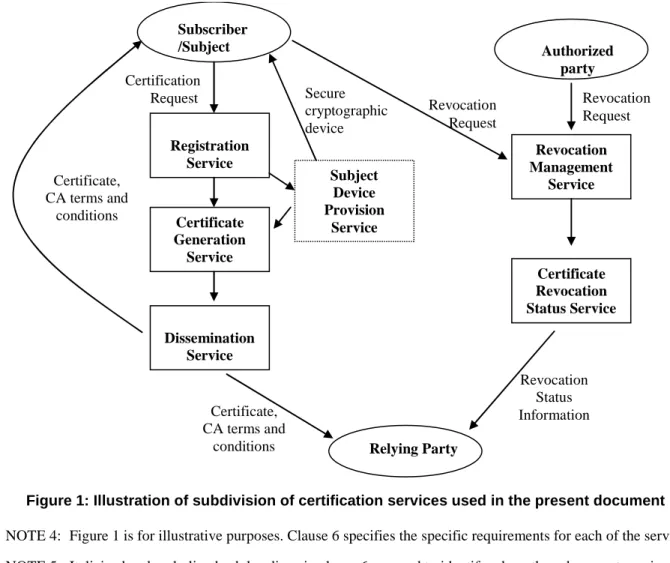
The certification services are broken down in the present document into the following component services for the purposes of classifying requirements:
• Registration service: verifies the identity and if applicable, any specific attributes of a subject. The results of
this service are passed to the certificate generation service.
NOTE 2: This service includes proof of possession of non-CA generated subject private keys.
• Certificate generation service: creates and signs certificates based on the identity and other attributes verified
by the registration service. This can include key generation.
• Dissemination service: disseminates certificates to subjects, and if the subject consents, makes them available
to relying parties. This service also makes available the TSP's terms and conditions, and any published policy and practice information, to subscribers and relying parties.
• Revocation management service: processes requests and reports relating to revocation to determine the
necessary action to be taken. The results of this service are distributed through the revocation status service.
• Revocation status service: provides certificate revocation status information to relying parties.
• Subject device provision service (optional): prepares, and provides or makes available secure cryptographic
devices, or other secure devices, to subjects. NOTE 3: Examples of this service are:
i) a service which generates the subject's key pair and distributes the private key to the subject; ii) a service which prepares the subject's signature-creation module and enabling codes and distributes
the module to the registered subject.
This subdivision of services is only for the purposes of clarification of policy requirements and places no restrictions on any subdivision of an implementation of the CA services.
Figure 1 illustrates the interrelationship between the services. Certificate Generation Service Registration Service Dissemination Service Revocation Management Service Certificate Revocation Status Service Subscriber /Subject Relying Party Authorized party Certification Request Revocation Request Certificate, CA terms and conditions Revocation Status Information Subject Device Provision Service Certificate, CA terms and conditions Secure cryptographic device Revocation Request
Figure 1: Illustration of subdivision of certification services used in the present document NOTE 4: Figure 1 is for illustrative purposes. Clause 6 specifies the specific requirements for each of the services. NOTE 5: Italicized and underlined sub headings in clause 6 are used to identify where the subsequent requirements
relate to a specific service component as described in clause 4.4 (e.g. certificate generation).
5
General provisions on Certification Practice
Statement and Certificate Policies
5.1 General
requirements
The present document is structured broadly in line with IETF RFC 3647 [i.3] to assist TSPs in applying these requirements to their own CP and CPS documentation.
The present document includes the provision of services for registration, certificate generation, dissemination, revocation management and revocation status (see clause 4.3). Where requirements relate to a specific service area of the TSP then it is listed under one of these subheadings. Where no service area is listed, or "General" is indicated, a requirement is relevant to the general operation of the TSP.
The requirements are indicated in terms of the security objectives followed by more specific requirements for controls to meet those objectives where considered necessary to provide the necessary confidence that those objective will be met.
NOTE 1: The details of controls required to meet an objective is a balance between achieving the necessary confidence whilst minimizing the restrictions on the techniques that a TSP can employ in issuing certificates. In some cases reference is made to other more general standards which can be used as a source of more detailed control requirements. Due to these factors the specificity of the requirements given under a given topic can vary.
NOTE 2: Italicized sub headings in this clause are used to identify where the subsequent requirements relate to a specific service component as described in clause 4.4 (e.g. certificate generation).
[NCP+, EVCP]: all requirements specified for [NCP] shall apply. [DVCP, OVCP]: all requirements specified for [LCP] shall apply.
5.2
Certification Practice Statement requirements
The general requirements specified in ETSI EN 319 401 [8], clause 6.1 shall apply. In addition the following particular requirements apply:
NOTE 1: A TSP can document practices relating to specific CP requirements separate from the main CPS document.
a) The TSP CPS should be structured in accordance with IETF RFC 3647 [i.3].
b) The CPS shall include the complete CA hierarchy, including root and subordinate CA's. c) The CPS shall include the signature algorithms and parameters employed.
d) The TSP shall publicly disclose its CPS through an online means that is available on a 24x7 basis. NOTE 2: The TSP is not obliged to disclose any aspects containing sensitive information.
e) [PTC]: Clause 2.2 of BRG [5] and clause 8.3 of EVCG [4] shall apply. f) [PTC]: Clause 2 of the BRG [5] and clause 8.2.1 of EVCG [4] shall apply.
g) The TSPs CPS shall specify the practice regarding the use of CA keys for signing certificates, CRLs and OCSP.
5.3
Certificate Policy name and identification
As described in IETF RFC 3647 [i.3], clause 3.3, certificates include a CP identifier which can be used by relying parties in determining the certificates suitability and trustworthiness for a particular application. The identifiers for the certificate policies specified in the present document are:
a) NCP: Normalized Certificate Policy
itu-t(0) identified-organization(4) etsi(0) other-certificate-policies(2042)
policy-identifiers(1) ncp (1)
b) NCP+: Normalized Certificate Policy requiring a secure cryptographic device
itu-t(0) identified-organization(4) etsi(0) other-certificate-policies(2042)
policy-identifiers(1) ncpplus (2)
c) LCP: Lightweight Certificate Policy
itu-t(0) identified-organization(4) etsi(0) other-certificate-policies(2042)
policy-identifiers(1) lcp (3)
d) EVCP: Extended Validation Certificate Policy
itu-t(0) identified-organization(4) etsi(0) other-certificate-policies(2042)
policy-identifiers(1) evcp (4)
e) DVCP: Domain Validation Certificate Policy
itu-t(0) identified-organization(4) etsi(0) other-certificate-policies(2042)
f) OVCP: Organizational Validation Certificate Policy
itu-t(0) identified-organization(4) etsi(0) other-certificate-policies(2042)
policy-identifiers(1) ovcp (7)
If any changes are made to a CP as described in clause 4.2.5 which affects the applicability then the policy identifier should be changed.
5.4 PKI
participants
5.4.1 Certification
Authority
The authority trusted by the users of the certification services (i.e. subscribers as well as relying parties) to create and assign certificates is called the CA. The CA has overall responsibility for the provision of the certification services identified in clause 4.4. The CA is identified in the certificate as the issuer and its private key is used to sign certificates. The CA may make use of other parties to provide parts of the certification service. However, the CA always maintains overall responsibility and ensures that the policy requirements identified in the present document are met.
EXAMPLE: A CA can sub-contract all the component services, including the certificate generation service (sometimes also called CA with the second meaning of CA as per definition above). However, the key used to sign the certificates is identified as belonging to the CA, and the CA maintains overall responsibility for meeting the requirements defined in the present document.
A CA is a type of Trust Service Provider (TSP), as defined in the Regulation (EU) No 910/2014 [i.14], and also a form of certification service provider as defined in the Electronic Signatures Directive 1999/93/EC [i.1], which issues public key certificates.
A TSP may include a hierarchy of CAs. Where a TSP includes a hierarchy of subordinate CAs up to a root CA the TSP is responsible for ensuring the subordinate-CAs comply with the applicable policy requirements. If the TSPs Trust Anchor is signed by a Root CA outside the scope of the TSP policies then the Root CA requirements apply to the TSP's Trust Anchor.
5.4.2
Subscriber and subject
In the framework of the present policies, the subject can be: a) a natural person;
b) a natural person identified in association with a legal person;
c) a legal person (that can be an Organization or a unit or a department identified in association with an Organization); or
d) a device or system operated by or on behalf of a natural or legal person.
When a subscriber is the subject it will be held directly responsible if its obligations are not correctly fulfilled. When the subscriber is acting on behalf of one or more distinct subjects to whom it is linked (e.g. the subscriber is a company requiring certificates for its employees to allow them to participate in electronic business on behalf of the company), responsibilities of the subscriber and of the subject are addressed in clause 6.3.4 item e).
The link between the subscriber and the subject is one of the following: a) To request a certificate for natural person the subscriber is:
i) the natural person itself;
ii) a natural person mandated to represent the subject; or
NOTE: The local legal dispositions can address the handover of responsibility to a third person.
iii) any entity with which the natural person is associated (such as the company employing the natural person or a non-profit legal person the natural person is member of).
b) To request a certificate for legal person the subscriber is:
i) any entity as allowed under the relevant legal system to represent the legal person; or
ii) a legal representative of a legal person subscribing for its subsidiaries or units or departments. c) To request a certificate for a device or system operated by or on behalf of a natural or legal person the
subscriber is:
i) the natural or legal person operating the device or system;
ii) any entity as allowed under the relevant legal system to represent the legal person; or
iii) a legal representative of a legal person subscribing for its subsidiaries or units or departments.
5.4.3 Others
Other participants, not covered by the present document, may be identified by the TSP.
5.5 Certificate
usage
The policies NCP, NCP+ and LCP place no constraints on the user community and applicability of the certificate. The applicability of other certificates is as described below.
The specific purpose of EV Certificates is described in EVCG [4], clause 2. The purpose of PTC is described in BRG [5], clause 1.4.1.
Certificates issued under EVCG [4] or BRG [5] are for publicly trusted certificates used to identify web servers accessed via the TLS or SSL protocol as per IETF RFC 5246 [i.11].
6
Trust Service Providers practice
6.1
Publication and repository responsibilities
The TSP shall make certificates available to subscribers, subjects and relying parties. In particular:
Dissemination
a) Upon generation, the complete and accurate certificate shall be available to the subscriber or subject for whom the certificate is being issued.
b) Certificates shall be available for retrieval in only those cases for which the subject's consent has been obtained. If the subject is a device or system, the consent of the natural or legal person responsible for the operating of the device or system needs to be obtained, instead of the subject.
c) The TSP shall make available to relying parties the terms and conditions regarding the use of the certificate (see clause 6.9.4).
d) The applicable terms and conditions shall be readily identifiable for a given certificate. e) [CONDITIONAL]:
i) [LCP]: the information identified in b) and c) above shall be available as specified in the TSP's CPS. ii) [NCP]: the information identified in b) and c) above shall be available 24 hours per day, 7 days per week.
Upon system failure, service or other factors which are not under the control of the TSP, the TSP shall apply best endeavours to ensure that this information service is not unavailable for longer than a maximum period of time as denoted in the CPS.
f) [CONDITIONAL] If the TSP is not issuing publicly-trusted certificates, the information identified in c) above should be publicly and internationally available.
g) [CONDITIONAL] If the TSP is issuing publicly-trusted certificates, the information identified in c) above shall be publicly and internationally available.
6.2
Identification and authentication
6.2.1 Naming
NOTE: Requirements for naming in certificates are as specified in Recommendation ITU-T X.509 [6] or IETF RFC 5280 [7] and the appropriate part of ETSI EN 319 412 [2], [9] and [10]. See clause 6.6.1 of the present document.
6.2.2
Initial identity validation
The TSP shall verify the identity of the subscriber and subject and shall check that certificate requests are accurate, authorized and complete according to the collected evidence or attestation of identity.
NOTE 1: When registering, a subject is identified as a person with specific attributes. The specific attributes can indicate, for example, an association within an organization and possibly, a role within that organization. In particular:
Registration
a) The TSP shall collect either direct evidence or an attestation from an appropriate and authorized source, of the identity (e.g. name) and if applicable, any specific attributes of subjects to whom a certificate is issued. Submitted evidence may be in the form of either paper or electronic documentation (in both cases the RA shall validate their authenticity). Verification of the subject's identity shall be at time of registration by appropriate means.
- [PTC]: The verification methods shall follow those specified in clause 11 of the EVCG [4] and clause 3.2 of BRG [5].
b) [CONDITIONAL] [NCP]: If the subject is a natural person (i.e. physical person as opposed to legal person) evidence of the subject's identity (e.g. name) shall be checked against this natural person either directly by physical presence of the person (the subject shall be witnessed in person unless a duly mandated subscriber represents the subject), or shall have been checked indirectly using means which provides equivalent assurance to physical presence.
NOTE 2: An example of the required indirect evidence of identity is one or more registration documents electronically signed by a person trusted to have checked the persons' identity in line with the requirements of this clause. Some other examples can be found in annexes B and C of the EVCG [4]. c) [CONDITIONAL]: If the subject is a natural person (i.e. physical personal as opposed to legal person),
evidence shall be provided of:
1) full name (including surname and given names consistent with the national identification practices); and 2) date and place of birth, reference to a nationally recognized identity document, or other attributes which
can be used to, as far as possible, distinguish the person from others with the same name. The place of birth should be given in accordance to national or other applicable conventions for registering births.
d) [CONDITIONAL] [NCP]: If the subject is a natural person who is identified in association with a legal person (e.g. the subscriber), evidence of the identity, in particular the ones listed in e), shall be checked against a natural person either directly by physical presence of the person (the subject shall be witnessed in person unless a duly mandated subscriber represents the subject), or shall have been checked indirectly using means which provides equivalent assurance to physical presence.
e) [CONDITIONAL]: If the subject is a natural person who is identified in association with a legal person (e.g. the subscriber), evidence shall be provided of:
1) full name (including surname and given names, consistently with the national or other applicable identification practices) of the subject;
2) date and place of birth, reference to a nationally recognized identity document, or other attributes of the subscriber which can be used to, as far as possible, distinguish the person from others with the same name;
3) full name and legal status of the associated legal person or other organizational entity (e.g. the subscriber);
4) any relevant existing registration information (e.g. company registration) of the associated legal person or other organizational entity identified in association with the legal person, consistent with the national or other applicable identification practices;
5) affiliation of the natural person to the legal person consistent with national or other applicable identification practices;
6) [CONDITIONAL]: when applicable, the association between the legal person and any organizational entity identified in association with this legal person that would appear in the organization attribute of the certificate, consistent with the national or other applicable identification practices; and
7) approval by the legal person and the natural person that the subject attributes also identify such organization.
f) [CONDITIONAL] [NCP]: If the subject is a legal person, or other organizational entity identified in association with a legal person, evidence of the identity, in particular the ones listed in g), shall be checked against a duly mandated subscriber either directly, by physical presence of a person allowed to represent the legal person, or shall have been checked indirectly using means which provides equivalent assurance to physical presence.
g) [CONDITIONAL]: If the subject is a legal person, or other organizational entity identified in association with a legal person, evidence shall be provided:
1) of full name of the organizational entity (private organization, government entity, business entity or non-commercial entity) consistent with the national or other applicable identification practices:
[PTC]: BRG [5], clause 3.2.2, shall apply. [EVCP]: EVCG [4], clause 11.2, shall apply.
2) [CONDITIONAL]: when applicable, the association between the legal person and the other
organizational entity identified in association with this legal person that would appear in the organization attribute of the certificate, consistent with the national or other applicable identification practices. h) [CONDITIONAL] [NCP]: If the subject is a device or system operated by or on behalf of a legal person, or
other organizational entity identified in association with a legal person, evidence of the identity, in particular the ones listed in i), shall be checked against a duly mandated subscriber either directly, by physical presence of a person, or shall have been checked indirectly using means which provides equivalent assurance to physical presence.
i) [CONDITIONAL]: If the subject is a device or system operated by or on behalf of a legal person, or other organizational entity identified in association with a legal person, evidence shall be provided of:
1) identifier of the device by which it can be referenced (e.g. Internet domain name); 2) full name of the organizational entity:
[PTC]: clause 3.2.2 of BRG [5] shall apply; [EVCP]: EVCG [4], clause 11.2.1, shall apply;
3) any relevant existing registration information (e.g. company registration) of the legal person or other organizational entity identified in association with the legal person that would appear in the organization attribute of the certificate, consistent with the national or other applicable identification practices; 4) a nationally recognized identity number, or other attributes which can be used to, as far as possible,
5) [CONDITIONAL]: when applicable, the association between the legal person and the other
organizational entity identified in association with this legal person that would appear in the organization attribute of the certificate, consistent with the national or other applicable identification practices. j) [CONDITIONAL] [NCP]: If the subject is a device or system operated by a natural person, evidence of the
identity, in particular the ones listed in k), shall be checked against either directly, by physical presence of the natural person, or shall have been checked indirectly using means which provides equivalent assurance to physical presence.
k) [CONDITIONAL]: If the subject is a device or system operated by a natural person, evidence shall be provided of:
1) identifier of the device by which it can be referenced (e.g. Internet domain name);
2) a nationally recognized identity number, or other attributes which can be used to, as far as possible, distinguish the natural person from others with the same name;
3) [PTC]: clause 3.2.3 of BRG [5] shall apply.
l) The TSP shall record all the information necessary to verify the subject's identity and if applicable, any specific attributes of the subject, including any reference number on the documentation used for verification, and any limitations on its validity.
m) [CONDITIONAL] If an entity other than the subject is subscribing to the TSP services (i.e. the subscriber and subject are separate entities - see clause 5.4.2) then evidence shall be provided that the subscriber is authorized to act for the subject as identified (e.g. is authorized for all members of the identified organization), in
particular:
1) full name (including surname and given names consistent with the national or other applicable identification practices) of the subscriber;
2) when the subscriber represents a natural person (not associated with a legal person) an agreement to this representation; or
3) when the subscriber represents a legal person (either for requesting a certificate for that legal person or to request a certificate for a natural person identified in association with the legal person), an agreement that the subscriber is allowed to represent the legal person and is entitled to request certificates for that legal person or its members are required. In particular, if the subscriber is not a natural person, it shall be represented by a natural person whose authorization to represent the subscriber shall be proved.
n) The subscriber shall provide a physical address, or other attributes, which describe how the subscriber shall be contacted.
o) The TSP shall provide evidence of how they meet applicable data protection legislation within their registration process.
p) The TSP's verification policy shall only require the capture of evidence of identity sufficient to satisfy the requirements of the intended use of the certificate.
q) To avoid any conflicts of interests, the subscriber and TSP organization entity shall be separate entities. The only exception is the organization running all or part of the RA tasks subscribing a certificate for itself or persons identified in association with it (as a subject), and for which the exception is stated in the TSP's policies.
6.2.3
Identification and authentication for Re-key requests
Requests for certificates issued to a subject who has previously been registered with the same TSP shall be complete, accurate and authorized. This includes re-key following revocation or prior to expiration, or update due to change to the subject's attributes.
In particular: Registration
a) i) The TSP shall check the existence and validity of the certificate to be rekeyed and that the information used to verify the identity and attributes of the subject are still valid.
ii) [EVCP]: Clauses 9.4 and 11.3 of EVCG [4] shall apply.
iii) [OVCP] and [DVCP]: Clauses 6.3.2 and 3.3.1 of BRG [5] shall apply.
b) If any of the TSP terms and conditions has changed, these shall be communicated to the subscriber and agreed to in accordance with clause 6.3.4, items a), b), c) and d).
c) Requirements of clause 6.2.2 shall apply.
NOTE: Existing evidences can be re-used to validate the identity depending on applicable legislation and whether the evidence remains valid given the time elapsed.
6.2.4
Identification and authentication for revocation requests
The TSP shall revoke certificates in a timely manner based on authorized and validated certificate revocation requests. In particular:
Revocation management
a) The TSP shall document as part of its CPS (see clause 5.2) the procedures for revocation of end user and CA certificates including:
i) Who can submit requests for revocation or reports of events which may indicate the need to revoke a certificate.
ii) How they can be submitted.
iii) Any requirements for subsequent confirmation of requests for revocation or reports of events which may indicate the need to revoke a certificate.
EXAMPLE 1: Confirmation can be required from the subscriber if a compromise is reported by a third party. iv) Whether and for what reasons certificates can be suspended or revoked.
[PTC]: Clause 4.9 of the BRG [5] shall apply.
v) The mechanism used for distributing revocation status information.
vi) The maximum delay between receipt of a revocation or suspension request and the decision to change its status information being available to all relying parties. This shall be at most 24 hours.
NOTE: If the revocation or suspension request cannot be confirmed within 24 hours then the status need not be changed.
vii) The maximum delay between the confirmation of the revocation of a certificate, or its suspension, to become effective and the actual change of the status information of this certificate being made available to relying parties. This shall be at most 60 minutes.
With regard to vii), if the revocation request requires revocation in advance (e.g. subject's planned cessation from his/her duties at a certain date), then the scheduled date may be considered as the confirmation time according to the TSP policies.
With regard to vi) and vii), a TSP may give faster process times for certain revocation reasons. viii) The time used for the provision of revocation services shall be synchronized with UTC at least once
b) Requests for revocation and reports of events relating to revocation shall be processed on receipt.
EXAMPLE 2: Compromise of subject's private key, death of the subject, unexpected termination of a subscriber's or subject's agreement or business functions, violation of contractual obligations.
c) Requests for revocation and reports of events relating to revocation shall be authenticated, checked to be from an authorized source. Such reports and requests will be confirmed as required under the TSP's practices.
6.3
Certificate Life-Cycle operational requirements
6.3.1 Certificate
application
NOTE: See also clause 6.2.2 regarding identity validation. In particular:
Registration
a) [CONDITIONAL] if the subject's key pair is not generated by the CA, the certificate request process shall check that the subject has possession or control of the private key associated with the public key presented for certification.
b) [EVCP]: For a dual control procedure in the validation process EVCG [4], clause 14.1.3, shall apply.
6.3.2
Certificate application processing
Application for certificates shall be from a trusted registration service.
NOTE: General requirements on the security of the TSP including human resources, operational security, and networks and privacy as specified in clauses 6.4.4, 6.5.6, 6.5.7 and 6.8.4 apply to external registration authorities.
In particular:
a) [CONDITIONAL] when external registration service providers are used registration data shall be exchanged securely and only with recognized registration service providers, whose identity is authenticated.
6.3.3 Certificate
issuance
The CA shall issue certificates securely to maintain their authenticity. The requirements for the use of the certificate profiles should be linked to a CP.
In particular:
Certificate generation
a) See clause 6.6.1 for certificate profiles.
b) The CA shall take measures against forgery of certificates, and in cases where the CA generates the subjects' key pair, guarantee confidentiality during the process of generating such data.
c) The procedure of issuing the certificate shall be securely linked to the associated registration, certificate renewal or rekey, including the provision of any subject-generated public key.
d) [CONDITIONAL] If the CA generated the subject's key pair:
i) the procedure of issuing the certificate shall be securely linked to the generation of the key pair by the CA;
ii) [LCP] and [NCP] the private key shall be securely passed to the registered subject; or to the TSP managing the subject's private key; and
iii) [NCP+] the secure cryptographic device containing the subject's private key shall be securely delivered to the registered subject or, in the case of the TSP managing the key on behalf of the subject, the TSP shall ensure that the subject has sole control (or if the subject is a legal person "control") over its signing key.
e) Over the life time of the CA a distinguished name which has been used in a certificate by it shall never be re-assigned to another entity.
f) [CONDITIONAL] If a certificate is issued to a natural person identified as being as associated with the legal person, then the subject attributes identifying the organization in the certificate should represent the legal person or sub-entity of that legal person and the subject identifier in the certificate shall be the natural person. g) Use of the policy identifier:
- [NCP]: The CP identifier shall be:
i) as specified in clause 5.3 item a); and/or
ii) an OID, allocated by the TSP, other relevant stakeholder or further standardization for a certificate policy enhancing the policy requirements defined in the present document.
- [NCP+] The CP identifier shall be:
i) as specified in clause 5.3 item b); and/or
ii) an OID, allocated by the TSP, other relevant stakeholder or further standardization for a certificate policy enhancing the policy requirements defined in the present document.
- [LCP] The CP identifier shall be:
i) as specified in clause 5.3 item c); and/or
ii) an OID, allocated by the TSP, other relevant stakeholder or further standardization for a certificate policy enhancing the policy requirements defined in the present document.
- [EVCP] The CP identifier shall be: i) as specified in clause 5.3, item d);
ii) as specified in EVCG [4], clause 9.3.5; and/or
iii) an OID, allocated by the TSP, other relevant stakeholder or further standardization for a certificate policy enhancing the policy requirements defined in the present document.
- [DVCP] The CP identifier shall be: i) as specified in clause 5.3, item e);
ii) as specified in BRG [5], clause 7.1.6.1; and/or
iii) an OID, allocated by the TSP, other relevant stakeholder or further standardization for a certificate policy enhancing the policy requirements defined in the present document.
- [OVCP] The CP identifier shall be: i) as specified in clause 5.3 item f);
ii) as specified in BRG [5], clause 7.1.6.1; and/or
iii) an OID, allocated by the TSP, other relevant stakeholder or further standardization for a certificate policy enhancing the policy requirements defined in the present document.
6.3.4 Certificate
acceptance
The terms and conditions shall indicate what is deemed to constitute acceptance of the certificate. See clause 6.9.4. In particular:
Registration
a) Before entering into a contractual relationship with a subscriber, the TSP shall inform the subscriber of the terms and conditions regarding use of the certificate as given in clause 6.9.4.
b) [CONDITIONAL]: If the subject is a person and not the same as the subscriber, the subject shall be informed of his/her obligations.
c) i) The TSP shall communicate the terms and conditions through a durable (i.e. with integrity over time) means of communication, and in a human readable form.
ii) The terms and conditions may be transmitted electronically.
iii) The terms and conditions may use the model PKI disclosure statement given in annex A. d) The TSP shall record the signed agreement with the subscriber (see clause 6.4.5 c)).
e) [CONDITIONAL]: Where the subscriber and subject are two separate entities and the subject is a natural person, the signed agreement shall be in 2 parts:
1) The first part shall be signed by the subscriber and shall include:
i) agreement to the subscriber's obligations (see clause 6.9.4) and the general terms and conditions as identified in clause 6.1;
ii) if required by the TSP, agreement by the subscriber to use a secure cryptographic device; iii) consent to the keeping of a record by the TSP of information used in registration, subject device
provision, including whether this is to the subscriber or to the subject where they differ, and any subsequent revocation (see clauses 6.4.5 and 6.4.6), the identity and any specific attributes placed in the certificate, and the passing of this information to third parties under the same conditions as required by this policy in the case of the TSP terminating its services;
iv) whether, and under what conditions, the subscriber requires and the subject consents to the publication of the certificate;
v) confirmation that the information held in the certificate is correct; vi) obligations applicable to subjects (see clause 6.9.4);
vii) [PTC]: clause 9.6.3 of BRG [5] shall apply; viii) [EVCG]: EVCG [4] clause 11.8 shall apply.
2) The second part shall be signed by the subject and shall include: i) the agreement by the subject;
ii) obligations applicable to subjects (see clause 6.9.4);
iii) if required by the TSP, agreement by the subject to use a secure cryptographic device;
iv) consent to the keeping of a record by the TSP of information used in registration, subject device provision, including whether this is to the subscriber or to the subject where they differ, and any subsequent revocation (see clauses 6.4.5 and 6.4.6), the identity and any specific attributes placed in the certificate, and the passing of this information to third parties under the same conditions as required by this policy in the case of the TSP terminating its services.
f) [CONDITIONAL]: Where the subject and subscriber are the same entity the agreement shall be in one or two parts and shall include the part 1 and part 2 items listed above.