UDe: 007.5:316.77 Original scientific paper
NON- TECHNICAL COMPETENCIES REQUIRED FOR
INFORMATION TECHNOLOGY PROFESSIONALS:
HOW TO EFFECTIVELY INTERACT WITH CLIENTS/USERS
Goran Bubaš
University of Zagreb, Faculty ofOrganization and lnformatics, Varaždin, Croatia E-mail: [email protected]
Boris Aurer
University ofZagreb, Faculty ofOrganization and lnformatics, Varaždin, Croatia E-mail: [email protected]
After considering reasons for developing the competencies of information technology (IT) professionals, some of their key non-technical competencies are identijied and discussed.
Focusing on competence in their communicative interactions, results are presented from a survey which wasperformed toidentify specijic components of competence in interaction with clienls/users. A total of 150 traits was evaluated by 424ITprofessionals. Fourfactors have been found to contribute lo compelence in interaction with clients/users: (1) work effectiveness; (2)productive information exchange; (3) agreeableness; and (4) sales related characteristics. Results are interpreted in relation lo -the demands of the professional environment of ITpersonnel.
Kcywords: information technology, software engineering, personnel, competency, communication skills, college curriculurn.
1.INTRODUCTION
Modern organizations are facing the challenge of rapid change in both their
external and internal environments. Their structure and information processes have to adapt to increasingly competitive business surroundings, as well as to the
unprecedented advan cement of information technology (IT). An important way to
sustain competitiveness is byadequately implementing the rapidly evolving ITinto the business processes of an organization.
Today's competencies of professionals who implement IT need to answer the demands imposed by organizational restructuring, accelerating advances in technology, and increased client/user expectancy. Scholars and experts inthe field of software engineering and computer science are making efforts to identify the key competencies of IT professionals which would enable them to more effectively
provide their products and services. Insufficiency of college curricula and
organizational training to develop the required competencies need to be overcome to increase thepotential for(1)viable software development and implementation process, (2)successful individual and team performance, and (3) improved customer service.
G. Bubaš, B.Aurer. Non-technical competetencies requiredfor ITprofcssionals
Both technical and social factors influence the development, acceptance and utilization of IT inorganizations. While the pace ofIT evolution imposes pressure on acquisition and retention of up-to-date technical competence, changes in the work environment and customer expectation foster advancement in the social competencies of IT professionals. After ref1ecting on the non-technical competencies accentuated by diverse experts and scholars, this paper focuses on presenting the resuits of empirical research into the competericies needed by IT professionals to effectively interact with users.
2. T
HE
TURB
U
L
EN
T AR
EN
A
F
OR IT PRO
FESS
ION
A
L PRAC
T
I
CE
Today's software development is confronted with an ever-increasing environmental comp\exity together with a common demand to incorporate legacy systems from preceding generations: companies are straining to manage the production and maintenance processes over the multitude of programming and scripting languages, database systems, communications and operating systems, terminal emulations and Web interfaces, relying mostiy on their messy and deficientiy documented details [13]. Moreover, software developers have to adapt to technology changes seven times faster than doother engineers, to adopt ever newer yet short-lived languages, to build highly complex software under tight schedules and budgets, and at the same time to often be dependent on capricious superiors [16].
Software makes an important contribution to the advancement of the Information age, but it is experiencing a fallback in relation to progress on the hardware side, with trends that indicate the unlikelihood of a substantial increase in programmer productivity [1S]. There is still a software crisis since management expectations and customer desires have risen during the last two decades of technological advancement, while at the same time about 60 percent of software projects exceed forecasted program costs and finish behind schedu\e [4]. In addition, many organizations are discovering that the total cost of investing, operating and maintaining IT systems greatiy exceeds its identifiable benefits [24].
In the current environment of corp orate restructuring, reengineering, downsizing, and rightsizing, on the one hand, and increased demand for computer technology, on the other hand, there is a composite of other influences which affects the IT work force: the changing mix of skills demanded of IT professionals, the adoption of la bor-saving technology, the trend toward IT outsourcing strategies, and the hiring of offshore software vendors [14]. Despite the many problems which characterize the IT profession, there remain good job prospects since the US Bureau of Labor Statistics has projected that more than 600,000 jobs for systems analysts and computer engineers will be added inthe US alone between 1994 and 200S I.Currently there is anestimated shortage of 300,000 software professionals in the US, and even retired mainframe programmers are re-employed to work on the Year 2000 problem [28].
'Recent trends toward global recession could disrupt previously favorable projections for employment inother world regions.
Zbornik radova. Volume 22, Number I(J998)
3. THE DEMAND FOR THE ADV ANCED COMPETENCY OF IT
PROFESSIONALS
We have outlined numerous factors which contribute to the importance of diverse
kinds of competency in IT professional practice: the pressure for the increased
effectiveness of organizations, an upgrade of software complexity inan organizational
setting, restructuring and rapid technological change, transformation of work systems, the quantity of the IT work force, and the impact of IT professional practice on the organizational and social environments. More than 25years ago it was recognized that people are one of the most important factors insoftware development [27], and today there is still much attention given to the advancement of various competencies of IT professionals due to the high costs and failures associated with IT development and implementation. As an illustration, there are estimates that worldwide expenditure to solve the Year 2000 problem may exceed $500 billion, and that costs associated with lawsuits due to non-compliant software could bealmost double that amount [28].
Scholars and experts in IT emphasize the importance of attaining up-to-date technical competency, as well as diverse non-technical competencies and skills for
successful IT practice [3; 6; 7; 8;9; 12; 18]. Sorne of the most commonly emphasized non-technical competencies required from IT professionals are related to: (i) problem solving, creativity and innovation; (ii) oral and written communication; (iii) effective
cooperation and teamwork; (iv) interpersonal skills; (v) business knowledge/skills; and (vi) ability to continuously re-skill and acquire new knowledge, These competencies
are associated with many fields ofIT related professional activity:
(i) Problem solving skills, creativity and innovation contribute to the problem
assessment and software design process, as well as toproject management and decision rnaking in the software development and implementation processes. (ii) Oral and written cornmunication is important in inter-organizational and
client-related or user-related communications and presentations, as well as in
written correspondence, and in writing manuals and documentation.
(iii)Effective cooperation and teamwork are necessary to integrate diverse
individual competencies and work assignments when complex tasks have to be performed in software design/implementation teams, in group decision
making, and particularly invirtual organizations or teams connected by means of videoteleconferencing, groupware, or other kinds of cornputer-mediated communication.
(iv) Interpersonal skil1s (i.e, social and people skills) are helpful in developing interpersonal relations, the communication c!imate, cooperation and trust in organizations, and they can also contribute to sales activities and customer satisfaction with IT implementation and service.
(v) Business knowledge/skills are necessary for assessment of the economic
aspects of IT projects and cost-effectiveness of teams, for management of work groups, for understanding the human resource issues related to IT personnel, as well as for decision making and effective implementation of IT inorganizational structures.
G. Bubaš, B.Aurer. Non-technical competctcncies requiredfor Hprofessionols
(vi) The ability to continuously re-skill and acquire new knowledge is important for comprehension, adoption and utilization of novel IT, as well as for adaptation to different problem domains and professional environments, especially in relation to the demands imposed by career advancement (i.e. from programmer to manager).
4. A FOCUS ON THE COMMUNICATIVE COMPETENCIES OF IT
PROFESSIONALS
An exemplar of communication skills will provide insight into the growing concern in the development and utilization of non-technical competencies of IT professionals. For more than two decades there has existed interest in including communication courses incurricula for students ofIT disciplines [lO; 2]. However, the early concerns for communication training were narrow and predominantly limited to written communication and orallpresentation skills [5]. Recently, more attention has been given to other areas: interpersonal communication, small group communication and teamwork, interculturai interaction, communicating in group decision making, negotiation, as well as to interviewing, questioning, and other client-related forms of communication [6].
Significant effects of communicative practice and network structure on cooperative software development have been accounted for by theory [19], and confirmed by system dynamics simulations [I], as well as by empirical studies in organizational settings [22]. Finally, it mu st be noted that computer-mediated communication [25] further expands the demand on the communicative competencies of IT professionals, as for instance invirtual team shift work ar 24-hour software development [II].
5. RESEARCH INTO COMPETENCE IN PROFESSIONAL INTERACTION
WITH CLIENTS/uSERS
Competence can be defined as adequacy, i.e. possession of the required knowledge, skill, qualification, ar capacity. Numerous studies reviewed by Spitzberg [23] give evidence that a significant proportion of adults lack competence and express incompetent behaviors in their interpersonal interactions with others, i.e. that they have social difficulty and experience functional disability, or even handicap due to social anxiety or lack of sociallcommunicative skills. Furthermore, interpersonal relationships appear to be affected by conflict, communicative aggression, defensiveness, complaints, insults, degradation, guilt, predicaments, hassles, betrayal, regrettable messages, conversational abandonment, and narcissism. Finally, information exchange in relationships is commonly erroneous, with or without the intention of the actors, and is characterized by uncertainty, second-guessing, withholding of information, deliberate miscornmunication, deception, suspicion, and topics about which the actors cannot communicate. We can conclude that there is great potential for difficulty, erosion, and even breakdown inany interpersonal interaction.
Competence can also be defined as: (1) the manifested potential of individuals to satisfy a goal and to perceive that they have satisfied a goal within the limits of a given situation, without jeopardizing their ability or opportunity to pursue other subjectively
Zbornik radova. Volume 22. Nuniber J(/ 998)
OI' objectively more important goals; as well as (2) the ability to appropriately express
adaptation, control and collaboration in interaction with other actors (adapted from [20]).
The quality ofservice delivered ishighly dependent on the cornpetencies related to
interaction with the c1ients/users of IT. Preliminary research on this topic [2] revealed
potential causes of communicative failure in interaction between IT professionals and
users, while further research, presented later in this paper, focused on identifying
factors that contribute to the manifestation of competence in those interactions.
5.1. Method
The empirical part of this research was performed over a three-year period and
consisted of the following phases:
l. More than 300 students of software engineering were asked to list up to 10traits
which contribute to the effective communication ofIT professionals with users.
2. A preliminary extensive list with ISO different traits was created from student
responses and given for evaluation to 186IT professionals (rating was carried
out ona 1-5 scale in relation to the importance of a trait incommunication with
clients/users ofIT).
3. Ranking by average rating, as well as factor analyses were performed on the
evaluation data collected from IT professionals. The most important and the
least important traits, and also different classes of traits were identified.
4. In aparallei survey, 195IT professionals responded toaquestion in which they
were asked to freely select three traits on the basis of their job experience (no
list was used this time) which they believed are the most important in relation to
cornmunication with users. Ranking of traits collected from their responses was
performed on the basis of the frequency with which a specific trait was
mentioned.
5. ResuIts of the analyses in phases 3and 4were combined to create a final list of
150 different traits (traits with higher rating/frequency, and factor markers as
well, were selected from the previous lists oftraits to constitute a new list).
6. The final list with ISO traits, which had been proven to be related to
communication with users, was evaluated by 424 IT professionals on a 1-5
scale ranging from "especially unimportant" to "especially important" for IT
professionals when they communicate with users.
7. Ranking by average rating, as well as factor analysis (principal components
method, Varimax rotation), was used to identify the components ofcompetence
incommunication with users of Tl'.
The 424 subjects in the final phase of our research were predominantly software
engineers and programmers, but our sample also included computer scientists,
economists, electrical engineers, and other professionals with knowledge of IT, who
were engaged in development, service, sales, and educational activities related to IT.
G. Bubaš. B.Aurer. Non-technical competetencies requiredfor I'lprofessionals
5.2. ResuIts
The following traits received highest average rating by IT professionals in our
sample (we chose to present only a shorter list of traits with average ratings from 4.30 to 4.57, and to list the traits in descending order of their average rating): problem identification, knowledge of the essence of the problem, good communicator, comprehension of true necessities of the user, capability to recognize problerns, ability
to solve the problems of the user, good presenter, helping the user find out what
his/her needs relating to IT are, completeness, qualification, ability to provide argument for personal attitude, ability to understand the user, ability to clearly define goals and objectives, being informed, clarity, good knowledge of information
technology, ability to communicate at the user level, cornprehensibility, ability to eliminate the users' fear of the unknown, self-confidence. The traits with the highest
rating are predominantly related to: (1) problem solving; (2) information exchange with users; (3) persuasion; and (4) personal expertise. lt must be noted that even this short list of traits is of substantial informative value. For instance, we can conclude that in interaction with users greatest emphasis could be given to "soIving the problems of the user and effective exchange of information with him/her in a
persuasive and expert manner".
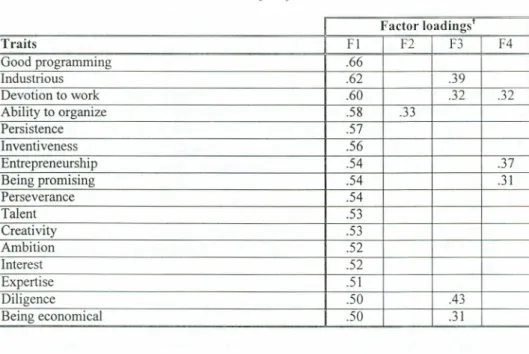
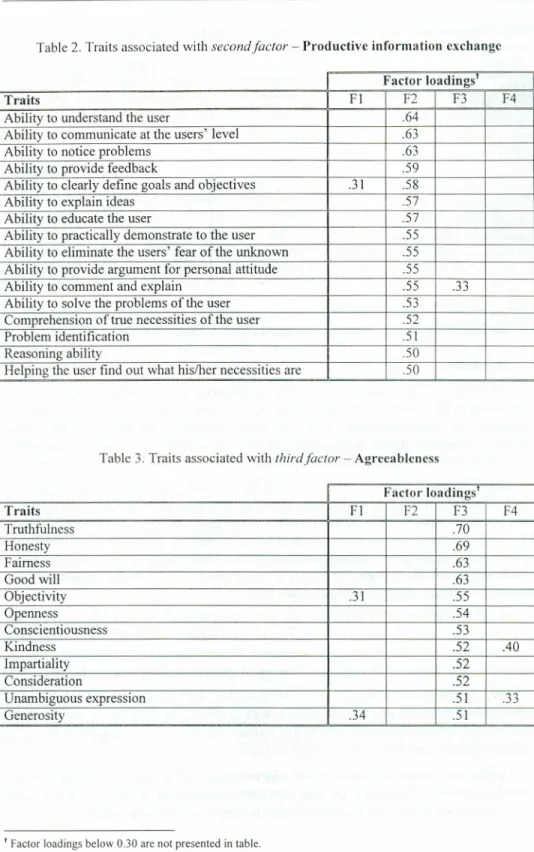
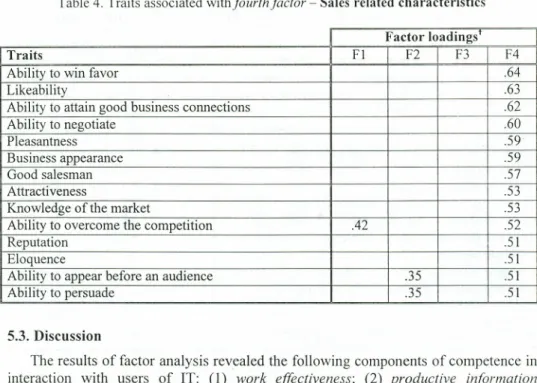
The factor analysis of the 150 traits rated by IT professionals produced several different solutions, but afour-factor solution was chosen above others since it was the most comprehensive, consistent and interpretable. Traits which constitute these four
factors are presented in Tables 1-4.
Table I. Traits associated withfirsl factor -Work effectiveness Factor loadings
Traits FI F2 F3 F4
Good programming .66
Industrious .62 .39 Devotionto work .60 .32 .32 Abilityto organize .58 .33 Persistenee .57 Inventiveness .56 Entrepreneurshi p .54 .37 Beingpromising .54 .31 Perseveranee .54 Talent .53 Creativity .53 Ambition .52 Interest .52 Expertise .51 Diligence .50 .43 Being economical .50 .31
tFactor loadings below0.30 arenot presented intable.
Zbornik radova, Volume 22, Number I(!998)
Table 2. Traits associated with second factor - Productive information exchange
Factor loadings
Traits FI F2 F3 F4
Ability to understand the user .64
Ability to communicate atthe users' level .63
Ability to noti ceproblems .63
Ability to provide feedback .59
Ability to clearly define goals and objectives .31 .58
Ability to explain ideas .57
Ability to educate the user .57
Ability to practically demonstrate to the user .55
Ability to eliminate the users' fear of the unknown .55 Ability to provide argument for personal attitude .55
Ability to comment and explain .55 .33
Ability to solve the problems of the user .53
Comprehension oftrue necessities of the user .52
Problem identification .51
Reasoning ability .50
Helping the user find out what his/her necessities are .50
Table 3.Traits associated with thirdfactor - Agreeableness Facto!" loadings Traits FI F2 F3 F4 Truthfulness .70 Honesty .69 Faimess .63 Good will .63 Objectivity .31 .55 Openness .54 Conscientiousness .53 Kindness .52 .40 Impartiality .52 Consideration .52 Unambiguous expression .51 .33 Generosity .34 .51
tFactor loadings below 0.30 arenot presented in table.
G. Bubaš, B.Aurer. Non-technical competetencies requiredfor
Ir
professionalsTable 4. Traits associated withfourthfactor - Sales related characteristics Factor loadings
Traits FI F2 F3 F4
Ability to win favor .64
Likeability .63
Ability to attain good business connections .62
Abilityto negotiate .60
Pleasantness .59
Business appearance .59
Good salesman .57
Attractiveness .53
Knowledge of the market .53
Ability to overcome the competition .42 .52
Reputation .51
Eloquence .51
Abilityto appear before an audience .35 .51
Abilityto persuade .35 .51
5.3. Discussion
The resuits of factor analysis revealed the following components of competence in interaction with users of IT: (\) work effectiveness; (2) productive informa/ion exchange; (3) agreeableness; and (4) sales related characteristics. The most descriptive traits or "factor markers" in Tables 1 - 4 provide amore precise definition of these factors. How can we interpret the resuits of factor analysis?
Since products and services provided by IT professionals represent the main reason fortheir interaction with clients/users, the ability todeliver quality with ingiven time limits is probably the most essential competency required of IT professionals. Therefore, the work effectiveness factor (F1) is a means for communicating excellence of service and appropriate attitude toward the clientluser. We must note that two traits which define this factor (see Table 1), i.e. "good programming" and "expertise ", are related to technical skills and knowledge of IT.
Much interaction of IT professionals with clients/users is devoted to working out their problems, and the effective exchange of information. The traits which constitute the factor ofproductive information exchange (F2) are important for achieving mutual understanding, as well as for the empowering of the client/user to put the IT to use.
The agreeableness factor (F3) is essential for developing the gratifying interpersonal relations of IT professionals with clients/users, and for the development of trust and cooperation. One can easily foresee the far-reaching negative effects of expressing traits opposite to those listed in Table 3.
Finally, the factor of sales-related characteristics (F4) emphasizes traits which contribute to the seli ing of IT, i.e. that represent business-related knowledge and skills which should be utilized by IT professionals in sa\es activities with clients/users.
Zbornik radova, Volume 22,Number 1(1998)
The uncovered facto rs of competence in the interaction of IT professionals with c1ients/users correspond to non-technical competencies listed earlier in this paper. Problem solving, creativity and innovation could be linked with factors
FJ
andF2,
oral and written communication skills withF2,
interpersonal skills withF3,
and business knowledge/skill withF4,
These uncovered factors could also be associated with our earlier definition of competence, i.e.FJ
andF2
could be associated with adaptation,F4
with control, andF2
andF3
with cooperation.6.CONCLUSION
Information systems (IS) specialists have recently been viewed as important agents of organizational change [17]. Products of their work are crucial for the global competitiveness of their organizations. The complex, turbulent and competitive business environment of IT professionals creates the demand for the development of non-technical competencies like problem solving, communication skills, teamwork, and business skills.
The situations in which ITprofessionals interact with c1ients/users are among the most important for their career and business success. Empirical research of competencies needed insuch interactions, presented inthis paper, revealed four factors which contribute to the overall competence of IT professionals: work effectiveness, productive information exchange, agreeableness, and sales-related characteristics.
The method which was used has proven informative and effective for this specific subject and domain, but its application could be expanded to other non-technical competencies of IT professionals, as well as todifferent vocations. I-!owever, we must note that there have been other efforts to empirically identify general comrnunicator characteristics which contribute to communicative competence [21]. Furthermore, non-technical variables, related to the successful performance of IT personnel, which could be utilized in processes of selection, have also been analyzed by other authors with a focus on personality traits [3].
Finally, we would emphasize that designing a college curriculum to meet the requirements of future IT professionals could rely on research findings like those presented in this paper. Also, we have illustrated the necessity for the non-technical education of future IT professionals in creativity and innovation, communication and interpersonal skills, and business/selling skills.
The curriculum at the Faculty of Organization and Informatics in Varaždin, Croatia, is oriented toward providing future IS designers with exceptional technical knowledge, and also with knowledge and skills from non-technical areas like management, economics, decision-making, communication, etc. There is much correspondence between this undergraduate college curri culum and the research results presented in this paper on the non-technical requirements of IT professional s, and also with the Model Curriculum for Undergraduate Degree Program 'in Information Systems which has recently been proposed by numerous experts in this area [6]. Since there are many indications that the IT profession will continue to be among the leading and most important vocations in the decades to come, we
G. Bubaš,B. Aurer. Non-technical competetencies requiredfor Ir professionals
emphasize that the np-to-date education and training of future IT professionals should
not be our objective of tomorrow, but oftoday.
REF
E
R
E
NC
E
S
(1] T.K. Abdel-Hamid. The slippery path to productivity improvement. IEEE
Software, Vol. 13,No. 4, 1996, pp. 43-52.
[2] G. Bubaš. Prilog istraživanju obrazovnih potreba informatičara na području
komuniciranja s korisnicima. In V međunarodni simpozij "Informacijski sustavi
'94 ",Zbornik radova, Varaždin, 1994, pp. IV:1-8.
[3] A.P. Calitz, M.B. Watson, G. de V de Kock. Identification and selection of
successful future IT personnel in a changing technological and business'
environment. In SIGCPR '97, Proceedings of the 1997 Conference on Computer
Personnel Research, 1997, pp. 31-35
[4] R.N. Charette. Are we developers liars or just fools? IEEE Software, Vol. 12,No.
4, 1995, pp. 90-92.
[5] 1. Collofello. Proposed curriculum for a Master of Software Engineering (MSE).
In N.E. Gibbs, R.E. Fairley, eds., Software Engineering Education. The
Educational Needs of the Software Community. Springer-Verlag, New York, 1987,
pp.420-431.
[6] G.B. Davis, 1.T. Gorgone, J.D. Couger, D.L. Feinstein, H.E. Longenecker, Jr. IS'97: Model Curriculum and Guidelines for Undergraduate Degree Programs in Information Science. Association of Information Technology Professionals, Park
Ridge, Illinois, 1997.
[7] P.A. Freeman. Elements of effective computer science. Computer, Vol. 30, No.
II,1997, pp. 47-48.
[8] D. Garlan, D.P. Gluch, 1.E. Tomayko. Agents of change: educating software
engineering leaders. Computer, Vol. 30, No. II, 1997, pp. 59-65.
[9] A.Q. Gates, C.K. Della-Piana, A. Bernat. Affinity groups: a framework for
developing workplace skills. Proceedings of the Frontiers inEducation 1997,
2i"
Annual Conference on Teaching and Learning in an Era of Change, 1997, pp. 53
-56,vol.
I
.
[10] N.E. Gibbs, R.E. Fairiey, eds. Software Engineering Education. The Educational
Needs of the Software Community. Springer-Verlag, New York, 1987.
[Il]
I
.
Gorton, S. Motwani. Issues in co-operative software engineering using globallydistributed teams. Information and Software Technology, Vol. 38, No. 10, 1996,
pp. 647-655.
(12] J.E. Haines. The case for more relevant computing skills. Computer, Vol. 30, No.
11,1997, pp. 55-56.
Zbornik radova, Volume 22, Number j(1998)
[13] M. Jackson. Will there ever be software engineering? IEEE Software
Engineering, Vol. IS,No. I, 1998, pp. 36-39.
[14] J. Keaton, S. Hamilton. Employment 2005: boom ar bust for computer
professionals? Computer, Vol. 29, No. 5, 1996, pp. 87-98.
[IS] T. Lewis. The next 10,0002 years. Computer, Vol. 29, No. 5,1996, p. 78.
[16] T. Matsubara. Instability and uncertainty are our challenge. IEEE Software, Vol.
14,No. 6, 1997, pp. 83-84. .
[17] M.L. Marcus, R.I. Benjamin. Change agentry - the next
IS
fronti er. MISQuarterly, Vol. 20, No. 4, 1996, pp. 385-407
[18] W.M. McCracken. Counterpoint - SE education: what academia can do. IEEE
Software, Vol. 14,No. 6, 1997, pp. 27-29.
[19] J. Mcl.endon, G.M. Weinberg. Beyond blaming: congruence in large systems
development projects. IEEE Software, Vol. 13,No. 4, 1996, pp. 33-42.
[20] M.R. Parks. Communicative competence and interpersonal control.
In
M.L.Knapp, G.R. Miller, eds. Handbook of Interpersonal Communication. Sage,
Thousand Oaks, California, 1994, pp. 589-618.
[21] D.Schrader. A refined measure of interpersonal communication competence: the
inventory of comrnunicator characteristics. Journal of Social Behavior and
Personality, Vol. 5,No. 5, 1990, pp. 343-355.
[22] C.B. Seaman, V.R. Basili. Communication and organization: an empirical study
of discussion in inspection meetings. IEEE Transactions on Software
Engineering, Vol. 24, No. 7, 1998, pp. 559-572.
[23] B.H. Spitzberg. The dark side of (in)competence. In W.R. Cupach, B.H.
Spitzberg, eds. The Dark Side of Interpersonal Communication. Lawrence
Erlbaum Associates, Inc., Hillsdale, New Jersey, 1994, pp. 25-49.
[24] J. Strassmann. TheSquandered Computer: Evaluating the Business Alignment of
Information Technologies. The Information Economics Press, New Canaaee
-Connecticut, 1997.
[25] J.B. Walther. Computer-mediated communication: impersonal, interpersonal and
hyperpersonal interaction. Communication Research, Vol. 23, No. 1, 1996, pp. 3
-43.
[26] A. Waserman, P. Freeman, eds. Software Engineering Education: Needs and
Objectives. Springer- Verlag, Berlin, 1976.
[27] G.M. Weinberg (1971). The Psychology of Computer Programming. Van
Nostrand Reinhold, New York, 1971.
[28] E. Yourdon. (1998). A tale of two futures. IEEE Software, Vol. 15,No. 1,1998,
pp.23-29.
Received: 13 October 1998
Accepted: 24 November 1998
G. Bubaš, B.Aurer. Non-technical competetencies requiredfor JT professionals
Goran Bubaš
Boris Aurer
NETEHNIČKE KOMPETENCIJE KOJE SU POTREBNE STRUČNJACIMA
ZA INFORMACIJSKE TEHNOLOGIJE:
KAKO DJELOTVORNO OBLIKOVATI INTERAKCIJU S KORISNICIMA?
Sažetak
Brze promjene u informacijskim tehnologijama (JT)ireorganizacije poduzeća, koja se nalaze u iznimnoj konkurenciji na svjetskom tržištu,postavljaju sve veće zahtjevepred informatičare idrugestručnjake za JT Porast kompleksnosti programske podrške izahtjevi za ekonomskim osnovama u primjeni JT u organizacijama, kao ipromjene u sustavima rada, traže od stručnjaka za JT različite vidove kompetencije. Nakon razmatranja netehničkih oblika kompetencije, koji su od važnosti za stručnjake izJr,daju serezultati empirijskog istraživanja činitelja kampetencije informatičara na užem području interakcijeskorisnicima.
Ključne riječi: informacijska tehnologija, softversko inženjerstvo, kadrovi, kompetencije,
komunikacijske vještine, program fakultetskog studija.